

EN 1998-5:2024
(Main)Eurocode 8 - Design of structures for earthquake resistance - Part 5: Geotechnical aspects, foundations, retaining and underground structures
- Abstract
1.1 Scope of EN 1998-5
(1) This document establishes general principles for the design and assessment of geotechnical systems in seismic regions. It gives general rules relevant to all families of geotechnical structures, to the design of foundations, retaining structures and underground structures and complements EN 1997-3 for the seismic design situation.
(2) This document contains the basic performance requirements and compliance criteria applicable to geotechnical structures and geotechnical systems in seismic regions.
(3) This document refers to the rules for the representation of seismic actions and the description of the seismic design situations defined in EN 1998-1-1 and provides specific definition of the seismic action applicable to geotechnical structures.
1.2 Assumptions
(1) The assumptions of EN 1990 apply to this document.
- Status
- Published
- Publication Date
- 24-Sep-2024
- Technical Committee
- CEN/TC 250 - Structural Eurocodes
- Drafting Committee
- CEN/TC 250/SC 8/WG 7 - Evolution of Eurocode 8
- Current Stage
- 6060 - Definitive text made available (DAV) - Publishing
- Start Date
- 25-Sep-2024
- Due Date
- 04-Sep-2023
- Completion Date
- 25-Sep-2024

Overview
EN 1998-5:2024 - Eurocode 8 Part 5 (CEN) sets out the general principles, performance requirements and compliance criteria for the seismic design and assessment of geotechnical systems in earthquake-prone regions. It complements EN 1997-3 and refers to seismic action definitions in EN 1998-1-1, while the assumptions of EN 1990 apply. The standard covers geotechnical aspects for foundations, retaining structures and underground structures, and defines how seismic actions should be represented for geotechnical design situations.
Key Topics
- Scope and performance requirements
- Basic performance objectives and compliance criteria for geotechnical structures and systems in seismic regions.
- Seismic action definition
- Specific rules for representing seismic loading on geotechnical elements, referencing EN 1998-1-1.
- Ground properties and investigations
- Requirements for site investigation, water levels, stiffness, strength parameters and partial factors relevant to seismic design.
- Site evaluation
- Siting, detection of active faults, slope stability, liquefaction potential and settlement under cyclic loading.
- Soil–structure interaction
- Procedures for modelling inertial and kinematic effects, force- and displacement-based approaches, and combined analysis.
- Foundation systems
- Design considerations and verifications for shallow, embedded and pile foundations under seismic loads.
- Retaining structures
- Calculation of seismic earth pressures, hydrodynamic pressures, verification of performance and special rules for anchored, gravity and pile-founded walls.
- Underground structures
- Seismic actions and response for tunnels, culverts and large underground spaces including transient motion and permanent ground deformation.
- Analysis methods and verification
- Guidance on methods of analysis, site-specific response analyses and verification of seismic performance.
Applications and Users
EN 1998-5:2024 is used for the seismic design and assessment of geotechnical elements in buildings, bridges, tunnels and infrastructure. Typical users include:
- Geotechnical and structural engineers
- Foundation and piling designers
- Tunnel and underground-space designers
- Retaining-structure and slope-stability specialists
- Regulatory bodies, contractors and consultants involved in seismic risk mitigation
Practical applications include designing seismic-resilient foundations and retaining walls, assessing liquefaction risk, performing site response analyses, and verifying soil–structure interaction under earthquake loading.
Related standards
- EN 1998-1-1 (seismic actions representation and design situations)
- EN 1997-3 (geotechnical design for seismic situations)
- EN 1990 (basis of structural design assumptions)
Keywords: EN 1998-5:2024, Eurocode 8, geotechnical aspects, seismic design, foundations, retaining structures, underground structures, soil-structure interaction, liquefaction, site response.
Relations
- Effective Date
- 18-Jan-2023
- Effective Date
- 25-Aug-2026
- Effective Date
- 25-Aug-2026
- Effective Date
- 25-Aug-2026
- Effective Date
- 25-Aug-2026
- Effective Date
- 25-Aug-2026
- Effective Date
- 25-Aug-2026
- Effective Date
- 25-Aug-2026
- Effective Date
- 25-Aug-2026
- Effective Date
- 09-Feb-2026
- Effective Date
- 09-Feb-2026
- Effective Date
- 09-Feb-2026
- Effective Date
- 28-Jan-2026
- Effective Date
- 28-Jan-2026
- Effective Date
- 28-Jan-2026
Get Certified
Connect with accredited certification bodies for this standard

DIBt (Deutsches Institut für Bautechnik)
German Institute for Building Technology.
DIN CERTCO
DIN Group product certification.

Aboma Certification B.V.
Specialized in construction, metal, and transport sectors.
Sponsored listings
Frequently Asked Questions
EN 1998-5:2024 is a draft published by the European Committee for Standardization (CEN). Its full title is "Eurocode 8 - Design of structures for earthquake resistance - Part 5: Geotechnical aspects, foundations, retaining and underground structures". This standard covers: 1.1 Scope of EN 1998-5 (1) This document establishes general principles for the design and assessment of geotechnical systems in seismic regions. It gives general rules relevant to all families of geotechnical structures, to the design of foundations, retaining structures and underground structures and complements EN 1997-3 for the seismic design situation. (2) This document contains the basic performance requirements and compliance criteria applicable to geotechnical structures and geotechnical systems in seismic regions. (3) This document refers to the rules for the representation of seismic actions and the description of the seismic design situations defined in EN 1998-1-1 and provides specific definition of the seismic action applicable to geotechnical structures. 1.2 Assumptions (1) The assumptions of EN 1990 apply to this document.
1.1 Scope of EN 1998-5 (1) This document establishes general principles for the design and assessment of geotechnical systems in seismic regions. It gives general rules relevant to all families of geotechnical structures, to the design of foundations, retaining structures and underground structures and complements EN 1997-3 for the seismic design situation. (2) This document contains the basic performance requirements and compliance criteria applicable to geotechnical structures and geotechnical systems in seismic regions. (3) This document refers to the rules for the representation of seismic actions and the description of the seismic design situations defined in EN 1998-1-1 and provides specific definition of the seismic action applicable to geotechnical structures. 1.2 Assumptions (1) The assumptions of EN 1990 apply to this document.
EN 1998-5:2024 is classified under the following ICS (International Classification for Standards) categories: 91.010.30 - Technical aspects; 91.120.25 - Seismic and vibration protection. The ICS classification helps identify the subject area and facilitates finding related standards.
EN 1998-5:2024 has the following relationships with other standards: It is inter standard links to EN 1998-5:2004, ISO 80000-5:2019, ISO 80000-7:2019, ISO 80000-3:2019, ISO 80000-10:2019, ISO 80000-8:2020, ISO 80000-2:2019, ISO 80000-1:2022, ISO 80000-4:2019, ISO 80000-11:2019, ISO 80000-9:2019, ISO 80000-12:2019, EN 6059-309:2018, EN 1998-3:2025, EN 13697:2015/FprA1:2019. Understanding these relationships helps ensure you are using the most current and applicable version of the standard.
EN 1998-5:2024 is available in PDF format for immediate download after purchase. The document can be added to your cart and obtained through the secure checkout process. Digital delivery ensures instant access to the complete standard document.
Standards Content (Sample)
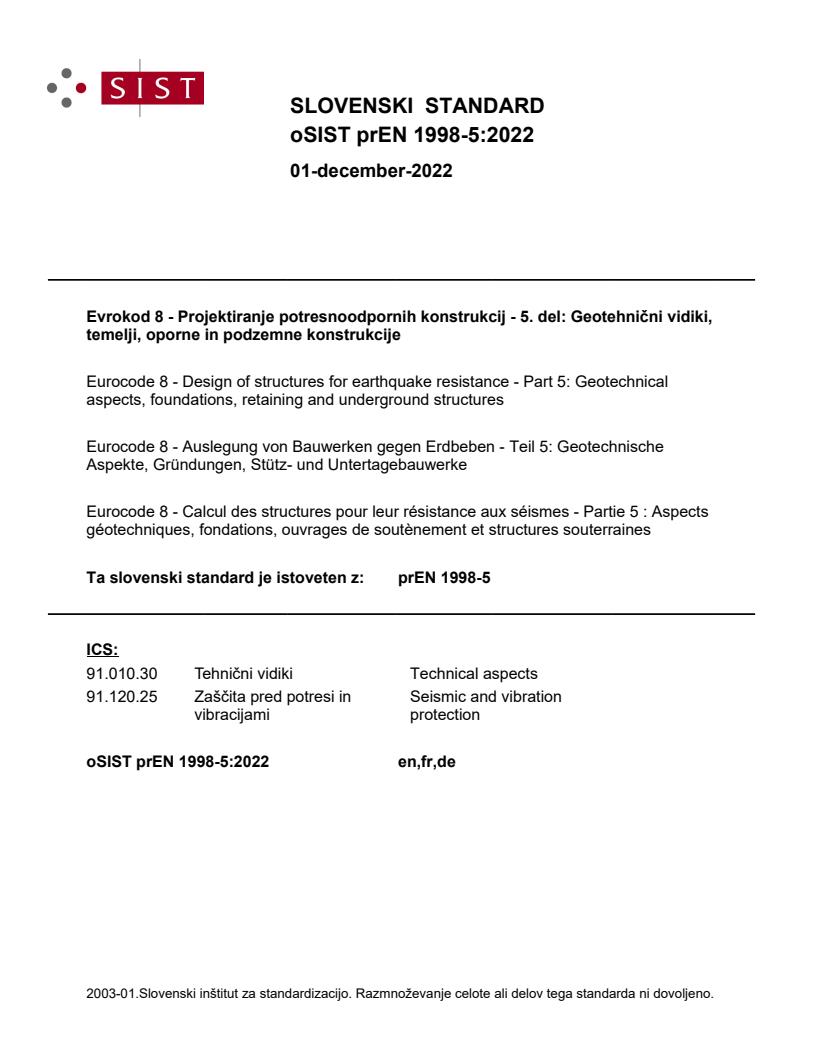
SLOVENSKI STANDARD
oSIST prEN 1998-5:2022
01-december-2022
Evrokod 8 - Projektiranje potresnoodpornih konstrukcij - 5. del: Geotehnični vidiki,
temelji, oporne in podzemne konstrukcije
Eurocode 8 - Design of structures for earthquake resistance - Part 5: Geotechnical
aspects, foundations, retaining and underground structures
Eurocode 8 - Auslegung von Bauwerken gegen Erdbeben - Teil 5: Geotechnische
Aspekte, Gründungen, Stütz- und Untertagebauwerke
Eurocode 8 - Calcul des structures pour leur résistance aux séismes - Partie 5 : Aspects
géotechniques, fondations, ouvrages de soutènement et structures souterraines
Ta slovenski standard je istoveten z: prEN 1998-5
ICS:
91.010.30 Tehnični vidiki Technical aspects
91.120.25 Zaščita pred potresi in Seismic and vibration
vibracijami protection
oSIST prEN 1998-5:2022 en,fr,de
2003-01.Slovenski inštitut za standardizacijo. Razmnoževanje celote ali delov tega standarda ni dovoljeno.
oSIST prEN 1998-5:2022
oSIST prEN 1998-5:2022
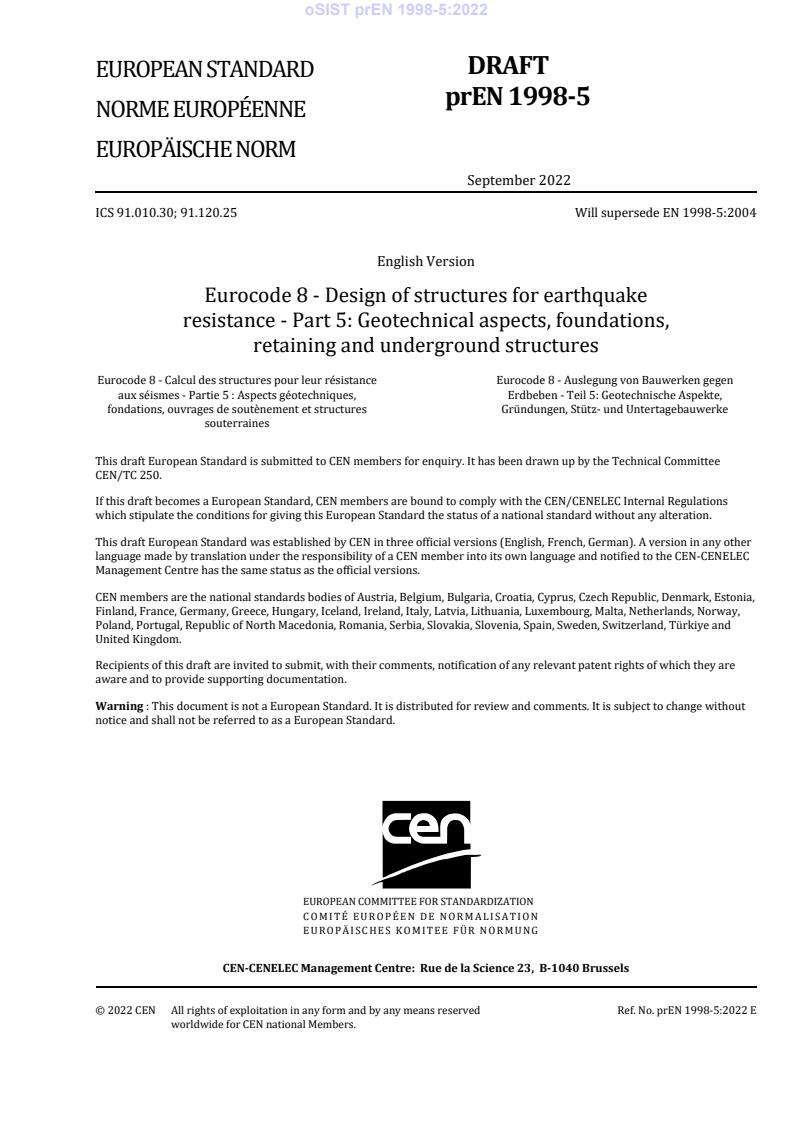
DRAFT
EUROPEAN STANDARD
prEN 1998-5
NORME EUROPÉENNE
EUROPÄISCHE NORM
September 2022
ICS 91.010.30; 91.120.25 Will supersede EN 1998-5:2004
English Version
Eurocode 8 - Design of structures for earthquake
resistance - Part 5: Geotechnical aspects, foundations,
retaining and underground structures
Eurocode 8 - Calcul des structures pour leur résistance Eurocode 8 - Auslegung von Bauwerken gegen
aux séismes - Partie 5 : Aspects géotechniques, Erdbeben - Teil 5: Geotechnische Aspekte,
fondations, ouvrages de soutènement et structures Gründungen, Stütz- und Untertagebauwerke
souterraines
This draft European Standard is submitted to CEN members for enquiry. It has been drawn up by the Technical Committee
CEN/TC 250.
If this draft becomes a European Standard, CEN members are bound to comply with the CEN/CENELEC Internal Regulations
which stipulate the conditions for giving this European Standard the status of a national standard without any alteration.
This draft European Standard was established by CEN in three official versions (English, French, German). A version in any other
language made by translation under the responsibility of a CEN member into its own language and notified to the CEN-CENELEC
Management Centre has the same status as the official versions.
CEN members are the national standards bodies of Austria, Belgium, Bulgaria, Croatia, Cyprus, Czech Republic, Denmark, Estonia,
Finland, France, Germany, Greece, Hungary, Iceland, Ireland, Italy, Latvia, Lithuania, Luxembourg, Malta, Netherlands, Norway,
Poland, Portugal, Republic of North Macedonia, Romania, Serbia, Slovakia, Slovenia, Spain, Sweden, Switzerland, Türkiye and
United Kingdom.
Recipients of this draft are invited to submit, with their comments, notification of any relevant patent rights of which they are
aware and to provide supporting documentation.
Warning : This document is not a European Standard. It is distributed for review and comments. It is subject to change without
notice and shall not be referred to as a European Standard.
EUROPEAN COMMITTEE FOR STANDARDIZATION
COMITÉ EUROPÉEN DE NORMALISATION
EUROPÄISCHES KOMITEE FÜR NORMUNG
CEN-CENELEC Management Centre: Rue de la Science 23, B-1040 Brussels
© 2022 CEN All rights of exploitation in any form and by any means reserved Ref. No. prEN 1998-5:2022 E
worldwide for CEN national Members.
oSIST prEN 1998-5:2022
prEN 1998-5:2022 (E)
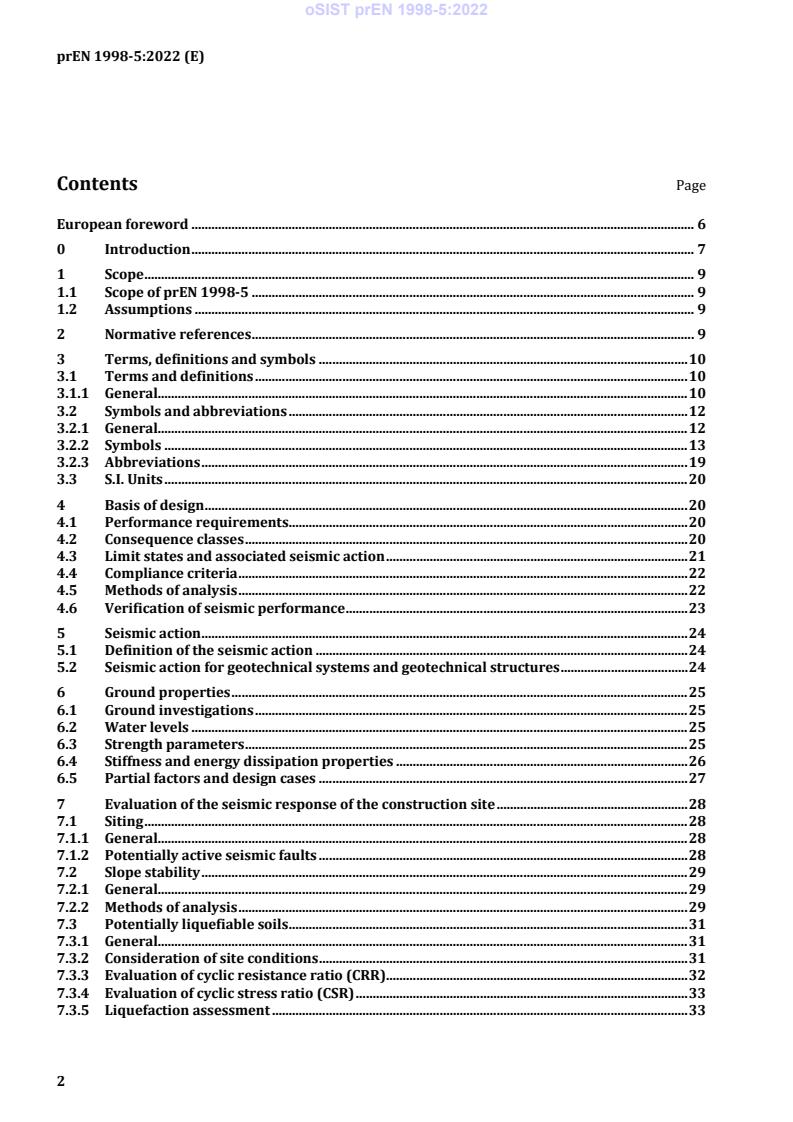
Contents Page
European foreword . 6
0 Introduction . 7
1 Scope . 9
1.1 Scope of prEN 1998-5 . 9
1.2 Assumptions . 9
2 Normative references . 9
3 Terms, definitions and symbols . 10
3.1 Terms and definitions . 10
3.1.1 General. 10
3.2 Symbols and abbreviations . 12
3.2.1 General. 12
3.2.2 Symbols . 13
3.2.3 Abbreviations . 19
3.3 S.I. Units . 20
4 Basis of design . 20
4.1 Performance requirements . 20
4.2 Consequence classes . 20
4.3 Limit states and associated seismic action . 21
4.4 Compliance criteria . 22
4.5 Methods of analysis . 22
4.6 Verification of seismic performance . 23
5 Seismic action . 24
5.1 Definition of the seismic action . 24
5.2 Seismic action for geotechnical systems and geotechnical structures . 24
6 Ground properties . 25
6.1 Ground investigations . 25
6.2 Water levels . 25
6.3 Strength parameters . 25
6.4 Stiffness and energy dissipation properties . 26
6.5 Partial factors and design cases . 27
7 Evaluation of the seismic response of the construction site . 28
7.1 Siting . 28
7.1.1 General. 28
7.1.2 Potentially active seismic faults . 28
7.2 Slope stability . 29
7.2.1 General. 29
7.2.2 Methods of analysis . 29
7.3 Potentially liquefiable soils . 31
7.3.1 General. 31
7.3.2 Consideration of site conditions . 31
7.3.3 Evaluation of cyclic resistance ratio (CRR) . 32
7.3.4 Evaluation of cyclic stress ratio (CSR) . 33
7.3.5 Liquefaction assessment . 33
oSIST prEN 1998-5:2022
prEN 1998-5:2022 (E)
7.3.6 Liquefaction remediation . 34
7.4 Settlements of soils under cyclic loading . 34
7.5 Site-specific response analyses . 35
7.5.1 General . 35
7.5.2 Ground response analysis . 35
8 Soil-structure interaction . 35
8.1 General . 35
8.2 Analysis of inertial effects . 37
8.2.1 General . 37
8.2.2 Force-based approach. 37
8.2.3 Displacement-based approach . 38
8.3 Modelling of kinematic effects . 39
8.4 Combination of inertial and kinematic effects for internal forces . 40
8.5 Simultaneous modelling of kinematic and inertial effects . 40
9 Foundation system . 40
9.1 General requirements . 40
9.2 Design values of the action effects . 41
9.3 Foundation horizontal connections . 42
9.4 Surface and shallow embedded foundations . 43
9.4.1 General . 43
9.4.2 Verifications . 43
9.4.3 Structural design. 46
9.5 Pile foundations . 47
9.5.1 General . 47
9.5.2 General design requirements. 47
9.5.3 Methods of analysis . 48
9.5.4 Design verifications . 49
9.5.5 Detailing and minimum reinforcement ratio for reinforced concrete piles . 51
10 Earth retaining structures . 52
10.1 General . 52
10.2 General design considerations . 52
10.3 Analysis and verification of performance. 53
10.3.1 General principles . 53
10.3.2 Earth pressures for active and passive limit states . 53
10.3.3 Calculation of the hydrodynamic pressures . 54
10.3.4 Verification of seismic performance . 55
10.3.5 Specific rules for displacing retaining structures . 55
10.3.6 Specific rules for gravity retaining walls . 56
10.3.7 Specific rules for retaining walls founded on piles . 57
10.3.8 Specific rules for anchored retaining walls . 57
10.3.9 Specific rules for non-displacing retaining systems . 57
10.3.10 Specific rules for bridge abutments . 58
11 Underground structures . 58
11.1 General . 58
11.2 Seismic actions . 59
11.2.1 General . 59
11.2.2 Ground motion parameters . 59
11.2.3 Ground motion parameters . 60
11.3 Methods of analysis . 60
11.3.1 Seismic action for underground structures . 60
11.3.2 Transient seismic action . 60
oSIST prEN 1998-5:2022
prEN 1998-5:2022 (E)
11.3.3 Permanent ground deformation . 61
11.4 Seismic loading for large underground spaces . 62
11.4.1 Ground shaking . 62
11.4.2 Permanent ground displacements . 63
11.5 Culverts . 63
Annex A (informative) Reduction of the seismic action as an effect of wall height and
predominant wavelength . 65
A.1 Use of this annex . 65
A.2 Scope and field of application . 65
A.3 Simplified evaluation . 65
A.4 Use of site-specific ground response analyses . 66
Annex B (informative) Procedure for liquefaction analyses . 68
B.1 Use of this informative annex . 68
B.2 Scope and field of application . 68
B.3 General. 68
B.4 Assessment of liquefaction susceptibility . 68
B.5 In situ evaluation of CRR . 69
B.5.1 General. 69
B.5.2 SPT-based method . 69
B.5.3 CPT-based method . 71
B.6 Evaluation of the stress reduction factor . 72
B.7 Simplified liquefaction index. 73
Annex C (informative) Evaluation of settlements of coarse-grained soils . 74
C.1 Use of this annex . 74
C.2 Scope and field of application . 74
C.3 Free-field settlement . 74
C.4 Volumetric strain in saturated sands . 74
C.4.1 Method based on Factor of Safety (FS) against liquefaction . 74
C.4.2 Method based on SPT data . 75
C.4.3 Method based on CPT . 76
C.5 Volumetric strain in dry sand . 77
C.6 Settlement under a building . 78
C.7 Lateral spreading due to liquefaction . 80
Annex D (informative) Impedance functions for surface and deep foundations . 82
D.1 Use of this annex . 82
D.2 Scope and field of application . 82
D.3 Impedance of a rectangular foundation on a homogeneous half-space . 82
D.3.1 Stiffness coefficient . 82
oSIST prEN 1998-5:2022
prEN 1998-5:2022 (E)
D.3.2 Dashpot coefficient . 83
D.4 Static impedance of embedded footings in a homogeneous half-space . 86
D.5 Static lateral impedance of a single pile in a homogeneous layer . 87
D.6 Static lateral impedance of a single pile in a linearly inhomogeneous layer . 88
D.7 Lateral impedance of a pile group . 89
Annex E (informative) Seismic bearing capacity of shallow foundations . 90
E.1 Use of this annex . 90
E.2 Scope and field of application . 90
E.3 Surface strip foundation . 90
E.4 Surface circular foundation on fine-grained soils . 92
E.5 Shallow embedded rectangular foundation on fine-grained soils . 92
E.6 Shallow embedded rectangular foundation on coarse-grained soils . 93
E.7 Use of a global safety factor on resistance . 93
Annex F (informative) Evaluation of earth pressures on retaining structures . 95
F.1 Use of this annex . 95
F.2 Scope and field of application . 95
F.3 Coefficients of active and passive earth pressure . 95
F.4 Earth pressure on non-displacing retaining structures . 96
Annex G (informative) Simplified evaluation of peak ground parameters for seismic design
of underground structures . 98
G.1 Use of this annex . 98
G.2 Scope and field of application . 98
G.3 Seismic action . 98
G.4 Effects of seismic action on underground structures . 99
G.5 Variability of ground motion . 99
Annex H (informative) Simplified analytical expressions for the seismic design of tunnels . 100
H.1 Use of this annex . 100
H.2 Scope and field of application . 100
H.3 Circular shape tunnels – Transverse response . 100
H.4 Rectangular shape tunnels – Transverse response . 103
H.5 Longitudinal response . 106
Annex I (informative) Impedance functions for underground structures . 110
I.1 Use of this annex . 110
I.2 Scope and field of application . 110
I.3 Transverse response . 110
I.4 Longitudinal response . 111
Bibliography . 113
oSIST prEN 1998-5:2022
prEN 1998-5:2022 (E)
European foreword
This document (prEN 1998-5:2022) has been prepared by Technical Committee CEN/TC 250
“Structural Eurocodes”, the secretariat of which is held by BSI. CEN/TC 250 is responsible for all
Structural Eurocodes and has been assigned responsibility for structural and geotechnical design
matters by CEN.
This document is currently submitted to the CEN Enquiry.
This document will supersede EN 1998-5:2004.
The first generation of EN Eurocodes was published between 2002 and 2007. This document forms part
of the second generation of the Eurocodes, which have been prepared under Mandate M/515 issued to
CEN by the European Commission and the European Free Trade Association.
The Eurocodes have been drafted to be used in conjunction with relevant execution, material, product
and test standards, and to identify requirements for execution, materials, products and testing that are
relied upon by the Eurocodes.
The Eurocodes recognise the responsibility of each Member State and have safeguarded their right to
determine values related to regulatory safety matters at national level through the use of National
Annexes.
oSIST prEN 1998-5:2022
prEN 1998-5:2022 (E)
0 Introduction
0.1 Introduction to the Eurocodes
The Structural Eurocodes comprise the following standards generally consisting of a number of Parts:
— EN 1990 Eurocode: Basis of structural and geotechnical design
— EN 1991 Eurocode 1: Actions on structures
— EN 1992 Eurocode 2: Design of concrete structures
— EN 1993 Eurocode 3: Design of steel structures
— EN 1994 Eurocode 4: Design of composite steel and concrete structures
— EN 1995 Eurocode 5: Design of timber structures
— EN 1996 Eurocode 6: Design of masonry structures
— EN 1997 Eurocode 7: Geotechnical design
— EN 1998 Eurocode 8: Design of structures for earthquake resistance
— EN 1999 Eurocode 9: Design of aluminium structures
— New parts are under development, e.g. Eurocode for design of structural glass.
The Eurocodes are intended for use by designers, clients, manufacturers, constructors, relevant
authorities (in exercising their duties in accordance with national or international regulations),
educators, software developers, and committees drafting standards for related product, testing and
execution standards.
NOTE Some aspects of design are most appropriately specified by relevant authorities or, where not
specified, can be agreed on a project-specific basis between relevant parties such as designers and clients. The
Eurocodes identify such aspects making explicit reference to relevant authorities and relevant parties.
0.2 Introduction to EN 1998 Eurocode 8
EN 1998 defines the rules for the seismic design of new buildings and engineering works and the
assessment and retrofit of existing ones, including geotechnical aspects, as well as temporary
structures.
For the design of structures in seismic regions, the provisions of EN 1998 should be applied in addition
to the relevant provisions of EN 1990 to EN 1997 and EN 1999.
By nature, perfect protection (a null seismic risk) against earthquakes is not feasible in practice, in
particular because the knowledge of the hazard itself is characterised by a significant uncertainty.
Therefore, in Eurocode 8, the seismic action is represented in a conventional form, proportional in
amplitude to earthquakes likely to occur at a given location and representative of their frequency
content. This representation is not the prediction of a particular seismic movement, and such a
movement could give rise to more severe effects than those of the seismic action considered, inflicting
damage greater than the one described by the Limit States contemplated in this Standard.
Not only the seismic action cannot be predicted but, in addition, it should be recognised that
engineering methods are not perfectly predictive when considering the effects of this specific action,
under which structures are assumed to respond in the non-linear regime. Such uncertainties are taken
oSIST prEN 1998-5:2022
prEN 1998-5:2022 (E)
into account according to the general framework of EN 1990, with a residual risk of underestimation of
their effects.
0.3 Introduction to prEN 1998-5
This document provides general requirements for earthquake resistant design of geotechnical
structures and geotechnical systems, including the definition of the seismic action, of the ground
characteristics, general requirements for siting and foundations soils, design of foundation systems,
retaining structures and underground structures, as well as rules for consideration of soil-structure
interaction.
This document also contains provisions for the assessment of existing geotechnical structures and
geotechnical systems.
0.4 Verbal forms used in the Eurocodes
The verb “shall” expresses a requirement strictly to be followed and from which no deviation is
permitted in order to comply with the Eurocodes.
The verb “should” expresses a highly recommended choice or course of action. Subject to national
regulation and/or any relevant contractual provisions, alternative approaches could be used/adopted
where technically justified.
The verb “may” expresses a course of action permissible within the limits of the Eurocodes.
The verb “can” expresses possibility and capability; it is used for statements of fact and clarification of
concepts.
0.5 National annex for prEN 1998-5
National choice is allowed in this document where explicitly stated within notes. National choice
includes the selection of values for Nationally Determined Parameters (NDPs).
The national standard implementing EN 1998-5 can have a National Annex containing all national
choices to be used for the design of buildings, civil engineering and geotechnical works to be
constructed in the relevant country.
When no national choice is given, the default choice given in this document is to be used.
When no national choice is made and no default is given in this document, the choice can be specified by
a relevant authority or, where not specified, agreed for a specific project by appropriate parties.
National choice is allowed in prEN 1998-5 through notes to the following:
4.2(3) 4.2(6) 4.3(3) NOTE 1 4.3(3) NOTE 2
6.5(2) 6.5(3) 7.3.1(2) 9.4.2.1.3(7) NOTE 1
National choice is allowed in prEN 1998-5 on the application of the following informative annexes:
Annex A Annex B Annex C Annex D
Annex E Annex F Annex G Annex H
Annex I
The National Annex can contain, directly or by reference, non-contradictory complementary
information for ease of implementation, provided it does not alter any provisions of the Eurocodes.
oSIST prEN 1998-5:2022
prEN 1998-5:2022 (E)
1 Scope
1.1 Scope of prEN 1998-5
(1) This document establishes general principles for the design and assessment of geotechnical
systems in seismic regions. It gives general rules relevant to all families of geotechnical structures, to
the design of foundations, retaining structures and underground structures and complements EN 1997-
3 for the seismic design situation.
(2) This document contains the basic performance requirements and compliance criteria applicable to
geotechnical structures and geotechnical systems in seismic regions.
(3) This document refers to the rules for the representation of seismic actions and the description of
the seismic design situations defined in EN 1998-1-1 and provides specific definition of the seismic
action applicable to geotechnical structures.
1.2 Assumptions
(1) The general assumptions of prEN 1990:2021, 1.2, are assumed to be applied.
(2) The provisions of this Standard assume that the parties of the project in charge of the analyses, for
assessment and possible design of the retrofitting of existing geotechnical structures, have appropriate
experience of the type of structures being strengthened or repaired.
2 Normative references
The following documents are referred to in the text in such a way that some or all of their content
constitutes requirements of this document. For dated references, only the edition cited applies. For
undated references, the latest edition of the referenced document (including any amendments) applies.
NOTE See the Bibliography for a list of other documents cited that are not normative references, including
those referenced as recommendations (i.e. in ‘should’ clauses), permissions (‘may’ clauses), possibilities ('can'
clauses), and in notes.
prEN 1990:2021, Basis of structural and geotechnical design
prEN 1997-1:2022, Eurocode 7 — Geotechnical design — Part 1: General rules
prEN 1997-2:2022, Eurocode 7 — Geotechnical design — Part 2: Ground investigation
prEN 1997-3:2022, Eurocode 7 — Geotechnical design — Part 3: Geotechnical structures
prEN 1998-1-1:2022, Eurocode 8 — Design of structures for earthquake resistance — Part 1-1: General
rules and seismic action
prEN 1998-3, Eurocode 8 — Design of structures for earthquake resistance — Part 3: Assessment and
retrofitting of buildings and bridges (under development)
ISO 80000, Quantities and units
oSIST prEN 1998-5:2022
prEN 1998-5:2022 (E)
3 Terms, definitions and symbols
3.1 Terms and definitions
3.1.1 General
(1) For the purposes of this document, the terms and definitions given in EN 1990 and in prEN 1998-
1-1:2022, 3.1, apply.
(2) The terms and definitions in EN 1997-1, EN 1997-2 and EN 1997-3 apply, while the definitions of
other geotechnical terms specifically related to earthquakes are given in this standard.
(3) Additional terms in 3.1.2 to 3.1.29 are used in this document with the corresponding definitions.
3.1.2
apparent wave velocity
horizontal surface velocity of the wave field under an incident angle within the ground
Note 1 to entry: It can be closer to the velocity of seismic waves through deep rocks.
3.1.3
clay fraction
percent in dry weight of soil with particle size smaller than 2 μm
3.1.4
coarse-grained soil
soil where particle sizes between 0,063 mm and 63 mm predominate
3.1.5
critical layer
soil layer within a soil profile identified on the basis of its depth, relative density, and thickness, as the
most likely to liquefy and be responsible for the greatest amount of damage
3.1.6
critical zone (of piles)
section in a pile where the action effect reaches the elastic limit expressed in terms of stresses or
deformations
3.1.7
critical seismic coefficient
minimum value of the seismic coefficient that leads to pseudo-static failure
3.1.8
cyclic undrained shear strength
shear strength of a ground material under the cyclic undrained loading produced by the considered
earthquake, also referred to as the cyclic resistance of a material
3.1.9
cyclic stress ratio
CSR
cyclic shear stress normalised by the initial vertical effective stress for a given depth. Described also as
the cyclic load on the soil
oSIST prEN 1998-5:2022
prEN 1998-5:2022 (E)
3.1.10
cyclic resistance ratio
CRR
cyclic undrained shear strength normalised by the initial vertical effective stress for a given depth,
described also as the resistance of a soil to liquefaction triggering
3.1.11
displacing retaining structure
retaining structure that is able to undergo permanent seismic displacements
3.1.12
fine-grained soil
soil where particle sizes smaller than 0,063 mm predominate
3.1.13
fines content
percent in dry weight of material smaller than 63 μm
3.1.14
foundation element
structural member of a foundation system
EXAMPLE footings, foundation beams, rafts, pile caps, tie-beams
3.1.15
geotechnical structure
structure that includes ground or a structural member that relies on the ground for resistance
3.1.16
geotechnical system
complex system where one geotechnical structure interacts with other structures or geotechnical
structures
EXAMPLE retaining walls with a supported structure at the crest, slopes with a structure at the crest or toe
3.1.17
inertial effect
action effect induced in the seismic design situation by the inertia forces
3.1.18
kinematic effect
action effect induced in the seismic design situation caused by the seismic ground displacement
3.1.19
liquefaction susceptibility
potential for a soil deposit to trigger liquefaction in the seismic design situation
3.1.20
material damping
energy dissipated by the material in cyclic loading
3.1.21
non-displacing retaining structure
retaining structure that is not able to undergo permanent seismic displacements
oSIST prEN 1998-5:2022
prEN 1998-5:2022 (E)
3.1.22
p-y curve
relationship between the resultant of the normal contact stresses per unit length of the pile and the
corresponding horizontal displacement
3.1.23
permanent seismic displacement
seismic induced displacements that remain after the earthquake
3.1.24
pile group effect
modification of the pile group response due to the pile–soil–pile interaction
3.1.25
precarious slope
slope with a low margin of safety in a static situation as calculated according to EN 1997-3 or slopes
classified with a geotechnical complexity GCC3 according to prEN 1997-1:2022, 4.1.2.3
3.1.26
radiation damping
energy dissipated in the ground by waves travelling away from the foundation
3.1.27
residual strength
shear strength of a liquefied material, or lower limit of the shear strength of a fine-grained soil reached
after extensive shearing and particle reorientation as defined in prEN 1997-2:2022, 3.1.5.6
3.1.28
t-z curve
relationship between the resultant of the shear contact stresses per unit length of the pile and the
corresponding vertical displacement
3.1.29
yielding (non-yielding) pile
pile that undergoes (does not undergo) inelastic deformation in the seismic design situation
3.2 Symbols and abbreviations
3.2.1 General
(1) The symbols and abbreviations listed in prEN 1990:2021, 3.2 should be used.
(2) The symbols and abbreviations listed in prEN 1998-1-1:2022, 3.2 should be used.
(3) For the symbols related to materials, as well as for symbols not specifically related to the seismic
design situation, the provisions of the relevant Eurocodes should be applied.
(4) Further symbols and abbreviations, used in connection with the seismic situation, are defined in
the present standard where they occur, for ease of use. However, in addition, the most frequently
occurring symbols used in EN 1998-5 are listed and defined in 3.2.2 and additional abbreviations are
given in 3.2.3.
oSIST prEN 1998-5:2022
prEN 1998-5:2022 (E)
3.2.2 Symbols
3.2.2.1 Symbols used in EN 1998–5
3.2.2.1.1 Upper case Latin symbols
A Area of the base of the footing in contact with the ground
b
A Area of the cross-section of the tunnel
T
A Amplitude of the shear wav
...