

EN 1997-1:2024
(Main)Eurocode 7 - Geotechnical design - Part 1: General rules
- Abstract
1.1 Scope of EN 1997 1
(1) This document provides general rules for the design and verification of geotechnical structures.
(2) This document is applicable for the design and verification of geotechnical structures outside the scope of EN 1997 3.
NOTE In this case, additional or amended provisions can be necessary.
1.2 Assumptions
(1) In addition to the assumptions given in EN 1990, the provisions of EN 1997 (all parts) assume that:
— ground investigations are planned by individuals or organisations with knowledge of potential ground and groundwater conditions;
— ground investigations are executed by individuals with appropriate skills and experience;
— the evaluation of test results and derivation of ground properties from the ground investigation are carried out by individuals with appropriate geotechnical experience and qualifications;
— the data required for design are collected, recorded, and interpreted by appropriately qualified and experienced individuals;
— geotechnical structures are designed and verified by individuals with appropriate qualifications and experience in geotechnical design;
— adequate continuity and communication exist between the individuals involved in data collection, design, verification and execution.
(2) This document is intended to be used in conjunction with EN 1990, which establishes principles and requirements for the safety, serviceability, robustness, and durability of structures, including geotechnical structures, and other construction works.
NOTE Additional or amended provisions can be necessary for assessment of existing structures, see EN 1990 2.
(3) This document is intended to be used in conjunction with EN 1997 2, which gives provisions for determining ground properties from ground investigations.
(4) This document is intended to be used in conjunction with EN 1997 3, which gives specific rules for the design and verification of certain types of geotechnical structures.
(5) This document is intended to be used in conjunction with other Eurocodes for the design of geotechnical structures, including temporary geotechnical structures.
- Status
- Published
- Publication Date
- 24-Sep-2024
- Technical Committee
- CEN/TC 250 - Structural Eurocodes
- Drafting Committee
- CEN/TC 250/SC 7 - Eurocode 7: Geotechnical design
- Current Stage
- 6060 - Definitive text made available (DAV) - Publishing
- Start Date
- 25-Sep-2024
- Due Date
- 09-Feb-2022
- Completion Date
- 25-Sep-2024

Overview
EN 1997-1:2024 - Eurocode 7: Geotechnical design, Part 1: General rules provides the fundamental rules, principles and verification methods for the design of geotechnical structures. Published by CEN as part of the Eurocode suite, this standard sets out the framework for safe, serviceable and durable geotechnical design and is intended to be used with EN 1990, EN 1997-2 (ground properties) and EN 1997-3 (specific geotechnical structures). The standard emphasises reliability-based design (partial factor method), the observational method, prescriptive rules and testing, and requires appropriate ground investigation and qualified personnel throughout the project lifecycle.
Key topics and technical requirements
- Scope and assumptions: Applicability to geotechnical structures not covered by EN 1997-3; requirement that ground investigations, interpretation and design be carried out by qualified personnel with clear communication and continuity between phases.
- Basis of design: Principles of limit state design (ULS and SLS), basic variables, and verification by the partial factor method or alternative reliability-based approaches.
- Ground investigation & properties: Requirements for planning, execution, testing and derivation of design values (used together with EN 1997-2).
- Materials and groundwater: Guidance on ground, engineered fill, geosynthetics, concrete, steel and groundwater measurement, representative and design groundwater pressures.
- Geotechnical analysis: Calculation models, model factors and numerical modelling procedures for stability and deformation assessments.
- Ultimate and serviceability limit states: Procedures for assessing failure modes, deformation limits, settlement calculations and structural effects.
- Implementation & construction: Supervision of execution, inspection, monitoring, maintenance and application of the Observational Method.
- Testing and reporting: Testing to determine ground parameters and verify resistance, plus required content for Ground Investigation Reports, Geotechnical Design Reports and construction records.
- National choices: Provision for Nationally Determined Parameters (NDPs) and national annexes to reflect regulatory differences.
Applications and who uses it
EN 1997-1 is used for design and verification of foundations, retaining structures, earthworks, excavation support, underground works and other geotechnical structures. Typical users:
- Geotechnical and structural engineers
- Site investigation specialists and laboratories
- Contractors and construction supervisors
- Regulatory authorities and code officials
- Software developers producing geotechnical design tools
- Educators and consultants
Related standards
- EN 1990 - Basis of structural and geotechnical design
- EN 1997-2 - Geotechnical design: Ground properties
- EN 1997-3 - Geotechnical design: Specific geotechnical structures
Keywords: EN 1997-1:2024, Eurocode 7, geotechnical design, ground investigation, limit state design, partial factor method, observational method, groundwater, geotechnical structures.
Relations
- Effective Date
- 02-Oct-2024
- Effective Date
- 02-Oct-2024
- Effective Date
- 18-Jan-2023
- Effective Date
- 11-Mar-2026
- Effective Date
- 11-Mar-2026
- Effective Date
- 28-Jan-2026
- Refers
EN 1990:2023/FprA1 - Eurocode - Basis of structural and geotechnical design - Part 1: New structures - Effective Date
- 28-Jan-2026
- Effective Date
- 28-Jan-2026
- Effective Date
- 28-Jan-2026
- Effective Date
- 28-Jan-2026
- Effective Date
- 28-Jan-2026
- Effective Date
- 28-Jan-2026
- Effective Date
- 28-Jan-2026
- Refers
EN 1996-1-2:2024 - Eurocode 6 - Design of masonry structures - Part 1-2: Structural fire design - Effective Date
- 28-Jan-2026
- Effective Date
- 28-Jan-2026
Get Certified
Connect with accredited certification bodies for this standard

DIBt (Deutsches Institut für Bautechnik)
German Institute for Building Technology.
DIN CERTCO
DIN Group product certification.
Zavod za gradbeništvo Slovenije (ZAG) - Inšpekcija
ZAG inspection body for construction products, structures, and materials.
Sponsored listings
Frequently Asked Questions
EN 1997-1:2024 is a draft published by the European Committee for Standardization (CEN). Its full title is "Eurocode 7 - Geotechnical design - Part 1: General rules". This standard covers: 1.1 Scope of EN 1997 1 (1) This document provides general rules for the design and verification of geotechnical structures. (2) This document is applicable for the design and verification of geotechnical structures outside the scope of EN 1997 3. NOTE In this case, additional or amended provisions can be necessary. 1.2 Assumptions (1) In addition to the assumptions given in EN 1990, the provisions of EN 1997 (all parts) assume that: — ground investigations are planned by individuals or organisations with knowledge of potential ground and groundwater conditions; — ground investigations are executed by individuals with appropriate skills and experience; — the evaluation of test results and derivation of ground properties from the ground investigation are carried out by individuals with appropriate geotechnical experience and qualifications; — the data required for design are collected, recorded, and interpreted by appropriately qualified and experienced individuals; — geotechnical structures are designed and verified by individuals with appropriate qualifications and experience in geotechnical design; — adequate continuity and communication exist between the individuals involved in data collection, design, verification and execution. (2) This document is intended to be used in conjunction with EN 1990, which establishes principles and requirements for the safety, serviceability, robustness, and durability of structures, including geotechnical structures, and other construction works. NOTE Additional or amended provisions can be necessary for assessment of existing structures, see EN 1990 2. (3) This document is intended to be used in conjunction with EN 1997 2, which gives provisions for determining ground properties from ground investigations. (4) This document is intended to be used in conjunction with EN 1997 3, which gives specific rules for the design and verification of certain types of geotechnical structures. (5) This document is intended to be used in conjunction with other Eurocodes for the design of geotechnical structures, including temporary geotechnical structures.
1.1 Scope of EN 1997 1 (1) This document provides general rules for the design and verification of geotechnical structures. (2) This document is applicable for the design and verification of geotechnical structures outside the scope of EN 1997 3. NOTE In this case, additional or amended provisions can be necessary. 1.2 Assumptions (1) In addition to the assumptions given in EN 1990, the provisions of EN 1997 (all parts) assume that: — ground investigations are planned by individuals or organisations with knowledge of potential ground and groundwater conditions; — ground investigations are executed by individuals with appropriate skills and experience; — the evaluation of test results and derivation of ground properties from the ground investigation are carried out by individuals with appropriate geotechnical experience and qualifications; — the data required for design are collected, recorded, and interpreted by appropriately qualified and experienced individuals; — geotechnical structures are designed and verified by individuals with appropriate qualifications and experience in geotechnical design; — adequate continuity and communication exist between the individuals involved in data collection, design, verification and execution. (2) This document is intended to be used in conjunction with EN 1990, which establishes principles and requirements for the safety, serviceability, robustness, and durability of structures, including geotechnical structures, and other construction works. NOTE Additional or amended provisions can be necessary for assessment of existing structures, see EN 1990 2. (3) This document is intended to be used in conjunction with EN 1997 2, which gives provisions for determining ground properties from ground investigations. (4) This document is intended to be used in conjunction with EN 1997 3, which gives specific rules for the design and verification of certain types of geotechnical structures. (5) This document is intended to be used in conjunction with other Eurocodes for the design of geotechnical structures, including temporary geotechnical structures.
EN 1997-1:2024 is classified under the following ICS (International Classification for Standards) categories: 91.010.30 - Technical aspects; 93.020 - Earthworks. Excavations. Foundation construction. Underground works. The ICS classification helps identify the subject area and facilitates finding related standards.
EN 1997-1:2024 has the following relationships with other standards: It is inter standard links to EN 1997-1:2004/A1:2013, EN 1997-1:2004/AC:2009, EN 1997-1:2004, EN 206-2:2026, EN 206-1:2026, EN ISO 14688-1:2018, EN 1990:2023/FprA1, EN 206:2013+A2:2021, EN 1998-1-1:2024, EN 1996-2:2024, EN 13670:2009, EN 14487-2:2006, EN 12716:2018, EN 1996-1-2:2024, EN ISO 14688-2:2018. Understanding these relationships helps ensure you are using the most current and applicable version of the standard.
EN 1997-1:2024 is associated with the following European legislation: EU Directives/Regulations: 305/2011; Standardization Mandates: M/515. When a standard is cited in the Official Journal of the European Union, products manufactured in conformity with it benefit from a presumption of conformity with the essential requirements of the corresponding EU directive or regulation.
EN 1997-1:2024 is available in PDF format for immediate download after purchase. The document can be added to your cart and obtained through the secure checkout process. Digital delivery ensures instant access to the complete standard document.
Standards Content (Sample)
SLOVENSKI STANDARD
oSIST prEN 1997-1:2022
01-december-2022
Evrokod 7 - Geotehnično projektiranje - 1. del: Splošna pravila
Eurocode 7: Geotechnical design - Part 1: General rules
Eurocode 7: Entwurf, Berechnung und Bemessung in der Geotechnik - Teil 1: Allgemeine
Regeln
Eurocode 7 : Calcul géotechnique - Partie 1 : règles générales
Ta slovenski standard je istoveten z: prEN 1997-1
ICS:
91.010.30 Tehnični vidiki Technical aspects
93.020 Zemeljska dela. Izkopavanja. Earthworks. Excavations.
Gradnja temeljev. Dela pod Foundation construction.
zemljo Underground works
oSIST prEN 1997-1:2022 en,fr,de
2003-01.Slovenski inštitut za standardizacijo. Razmnoževanje celote ali delov tega standarda ni dovoljeno.
oSIST prEN 1997-1:2022
oSIST prEN 1997-1:2022
DRAFT
EUROPEAN STANDARD
prEN 1997-1
NORME EUROPÉENNE
EUROPÄISCHE NORM
September 2022
ICS 91.010.30; 93.020 Will supersede EN 1997-1:2004
English Version
Eurocode 7: Geotechnical design - Part 1: General rules
Eurocode 7: Calcul géotechnique - Partie 1: Règles Eurocode 7: Entwurf, Berechnung und Bemessung in
générales der Geotechnik - Teil 1: Allgemeine Regeln
This draft European Standard is submitted to CEN members for enquiry. It has been drawn up by the Technical Committee
CEN/TC 250.
If this draft becomes a European Standard, CEN members are bound to comply with the CEN/CENELEC Internal Regulations
which stipulate the conditions for giving this European Standard the status of a national standard without any alteration.
This draft European Standard was established by CEN in three official versions (English, French, German). A version in any other
language made by translation under the responsibility of a CEN member into its own language and notified to the CEN-CENELEC
Management Centre has the same status as the official versions.
CEN members are the national standards bodies of Austria, Belgium, Bulgaria, Croatia, Cyprus, Czech Republic, Denmark, Estonia,
Finland, France, Germany, Greece, Hungary, Iceland, Ireland, Italy, Latvia, Lithuania, Luxembourg, Malta, Netherlands, Norway,
Poland, Portugal, Republic of North Macedonia, Romania, Serbia, Slovakia, Slovenia, Spain, Sweden, Switzerland, Turkey and
United Kingdom.
Recipients of this draft are invited to submit, with their comments, notification of any relevant patent rights of which they are
aware and to provide supporting documentation.
Warning : This document is not a European Standard. It is distributed for review and comments. It is subject to change without
notice and shall not be referred to as a European Standard.
EUROPEAN COMMITTEE FOR STANDARDIZATION
COMITÉ EUROPÉEN DE NORMALISATIO N
EUROPÄISCHES KOMITEE FÜR NORMUN G
CEN-CENELEC Management Centre: Rue de la Science 23, B-1040 Brussels
© 2022 CEN All rights of exploitation in any form and by any means reserved Ref. No. prEN 1997-1:2022 E
worldwide for CEN national Members.
oSIST prEN 1997-1:2022
prEN 1997-1:2022 (E)
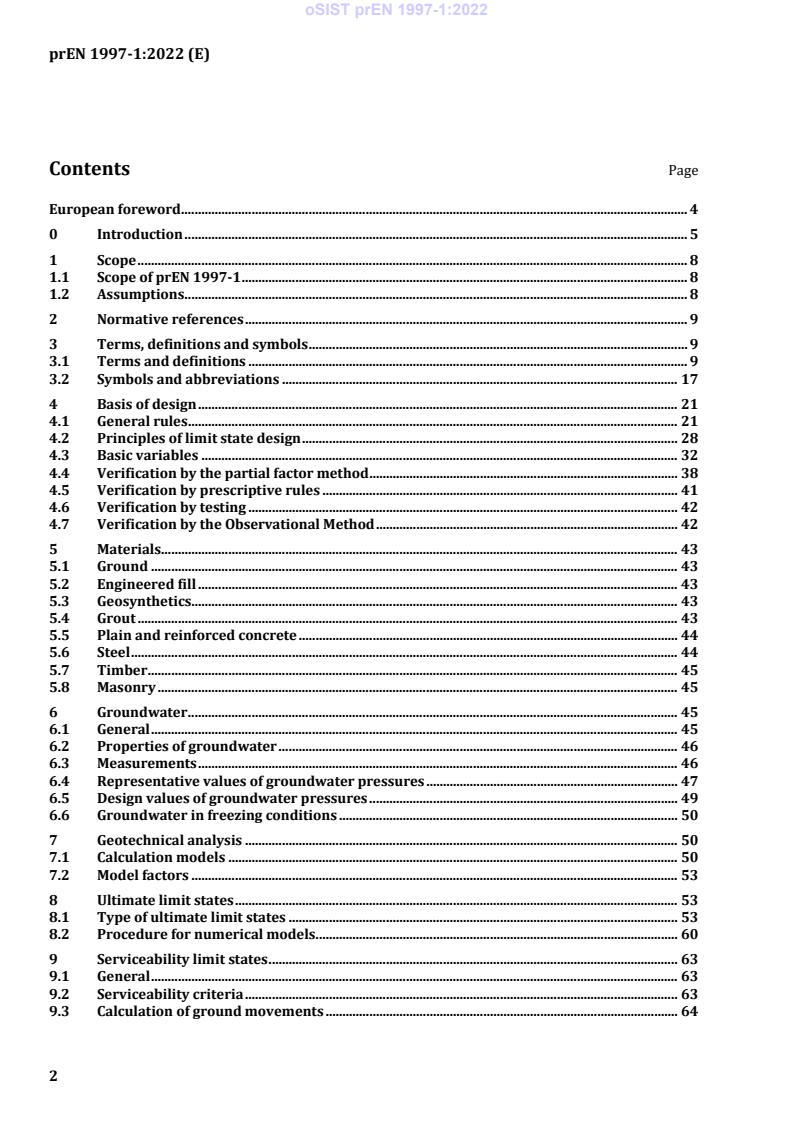
Contents Page
European foreword . 4
0 Introduction . 5
1 Scope . 8
1.1 Scope of prEN 1997-1 . 8
1.2 Assumptions . 8
2 Normative references . 9
3 Terms, definitions and symbols . 9
3.1 Terms and definitions . 9
3.2 Symbols and abbreviations . 17
4 Basis of design . 21
4.1 General rules . 21
4.2 Principles of limit state design . 28
4.3 Basic variables . 32
4.4 Verification by the partial factor method . 38
4.5 Verification by prescriptive rules . 41
4.6 Verification by testing . 42
4.7 Verification by the Observational Method . 42
5 Materials . 43
5.1 Ground . 43
5.2 Engineered fill . 43
5.3 Geosynthetics. 43
5.4 Grout . 43
5.5 Plain and reinforced concrete . 44
5.6 Steel . 44
5.7 Timber . 45
5.8 Masonry . 45
6 Groundwater . 45
6.1 General . 45
6.2 Properties of groundwater . 46
6.3 Measurements . 46
6.4 Representative values of groundwater pressures . 47
6.5 Design values of groundwater pressures . 49
6.6 Groundwater in freezing conditions . 50
7 Geotechnical analysis . 50
7.1 Calculation models . 50
7.2 Model factors . 53
8 Ultimate limit states . 53
8.1 Type of ultimate limit states . 53
8.2 Procedure for numerical models. 60
9 Serviceability limit states . 63
9.1 General . 63
9.2 Serviceability criteria . 63
9.3 Calculation of ground movements . 64
oSIST prEN 1997-1:2022
prEN 1997-1:2022 (E)
9.4 Structural aspects . 65
9.5 Hydraulic aspects . 65
10 Implementation of design . 65
10.1 General . 65
10.2 Supervision of execution . 67
10.3 Inspection . 67
10.4 Monitoring . 68
10.5 Maintenance . 69
10.6 Application of Observational Method . 70
11 Testing . 70
11.1 General . 70
11.2 Testing to determine ground properties . 71
11.3 Testing to determine parameters for use in design . 71
11.4 Testing to verify resistance . 72
11.5 Testing to control quality . 72
11.6 Testing to determine geotechnical behaviour . 72
12 Reporting . 72
12.1 General . 72
12.2 Ground Investigation Report . 73
12.3 Geotechnical Design Report . 74
12.4 Geotechnical Construction Record . 75
12.5 Geotechnical test reports . 75
Annex A (informative) Characteristic value determination procedure . 76
Annex B (informative) Limiting values of structural deformation and ground movement . 83
Annex C (normative) Additional requirements and recommendations for reporting . 89
Annex D (informative) Guideline on selection of Geotechnical Complexity Class . 98
Bibliography . 101
oSIST prEN 1997-1:2022
prEN 1997-1:2022 (E)
European foreword
This document (prEN 1997-1:2022) has been prepared by Technical Committee CEN/TC 250 “Structural
Eurocodes”, the secretariat of which is held by BSI. CEN/TC 250 is responsible for all Structural
Eurocodes and has been assigned responsibility for structural and geotechnical design matters by CEN.
This document will partially supersede EN 1997-1:2004. Some content is migrated into prEN 1990:2021.
The first generation of EN Eurocodes was published between 2002 and 2007. This document forms part
of the second generation of the Eurocodes, which have been prepared under Mandate M/515 issued to
CEN by the European Commission and the European Free Trade Association.
The Eurocodes have been drafted to be used in conjunction with relevant execution, material, product
and test standards, and to identify requirements for execution, materials, products and testing that are
relied upon by the Eurocodes.
The Eurocodes recognize the responsibility of each Member State and have safeguarded their right to
determine values related to regulatory safety matters at national level through the use of National
Annexes.
oSIST prEN 1997-1:2022
prEN 1997-1:2022 (E)
0 Introduction
0.1 Introduction to the Eurocodes
The Structural Eurocodes comprise the following standards generally consisting of a number of Parts:
— EN 1990, Eurocode: Basis of structural and geotechnical design
— EN 1991, Eurocode 1: Actions on structures
— EN 1992, Eurocode 2: Design of concrete structures
— EN 1993, Eurocode 3: Design of steel structures
— EN 1994, Eurocode 4: Design of composite steel and concrete structures
— EN 1995, Eurocode 5: Design of timber structures
— EN 1996, Eurocode 6: Design of masonry structures
— EN 1997, Eurocode 7: Geotechnical design
— EN 1998, Eurocode 8: Design of structures for earthquake resistance
— EN 1999, Eurocode 9: Design of aluminium structures
— New parts are under development, e.g. Eurocode for design of structural glass
The Eurocodes are intended for use by designers, clients, manufacturers, constructors, relevant
authorities (in exercising their duties in accordance with national or international regulations),
educators, software developers, and committees drafting standards for related product, testing and
execution standards.
NOTE Some aspects of design are most appropriately specified by relevant authorities or, where not specified,
can be agreed on a project-specific basis between relevant parties such as designers and clients. The Eurocodes
identify such aspects making explicit reference to relevant authorities and relevant parties.
0.2 Introduction to EN 1997 Eurocode 7
EN 1997 consists of a number of parts:
— EN 1997-1, Geotechnical design – Part 1: General rules
— EN 1997-2, Geotechnical design – Part 2: Ground properties
— EN 1997-3, Geotechnical design – Part 3: Geotechnical structures
EN 1997 standards establish additional principles and requirements to those given in EN 1990 for the
safety, serviceability, robustness, and durability of geotechnical structures.
Design and verification in EN 1997 (all parts) are based on the partial factor method or other reliability-
based methods, prescriptive rules, testing, or the observational method.
oSIST prEN 1997-1:2022
prEN 1997-1:2022 (E)
0.3 Introduction to prEN 1997-1
prEN 1997-1 establish additional principles and requirements to those given in EN 1990 for the safety,
serviceability, robustness, and durability of geotechnical structures.
Design and verification in prEN 1997-1:2022 are based on the partial factor method, prescriptive rules,
testing, or the observational method.
0.4 Verbal forms used in the Eurocodes
The verb “shall" expresses a requirement strictly to be followed and from which no deviation is
permitted in order to comply with the Eurocodes.
The verb “should” expresses a highly recommended choice or course of action. Subject to national
regulation and/or any relevant contractual provisions, alternative approaches could be used/adopted
where technically justified.
The verb “may" expresses a course of action permissible within the limits of the Eurocodes.
The verb “can" expresses possibility and capability; it is used for statements of fact and clarification of
concepts.
0.5 National annex for prEN 1997-1
National choice is allowed in this standard where explicitly stated within notes. National choice includes
the selection of values for Nationally Determined Parameters (NDPs).
The national standard implementing prEN 1997-1:2022 can have a National Annex containing all
national choices to be used for the design of buildings and civil engineering works to be constructed in
the relevant country.
When no national choice is given, the default choice given in this standard is to be used.
When no national choice is made and no default is given in this standard, the choice can be specified by
a relevant authority or, where not specified, agreed for a specific project by appropriate parties.
National choice is allowed in prEN 1997-1:2022 through the following clauses:
3.1 Table 3.1 4.1.2.2 Table 4.1
4.1.2.3 Table 4.2 4.1.3 Table 4.3
4.1.8 Table 4.4 4.2.3 Table 4.5
4.2.4 Table 4.6 4.4.3 Table 4.7
4.4.3 Table 4.8 7.1.2 Table 7.1
8.2 Table 8.1 12.1 Table 12.1
A.4 Table A.2 A.4 Table A.3
D.3 Table D.1 E.3 Table E.1
E.3 Table E.2
oSIST prEN 1997-1:2022
prEN 1997-1:2022 (E)
National choice is allowed in prEN 1997-1:2022 on the application of the following informative
annexes:
Annex A Annex B Annex D
The National Annex can contain, directly or by reference, non-contradictory complementary
information for ease of implementation, provided it does not alter any provisions of the Eurocodes.
oSIST prEN 1997-1:2022
prEN 1997-1:2022 (E)
1 Scope
1.1 Scope of prEN 1997-1
(1) This document provides general rules for the design and verification of geotechnical structures.
(2) This document is applicable for the design and verification of geotechnical structures outside the
scope of prEN 1997-3:2022.
NOTE In this case, additional or amended provisions can be necessary.
1.2 Assumptions
(1) In addition to the assumptions given in prEN 1990:2021, the provisions of prEN 1997:2022 (all
parts) assume that:
— ground investigations are planned by personnel or enterprises knowledgeable about potential
ground and groundwater conditions;
— ground investigations are executed by personnel having appropriate skill and experience;
— evaluation of test results and derivation of ground properties from ground investigation are carried
out by personnel with appropriate geotechnical experience and qualifications;
— data required for design are collected, recorded, and interpreted by appropriately qualified and
experienced personnel;
— geotechnical structures are designed and verified by personnel with appropriate qualifications and
experience in geotechnical design;
— adequate continuity and communication exist between the personnel involved in data-collection,
design, verification and execution.
(2) This document is intended to be used in conjunction with prEN 1990:2021, which establishes
principles and requirements for the safety, serviceability, robustness, and durability of structures,
including geotechnical structures, and other construction works.
(3) This document is intended to be used in conjunction with prEN 1997-2, which gives provisions rules
for determining ground properties from ground investigations.
(4) This document is intended to be used in conjunction with prEN 1997-3, which gives specific rules for
the design and verification of certain types of geotechnical structures.
(5) This document is intended to be used in conjunction with the other Eurocodes for the design of
geotechnical structures, including temporary geotechnical structures.
oSIST prEN 1997-1:2022
prEN 1997-1:2022 (E)
2 Normative references
The following documents are referred to in the text in such a way that some or all of their content
constitutes requirements of this document. For dated references, only the edition cited applies. For
undated references, the latest edition of the referenced document (including any amendments) applies.
NOTE See the Bibliography for a list of other documents cited that are not normative references,
including those referenced as recommendations (i.e. in ‘should’ clauses), permissions (i.e. in ‘may’
clauses), possibilities (i.e. in ‘can’ clauses), and in notes.
EN 206, Concrete - Specification, performance, production and conformity
prEN 1990:2021, Eurocode - Basis of structural and geotechnical design
prEN 1991-2:2021, Eurocode 1: Actions on structures
prEN 1992-1-1:2021 Eurocode 2: Design of concrete structures - Part 1-1: General rules, rules for buildings,
bridges and civil engineering structures
prEN 1993-1-1:2020, Eurocode 3: Design of steel structures - Part 1-1: General rules and rules for buildings
prEN 1993-5, Eurocode 3: Design of steel structures - Part 5: Piling
prEN 1995-1-1, Eurocode 5: Design of timber structures - Part 1-1: General - Common rules and rules for
buildings
prEN 1996 (all parts), Eurocode 6 Design and masonry structures
prEN 1997-2:2022, Eurocode 7: Geotechnical design - Part 2: Ground properties
prEN 1997-3:2022, Eurocode 7: Geotechnical design - Part 3: Geotechnical structures
3 Terms, definitions and symbols
3.1 Terms and definitions
For the purposes of this document, the terms and definitions given in prEN 1990:2021 and the
following apply.
3.1.1 Terms relating to the ground
3.1.1.1
ground
soil, rock, and fill existing in place prior to execution of the construction works
[SOURCE: prEN 1990:2021]
3.1.1.2
soil
aggregate of minerals and/or organic materials including fills which can be disaggregated by hand in
water
[SOURCE: EN ISO 14688]
oSIST prEN 1997-1:2022
prEN 1997-1:2022 (E)
3.1.1.3
rock
naturally occurring assemblage or aggregate of mineral grains, crystals or mineral based particles
compacted, cemented, or otherwise bound together and which cannot be disaggregated by hand in water
[SOURCE: EN ISO 14689]
3.1.1.4
rock mass
rock comprising the intact material together with the discontinuities and weathering zones
[SOURCE: EN ISO 14689]
3.1.1.5
rock material (intact rock)
intact rock between the discontinuities
[SOURCE: EN ISO 14689]
3.1.1.6
weathering zone
distinctive layer of weathered ground material, differing physically, chemically, and/or mineralogically
from the layers above and/or below
3.1.1.7
discontinuities
bedding planes, joints, fissures, faults and shear planes
[SOURCE: EN ISO 14688]
3.1.1.8
foliation
planar arrangements of constituents such as crystals in any type of rock, especially the parallel
structure that results from flattening, segregation and other processes undergone by the grains in a
metamorphic rock in geology refers to repetitive layering in metamorphic rocks
[SOURCE: EN ISO 14689]
3.1.1.9
interface
surface where two systems of ground interact or surface where ground and structure interact
3.1.1.10
infill
material that fills or is used to fill a space, hole or discontinuity
3.1.1.12
fill (or made ground)
ground that has been formed by using material to fill in a depression or to raise the level of a site
[SOURCE: EN ISO 14689]
oSIST prEN 1997-1:2022
prEN 1997-1:2022 (E)
3.1.1.12
engineered fill
material placed in a controlled manner to ensure that its geotechnical properties conform to a
predetermined specification
3.1.1.13
non-engineered fill
material placed with no compaction control and likely to have heterogeneous and anisotropic
geotechnical properties within its mass
3.1.2 Terms relating to geotechnical reliability
3.1.2.1
desk study
analysis of information about the construction site from existing documentation
Note 1 to entry: A desk study includes, for example, the history of the site, observations of neighbouring
structures, previous construction activities, information from aerial photographs, satellite observations, local
experience in the area, and seismicity
Note 2 to entry: See also prEN 1997-2:2022, Annex B
3.1.2.2
Geotechnical Complexity Class
classification of a geotechnical structure on the basis of the complexity of the ground and ground-
structure interaction, taking account of prior knowledge
3.1.2.3
comparable experience
documented previous information about ground and structural behaviour that is considered relevant
for design, as established by geological, geotechnical and structural similitude with the design situation
3.1.3 Terms relating to ground properties
3.1.3.1
ground property
physical, mechanical, geometrical, or chemical attribute of a ground material
[SOURCE: modified from ISO 6707-1]
3.1.3.2
derived value of a ground property
value of a ground property obtained by theory, correlation or empiricism from test results or field
measurements
3.1.3.3
nominal value of a ground property
cautious estimate of the value of a ground property that affects the occurrence of a limit state
Note 1 to entry: Further explanation of ‘cautious estimate’ is given in 4.3.2.
oSIST prEN 1997-1:2022
prEN 1997-1:2022 (E)
3.1.3.4
characteristic value of a ground property
statistical determination of the value of a ground property that affects the occurrence of a limit state
having a prescribed probability of not being attained
Note 1 to entry: This value corresponds to a specified fractile (mean, superior or inferior) of the assumed
statistical distribution of the particular property of the ground.
3.1.3.5
representative value of a ground property
nominal or characteristic value including the conversion factor
Note 1 to entry: Further explanation on representative value is given in 4.3.2.
3.1.3.6
best estimate value of a ground property
estimate of the most probable value of a ground property
Note 1 to entry: Further explanation about best estimate value is given in 4.3.2.
3.1.4 Terms relating to actions and resistance
3.1.4.1
ground resistance
capacity of the ground, or part of it, to withstand actions without failure
3.1.4.2
ground strength
mechanical property of the ground indicating its ability to resist actions
3.1.4.3
overall stability
failure mechanism in the ground that encompasses the entire geotechnical structure
3.1.4.4
local stability
failure mechanism that encompasses only a certain part of the entire geotechnical structure without
failure of the entire geotechnical structure
3.1.4.5
cyclic actions
variable load that can induce significant stiffness and strength degradation, generation of excess pore
pressure, liquefaction, or permanent settlements
3.1.4.6
creep
increase in strain during sustained load
[SOURCE: ISO 6707-1]
oSIST prEN 1997-1:2022
prEN 1997-1:2022 (E)
3.1.5 Terms relating to verification methods
3.1.5.1
Observational Method (-)
continuous, managed, integrated process of design; construction control, monitoring and review that
enables previously defined modifications to be incorporated during or after construction as appropriate
[SOURCE: CIRIA Report 185, 1999]
3.1.5.2
prescriptive rules
pre-determined, experienced-based, and suitably conservative rules for design
3.1.5.3
verification assisted by testing
testing of a structural element to verify design ground properties or resistance
Note 1 to entry: Verification assisted by testing includes, the determination of shaft friction and end bearing of
piles; pull-out strength of anchors; and shear strength of lime-cement columns, for example.
3.1.5.4
verification by testing
testing performed to verify that the performance of the geotechnical structure (or part of the structure)
is within the limiting values
Note 1 to entry: Verification by testing includes full-scale or reduced-scale tests.
3.1.5.5
design variant
describes the anticipated behaviour of the geotechnical structure, given that the relevant ground
properties lie in a predefined range
3.1.6 Terms relating to analysis and models
3.1.6.1
zone of influence
zone where construction works or the geotechnical structure can induce adversely affects in terms of
safety, serviceability, robustness, durability or sustainability on the geotechnical structure itself, other
structures, utilities, ground, or groundwater
3.1.6.2
geotechnical analysis
procedure or algorithm for determining effects-of-actions in and resistance of the ground
3.1.6.3
geotechnical system
term describing the ground and the structure interacting with it
3.1.6.4
Geotechnical Design Model
conceptual representation of the site derived from the ground model for the verification of each
appropriate design situation and limit state
Note 1 to entry: Guidance on the contents of a Geotechnical Design Model are given in Clause 12 and Annex C.
oSIST prEN 1997-1:2022
prEN 1997-1:2022 (E)
3.1.6.5
geotechnical unit
volume of ground or ground layer that is defined as a single material in a Geotechnical Design Model
3.1.6.6
Ground Model
site specific outline of the disposition and character of the ground and groundwater based on results from
ground investigations and other available data
3.1.6.7
numerical models
calculation models involving numerical approximation to obtain solutions
Note 1 to entry: Numerical methods include, but are not limited to, finite-element, finite-difference, boundary-
element, discrete-element and subgrade reaction methods.
3.1.6.8
validation
process of determining the degree to which a calculation model and its input parameters represent a
real design situation
3.1.6.9
robustness
ability of a structure to withstand unforeseen adverse events without being damaged to an extent
disproportionate to the original cause
[SOURCE: prEN 1990:2021]
Note 1 to entry: The aim of designing for robustness is either to prevent disproportionate consequences as a
resulting from an adverse or unforeseen event or to provide some additional resistance to reduce the likelihood and
extent of such an event.
Note 2 to entry: There is a distinction between design for identified accidental actions and design for robustness.
In design for accidental actions, a target level of reliability is expected to be achieved whereas design for robustness
aims to increase the safety margin without aiming for a specified target reliability.
3.1.6.10
toppling
loss of static equilibrium due to rotation of the structure
3.1.6.11
overturning
rotation of the structure involving failure of the ground
3.1.7 Terms relating to structural deformation and ground movement
Definitions of some terms for foundation movement and deformation are given in Figure 3.1.
oSIST prEN 1997-1:2022
prEN 1997-1:2022 (E)
Key
S settlement ∆/L deflection ratio
δs differential settlement ω tilt
rotation β angular distortion
θ
angular strain 1 original position and shape
α
∆ relative deflection 2 deformed position and shape
Figure 3.1 — Definitions of foundation movement
3.1.8 Terms relating to groundwater
3.1.8.1
groundwater level
level of the water surface in the ground
3.1.8.2
piezometric level
level to which water would rise in a standpipe designed to detect the pressure of water at a point
beneath the ground surface
3.1.8.3
surface water level
level of water above the ground surface
oSIST prEN 1997-1:2022
prEN 1997-1:2022 (E)
3.1.9 Terms relating to implementation of design
3.1.9.1
limiting value
value of the serviceability criteria
Note 1 to entry: Expressed for example as, deformation, stress, strain, or vibration.
3.1.9.2
threshold value
value that, with an appropriate safety margin, defines the point at which contingency measures is
applied to avoid exceeding the limiting value
3.1.9.3
acceptance criteria
acceptable variation of material, ground and geometrical properties expressed as tolerances to avoid
exceeding the serviceability criteria or the ultimate limit state
3.1.9.4
supervision
measures or activities during execution to check that the construction work follows the process,
including execution methods and construction stages, set by the execution specification
3.1.9.5
inspection
measures or activities during execution to check the compliance of the execution with the execution
specification and the validity of the design assumptions in relation to encountered ground conditions at
the site
3.1.9.6
monitoring
measuring/observation of the behaviour of the ground and/or structure, to check compliance with the
serviceability criteria
3.1.9.7
execution specification
synthesis of the requirements on material, products, dimensions, execution methods, control and
construction stages from the Geotechnical Design Report
Note 1 to entry: An execution specification can include method statements, supervision plan, inspection plan,
monitoring plan, maintenance plan, contingency plan, material specification, technical description etc. The
information can be presented in text, drawings, models or databases, for example.
3.1.10 Terms relating to reporting
3.1.10.1
Ground Investigation Report
factual report that compiles the results of ground investigation
3.1.10.2
Geotechnical Design Report
report that complies verification and design process of all construction phases and final design of the
geotechnical structure
oSIST prEN 1997-1:2022
prEN 1997-1:2022 (E)
3.1.10.3
Geotechnical Construction Record
collection of documents of construction, supervision, monitoring and inspection of the final structure and
each phase of execution
3.2 Symbols and abbreviations
For the purposes of this document, the following symbols and abbreviations apply.
NOTE 1 The symbols commonly used in all Eurocodes are defined in prEN 1990:2021.
NOTE 2 The notation of the symbols used is based on ISO 3898:1997.
3.2.1 Symbols
Latin upper-case letters
A accidental component of groundwater pressure
w,d
E modulus of elasticity (Young’s modulus)
G shear modulus
G design value of any permanent destabilising force (upwards) not caused by groundwater
d,dst
pressures
G design value of any stabilising (downward) force
d,stb
G permanent component of groundwater pressure
w
G characteristic value of G
wk w
G characteristic lower value of G
wk,inf w
G characteristic upper value of G
wk,sup w
G representative value of groundwater pressure
w,rep
hydraulic conductivity
K
K consequence factor applied to actions
F
K consequence factor applied to material properties
M
K consequence factor applied to resistance
R
K reduction factor for a transient design situation
tr
N normal distribution, evaluated for a 95% confidence level and infinite degrees of freedom
blow count measured in Standard Penetration Test
N
SPT
Q design value of any variable destabilising force (upwards) not caused by groundwater
d,dst
pressure
oSIST prEN 1997-1:2022
prEN 1997-1:2022 (E)
Q variable component of the groundwater pressure
w
Q combination value of Q
w,comb w
Q frequent value of Q
w,freq w
Q characteristic value of Q
w,k w
Q quasi-permanent value of Q
w,qper w
Qw,rep representative value of Qw
R design value of resistance
d
U design value of destabilising (uplift) force due to groundwater pressures
d,dst
V coefficient of variation of the ground material property X
X
V coefficient of variation of a ground material property X due to inherent ground variability
X,inh
coefficient of variation of the measurement error
V
X,quality
V coefficient of variation of the transformation error
X,tran
X ground material property
X design value of a ground property X
d
X characteristic value of a ground property X
k
X mean value of a ground property X from test results
mean
X nominal value of a ground property X
nom
X representative value of X
rep
Y Mean value of the logarithmic values of a ground property Y from text results.
mean
Latin lower-case letters
c' peak effective cohesion
p
c' residual effective cohesion
r
c undrained shear strength of soil
u
coefficient of horizontal consolidation
ch
c coefficient of vertical consolidation
v
f sleeve friction in a CPT
s
h piezometric level at elevation z
w,z
oSIST prEN 1997-1:2022
prEN 1997-1:2022 (E)
i design value of critical hydraulic gradient (when soil particles begin to move)
c,d
i design value of the hydraulic gradient
d
k coefficient that depends on n used to determine X
n k
n number of sample test results or of site-specific data
p pressuremeter limit pressure
l
representative value of any effective vertical overburden or surcharge pressure at the ground
p′
v,rep
surface
cone resistance in a CPT
qc
q unconfined compressive strength of soil or rock (for foundation purposes)
u
s standard deviation of the sample derived values
x
t student’s t-factor, evaluated for a 95% confidence level and (n – 1) degrees of freedom
u groundwater pressure at a point in the ground
Groundwater pressure in the absence of flow
u
u design value of groundwater pressure at a point in the ground
d
u design value of destabilising (uplift) groundwater pressures
d,dst
z vertical distance or depth of the point in the ground below the ground surface (not including
any overlying fill)
Greek upper-case letters
∆ relative deflection
deflection ratio
∆/L
∆u design excess groundwater pressure
d
Greek lower-case letters
β angular distortion
γ′ buoyant weight density (effective density) of the ground
partial factor on effective cohesion (x=p for peak, x=r for residual)
γ
c,x
partial factor on shear strength in total stress analysis
γcu
partial factor on effect-of-actions
γ
E
γ partial factor on action
F
oSIST prEN 1997-1:2022
prEN 1997-1:2022 (E)
partial factor for hydraulic heave
γ
HYD
γ partial factor on material, applied to ground properties
M
partial factor for effective vertical overburden pressure
γ
pv
partial factor on unconfined compressive strength
γ
qu
γ representative value of the weight density of the ground
rep
partial factor on coefficient of ground/structure interface friction
γ
tanδ
partial factor on tan ϕ,x where x is replaced by p for peak friction, cs for critical state, dis for
γtanϕ
,x
along discontinuity
γ weight density of groundwater
w
representative weight density of groundwater
γ
w,rep
partial factor on the shear strength of soil in effective stress analysis
γ
τf
δ ground/structure interface angle of friction
differential settlement
δ
s
δ vertical scale of fluctuation of the property
X
conversion factor
η
τ shear strength of soil in effective stress analysis
f
effective angle of friction of the ground
ϕ′
σ design value of the (stabilizing) vertical total stress at the base of the layer that is subject to
v,d
uplift.
σ standard deviation of a ground property X
x
shear strength at failure
τ
f
tanδ coefficient of the ground/structure interface friction
coefficient of effective friction
tanϕ′
ω tilt
oSIST prEN 1997-1:2022
prEN 1997-1:2022 (E)
3.2.2 Abbreviations
CC Consequence Class
DC Design Case
DCL Design Check Level
DQL Design Qualification (and experience) Level
EFA Effects Factoring Approach
GC Geotechnical Category
GCC Geotechnical Complexity Class
GCR Geotechnical Construction Record
GDM Geotechnical Design Model
GDR Geotechnical Design Report
GIR Ground Investigation Report
GM Ground Model
IL Inspection Level
MFA Material Factor Approach
NDP National Determined Parameter
OCR Over Consolidation Ratio
OM Observational Method
RFA Resistance Factor Approach
4 Basis of design
4.1 General rules
4.1.1 Basic requirements
(1) The assumptions given in this document (1.2) shall be verified.
(2) The design of geotechnical structures shall comply with prEN 1990:2021, prEN 1997-1:2022,
prEN 1997-2:2022 and prEN 1997-3:2022.
(3) The following models shall be used to verify the requirements for safety, serviceability, robustness,
and durability of geotechnical structures:
— Ground Model, as specified in prEN 1997-2:2022, Clause 4;
— Geotechnical Design Model, as specified in 4.2.3 and Annex C.
oSIST prEN 1997-1:2022
prEN 1997-1:2022 (E)
4.1.2 Geotechnical reliability
4.1.2.1 Zone of influence
(1) The extent of the zone of influence shall be defined.
(2) When defining the extent of the zone of influence consideration should be given, but not limited, to:
— the structure and its elements;
— any transient or persistent changes in ground conditions;
— all relevant ultimate limit states of surrounding ground;
— all relevant serviceability limit states;
— all relevant hydraulic or hydrogeological effects;
— relevant redistribution of the in-situ stress states; and
— the influence of work undertaken during execution.
(3) The extents of the zone of influence should also take account of:
— environmental impact;
— pollution;
— vibrations; and
— noise.
(4) The extents of the zone of influence shall be estimated prior to the ground investigation.
(5) The extents of the zone of influence should be updated based on the results of the ground
investigation and during the design process.
(6) The extent of potential failure surfaces and the potential occurrence of significant ground
displacements shall be determined.
(7) In addition to (4), the extents of the zone of influence shall include the extent of any transient or
...