

EN 14487-2:2006
(Main)Sprayed concrete - Part 2: Execution
- Abstract
This European Standard is applicable to sprayed concrete to be used for ground strengthening, repair and upgrading of existing structures and for free-standing structures.
The standard specifies requirements for the execution of concrete spraying both by wet and dry process.
The standard is applicable to temporary as well as permanent structures.
This standard does not cover safety and health aspects of execution.
This standard does not state requirements for quality assurance and for qualification of personnel for the various activities.
- Status
- Published
- Publication Date
- 17-Oct-2006
- Technical Committee
- CEN/TC 104 - Concrete ( performance, production, placing and compliance criteria )
- Drafting Committee
- CEN/TC 104/WG 10 - Sprayed concrete
- Current Stage
- 9093 - Decision to confirm - Review Enquiry
- Start Date
- 30-Jun-2023
- Completion Date
- 07-Oct-2026

Overview
EN 14487-2:2006 - "Sprayed concrete - Part 2: Execution" (CEN) defines the execution requirements for sprayed concrete (shotcrete) using both the dry and wet processes. It applies to sprayed concrete used for ground strengthening, repair and upgrading of existing structures, and free‑standing structures, for both temporary and permanent works. The standard sets out practical execution rules (documentation, preparatory works, reinforcement, equipment, batching, spraying, curing, tolerances and inspection) but does not cover health & safety, quality assurance systems or personnel qualification.
Key topics and technical requirements
- Project documentation: project specification and execution documentation must be prepared; include purpose (temporary/permanent), inspection category, design drawings and special site conditions.
- Preparatory works: substrate cleaning (high‑pressure water or grit blasting), removal of loose material, pre‑wetting considerations and protection against extreme temperatures during spraying and curing.
- Reinforcement: provision for mesh, bars, lattice girders or fibres; steel/polymer fibres to meet EN 14889; reinforcement must be fixed to resist vibration and minimise shadowing.
- Equipment and storage: correct storage of constituent materials, batching and mixing equipment performance, and suitable spraying and testing equipment.
- Batching, mixing & delivery: rules for dry‑mix and wet‑mix processes; example tolerances for batching (inspection category 2 / 3): cement ±5% / ±3%, water ±5% / ±3%, aggregates ±5% / ±3% (tolerances apply to composition during execution).
- Execution of spraying: nozzleman technique, layer sequence, avoiding rebound pockets, and achieving specified thickness and surface finish.
- Curing and protection: procedures to ensure early‑age hydration and protection from freezing or excessive heat.
- Geometrical tolerances & inspection: defined thickness tolerances, inspection actions and documentation requirements (inspection classes influence QA needs).
Practical applications
EN 14487-2:2006 is intended for practical use in:
- Tunnel and underground rock reinforcement (sprayed concrete ground support)
- Repair and upgrade of bridges, retaining walls, marine structures and buildings
- Construction of free‑standing sprayed concrete elements (temporary or permanent)
- Civil engineering works where sprayed concrete is specified as the execution method
Keywords: EN 14487-2:2006, sprayed concrete, shotcrete execution, wet mix, dry mix, ground strengthening, repair of concrete, sprayed concrete inspection.
Who should use this standard
- Contractors and subcontractors performing shotcrete works
- Structural and geotechnical engineers specifying execution requirements
- Site supervisors, quality inspectors and testing personnel
- Material and equipment suppliers preparing mixes and delivery systems
Related standards
- EN 14487-1:2005 (definitions, specifications, conformity)
- EN 206-1 (concrete specification/production)
- EN 1504 series (repair & protection of concrete)
- ENV 13670-1 (execution of concrete structures)
- EN 14889-1 / EN 14889-2 (steel and polymer fibres for concrete)
Relations
- Effective Date
- 28-Jan-2026
- Effective Date
- 28-Jan-2026
- Effective Date
- 28-Jan-2026
- Effective Date
- 28-Jan-2026
- Effective Date
- 28-Jan-2026
- Effective Date
- 28-Jan-2026
- Effective Date
- 28-Jan-2026
- Effective Date
- 28-Jan-2026
- Effective Date
- 28-Jan-2026
- Effective Date
- 28-Jan-2026
- Effective Date
- 28-Jan-2026
Get Certified
Connect with accredited certification bodies for this standard

DIBt (Deutsches Institut für Bautechnik)
German Institute for Building Technology.
DIN CERTCO
DIN Group product certification.

Aboma Certification B.V.
Specialized in construction, metal, and transport sectors.
Sponsored listings
Frequently Asked Questions
EN 14487-2:2006 is a standard published by the European Committee for Standardization (CEN). Its full title is "Sprayed concrete - Part 2: Execution". This standard covers: This European Standard is applicable to sprayed concrete to be used for ground strengthening, repair and upgrading of existing structures and for free-standing structures. The standard specifies requirements for the execution of concrete spraying both by wet and dry process. The standard is applicable to temporary as well as permanent structures. This standard does not cover safety and health aspects of execution. This standard does not state requirements for quality assurance and for qualification of personnel for the various activities.
This European Standard is applicable to sprayed concrete to be used for ground strengthening, repair and upgrading of existing structures and for free-standing structures. The standard specifies requirements for the execution of concrete spraying both by wet and dry process. The standard is applicable to temporary as well as permanent structures. This standard does not cover safety and health aspects of execution. This standard does not state requirements for quality assurance and for qualification of personnel for the various activities.
EN 14487-2:2006 is classified under the following ICS (International Classification for Standards) categories: 91.100.30 - Concrete and concrete products. The ICS classification helps identify the subject area and facilitates finding related standards.
EN 14487-2:2006 has the following relationships with other standards: It is inter standard links to EN 14487-1:2005, EN 206-1:2000, EN 13670:2009, EN 1504-3:2005, EN 14889-2:2006, EN 14889-1:2006, EN 14488-6:2006, EN 1504-10:2017, EN 14487-1:2022, EN 14974:2019, EN 1997-1:2024. Understanding these relationships helps ensure you are using the most current and applicable version of the standard.
EN 14487-2:2006 is associated with the following European legislation: EU Directives/Regulations: 305/2011, 89/106/EEC. When a standard is cited in the Official Journal of the European Union, products manufactured in conformity with it benefit from a presumption of conformity with the essential requirements of the corresponding EU directive or regulation.
EN 14487-2:2006 is available in PDF format for immediate download after purchase. The document can be added to your cart and obtained through the secure checkout process. Digital delivery ensures instant access to the complete standard document.
Standards Content (Sample)
2003-01.Slovenski inštitut za standardizacijo. Razmnoževanje celote ali delov tega standarda ni dovoljeno.Sprayed concrete - Part 2: ExecutionBrizgan beton - 2. del: IzvedbaBéton projeté - Partie 2 : ExécutionSpritzbeton - Teil 2: AusführungTa slovenski standard je istoveten z:EN 14487-2:2006SIST EN 14487-2:2007en91.100.30Beton in betonski izdelkiConcrete and concrete productsICS:SLOVENSKI
STANDARDSIST EN 14487-2:200701-marec-2007
EUROPEAN STANDARDNORME EUROPÉENNEEUROPÄISCHE NORMEN 14487-2October 2006ICS 91.100.30 English VersionSprayed concrete - Part 2: ExecutionBéton projeté - Partie 2 : ExécutionSpritzbeton - Teil 2: AusführungThis European Standard was approved by CEN on 3 August 2006.CEN members are bound to comply with the CEN/CENELEC Internal Regulations which stipulate the conditions for giving this EuropeanStandard the status of a national standard without any alteration. Up-to-date lists and bibliographical references concerning such nationalstandards may be obtained on application to the Central Secretariat or to any CEN member.This European Standard exists in three official versions (English, French, German). A version in any other language made by translationunder the responsibility of a CEN member into its own language and notified to the Central Secretariat has the same status as the officialversions.CEN members are the national standards bodies of Austria, Belgium, Cyprus, Czech Republic, Denmark, Estonia, Finland, France,Germany, Greece, Hungary, Iceland, Ireland, Italy, Latvia, Lithuania, Luxembourg, Malta, Netherlands, Norway, Poland, Portugal, Romania,Slovakia, Slovenia, Spain, Sweden, Switzerland and United Kingdom.EUROPEAN COMMITTEE FOR STANDARDIZATIONCOMITÉ EUROPÉEN DE NORMALISATIONEUROPÄISCHES KOMITEE FÜR NORMUNGManagement Centre: rue de Stassart, 36
B-1050 Brussels© 2006 CENAll rights of exploitation in any form and by any means reservedworldwide for CEN national Members.Ref. No. EN 14487-2:2006: E
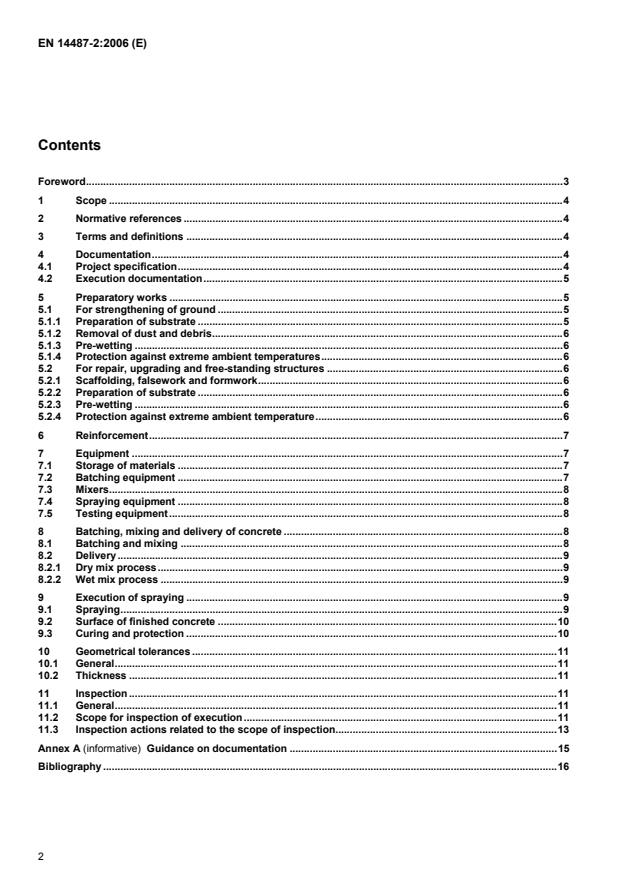
Guidance on documentation.15 Bibliography.16
applied for the sprayed concrete ground strengthening design, any particular execution conditions (e.g. frozen substrate, spraying under compressed air, special waste deposits). for repair, upgrading and free-standing structures also: requirements on surface finish, requirements on thickness.
main structural design principles and objectives NOTE 3 Informative Annex A contains a checklist of requirements and information that may have to be included in the project specification as appropriate. Before commencement of execution of any part of the works, the project specification relevant to that part of the works shall be complete and available. The project specification should also include statements on requirements for the distribution, the filing and recording of technical documents used for the works. 4.2 Execution documentation If required, a quality plan for the execution of the work shall be prepared including a complete listing of relevant references. References shall, where appropriate, be given to requirements and conformity criteria in EN 14487-1. The sprayed concrete execution shall be documented according to requirements put forward in this standard and the established QA plan. 5 Preparatory works 5.1 For strengthening of ground 5.1.1 Preparation of substrate All poor or loose rock shall be removed.
Scaffolding, falsework and formwork shall, generally, apply to ENV 13670-1. For scaffolding and falsework for sprayed concrete operations, the following additional clauses shall be considered: it shall be strong enough to take all the loads including the produced rebound, without undue deformations, it shall accommodate the safe working of the nozzleman, it shall be placed such that a sufficient distance between nozzle and surface of application can be achieved (see 9.1), it shall allow easy access to all parts of the members to be treated. Formwork for sprayed concrete operations shall be designed so as to avoid pockets of rebound. 5.2.2 Preparation of substrate It is essential that sprayed concrete is applied to a thoroughly clean, rough and defect-free surface. High pressure water jetting or grit blasting, capable of etching the substrate surface, are the recommended methods. For repair and upgrading, the preparation of concrete substrate and reinforcement shall conform to EN 1504-10. 5.2.3 Pre-wetting For repair and upgrading, pre-wetting of the substrate of the existing concrete (or other porous material) shall be considered according to EN 1504-10. 5.2.4 Protection against extreme ambient temperature Formwork or structural parts in contact with the section to be sprayed shall have a temperature which does not result in freezing of the sprayed concrete before it has sufficient strength to resist the effects of freezing.
...