

EN 14974:2019
(Main)Skateparks - Safety requirements and test methods
- Abstract
This document applies to skateparks for public use intended for the use of skateboards, other roller sports equipments and BMX bikes.
It specifies safety requirements and requirements for testing and marking, information supplied by the manufacturer, information for users, as well as for inspection and maintenance to protect users and third parties (e.g. spectators) from hazards, as far as possible, when using a skatepark as intended, or as can be reasonably expected.
This standard does not apply to bike facilities modelled from ground, gravel or rock.
- Status
- Published
- Publication Date
- 30-Apr-2019
- Withdrawal Date
- 29-Nov-2019
- Technical Committee
- CEN/TC 136 - Sports, playground and other recreational equipment
- Drafting Committee
- CEN/TC 136/WG 12 - Facilities for users of roller sport equipment
- Current Stage
- 9093 - Decision to confirm - Review Enquiry
- Start Date
- 11-Jul-2025
- Completion Date
- 07-Oct-2026



Overview
EN 14974:2019 - Skateparks: Safety requirements and test methods is the European (CEN) standard that defines safety, testing, marking and information requirements for public skateparks intended for skateboards, other roller-sport equipment and BMX bikes. Published May 2019, it supersedes EN 14974:2006+A1:2010 and targets protection of users and third parties through design, construction, testing and maintenance guidance. Note: it does not apply to bike facilities modelled from ground, gravel or rock.
Key topics and technical requirements
The standard covers the full lifecycle of a skatepark with emphasis on safety and conformity:
- Scope and definitions - clear terminology for skatepark elements (skate element, rolling surface, coping, vert, bowl, mini/vert ramp, safety zone, free-fall height).
- Materials - requirements for timber, metals, concrete, asphalt and other construction materials.
- Fastenings and bonding - guidance on mechanical fixings and adhesives to ensure durability and structural integrity.
- Safety requirements (design & construction):
- Structural integrity, stability and suitable ground conditions
- Drainage and surface performance for rolling and grinding
- Barriers, copings and pool coping specifications to reduce fall risks
- Limits and treatments for free-fall heights and interfaces between elements
- Specific element requirements - tailored requirements and test methods for rails, platforms/tables, skate elements with/without platforms, wall rides, mini ramps, vert ramps and bowls.
- Safety zone - recommended clearances and layout considerations to protect users and spectators.
- Testing and test reports - prescribed test methods to verify compliance and produce traceable test documentation.
- Marking and information - manufacturer marking, user information, installation instructions and preservative/maintenance data.
- Inspection and maintenance - schedules and competent-person requirements for ongoing safety management.
Practical applications and who uses it
EN 14974:2019 is essential for:
- Planners and landscape architects designing public skateparks
- Manufacturers and fabricators of skate elements and copings
- Contractors and constructors implementing skatepark builds
- Public authorities and operators approving, commissioning and operating facilities
- Inspectors, technical experts and maintenance teams performing compliance checks, testing, repairs and user-safety updates
Use cases include design validation, procurement specifications, conformity testing, installation guidance, user-safety signage and lifecycle maintenance planning.
Related standards
Normative references include several material and structural standards that support EN 14974:2019, for example:
- EN 206 (Concrete), EN 1992-1-1 (Eurocode 2), EN 13670 (Execution of concrete structures)
- EN 300 (OSB), EN 312 (Particleboards), EN 636 (Plywood)
- EN 338, EN 335, EN 351 series (timber durability and strength)
Keywords: EN 14974:2019, skateparks safety, skatepark standards, skatepark test methods, skate elements, skatepark inspection and maintenance.
Relations
- Effective Date
- 25-Jun-2014
- Effective Date
- 22-Jul-2026
- Effective Date
- 11-Mar-2026
- Effective Date
- 28-Jan-2026
- Effective Date
- 28-Jan-2026
- Effective Date
- 28-Jan-2026
- Effective Date
- 28-Jan-2026
- Effective Date
- 28-Jan-2026
- Effective Date
- 28-Jan-2026
- Effective Date
- 28-Jan-2026
- Effective Date
- 28-Jan-2026
- Effective Date
- 28-Jan-2026
- Effective Date
- 28-Jan-2026
- Effective Date
- 28-Jan-2026
- Effective Date
- 28-Jan-2026
Frequently Asked Questions
EN 14974:2019 is a standard published by the European Committee for Standardization (CEN). Its full title is "Skateparks - Safety requirements and test methods". This standard covers: This document applies to skateparks for public use intended for the use of skateboards, other roller sports equipments and BMX bikes. It specifies safety requirements and requirements for testing and marking, information supplied by the manufacturer, information for users, as well as for inspection and maintenance to protect users and third parties (e.g. spectators) from hazards, as far as possible, when using a skatepark as intended, or as can be reasonably expected. This standard does not apply to bike facilities modelled from ground, gravel or rock.
This document applies to skateparks for public use intended for the use of skateboards, other roller sports equipments and BMX bikes. It specifies safety requirements and requirements for testing and marking, information supplied by the manufacturer, information for users, as well as for inspection and maintenance to protect users and third parties (e.g. spectators) from hazards, as far as possible, when using a skatepark as intended, or as can be reasonably expected. This standard does not apply to bike facilities modelled from ground, gravel or rock.
EN 14974:2019 is classified under the following ICS (International Classification for Standards) categories: 97.220.10 - Sports facilities. The ICS classification helps identify the subject area and facilitates finding related standards.
EN 14974:2019 has the following relationships with other standards: It is inter standard links to EN 14974:2006+A1:2010, EN 312:2010, EN 206-2:2026, EN 335:2013, EN 14487-2:2006, EN 636:2012+A1:2015, EN 206:2013+A2:2021, EN 351-1:2023, EN 300:2006, EN 789:2004, EN 338:2016, CEN/TS 1099:2007, EN 1992-1-1:2023, EN 13670:2009, EN 599-1:2009+A1:2013. Understanding these relationships helps ensure you are using the most current and applicable version of the standard.
EN 14974:2019 is available in PDF format for immediate download after purchase. The document can be added to your cart and obtained through the secure checkout process. Digital delivery ensures instant access to the complete standard document.
Standards Content (Sample)
SLOVENSKI STANDARD
01-julij-2019
Nadomešča:
SIST EN 14974:2006+A1:2010
Skejt parki (poligoni za uporabnike rolk ali podobne opreme za šport s koleščki ter
kolesa BMX) - Varnostne zahteve in preskusne metode
Skateparks - Safety requirements and test methods
Skateparks - Sicherheitstechnische Anforderungen und Prüfverfahren
Skateparks - Exigences de sécurité et méthodes d'essai
Ta slovenski standard je istoveten z: EN 14974:2019
ICS:
97.220.10 Športni objekti Sports facilities
2003-01.Slovenski inštitut za standardizacijo. Razmnoževanje celote ali delov tega standarda ni dovoljeno.
EN 14974
EUROPEAN STANDARD
NORME EUROPÉENNE
May 2019
EUROPÄISCHE NORM
ICS 97.220.10 Supersedes EN 14974:2006+A1:2010
English Version
Skateparks - Safety requirements and test methods
Skateparks - Exigences de sécurité et méthodes d'essai Skateparks - Sicherheitstechnische Anforderungen und
Prüfverfahren
This European Standard was approved by CEN on 5 November 2018.
CEN members are bound to comply with the CEN/CENELEC Internal Regulations which stipulate the conditions for giving this
European Standard the status of a national standard without any alteration. Up-to-date lists and bibliographical references
concerning such national standards may be obtained on application to the CEN-CENELEC Management Centre or to any CEN
member.
This European Standard exists in three official versions (English, French, German). A version in any other language made by
translation under the responsibility of a CEN member into its own language and notified to the CEN-CENELEC Management
Centre has the same status as the official versions.
CEN members are the national standards bodies of Austria, Belgium, Bulgaria, Croatia, Cyprus, Czech Republic, Denmark, Estonia,
Finland, Former Yugoslav Republic of Macedonia, France, Germany, Greece, Hungary, Iceland, Ireland, Italy, Latvia, Lithuania,
Luxembourg, Malta, Netherlands, Norway, Poland, Portugal, Romania, Serbia, Slovakia, Slovenia, Spain, Sweden, Switzerland,
Turkey and United Kingdom.
EUROPEAN COMMITTEE FOR STANDARDIZATION
COMITÉ EUROPÉEN DE NORMALISATION
EUROPÄISCHES KOMITEE FÜR NORMUNG
CEN-CENELEC Management Centre: Rue de la Science 23, B-1040 Brussels
© 2019 CEN All rights of exploitation in any form and by any means reserved Ref. No. EN 14974:2019 E
worldwide for CEN national Members.
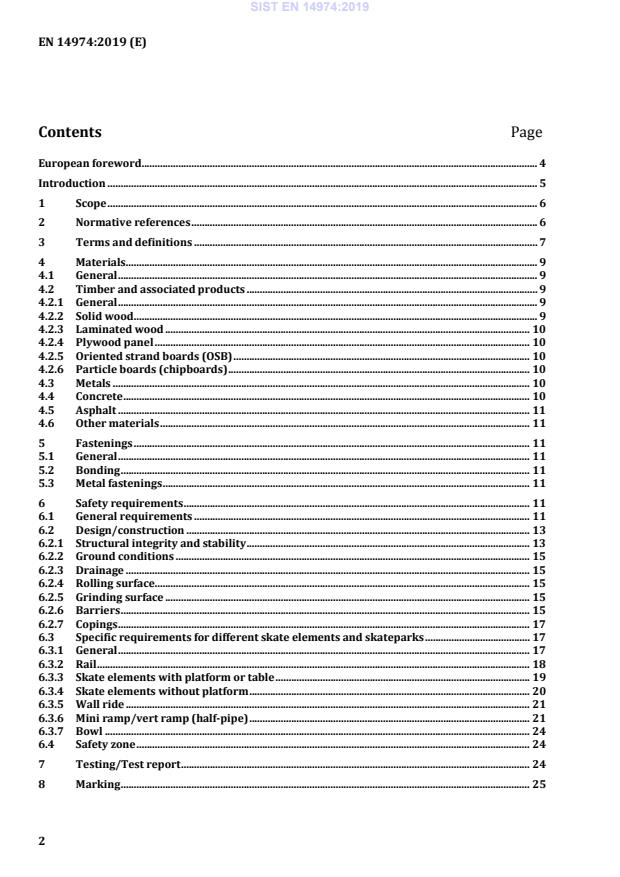
Contents Page
European foreword . 4
Introduction . 5
1 Scope . 6
2 Normative references . 6
3 Terms and definitions . 7
4 Materials . 9
4.1 General . 9
4.2 Timber and associated products . 9
4.2.1 General . 9
4.2.2 Solid wood. 9
4.2.3 Laminated wood . 10
4.2.4 Plywood panel . 10
4.2.5 Oriented strand boards (OSB) . 10
4.2.6 Particle boards (chipboards) . 10
4.3 Metals . 10
4.4 Concrete . 10
4.5 Asphalt . 11
4.6 Other materials . 11
5 Fastenings . 11
5.1 General . 11
5.2 Bonding . 11
5.3 Metal fastenings . 11
6 Safety requirements . 11
6.1 General requirements . 11
6.2 Design/construction . 13
6.2.1 Structural integrity and stability . 13
6.2.2 Ground conditions . 15
6.2.3 Drainage . 15
6.2.4 Rolling surface . 15
6.2.5 Grinding surface . 15
6.2.6 Barriers . 15
6.2.7 Copings . 17
6.3 Specific requirements for different skate elements and skateparks . 17
6.3.1 General . 17
6.3.2 Rail . 18
6.3.3 Skate elements with platform or table . 19
6.3.4 Skate elements without platform . 20
6.3.5 Wall ride . 21
6.3.6 Mini ramp/vert ramp (half-pipe) . 21
6.3.7 Bowl . 24
6.4 Safety zone . 24
7 Testing/Test report . 24
8 Marking . 25
9 Information supplied by the manufacturer . 25
9.1 General . 25
9.2 Installation/construction . 26
10 Inspection and maintenance . 26
10.1 General . 26
10.2 Implementation . 27
11 Information for users . 27
Bibliography . 28
European foreword
This document (EN 14974:2019) has been prepared by Technical Committee CEN/TC 136 “Sports,
playground and other recreational facilities and equipment”, the secretariat of which is held by DIN.
This European Standard shall be given the status of a national standard, either by publication of an
identical text or by endorsement, at the latest by November 2019, and conflicting national standards
shall be withdrawn at the latest by November 2019.
Attention is drawn to the possibility that some of the elements of this document may be the subject of
patent rights. CEN shall not be held responsible for identifying any or all such patent rights.
This document supersedes EN 14974:2006+A1:2010.
This edition contains the following technical changes in regards to EN 14974:2006+A1:2010:
— requirements revised;
— test methods revised;
— document restructured;
— editorially updated.
According to the CEN-CENELEC Internal Regulations, the national standards organisations of the
following countries are bound to implement this European Standard: Austria, Belgium, Bulgaria,
Croatia, Cyprus, Czech Republic, Denmark, Estonia, Finland, Former Yugoslav Republic of Macedonia,
France, Germany, Greece, Hungary, Iceland, Ireland, Italy, Latvia, Lithuania, Luxembourg, Malta,
Netherlands, Norway, Poland, Portugal, Romania, Serbia, Slovakia, Slovenia, Spain, Sweden, Switzerland,
Turkey and the United Kingdom.
Introduction
This standard primarily targets planners, manufacturers, constructors, public authorities, operators,
technical experts and inspectors of skate elements and/or skateparks.
The purpose of this European Standard is to specify the safety requirements, which to a large extent
protect users and third parties (e.g. spectators) from hazards.
The use of skateparks is connected with sporting risks. Sporting skills and the use of suitable roller
sports equipment in combination with appropriate protective equipment essentially reduces the risk of
accident.
Not all possible forms of design, combinations, materials and/or structural elements of skateparks
and/or skate elements will be specified within this European Standard, as they are constantly
developing. Skateparks are often characterised by interconnected flowing rolling surfaces and elements.
With regard to these specific skate elements the general requirements of this standard need to be
considered.
It is essential that the development, construction and maintenance are carried out by competent
persons with sufficient training, experience and knowledge of this standard, as well as an
understanding of roller sports.
1 Scope
This document applies to skateparks for public use intended for the use of skateboards, other roller
sports equipments and BMX bikes.
It specifies safety requirements and requirements for testing and marking, information supplied by the
manufacturer, information for users, as well as for inspection and maintenance to protect users and
third parties (e.g. spectators) from hazards, as far as possible, when using a skatepark as intended, or as
can be reasonably expected.
This standard does not apply to bike facilities modelled from ground, gravel or rock.
2 Normative references
The following documents are referred to in the text in such a way that some or all of their content
constitutes requirements of this document. For dated references, only the edition cited applies. For
undated references, the latest edition of the referenced document (including any amendments) applies.
EN 206, Concrete — Specification, performance, production and conformity
EN 300:2006, Oriented Strand Boards (OSB) — Definitions, classification and specifications
EN 312, Particleboards — Specifications
EN 335:2013, Durability of wood and wood-based products — Use classes: definitions, application to solid
wood and wood-based products
EN 338:2016, Structural timber — Strength classes
EN 351-1, Durability of wood and wood-based products — Preservative-treated solid wood — Part 1:
Classification of preservative penetration and retention
EN 599-1, Durability of wood and wood-based products — Efficacy of preventive wood preservatives as
determined by biological tests — Part 1: Specification according to use class
EN 636, Plywood — Specifications
EN 789, Timber structures — Test methods — Determination of mechanical properties of wood based
panels
CEN/TS 1099, Plywood — Biological durability — Guidance for the assessment of plywood for use in
different use classes
EN 1992-1-1, Eurocode 2: Design of concrete structures — Part 1-1: General rules and rules for buildings
EN 10020, Definition and classification of grades of steel
EN 13670, Execution of concrete structures
EN 14487 (all parts), Sprayed concrete
3 Terms and definitions
For the purposes of this document, the following terms and definitions apply.
ISO and IEC maintain terminological databases for use in standardization at the following addresses:
• IEC Electropedia: available at http://www.electropedia.org/
• ISO Online browsing platform: available at http://www.iso.org/obp
3.1
skatepark
facility with one or more skate elements and sport-specific areas for users of skateboards or similar
roller sports equipment as well as BMX bikes
3.2
skate element (obstacle)
sport-specific element, which can be used for rolling, jumping, grinding or sliding
Note 1 to entry: A skate element may consist of one element or a group of elements.
3.3
cluster
two or more separate skate elements in close proximity to each other providing combinations and
continuity
3.4
rolling surface
part of the skate element or the skatepark intended for rolling
3.5
transition
radial part of the rolling surface
3.6
bank
linear inclined part of the rolling surface
3.7
flat
horizontal rolling surface
3.8
grinding surface
part of the skate element intended for grinding and/or sliding
3.9
extension
raised part of a skate element with continuation of the rolling surface
3.10
vert
vertical area of the rolling surface at the top of the transition
3.11
coping
circular tube which is attached to the top of the rolling surface
3.12
pool coping
form of coping made from stone, concrete or other similar materials
3.13
safety zone
space around a skate element intended for the safety of the user, as well as third parties
3.14
free-fall height
vertical distance between the supporting surfaces and the next lowest flat surface beneath this
Note 1 to entry: Supporting surfaces are horizontal rolling surfaces and surfaces intended for standing.
Exceptions are described in relevant subclauses of Clause 6.
3.15
platform
horizontal standing surface of a skate element and/or group of elements with a barrier
3.16
table
horizontal rolling surface of a skate element and/or group of elements without a barrier
3.17
foot plate
part of the rolling surface connecting the skate element with the flat
Note 1 to entry: e.g. a transition plate.
3.18
barrier
construction which prevents the user and/or roller sports equipment from falling from a height
3.19
competent person
person with sufficient training, experience and knowledge of this standard, as well as an understanding
of roller sports or with a particular qualification required for properly performing their duty
3.20
gap
space between two rolling surfaces which is to be jumped over
3.21
curb/ledge
skate element for sliding and/or grinding
3.22
rail
elevated tube or bar on a rolling surface, stair or flat for sliding and/or grinding
3.23
bowl
combination of several curved rolling surfaces or other elements, blending into each other in various
ways creating a functional skate element
3.24
wall ride
skate element where its rolling surface turns into a wall
3.25
mini ramp
skate element consisting of two opposite transitions without vert with a flat between them
3.26
vert ramp (half-pipe)
skate element consisting of two opposite transitions with vert with a flat between them
Note 1 to entry: The term “half-pipe” is actually the name for two opposite transitions without a flat, but is often
used colloquially to refer to a vert ramp.
3.27
roll-in
rounded top edge of a skate element
4 Materials
4.1 General
Materials shall be selected and protected so that the structural integrity of the equipment manufactured
from does not deteriorate before the next relevant maintenance inspection.
The requirements in 4.2 and 4.3 relating to resistance to weather conditions may be ignored if the
skatepark is installed in indoor or covered areas.
No substance that can adversely affect health shall be present in the skatepark.
NOTE The restrictions on the marking and use of certain dangerous substances and preparations are ruled by
Regulation (EC) No 1907/2006.
4.2 Timber and associated products
4.2.1 General
Skate elements made of timber components shall be protected against rotting.
Consideration shall be given to the selection of timber and/or chemical components used. Some timbers
discolour surfaces and some chemical components accelerate corrosion of metals.
Constructive wood preservation measures shall be used, e.g. skate elements made of timber
components shall allow for water to drain or drop freely from them.
4.2.2 Solid wood
For outdoor use, solid wood shall meet the biological attack requirements of use class 4 according to
EN 335:2013. This natural or conferred durability of solid wood shall meet the levels required by
EN 351-1 and EN 599-1.
For structural use, solid wood shall be of at least class C 24 according to EN 338:2016.
4.2.3 Laminated wood
For outdoor use, laminated wood shall meet the requirements of use class 4 according to EN 335:2013.
Laminated wood with bondings shall be of structural quality, taking into account the intended use of it.
4.2.4 Plywood panel
Plywood panels shall meet the biological attack requirements of use class 2 for indoor use and of use
class 3 for outdoor use, according to EN 335:2013 and CEN/TS 1099.
For structural use and climatic resistance, the requirements for plywood panels according to EN 636
shall be met. The longitudinal modulus of elasticity and shear stress (mean value in each direction) and
bending, compressive and shear strength (characteristic value in each direction) shall be specified
according to EN 789.
4.2.5 Oriented strand boards (OSB)
Oriented strand boards shall meet the biological attack requirements of use class 2 for indoor use
according to EN 335:2013. For structural use the requirements of class OSB 4 shall be met according to
EN 300:2006. In addition, its mechanical properties, measured in accordance with EN 789, shall be
defined.
The use of oriented strand boards outdoors is not permissible.
4.2.6 Particle boards (chipboards)
Particle boards shall only be used for indoor skateparks. They shall meet the biological attack
requirements of use class 2 according to EN 335:2013.
For structural use, particle boards shall comply with EN 312.
4.3 Metals
Metal components shall be resistant to weathering under atmospheric conditions.
Stainless steel according to EN 10020 shall not be used as a grinding surface.
4.4 Concrete
4.4.1 Concrete for skateparks and skate elements shall comply with EN 206 and EN 1992-1-1
(Eurocode 2) together with relevant national annexes (e.g. concrete mix, exposure classes,
reinforcement, etc.).
In situ concrete and precast concrete shall comply with EN 13670.
Sprayed concrete shall comply with EN 14487 (all parts).
4.4.2 Concrete for rolling surfaces shall comply with the minimum requirement of strength class
given in table 1.
Table 1 — Types of concrete to be used
Concrete used for concrete strength class
Rolling surface C 35/45
NOTE Further detail on requirements is given in national regulations.
4.5 Asphalt
Asphalt shall at least be built up to the top layer. The binder agent shall be of the type 50/70 or harder.
Eroded and coarse-grained surfaces made from asphalt are not permitted for skateparks.
Asphalt surfaces are particularly not recommended as rolling surfaces in extreme heat.
4.6 Other materials
The use of other materials is acceptable provided their sport-specific suitability and durability has been
sufficiently proven.
NOTE Fiberglass rolling surfaces can cause risks.
5 Fastenings
5.1 General
Fastening systems shall be protected against corrosion.
NOTE This protection can be achieved, for example, by galvanising or equivalent procedures.
5.2 Bonding
If glues are used, they shall be
...