

EN 15567-1:2015+A1:2020
(Main + Amendment)Sports and recreational facilities - Ropes courses - Part 1: Construction and safety requirements
- Abstract
This European Standard applies to permanent and mobile ropes courses and their components.
This European Standard specifies safety requirements for the design, construction, inspection and maintenance of ropes courses and their components.
This European Standard does not apply to temporary ropes courses (see 3.3) and children's play grounds (see EN 1176 all parts).
For the use of ropes courses EN 15567 2 applies.
- Status
- Published
- Publication Date
- 18-Feb-2020
- Withdrawal Date
- 11-Aug-2020
- Technical Committee
- CEN/TC 136 - Sports, playground and other recreational equipment
- Drafting Committee
- CEN/TC 136 - Sports, playground and other recreational equipment
- Current Stage
- 9000 - Start of review/2 Year Review Enquiry - Review Enquiry
- Start Date
- 20-May-2020
- Completion Date
- 20-May-2020



Overview
EN 15567-1:2015+A1:2020 is the CEN European Standard that sets construction and safety requirements for ropes courses. It applies to both permanent and mobile ropes courses and their components, covering design, manufacture, inspection and maintenance. The standard excludes temporary ropes courses (installed ≤7 days) and children’s playground equipment (see EN 1176). EN 15567‑1 complements EN 15567‑2, which addresses operation requirements.
Key topics and technical requirements
The standard provides a structured framework for safe ropes-course systems, including:
- Scope and definitions - clear terminology for elements such as activity systems, support systems, platforms, zip lines, giant swings, safety lines and landing areas.
- Site selection and structural design (Clause 4.1–4.3) - guidance on choice of site, influence of loads, and requirements for support structures (poles, trees, foundations).
- Materials and components (Clause 4.2) - requirements for wire ropes, synthetic ropes and terminations; durability and suitability of wood and metal components.
- Safety systems and PPE (Clause 4.3–4.4) - specification of collective and individual safety systems (categories A–E), primary braking systems (active and passive), and conformity with PPE standards (e.g., EN 361, EN 358).
- Testing, marking and identification (Clause 5–6) - recommended test methods, element marking and traceability.
- Inspection and maintenance (Clause 7) - regular inspection schedules, maintenance manuals and discard criteria for components.
- Documentation and guidance (Clause 8; normative Annexes) - requirements for user manuals, arboreal assessment reports (Annex A), and informative guidance on risk assessment and relevance of ISO 4309 for wire rope care (Annex C–D).
Practical applications and users
EN 15567‑1 is practical for professionals involved in planning, constructing and maintaining ropes courses:
- Designers and manufacturers - to ensure components and systems meet safety and material requirements.
- Site owners and operators - to implement safe installations, inspection regimes and maintenance manuals.
- Inspectors and certifiers - for conformity assessment, marking and discard criteria.
- Arborists and structural engineers - when trees or natural supports are used.
- Training providers and risk assessors - to align operational practices with the construction standard and to inform EN 15567‑2 evaluations.
Keywords: ropes courses, EN 15567‑1, construction and safety requirements, ropes course inspection, PPE, zip line, wire rope maintenance.
Related standards
- EN 15567‑2 (Operation requirements)
- EN 1176 (Playground equipment - excluded scope)
- ISO 4309 (Wire rope care, inspection, discard)
- Relevant PPE and wire‑rope standards cited within EN 15567‑1 (e.g., EN 361, EN 358, EN 13411 series).
Relations
- Effective Date
- 19-Jan-2023
- Effective Date
- 18-Jan-2023
- Effective Date
- 09-Feb-2026
- Effective Date
- 28-Jan-2026
- Refers
EN 13411-4:2021 - Terminations for steel wire ropes - Safety - Part 4: Metal and resin socketing - Effective Date
- 28-Jan-2026
- Refers
EN 12927:2019 - Safety requirements for cableway installations designed to carry persons - Ropes - Effective Date
- 28-Jan-2026
- Effective Date
- 28-Jan-2026
- Effective Date
- 28-Jan-2026
- Effective Date
- 28-Jan-2026
- Effective Date
- 28-Jan-2026
- Effective Date
- 28-Jan-2026
- Refers
EN 12277:2015+A1:2018 - Mountaineering equipment - Harnesses - Safety requirements and test methods - Effective Date
- 28-Jan-2026
- Effective Date
- 28-Jan-2026
- Effective Date
- 28-Jan-2026
- Effective Date
- 28-Jan-2026
Frequently Asked Questions
EN 15567-1:2015+A1:2020 is a standard published by the European Committee for Standardization (CEN). Its full title is "Sports and recreational facilities - Ropes courses - Part 1: Construction and safety requirements". This standard covers: This European Standard applies to permanent and mobile ropes courses and their components. This European Standard specifies safety requirements for the design, construction, inspection and maintenance of ropes courses and their components. This European Standard does not apply to temporary ropes courses (see 3.3) and children's play grounds (see EN 1176 all parts). For the use of ropes courses EN 15567 2 applies.
This European Standard applies to permanent and mobile ropes courses and their components. This European Standard specifies safety requirements for the design, construction, inspection and maintenance of ropes courses and their components. This European Standard does not apply to temporary ropes courses (see 3.3) and children's play grounds (see EN 1176 all parts). For the use of ropes courses EN 15567 2 applies.
EN 15567-1:2015+A1:2020 is classified under the following ICS (International Classification for Standards) categories: 97.220.10 - Sports facilities. The ICS classification helps identify the subject area and facilitates finding related standards.
EN 15567-1:2015+A1:2020 has the following relationships with other standards: It is inter standard links to EN 15567-1:2015/FprA1, EN 15567-1:2015, ISO 4309:2010, EN 13411-6:2004+A1:2008, EN 13411-4:2021, EN 12927:2019, EN 13411-2:2001+A1:2008, EN 335:2013, EN 15567-2:2015, EN 13411-3:2004+A1:2008, EN 813:2024, EN 12277:2015+A1:2018, EN 636:2012+A1:2015, EN 350-2:1994, EN 358:2018. Understanding these relationships helps ensure you are using the most current and applicable version of the standard.
EN 15567-1:2015+A1:2020 is available in PDF format for immediate download after purchase. The document can be added to your cart and obtained through the secure checkout process. Digital delivery ensures instant access to the complete standard document.
Standards Content (Sample)
SLOVENSKI STANDARD
01-maj-2020
Nadomešča:
SIST EN 15567-1:2015
Športni in rekreacijski pripomočki - Vrvni plezalni parki - 1. del: Konstrukcijske in
varnostne zahteve
Sports and recreational facilities - Ropes courses - Part 1: Construction and safety
requirements
Sport- und Freizeitanlagen - Seilgärten - Teil 1: Konstruktion und sicherheitstechnische
Anforderungen
Structures de sport et d’activités de plein air - Parcours acrobatiques en hauteur - Partie
1 : Exigences de construction et de sécurité
Ta slovenski standard je istoveten z: EN 15567-1:2015+A1:2020
ICS:
97.220.10 Športni objekti Sports facilities
2003-01.Slovenski inštitut za standardizacijo. Razmnoževanje celote ali delov tega standarda ni dovoljeno.
EN 15567-1:2015+A1
EUROPEAN STANDARD
NORME EUROPÉENNE
February 2020
EUROPÄISCHE NORM
ICS 97.220.10 Supersedes EN 15567-1:2015
English Version
Sports and recreational facilities - Ropes courses - Part 1:
Construction and safety requirements
Structures de sport et d'activités de plein air - Parcours Sport- und Freizeitanlagen - Seilgärten - Teil 1:
acrobatiques en hauteur - Partie 1 : Exigences de Konstruktion und sicherheitstechnische
construction et de sécurité Anforderungen
This European Standard was approved by CEN on 12 March 2015 and includes Amendment 1 approved by CEN on 11 November
2019.
CEN members are bound to comply with the CEN/CENELEC Internal Regulations which stipulate the conditions for giving this
European Standard the status of a national standard without any alteration. Up-to-date lists and bibliographical references
concerning such national standards may be obtained on application to the CEN-CENELEC Management Centre or to any CEN
member.
This European Standard exists in three official versions (English, French, German). A version in any other language made by
translation under the responsibility of a CEN member into its own language and notified to the CEN-CENELEC Management
Centre has the same status as the official versions.
CEN members are the national standards bodies of Austria, Belgium, Bulgaria, Croatia, Cyprus, Czech Republic, Denmark, Estonia,
Finland, France, Germany, Greece, Hungary, Iceland, Ireland, Italy, Latvia, Lithuania, Luxembourg, Malta, Netherlands, Norway,
Poland, Portugal, Republic of North Macedonia, Romania, Serbia, Slovakia, Slovenia, Spain, Sweden, Switzerland, Turkey and
United Kingdom.
EUROPEAN COMMITTEE FOR STANDARDIZATION
COMITÉ EUROPÉEN DE NORMALISATION
EUROPÄISCHES KOMITEE FÜR NORMUNG
CEN-CENELEC Management Centre: Rue de la Science 23, B-1040 Brussels
© 2020 CEN All rights of exploitation in any form and by any means reserved Ref. No. EN 15567-1:2015+A1:2020 E
worldwide for CEN national Members.
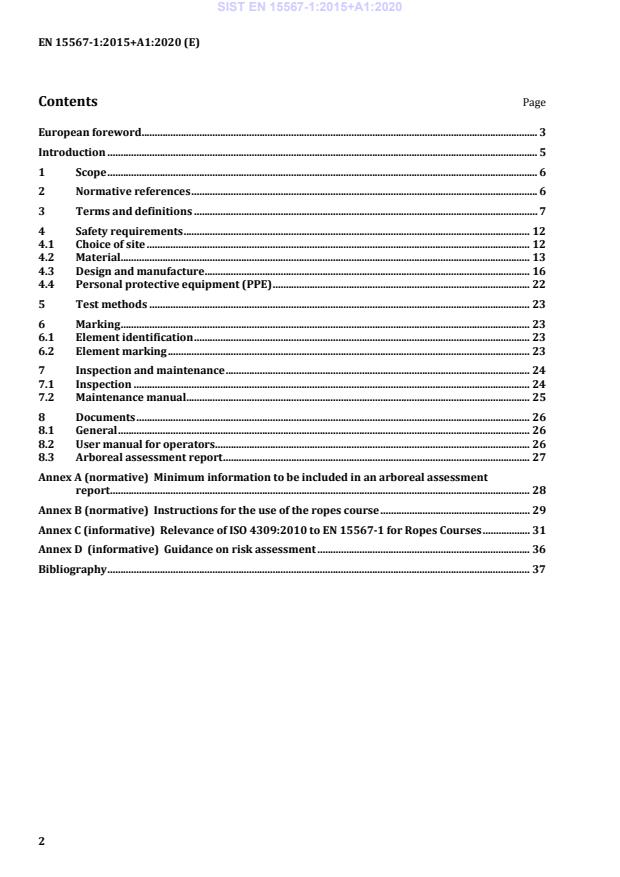
Contents Page
European foreword . 3
Introduction . 5
1 Scope . 6
2 Normative references . 6
3 Terms and definitions . 7
4 Safety requirements . 12
4.1 Choice of site . 12
4.2 Material . 13
4.3 Design and manufacture . 16
4.4 Personal protective equipment (PPE) . 22
5 Test methods . 23
6 Marking . 23
6.1 Element identification . 23
6.2 Element marking . 23
7 Inspection and maintenance . 24
7.1 Inspection . 24
7.2 Maintenance manual . 25
8 Documents . 26
8.1 General . 26
8.2 User manual for operators. 26
8.3 Arboreal assessment report . 27
Annex A (normative) Minimum information to be included in an arboreal assessment
report . 28
Annex B (normative) Instructions for the use of the ropes course . 29
Annex C (informative) Relevance of ISO 4309:2010 to EN 15567-1 for Ropes Courses . 31
Annex D (informative) Guidance on risk assessment . 36
Bibliography . 37
European foreword
This document (EN 15567-1:2015+A1:2020) has been prepared by Technical Committee CEN/TC 136
“Sports, playground and other recreational facilities and equipment”, the secretariat of which is held by
DIN.
This European Standard shall be given the status of a national standard, either by publication of an
identical text or by endorsement, at the latest by August 2020, and conflicting national standards shall
be withdrawn at the latest by August 2020.
Attention is drawn to the possibility that some of the elements of this document may be the subject of
patent rights. CEN shall not be held responsible for identifying any or all such patent rights.
This document includes amendment 1, approved by CEN on 11 November 2019.
This document supersedes !EN 15567-1:2015."
The start and finish of text introduced or altered by amendment is indicated in the text by tags !".
EN 15567 consists of the following parts, under the general title, Sports- and recreational facilities —
Ropes courses:
— Part 1: Construction and safety requirements;
— Part 2: Operation requirements.
The main changes to EN 15567-1:2007 are:
a) terms and definitions revised (Clause 3);
b) requirements for wire ropes revised (4.2.4);
c) new clause for synthetic ropes included (4.2.5);
d) influence of loads revised (4.3.2);
e) requirements for trees revised (4.3.3.3);
f) requirements for zip lines revised (4.3.4.2);
g) requirements for safety systems revised (4.3.5);
h) requirements for personal protective equipment revised in accordance with existing standards
(4.4);
i) requirements for inspection and maintenance revised (Clause 7);
j) Annex A revised;
k) Annex B deleted;
l) new Annex C “Relevance of ISO 4309:2010 to EN 15567-1 for ropes courses” added;
m) correction of editorial errors.
According to the CEN/CENELEC Internal Regulations, the national standards organizations of the
following countries are bound to implement this European Standard: Austria, Belgium, Bulgaria,
Croatia, Cyprus, Czech Republic, Denmark, Estonia, Finland, France, Germany, Greece, Hungary, Iceland,
Ireland, Italy, Latvia, Lithuania, Luxembourg, Malta, Netherlands, Norway, Poland, Portugal, Republic of
North Macedonia, Romania, Slovakia, Slovenia, Spain, Sweden, Switzerland, Turkey and the United
Kingdom.
Introduction
Ropes courses vary considerably and may be used for educational, recreational, training or therapeutic
purposes.
Ropes course activities involve risks that should be managed by the manufacturers and operators. This
is achieved through careful design, manufacture, supervision, training, instruction, information etc.
Ropes course activities should only be undertaken by those who are physically and mentally able to
comply with the safety requirements specified by the operator.
The various safety devices (for protection against falling from a height and collisions) consist of
equipment designed to limit the consequences of falls or collisions. There are inherent risks associated
with ropes courses. These risks should, however, be appropriately managed and reduced to an
acceptable level by the ropes course operator. However, it should be understood that such risks cannot
be eliminated altogether. It should be noted that no safety system can prevent deliberate misuse.
On the basis of a risk assessment, that takes into account the manufacturer's manual, operators should
take reasonably practicable measures to ensure the safety of participants and staff. This means that the
degree of risks in a particular job/work place/facility need to be balanced against the time, trouble,
cost, benefits and physical difficulty of taking measures to avoid or reduce the risk.
Ropes course operators should also consider EN 15567-2, when carrying out risk assessments.
1 Scope
This European Standard applies to permanent and mobile ropes courses and their components.
This European Standard specifies safety requirements for the design, construction, inspection and
maintenance of ropes courses and their components.
This European Standard does not apply to temporary ropes courses (see 3.3) and children's play
grounds (see EN 1176 all parts).
For the use of ropes courses EN 15567-2 applies.
2 Normative references
The following documents, in whole or in part, are normatively referenced in this document and are
indispensable for its application. For dated references, only the edition cited applies. For undated
references, the latest edition of the referenced document (including any amendments) applies.
EN 335, Durability of wood and wood-based products - Use classes: definitions, application to solid wood
and wood-based products
EN 350-2:1994, Durability of wood and wood-based products — Natural durability of solid wood — Part
2: Guide to natural durability and treatability of selected wood species of importance in Europe
EN 351-1:2007, Durability of wood and wood-based products - Preservative-treated solid wood - Part 1:
Classification of preservative penetration and retention
EN 358, Personal protective equipment for work positioning and prevention of falls from a height - Belts
and lanyards for work positioning or restraint
EN 361, Personal protective equipment against falls from a height - Full body harnesses
EN 636, Plywood — Specifications
EN 813, Personal fall protection equipment - Sit harnesses
EN 1176-1, Playground equipment and surfacing - Part 1: General safety requirements and test methods
EN 12277, Mountaineering equipment — Harnesses — Safety requirements and test methods
EN 12927-6, Safety requirements for cableway installations designed to carry persons — Ropes — Part 6:
Discard criteria
EN 13411-1, Terminations for steel wire ropes — Safety — Part 1: Thimbles for steel wire rope slings
EN 13411-2, Terminations for steel wire ropes — Safety — Part 2: Splicing of eyes for wire rope slings
EN 13411-3:2004+A1:2008, Terminations for steel wire ropes - Safety - Part 3: Ferrules and ferrule-
securing
EN 13411-4, Terminations for steel wire ropes - Safety - Part 4: Metal and resin socketing
EN 13411-5, Terminations for steel wire ropes — Safety — Part 5: U-bolt wire rope grips
EN 13411-6, Terminations for steel wire ropes — Safety — Part 6: Asymmetric wedge socket
EN 13411-7, Terminations for steel wire ropes — Safety — Part 7: Symmetric wedge socket
EN 15567-2:2015, Sports- and recreational facilities - Ropes courses - Part 2: Operation requirements
ISO 4309:2010, Cranes — Wire ropes — Care and maintenance, inspection and discard
3 Terms and definitions
For the purposes of this document, the following terms and definitions apply.
3.1
ropes course
constructed facility consisting of one or more activity systems, support systems and, if needed, an
appropriate safety system with restricted access and requiring supervision
Note 1 to entry: See Figure 1.
Key
Activity systems Support systems Belaying systems
A S B
A1 Elements S1 Poles B1 Assisted belaying system
trees
A2 Platforms S2 B2 Safety line
buildings,
A3 Access S3 B3 Safety system (categories A to
rock,
E)
other supporting
structures
Foundations, anchors
Guy lines
Figure 1 — Example of a ropes course
3.2
permanent ropes course
facility installed for more than seven days on the same site
3.3
temporary ropes course
facility that is not a mobile ropes course and is installed for a maximum of seven days
3.4
mobile ropes course
facility constructed in such a way that the support system is transportable from site to site
3.5
support system
artificial and/or natural structure intended for installation of activity and safety systems
Note 1 to entry: See Figure 1 for examples.
3.6
activity system
facility that permits the progression of the participant
EXAMPLE Examples are elements, platforms and access structures, see Figure 1.
3.7
element
activity unit in a ropes course
3.8
platform
raised area usually before or after an element on which participants can stand
3.9
giant swing
activity system where the participant performs guided pendulums (to- and-fro movements)
3.10
zip line
activity system in which the participant glides under gravity in a sloping direction
3.11
landing area
area in which a participant exiting an element can land
3.12
change-over
manual transfer from one part of a safety system to another
3.13
safety line
flexible or rigid, horizontal, vertical or sloping, continuous or discontinuous device used as a protection
against falling from a height
3.14
interlocking device
device with at least two gates whereby an action on the one gate results in an effect on another gate
EXAMPLE The opening of one gate causes the locking of another gate.
3.15
safety system
system used either to prevent, to arrest or cushion a participant's fall
Note 1 to entry: Examples of fall safety systems are guard rails, safety line, landing mat, net, retractable lifeline.
3.16
individual safety system
component(s) connecting the harness to the safety line
Note 1 to entry: Each of the following systems A to E provide adequate levels of safety when used in
combination with appropriate supervision, training, instruction and information. See also EN 15567-2.
3.16.1
individual safety system category A
self-closing device which is not automatically self-locking
EXAMPLE Self-closing or screw gate connector.
3.16.2
individual safety system category B
self-locking device
EXAMPLE Self-locking connector.
3.16.3
individual safety system category C
interlocking device designed to reduce the likelihood of unintentional detaching from the safety system
3.16.4
individual safety system category D
interlocking device designed to prevent unintentional detaching from the safety system
3.16.5
individual safety system category E
device that is permanently attached during operation and can only be opened with a tool
3.17
collective safety system
system which can protect at least one person and, once properly installed or erected, does not require
any action by the user to make sure it will work
Note 1 to entry: Examples include scaffolds, towers, nets, airbags, etc.
3.18
assisted belay system
belaying system where the participant is secured by at least one person
3.19
spotting
one or more persons working to catch, hold or give physical support to other participants
3.20
critical application
application where the consequences of a failure are likely to lead to a serious injury or death
3.21
serious injury
any of the following injuries:
— fractures, other than to fingers, thumbs and toes;
— amputations;
— any injury likely to lead to permanent loss of sight or reduction in sight;
— any crush injury to the head or torso causing damage to the brain or internal organs;
— serious burns (including scalding) which:
— covers more than 10 % of the body;
— causes significant damage to the eyes, respiratory system or other vital organs;
— any scalping requiring hospital treatment;
— any loss of consciousness caused by head injury or asphyxia;
— any other injury arising from working in an enclosed space which:
— leads to hypothermia or heat-induced illness;
— requires resuscitation or admittance to hospital for more than 24 h
3.22
primary brake
braking system engaged during normal operation to arrest the participant which can be either active or
passive
3.22.1
active braking system
braking system operated by the participant or another person
3.22.2
passive braking system
braking system operating without manual intervention
EXAMPLE Examples are bungee, gravity, net, water, impact absorbers, impact absorbent floors, landing mats,
etc.
3.23
emergency brake
passive braking system that controls participant deceleration upon failure of the primary brake without
causing serious injury or death
3.24
level 1 supervision
situation whereby an instructor can physically intervene to prevent a misuse of the individual safety
system that would otherwise lead to a significant risk of serious injury or death
3.25
level 2 supervision
situation whereby an instructor is able to see the participant and intervene verbally
3.26
level 3 supervision
situation whereby a participant is in a position to alert an instructor of their need for assistance, who is
able to respond promptly to the alert and provide adequate assistance
Note 1 to entry: It is intended that the role of the instructor is to be available to provide adequate assistance to a
participant if called upon to do so. This is a largely reactive, rather than proactive, role.
3.27
fall factor
the height of the fall or distance fallen divided by the length of the lanyard or rope that is used
3.28
falling space
any space into which a participant may enter during a fall stopped by the safety system
3.29
free space
space in, on or around an element that can accommodate a participant whilst attached to the safety
system
EXAMPLE Examples are oscillating space for a zip line or for a giant swing.
3.30
free height of fall
greatest vertical distance from the clearly intended structure supporting the body to the impact area
below
3.31
dead load
weight of the element when unloaded
3.32
characteristic load
maximum (un-factored) load that can be generated in normal use
3.33
imposed load
load corresponding to the average weight of a participant multiplied by the number of participants
simultaneously authorized on the element
3.34
dynamic load
vertical impact force imposed on the safety system generated by a falling participant
3.35
routine visual check
inspection intended to identify obvious hazards that can result from vandalism, use or weather
conditions
3.36
operational inspection
inspection, more detailed than routine visual inspection, to check the operation and condition of the
equipment
3.37
periodical inspection
verification carried out by an inspection body at least once per calendar year and within a maximum
interval of 15 months intended to establish the level of safety of the ropes course
3.38
functional test
practical test of elements to ensure they are fit for purpose
3.39
inspection body
body that performs inspections
Note 1 to entry: A body can be an organization or part of an organization.
[SOURCE: EN ISO/IEC 17020:2012, 3.5]
Note 2 to entry: EN ISO/IEC 17020 defines inspection bodies of type A, type B and type C, covered by
appropriate professional civil liability insurance.
3.40
arboricultural expert
competent person able to undertake arboreal assessments
Note 1 to entry: Expert covered by appropriate professional civil liability insurance.
3.41
competent person
someone who has the necessary technical expertise, training and experience to carry out the task
3.42
arboreal assessment report
report of a periodical inspection comparing the condition of the trees in relation to the last assessment
4 Safety requirements
4.1 Choice of site
The site of the ropes course shall be chosen to ensure that it is located in an area of reasonable
operating safety. It shall be possible to evacuate participants from any part of the ropes course.
The immediate surrounding area shall not impair the safety of the structure and the activities taking
place on the site.
Local factors (e.g. lightning, humidity, corrosion, flooding, avalanches, soil conditions, weather patterns
and evidence of previous tree failures, etc.) shall be taken into consideration in both the design and the
operation of the facility, see EN 15567-2. Local land managers and foresters may need to be consulted.
Unauthorized access to the ropes course shall be taken into account referring to national regulations.
NOTE In general, the installation and use of ropes courses will cause changes to the environment which are
covered by national legislation in force.
4.2 Material
4.2.1 General
Materials shall conform to 4.2.2, 4.2.3, 4.2.4 and 4.2.5.
Materials shall be fit for purpose.
NOTE 1 The provisions relating to certain materials in this standard do not imply that other equivalent
materials are unsuitable in the manufacture of ropes courses.
The selection of materials and their use should be in accordance with appropriate European Standards.
Materials shall be selected and protected so that the structural integrity of the equipment manufactured
from these materials should not be rendered unserviceable before the next relevant inspection.
NOTE 2 EN 15567-2 gives recommendations on inspections.
Particular care should be taken in the choice of materials where equipment is to be used in extreme
climatic or atmospheric conditions.
In the choice of materials or substances for ropes courses, consideration should be given to the eventual
disposal of the material or substance having regard to any possible environmental toxic hazard.
For all Materials used in critical applications, a competent person shall determine an inspection
procedure or comply with the manufacturer's recommendations.
Consideration should also be given to degradation of structural components through ultraviolet
influences.
4.2.2 Timber and associated products
Timber parts should be designed in such a way that precipitation can drain off freely and water
accumulation is avoided.
In cases of ground contact, one or more of the following methods shall be used to minimize the risk of
rot:
a) use of timber species with sufficient natural resistance in accordance with Classes 1 and 2 of the
natural resistance classification given in EN 350-2:1994, 4.2.2.
b) construction methods, e.g. post shoe;
c) use of timber treated with wood preservatives in accordance with EN 351-1:2007, Figure A.1 and in
accordance with hazard Class 4 of EN 335.
Consideration should also be given to other factors which can be hazardous, such as splintering,
poisoning etc.
All components made of timber and associated products, other than those species conforming to a), that
affect the stability of the structure and are in constant contact with the ground shall be treated in
accordance with c).
When selecting metal fastenings, consideration should be given to the species of timber and chemical
treatments used as some will accelerate corrosion of metals if there is contact.
Plywood used for outdoor installations shall conform to EN 636.
EN 14229 may be used for ropes courses where timber poles are used for the support system.
4.2.3 Metals
Consideration shall be given to the corrosion of metal components.
Metals that produce toxic oxides shall be protected by a non-toxic coating.
4.2.4 Wire ropes
The choice of the wire rope shall be appropriate for the application. For wire safety lines only
galvanized or stainless steel wire ropes shall be used. Synthetic core wire ropes may also be
appropriate.
Wire ropes with natural fibre core shall not be used in critical applications.
A wire rope discard criteria shall be in accordance with the relevant sections of ISO 4309:2010. For
guidance see Annex C. For cables which are not covered by ISO 4309:2010, EN 12927-6 applies.
All wire rope terminations shall conform to EN 13411-1, EN 13411-2, EN 13411-3, EN 13411-4,
EN 13411-5, EN 13411-6 and EN 13411-7 or an appropriate documented test shall be carried out.
Only the following conditions are considered to be acceptable variations from EN 13411-3 in relation to
the use of ferrules on wire rope termination used on ropes courses.
a) The fatigue test (EN 13411-3:2004+A1:2008, 5.1.2.3) is not required if a second ferrule-secured
termination is applied. In such cases, the second ferrule shall be applied in such a way that the end
of the cable is at least flush with the end of the compressed ferrule-secured termination and in a
manner that is consistent with the design provided by the ferrule-secured system designer.
b) All ferrules used for wire rope termination on ropes courses shall display (legibly) the ferrule-
secured termination manufacturer’s mark/identity. A mark for individual traceability, as would
normally be required by EN 13411-3:2004+A1:2008, 7.1 b), is waived.
c) A record shall be kept by the ropes course owner of the ferrule-secured termination manufacturer’s
details. There shall be no requirement to certificate the ferrule-secured termination as is required
by EN 13411-3:2004+A1:2008, 7.2.
If other types of wire rope terminations are used they shall be used in accordance with the
manufacturer's guidelines.
Terminations shall consider the effects of the closure angle. An angle α ≤ 60 ° is recommended (see
Figure 2, e.g. trees and poles).
Key
α = angle of
termination
Figure 2 — Angle of termination
If angles α > 60 °are applied, sufficient measures shall be taken to protect the termination from
inappropriate radial loading.
If the angle α is > 120 °, particular care shall be taken to ensure the strength of the wire rope is
sufficient.
If it is necessary to use rope clamps to make an in line connection of two separate wire rope
terminations, Figure 3 provides an example of an inline connection.
a) Correct and wrong placement of rope grips when connecting parallel rope ends
b) Double-lug head fittings
Figure 3 — Placement of wire rope grips
NOTE Figure 3 indicates only the position of wire rope grips. The number of wire rope grips according to
EN 13411-5 will depend on the nature and the diameter of the wire rope and the types of wire ropes and grips
used.
Plastic covered wire ropes shall not be used for zip lines.
If plastic covered wire ropes are used for a critical application they shall be constructed of galvanized or
stainless steel and an appropriate inspection process shall be applied to take account of difficulties in
their visual inspection. If during an inspection damage to the coating is observed (except for the dead
ends) sufficient to allow water ingress the wire rope shall be discarded.
Either of the following test methods for plastic covered ropes shall be undertaken every two years with
2 samples of the oldest or most subject to fatigue wire ropes used in the course:
1) breaking test, in which the minimum design calculation shall be reached;
2) interior wire rope inspection.
Points of attachment on wire ropes are liable to create changes in local curvature of wire rope and
might therefore create local fatigue, therefore these points shall be given special attention during
inspection and examination.
Care shall be taken to ensure that the torque settings of wire rope grips comply with EN 13411-5.
4.2.5 Synthetic ropes
The choice of the synthetic rope shall be appropriate for the application.
4.2.6 Synthetics and composites
If, in maintenance, it is difficult to determine at what point material becomes brittle, manufacturers
shall give an indication of the time period after which the part or equipment should be replaced.
It should be possible to identify excessive wear of the gelcoat of GRP (glass-reinforced plastics)
products intended for sliding before the participant becomes exposed to the glass fibres. (This can be
achieved for example by the use of different coloured layers in the sliding surface.)
4.2.7 Dangerous substances
Dangerous substances shall not be used in ropes courses in such a way that they can cause adverse
health effects to the user of the equipment.
NOTE Attention is drawn to the provisions of Directive 76/769/EEC. Such materials include, for example,
asbestos, lead, formaldehyde, coal tar oils, carbolineums and polychlorinated biphenyls (PCB).
4.3 Design and manufacture
4.3.1 General safety requirements
Ropes Courses shall be designed with consideration for the size and the body weight of the participants.
Moving parts shall be designed to limit the risk of injury.
There shall be no sharp edges or burrs on the facility within reach of the user.
The installation shall be constructed and the equipment shall be chosen so that any openings that can
be reached in normal use do not create hidden entrapment hazards.
The free and falling space shall not contain any unprotected obstacles that a person manoeuvring or
falling might crash into, other than the constituent parts of the activity system.
If there is a likelihood of a participant sustaining injury from collision with an obstacle located in the
vicinity of the element (for example a tree), an appropriate safety device should be installed (for
example a pad should be fitted over part of the tree).
On safety system categories A to C a clear distinction between the safety line and the activity system
(hauling system, handlines) shall be made.
It shall be impossible to connect to the dead end of any wire rope.
Ropes courses shall be designed with regard for course evacuation and the rescue of individual
participants (access, anchor location, egress).
Elements located one above the other shall be designed so that lowering of a person who has to be
rescued is not prevented.
It shall not be possible to undo critical components without a tool.
4.3.2 Influence of loads
4.3.2.1 General
The influence of loads needs to be taken into account during design and manufacture of ropes courses.
Such loads can be permanent or variable.
4.3.2.2 Permanent loads
The permanent loads consist of the dead load of the built structure.
4.3.2.3 Variable loads
4.3.2.3.1 General
The variable loads consist of:
a) user loads (static and dynamic);
b) snow loads;
c) wind loads;
d) effects of temperature;
e) special loads.
4.3.2.3.2 User loads
Empirical evidence suggests that it is impossible to have two or more users/participants create a peak
impact force simultaneously due to a fall. The user loads are given in Table 1.
Table 1 — User loads
Description Characteristic Characteristic Characteristic
Vertical Load Vertical Load Horizontal Load
(component) (component) (component, only if
needed)
F q q
v h
Weight of user 0,8 kN — 0,08 kN (1/10 F)
User Load on platforms
and elements where an
2 2
independent, — 1,6 kN/m 0,16 kN/m (1/10 q )
v
individual, or collective
safety system exists
User load on zip lines
where the fall factor is 3,0 kN — 0,6 kN (1/5 F)
less than 0,5
User load for all other 6,0 kN — 1,2 kN (1/5 F)
types of safety systems
User load on elements
where a fall factor
cannot occur e.g. when 3,0 kN — 0,6 kN (1/5 F)
participant is enclosed
within a net
4.3.2.3.3 Snow loads, wind loads and effects of temperature
Data for snow loads, wind loads and effects of temperature can be found in the Eurocodes for actions on
structures (EN 1991-1-1, EN 1991-1-2, EN 1991-1-3, EN 1991-1-4 and EN 1991-1-5) or appropriate
national standard.
4.3.2.3.4 Special loads
These may include earthquakes or unusual emergency procedures.
NOTE User Loads are not special loads.
4.3.2.3.5 Calculations
The calculation of artificial supporting structures shall be in accordance with relevant Eurocodes.
Design calculations shall be provided for all artificial supporting structures.
Loads provided in Table 1 are characteristic loads (un-factored) and therefore relevant factors of safety
shall be applied (i.e. dependent on the materials used).
For the purposes of design a safety factor of 3 of the minimum breaking load shall be applied to wire
ropes. For a belaying system this shall be in accordance with the loads defined in Table 1. The
calculation shall take into account the weakness coefficient caused by wire rope termination (see
EN 13411 all parts).
For the assessment of natural supporting structures (e.g. trees and rock) see 4.3.3.3.
4.3.3 Support system
4.3.3.1 General
The support system shall have the stability and resistance appropriate for the loads given in 4.3.2.3.
The support system may include:
a) Artificial elements like:
1) framework with foundation;
2) guys;
3) foundations;
4) tension bars and compression bars;
5) mounting parts on or in buildings.
b) Natural elements like:
1) trees;
2) rocks.
4.3.3.2 Safety requirements for artificial components
4.3.3.2.1 General
Hauling systems, retrieval systems and guys shall either be inaccessible for participants or clearly
identified as not being a safe connection point.
4.3.3.2.2 Guys
Careful attention shall be given to the position of guys.
When they are accessible from the ground they shall be clearly visible or protected to avoid injury.
Guys shall either be made inaccessible to participants or, when guys are accessible on a belaying system
or from the ground, they shall have a device that discourages misuse.
4.3.3.2.3 Existing supporting structures
Before attaching elements to an existing supporting structure, it shall be evaluated for structural
strength, hazards (e.g. electrical) and accessibility.
In instances where the ropes course transmits loads to the existing supporting structure (e.g. a host
building) care shall be exercised to ensure that the existing supporting structure can bear the loads
created by the ropes course.
Design calculations shall confirm that the existing supporting structure is fit for purpose.
The manufacturer of the ropes course shall provide the owner of the existing supporting structure (or
their agent) with all the relevant information relating to the loads and forces that the ropes course and
associated equipment may apply to the existing supporting structure.
4.3.3.3 Safety requirements for natural supporting structures
4.3.3.3.1 Trees
4.3.3.3.1.1 Tree strength assessment
A tree strength assessment shall be undertaken to consider the suitability of each tree in relation to its
intended use and loads applied. The use of additional supports (e.g. guys) shall be considered.
4.3.3.3.1.2 Arboreal assessment
An assessment shall be undertaken of each intended site to consider its general suitability. The general
condition of other trees in the vicinity of the course shall be considered, in order that a reasonably safe
environment can be achieved.
Following initial selection by the course designer, all trees used should be subject to inspection by a
competent arboriculturist to assess their physiological condition and suitability for the intended use.
The assessment shall be carried out post course design and preferably before construction commences.
In any event, the inspection should take place before the course is inaugurated.
Tree selection shall be based primarily on visual assessment of external features to determine each
tree’s physiological and structural condition. Initial assessment may prompt further investigation using
simple tools (such as soft-headed hammers and rigid probes) or more complex methods (such as micro
drilling and sonic tomography) to evaluate internal stem condition.
The inspection shall include an assessment of each tree's diameter, estimated height, vitality and form.
Consideration should also be given to the effect on tree roots from compaction, erosion and physical
damage during the construction phase and continued use. Suitable remedial action should be taken
where necessary. Where assessment identifies work required to trees on site, to improve their
suitability or to remove a danger, this should be carried out by competent arboriculturists before
inauguration.
4.3.3.3.1.3 Periodic arboreal assessment and inspection
For periodic arboreal assessment and inspection Annex A applies.
4.3.3.3.1.4 Tree and root system protection
The systems used to fix the platforms, safety lines and elements shall be designed to minimize any
damage to the trees.
Measures should be taken to protect the root system, particularly against compaction.
4.3.3.3.2 Rocks
When rocks are used as supporting structures the anchor pull out strength shall be at least 4 times the
applied load. The choice of anchor should take into account the environmental conditions of the site.
4.3.4 Activity system
4.3.4.1 General
The activity systems shall be designed to accommodate the imposed loads.
The activity system may include for example:
a) ropes, chains and straps;
b) beams, ladders, bridges;
c) landings and platforms;
d) nets; and
e) descending devices.
4.3.4.2 Zip lines
4.3.4.2.1 General
Zip lines shall have no exposed broken wire ends within the reach of the participants.
If any part of the zip line or the landing area is not visible from the starting point, a departure regulation
system shall be used.
Appropriate training and equipment shall be provided if participants are required to brake actively
during the descent.
A passive braking system shall always be in place.
4.3.4.2.2 Special case: zip line with safety line
If a zip line is designed with a supporting cable for the trolley and another cable for the belay then each
cable shall be calculated according to 4.3.2.3.2.
4.3.4.2.3 Single rope zip lines
If a zip line consists of a single rope that is used both as a progression rope and a safety line, the safety
line calculation rules shall be applied, see 4.3.2.3.2.
For single rope zip lines different fall factors and user loads shall be considered (see Figure 4).
a) fall factor > 0,5, user load = 6 kN b) fall factor ≤ 0,5, user load = 3 kN
Figure 4 — Fall factors and user loads for single ropes zip lines
4.3.4.2.4 Protection at zip line arrival areas
A primary brake shall be in place to control the rate of deceleration in the arrival area thereby reducing
the risk of injury to an acceptable level.
An emergency brake shall be in place where failure of the primary brake would result in a significant
risk of serious injury or death.
4.3.4.3 Platform
The characteristics of the platforms used for an activity system shall:
a) ensure a stable position of balance;
b) withstand the load for which they are designed.
4.3.5 Safety system
4.3.5.1 General
Each safety system and its constituent equipment shall be fit for purpose when combined with the
appropriate levels of design, manufacture, information, instruction, training and supervision as set out
in EN 15567-2.
Evidence of appropriate welding shall be provided when welding forms part of a critical application.
Evidence of suitability shall be supplied for any non-certified component, e.g. type examinations, design
calculations, etc.
Specific attention should be given to the frequency of use. When equipment is provided to participants,
the manufacturer's instructions and the requirements specified in this document shall be observed on
all the used safety systems.
EXAMPLE A device conforming to EN 341 may be suitable for a rescue of a fall from a tower. However, it may
not be fit for purpose for everyday use in a ropes course.
Safety systems can be:
a) collective:
1) guard rails and railings;
2) nets, landing mats and impact absorbent floors appropriate to the potential fall height;
b) individual:
1) safety systems categories A to E: in this case, participants shall wear a harness attached to a
safety line;
2) safety systems categories A to E shall conform to the relevant clauses of European PPE
standards;
c) assisted belaying system: in this case participants shall wear a harness attached to a rope, belayed
by one or more persons using appropriate techniques. assisted belaying systems shall conform to
the relevant clauses of European PPE
...