

EN 12927:2019
(Main)Safety requirements for cableway installations designed to carry persons - Ropes
- Abstract
This document specifies the safety requirements applicable to:
- Selection criteria for ropes and their end fixings
- Safety factors (excluding brake ropes)
- Discard criteria
- Storage, handling, transportation and installation (including tensioning, connecting and/or splicing)
- Long splicing of 6 strand haulage, carrying-hauling rope and carrying-hauling rope (for ski-tow)
- End fixings
- Maintenance
and the minimum requirements applicable to:
- MRT, visual and radiographic equipment and procedures for the examination of steel wire ropes.
This document is not applicable to cableway installations for the transportation of goods nor to lifts.
This document includes requirements relating to the prevention of accidents and the protection of workers irrespective of the application of national regulations.
National regulations of a building or federal/state nature or which serve to protect particular groups of people remain unaffected.
- Status
- Published
- Publication Date
- 14-May-2019
- Withdrawal Date
- 29-Nov-2019
- Technical Committee
- CEN/TC 242 - Safety requirements for passenger transportation by rope
- Drafting Committee
- CEN/TC 242/WG 3 - Ropes
- Current Stage
- 9092 - Decision on results of review/2YR ENQ - revise - Review Enquiry
- Start Date
- 17-Jun-2025
- Completion Date
- 07-Oct-2026
2016/424 - REGULATION (EU) 2016/424 OF THE EUROPEAN PARLIAMENT AND OF THE COUNCIL of 9 March 2016 on cableway installations and repealing Directive 2000/9/ECOJ Ref: L298/, L298/10 OJ Date: 19-Nov-2019
Buy Documents




Overview
EN 12927:2019 - Safety requirements for cableway installations designed to carry persons - Ropes is the European (SIST-adopted) standard that sets minimum safety, selection, installation and inspection requirements for steel and specified fibre ropes used on passenger cableway systems. It replaces the earlier EN 12927 parts (‑1 to ‑8) and applies to rope elements of gondolas, chairlifts, surface lifts (including ski-tows) and similar passenger cableway equipment. This standard is not applicable to cableways for goods transport or to lifts.
Keywords: EN 12927:2019, cableway installations, ropes, safety requirements, rope inspection
Key topics and technical requirements
- Selection criteria for ropes and end fixings - guidance on choosing appropriate rope type, construction and end-termination methods for passenger-carrying installations.
- Safety factors - prescribed tensile and geometric safety factors used in design checks (note: brake ropes are excluded).
- Discard criteria - objective conditions for removing ropes from service based on visual inspection or non-destructive testing.
- Storage, handling, transportation and installation - minimum requirements for safe storage, transport, tensioning, connecting and splicing of ropes.
- Splicing - detailed requirements for long splicing of 6‑strand haulage/carrying ropes and splices specific to ski-tow carrying-hauling ropes.
- End fixings - design, manufacture and execution requirements for sockets, clamps, drums, wedges, spliced/gripped eyes and ferrule terminations.
- Maintenance and inspection - servicing, lubrication, relocation, shortening, and inspection regimes including personnel qualifications and records.
- Examination techniques - minimum requirements for visual inspection (VI), magnetic rope testing (MRT) and radiographic testing equipment and procedures for steel wire ropes.
Keywords: rope splice, end fixings, discard criteria, MRT, visual inspection, radiographic testing
Practical applications - who uses this standard
- Cableway designers and manufacturers selecting rope constructions and end-terminals.
- Operators and maintenance teams of ski lifts, gondolas and chairlifts implementing handling, storage and servicing procedures.
- Inspection bodies and rope testers performing VI, MRT and radiographic examinations and preparing conformity reports.
- Safety managers and regulators conducting audits and ensuring compliance with European rope safety practice.
Keywords: cableway operators, rope inspection, maintenance procedures
Related standards and notes
- Supersedes earlier EN 12927 parts (‑1 to ‑8).
- Classified under ICS 45.100 (Cableway equipment).
- National building/federal or special-person protection regulations remain applicable and unaffected by this standard.
Using EN 12927:2019 helps reduce rope-related accidents, ensures consistent discard/inspection practice and supports safe, reliable operation of passenger cableway installations.
Relations
- Effective Date
- 28-Jan-2026
- Effective Date
- 28-Jan-2026
- Effective Date
- 28-Jan-2026
- Refers
EN 10228-1:2016 - Non-destructive testing of steel forgings - Part 1: Magnetic particle inspection - Effective Date
- 28-Jan-2026
- Effective Date
- 28-Jan-2026
- Effective Date
- 28-Jan-2026
- Effective Date
- 28-Jan-2026
- Effective Date
- 28-Jan-2026
- Effective Date
- 28-Jan-2026
- Effective Date
- 28-Jan-2026
- Effective Date
- 28-Jan-2026
- Refers
EN 13411-4:2021 - Terminations for steel wire ropes - Safety - Part 4: Metal and resin socketing - Effective Date
- 28-Jan-2026
- Effective Date
- 28-Jan-2026
- Effective Date
- 28-Jan-2026
- Effective Date
- 28-Jan-2026
Buy Documents
Get Certified
Connect with accredited certification bodies for this standard

IRIS Certification (UNIFE)
International Railway Industry Standard certification.

TÜV SÜD Rail GmbH
TÜV SÜD railway certification services.

Bureau Veritas Railway Certification
Railway and transportation certification.
Sponsored listings
Frequently Asked Questions
EN 12927:2019 is a standard published by the European Committee for Standardization (CEN). Its full title is "Safety requirements for cableway installations designed to carry persons - Ropes". This standard covers: This document specifies the safety requirements applicable to: - Selection criteria for ropes and their end fixings - Safety factors (excluding brake ropes) - Discard criteria - Storage, handling, transportation and installation (including tensioning, connecting and/or splicing) - Long splicing of 6 strand haulage, carrying-hauling rope and carrying-hauling rope (for ski-tow) - End fixings - Maintenance and the minimum requirements applicable to: - MRT, visual and radiographic equipment and procedures for the examination of steel wire ropes. This document is not applicable to cableway installations for the transportation of goods nor to lifts. This document includes requirements relating to the prevention of accidents and the protection of workers irrespective of the application of national regulations. National regulations of a building or federal/state nature or which serve to protect particular groups of people remain unaffected.
This document specifies the safety requirements applicable to: - Selection criteria for ropes and their end fixings - Safety factors (excluding brake ropes) - Discard criteria - Storage, handling, transportation and installation (including tensioning, connecting and/or splicing) - Long splicing of 6 strand haulage, carrying-hauling rope and carrying-hauling rope (for ski-tow) - End fixings - Maintenance and the minimum requirements applicable to: - MRT, visual and radiographic equipment and procedures for the examination of steel wire ropes. This document is not applicable to cableway installations for the transportation of goods nor to lifts. This document includes requirements relating to the prevention of accidents and the protection of workers irrespective of the application of national regulations. National regulations of a building or federal/state nature or which serve to protect particular groups of people remain unaffected.
EN 12927:2019 is classified under the following ICS (International Classification for Standards) categories: 45.100 - Cableway equipment. The ICS classification helps identify the subject area and facilitates finding related standards.
EN 12927:2019 has the following relationships with other standards: It is inter standard links to EN 12408:2004, EN 13223:2015+A1:2022, EN 12385-8:2002, EN 10228-1:2016, EN 1559-2:2014, EN ISO 9554:2019, EN 13411-5:2003+A1:2008, EN 13796-3:2017+A1:2022, EN 12385-4:2002+A1:2008, EN 12385-9:2002, EN 13411-6:2004+A1:2008, EN 13411-4:2021, EN 13411-2:2001+A1:2008, EN 12385-2:2002+A1:2008, EN 12929-2:2015+A1:2022. Understanding these relationships helps ensure you are using the most current and applicable version of the standard.
EN 12927:2019 is associated with the following European legislation: EU Directives/Regulations: 2000/9/EC, 2016/424, 2016/426; Standardization Mandates: M/300. When a standard is cited in the Official Journal of the European Union, products manufactured in conformity with it benefit from a presumption of conformity with the essential requirements of the corresponding EU directive or regulation.
EN 12927:2019 is available in PDF format for immediate download after purchase. The document can be added to your cart and obtained through the secure checkout process. Digital delivery ensures instant access to the complete standard document.
Standards Content (Sample)
SLOVENSKI STANDARD
01-julij-2019
Nadomešča:
SIST EN 12927-1:2005
SIST EN 12927-2:2005
SIST EN 12927-3:2005
SIST EN 12927-4:2005
SIST EN 12927-5:2005
SIST EN 12927-6:2005
SIST EN 12927-7:2005
SIST EN 12927-8:2005
Varnostne zahteve za žičniške naprave za prevoz oseb - Vrvi
Safety requirements for cableway installations designed to carry persons - Ropes
Sicherheitsanforderungen an Seilbahnen für den Personenverkehr - Seile
Prescriptions de sécurité des installations à câbles transportant des personnes - Câbles
Ta slovenski standard je istoveten z: EN 12927:2019
ICS:
45.100 Oprema za žičnice Cableway equipment
2003-01.Slovenski inštitut za standardizacijo. Razmnoževanje celote ali delov tega standarda ni dovoljeno.
EN 12927
EUROPEAN STANDARD
NORME EUROPÉENNE
May 2019
EUROPÄISCHE NORM
ICS 45.100 Supersedes EN 12927-1:2004, EN 12927-2:2004, EN
12927-3:2004, EN 12927-4:2004, EN 12927-5:2004,
EN 12927-6:2004, EN 12927-7:2004, EN 12927-
8:2004
English Version
Safety requirements for cableway installations designed to
carry persons - Ropes
Prescriptions de sécurité des installations à câbles Sicherheitsanforderungen an Seilbahnen für die
transportant des personnes - Câbles Personenbeförderung - Seile
This European Standard was approved by CEN on 11 February 2019.
CEN members are bound to comply with the CEN/CENELEC Internal Regulations which stipulate the conditions for giving this
European Standard the status of a national standard without any alteration. Up-to-date lists and bibliographical references
concerning such national standards may be obtained on application to the CEN-CENELEC Management Centre or to any CEN
member.
This European Standard exists in three official versions (English, French, German). A version in any other language made by
translation under the responsibility of a CEN member into its own language and notified to the CEN-CENELEC Management
Centre has the same status as the official versions.
CEN members are the national standards bodies of Austria, Belgium, Bulgaria, Croatia, Cyprus, Czech Republic, Denmark, Estonia,
Finland, Former Yugoslav Republic of Macedonia, France, Germany, Greece, Hungary, Iceland, Ireland, Italy, Latvia, Lithuania,
Luxembourg, Malta, Netherlands, Norway, Poland, Portugal, Romania, Serbia, Slovakia, Slovenia, Spain, Sweden, Switzerland,
Turkey and United Kingdom.
EUROPEAN COMMITTEE FOR STANDARDIZATION
COMITÉ EUROPÉEN DE NORMALISATION
EUROPÄISCHES KOMITEE FÜR NORMUNG
CEN-CENELEC Management Centre: Rue de la Science 23, B-1040 Brussels
© 2019 CEN All rights of exploitation in any form and by any means reserved Ref. No. EN 12927:2019 E
worldwide for CEN national Members.
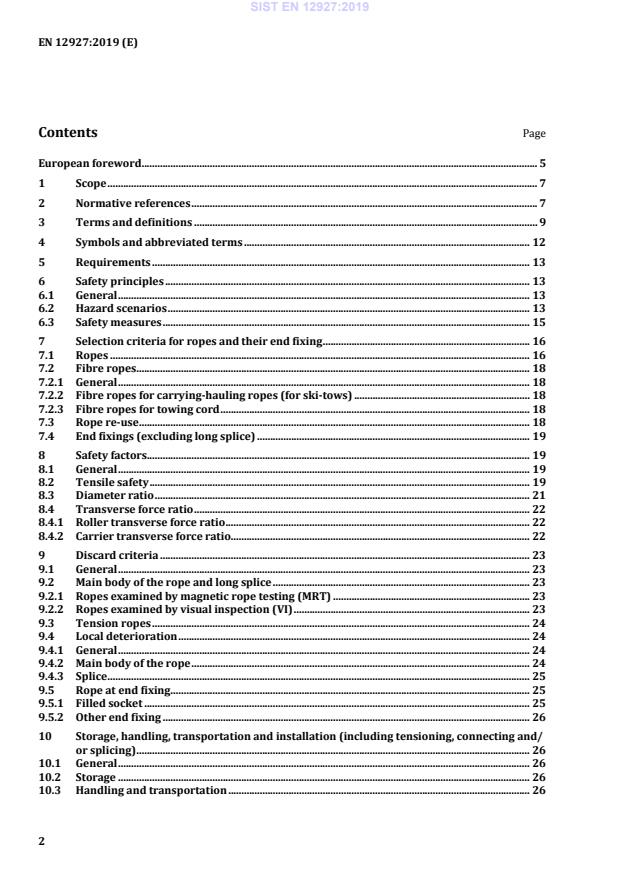
Contents Page
European foreword . 5
1 Scope . 7
2 Normative references . 7
3 Terms and definitions . 9
4 Symbols and abbreviated terms . 12
5 Requirements . 13
6 Safety principles . 13
6.1 General . 13
6.2 Hazard scenarios . 13
6.3 Safety measures . 15
7 Selection criteria for ropes and their end fixing . 16
7.1 Ropes . 16
7.2 Fibre ropes. 18
7.2.1 General . 18
7.2.2 Fibre ropes for carrying-hauling ropes (for ski-tows) . 18
7.2.3 Fibre ropes for towing cord . 18
7.3 Rope re-use . 18
7.4 End fixings (excluding long splice) . 19
8 Safety factors. 19
8.1 General . 19
8.2 Tensile safety . 19
8.3 Diameter ratio . 21
8.4 Transverse force ratio . 22
8.4.1 Roller transverse force ratio . 22
8.4.2 Carrier transverse force ratio. 22
9 Discard criteria . 23
9.1 General . 23
9.2 Main body of the rope and long splice . 23
9.2.1 Ropes examined by magnetic rope testing (MRT) . 23
9.2.2 Ropes examined by visual inspection (VI) . 23
9.3 Tension ropes . 24
9.4 Local deterioration . 24
9.4.1 General . 24
9.4.2 Main body of the rope . 24
9.4.3 Splice . 25
9.5 Rope at end fixing . 25
9.5.1 Filled socket . 25
9.5.2 Other end fixing . 26
10 Storage, handling, transportation and installation (including tensioning, connecting and/
or splicing) . 26
10.1 General . 26
10.2 Storage . 26
10.3 Handling and transportation . 26
10.4 Installation (including tensioning, connecting and/or splicing) . 27
10.4.1 General . 27
10.4.2 Measurements, adjustments and records . 28
11 Splicing of 6 stranded steel wire ropes . 28
11.1 General . 28
11.2 Splice geometry . 28
11.2.1 General . 28
11.2.2 Splice dimensions . 29
11.2.3 Documentation . 29
12 End fixing . 29
12.1 General . 29
12.2 Design. 29
12.3 Execution and conformity . 30
12.4 Filled socket . 30
12.4.1 General . 30
12.4.2 Design. 31
12.4.3 Manufacture . 31
12.4.4 Socketing execution . 31
12.5 Clamp socket. 32
12.5.1 General . 32
12.5.2 Design. 33
12.5.3 Manufacture . 33
12.5.4 Execution . 33
12.6 Drum (Fixing drum and anchor drum) . 34
12.7 Bolted clamp . 34
12.7.1 Design. 34
12.7.2 Manufacture . 35
12.7.3 Execution and maintenance . 35
12.8 Wedge socket . 36
12.8.1 Symmetrical . 36
12.8.2 Asymmetrical . 36
12.9 Spliced eye . 36
12.10 Gripped eye . 36
12.11 Ferrule secured eye . 36
12.12 Lever winch . 36
13 Maintenance . 36
13.1 General . 36
13.2 Servicing . 44
13.2.1 General . 44
13.2.2 Rope cleaning and lubrication . 44
13.2.3 Relocation of carrying ropes, fixed grips on monocable aerial ropeways and signal
ropes . 44
13.2.4 Relocation of signal ropes . 45
13.2.5 End fixing . 45
13.2.6 Shortening of rope loops . 45
13.2.7 End fixing of towing cords . 45
13.3 Inspection . 45
13.3.1 General . 45
13.3.2 Personnel requirements . 46
13.3.3 Initial inspection . 46
13.3.4 Periodical inspection . 46
13.3.5 Extraordinary inspection . 46
13.3.6 Visual inspection (VI) . 46
13.3.7 Inspection types . 47
13.3.8 Optical inspection devices (OID) . 47
13.3.9 Measurements . 47
13.3.10 Magnetic rope testing . 49
13.3.11 Radiographic testing . 49
13.3.12 Report . 49
13.3.13 Rope indicators . 49
13.4 Repair . 50
13.4.1 General . 50
13.4.2 Stranded rope . 50
13.4.3 Locked coil rope . 50
13.4.4 Anchor drum repair . 51
14 Magnetic rope testing (MRT) . 51
14.1 General . 51
14.2 Instrumentation . 51
14.2.1 Function and operational principles of magnetic flux leakage instruments. 51
14.2.2 Test head . 52
14.2.3 Visual display unit and permanent recording instrument . 52
14.3 Test procedure . 52
14.3.1 Personnel . 52
14.3.2 Setting up . 52
14.3.3 Test execution . 53
14.3.4 Interpretation of results . 53
14.3.5 Instrument verification . 54
15 Fire protection and fire fighting . 55
Annex A (informative) Guidelines for executing visual inspection type “A”. 56
Annex B (informative) Magnetic flux density . 57
Annex C (informative) Magnetic rope testing - Personnel qualifications levels . 58
Annex D (informative) Bolted clamp - Calculation of slipping force . 60
Annex E (informative) Determination of intervals related to visual inspections . 61
E.1 General . 61
E.2 Operational conditions . 61
E.2.1 Bendings of stranded ropes . 61
E.2.2 Number of passages of rollers per year for locked coil ropes. 61
E.3 Operating personnel . 62
E.4 Carriers related conditions . 62
E.5 Cableway configuration . 63
E.6 Environmental conditions . 63
E.7 Final evaluation and result . 63
Annex ZA (informative) Relationship between this European Standard and the Essential
Requirements of Regulation (EU) 2016/424 on “Cableway installations” aimed to be
covered. 65
European foreword
This document (EN 12927:2019) has been prepared by Technical Committee CEN/TC 242 “Safety
requirements for passenger transportation by rope”, the secretariat of which is held by AFNOR.
This European Standard shall be given the status of a national standard, either by publication of an identical
text or by endorsement, at the latest by November 2019, and conflicting national standards shall be withdrawn
at the latest by November 2019.
Attention is drawn to the possibility that some of the elements of this document may be the subject of patent
rights. CEN shall not be held responsible for identifying any or all such patent rights.
This document has been prepared under a mandate given to CEN by the European Commission and the
European Free Trade Association, and supports essential requirements of Regulation (EU) 2016/424.
For relationship with Regulation (EU) 2016/424, see informative Annex ZA, which is an integral part of this
document.
This document replaces:
— EN 12927-1:2004: Safety requirements for cableway installations designed to carry persons - Ropes - Part
1: Selection criteria for ropes and their end fixings”
— EN 12927-2:2004: Safety requirements for cableway installations designed to carry persons - Ropes – Part
2: Safety factors
— EN 12927-3:2004: Safety requirements for cableway installations designed to carry persons - Ropes – Part
3: Long splicing of 6 strand hauling, carrying hauling and towing ropes
— EN 12927-4:2004: Safety requirements for cableway installations designed to carry persons - Ropes – Part
4: End fixings
— EN 12927-5:2004: Safety requirements for cableway installations designed to carry persons - Ropes – Part
5: Storage, transportation, installation and tensioning
— EN 12927-6:2004: Safety requirements for cableway installations designed to carry persons - Ropes – Part
6: Discard criteria
— EN 12927-7:2004: Safety requirements for cableway installations designed to carry persons - Ropes – Part
7: Inspection, repair and maintenance
— EN 12927-8:2004: Safety requirements for cableway installations designed to carry persons - Ropes – Part
8: Magnetic rope testing (MRT)
During the systematic review regarding the EN 12927 Part 1 to Part 8, it was decided to merge the 8 parts into
one single document.
In comparison to EN 12927, parts 1:2004 to 8:2004, the following major changes have been applied:
— the former parts 1 to 8 have been merged to a single document in order to simplify orientation in working
with the standard. Following this principle, the former paragraph-references had to be changed in total.
Therefore, especially general chapters like “normative references”, “terms and definitions”, “safety
principles” and so on, now have been compacted for a better overview;
— ambiguous or unclear details of the former versions have been generally rewritten and improved;
— technical developments since the last versions have been adopted to the actual state of the art, e.g.
inclusion of optical inspection devices;
— requirements and descriptions in the scope of inspection methods have been improved and extended to
details, especially for visual inspection;
— requirements and descriptions for storage, handling and transportation have been improved and extended
to details.
According to the CEN-CENELEC Internal Regulations, the national standards organisations of the following
countries are bound to implement this European Standard: Austria, Belgium, Bulgaria, Croatia, Cyprus, Czech
Republic, Denmark, Estonia, Finland, Former Yugoslav Republic of Macedonia, France, Germany, Greece,
Hungary, Iceland, Ireland, Italy, Latvia, Lithuania, Luxembourg, Malta, Netherlands, Norway, Poland, Portugal,
Romania, Serbia, Slovakia, Slovenia, Spain, Sweden, Switzerland, Turkey and the United Kingdom.
1 Scope
This document specifies the safety requirements applicable to:
— Selection criteria for ropes and their end fixings
— Safety factors (excluding brake ropes)
— Discard criteria
— Storage, handling, transportation and installation (including tensioning, connecting and/or splicing)
— Long splicing of 6 strand haulage, carrying-hauling rope and carrying-hauling rope (for ski-tow)
— End fixings
— Maintenance
and the minimum requirements applicable to:
— MRT, visual and radiographic equipment and procedures for the examination of steel wire ropes.
This document is not applicable to cableway installations for the transportation of goods nor to lifts.
This document includes requirements relating to the prevention of accidents and the protection of workers
irrespective of the application of national regulations.
National regulations of a building or federal/state nature or which serve to protect particular groups of people
remain unaffected.
2 Normative references
The following documents are referred to in the text in such a way that some or all of their content constitutes
requirements of this document. For dated references, only the edition cited applies. For undated references, the
latest edition of the referenced document (including any amendments) applies.
EN 1559-2, Founding — Technical conditions of delivery — Part 2: Additional requirements for steel castings
EN 1709, Safety requirements for cableway installations designed to carry persons — Precommissioning
inspection, maintenance, operational inspection and checks
EN 1907:2017, Safety requirements for cableway installations designed to carry persons — Terminology
EN 1908, Safety requirements of cableway installations designed to carry persons — Tensioning devices
EN 1909, Safety requirements for cableway installations designed to carry persons — Recovery and evacuation
EN 10228-1, Non-destructive testing of steel forgings — Part 1: Magnetic particle inspection
EN 12385-2, Steel wire ropes — Safety — Part 2: Definitions, designation and classification
EN 12385-4, Steel wire ropes — Safety — Part 4: Stranded ropes for general lifting applications
EN 12385-8, Steel wire ropes — Safety — Part 8: Stranded hauling and carrying-hauling ropes for cableway
installations designed to carry persons
EN 12385-9, Steel wire ropes — Safety — Part 9: Locked coil carrying ropes for cableway installations designed to
carry persons
EN 12397, Safety requirements for cableway installations designed to carry persons — Operation
EN 12408, Safety requirements for cableway installations designed to carry persons — Quality assurance
EN 12929-1, Safety requirements for cableway installations designed to carry persons — General requirements —
Part 1: Requirements for all installations
EN 12929-2, Safety requirements for cableway installations designed to carry persons — General requirements —
Part 2: Additional requirements for reversible bicable aerial ropeways without carrier truck brakes
EN 12930, Safety requirements for cableway installations designed to carry persons — Calculations
EN 13107, Safety requirements for cableway installations designed to carry persons — Civil engineering works
EN 13223, Safety requirements for cableway installations designed to carry persons — Drive systems and other
mechanical equipment
EN 13243, Safety requirements for cableway installations designed to carry persons — Electrical equipment other
than for drive systems
EN 13411-2, Terminations for steel wire ropes — Safety — Part 2: Splicing of eyes for wire rope slings
EN 13411-3, Terminations for steel wire ropes — Safety — Part 3: Ferrules and ferrule-securing
EN 13411-4, Terminations for steel wire ropes — Safety — Part 4: Metal and resin socketing
EN 13411-5, Terminations for steel wire ropes — Safety — Part 5: U-bolt wire rope grips
EN 13411-6, Terminations for steel wire ropes — Safety — Part 6: Asymmetric wedge socket
EN 13411-7, Terminations for steel wire ropes — Safety — Part 7: Symmetric wedge socket
EN 13796-1, Safety requirements for cableway installations designed to carry persons — Carriers — Part 1: Grips,
carrier trucks, on-board brakes, cabins, chairs, carriages, maintenance carriers, tow-hangers
EN 13796-2, Safety requirements for cableway installations designed to carry persons — Carriers — Part 2:
Slipping resistance tests for grips
EN 13796-3, Safety requirements for cableway installations designed to carry persons — Carriers — Part 3:
Fatigue testing
EN ISO 148-1, Metallic materials — Charpy pendulum impact test — Part 1: Test method (ISO 148-1)
EN ISO 5579, Non-destructive testing — Radiographic testing of metallic materials using film and X- or gamma
rays — Basic rules (ISO 5579)
EN ISO 9554, Fibre ropes — General specifications (ISO 9554)
EN ISO 10547, Polyester fibre ropes — Double braid construction (ISO 10547)
3 Terms and definitions
For the purposes of this document, the terms and definitions given in EN 1907 and the following apply.
ISO and IEC maintain terminological databases for use in standardization at the following addresses:
• IEC Electropedia: available at http://www.electropedia.org/
• ISO Online browsing platform: available at http://www.iso.org/obp
NOTE For a better accessibility, some terms and definitions have been taken from EN 1907 are repeated in this
Clause.
3.1
additional tensioning device
additional device intended to hold the tension in a rope in case of failure of the main tensioning device
3.2
bolted clamp
end fixing accessory consisting of two grooved plates bolted together between which the entire rope is pressed
and secured by means of bolts
3.3
clamp socket
socket end fixing where the end of rope is immobilized mechanically
[SOURCE: EN 1907:2017, 4.3.1.2]
3.4
diameter ratio
ratio between the pitch diameter (D) f. i. of a sheave, a rope shoe or a roller chain and the nominal diameter of
the rope (d)
[SOURCE: EN 1907:2017, 4.3.4]
3.5
discard criteria
level of deterioration at which the rope or the end fixing is declared unfit for further service
3.6
drum
end fixing consisting of a number of dead turns of rope permanently wound around a winch support, the end of
the rope being secured by means of a bolted clamp
3.7
efficiency
ratio between the breaking force of the combination of rope and end fixing, and the minimum breaking force of
the rope
Note 1 to entry: It determines the load bearing capacity of the combination with respect to that of the wire rope.
3.8
end fixing
termination
component connecting one of the ends of a rope to the component on which the rope pulls
[SOURCE: EN 1907:2017, 4.3]
3.9
installation sheave and roller
wheel with a groove along its edge for holding a rope
3.10
installer
person or organisation responsible for all or part of the installation of a rope, the splicing and the end fixing, the
tensioning and the adjustment
3.11
lever winch
end fixing accessory comprising a mechanism actuated by a lever and acting on two sets of jaws alternately
gripping the rope and moving it longitudinally
3.12
local discontinuity
localised fault or defect on a wire
EXAMPLE A broken or damaged wire or a corrosion pit on a wire
3.13
loss of metallic cross sectional area
reduction in area expressed as a percentage of the nominal metallic cross sectional area of the new rope, taking
into account the effects of broken wires and the effect of corrosion and wear
3.14
lubrication agent
any product applied to the rope in service in order to protect it against internal wear, corrosion or both
3.15
magnetic rope testing
method of testing based on the detection of the magnetic flux leakage of a magnetized rope
3.16
main body of the rope
whole of the length of the rope excluding any sections within an end fixing or a long splice
3.17
optical inspection device
instrumentation designed to acquire and record images of the surface of a rope
3.18
radiographic testing
method of testing based on the impression of a film by X- or gamma rays passing through a wire rope
3.19
reference bendings
total number of bends over sheaves in one complete revolution (unidirectional ropeways) or one complete ride
forwards and backwards (reversible ropeways)
3.20
reference length
length of rope over which the value of a specified characteristic is measured or assessed e.g. 6xd (6 × nominal
diameter of the rope)
3.21
reference point
origin chosen on the rope or the installation to locate specific sections on the ropes
3.22
resin filled socket
socket end fixing where a brushed rope end is secured using poured resin or other suitable means
3.23
rope indicator
device inserted into the rope to identify and mark particular rope areas
3.24
rope nominal diameter
(d)
diameter by which the rope is designated
3.25
rope signature
reflects the changes in magnetic characteristics of the rope among its length, e.g. differences in magnetic
permeability
3.26
rope untwisting
untwisting of a rope in between a pair of clamps to allow internal visual inspection
3.27
slipping force
maximum longitudinal tension force, which can be applied to a clamped rope, held by friction, before its initial
slippage
3.28
socket basket
part of the filled socket containing the metal or synthetic resin cone
[SOURCE: EN 1907:2017, 4.3.1.1.1]
3.29
static bending
rope bending which does not vary significantly during operations
3.30
tail
area in a splice where 1 outer strand (properly wrapped) replaces the rope core
3.31
tensile safety
ratio between the minimum breaking force of the rope and the calculated tension force
[SOURCE: EN 1907:2017, 4.8]
3.32
test head
device on that part of the test instrument positioned around the rope during testing which generates the
magnetising field and contains the detecting or sensing elements
3.33
tuck
location in a splice where 2 opposite outer strands of a rope enter into the core
3.34
visual inspection
non-destructive test of the state of a component by visual means only, possibly taking into account particular
circumstances
3.35
wire break indication
indication from the local discontinuity (LD) channel of the test instrument specifically identified as an internal
or external wire break type
3.36
wrapping
addition of material to a tail in order to increase its diameter
4 Symbols and abbreviated terms
For the purposes of this document, the symbols and abbreviated terms in Table 1 shall be applied.
Table 1 — Symbols and abbreviated terms
Symbol Description
D/d diameter ratio
F
minimum breaking force of the rope
min
LD local discontinuity
LMA loss of metallic cross-sectional area
MRT magnetic rope testing
NDT non-destructive testing
OID optical inspection device
RT radiographic testing
VI visual inspection
5 Requirements
The requirements of this document apply to all installations along with those of EN 1709, EN 1908, EN 1909,
EN 12397, EN 12408, EN 12929-1, EN 12929-2, EN 12930, EN 13107, EN 13223, EN 13243, EN 13796-1,
EN 13796-2 and EN 13796-3.
6 Safety principles
6.1 General
The safety principles set out in EN 12929-1 apply.
If ropes of different productions are required to be spliced together, they shall have the same basic design
characteristics as agreed by a competent person. Rope repairs using ropes or strands of different production
batches are allowed.
Irrespective of whether the rope is inspected by MRT or visual means, the same wire broken in several places
over the stated reference length shall be regarded as a single broken wire.
Loose wires and wires repaired by welding, brazing or gluing shall be regarded as broken wires.
Ropes shall be discarded if their condition cannot, or can no longer, be assessed with the methods of inspection
which are mentioned in this standard.
6.2 Hazard scenarios
The following events can give rise to hazardous situations which may be avoided or reduced by the safety
requirements of this standard.
Concerning selection criteria for ropes and their end fixings:
a) the breakage of a rope or the failure of an end fixing may lead to the following hazardous situations:
1) falling down of rope with the risk of carrier crash and the risk of impact to persons;
2) release of the elastic potential energy of a tensioned or extended rope.
b) deterioration/damages of the structure of the rope can lead to the following hazardous situations:
1) derailment of rope;
2) derailment of carrier truck.
c) the rotation of the rope around its axis in low level ski-tow systems can create a dangerous situation for the
user.
d) vibrations may lead to premature failures of parts of the installation.
Concerning safety factors:
e) excessive working stresses in the wires may lead to premature fatigue breaks and rope-failure within the
stated inspection intervals.
Concerning discard criteria:
f) excessive loss of the metallic cross sectional area may lead to the breakage of the rope;
g) fatigue breaks, loose wires, corrosion and wear may lead to a failure of end fixings and of ropes;
h) deterioration/damaging of the structure of the rope can lead to derailment of the rope or to insufficient
connection of the grip.
Concerning storage, handling, transportation and installation (including tensioning, connecting and/or
splicing):
i) elevated temperature and inefficient rope protection during storage may lead to corrosion which may lead
to rope failure within an inspection period;
j) failure of supporting the reels properly may allow them to unwind ;
k) failure of the rope connection with an auxiliary rope or with the brake controlled reel may lead to loss of
control of the rope uncoiling process.
Concerning long splicing of 6 strand haulage, carrying-hauling and carrying-hauling ropes for ski-tow:
l) slipping apart of the two rope ends connected by a long splice may lead to a failure of the long splice;
m) variations of the diameter in the splice area may lead to slippage or malfunction of the grips;
n) reduction of the diameter in the splice area may lead to an increase of stresses in the rope.
Concerning end fixings:
o) failure of the end fixing may lead to the release of the rope end from the end fixing or from the installation
anchor point;
p) slipping of the rope end in the end fixing may lead to hazardous disturbances in the function with other
components;
q) the risk of lack of brush cleaning, due to environmental operating conditions during socketing, may reduce
the safety level of the end fixing.
Concerning maintenance:
r) a dirty rope surface may lead to a malfunction of components (carrying rope brake, detachable grips, etc.)
...
SLOVENSKI SIST EN 12927
STANDARD julij 2019
Varnostne zahteve za žičniške naprave za prevoz oseb – Vrvi
Safety requirements for cableway installations designed to carry persons – Ropes
Sicherheitsanforderungen an Seilbahnen für den Personenverkehr – Seile
Prescriptions de sécurité des installations à câbles transportant des personnes –
Câbles
Referenčna oznaka
ICS 45.100 SIST EN 12927:2019 (sl)
Nadaljevanje na straneh II do IV in od 1 do 66
2022-02: Slovenski inštitut za standardizacijo. Razmnoževanje ali kopiranje celote ali delov tega dokumenta ni dovoljeno.
SIST EN 12927 : 2019
NACIONALNI UVOD
Standard SIST EN 12927 (sl), Varnostne zahteve za žičniške naprave za prevoz oseb – Vrvi, 2019, ima
status slovenskega standarda in je istoveten evropskemu standardu EN 12927 (en), Safety
requirements for cableway installations designed to carry persons – Ropes, 2019.
Ta standard nadomešča:
SIST EN 12927-1:2005
SIST EN 12927-2:2005
SIST EN 12927-3:2005
SIST EN 12927-4:2005
SIST EN 12927-5:2005
SIST EN 12927-6:2005
SIST EN 12927-7:2005
SIST EN 12927-8:2005
NACIONALNI PREDGOVOR
Evropski standard EN 12927:2019 je pripravil tehnični odbor Evropskega komiteja za standardizacijo
CEN/TC 242 Varnostne zahteve za prevoz oseb z žičniškimi napravami. Slovenski standard SIST EN
12927:2019 je prevod evropskega standarda EN 12927:2019. V primeru spora glede besedila
slovenskega prevoda v tem standardu je odločilen izvirni evropski standard v angleškem jeziku.
Slovensko izdajo standarda je pripravil tehnični odbor SIST/TC DTN.
Odločitev za izdajo tega standarda je dne 4. junija 2019 sprejel tehnično odbor SIST/TC DTN Dvigalne
in transportne naprave.
ZVEZE S STANDARDI
S privzemom tega standarda veljajo za omejeni namen referenčnih standardov vsi standardi, navedeni
v izvirniku, razen standardov, ki so že sprejeti v nacionalno standardizacijo.
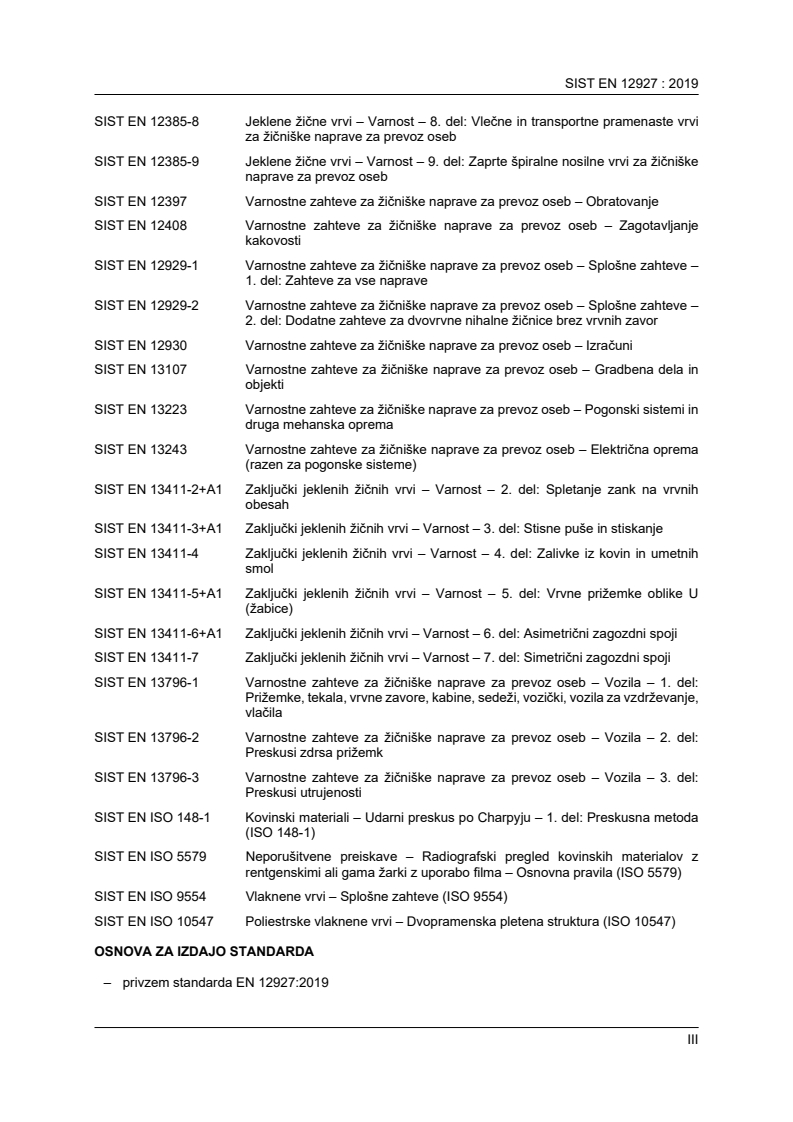
SIST EN 1559-2 Livarstvo – Tehnični dobavni pogoji – 2. del: Dodatne zahteve pri jeklenih
ulitkih
SIST EN 1709 Varnostne zahteve za žičniške naprave za prevoz oseb – Prevzemni pregled,
vzdrževanje, pregledi in kontrole obratovanja
SIST EN 1907:2018 Varnostne zahteve za žičniške naprave za prevoz oseb – Izrazje
SIST EN 1908 Varnostne zahteve za žičniške naprave za prevoz oseb – Napenjalne naprave
SIST EN 1909 Varnostne zahteve za žičniške naprave za prevoz oseb – Izpraznitev in
reševanje
SIST EN 10228-1 Neporušitveno preskušanje jeklenih izkovkov – 1. del: Preiskave z magnetnimi
prahovi
SIST EN 12385-2+A1 Jeklene žične vrvi – Varnost – 2. del: Pojmi, označbe in razvrstitev
SIST EN 12385-4+A1 Jeklene žične vrvi – Varnost – 4. del: Pramenaste vrvi za splošne dvigalne
namene
II
SIST EN 12927 : 2019
SIST EN 12385-8 Jeklene žične vrvi – Varnost – 8. del: Vlečne in transportne pramenaste vrvi
za žičniške naprave za prevoz oseb
SIST EN 12385-9 Jeklene žične vrvi – Varnost – 9. del: Zaprte špiralne nosilne vrvi za žičniške
naprave za prevoz oseb
SIST EN 12397 Varnostne zahteve za žičniške naprave za prevoz oseb – Obratovanje
SIST EN 12408 Varnostne zahteve za žičniške naprave za prevoz oseb – Zagotavljanje
kakovosti
SIST EN 12929-1 Varnostne zahteve za žičniške naprave za prevoz oseb – Splošne zahteve –
1. del: Zahteve za vse naprave
SIST EN 12929-2 Varnostne zahteve za žičniške naprave za prevoz oseb – Splošne zahteve –
2. del: Dodatne zahteve za dvovrvne nihalne žičnice brez vrvnih zavor
SIST EN 12930 Varnostne zahteve za žičniške naprave za prevoz oseb – Izračuni
SIST EN 13107 Varnostne zahteve za žičniške naprave za prevoz oseb – Gradbena dela in
objekti
SIST EN 13223 Varnostne zahteve za žičniške naprave za prevoz oseb – Pogonski sistemi in
druga mehanska oprema
SIST EN 13243 Varnostne zahteve za žičniške naprave za prevoz oseb – Električna oprema
(razen za pogonske sisteme)
SIST EN 13411-2+A1 Zaključki jeklenih žičnih vrvi – Varnost – 2. del: Spletanje zank na vrvnih
obesah
SIST EN 13411-3+A1 Zaključki jeklenih žičnih vrvi – Varnost – 3. del: Stisne puše in stiskanje
SIST EN 13411-4 Zaključki jeklenih žičnih vrvi – Varnost – 4. del: Zalivke iz kovin in umetnih
smol
SIST EN 13411-5+A1 Zaključki jeklenih žičnih vrvi – Varnost – 5. del: Vrvne prižemke oblike U
(žabice)
SIST EN 13411-6+A1 Zaključki jeklenih žičnih vrvi – Varnost – 6. del: Asimetrični zagozdni spoji
SIST EN 13411-7 Zaključki jeklenih žičnih vrvi – Varnost – 7. del: Simetrični zagozdni spoji
SIST EN 13796-1 Varnostne zahteve za žičniške naprave za prevoz oseb – Vozila – 1. del:
Prižemke, tekala, vrvne zavore, kabine, sedeži, vozički, vozila za vzdrževanje,
vlačila
SIST EN 13796-2 Varnostne zahteve za žičniške naprave za prevoz oseb – Vozila – 2. del:
Preskusi zdrsa prižemk
SIST EN 13796-3 Varnostne zahteve za žičniške naprave za prevoz oseb – Vozila – 3. del:
Preskusi utrujenosti
SIST EN ISO 148-1 Kovinski materiali – Udarni preskus po Charpyju – 1. del: Preskusna metoda
(ISO 148-1)
SIST EN ISO 5579 Neporušitvene preiskave – Radiografski pregled kovinskih materialov z
rentgenskimi ali gama žarki z uporabo filma – Osnovna pravila (ISO 5579)
SIST EN ISO 9554 Vlaknene vrvi – Splošne zahteve (ISO 9554)
SIST EN ISO 10547 Poliestrske vlaknene vrvi – Dvopramenska pletena struktura (ISO 10547)
OSNOVA ZA IZDAJO STANDARDA
– privzem standarda EN 12927:2019
III
SIST EN 12927 : 2019
PREDHODNE IZDAJE
SIST EN 12927-1:2005
SIST EN 12927-2:2005
SIST EN 12927-3:2005
SIST EN 12927-4:2005
SIST EN 12927-5:2005
SIST EN 12927-6:2005
SIST EN 12927-7:2005
SIST EN 12927-8:2005
OPOMBE
– Povsod, kjer se v besedilu standarda uporablja izraz "evropski standard", v SIST EN 12927:2019
to pomeni "slovenski standard".
– Nacionalni uvod in nacionalni predgovor nista sestavni del standarda.
– Ta nacionalni dokument je enakovreden EN 12927:2019 in je objavljen z dovoljenjem
Upravni center
CEN/CENELEC
Rue de la Science 23
B-1040 Bruselj
This national document is identical with EN 12927:2019 and is published with the permission of
CEN/CENELEC
Management Centre
Rue de la Science 23
B-1040 Brussels
IV
EVROPSKI STANDARD EN 12927
EUROPEAN STANDARD
NORME EUROPÉENNE
maj 2019
EUROPÄISCHE NORM
ICS 45.100 Nadomešča EN 12927-1:2004, EN
12927-2:2004, EN 12927-3:2004, EN
12927-4:2004, EN 12927-5:2004, EN
12927-6:2004, EN 12927-7:2004, EN
12927-8:2004
Slovenska izdaja
Varnostne zahteve za žičniške naprave za prevoz oseb – Vrvi
Safety requirements for Prescriptions de sécurité des Sicherheitsanforderungen an
cableway installations designed installations à câbles Seilbahnen für den
to carry persons – Ropes transportant des personnes – Personenverkehr – Seile
Câbles
Ta evropski standard je CEN sprejel 11. februarja 2019.
Člani CEN morajo izpolnjevati notranje predpise CEN/CENELEC, ki določajo pogoje, pod katerimi
dobi ta evropski standard status nacionalnega standarda brez kakršnih koli sprememb. Najnovejši
seznami teh nacionalnih standardov in njihovi bibliografski podatki se na zahtevo lahko dobijo pri
Upravnem centru CEN-CENELEC ali kateremkoli članu CEN.
Ta evropski standard obstaja v treh uradnih izdajah (angleški, francoski in nemški). Izdaje v drugih
jezikih, ki jih člani CEN na lastno odgovornost prevedejo in izdajo ter prijavijo pri Upravnem centru
CEN-CENELEC, veljajo kot uradne izdaje.
Člani CEN so nacionalni organi za standarde Avstrije, Belgije, Bolgarije, Cipra, Češke republike,
Danske, Estonije, Finske, Francije, Grčije, Hrvaške, Irske, Islandije, Italije, Latvije, Litve,
Luksemburga, Madžarske, Malte, Nekdanje jugoslovanske republike Makedonije, Nemčije,
Nizozemske, Norveške, Poljske, Portugalske, Romunije, Slovaške, Slovenije, Srbije, Španije,
Švedske, Švice, Turčije in Združenega kraljestva.
CEN
Evropski komite za standardizacijo
European Committee for Standardization
Comité Européen de Normalisation
Europäisches Komitee für Normung
Upravni center CEN-CENELEC: Rue de la Science 23, B-1040 Bruselj
© 2019 CEN Lastnice avtorskih pravic so vse države članice CEN. Ref. oznaka EN 12927:2019 E
SIST EN 12927 : 2019
VSEBINA Stran
Evropski predgovor . 6
1 Področje uporabe . 8
2 Zveze s standardi . 8
3 Izrazi in definicije . 9
4 Simboli in okrajšave . 13
5 Zahteve . 13
6 Varnostna načela . 13
6.1 Splošno . 13
6.2 Možne nevarnosti . 14
6.3 Varnostni ukrepi . 15
7 Kriteriji za izbiro vrvi in pritrditev njihovih koncev . 16
7.1 Vrvi . 16
7.2 Vrvi iz umetnih vlaken. 18
7.2.1 Splošno . 18
7.2.2 Vrvi iz umetnih vlaken za transportne vrvi vlečnic . 18
7.2.3 Vrvi iz umetnih vlaken za vrvice vlačila . 19
7.3 Ponovna uporaba vrvi . 19
7.4 Pritrditve koncev vrvi (razen dolgih vrvnih spletov) . 19
8 Varnostni faktorji . 20
8.1 Splošno . 20
8.2 Natezna varnost . 20
8.3 Razmerje premerov . 21
8.4 Razmerje prečne sile . 23
8.4.1 Razmerje prečne sile kolesa . 23
8.4.2 Razmerje prečne sile vozila . 23
9 Izločitveni kriteriji . 23
9.1 Splošno . 23
9.2 Prosta dolžina vrvi in dolg vrvni splet . 24
9.2.1 Vrvi, pregledane z magnetno induktivno metodo (MRT) . 24
9.2.2 Vrvi, pregledane z vizualnim pregledom (VI) . 24
9.3 Napenjalne vrvi . 25
9.4 Lokalno poslabšanje stanja vrvi . 25
9.4.1 Splošno . 25
9.4.2 Prosta dolžina vrvi . 25
9.4.3 Splet . 25
9.5 Vrv na pritrditvi konca vrvi . 26
9.5.1 Zalivne glave . 26
9.5.2 Druge pritrditve koncev vrvi . 26
SIST EN 12927 : 2019
10 Skladiščenje, ravnanje z vrvmi, transport in nameščanje (vključno z napenjanjem, spajanjem
in/ali spletanjem) . 26
10.1 Splošno . 26
10.2 Skladiščenje . 27
10.3 Ravnanje z izdelki in transport . 27
10.4 Nameščanje (vključno z napenjanjem, spajanjem in/ali spletanjem) . 27
10.4.1 Splošno . 27
10.4.2 Meritve, nastavitve in zapisi . 28
11 Spleti 6-pramenskih jeklenih žičnih vrvi . 29
11.1 Splošno . 29
11.2 Geometrija spleta . 29
11.2.1 Splošno . 29
11.2.2 Dimenzije spleta . 29
11.2.3 Dokumentacija . 30
12 Pritrditev koncev vrvi . 30
12.1 Splošno . 30
12.2 Načrtovanje . 30
12.3 Izvedba in skladnost . 30
12.4 Zalivna glava . 31
12.4.1 Splošno . 31
12.4.2 Načrtovanje . 31
12.4.3 Izdelava . 31
12.4.4 Zalivanje . 32
12.5 Prižemna glava . 33
12.5.1 Splošno . 33
12.5.2 Načrtovanje . 33
12.5.3 Izdelava . 34
12.5.4 Izvedba del . 34
12.6 Boben (pritrditveni boben in sidrni boben) . 34
12.7 Vijačna prižema . 35
12.7.1 Načrtovanje . 35
12.7.2 Izdelava . 36
12.7.3 Izvedba in vzdrževanje . 36
12.8 Zagozdni spoj . 36
12.8.1 Simetrični . 36
12.8.2 Asimetrični . 36
12.9 Spletena zanka . 36
12.10 Zanka z vrvno prižemko . 37
12.11 Zanka s stisnjeno pušo . 37
12.12 Vrvno dvigalo (tirfor) . 37
13 Vzdrževanje . 37
SIST EN 12927 : 2019
13.1 Splošno . 37
13.2 Vzdrževanje . 45
13.2.1 Splošno . 45
13.2.2 Čiščenje in mazanje vrvi . 45
13.2.3 Popuščanje nosilnih vrvi, fiksnih prižemk enovrvnih žičnic in signalnih vrvi . 45
13.2.4 Prestavitev signalnih vrvi . 46
13.2.5 Pritrditev koncev vrvi . 46
13.2.6 Krajšanje vrvi . 46
13.2.7 Pritrditve koncev vrvic vlačila . 46
13.3 Pregledi . 46
13.3.1 Splošno . 46
13.3.2 Zahteve za osebje . 47
13.3.3 Začetni pregled . 47
13.3.4 Periodični pregled . 47
13.3.5 Izredni pregled . 47
13.3.6 Vizualni pregled (VI) . 47
13.3.7 Vrste pregledov . 48
13.3.8 Naprava za vizualni pregled vrvi (OID). 48
13.3.9 Merjenje vrvi . 48
13.3.10 Pregled vrvi z magnetno induktivno metodo . 50
13.3.11 Radiografska preiskava . 50
13.3.12 Poročilo . 50
13.3.13 Trajno označevanje mest na vrvi . 50
13.4 Popravila . 51
13.4.1 Splošno . 51
13.4.2 Pramenasta vrv . 51
13.4.3 Zaprta spiralna vrv . 51
13.4.4 Popravilo vrvi na sidrnem bobnu . 52
14 Pregledi vrvi z magnetno induktivno metodo (MRT) . 52
14.1 Splošno . 52
14.2 Instrumenti . 52
14.2.1 Funkcija in načela delovanja instrumentov za merjenje magnetnega pretoka . 52
14.2.2 Preskusna glava . 53
14.2.3 Enota za prikazovanje in naprava za trajno zapisovanje . 53
14.3 Preskusni postopek . 53
14.3.1 Osebje . 53
14.3.2 Namestitev . 53
14.3.3 Izvedba preskusa . 54
14.3.4 Ovrednotenje rezultatov . 54
14.3.5 Preverjanje instrumentov . 55
15 Požarna zaščita in gašenje požara . 56
SIST EN 12927 : 2019
Dodatek A (informativni): Smernice za izvajanje vizualnega pregleda vrste "A" . 57
Dodatek B (informativni): Gostota magnetnega pretoka . 58
Dodatek C (informativni): Pregled vrvi z magnetno induktivno metodo – Ravni usposobljenosti
osebja . 59
Dodatek D (informativni): Vijačna prižema – Izračun sile zdrsa . 61
Dodatek E (informativni): Določanje intervalov za vizualne preglede . 62
E.1 Splošno . 62
E.2 Obratovalni pogoji . 62
E.2.1 Upogibi pramenastih vrvi . 62
E.2.2 Število prehodov koles na leto za zaprte spiralne vrvi . 62
E.3 Upravljalno osebje . 63
E.4 Pogoji, povezani z vozili . 63
E.5 Konfiguracija žičniške naprave . 64
E.6 Okoljske razmere . 64
E.7 Končno ovrednotenje in rezultat . 64
Dodatek ZA (informativni): Povezava med tem evropskim standardom in bistvenimi zahtevami
Uredbe (EU) 2016/424 glede žičniških naprav, na katere se nanaša . 66
SIST EN 12927 : 2019
Evropski predgovor
Ta dokument (EN 12927:2019) je pripravil tehnični odbor CEN/TC 242 Varnostne zahteve za prevoz
oseb z žičniškimi napravami, katerega sekretariat vodi AFNOR.
Ta evropski standard mora dobiti status nacionalnega standarda bodisi z objavo istovetnega besedila
bodisi z razglasitvijo najpozneje do novembra 2019, nasprotujoče nacionalne standarde pa je treba
razveljaviti najpozneje do novembra 2019.
Opozoriti je treba na možnost, da so lahko nekateri elementi tega dokumenta predmet patentnih pravic.
CEN ne prevzema odgovornosti za identifikacijo nekaterih ali vseh takih patentnih pravic.
Ta dokument je bil pripravljen v okviru mandata, ki sta ga Evropska komisija in Evropsko združenje za
prosto trgovino dodelila CEN, ter podpira bistvene zahteve Uredbe (EU) 2016/424.
Za povezavo tega standarda z Direktivo (EU) 2016/424 glej informativni dodatek ZA, ki je sestavni del
tega dokumenta.
Ta dokument nadomešča naslednje standarde:
– EN 12927-1:2004: Varnostne zahteve za žičniške naprave za prevoz oseb – Vrvi – 1. del: Kriteriji
za izbiro vrvi in pritrditev njihovih koncev
– EN 12927-2:2004: Varnostne zahteve za žičniške naprave za prevoz oseb – Vrvi – 2. del: Varnostni
faktorji
– EN 12927-3:2004: Varnostne zahteve za žičniške naprave za prevoz oseb – Vrvi – 3. del: Dolgi
spleti 6-pramenskih vlečnih, transportnih vrvi in transportnih vrvi vlečnic
– EN 12927-4:2004: Varnostne zahteve za žičniške naprave za prevoz oseb – Vrvi – 4. del:
Pritrjevanje koncev vrvi
– EN 12927-5:2004: Varnostne zahteve za žičniške naprave za prevoz oseb – Vrvi – 5. del:
Skladiščenje, transport, nameščanje in napenjanje
– EN 12927-6:2004: Varnostne zahteve za žičniške naprave za prevoz oseb – Vrvi – 6. del: Izločitveni
kriteriji
– EN 12927-7:2004: Varnostne zahteve za žičniške naprave za prevoz oseb – Vrvi – 7. del: Pregledi,
popravila in vzdrževanje
– EN 12927-8:2004: Varnostne zahteve za žičniške naprave za prevoz oseb – Vrvi – 8. del: Pregledi
vrvi z magnetno induktivno metodo
Med sistematičnim pregledom standarda EN 12927 od 1. do 8. dela je bilo sklenjeno, da se 8 delov
združi v en sam dokument.
Glavne spremembe glede na standard EN 12927, deli 1:2004 do 8:2004, so naslednje:
– prejšnji deli od 1 do 8 so bili združeni v en dokument, da se poenostavi preglednost in delo s
standardom. Zaradi tega je bilo treba prejšnje sklice na odstavke v celoti spremeniti.
Zato so zdaj za boljši pregled preoblikovana zlasti splošna poglavja, kot so "Zveze s standardi",
"Izrazi in definicije", "Varnostna načela" itd.;
– dvoumne ali nejasne podrobnosti iz prejšnjih različic so bile na splošno ponovno napisane in
izpopolnjene;
– upoštevan je bil tehnični razvoj od zadnjih različic do dejanskega stanja tehnike, npr. vključitev
optičnih kontrolnih naprav;
– zahteve in opisi metod pregledovanja so bili izboljšani in razširjeni na podrobnosti, zlasti za vizualni
pregled;
SIST EN 12927 : 2019
– zahteve in opisi za skladiščenje, ravnanje z njimi in transport so izboljšani in razširjeni na
podrobnosti.
V skladu z notranjimi predpisi CEN-CENELEC morajo ta evropski standard uvesti nacionalne
organizacije za standarde naslednjih držav: Avstrije, Belgije, Bolgarije, Cipra, Češke republike, Danske,
Estonije, Finske, Francije, Grčije, Hrvaške, Irske, Islandije, Italije, Latvije, Litve, Luksemburga,
Madžarske, Malte, Nekdanje jugoslovanske republike Makedonije, Nemčije, Nizozemske, Norveške,
Poljske, Portugalske, Romunije, Srbije, Slovaške, Slovenije, Španije, Švedske, Švice, Turčije in
Združenega kraljestva.
SIST EN 12927 : 2019
1 Področje uporabe
Ta dokument določa varnostne zahteve, ki se uporabljajo za:
– kriterije za izbiro vrvi in pritrditev njihovih koncev,
– varnostne faktorje (razen za zavorne vrvi),
– izločitvene kriterije,
– skladiščenje, ravnanje z vrvmi, transport in nameščanje (vključno z napenjanjem, spajanjem in/ali
spletanjem),
– dolge splete 6-pramenskih vlečnih, transportnih vrvi in transportnih vrvi vlečnic,
– pritrjevanje koncev vrvi,
– vzdrževanje
in minimalne zahteve, ki se uporabljajo za:
– preglede vrvi z magnetno induktivno metodo (MRT) kot tudi opremo in potek vizualnega in
radiografskega (rentgenskega) pregleda jeklenih žičnih vrvi
Ta dokument se ne uporablja za žičniške naprave za prevoz tovora ali dvigala.
Ta dokument vključuje zahteve v zvezi s preprečevanjem nesreč in zaščito delavcev ne glede na
uporabo nacionalnih predpisov.
Nacionalni predpisi, ki urejajo gradnjo, predpisi na državni ravni ali predpisi v zvezi z zaščito določene
skupine ljudi ostanejo nespremenjeni.
2 Zveze s standardi
Naslednji dokumenti se v besedilu sklicujejo na ta dokument tako, da nekateri njihovi deli ali njihova
celotna vsebina tvorijo zahteve tega dokumenta. Pri datiranih sklicevanjih se uporablja samo navedena
izdaja. Pri nedatiranih sklicevanjih velja najnovejša izdaja dokumenta, na katerega se sklicuje (vključno
z vsemi dopolnili).
EN 1559-2 Livarstvo – Tehnični dobavni pogoji – 2. del: Dodatne zahteve pri jeklenih
ulitkih
EN 1709 Varnostne zahteve za žičniške naprave za prevoz oseb – Prevzemni pregled,
navodila za vzdrževanje, pregledi in kontrole obratovanja
EN 1907:2017 Varnostne zahteve za žičniške naprave za prevoz oseb – Izrazje
EN 1908 Varnostne zahteve za žičniške naprave za prevoz oseb – Napenjalne naprave
EN 1909 Varnostne zahteve za žičniške naprave za prevoz oseb – Izpraznitev in
reševanje
EN 10228-1 Neporušitveno preskušanje jeklenih izkovkov – 1. del: Preiskave z magnetnimi
prahovi
EN 12385-2 Jeklene žične vrvi – Varnost – 2. del: Pojmi, označbe in razvrstitev
EN 12385-4 Jeklene žične vrvi – Varnost – 4. del: Pramenaste vrvi za splošne dvigalne
namene
EN 12385-8 Jeklene žične vrvi – Varnost – 8. del: Vlečne in nosilne pramenaste vrvi za
žičniške naprave za prevoz oseb
EN 12385-9 Jeklene žične vrvi – Varnost – 9. del: Zaprte spiralne nosilne vrvi za žičniške
naprave za prevoz oseb
SIST EN 12927 : 2019
EN 12397 Varnostne zahteve za žičniške naprave za prevoz oseb – Obratovanje
EN 12408 Varnostne zahteve za žičniške naprave za prevoz oseb – Zagotavljanje
kakovosti
EN 12929-1 Varnostne zahteve za žičniške naprave za prevoz oseb – Splošne zahteve –
1. del: Zahteve za vse naprave
EN 12929-2 Varnostne zahteve za žičniške naprave za prevoz oseb – Splošne zahteve –
2. del: Dodatne zahteve za dvovrvne nihalne žičnice brez vrvnih zavor
EN 12930 Varnostne zahteve za žičniške naprave za prevoz oseb – Izračuni
EN 13107 Varnostne zahteve za žičniške naprave za prevoz oseb – Gradbena dela in
objekti
EN 13223 Varnostne zahteve za žičniške naprave za prevoz oseb – Pogonski sistemi in
druga mehanska oprema
EN 13243 Varnostne zahteve za žičniške naprave za prevoz oseb – Električna oprema
(razen za pogonske sisteme)
EN 13411-2 Zaključki jeklenih žičnih vrvi – Varnost – 2. del: Spletanje zank na vrvnih
obesah
EN 13411-3 Zaključki jeklenih žičnih vrvi – Varnost – 3. del: Stisne puše in stiskanje
EN 13411-4 Zaključki jeklenih žičnih vrvi – Varnost – 4. del: Zalivke iz kovin in umetnih
smol
EN 13411-5 Zaključki jeklenih žičnih vrvi – Varnost - 5. del: Vrvne prižemke oblike U
(žabice)
EN 13411-6 Zaključki jeklenih žičnih vrvi – Varnost – 6. del: Asimetrične konusne glave
EN 13411-7 Zaključki jeklenih žičnih vrvi – Varnost – 7. del: Simetrične konusne glave
EN 13796-1 Varnostne zahteve za žičniške naprave za prevoz oseb – Vozila – 1. del:
Prižemke, tekala, vrvne zavore, kabine, sedeži, vozički, vozila za vzdrževanje,
vlačila
EN 13796-2 Varnostne zahteve za žičniške naprave za prevoz oseb – Vozila – 2. del:
Preskusi zdrsa prižemk
EN 13796-3 Varnostne zahteve za žičniške naprave za prevoz oseb – Vozila – 3. del:
Preskusi utrujenosti
EN ISO 148-1 Kovinski materiali – Udarni preskus žilavosti po Charpyju – 1. del: Preskusna
metoda (ISO 148-1)
EN ISO 5579 Neporušitvene preiskave – Radiografski pregled kovinskih materialov z
rentgenskimi ali gama žarki z uporabo filma – Osnovna pravila (ISO 5579)
EN ISO 9554 Vlaknene vrvi – Splošne zahteve (ISO 9554)
EN ISO 10547 Poliestrske vlaknene vrvi – Dvopramenska pletena struktura (ISO 10547)
3 Izrazi in definicije
V tem dokumentu se uporabljajo izrazi in definicije, podani v standardu EN 1907, ter naslednji izrazi in
definicije.
ISO in IEC hranita terminološke zbirke podatkov za uporabo v standardizaciji na naslednjih naslovih:
– IEC Electropedia: na voljo na spletnem mestu http://www.electropedia.org/
– brskanje po spletni strani ISO: na voljo na spletnem mestu http://www.iso.org/obp
SIST EN 12927 : 2019
OPOMBA: Za boljše razumevanje so v tej točki ponovljeni nekateri izrazi in definicije iz standarda EN 1907.
3.1
dodatna napenjalna naprava
dodatna naprava, namenjena zadrževanju napetosti v vrvi v primeru okvare glavne napenjalne naprave
3.2
vijačna prižema
pritrditev konca vrvi, ki se sestoji iz dveh plošč z utorom, med katerima je z vijaki stisnjena in zavarovana
celotna vrv
3.3
prižemna glava
zaključek vrvi, pri katerem je konec vrvi stisnjen v puši (tulcu)
[VIR: EN 1907:2017, 4.3.1.2]
3.4
razmerje premerov
razmerje med premerom (D), na primer vrvnega kolesa, vrvnega čevlja ali vodilne verige, merjen v osi
vrvi, in nazivnim premerom vrvi (d)
[VIR: EN 1907:2017, 4.3.4]
3.5
izločitveni kriterij
obseg poslabšanja, pri katerem se vrv ali pritrditev konca vrvi določi kot neprimerna za nadaljnjo
uporabo
3.6
vrvni boben
pritrditev konca vrvi, kjer je vrv z določenim številom ovojev trajno ovita okoli bobna, konec vrvi pa je
zavarovan z vijačno prižemo
3.7
izkoristek
razmerje med pretržno silo kombinacije vrvi in pritrditve konca vrvi ter najmanjšo pretržno silo vrvi
Opomba 1: Določa nosilnost kombinacije v primerjavi z nosilnostjo žične vrvi.
3.8
pritrditev konca vrvi
element za povezavo med koncem vrvi in elementom, na katerega se prenaša natezna sila vrvi
[VIR: EN 1907:2017, 4.3]
3.9
montažna vrvenica in kolo
kolo z utorom vzdolž oboda za vodenje vrvi
3.10
monter
oseba ali organizacija, odgovorna za celotno ali delno namestitev vrvi, spletanje in pritrditev koncev vrvi,
napenjanje in nastavitev
3.11
vrvno dvigalo (tirfor)
pripomoček za pritrjevanje konca vrvi, ki je sestavljen iz mehanizma z ročico (vzvodom), pri katerem
dve skupini prijemnih čeljusti izmenično prijemata vrv in jo vzdolžno pomikata
SIST EN 12927 : 2019
3.12
lokalna nepravilnost (LD)
(angl. local discontinuity)
lokalno omejena napaka ali okvara (pomanjkljivost) na žici
PRIMER: Ena počena ali poškodovana žica ali korozija (razjeda) na žici.
3.13
zmanjšanje kovinskega preseka
zmanjšanje preseka, podano v odstotkih nazivnega kovinskega preseka nove vrvi, ki upošteva učinek
počenih žic, korozije in obrabe
3.14
mazivo
vsak izdelek, ki se nanese na vrv v uporabi, da se vrv zaščiti pred notranjo obrabo, korozijo ali obojim
3.15
magnetno induktivni pregled
način pregleda vrvi, ki temelji na odklonu magnetnega (induciranega) toka magnetizirane vrvi
3.16
prosta dolžina vrvi
skupna dolžina vrvi, razen odsekov pritrditve koncev vrvi ali vrvnih spletov
3.17
naprava za vizualni pregled vrvi
naprava za pregledovanje, zajem in snemanje površine vrvi
3.18
rentgenski pregled
pregled s pomočjo rentgenskih ali gama žarkov, ki potujejo skozi vrv in se zabeležijo na filmu
3.19
referenčno število upogibov
število upogibov vrvi na vrvenicah (pogonskem, odklonskem in povratnem kolesu) pri enem obhodu vrvi
pri krožnih žičnicah ali eni celotni vožnji naprej in nazaj (navzgor in navzdol) pri nihalnih žičnicah
3.20
referenčna dolžina
dolžina vrvi, na kateri se meri ali ugotavlja število (vrednost) posebnih značilnosti, na primer
6 ×d (6 × nazivni premer vrvi)
3.21
referenčna točka
izbrana točka na vrvi ali napravi, ki je namenjena za lociranje specifičnih odsekov vrvi
3.22
zalivka iz umetne mase
zaključek vrvi, pri katerem se krtačasto razpleten konec vrvi zalije s tekočo smolo ali drugim primernim
sredstvom
3.23
stalna označitev mesta na vrvi
v vrv vstavljen element za določitev in označitev določenih odsekov vrvi
3.24
nazivni premer vrvi
(d)
mera, ki označuje premer vrvi
SIST EN 12927 : 2019
3.25
osnovni signal vrvi
odraža spremembe magnetnih lastnosti vrvi po njeni dolžini, npr. razlike v magnetni prepustnosti
3.26
razplet vrvi
razplet vrvi (zasuk vrvi v smeri, ki je nasprotna smeri pletenja) med parom spon (čeljusti), da se omogoči
pregled notranjosti vrvi
3.27
sila zdrsa
največja vzdolžna natezna sila, kateri je lahko izpostavljena vpeta vrv, ki jo drži trenje, preden začne
drseti
3.28
ohišje zalivke
del zalivne glave, ki vsebuje konus iz kovine ali umetne smole
[VIR: EN 1907:2017, 4.3.1.1.1]
3.29
statični upogib
upogib vrvi, ki se med obratovanjem bistveno ne spreminja
3.30
potopljeni pramen
območje spleta, v katerem zunanji pramen (ustrezno povit) zamenjuje jedro vrvi
3.31
natezna varnost
razmerje med najmanjšo pretržno silo vrvi in izračunano natezno silo vrvi
[VIR: EN 1907:2017, 4.8]
3.32
preskusna glava
pripomoček na delu preskusnega instrumenta, nameščenega okoli vrvi med preskušanjem, ki ustvarja
magnetno polje in vsebuje senzorje za sprejem ali merjenje
3.33
vozel
območje spleta, kjer dva nasproti tekoča pramena vrvi vstopata v jedro vrvi
3.34
vizualni pregled
neporušitveni pregled stanja elementa samo z očmi (vizualno), po potrebi pod določenimi pogoji
3.35
označitev pretrgane žice
označitev lokalne nepravilnosti s pomočjo (LD)-kanala merilne naprave, ki je določena kot lom (pretrg)
notranje ali zunanje žice
3.36
povitje
material, ki se uporablja za povečanje premera potopljenega pramena
SIST EN 12927 : 2019
4 Simboli in okrajšave
V tem dokumentu se uporabljajo simboli in okrajšave, ki so podani v preglednici 1.
Preglednica 1: Simboli in okrajšave
Simbol Opis
D/d Razmerje premerov
F Najmanjša pretržna sila vrvi
min
LD Lokalna nepravilnost
LMA Izguba kovinskega preseka
(angl. loss of metallic cross-sectional
area)
MRT Magnetno induktivni pregled
(angl. magnetic rope testing)
NDT Neporušitveni pregled
(angl. non-destructive testing)
OID Naprava za vizualni pregled
(angl. optical inspection device)
RT Rentgenski pregled (angl. radiografic test)
VI Vizualni pregled (angl. visual inspection)
5 Zahteve
Zahteve tega dokumenta veljajo za vse žičniške naprave skupaj z zahtevami iz standardov EN 1709,
EN 1908, EN 1909, EN 12397, EN 12408, EN 12929-1, EN 12929-2, EN 12930, EN 13107, EN 13223,
EN 13243, EN 13796-1, EN 13796-2 in EN 13796-3.
6 Varnostna načela
6.1 Splošno
Veljajo varnostna načela, ki so določena v EN 12929-1.
Če je treba splesti vrvi, ki so različne proizvodnje, morajo te imeti enake osnovne lastnosti in potrebno
je soglasje pristojne osebe. Dovoljena so popravila vrvi z vrvmi ali prameni različnih proizvodnih serij.
Ne glede na to, ali se izvaja pregled vrvi z magnetno induktivno metodo ali vizualni pregled, se ista žica,
ki je pr
...