

EN 14487-1:2005
(Main)Sprayed concrete - Part 1: Definitions, specifications and conformity
- Abstract
This European Standard is applicable to sprayed concrete, to be used for repair and upgrading of structures, for new structures and for strengthening of ground.
This European Standard covers:
¾ classification related to consistence of wet mix;
¾ environmental exposure classes; young, hardened and fibre reinforced concrete;
¾ requirements for constituent materials, for concrete composition and for basic mix, for fresh and hardened concrete and all types of fibre reinforced sprayed concrete;
¾ specification for designed and prescribed mixes;
¾ conformity.
This European Standard is applicable to wet mix as well as dry mix sprayed concrete.
The substrates to which sprayed concrete can be applied include:
¾ ground (rock and soil);
¾ sprayed concrete;
¾ different types of formwork;
¾ structural components constituted of concrete, masonry and steel;
¾ drainage materials;
¾ insulating materials.
Additional or different requirements may be needed for applications not within this document, for instance-refractory uses.
- Status
- Withdrawn
- Publication Date
- 01-Nov-2005
- Withdrawal Date
- 06-Oct-2026
- Technical Committee
- CEN/TC 104 - Concrete ( performance, production, placing and compliance criteria )
- Drafting Committee
- CEN/TC 104/WG 10 - Sprayed concrete
- Current Stage
- 9960 - Withdrawal effective - Withdrawal
- Start Date
- 09-Nov-2022
- Completion Date
- 07-Oct-2026

Relations
- Effective Date
- 16-Nov-2022
- Effective Date
- 25-Aug-2026
- Effective Date
- 25-Aug-2026
- Effective Date
- 25-Aug-2026
- Effective Date
- 28-Jan-2026
- Effective Date
- 28-Jan-2026
- Effective Date
- 28-Jan-2026
- Effective Date
- 28-Jan-2026
- Effective Date
- 28-Jan-2026
- Effective Date
- 28-Jan-2026
- Effective Date
- 28-Jan-2026
- Effective Date
- 28-Jan-2026
- Effective Date
- 28-Jan-2026
- Refers
EN 14488-7:2006 - Testing sprayed concrete - Part 7: Fibre content of fibre reinforced concrete - Effective Date
- 28-Jan-2026
- Effective Date
- 28-Jan-2026
Get Certified
Connect with accredited certification bodies for this standard

DIBt (Deutsches Institut für Bautechnik)
German Institute for Building Technology.
DIN CERTCO
DIN Group product certification.

Aboma Certification B.V.
Specialized in construction, metal, and transport sectors.
Sponsored listings
Frequently Asked Questions
EN 14487-1:2005 is a standard published by the European Committee for Standardization (CEN). Its full title is "Sprayed concrete - Part 1: Definitions, specifications and conformity". This standard covers: This European Standard is applicable to sprayed concrete, to be used for repair and upgrading of structures, for new structures and for strengthening of ground. This European Standard covers: ¾ classification related to consistence of wet mix; ¾ environmental exposure classes; young, hardened and fibre reinforced concrete; ¾ requirements for constituent materials, for concrete composition and for basic mix, for fresh and hardened concrete and all types of fibre reinforced sprayed concrete; ¾ specification for designed and prescribed mixes; ¾ conformity. This European Standard is applicable to wet mix as well as dry mix sprayed concrete. The substrates to which sprayed concrete can be applied include: ¾ ground (rock and soil); ¾ sprayed concrete; ¾ different types of formwork; ¾ structural components constituted of concrete, masonry and steel; ¾ drainage materials; ¾ insulating materials. Additional or different requirements may be needed for applications not within this document, for instance-refractory uses.
This European Standard is applicable to sprayed concrete, to be used for repair and upgrading of structures, for new structures and for strengthening of ground. This European Standard covers: ¾ classification related to consistence of wet mix; ¾ environmental exposure classes; young, hardened and fibre reinforced concrete; ¾ requirements for constituent materials, for concrete composition and for basic mix, for fresh and hardened concrete and all types of fibre reinforced sprayed concrete; ¾ specification for designed and prescribed mixes; ¾ conformity. This European Standard is applicable to wet mix as well as dry mix sprayed concrete. The substrates to which sprayed concrete can be applied include: ¾ ground (rock and soil); ¾ sprayed concrete; ¾ different types of formwork; ¾ structural components constituted of concrete, masonry and steel; ¾ drainage materials; ¾ insulating materials. Additional or different requirements may be needed for applications not within this document, for instance-refractory uses.
EN 14487-1:2005 is classified under the following ICS (International Classification for Standards) categories: 01.040.91 - Construction materials and building (Vocabularies); 91.100.30 - Concrete and concrete products. The ICS classification helps identify the subject area and facilitates finding related standards.
EN 14487-1:2005 has the following relationships with other standards: It is inter standard links to EN 14487-1:2022, ISO 6784:1982, ISO 6782:1982, ISO 758:1976, EN 934-5:2007, EN 12620:2002+A1:2008, EN 14488-3:2023, EN 12390-5:2019, EN 206-1:2000, EN 934-6:2019, EN 13412:2006, EN 12350-5:2019, EN 12504-2:2021, EN 14488-7:2006, EN 14889-1:2006. Understanding these relationships helps ensure you are using the most current and applicable version of the standard.
EN 14487-1:2005 is associated with the following European legislation: EU Directives/Regulations: 305/2011, 89/106/EEC. When a standard is cited in the Official Journal of the European Union, products manufactured in conformity with it benefit from a presumption of conformity with the essential requirements of the corresponding EU directive or regulation.
EN 14487-1:2005 is available in PDF format for immediate download after purchase. The document can be added to your cart and obtained through the secure checkout process. Digital delivery ensures instant access to the complete standard document.
Standards Content (Sample)
2003-01.Slovenski inštitut za standardizacijo. Razmnoževanje celote ali delov tega standarda ni dovoljeno.Brizgani beton – 1. del: Definicije, zahteve in skladnostSpritzbeton - Teil 1: Begriffe, Festlegungen und KonformitätBéton projeté - Partie 1: Définitions, spécifications et conformitéSprayed concrete - Part 1: Definitions, specifications and conformity91.100.30Beton in betonski izdelkiConcrete and concrete products01.040.91Gradbeni materiali in gradnja (Slovarji)Construction materials and building (Vocabularies)ICS:Ta slovenski standard je istoveten z:EN 14487-1:2005SIST EN 14487-1:2006en01-maj-2006SIST EN 14487-1:2006SLOVENSKI
STANDARD
EUROPEAN STANDARDNORME EUROPÉENNEEUROPÄISCHE NORMEN 14487-1November 2005ICS 91.100.30; 01.040.91 English VersionSprayed concrete - Part 1: Definitions, specifications andconformityBéton projeté - Partie 1: Définitions, spécifications etconformitéSpritzbeton - Teil 1: Begriffe, Festlegungen und KonformitätThis European Standard was approved by CEN on 25 May 2005.CEN members are bound to comply with the CEN/CENELEC Internal Regulations which stipulate the conditions for giving this EuropeanStandard the status of a national standard without any alteration. Up-to-date lists and bibliographical references concerning such nationalstandards may be obtained on application to the Central Secretariat or to any CEN member.This European Standard exists in three official versions (English, French, German). A version in any other language made by translationunder the responsibility of a CEN member into its own language and notified to the Central Secretariat has the same status as the officialversions.CEN members are the national standards bodies of Austria, Belgium, Cyprus, Czech Republic, Denmark, Estonia, Finland, France,Germany, Greece, Hungary, Iceland, Ireland, Italy, Latvia, Lithuania, Luxembourg, Malta, Netherlands, Norway, Poland, Portugal, Slovakia,Slovenia, Spain, Sweden, Switzerland and United Kingdom.EUROPEAN COMMITTEE FOR STANDARDIZATIONCOMITÉ EUROPÉEN DE NORMALISATIONEUROPÄISCHES KOMITEE FÜR NORMUNGManagement Centre: rue de Stassart, 36
B-1050 Brussels© 2005 CENAll rights of exploitation in any form and by any means reservedworldwide for CEN national Members.Ref. No. EN 14487-1:2005: ESIST EN 14487-1:2006
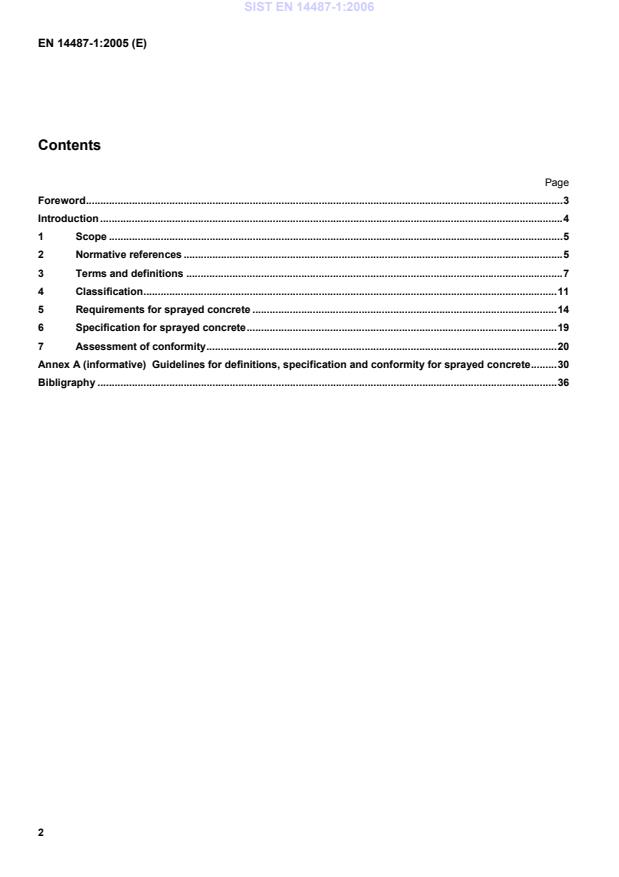
Guidelines for definitions, specification and conformity for sprayed concrete.30 Bibligraphy.36
1 Scope This European Standard is applicable to sprayed concrete, to be used for repair and upgrading of structures, for new structures and for strengthening of ground. This European Standard covers: classification related to consistence of wet mix; environmental exposure classes; young, hardened and fibre reinforced concrete; requirements for constituent materials, for concrete composition and for basic mix, for fresh and hardened concrete and all types of fibre reinforced sprayed concrete; specification for designed and prescribed mixes; conformity. This European Standard is applicable to wet mix as well as dry mix sprayed concrete. The substrates to which sprayed concrete can be applied include: ground (rock and soil); sprayed concrete; different types of formwork; structural components constituted of concrete, masonry and steel; drainage materials; insulating materials. Additional or different requirements may be needed for applications not within this document, for instance-refractory uses. 2 Normative references The following referenced documents are indispensable for the application of this document. For dated references, only the edition cited applies. For undated references, the latest edition of the referenced document (including any amendments) applies. EN 197-1, Cement — Part 1: Composition, specifications and conformity criteria for common cements EN 206-1:2000, Concrete — Part 1: Specification, performance, production and conformity EN 933-1, Tests for geometrical properties of aggregates — Part 1: Determination of particle size distribution — Sieving method EN 934-2, Admixtures for concrete, mortar and grout — Part 2: Concrete admixtures — Definitions, requirements, conformity, marking and labelling EN 934-5:2005, Admixtures for concrete, mortar and grout — Part 5: Admixtures for sprayed concrete — Definitions, requirements, conformity, marking and labelling SIST EN 14487-1:2006
EN 12504-2, Testing concrete in structures — Part 2: Non-destructive testing — Determination of rebound number EN 12620, Aggregates for concrete EN 13412, Products and systems for the protection and repair of concrete structures — Test methods — Determination of modulus of elasticity in compression prEN 14487-2, Sprayed concrete — Part 2: Execution EN 14488-1, Testing sprayed concrete — Part 1: Sampling fresh and hardened concrete prEN 14488-2, Testing sprayed concrete — Part 2: Compressive strength of young sprayed concrete prEN 14488-3, Testing sprayed concrete — Part 3: Flexural strengths (first peak, ultimate and residual) of fibre reinforced beam specimens EN 14488-4, Testing sprayed concrete — Part 4: Bond strength of cores by direct tension prEN 14488-5, Testing sprayed concrete — Part 5: Determination of energy absorption capacity of fibre reinforced slab specimens prEN 14488-7, Testing sprayed concrete — Part 7: Fibre content of fibre reinforced concrete prEN 14889-1:2004, Fibres for concrete — Part 1: Steel fibres — Definition, specification and conformity prEN 14889-2:2004, Fibres for concrete — Part 2: Polymer fibres — Definition, specification and conformity ISO 758, Liquid chemical products for industrial use — Determination of density at 20 degrees C ISO 6782, Aggregates for concrete — Determination of bulk density SIST EN 14487-1:2006
1 The recommended time intervals in which strength data have to be evaluated are: 0 h to 1 h; 4 h to
6 h; 12 h to 24 h. SIST EN 14487-1:2006
Key X Minutes Y Compressive strength 2mmN in fG Z Hours
Figure 1 — Early strength classes of young sprayed concrete
Table 1 — Range of strength of young concrete determined by different test methods Method Range of strength of young concrete (MPa) prEN 14488-2 – Method A 0,2 to 1,2 prEN 14488-2 – Method B
2 to 16
NOTE Current available test methods are not able to cover the entire range of expected early strength. SIST EN 14487-1:2006
Table 2 — Definitions of residual strength classes Deformation range Strength level (minimum strength, MPa) Deflection
mm S1 S2 S3 S4 D1 0,5 to 1 D2 0,5 to 2 D3 0,5 to 4 1 2 3 4
4.5.3 Energy absorption capacity If the energy absorption capacity of the material is specified, it shall be determined from a slab specimen tested in accordance to prEN 14488-5. Table 3 — Definitions of energy absorption classes Energy absorption class Energy absorption in J for deflection up to 25 mm E500 500 E700 700 E1000 1 000 5 Requirements for sprayed concrete 5.1 Requirements for constituent materials Constituent materials shall not contain harmful ingredients in such quantities as may be detrimental to the durability of the concrete, or cause corrosion of the reinforcement and shall be suitable for the intended use in sprayed concrete. Where general suitability is established for a constituent material, this does not indicate suitability in every situation and for every sprayed concrete composition. Only constituents with established suitability for the specified application shall be used in sprayed concrete conforming to this document. The general suitability of a constituent material is established when it conforms to a European Standard. Requirements for constituent materials are given in Table 4. SIST EN 14487-1:2006
Alternatively, where either the European Standard does not cover the particular material or its intended performance, or the material deviates from an existing European Standard, the establishment of suitability may result from: European Technical Approval which refers specifically to the use of the material in sprayed concrete conforming to this document; relevant national standards or provisions valid in the place of use of the sprayed concrete, which refer specifically to the use of the material in sprayed concrete conforming to this document. 5.2 Requirements for sprayed concrete composition 5.2.1 General The concrete mix proportions shall be selected to satisfy all the performance criteria for fresh and hardened concrete including consistence (wet mix), density, strength, durability, protection of embedded steel against corrosion and taking into account the current process technique and quantity of rebound and dust when executing the spraying works. The requirements for concrete composition and properties related to exposure classes depend on the intended design life of the sprayed concrete structure and in conformity with EN 206-1. Values for the composition of the concrete refer to the concrete after spraying and have to take into account the influence of water and accelerator admixtures addition by the spraying process as well as the effect of rebound. The achievement of the design life depends on: the concrete being sprayed and cured in accordance with prEN 14487-2. the sprayed concrete having an adequate cover over reinforcement or required extra thickness. In case of steel fibre reinforcement, the cover requirement does not apply to the fibres; the sprayed concrete being used in the environment for which the particular limiting values apply; the anticipated maintenance without major repair.
C and 30 °C in order to maintain the workability conditions and avoid adverse set effects. NOTE The concrete consistency required for spraying depends on the type of conveyance and the application procedure.
5.4 Requirements for the fresh sprayed concrete Table 7 — Requirements of the fresh sprayed concrete Property Requirement and test methods Density The density shall be determined in accordance with EN 12350-6. Fibre content Fibre content shall be determined from a fresh sample according to prEN 14488-7. The sample shall be taken from in situ material unless otherwise specified.
The length/diameter ratio should be: – 2,0 if the strength result is to be compared to cylinder strength; –
1,0 if the strength result is to be compared to cube strength. Density
The density of hardened concrete shall be determined in accordance with
EN
12390-7. Modulus of elasticity The modulus of elasticity in compression shall be determined in accordance with ISO 6784, except in repair application where EN 13412 shall apply. Flexural strength The flexural strength shall be determined in accordance with EN 12390-5 for sprayed concrete without fibres unless it is to be compared to fibre reinforced sprayed concrete when prEN 14488-3 shall be used. Resistance to water penetration The resistance to water penetration shall be determ
...