

EN 15129:2009
(Main)Anti-seismic devices
- Abstract
This European Standard covers the design of devices that are provided in structures, with the aim of modifying their response to the seismic action. It specifies functional requirements and general design rules for the seismic situation, material characteristics, manufacturing and testing requirements, as well as evaluation of conformity, installation and maintenance requirements. This European Standard covers the types of devices and combinations thereof as defined in 3.4.
NOTE Additional information concerning the scope of this European Standard is given in Annex A.
- Status
- Withdrawn
- Publication Date
- 03-Nov-2009
- Withdrawal Date
- 06-Oct-2026
- Technical Committee
- CEN/TC 340 - Anti-seismic devices
- Drafting Committee
- CEN/TC 340 - Anti-seismic devices
- Current Stage
- 9960 - Withdrawal effective - Withdrawal
- Start Date
- 23-May-2018
- Completion Date
- 07-Oct-2026
- Directive
- 305/2011 - Regulation (eu) No 305/2011 of the European Parliament and of the Council of 9 march 2011 laying down harmonised conditions for the marketing of construction products and repealing council directive 89/106/eecOJ Ref: C, C 259 OJ Date: 08-Aug-2014
89/106/EEC - Construction productsOJ Ref: C, C 71 OJ Date: 19-Mar-2010
- Ref Project
SIST EN 15129:2010 - Anti-seismic devices

Relations
- Replaced By
EN 15129:2018 - Anti-seismic devices - Effective Date
- 29-Jul-2015
- Effective Date
- 25-Aug-2026
- Effective Date
- 25-Aug-2026
- Effective Date
- 25-Aug-2026
- Effective Date
- 25-Aug-2026
- Effective Date
- 25-Aug-2026
- Effective Date
- 25-Aug-2026
- Effective Date
- 25-Aug-2026
- Effective Date
- 25-Aug-2026
- Refers
ISO 188:2007 - Rubber, vulcanized or thermoplastic — Accelerated ageing and heat resistance tests - Effective Date
- 25-Aug-2026
- Effective Date
- 25-Aug-2026
- Effective Date
- 25-Aug-2026
- Effective Date
- 25-Aug-2026
- Refers
EN 1998-1-2:2026 - Eurocode 8 - Design of structures for earthquake resistance - Part 1-2: Buildings - Effective Date
- 25-Mar-2026
- Effective Date
- 09-Feb-2026
Get Certified
Connect with accredited certification bodies for this standard

DIBt (Deutsches Institut für Bautechnik)
German Institute for Building Technology.
DIN CERTCO
DIN Group product certification.

Aboma Certification B.V.
Specialized in construction, metal, and transport sectors.
Sponsored listings
Frequently Asked Questions
EN 15129:2009 is a standard published by the European Committee for Standardization (CEN). Its full title is "Anti-seismic devices". This standard covers: This European Standard covers the design of devices that are provided in structures, with the aim of modifying their response to the seismic action. It specifies functional requirements and general design rules for the seismic situation, material characteristics, manufacturing and testing requirements, as well as evaluation of conformity, installation and maintenance requirements. This European Standard covers the types of devices and combinations thereof as defined in 3.4. NOTE Additional information concerning the scope of this European Standard is given in Annex A.
This European Standard covers the design of devices that are provided in structures, with the aim of modifying their response to the seismic action. It specifies functional requirements and general design rules for the seismic situation, material characteristics, manufacturing and testing requirements, as well as evaluation of conformity, installation and maintenance requirements. This European Standard covers the types of devices and combinations thereof as defined in 3.4. NOTE Additional information concerning the scope of this European Standard is given in Annex A.
EN 15129:2009 is classified under the following ICS (International Classification for Standards) categories: 91.120.25 - Seismic and vibration protection. The ICS classification helps identify the subject area and facilitates finding related standards.
EN 15129:2009 has the following relationships with other standards: It is inter standard links to EN 15129:2018, ISO 34-1:2004, ISO 1083:2004, ISO 898-5:1998, ISO 898-2:1992, ISO 48:2007, ISO 898-6:1994, ISO 37:2005, ISO 815-2:2008, ISO 188:2007, ISO 4664-2:2006, ISO 3755:1991, ISO 898-7:1992, EN 1998-1-2:2026, ISO 815-1:2008. Understanding these relationships helps ensure you are using the most current and applicable version of the standard.
EN 15129:2009 is associated with the following European legislation: EU Directives/Regulations: 305/2011, 89/106/EEC; Standardization Mandates: M/132. When a standard is cited in the Official Journal of the European Union, products manufactured in conformity with it benefit from a presumption of conformity with the essential requirements of the corresponding EU directive or regulation.
EN 15129:2009 is available in PDF format for immediate download after purchase. The document can be added to your cart and obtained through the secure checkout process. Digital delivery ensures instant access to the complete standard document.
Standards Content (Sample)
2003-01.Slovenski inštitut za standardizacijo. Razmnoževanje celote ali delov tega standarda ni dovoljeno.Naprave za zagotavljanje potresne varnosti konstrukcijErdbebenvorrichtungenDispositifs anti-sismiquesAnti-seismic devices91.120.25YLEUDFLMDPLSeismic and vibration protectionICS:Ta slovenski standard je istoveten z:EN 15129:2009SIST EN 15129:2010en01-januar-2010SIST EN 15129:2010SLOVENSKI
STANDARD
EUROPEAN STANDARD NORME EUROPÉENNE EUROPÄISCHE NORM
EN 15129
November 2009 ICS 91.120.25 English Version
Anti-seismic devices
Dispositifs anti-sismiques
Erdbebenvorrichtungen This European Standard was approved by CEN on 19 September 2009.
CEN members are bound to comply with the CEN/CENELEC Internal Regulations which stipulate the conditions for giving this European Standard the status of a national standard without any alteration. Up-to-date lists and bibliographical references concerning such national standards may be obtained on application to the CEN Management Centre or to any CEN member.
This European Standard exists in three official versions (English, French, German). A version in any other language made by translation under the responsibility of a CEN member into its own language and notified to the CEN Management Centre has the same status as the official versions.
CEN members are the national standards bodies of Austria, Belgium, Bulgaria, Cyprus, Czech Republic, Denmark, Estonia, Finland, France, Germany, Greece, Hungary, Iceland, Ireland, Italy, Latvia, Lithuania, Luxembourg, Malta, Netherlands, Norway, Poland, Portugal, Romania, Slovakia, Slovenia, Spain, Sweden, Switzerland and United Kingdom.
EUROPEAN COMMITTEE FOR STANDARDIZATION
COMITÉ EUROPÉEN DE NORMALISATION EUROPÄISCHES KOMITEE FÜR NORMUNG
Management Centre:
Avenue Marnix 17,
B-1000 Brussels © 2009 CEN All rights of exploitation in any form and by any means reserved worldwide for CEN national Members. Ref. No. EN 15129:2009: ESIST EN 15129:2010
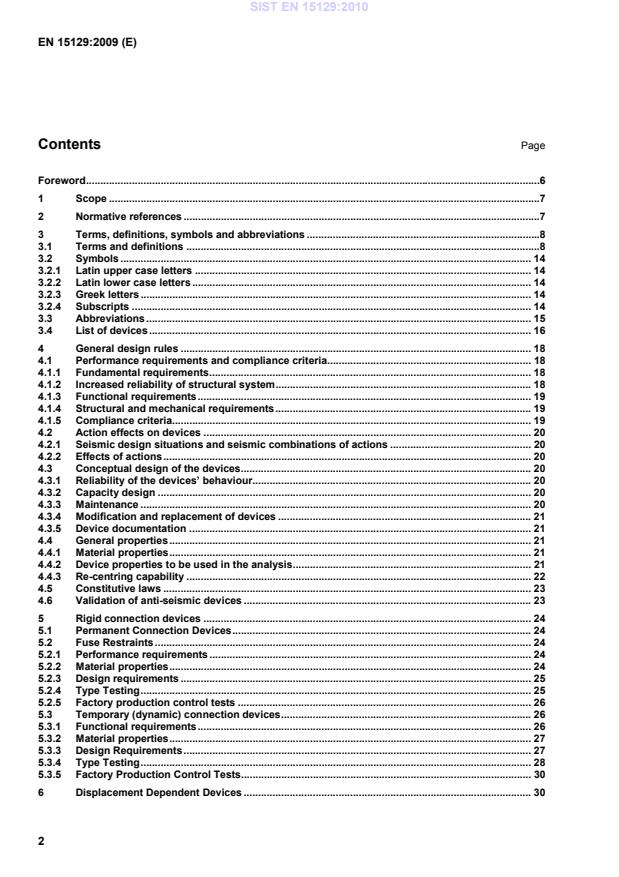
Commentary to Clause 1: Scope . 103Annex B (informative)
Commentary to Clause 4: General design rules . 104B.1 Service life of a device . 104B.2 Basic requirements. 104B.3 Reliability differentiation . 104B.4 Increased reliability . 104B.5 Requirements at the ULS . 105B.6 Requirements at the SLS . 105B.7 Structural analysis . 105B.8 Material properties . 105B.9 Re-centring capability . 106Annex C (informative)
Commentary to Clause 5: Rigid connection devices . 107C.1 Functional requirements . 107C.2 Material properties . 107C.3 Design Requirements . 108C.4 Testing . 108C.4.1 General . 108C.4.2 Low velocity test . 109C.4.3 Seal Wear Test . 110C.4.4 Impulsive Load Test . 110C.4.5 Overload Test . 111C.4.6 Cyclic Load Test . 111Annex D (informative)
Commentary to Clause 6: Displacement Dependent Devices . 112D.1 Categories of Non Linear Devices (NLD) . 112D.2 Examples of linear devices — Elastomeric shear-strained devices . 114D.3 Examples of non linear devices . 114D.3.1 Buffer . 114D.3.2 Steel hysteretic energy dissipating devices . 114D.3.3 Buckling Restrained Braces . 114D.3.4 SMA Re-centring Devices . 115Annex E (informative)
Commentary to Clause 7: Velocity Dependent Devices . 116E.1 Functional requirements . 116E.2 Design Requirements . 118E.3 Testing . 120E.3.1 General . 120E.3.2 Low velocity test for Fluid Viscous Dampers . 120E.3.3 Low velocity test for Fluid Spring Dampers . 121E.3.4 Constitutive law test for Fluid Viscous Dampers . 122E.3.5 Constitutive law test for Fluid Spring Dampers . 122SIST EN 15129:2010
Commentary to Clause 8: Isolators . 125F.1 Ageing conditions for elastomeric isolators . 125F.2 Low temperature crystallisation . 125F.3 Commentary on Basis of design . 126F.3.1 Shape Factor . 126F.3.2 Design shear strain due to compression by vertical loads . 127F.3.3 Isolator stiffnesses . 127F.4 Determination of the restoring stiffness by tests for curved and flat surface sliders . 128Annex G (normative)
Equipment for combined compression and shear . 130G.1 General requirements . 130G.2 Data Acquisition . 130G.3 Combined compression and shear equipment . 130G.4 Load Platens . 131G.5 Data analysis . 131Annex H (informative)
Design of Connections for Devices . 133H.1 Elastomeric Isolators . 133H.2 Sliders . 133Annex I (informative)
Method for calculating pressure distributions on spherical surfaces . 135I.1 General . 135I.2 Modelling assumptions. 135I.3 Effects of vertical loads . 135I.4 Effects of horizontal loads . 137I.5 Combined loads . 137Annex J (informative)
λλλλ-FACTORS FOR COMMON ISOLATOR TYPES . 139J.1 max- values for elastomeric isolators . 139J.2 max- values for sliding isolator units . 140Annex ZA (informative)
Relationship between this European Standard and the Essential Requirements of EU Directive . 142ZA.1 Scope and relevant characteristics . 142ZA.2 Procedure(s) for attestation of conformity of anti-seismic devices . 149ZA.2.1 System(s) of attestation of conformity. 149ZA.2.2 EC Certificate and Declaration of conformity . 151ZA.3
CE marking and labelling . 153ZA.3.1 Declaration of product properties . 154ZA.3.2 Declaration of compliance with given design specification . 155Bibliography . 159 SIST EN 15129:2010
EN 10088 (all parts), Stainless steels EN 10204:2004, Metallic products – Types of inspection documents EN ISO 4287, Geometrical product specifications (GPS) – Surface texture: Profile method – Terms, definitions and surface texture parameters (ISO 4287:1997) EN ISO 4526, Metallic coatings – Electroplated coating of nickel for engineering purposes (ISO 4526:2004) EN ISO 6158, Metallica coatings – Electrodeposited coatings of chromium for engineering purposes (ISO 6158:2004) ISO 34 (all parts), Rubber, vulcanized or thermoplastic – Determination of tear strength ISO 37, Rubber, vulcanized or thermoplastic – Determination of tensile stress-strain properties ISO 48, Rubber, vulcanized or thermoplastic – Determination of hardness (hardness between 10 IRHD and 100 IRHD) ISO 188, Rubber, vulcanized or thermoplastic – Accelerated ageing and heat resistance tests
ISO 815 (all parts), Rubber, vulcanized or thermoplastic – Determination of compression set ISO 898 (all parts), Mechanical properties of fasteners ISO 1083, Spheroidal graphite cast irons – Classification SIST EN 15129:2010
NOTE In this European Standard, compressive forces, stresses and strains are positive. 3.1.1 activation velocity velocity at which a Shock Transmission Unit (STU) reacts with its design force
3.1.2 axial force NEd acting on a device under the design seismic action maximum value during the action is denoted NEd,max and the minimum value NEd,min. The minimum value acting on a device may be tensile
3.1.3 core element component of a Linear Device (LD) or of a Non Linear Device (NLD) on which the mechanism characterising the device’s behaviour is based
NOTE Core elements of a LD or of a NLD are the device’s components that provide it with the flexibility and, eventually, with the energy dissipation and/or re-centring capacity or any other mechanical characteristic compatible with the requirements of a LD or of a NLD. Examples of core elements are steel plates or bars, shape memory alloy wires or bars, rubber elements. 3.1.4 design displacement dbd (of a device) total displacement (due to both translation and rotation about the vertical axis of the isolation system) that a device will undergo when the structural system is subjected to the design seismic action alone according to EN 1998-1 3.1.5 design displacement of an isolation system in a principal direction dcd horizontal displacement at the effective stiffness centre, occurring under the design seismic action alone 3.1.6 (maximum ) displacement of a device in a principal direction dEd for an anti-seismic device in a bridge dEd equals dmax, the maximum total horizontal displacement at the location of the device including all actions effects and the application of the reliability factor to dbd, according to EN 1998-2:2005, 7.6.2 (2)P
For devices in other structures dEd equals γx dbd , the design displacement increased by the reliability factor. 3.1.7 design force Vbd (of a device) force (or moment) corresponding to dbd
value of the effective viscous damping, corresponding to the energy dissipated by the device during cyclic response at the total design displacement: Íeffb = W(dbd) /(2π VEbd dbd)
(1) where W(dbd) = energy actually dissipated by a device during the 3rd load cycle, with maximum displacement equal to dbd. NOTE Íeffb is introduced for a simple characterisation of the behaviour of any device. It cannot be used in the analytical calculations of the response of the structural system, unless they can be carried out by linear analysis and all the devices have the same damping and stiffness in the given direction. Where different devices are used, reference is made to the overall effective damping of the isolation system. 3.1.11 effective period Teff in the case of seismic isolation, is the period of a single degree of freedom system moving in the direction considered, having the mass of the superstructure and the stiffness equal to the effective stiffness of the isolation system 3.1.12 effective stiffness of a device in a principal direction Keffb ratio between the value of the total horizontal force transferred through the device and the component of the total design displacement in the same direction, divided by the absolute value of the total design displacement (secant stiffness) Keffb = VEbd /dbd (2) NOTE Keffb is introduced for a simple characterisation of the behaviour of a device. It cannot be used in the analytical calculations of the response of the structural system, unless they can be carried out by linear analysis and all the devices have the same damping and stiffness in the given direction. Where different devices are used, reference is made to the overall effective stiffness of the isolation system. 3.1.13 effective stiffness of an isolation system in a principal direction Keff sum of the effective stiffness of the devices located at the isolation interface 3.1.14 effective stiffness centre stiffness centre of an isolation system, accounting for the effective stiffness of the devices
device which has a large energy dissipation capacity, i.e. which dissipates a large amount of the energy stored during the loading phase. After unloading it normally shows a large residual displacement. A device is classified as EDD if the equivalent viscous damping
is greater than 15 % 3.1.18 first branch stiffness K1 of a NLD initial stiffness of a NLD is defined as the secant stiffness between the points corresponding to the forces VEbd/10 and VEbd/5: K1 = (VEbd/5 – VEbd/10) /[d(VEbd/5) - d(VEbd/10)] (3) NOTE K1 is referred to as initial or elastic stiffness when dealing with softening devices. 3.1.19 Fluid Viscous Damper (FVD) anti-seismic device whose output is an axial force that depends on the imposed velocity only; its principle of functioning consists of exploiting the reaction force of a viscous fluid forced to flow through an orifice and/or valve system 3.1.20 Fluid Spring Damper (FSD) anti-seismic device whose output is an axial force that depends on both imposed velocity and stroke; its principle of functioning consists of exploiting the reaction force of a viscous fluid forced to flow through an orifice and valve system and at the same time is subjected to progressive compression 3.1.21 Hardening Device (HD)
NLD whose effective stiffness Keffb and second branch stiffness K2 are greater than the first branch stiffness K1 3.1.22 Hydraulic Fuse Restraint (HFR) Hydraulic Fuse Restraints are SRs whose behaviour is hydraulic in nature and depends upon the opening of relief valves 3.1.23 stiffness K1 of a LD stiffness of a LD is defined as the secant stiffness between the points corresponding to the forces VEbd/10 and VEbd/5: K1 = (0,2Vbd – 0,1Vbd)/[d(0,2Vbd) - d(0,1Vbd)] (4) NOTE The evaluation of K1 as secant stiffness is justified by the difficulty of tracing the tangent to a curve at the origin in an experimentally drawn diagram. 3.1.24 isolation system collection of devices used for providing seismic isolation SIST EN 15129:2010
NOTE For visco-elastic devices, residual displacements can be partially or totally recovered after some hours. In this case, the final residual displacement should be referred to. 3.1.28 Mechanical Fuse Restraint (MFR) SR whose behaviour is determined by the break-away of sacrificial components 3.1.29 Non Linear Device (NLD)
anti-seismic device which is characterised by a non linear load-displacement relationship, with a stable behaviour under the required number of cycles and substantial independence from velocity. A device is classified as non linear if either ξeffb is greater than 15 % or the ratio | Keffb -K1|/K1 is greater than 20 %, where ξeffb and Keffb are evaluated at the 3rd cycle with maximum displacement equal to dbd
3.1.30 Non linear Elastic Devices (NLED)
NLD which normally dissipates a negligible amount of the energy stored during the loading phase. The static residual displacement after unloading shall be negligible. A device is classified as NLED if Íeffb is less than 15 % while the ratio | Keffb -K1|/K1 is greater than 20 %
Figure 1 — Initial and effective stiffness of a linear device SIST EN 15129:2010
Figure 2 — Effective stiffness of a non
...