

EN 1998-4:2025
(Main)Eurocode 8 - Design of structures for earthquake resistance - Part 4: Silos, tanks, pipelines, towers, masts and chimneys
- Abstract
EN 1998-4 is applicable to the seismic design of on-ground and elevated silos, on-ground, elevated and underground tanks, above-ground and buried pipeline systems, towers, masts and chimneys and ancillary elements attached to the aforementioned structures or in industrial facilities.
- Status
- Published
- Publication Date
- 30-Sep-2025
- Technical Committee
- CEN/TC 250 - Structural Eurocodes
- Drafting Committee
- CEN/TC 250/SC 8/WG 7 - Evolution of Eurocode 8
- Current Stage
- 6060 - Definitive text made available (DAV) - Publishing
- Start Date
- 01-Oct-2025
- Due Date
- 15-Jan-2025
- Completion Date
- 01-Oct-2025

Overview
EN 1998-4:2025 - Eurocode 8, Part 4 specifies requirements for the seismic design of silos, tanks, pipelines, towers, masts and chimneys. The standard covers on-ground and elevated silos, on-ground, elevated and underground tanks, above‑ground and buried pipeline systems, and ancillary elements in industrial facilities. It defines the basis of design, modelling approaches, seismic actions and combinations, and verification to limit states to ensure earthquake-resistant performance.
Key Topics
- Scope and assumptions - applicability to various storage and industrial structures (silos, tanks, pipelines, towers, masts, chimneys).
- Basis of design - performance requirements, consequence classes and the relationship to Eurocode principles (design situations and limit states).
- Limit states and performance levels - verification for Significant Damage (SD), Damage Limitation (DL) and Fully Operational (OP) states.
- Modelling and methods of analysis - recommended modelling practices and analytical methods for dynamic/seismic analysis.
- Seismic actions and combinations - horizontal and vertical components, superposition rules, and combination of modal responses.
- Force‑based seismic loads - calculation of total base shear, overturning moments, vertical reaction, and seismic pressures (e.g., on silo walls, tank shells, hoppers).
- Behaviour factors and material requirements - guidelines for ductility, energy dissipation and safety verification (anchored vs unanchored tanks, embedded tanks, elevated tanks).
- Special provisions - rules for above‑ground and buried pipelines, seismic restraints, and structural detailing to limit damage.
Applications
Who uses EN 1998-4:2025 and why:
- Structural and seismic engineers - for designing new silos, storage tanks, pipelines, chimneys, towers and masts to meet earthquake resistance requirements.
- Plant and facility designers / operators - to ensure continuity of operations in industrial facilities and to reduce seismic risk of storage systems.
- Infrastructure owners and asset managers - for seismic assessment, retrofit planning and resilience upgrades.
- Regulators and code officials - to reference consistent seismic design rules and national annex decisions. Practical uses include seismic design calculations, selection of anchorage and restraint systems, pressure and overturning checks for tanks and silos, pipeline routing and flexibility design, and verification to DL/SD/OP limit states.
Related Standards
- Eurocode 8 (EN 1998 series) - overarching seismic design framework.
- EN 1998-4 supersedes earlier editions (draft documents indicated replacement of EN 1998-4:2006 and EN 1998-6:2005 in prior drafts).
- Refer also to general Eurocodes (EN 1990, EN 1991) and relevant national annexes for mandatory national parameters.
Keywords: EN 1998-4:2025, Eurocode 8, seismic design, silos, tanks, pipelines, chimneys, towers, masts, earthquake resistance.
Relations
- Effective Date
- 12-Oct-2022
- Effective Date
- 12-Oct-2022
- Effective Date
- 25-Aug-2026
- Effective Date
- 25-Aug-2026
- Effective Date
- 25-Aug-2026
- Effective Date
- 25-Aug-2026
- Effective Date
- 25-Aug-2026
- Effective Date
- 25-Aug-2026
- Effective Date
- 25-Aug-2026
- Effective Date
- 25-Aug-2026
- Refers
ISO 80000-11:2019/Amd 1:2025 - Quantities and units — Part 11: Characteristic numbers — Amendment 1 - Effective Date
- 09-Feb-2026
- Effective Date
- 09-Feb-2026
- Effective Date
- 09-Feb-2026
- Effective Date
- 09-Feb-2026
- Effective Date
- 09-Feb-2026
Get Certified
Connect with accredited certification bodies for this standard

DIBt (Deutsches Institut für Bautechnik)
German Institute for Building Technology.
DIN CERTCO
DIN Group product certification.

Aboma Certification B.V.
Specialized in construction, metal, and transport sectors.
Sponsored listings
Frequently Asked Questions
EN 1998-4:2025 is a draft published by the European Committee for Standardization (CEN). Its full title is "Eurocode 8 - Design of structures for earthquake resistance - Part 4: Silos, tanks, pipelines, towers, masts and chimneys". This standard covers: EN 1998-4 is applicable to the seismic design of on-ground and elevated silos, on-ground, elevated and underground tanks, above-ground and buried pipeline systems, towers, masts and chimneys and ancillary elements attached to the aforementioned structures or in industrial facilities.
EN 1998-4 is applicable to the seismic design of on-ground and elevated silos, on-ground, elevated and underground tanks, above-ground and buried pipeline systems, towers, masts and chimneys and ancillary elements attached to the aforementioned structures or in industrial facilities.
EN 1998-4:2025 is classified under the following ICS (International Classification for Standards) categories: 91.010.30 - Technical aspects; 91.060.40 - Chimneys, shafts, ducts; 91.120.25 - Seismic and vibration protection. The ICS classification helps identify the subject area and facilitates finding related standards.
EN 1998-4:2025 has the following relationships with other standards: It is inter standard links to EN 1998-4:2006, EN 1998-6:2005, ISO 80000-8:2020, ISO 80000-7:2019, ISO 80000-1:2022, ISO 80000-5:2019, ISO 80000-2:2019, ISO 80000-10:2019, ISO 80000-4:2019, ISO 80000-3:2019, ISO 80000-11:2019/Amd 1:2025, ISO 80000-8:2020/Amd 1:2025, ISO 80000-12:2019, ISO 80000-3:2019/Amd 1:2025, ISO 80000-10:2019/Amd 1:2025. Understanding these relationships helps ensure you are using the most current and applicable version of the standard.
EN 1998-4:2025 is associated with the following European legislation: Standardization Mandates: M/515. When a standard is cited in the Official Journal of the European Union, products manufactured in conformity with it benefit from a presumption of conformity with the essential requirements of the corresponding EU directive or regulation.
EN 1998-4:2025 is available in PDF format for immediate download after purchase. The document can be added to your cart and obtained through the secure checkout process. Digital delivery ensures instant access to the complete standard document.
Standards Content (Sample)
SLOVENSKI STANDARD
oSIST prEN 1998-4:2023
01-december-2023
Evrokod 8: Projektiranje potresnoodpornih konstrukcij – 4. del: Silosi, rezervoarji,
cevovodi, stolpi, jambori in dimniki
Eurocode 8 - Design of structures for earthquake resistance - Part 4: Silos, tanks,
pipelines, towers, masts and chimneys
Eurocode 8 - Auslegung von Bauwerken gegen Erdbeben - Teil 4: Silos, Tankbauwerke
und Rohrleitungen, Türme, Maste und Schornsteine
Eurocode 8 - Calcul des structures pour leur résistance au séisme - Part 4: Silos,
réservoirs, canalisations, tours, mâts et cheminées
Ta slovenski standard je istoveten z: prEN 1998-4
ICS:
91.010.30 Tehnični vidiki Technical aspects
91.060.40 Dimniki, jaški, kanali Chimneys, shafts, ducts
91.120.25 Zaščita pred potresi in Seismic and vibration
vibracijami protection
oSIST prEN 1998-4:2023 en,fr,de
2003-01.Slovenski inštitut za standardizacijo. Razmnoževanje celote ali delov tega standarda ni dovoljeno.
oSIST prEN 1998-4:2023
oSIST prEN 1998-4:2023
DRAFT
EUROPEAN STANDARD
prEN 1998-4
NORME EUROPÉENNE
EUROPÄISCHE NORM
September 2023
ICS Will supersede EN 1998-4:2006, EN 1998-6:2005
English Version
Eurocode 8 - Design of structures for earthquake
resistance - Part 4: Silos, tanks, pipelines, towers, masts
and chimneys
Eurocode 8 - Calcul des structures pour leur résistance Eurocode 8 - Auslegung von Bauwerken gegen
au séisme - Part 4: Silos, réservoirs, tuyauteries, tours, Erdbeben - Teil 4: Silos, Tankbauwerke und
mâts et cheminées Rohrleitungen, Türme, Maste und Schornsteine
This draft European Standard is submitted to CEN members for enquiry. It has been drawn up by the Technical Committee
CEN/TC 250.
If this draft becomes a European Standard, CEN members are bound to comply with the CEN/CENELEC Internal Regulations
which stipulate the conditions for giving this European Standard the status of a national standard without any alteration.
This draft European Standard was established by CEN in three official versions (English, French, German). A version in any other
language made by translation under the responsibility of a CEN member into its own language and notified to the CEN-CENELEC
Management Centre has the same status as the official versions.
CEN members are the national standards bodies of Austria, Belgium, Bulgaria, Croatia, Cyprus, Czech Republic, Denmark, Estonia,
Finland, France, Germany, Greece, Hungary, Iceland, Ireland, Italy, Latvia, Lithuania, Luxembourg, Malta, Netherlands, Norway,
Poland, Portugal, Republic of North Macedonia, Romania, Serbia, Slovakia, Slovenia, Spain, Sweden, Switzerland, Türkiye and
United Kingdom.
Recipients of this draft are invited to submit, with their comments, notification of any relevant patent rights of which they are
aware and to provide supporting documentation.
Warning : This document is not a European Standard. It is distributed for review and comments. It is subject to change without
notice and shall not be referred to as a European Standard.
EUROPEAN COMMITTEE FOR STANDARDIZATION
COMITÉ EUROPÉEN DE NORMALISATION
EUROPÄISCHES KOMITEE FÜR NORMUNG
CEN-CENELEC Management Centre: Rue de la Science 23, B-1040 Brussels
© 2023 CEN All rights of exploitation in any form and by any means reserved Ref. No. prEN 1998-4:2023 E
worldwide for CEN national Members.
oSIST prEN 1998-4:2023
prEN 1998-4:2023 (E)
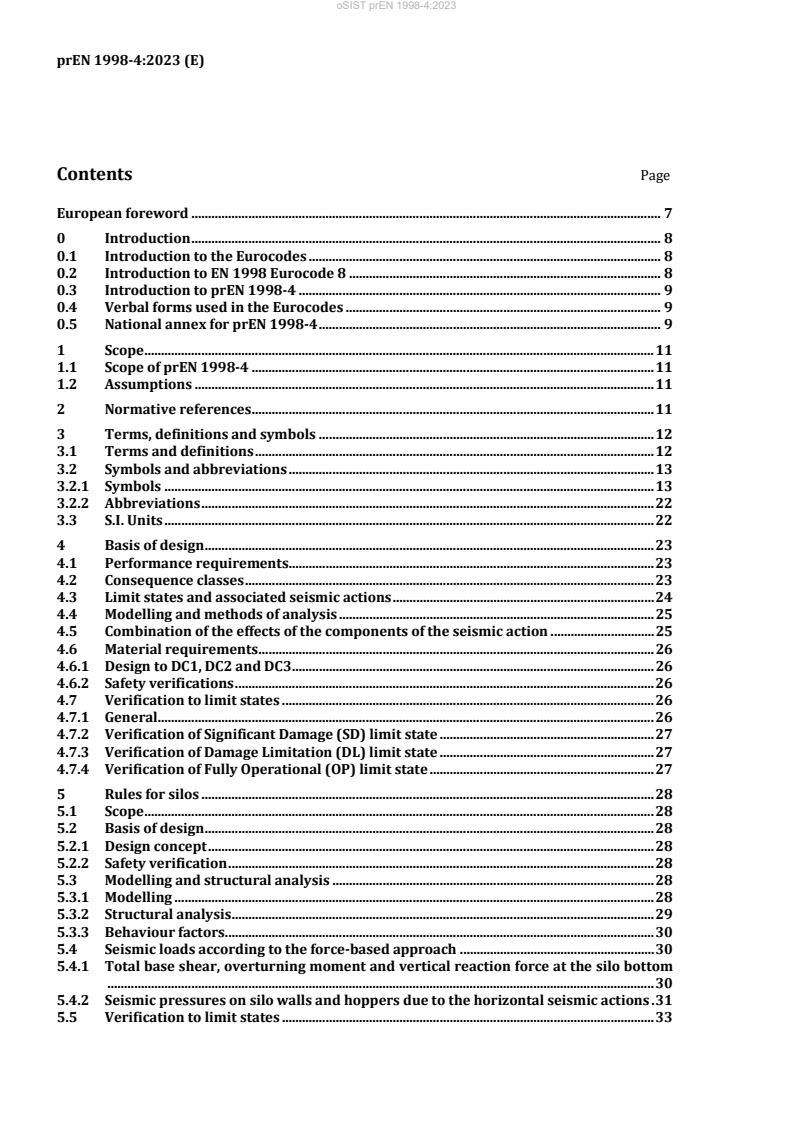
Contents Page
European foreword . 7
0 Introduction . 8
0.1 Introduction to the Eurocodes . 8
0.2 Introduction to EN 1998 Eurocode 8 . 8
0.3 Introduction to prEN 1998-4 . 9
0.4 Verbal forms used in the Eurocodes . 9
0.5 National annex for prEN 1998-4 . 9
1 Scope . 11
1.1 Scope of prEN 1998-4 . 11
1.2 Assumptions . 11
2 Normative references . 11
3 Terms, definitions and symbols . 12
3.1 Terms and definitions . 12
3.2 Symbols and abbreviations . 13
3.2.1 Symbols . 13
3.2.2 Abbreviations . 22
3.3 S.I. Units . 22
4 Basis of design . 23
4.1 Performance requirements . 23
4.2 Consequence classes . 23
4.3 Limit states and associated seismic actions . 24
4.4 Modelling and methods of analysis . 25
4.5 Combination of the effects of the components of the seismic action . 25
4.6 Material requirements . 26
4.6.1 Design to DC1, DC2 and DC3 . 26
4.6.2 Safety verifications . 26
4.7 Verification to limit states . 26
4.7.1 General. 26
4.7.2 Verification of Significant Damage (SD) limit state . 27
4.7.3 Verification of Damage Limitation (DL) limit state . 27
4.7.4 Verification of Fully Operational (OP) limit state . 27
5 Rules for silos . 28
5.1 Scope . 28
5.2 Basis of design . 28
5.2.1 Design concept . 28
5.2.2 Safety verification . 28
5.3 Modelling and structural analysis . 28
5.3.1 Modelling . 28
5.3.2 Structural analysis . 29
5.3.3 Behaviour factors . 30
5.4 Seismic loads according to the force-based approach . 30
5.4.1 Total base shear, overturning moment and vertical reaction force at the silo bottom
................................................................................................................................................................... 30
5.4.2 Seismic pressures on silo walls and hoppers due to the horizontal seismic actions . 31
5.5 Verification to limit states . 33
oSIST prEN 1998-4:2023
prEN 1998-4:2023 (E)
5.5.1 General . 33
5.5.2 Verification of Significant Damage (SD) limit state . 33
5.5.3 Verification of Damage Limitation (DL) limit state . 35
5.5.4 Verification of Fully Operational (OP) limit state . 35
6 Rules for tanks . 35
6.1 Scope . 35
6.2 Basis of design . 36
6.2.1 Design concept . 36
6.2.2 Safety verification . 36
6.3 Modelling and structural analysis . 36
6.3.1 Modelling . 36
6.3.2 Structural analysis . 39
6.3.3 Behaviour factors . 39
6.4 Seismic loads according to the force-based approach for vertical cylindrical tanks . 39
6.4.1 Above ground anchored tanks . 39
6.4.2 Above ground unanchored tanks . 48
6.5 Seismic loads according to the force-based approach for vertical rectangular tanks
................................................................................................................................................................... 49
6.5.1 Above ground anchored tanks . 49
6.5.2 Above ground unanchored tanks . 54
6.6 Seismic loads according to the force-based approach for horizontal cylindrical tanks
................................................................................................................................................................... 54
6.6.1 Assumptions . 54
6.7 Seismic loads according to the force-based approach for elevated tanks . 56
6.8 Seismic loads according to the force-based approach for spherical tanks . 59
6.8.1 Spherical tanks . 59
6.9 Seismic loads on embedded tanks . 61
6.10 Superposition of horizontal and vertical seismic pressures . 61
6.10.1 Superposition of horizontal pressure components due to different modes of response
................................................................................................................................................................... 61
6.10.2 Superposition of horizontal pressure components due to different modes of response
................................................................................................................................................................... 61
6.10.3 Superposition of resulting pressures in horizontal and vertical directions . 62
6.11 Superposition of base shear, overturning moment and vertical reaction force . 62
6.11.1 Superposition of base shear . 62
6.11.2 Superposition of the overturning moments . 62
6.12 Verification to limit states . 62
6.12.1 General . 62
6.12.2 Verification of Significant Damage (SD) limit state . 62
6.12.3 Verification of Damage Limitation (DL) limit state . 64
7 Rules for above-ground pipelines . 66
7.1 Scope . 66
7.2 Basis of design . 66
7.2.1 Design concept . 66
7.2.2 Safety verification . 67
7.3 Modelling and structural analysis . 67
7.3.1 Modelling . 67
7.3.2 Structural analysis . 67
7.4 Actions and combination of actions in the seismic design situation . 68
7.5 Behaviour factors . 68
7.5.1 Behaviour factor for the horizontal components of the seismic action . 68
7.5.2 Seismic loads . 69
oSIST prEN 1998-4:2023
prEN 1998-4:2023 (E)
7.6 Verification to limit states . 70
7.6.1 General. 70
7.6.2 Verification of Significant Damage (SD) limit state . 70
7.6.3 Verification of Damage Limitation (DL) limit state . 71
8 Rules for buried pipelines . 73
8.1 Scope . 73
8.2 Basis of design . 73
8.2.1 Design concept . 73
8.2.2 Safety verification . 74
8.3 Modelling and structural analysis . 74
8.3.1 Modelling . 74
8.3.2 Structural analysis . 75
8.3.3 Seismic loads . 75
8.4 Actions and combination of actions in the seismic design situation . 81
8.5 Verification to limit states . 82
8.5.1 General. 82
8.5.2 Verification of Significant Damage (SD) limit state . 82
8.5.3 Verification of Damage Limitation (DL) limit state . 83
9 Rules for ancillary elements in industrial facilities . 84
9.1 Scope . 84
9.2 Basis of design . 84
9.2.1 Design concept . 84
9.2.2 Safety verification . 84
9.3 Modelling and structural analysis . 84
9.3.1 Modelling . 84
9.3.2 Structural analysis . 85
9.3.3 Seismic loads . 86
9.4 Verification to limit states . 89
9.4.1 General. 89
9.4.2 Verification of Significant Damage (SD) limit state . 89
9.4.3 Verification of Damage Limitation (DL) limit state . 89
9.4.4 Verification of Fully Operational (OP) limit state . 89
10 Rules for towers, masts and chimneys . 90
10.1 Scope . 90
10.2 Basis of Design . 90
10.3 Modelling and structural analysis . 90
10.3.2 Structural analysis . 92
10.3.3 Behaviour factors . 92
10.3.4 Behaviour factors for systems with base isolation or energy dissipation systems . 93
10.4 Verification to limit states . 93
10.4.1 Verification of Significant Damage (SD) limit state . 93
10.4.2 Verification of Damage Limitation (DL) limit state . 95
10.4.3 Verification of Fully Operational (OP) limit state . 96
10.5 Specific rules for reinforced concrete chimneys . 96
10.5.1 General. 96
10.5.2 Design for dissipative behaviour . 96
10.5.3 Minimum reinforcement (vertical and horizontal). 97
10.5.4 Minimum reinforcement around openings . 97
10.6 Specific rules for steel chimneys . 98
10.6.1 General. 98
10.6.2 Design for dissipative behaviour . 98
10.6.3 Materials . 98
oSIST prEN 1998-4:2023
prEN 1998-4:2023 (E)
10.6.4 Connections . 98
10.7 Specific rules for steel towers . 98
10.7.1 General . 98
10.7.2 Materials . 99
10.7.3 Design for dissipative behaviour . 99
10.7.4 Other design rules . 101
Annex A (normative) Tables for the seismic design of tanks . 102
A.1 Use of this normative annex . 102
A.2 Tables of parameter values . 102
Annex B (informative) Soil-structure interaction effects of tanks. 106
B.1 Use of this annex . 106
B.2 Scope and field of application . 106
B.3 Impulsive rigid vibration mode in horizontal direction . 106
B.4 Impulsive rigid vibration mode in vertical direction . 107
B.5 Impulsive flexible vibration mode in horizontal direction . 107
B.6 Impulsive flexible vibration mode in vertical direction . 108
Annex C (informative) General design considerations for buried pipelines . 109
C.1 Use of this annex . 109
C.2 Scope and field of application . 109
C.3 General design consideration for buried pipelines . 109
Annex D (informative) Modelling of soil-structure interaction of buried pipelines . 111
D.1 Use of this annex . 111
D.2 Scope and field of application . 111
D.3 Characteristics of spring elements . 111
D.4 Analytical relations of the spring model . 112
D.4.1 General . 112
D.4.2 Axial spring model . 112
D.4.3 Transverse spring model in horizontal direction . 113
D.4.4 Transverse spring model in vertical direction . 114
Annex E (informative) Design differential surface displacement at pipeline – fault crossing
................................................................................................................................................................ 116
E.1 Use of this annex . 116
E.2 Scope and field of application . 116
E.3 Differential surface displacements at pipeline – fault crossings. 116
Annex F (informative) Number of degrees of freedom and of modes of vibration for dynamic
analysis of towers, masts and chimneys . 125
F.1 Use of this annex . 125
F.2 Scope and field of application . 125
F.3 Modelling and analysis . 125
Annex G (informative) Masonry chimneys . 126
G.1 Use of this annex . 126
G.2 Scope and field of application . 126
G.3 Modelling and analysis . 126
G.4 Design detailing . 126
G.4.1 Footings and foundations . 126
G.4.2 Minimum vertical reinforcement . 126
G.4.3 Minimum horizontal reinforcement . 126
G.4.4 Minimum seismic anchorage . 127
G.4.5 Cantilevering . 127
oSIST prEN 1998-4:2023
prEN 1998-4:2023 (E)
G.4.6 Changes in dimension . 127
G.4.7 Offsets. 127
G.4.8 Wall thickness . 127
Bibliography . 128
oSIST prEN 1998-4:2023
prEN 1998-4:2023 (E)
European foreword
This document (prEN 1998-4:2023) has been prepared by Technical Committee CEN/TC 250 “Structural
Eurocodes”, the secretariat of which is held by BSI. CEN/TC 250 is responsible for all Structural
Eurocodes and has been assigned responsibility for structural and geotechnical design matters by CEN.
This document is currently submitted to the CEN Enquiry.
This document will supersede EN 1998-4:2007 and EN 1998-6:2005.
The first generation of EN Eurocodes was published between 2002 and 2007. This document forms part
of the second generation of the Eurocodes, which have been prepared under Mandate M/515 issued to
CEN by the European Commission and the European Free Trade Association.
The Eurocodes have been drafted to be used in conjunction with relevant execution, material, product
and test standards, and to identify requirements for execution, materials, products and testing that are
relied upon by the Eurocodes.
The Eurocodes recognise the responsibility of each Member State and have safeguarded their right to
determine values related to regulatory safety matters at national level through the use of National
Annexes.
oSIST prEN 1998-4:2023
prEN 1998-4:2023 (E)
0 Introduction
0.1 Introduction to the Eurocodes
The Structural Eurocodes comprise the following standards generally consisting of a number of parts:
— EN 1990 Eurocode: Basis of structural and geotechnical design
— EN 1991 Eurocode 1: Actions on structures
— EN 1992 Eurocode 2: Design of concrete structures
— EN 1993 Eurocode 3: Design of steel structures
— EN 1994 Eurocode 4: Design of composite steel and concrete structures
— EN 1995 Eurocode 5: Design of timber structures
— EN 1996 Eurocode 6: Design of masonry structures
— EN 1997 Eurocode 7: Geotechnical design
— EN 1998 Eurocode 8: Design of structures for earthquake resistance
— EN 1999 Eurocode 9: Design of aluminium structures
— New parts are under development, e.g. Eurocode for design of structural glass
The Eurocodes are intended for use by designers, clients, manufacturers, constructors, relevant
authorities (in exercising their duties in accordance with national or international regulations),
educators, software developers, and committees drafting standards for related product, testing and
execution standards.
NOTE Some aspects of design are most appropriately specified by relevant authorities or, where not specified,
can be agreed on a project-specific basis between relevant parties such as designers and clients. The Eurocodes
identify such aspects making explicit reference to relevant authorities and relevant parties.
0.2 Introduction to EN 1998 (all parts)
EN 1998 (all parts) defines the rules for the seismic design of new buildings and engineering works and
the assessment and retrofit of existing ones, including geotechnical aspects, as well as temporary
structures.
NOTE This standard also covers the verification of structures in the seismic situation during construction, when
required.
Attention should be paid to the fact that, for the design of structures in seismic regions, the provisions of
EN 1998 should be applied in addition to the relevant provisions of EN 1990 to EN 1997 (all parts) and
EN 1999 (all parts). In particular, EN 1998 should be applied to structures of consequence classes CC1,
CC2 and CC3, as defined in EN 1990:2023, 4.3. Structures of consequence class CC4 are not fully covered
by the Eurocodes but may be required to follow EN 1998, or parts of it, by the relevant Authorities.
By nature, perfect protection (a null seismic risk) against earthquakes is not feasible in practice, namely
because the knowledge of the hazard itself is characterized by a significant uncertainty. Therefore, in
Eurocode 8, the seismic action is represented in a conventional form, proportional in amplitude to
earthquakes likely to occur at a given location and representative of their frequency content. This
representation is not the prediction of a particular seismic movement, and such a movement could give
rise to more severe effects than those of the seismic action considered, inflicting damage greater than the
one described by the Limit States contemplated in this standard.
oSIST prEN 1998-4:2023
prEN 1998-4:2023 (E)
Not only the seismic action cannot be predicted, but in addition, it should be recognised that engineering
methods are not perfectly predictive when considering the effects of this specific action, under which
structures are assumed to respond in the non-linear regime. Such uncertainties are taken into account
according to the general framework of EN 1990, with a residual risk of underestimation of their effects.
EN 1998 is subdivided in various parts
EN 1998-1-1, Eurocode 8 — Design of structures for earthquake resistance – Part 1-1: General rules and
seismic action;
EN 1998-1-2, Eurocode 8 —Design of structures for earthquake resistance – Part 1-2: Buildings;
EN 1998-2, Eurocode 8 — Design of structures for earthquake resistance – Part 2: Bridges;
EN 1998-3, Eurocode 8 —Design of structures for earthquake resistance – Part 3: Assessment and
retrofitting of buildings and bridges;
EN 1998-4, Eurocode 8 — Design of structures for earthquake resistance – Part 4 Silos, tanks, pipelines,
towers, masts and chimneys;
EN 1998-5, Eurocode 8 —Design of structures for earthquake resistance – Part 5: Geotechnical aspects,
foundations, retaining and underground structures.
0.3 Introduction to prEN 1998-4
prEN 1998-4 provides specific requirements for earthquake resistant design of new on-ground and
elevated silos, on-ground, elevated and underground tanks, above-ground and buried pipeline systems,
towers, masts and chimneys and ancillary elements attached to the aforementioned structures or in
industrial facilities, which are additional to the ones in other Eurocodes.
prEN 1998-4 is subdivided in ten clauses and includes seven annexes, where Annex A is normative and
Annexes B, C, D, E, F, G are informative.
0.4 Verbal forms used in the Eurocodes
The verb “shall” expresses a requirement strictly to be followed and from which no deviation is permitted
in order to comply with the Eurocodes.
The verb “should” expresses a highly recommended choice or course of action. Subject to national
regulation and/or any relevant contractual provisions, alternative approaches could be used/adopted
where technically justified.
The verb “may" expresses a course of action permissible within the limits of the Eurocodes.
The verb “can" expresses possibility and capability; it is used for statements of fact and clarification of
concepts.
0.5 National annex for prEN 1998-4
National choice is allowed in this standard where explicitly stated within notes. National choice includes
the selection of values for Nationally Determined Parameters (NDPs).
The national standard implementing prEN 1998-4 can have a National Annex containing all national
choices to be used for the design of buildings to be constructed in the relevant country.
When no national choice is given, the default choice given in this standard is to be used.
When no national choice is made and no default is given in this document, the choice can be specified by
a relevant authority or, where not specified, agreed for a specific project by the relevant parties.
National choice is allowed in prEN 1998-4 through notes to the following clauses:
oSIST prEN 1998-4:2023
prEN 1998-4:2023 (E)
4.2(2) 4.2(3) 4.3(6) 4.3(7)
National choice is also allowed in prEN 1998-4 on the application of the following informative annexes:
Annex B Annex C Annex D Annex E
Annex F Annex G
The National Annex can contain, directly or by reference, non-contradictory complementary information
for ease of implementation, provided it does not alter any provisions of the Eurocodes.
oSIST prEN 1998-4:2023
prEN 1998-4:2023 (E)
1 Scope
1.1 Scope of prEN 1998-4
(1) This document is applicable to the seismic design of on-ground and elevated silos, on-ground,
elevated and underground tanks, above-ground and buried pipeline systems, towers, masts and
chimneys and ancillary elements attached to the aforementioned structures or in industrial facilities.
2 4
(2) Unless specifically stated, EN 1998-1-1:— , and EN 1998-5:— apply.
(3) prEN 1998-4 is applicable in complement to the other relevant Eurocodes.
NOTE This document contains only those provisions that, in addition to the provisions of the other relevant
Eurocodes, are used for the design of new structures, as listed in (1), in seismic regions. prEN 1998-4 complements
in this respect the other Eurocodes.
1.2 Assumptions
(1) The assumptions of EN 1998-1-1:— , 1.2, are assumed to be applied.
(2) It is assumed that the changes in a) and b) will not take place during the construction phase or during
the subsequent life span for all structures covered by prEN 1998-4, unless proper justification and
verification is provided:
a) substantial changes in the structural systems, supporting structures or attached ancillary
elements listed in 1.1 (1);
b) substantial changes of masses or mass distribution. This includes, in particular, changes in
production, such as specific changes of filling loads, filling states and ancillary elements.
2 Normative references
The following documents are referred to in the text in such a way that some or all of their content
constitutes requirements of this document. For dated references, only the edition cited applies. For
undated references, the latest edition of the referenced document (including any amendments) applies.
NOTE See the Bibliography for a list of other documents cited that are not normative references, including those
referenced as recommendations (i.e. in ‘should’ clauses), permissions (‘may’ clauses), possibilities ('can' clauses),
and in notes.
EN 1990:2023, Eurocode — Basis of structural and geotechnical design
EN 1991-1-4:— , Eurocode 1 – Actions on structures – Part 1-4: Wind Actions
EN 1998-1-1:— , Eurocode 8 – Design of structures for earthquake resistance – Part 1-1: General rules and
seismic action
EN 1998-1-2:— , Eurocode 8 - Design of structures for earthquake resistance - Part 1-2: Buildings
EN 1998-5:— , Eurocode 8 – Design of structures for earthquake resistance – Part 5: Geotechnical aspects,
foundations, retaining and underground structures
EN ISO 80000 (all parts), Quantities and units
Under development.
. Under preparation. Stage at the time of publication: prEN 1998-1-1:2022.
Under preparation. Stage at the time of publication: prEN 1998-1-2:2023.
Under preparation. Stage at the time of publication: prEN 1998-5:2022.
oSIST prEN 1998-4:2023
prEN 1998-4:2023 (E)
3 Terms, definitions and symbols
3.1 Terms and definitions
For the purposes of this document, the terms and definitions given in EN 1990, EN 1991-1-4:— ,
2 4
EN 1998-1-1:— , EN 1998-5:— , and the following, apply.
3.1.1
ancillary element
architectural, mechanical or electrical element, system and technical plant component such as container,
pipeline, pump, conveyor and many other plant-specific components connected to or supported by the
structures of 1.2 (1). An ancillary element is not considered in seismic design as load-carrying element
but required for the safe operation of the facility and may be the cause of risk to persons or to the
structure in case of earthquake
3.1.2
floating roof
height adjustable roof of tanks. The roof rises and falls with the liquid level in the tank
3.1.3
freeboard
space kept between the top of liquid level and the bottom of the roof slab of the tank or the
...