


EN 13463-1:2001
(Main)Non-electrical equipment for potentially explosive atmospheres - Part 1: Basic method and requirements
Non-electrical equipment for potentially explosive atmospheres - Part 1: Basic method and requirements
This European Standard specifies the basic method and requirements for design, construction, testing and marking of non-electrical equipment intended for use in potentially explosive atmospheres in air of gas, vapour, mist and dusts. This standard is valid for atmospheres having pressures ranging from 0,8 bar to 1,1 bar and temperatures ranging from -20 °C to + 60 °C. Such atmospheres can also exist inside the equipment. The external atmosphere can be drawn inside the equipment by natural breathing produced as a result of fluctuations in the equipment's internal operating pressure, and/or temperature.
This standard can also be helpful for the design, construction, testing and marking of equipment intended for use in atmospheres outside the validity range stated above, but in this case, the ignition risk assessment, ignition protection provided, additional testing (if necessary), manufacturer's technical documentation and instructions to the user, should clearly demonstrate and indicate the equipment's suitability for the conditions it may encounter.
NOTE 1 This standard does not cover additional marking for equipment intended for use outside the scope of its validity such as an oxygen enriched atmosphere.
Nicht-elektrische Geräte für den Einsatz in explosionsgefährdeten Bereichen - Teil 1: Grundlagen und Anforderungen
Diese Europäische Norm legt die grundsätzlichen Anforderungen an Konstruktion, Bau, Prüfung und Kennzeichnung von nicht-elektrischen Geräten fest, die für den Einsatz in Luft durch Gase, Dämpfe, Nebel und Stäube explosionsgefährdeten Bereichen bestimmt sind. Diese Norm gilt für Atmosphären mit Drücken von 0,8 bar bis 1,1 bar und Temperaturen von -20 °C bis +60 °C. Derartige Atmosphären können auch im Inneren der Geräte vorliegen. Als Folge der Schwankungen von Innenbetriebsdruck und/oder -temperatur der Geräte kann die Außenatmosphäre durch natürliche Lüftung in das Geräteinnere gelangen.
Für Konstruktion, Bau, Prüfung und Kennzeichnung der Geräte, die für den Einsatz in Atmosphären bestimmt sind, die nicht in den Gültigkeitsbereich dieser Norm fallen, kann diese Norm als Leitfaden angewendet werden, jedoch sollten in diesem Fall durch Bewertung des Zündrisikos, der vorgesehenen Zündschutzart, der zusätzlichen Prüfung (falls erforderlich), der technischen Dokumentation des Herstellers und den Bedienungsanweisungen, die Eignung der Geräte für mögliche Einsatzbedingungen eindeutig dargestellt und nachgewiesen werden.
ANMERKUNG 1 Die vorliegende Norm umfasst nicht die zusätzliche Kennzeichnung von Geräten, die für den Einsatz außerhalb des Geltungsbereiches vorgesehen sind, z. B. in mit Sauerstoff angereicherter Atmosphäre.
Die vorliegende Norm legt die Anforderungen an Konstruktion und Bau von Geräten für explosions-gefährdete Bereiche für sämtliche Kategorien der Gerätegruppen I und II fest. Diese Europäische Norm kann für die spezifischen Zündschutzarten durch Europäische Normen ergänzt werden, die gegenwärtig erarbeitet werden.
Matériels non électriques pour utilisation en atmosphères explosibles - Partie 1: Prescriptions et méthode de base
La présente Norme européenne définit la méthode et les exigences de base pour la conception, la construction, les essais et le marquage des appareils non électriques prévus pour l'utilisation en atmosphères explosibles sous forme de gaz, vapeurs, brouillards et poussières. La présente norme est valable dans des atmosphères avec des pressions allant de 0,8 bar à 1,1 bar et des températures allant de - 20 °C à + 60 °C. Ces atmosphères peuvent également exister à l'intérieur de l'appareil si, par exemple, l'atmosphère extérieure peut être aspirée naturellement à l'intérieur de l'appareil en raison des fluctuations de pression de service interne de l'appareil et/ou de température.
La présente Norme européenne peut également s'avérer utile pour la conception, la construction, les essais et le marquage des appareils destinés à être utilisés dans des atmosphères n'entrant pas dans la plage indiquée ci-dessus, mais, dans ce cas, il convient que l'évaluation du risque d'inflammation, la protection prévue à cet effet, les essais supplémentaires (si nécessaire), la documentation technique du fabricant et les instructions destinées à l'utilisateur démontrent et indiquent clairement que l'appareil est adapté aux conditions qu'il peut rencontrer.
NOTE 1 La présente Norme européenne ne traite pas des marquages complémentaires pour les appareils destinés à être utilisés hors du domaine d'application prévu, comme par exemple dans des atmosphères enrichies en oxygène.
Elle définit les prescriptions relatives à la conception et la construction des appareils prévus pour une utilisation en atmosphères explosibles en conformité avec toutes les catégories des groupes I et II. La présente Norme européenne peut être complétée par des Normes européennes en préparation, spécifiques de chacun des modes de protection contre l'inflammation :
NOTE 2 Ces normes sont indiquées ci-dessous :
Neelektrična oprema za potencialno eksplozivne atmosfere – 1. del: Osnove in zahteve
General Information
- Status
- Withdrawn
- Publication Date
- 20-Nov-2001
- Withdrawal Date
- 20-Jan-2009
- Current Stage
- 9960 - Withdrawal effective - Withdrawal
- Start Date
- 21-Jan-2009
- Completion Date
- 21-Jan-2009
Relations
- Effective Date
- 22-Dec-2008
- Referred By
CLC/TR 60079-32-1:2018 - Explosive atmospheres - Part 32-1: Electrostatic hazards, guidance - Effective Date
- 09-Feb-2026
- Referred By
CLC/TR 60079-32-1:2015 - Explosive atmospheres - Part 32-1: Electrostatic Hazards - Guidance - Effective Date
- 09-Feb-2026
- Effective Date
- 28-Jan-2026
- Effective Date
- 28-Jan-2026
- Effective Date
- 28-Jan-2026
- Effective Date
- 28-Jan-2026
- Effective Date
- 28-Jan-2026
- Effective Date
- 28-Jan-2026
- Effective Date
- 28-Jan-2026
- Referred By
EN 14492-1:2006+A1:2009 - Cranes - Power driven winches and hoists - Part 1: Power driven winches - Effective Date
- 28-Jan-2026
- Effective Date
- 28-Jan-2026
- Effective Date
- 28-Jan-2026
- Effective Date
- 28-Jan-2026
- Effective Date
- 28-Jan-2026

Get Certified
Connect with accredited certification bodies for this standard

NSF International
Global independent organization facilitating standards development and certification.

CIS Institut d.o.o.
Personal Protective Equipment (PPE) certification body. Notified Body NB-2890 for EU Regulation 2016/425 PPE.

Kiwa BDA Testing
Building and construction product certification.
Sponsored listings
Frequently Asked Questions
EN 13463-1:2001 is a standard published by the European Committee for Standardization (CEN). Its full title is "Non-electrical equipment for potentially explosive atmospheres - Part 1: Basic method and requirements". This standard covers: This European Standard specifies the basic method and requirements for design, construction, testing and marking of non-electrical equipment intended for use in potentially explosive atmospheres in air of gas, vapour, mist and dusts. This standard is valid for atmospheres having pressures ranging from 0,8 bar to 1,1 bar and temperatures ranging from -20 °C to + 60 °C. Such atmospheres can also exist inside the equipment. The external atmosphere can be drawn inside the equipment by natural breathing produced as a result of fluctuations in the equipment's internal operating pressure, and/or temperature. This standard can also be helpful for the design, construction, testing and marking of equipment intended for use in atmospheres outside the validity range stated above, but in this case, the ignition risk assessment, ignition protection provided, additional testing (if necessary), manufacturer's technical documentation and instructions to the user, should clearly demonstrate and indicate the equipment's suitability for the conditions it may encounter. NOTE 1 This standard does not cover additional marking for equipment intended for use outside the scope of its validity such as an oxygen enriched atmosphere.
This European Standard specifies the basic method and requirements for design, construction, testing and marking of non-electrical equipment intended for use in potentially explosive atmospheres in air of gas, vapour, mist and dusts. This standard is valid for atmospheres having pressures ranging from 0,8 bar to 1,1 bar and temperatures ranging from -20 °C to + 60 °C. Such atmospheres can also exist inside the equipment. The external atmosphere can be drawn inside the equipment by natural breathing produced as a result of fluctuations in the equipment's internal operating pressure, and/or temperature. This standard can also be helpful for the design, construction, testing and marking of equipment intended for use in atmospheres outside the validity range stated above, but in this case, the ignition risk assessment, ignition protection provided, additional testing (if necessary), manufacturer's technical documentation and instructions to the user, should clearly demonstrate and indicate the equipment's suitability for the conditions it may encounter. NOTE 1 This standard does not cover additional marking for equipment intended for use outside the scope of its validity such as an oxygen enriched atmosphere.
EN 13463-1:2001 is classified under the following ICS (International Classification for Standards) categories: 13.230 - Explosion protection. The ICS classification helps identify the subject area and facilitates finding related standards.
EN 13463-1:2001 has the following relationships with other standards: It is inter standard links to EN 13463-1:2009, CLC/TR 60079-32-1:2018, CLC/TR 60079-32-1:2015, EN 14986:2007, EN 13160-1:2003, EN 12981:2005+A1:2009, EN 13463-6:2005, EN 14677:2008, EN 13463-8:2003, EN 12621:2006+A1:2010, EN 14492-1:2006+A1:2009, EN 1804-1:2001+A1:2010, EN 1804-2:2001+A1:2010, EN 12757-1:2005+A1:2010, EN 1804-3:2006+A1:2010. Understanding these relationships helps ensure you are using the most current and applicable version of the standard.
EN 13463-1:2001 is associated with the following European legislation: EU Directives/Regulations: 94/9/EC; Standardization Mandates: M/BC/CEN/92/46. When a standard is cited in the Official Journal of the European Union, products manufactured in conformity with it benefit from a presumption of conformity with the essential requirements of the corresponding EU directive or regulation.
EN 13463-1:2001 is available in PDF format for immediate download after purchase. The document can be added to your cart and obtained through the secure checkout process. Digital delivery ensures instant access to the complete standard document.
Standards Content (Sample)
2003-01.Slovenski inštitut za standardizacijo. Razmnoževanje celote ali delov tega standarda ni dovoljeno.Non-electrical equipment for potentially explosive atmospheres - Part 1: Basic method and requirements]DKWHYHMatériels non électriques pour utilisation en atmospheres explosibles - Partie 1: Prescriptions et méthode de baseNicht-elektrische Geräte für den Einsatz in explosionsgefährdeten Bereichen - Teil 1: Grundlagen und Anforderungen13.230Varstvo pred eksplozijoExplosion protectionICS:SIST EN 13463-1:2002enTa slovenski standard je istoveten z:EN 13463-1:200101-marec-2002SIST EN 13463-1:2002SLOVENSKI
STANDARD
EUROPEAN STANDARDNORME EUROPÉENNEEUROPÄISCHE NORMEN 13463-1November 2001ICS 13.230English versionNon-electrical equipment for potentially explosive atmospheres -Part 1: Basic method and requirementsMatériels non électriques pour utilisation en atmosphèresexplosibles - Partie 1: Prescriptions et méthode de baseNicht-elektrische Geräte für den Einsatz inexplosionsgefährdeten Bereichen - Teil 1: Grundlagen undAnforderungenThis European Standard was approved by CEN on 14 October 2001.CEN members are bound to comply with the CEN/CENELEC Internal Regulations which stipulate the conditions for giving this EuropeanStandard the status of a national standard without any alteration. Up-to-date lists and bibliographical references concerning such nationalstandards may be obtained on application to the Management Centre or to any CEN member.This European Standard exists in three official versions (English, French, German). A version in any other language made by translationunder the responsibility of a CEN member into its own language and notified to the Management Centre has the same status as the officialversions.CEN members are the national standards bodies of Austria, Belgium, Czech Republic, Denmark, Finland, France, Germany, Greece,Iceland, Ireland, Italy, Luxembourg, Netherlands, Norway, Portugal, Spain, Sweden, Switzerland and United Kingdom.EUROPEAN COMMITTEE FOR STANDARDIZATIONCOMITÉ EUROPÉEN DE NORMALISATIONEUROPÄISCHES KOMITEE FÜR NORMUNGManagement Centre: rue de Stassart, 36
B-1050 Brussels© 2001 CENAll rights of exploitation in any form and by any means reservedworldwide for CEN national Members.Ref. No. EN 13463-1:2001 E
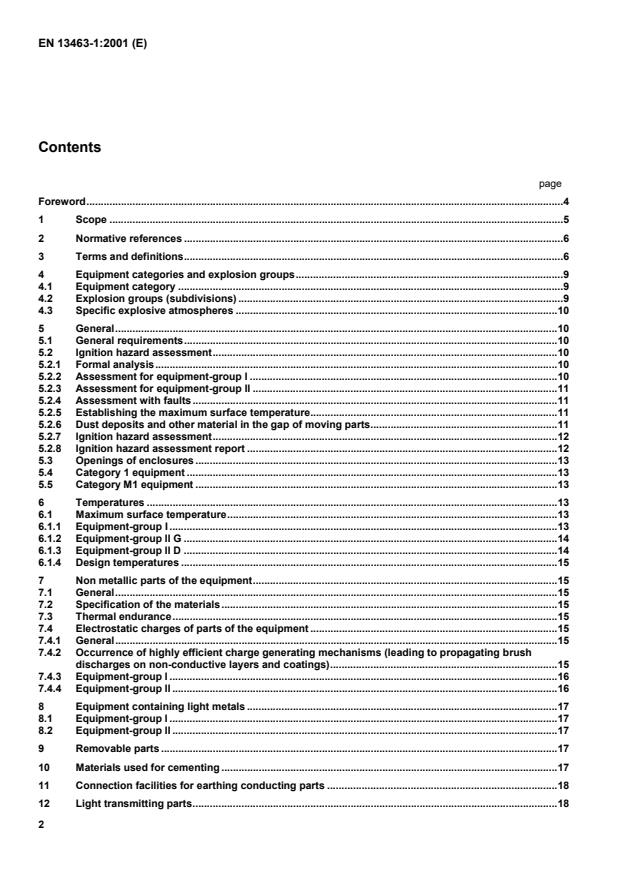
Methodology for confirming the category.28A.1Methodology for confirming the category of Equipment-group I.28A.1.1Category M1 Equipment.28A.1.2Category M2 Equipment.28A.2Methodology for confirming the Category of Equipment-group II.29A.2.1Category 1 Equipment.29A.2.2Category 2 Equipment.29A.2.3Category 3 Equipment.29Annex B (informative)
Ignition hazard assessment.30B.1Example of an ignition hazard assessment for the non-electrical part of a solenoid valve.30B.2Example of an ignition risk assessment document for a conveyor belt intended for use in apotentially explosive atmosphere.31B.2.1Intended usage of the equipment.31B.2.2Description of the equipment.31B.2.3Assessment.31Annex C (normative)
Charging tests with non conductive materials.36C.1Introduction.36C.2Principle of the test.36C.3Samples and apparatus.36C.4Procedure.37C.4.1Conditioning.37C.4.2Determination of the most efficient charging method.37Annex D (informative)
Example of rig for resistance to impact test.40Annex ZA (informative)
Clauses of this European Standard addressing essential requirements orother provisions of EU Directives.41Bibliography.43
the power supply or other services; loss of control by the operator (especially for hand-held machines) [3.25
of EN 1127-1:1997].3.4.1expected malfunctiondisturbances or equipment faults which normally occur in practice3.4.2rare malfunctiontype of malfunction which is known to happen but only in rare instances. Two independent foreseeable malfunctionswhich, separately, would not create an ignition hazard but which, in combination, do create an ignition hazard, areregarded as a single rare malfunction3.5maximum surface temperaturehighest temperature attained in service as determined in 13.3.3 under the most adverse operating conditions (butwithin the recognised tolerance) by any part or surface of equipment, protective system or component which canproduce an ignition of the surrounding explosive atmosphereNOTE 1The relevant surface temperature can be internal or external depending upon the type of ignition protectionconcerned.NOTE 2In order to avoid ignition it follows that the maximum surface temperature should be lower than the ignitiontemperature of the explosive atmosphere (see EN 1127-1).NOTE 3On the aspects of dust layers and their ignition see EN 50281-1-2 [prEN 13237-1].3.6type of ignition protectiontypes of protection listed in the scope
...
Questions, Comments and Discussion
Ask us and Technical Secretary will try to provide an answer. You can facilitate discussion about the standard in here.
Loading comments...