

EN 1804-2:2001+A1:2010
(Main + Amendment)Machines for underground mines - Safety requirements for hydraulic powered roof supports - Part 2: Power set legs and rams
- Abstract
This standard specifies the safety requirements for legs and rams when used as specified by the manufacturer or his authorised representative. Examples covered by the standard include legs, support rams and rams with their mechanical extensions, internal valves and safety devices, seals, hydraulic connections (up to the first hose or Type B valve, see Part 3) and their lifting points but excluding protective pipes and gaiters, external valves and hydraulic and electrohydraulic control systems.
NOTE Some components are dealt with in other parts of this standard.
This standard applies to legs, support rams and rams used at ambient temperatures from –10 °C to 60 °C.
This standard identifies and takes account of:
- Possible hazards which may be caused by the operation of legs, support rams and rams;
- Areas and operating conditions which may create such hazards;
- Hazardous situations which may cause injury or may be damaging to health.
This standard describes methods for the reduction of these hazards.
A list of hazards covered appears in clause 4.
This standard is applicable to all legs, support rams and rams placed on the market for the first time and which are manufactured after the date on which this standard was published.
This European standard does not establish the additional requirements for:
- Specially corrosive environments;
- Hazards occurring during construction, transportation, decommissioning;
- Earthquake.
- Status
- Withdrawn
- Publication Date
- 26-Jan-2010
- Withdrawal Date
- 06-Oct-2026
- Technical Committee
- CEN/TC 196 - Machines for undergroung mines - Safety
- Drafting Committee
- CEN/TC 196/WG 3 - Hydraulic driven supports
- Current Stage
- 9960 - Withdrawal effective - Withdrawal
- Start Date
- 23-Dec-2020
- Completion Date
- 07-Oct-2026
- Directive
- 2006/42/EC - Directive 2006/42/EC of the European Parliament and of the Council of 17 May 2006 on machinery, and amending Directive 95/16/EC (recast)OJ Ref: C, C 136 OJ Date: 26-May-2010



Relations
- Effective Date
- 13-Nov-2017
- Effective Date
- 25-Aug-2026
- Effective Date
- 28-Jan-2026
- Effective Date
- 28-Jan-2026
- Effective Date
- 28-Jan-2026
- Effective Date
- 28-Jan-2026
- Effective Date
- 28-Jan-2026
- Effective Date
- 28-Jan-2026
- Effective Date
- 28-Jan-2026
- Effective Date
- 28-Jan-2026
- Effective Date
- 28-Jan-2026
- Effective Date
- 28-Jan-2026
- Effective Date
- 28-Jan-2026
- Effective Date
- 28-Nov-2009
Get Certified
Connect with accredited certification bodies for this standard

Bureau Veritas Chile
Bureau Veritas certification services in Chile.
Bureau Veritas Peru
Bureau Veritas certification services in Peru.
BVQI Peru
Bureau Veritas certification in Peru.
Sponsored listings
Frequently Asked Questions
EN 1804-2:2001+A1:2010 is a standard published by the European Committee for Standardization (CEN). Its full title is "Machines for underground mines - Safety requirements for hydraulic powered roof supports - Part 2: Power set legs and rams". This standard covers: This standard specifies the safety requirements for legs and rams when used as specified by the manufacturer or his authorised representative. Examples covered by the standard include legs, support rams and rams with their mechanical extensions, internal valves and safety devices, seals, hydraulic connections (up to the first hose or Type B valve, see Part 3) and their lifting points but excluding protective pipes and gaiters, external valves and hydraulic and electrohydraulic control systems. NOTE Some components are dealt with in other parts of this standard. This standard applies to legs, support rams and rams used at ambient temperatures from –10 °C to 60 °C. This standard identifies and takes account of: - Possible hazards which may be caused by the operation of legs, support rams and rams; - Areas and operating conditions which may create such hazards; - Hazardous situations which may cause injury or may be damaging to health. This standard describes methods for the reduction of these hazards. A list of hazards covered appears in clause 4. This standard is applicable to all legs, support rams and rams placed on the market for the first time and which are manufactured after the date on which this standard was published. This European standard does not establish the additional requirements for: - Specially corrosive environments; - Hazards occurring during construction, transportation, decommissioning; - Earthquake.
This standard specifies the safety requirements for legs and rams when used as specified by the manufacturer or his authorised representative. Examples covered by the standard include legs, support rams and rams with their mechanical extensions, internal valves and safety devices, seals, hydraulic connections (up to the first hose or Type B valve, see Part 3) and their lifting points but excluding protective pipes and gaiters, external valves and hydraulic and electrohydraulic control systems. NOTE Some components are dealt with in other parts of this standard. This standard applies to legs, support rams and rams used at ambient temperatures from –10 °C to 60 °C. This standard identifies and takes account of: - Possible hazards which may be caused by the operation of legs, support rams and rams; - Areas and operating conditions which may create such hazards; - Hazardous situations which may cause injury or may be damaging to health. This standard describes methods for the reduction of these hazards. A list of hazards covered appears in clause 4. This standard is applicable to all legs, support rams and rams placed on the market for the first time and which are manufactured after the date on which this standard was published. This European standard does not establish the additional requirements for: - Specially corrosive environments; - Hazards occurring during construction, transportation, decommissioning; - Earthquake.
EN 1804-2:2001+A1:2010 is classified under the following ICS (International Classification for Standards) categories: 73.100.10 - Tunnelling and tubbing equipment. The ICS classification helps identify the subject area and facilitates finding related standards.
EN 1804-2:2001+A1:2010 has the following relationships with other standards: It is inter standard links to EN 1804-2:2020, ISO 7745:1989, EN ISO 6892-1:2019, EN ISO 15614-1:2017, EN ISO 15607:2019, EN 13463-1:2001, EN 1050:1996, EN ISO 15609-1:2019, EN 1804-3:2020, EN 292-2:1991/A1:1995, EN ISO 9606-1:2017, EN ISO 8780-3:1995, EN 292-2:1991, EN 1804-2:2001. Understanding these relationships helps ensure you are using the most current and applicable version of the standard.
EN 1804-2:2001+A1:2010 is associated with the following European legislation: EU Directives/Regulations: 2006/42/EC, 98/37/EC; Standardization Mandates: M/396, M/BC/CEN/91/1. When a standard is cited in the Official Journal of the European Union, products manufactured in conformity with it benefit from a presumption of conformity with the essential requirements of the corresponding EU directive or regulation.
EN 1804-2:2001+A1:2010 is available in PDF format for immediate download after purchase. The document can be added to your cart and obtained through the secure checkout process. Digital delivery ensures instant access to the complete standard document.
Standards Content (Sample)
2003-01.Slovenski inštitut za standardizacijo. Razmnoževanje celote ali delov tega standarda ni dovoljeno.Maschinen für den Bergbau unter Tage - Sicherheitsanforderungen für hydraulischen Schreitausbau - Teil 2: Stempel und ZylinderMachines pour mines souterraines - Exigences de sécurité relatives aux soutènements marchants applicables aux piles - Partie 2: Etançons et vérins à pose mécaniséeMachines for underground mines - Safety requirements for hydraulic powered roof supports - Part 2: Power set legs and rams73.100.10Oprema za gradnjo predorov in podzemnih železnicTunnelling and tubbing equipmentICS:Ta slovenski standard je istoveten z:EN 1804-2:2001+A1:2010SIST EN 1804-2:2002+A1:2010en,de01-marec-2010SIST EN 1804-2:2002+A1:2010SLOVENSKI
STANDARD
EUROPEAN STANDARD NORME EUROPÉENNE EUROPÄISCHE NORM
EN 1804-2:2001+A1
January 2010 ICS 73.100.10 Supersedes EN 1804-2:2001English Version
Machines for underground mines - Safety requirements for hydraulic powered roof supports - Part 2: Power set legs and rams
Machines pour mines souterraines - Exigences de sécurité relatives aux soutènements marchants applicables aux piles - Partie 2: Etançons et vérins à pose mécanisée
Maschinen für den Bergbau unter Tage - Sicherheitsanforderungen für hydraulischen Schreitausbau - Teil 2: Stempel und Zylinder This European Standard was approved by CEN on 21 September 2001 and includes Amendment 1 approved by CEN on 21 December 2009.
CEN members are bound to comply with the CEN/CENELEC Internal Regulations which stipulate the conditions for giving this European Standard the status of a national standard without any alteration. Up-to-date lists and bibliographical references concerning such national standards may be obtained on application to the CEN Management Centre or to any CEN member.
This European Standard exists in three official versions (English, French, German). A version in any other language made by translation under the responsibility of a CEN member into its own language and notified to the CEN Management Centre has the same status as the official versions.
CEN members are the national standards bodies of Austria, Belgium, Bulgaria, Croatia, Cyprus, Czech Republic, Denmark, Estonia, Finland, France, Germany, Greece, Hungary, Iceland, Ireland, Italy, Latvia, Lithuania, Luxembourg, Malta, Netherlands, Norway, Poland, Portugal, Romania, Slovakia, Slovenia, Spain, Sweden, Switzerland and United Kingdom.
EUROPEAN COMMITTEE FOR STANDARDIZATION
COMITÉ EUROPÉEN DE NORMALISATION EUROPÄISCHES KOMITEE FÜR NORMUNG
Management Centre:
Avenue Marnix 17,
B-1000 Brussels © 2010 CEN All rights of exploitation in any form and by any means reserved worldwide for CEN national Members. Ref. No. EN 1804-2:2001+A1:2010: ESIST EN 1804-2:2002+A1:2010
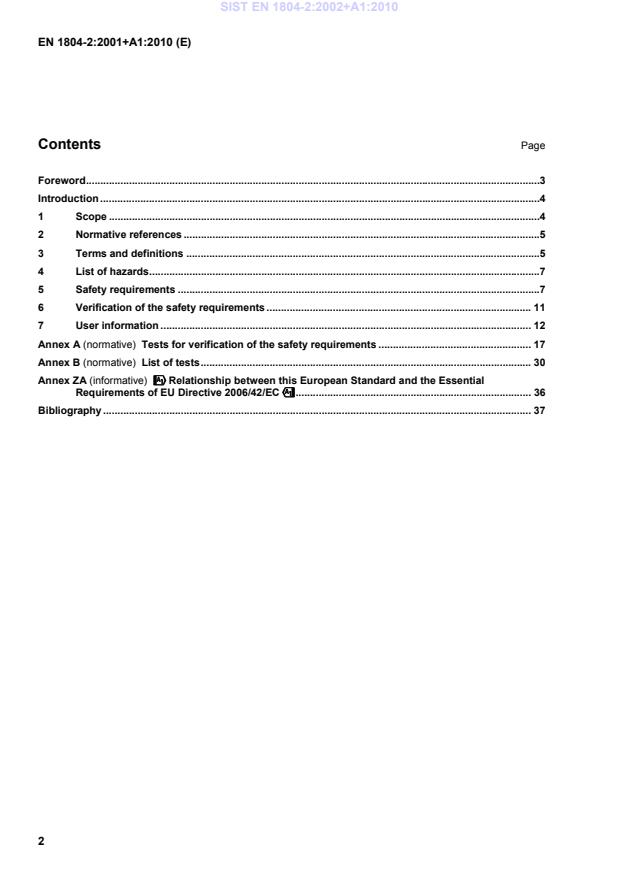
Tests for verification of the safety requirements . 17Annex B (normative)
List of tests . 30Annex ZA (informative)
!!!!Relationship between this European Standard and the Essential Requirements of EU Directive 2006/42/EC"""" . 36Bibliography . 37 SIST EN 1804-2:2002+A1:2010
This European Standard shall be given the status of a national standard, either by publication of an identical text or by endorsement, at the latest by July 2010, and conflicting national standards shall be withdrawn at the latest by July 2010. Attention is drawn to the possibility that some of the elements of this document may be the subject of patent rights. CEN [and/or CENELEC] shall not be held responsible for identifying any or all such patent rights. This document includes Amendment 1, approved by CEN on 2009-12-21. This document supersedes EN 1804-2:2001. The start and finish of text introduced or altered by amendment is indicated in the text by tags ! ". !This European Standard has been prepared under a mandate given to CEN by the European Commission and the European Free Trade Association, and supports essential requirements of EU Directive(s). For relationship with EU Directive(s), see informative Annex ZA, which is an integral part of this document." This standard is Part 1 of a European Standard specifying the safety requirements for hydraulic powered roof supports. Other parts are: Part 1: Support units and general requirements
Part 3: Hydraulic control systems Part 41): Electro-hydraulic control systems Annexes A and B are normative. This standard includes a Bibliography. According to the CEN/CENELEC Internal Regulations, the national standards organizations of the following countries are bound to implement this European Standard: Austria, Belgium, Bulgaria, Croatia, Cyprus, Czech Republic, Denmark, Estonia, Finland, France, Germany, Greece, Hungary, Iceland, Ireland, Italy, Latvia, Lithuania, Luxembourg, Malta, Netherlands, Norway, Poland, Portugal, Romania, Slovakia, Slovenia, Spain, Sweden, Switzerland and United Kingdom.
1) in preparation SIST EN 1804-2:2002+A1:2010
support unit
type of hydraulic powered roof support e.g. frame support, chock support, shield support, consisting of support components and support accessories [EN 1804-1:2001] SIST EN 1804-2:2002+A1:2010
actuator any type of hydraulic linear reciprocating device referred to in this standard 3.2.2
legs and support rams hydraulic actuators for producing the support bearing force of the support unit 3.2.3
single telescopic legs and support rams hydraulic legs and support rams with one extension stage 3.2.4
multi telescopic legs and support rams hydraulic legs and support rams with several extension stages 3.3 rams all actuators which do not lie within the flow of the support bearing force but which are necessary for the functioning of the powered roof support 3.4
valve device for controlling the hydraulic functions 3.5
pressures 3.5.1
setting pressure hydraulic pressure in the legs and support rams on completion of the setting procedure. This pressure is supplied by the hydraulic system 3.5.2
yield pressure of an actuator Hydraulic pressure in an actuator when the relevant pressure limiting valve is opened. This pressure in the actuator is induced by external forces (yield forces; see 3.5.2 of EN 1804-1:2001). 3.5.3
maximum permissible working pressure of an actuator maximum hydraulic pressure at which a hydraulic component is intended be operated and/or yielded 3.6
rated actuator force Maximum force to which an actuator is designed. It is a calculated value which is determined from the actuator geometry and the maximum permissible working pressure, neglecting friction. 3.7
functions 3.7.1
extension pushing out of the actuator operating piston by means of hydraulic pressure SIST EN 1804-2:2002+A1:2010
retraction drawing in of the actuator operating piston by means of hydraulic pressure 3.7.3
setting
extending of the support unit between the roof and the floor by pressuring the legs and support rams 3.7.4
yielding
alteration in length of an actuator which occurs when external forces cause the yield pressure to be exceeded 4 List of hazards All the items in the following list of hazards refer to continuous operation and to installation and maintenance.
This list contains the hazards and hazardous situations, as far as they are dealt with in this European Standard, identified by risk assessment as being significant for this type of machinery and which require action to eliminate or reduce risk. Table 1 — List of hazards with cross references to safety requirements No. EN 1050:1996 Safety requirements (clause) Hazards
1 1.1; 1.2; 1.3 5.8 Crushing, shearing and cutting 2 1.9 5.2; 5.4 High pressure fluid jets 3 17 5.2; 5.6; 5.7; 5.8 Ejected parts 4 1e; 1.8 5.2; 5.5; 5.6; 5.7; 5.8; 5.10 to 5.13 Fatigue, overload; friction or wear 5 2.4 5.12.3 Electrical energy resulting from electrostatic phenomena 6 7.1 5.9 Inhalation of harmful fluids, mists and fumes 7 7.2 5.3; 5.12.2 Fire or explosion 8 17 5.4 to 5.14 Unexpected ejection of machine parts or fluids 9
5.15 Errors of fitting 10 27.8 5.1; 5.15 Absence or incorrect installation of devices and accessories for assembly and maintenance 11 10.6 5.1; 5.15 operating error 12 1.C 5.1; 5.15. Potential energy of actuators parts which may move under the effect of gravity
5 Safety requirements 5.1 Lifting points
Where lifting points are fitted to actuators they shall be suitable for their intended purpose. They shall be designed to have a calculated minimum factor of safety of 4 on ultimate breaking load in relation to their SIST EN 1804-2:2002+A1:2010
internal valves external valves (see !EN 1804-3") safety devices such as bursting blanks. The pressure in the piston compartment of hydraulic legs shall be capable of being monitored so that leakages are recognised in good time and hazards from inadequate strata control as a result of a pressure drop in the legs are avoided. As a result of the type of fluid used and the small number of pressure cycles per day, actuators of hydraulic powered roof supports need neither to be self-bleeding nor shall they have external air bleeds. In addition, internal valves, excluding constant yield valves, are covered by !EN 1804-3" of the standard. 5.3 Hydraulic fluids Actuators shall be designed such that they may be used with: a) fire-resistant fluids category HFA (ISO 7745:1989) specified by the support unit manufacturer in according to 6.2.1 of ISO 7745:1989 or b) water without additives. NOTE Hydraulic systems of roof supports, designed for coal mines and other mines with potentially explosive atmospheres, should be designed for use with non-toxic and fire-resistant fluids in accordance with SHCMOEI 7th Report (see Bibliography). 5.4 Protection against ejecting fluids Actuators that intentionally eject fluid in to the atmosphere shall be designed to prevent any hazard due to the releasing fluid (e.g. by means of a guard). 5.5 Yield capability Legs and support rams shall be designed such that at yield pressure they are capable of supporting the forces and the movements of attached components, see annex A (see 5.3.1 of EN 1804-1:2001). 5.6 Behaviour under axial overload Legs and support rams, including their mechanical extensions, shall be designed so that their function is not affected it they are subjected statically to 1,5 times the rated compressive or tensile force and dynamically to a mechanical impact load resulting in 1,5 times the maximum permissible working pressure. (See annex A). Where dynamic load testing is not practicable legs and support rams shall be subjected statically to 2 times the rated compressive or tensile force.
5.12 Materials 5.12.1 Steel 5.12.1.1 General The tensile strength of the steel grades used shall be at least 1,08 times the determined yield point or 0,2 % proof stress if the calculated stresses are more than 90 % of the permissible stresses (see 5.13.1). The elongation at fracture (A) of the steel grades used shall be not less than 10 %. 5.12.1.2 Steel for welded actuator components The steel shall be of fine grain, (ferrite grain size 6 or finer as described in EURONORM 103: 1971) and shall have an impact value of at least 27 J at a temperature of -20 °C.
5.13 Calculated permissible stresses 5.13.1 Permissible stresses under axial central rated force conditions The axial stresses in the individual parts of the actuators shall not exceed 70 % of the guaranteed yield point, 0,2 % proof stress or compressive limit of the materials (also valid for annular stresses as a result of fluid pressure). The axial stresses in the bases of actuators shall not exceed 80 % of the guaranteed yield point, 0,2 % proof stress or compressive limit of the materials. The shear stresses shall not exceed 65 % of the guaranteed yield point, 0,2 % proof stress or compressive limit of the materials. 5.13.2 Permissible stresses under double axial central rated force conditions In the case of twice the central rated force in the fully retracted state of legs and support rams, the stresses shall not exceed the guaranteed yield point or 0,2 % proof stress of the materials. NOTE This requirement only involves mechanical loading. There are no hydraulic pressures. 5.13.3 Permissible stresses under eccentric rated force conditions In the case of the eccentric rated force as described in A.1.3.1 the axial stresses of the leg and support ram components involved in bending shall not exceed the guaranteed yield point or 0,2 % proof stress or compressive limit of the materials. The deflections determined by means of a test as specified in A.1.3.2 shall be used as a basis for calculating the stresses. In the case of an eccentric rated force and simultaneous lateral loading (e.g. to stabilize the support unit), the axial stresses of the leg and support ram components involved in bending shall not exceed the guaranteed yield point or 0,2 % proof stress or compressive limit of the materials. SIST EN 1804-2:2002+A1:2010
Axial stresses Shear stresses Combined stresses Fillet welds 65 % 65 % 100 % Butt welds 80 % 80 % 100 %
Where these stresses are exceeded due to result of non-destructive testing the manufacturer shall document them specially.
5.14 Welding All welding shall be carried out in accordance with EN 288-1, EN 288-2 and EN 288-3. The manufacturer shall make use of competent welding shops and welders. This can be reached by either:
a) operating a certified quality system according to EN ISO 9001; or b) a certificate issued by an accredited body confirming compliance with the quality requirements of EN 729-3. The welding shall be done by welders qualified in accordance with EN 287-1. 5.15 Correct assembly and installation It shall be possible to assemble and install the actuator correctly in accordance with the assembly instructions or other documents provided by the manufacturer. 6 Verification of the safety requirements 6.1 Type testing One specimen of the actuator shall be type tested in accordance with annex A. The test requirements given in annex A shall be met. The following documents shall be made available to the laboratory running the type test: User information; Results of a static calculation in accordance with A.2; Manufacturing drawings; Drawing of welded parts; Evidence of the competence of the welding workshop; Data relating to the material characteristics; Data relating to the seals used. SIST EN 1804-2:2002+A1:2010
If no provision has been made in annex A for verification of the requirements in clause 5 by specified tests, they shall be verified by means of visual inspection, function test or reference to documents.
Verification of the safety requirements is shown in Table 3. Table 3 — Tests for verification of the safety requirements Safety requirements Verification 5.1 *see A.1.5 5.2 *visual Inspection/comparison with manufacturer's drawings 5.3 *Inspection of the oil-manufacturer's test documentation 5.4 *visual Inspection/ comparison with manufacturer's drawings 5.5 *see A.1.2.2 5.6 *see A.1.2.3 5.7 *see A.1.3 5.8 *see A.1.4 5.9 *see A.1.2.4 5.10 *see A.1.2.1 and A.1.4.3 5.11 *see A.1.2.3.1 5.12 **see A.3 5.13 *see A.2 5.14 **see A.3.2 5.15 *Inspection of manufacturer's test documentation *type test; **series test
6.2 Series verification See Table 3; Verification with ** 7 User information 7.1 General requirements The actuator manufacturer shall provide user information meeting the requirements of clause 5 of EN 292 2:1991 + A1:1995 and clause 7. The user information shall be the primary source of information on a complete actuator and shall contain all the information relating to its safe application and this shall be produced as an instruction handbook as specified in 5.5 of EN 292 2:1991 + A1:1995. Clause 7 User information of EN 1804-1:2001 also applies to !EN 1804-3" and !prEN 1804-4") and is complemented, as appropriate, by corresponding clauses in those parts. Care shall be taken to ensure that the user information is available to the user on receipt of the actuator.
The data necessary to design the hydraulic system including yield and setting characteristics shall be given. In addition, it shall include a list of the hydraulic fluids specified by the manufacturer of the actuator (see 5.3). 7.2.5 List of additional drawings and documents A complete list of all drawings, illustrations and other documents including e.g. information about welding qualification, which are part of the information for use but provided separately from the user information, but which form part of the information required by this standard shall be provided. The list shall include, appropriate cross-reference to the text, of the user information. 7.3 Handling, transport and storage 7.3.1 Introduction This section of the user information shall include information and instructions for the safe handling, transport and storage of the actuator. 7.3.2 Handling and transport The details shall include: a) Weights and outline dimensions of all the supplied actuators. b) Precautions to be taken during handling and transportation. In addition, indications of possible damage to the actuators during handling and transport. c) Information on the number and rated load of any ancillary lifting equipment (e.g. shackles, eye bolts) not supplied but necessary in order to enable safe lifting/installation of the actuators. 7.3.3 Storage The following information shall be given for the storage of the actuator on the surface and underground: SIST EN 1804-2:2002+A1:2010
c) commissioning the actuator and testing individual functions. 7.4.3 Operation This section of the user information shall include the information and instructions necessary for the safe operation of the actuators. Details shall be given for the correct use, with information on the operating range and prohibited applications. 7.5 Maintenance 7.5.1 Introduction This section of the user information shall contain the necessary information and instructions to enable the actuator to be maintained in, or restored to, safe working order. The information provided shall be according to 7.5.2 to 7.5.5.
7.5.2 Maintenance instructions Instructions shall be provided, with illustrations where necessary, detailing the methods and procedures for preventative and corrective maintenance. The instructions shall include reference to the following: a) dismantling and
...