

EN 12312-5:2005+A1:2009
(Main + Amendment)Aircraft ground support equipment - Specific requirements - Part 5: Aircraft fuelling equipment
General Information
- Abstract
This document specifies the technical requirements to minimise the hazards listed in Clause 4 which can arise during the commissioning, operation and maintenance of AFE when carried out in accordance with the specifications given by the manufacturer or his authorised representative. It also takes into account some performance requirements recognised as essential by authorities, aircraft and ground support equipment (GSE) manufacturers as well as airlines, airports and fuelling companies.
This document applies to all types of aircraft fuelling equipment:
- aircraft refuellers;
- hydrant dispensers;
- defuellers;
- hydrant pit servicing vehicles;
- stationary dispensing units,
intended to service aircraft with aviation fuels and to be operated on airfields, heliports and other aircraft refuelling re-lated areas such as maintenance bases.
NOTE 1 In general, the European Agreement concerning the International Carriage of Dangerous Goods by Road (ADR) is not applicable to AFE as they are not deemed to be used on public roads. However, certain requirements have been considered when developing this standard.
The use of AFE on public roads is not intended with the following exceptions:
- transportation of fuel from tank farms to refuelling areas;
- maintenance purposes with empty cargo tanks.
NOTE 2 This may include the need of local traffic derogation (see Clause 0 of EN 1915 1:2001 — negotiation).
The intended functions of AFE are:
- loading fuel from the tank farm and/or a hydrant system to the AFE;
- storage and transportation of fuel;
- fuelling from the AFE to the aircraft;
- filtration of the fuel;
- metering the fuel for a transfer of custody;
- defuelling the aircraft to the AFE;
- flushing fuel from hydrant systems;
- unloading AFE to the tank farm after defuelling of an aircraft;
- transferring fuel from one AFE to another.
- Status
- Withdrawn
- Publication Date
- 28-Apr-2009
- Withdrawal Date
- 29-Sep-2026
- Technical Committee
- CEN/TC 274 - Aircraft ground support equipment
- Current Stage
- 9960 - Withdrawal effective - Withdrawal
- Start Date
- 03-Mar-2021
- Completion Date
- 30-Sep-2026
- Directive
- 2006/42/EC - Directive 2006/42/EC of the European Parliament and of the Council of 17 May 2006 on machinery, and amending Directive 95/16/EC (recast)OJ Ref: C, C 214 OJ Date: 08-Sep-2009


Relations
- Effective Date
- 19-Jan-2023
- Effective Date
- 11-Feb-2009
- Effective Date
- 10-Mar-2021
- Effective Date
- 17-Sep-2026
- Effective Date
- 17-Sep-2026
- Effective Date
- 25-Aug-2026
- Effective Date
- 25-Aug-2026
- Effective Date
- 25-Aug-2026
- Effective Date
- 25-Aug-2026
- Effective Date
- 25-Aug-2026
- Effective Date
- 25-Aug-2026
- Effective Date
- 25-Aug-2026
- Effective Date
- 25-Aug-2026
- Effective Date
- 18-Mar-2026
- Refers
EN IEC 60079-11:2024 - Explosive atmospheres - Part 11: Equipment protection by intrinsic safety "i" - Effective Date
- 09-Feb-2026
Get Certified
Connect with accredited certification bodies for this standard

BUREAU VERITAS Certification Germany
Bureau Veritas certification in Germany.

Element Materials Technology
Materials testing and product certification.

AQMS Ltd.
AQMS provides ISO certification to SMEs across the UK.
Sponsored listings
Frequently Asked Questions
EN 12312-5:2005+A1:2009 is a standard published by the European Committee for Standardization (CEN). Its full title is "Aircraft ground support equipment - Specific requirements - Part 5: Aircraft fuelling equipment". This standard covers: This document specifies the technical requirements to minimise the hazards listed in Clause 4 which can arise during the commissioning, operation and maintenance of AFE when carried out in accordance with the specifications given by the manufacturer or his authorised representative. It also takes into account some performance requirements recognised as essential by authorities, aircraft and ground support equipment (GSE) manufacturers as well as airlines, airports and fuelling companies. This document applies to all types of aircraft fuelling equipment: - aircraft refuellers; - hydrant dispensers; - defuellers; - hydrant pit servicing vehicles; - stationary dispensing units, intended to service aircraft with aviation fuels and to be operated on airfields, heliports and other aircraft refuelling re-lated areas such as maintenance bases. NOTE 1 In general, the European Agreement concerning the International Carriage of Dangerous Goods by Road (ADR) is not applicable to AFE as they are not deemed to be used on public roads. However, certain requirements have been considered when developing this standard. The use of AFE on public roads is not intended with the following exceptions: - transportation of fuel from tank farms to refuelling areas; - maintenance purposes with empty cargo tanks. NOTE 2 This may include the need of local traffic derogation (see Clause 0 of EN 1915 1:2001 — negotiation). The intended functions of AFE are: - loading fuel from the tank farm and/or a hydrant system to the AFE; - storage and transportation of fuel; - fuelling from the AFE to the aircraft; - filtration of the fuel; - metering the fuel for a transfer of custody; - defuelling the aircraft to the AFE; - flushing fuel from hydrant systems; - unloading AFE to the tank farm after defuelling of an aircraft; - transferring fuel from one AFE to another.
This document specifies the technical requirements to minimise the hazards listed in Clause 4 which can arise during the commissioning, operation and maintenance of AFE when carried out in accordance with the specifications given by the manufacturer or his authorised representative. It also takes into account some performance requirements recognised as essential by authorities, aircraft and ground support equipment (GSE) manufacturers as well as airlines, airports and fuelling companies. This document applies to all types of aircraft fuelling equipment: - aircraft refuellers; - hydrant dispensers; - defuellers; - hydrant pit servicing vehicles; - stationary dispensing units, intended to service aircraft with aviation fuels and to be operated on airfields, heliports and other aircraft refuelling re-lated areas such as maintenance bases. NOTE 1 In general, the European Agreement concerning the International Carriage of Dangerous Goods by Road (ADR) is not applicable to AFE as they are not deemed to be used on public roads. However, certain requirements have been considered when developing this standard. The use of AFE on public roads is not intended with the following exceptions: - transportation of fuel from tank farms to refuelling areas; - maintenance purposes with empty cargo tanks. NOTE 2 This may include the need of local traffic derogation (see Clause 0 of EN 1915 1:2001 — negotiation). The intended functions of AFE are: - loading fuel from the tank farm and/or a hydrant system to the AFE; - storage and transportation of fuel; - fuelling from the AFE to the aircraft; - filtration of the fuel; - metering the fuel for a transfer of custody; - defuelling the aircraft to the AFE; - flushing fuel from hydrant systems; - unloading AFE to the tank farm after defuelling of an aircraft; - transferring fuel from one AFE to another.
EN 12312-5:2005+A1:2009 is classified under the following ICS (International Classification for Standards) categories: 49.100 - Ground service and maintenance equipment. The ICS classification helps identify the subject area and facilitates finding related standards.
EN 12312-5:2005+A1:2009 has the following relationships with other standards: It is inter standard links to EN 12312-5:2005/prA1, EN 12312-5:2005, EN 12312-5:2021, EN 1915-2:2026, EN ISO 31915-3:2026, ISO 3584:2001, ISO 1102:2001, ISO 45:1990, ISO 3795:1989, ISO 2883:1980, ISO 4009:2000, ISO 46:1973, ISO 8755:2001, EN ISO 1825:2026, EN IEC 60079-11:2024. Understanding these relationships helps ensure you are using the most current and applicable version of the standard.
EN 12312-5:2005+A1:2009 is associated with the following European legislation: EU Directives/Regulations: 2006/42/EC, 98/37/EC; Standardization Mandates: M/079, M/396. When a standard is cited in the Official Journal of the European Union, products manufactured in conformity with it benefit from a presumption of conformity with the essential requirements of the corresponding EU directive or regulation.
EN 12312-5:2005+A1:2009 is available in PDF format for immediate download after purchase. The document can be added to your cart and obtained through the secure checkout process. Digital delivery ensures instant access to the complete standard document.
Standards Content (Sample)
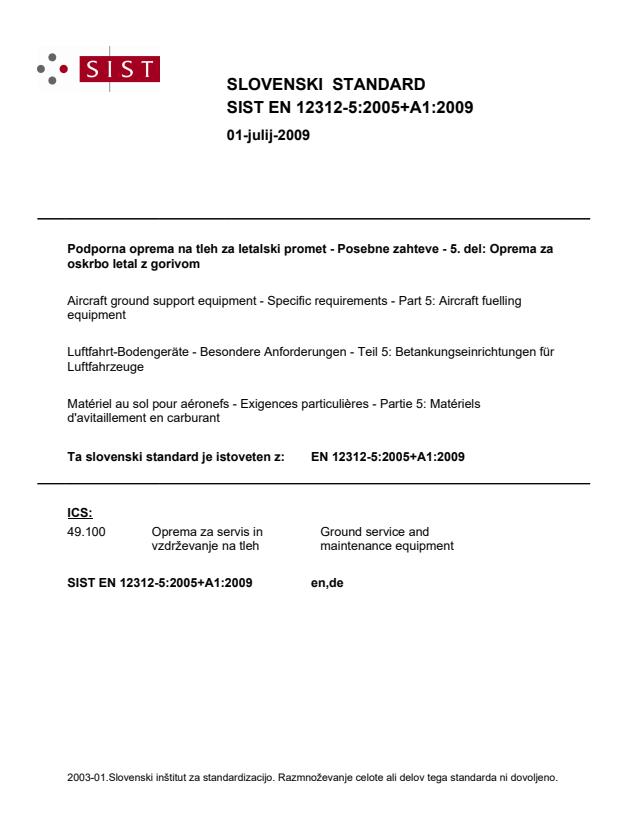
2003-01.Slovenski inštitut za standardizacijo. Razmnoževanje celote ali delov tega standarda ni dovoljeno.Podporna oprema na tleh za letalski promet - Posebne zahteve - 5. del: Oprema za oskrbo letal z gorivomLuftfahrt-Bodengeräte - Besondere Anforderungen - Teil 5: Betankungseinrichtungen für LuftfahrzeugeMatériel au sol pour aéronefs - Exigences particulières - Partie 5: Matériels d'avitaillement en carburantAircraft ground support equipment - Specific requirements - Part 5: Aircraft fuelling equipment49.100Oprema za servis in vzdrževanje na tlehGround service and maintenance equipmentICS:Ta slovenski standard je istoveten z:EN 12312-5:2005+A1:2009SIST EN 12312-5:2005+A1:2009en,de01-julij-2009SIST EN 12312-5:2005+A1:2009SLOVENSKI
STANDARD
EUROPEAN STANDARD NORME EUROPÉENNE EUROPÄISCHE NORM
EN 12312-5:2005+A1
April 2009 ICS 49.100 Supersedes EN 12312-5:2005English Version
Aircraft ground support equipment - Specific requirements - Part 5: Aircraft fuelling equipment
Matériel au sol pour aéronefs - Exigences particulières - Partie 5: Matériels d'avitaillement en carburant
Luftfahrt-Bodengeräte - Besondere Anforderungen - Teil 5: Betankungseinrichtungen für Luftfahrzeuge This European Standard was approved by CEN on 3 January 2005 and includes Amendment 1 approved by CEN on 1 March 2009.
CEN members are bound to comply with the CEN/CENELEC Internal Regulations which stipulate the conditions for giving this European Standard the status of a national standard without any alteration. Up-to-date lists and bibliographical references concerning such national standards may be obtained on application to the CEN Management Centre or to any CEN member.
This European Standard exists in three official versions (English, French, German). A version in any other language made by translation under the responsibility of a CEN member into its own language and notified to the CEN Management Centre has the same status as the official versions.
CEN members are the national standards bodies of Austria, Belgium, Bulgaria, Cyprus, Czech Republic, Denmark, Estonia, Finland, France, Germany, Greece, Hungary, Iceland, Ireland, Italy, Latvia, Lithuania, Luxembourg, Malta, Netherlands, Norway, Poland, Portugal, Romania, Slovakia, Slovenia, Spain, Sweden, Switzerland and United Kingdom.
EUROPEAN COMMITTEE FOR STANDARDIZATION
COMITÉ EUROPÉEN DE NORMALISATION EUROPÄISCHES KOMITEE FÜR NORMUNG
Management Centre:
Avenue Marnix 17,
B-1000 Brussels © 2009 CEN All rights of exploitation in any form and by any means reserved worldwide for CEN national Members. Ref. No. EN 12312-5:2005+A1:2009: ESIST EN 12312-5:2005+A1:2009
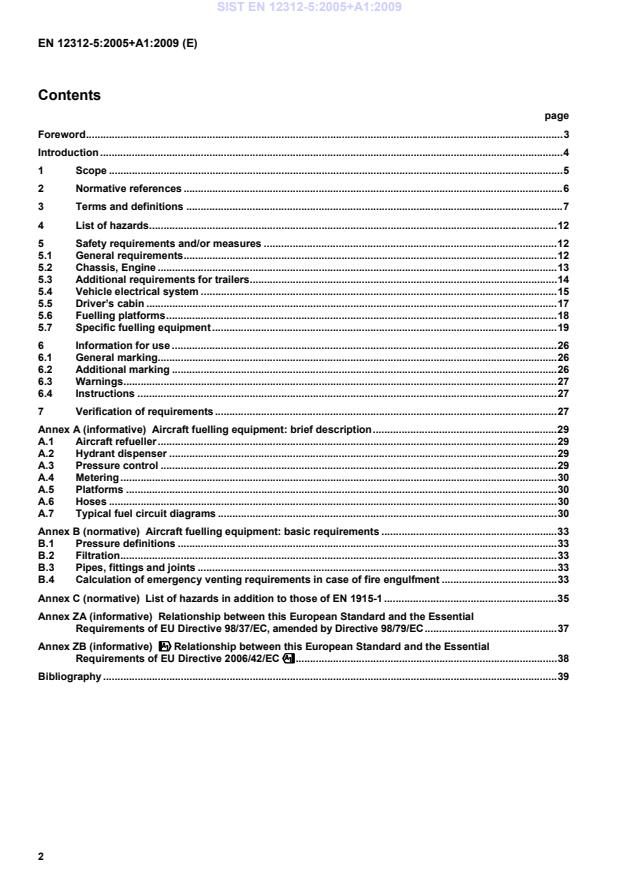
Aircraft fuelling equipment: brief description . 29A.1Aircraft refueller . 29A.2Hydrant dispenser . 29A.3Pressure control . 29A.4Metering . 30A.5Platforms . 30A.6Hoses . 30A.7Typical fuel circuit diagrams . 30Annex B (normative)
Aircraft fuelling equipment: basic requirements . 33B.1Pressure definitions . 33B.2Filtration . 33B.3Pipes, fittings and joints . 33B.4Calculation of emergency venting requirements in case of fire engulfment . 33Annex C (normative)
List of hazards in addition to those of EN 1915-1 . 35Annex ZA (informative)
Relationship between this European Standard and the Essential Requirements of EU Directive 98/37/EC, amended by Directive 98/79/EC . 37Annex ZB (informative)
!!!!Relationship between this European Standard and the Essential Requirements of EU Directive 2006/42/EC"""" . 38Bibliography . 39
Pressure equipment — Part 1: Terminology — Pressure, temperature, volume, nominal size" EN 954-1, Safety of machinery — Safety-related parts of control systems — Part 1: General principles for design EN 1050:1996, Safety of machinery — Principles for risk assessment EN 1361, Rubber hoses and hose assemblies for aviation fuel handling - Specification EN 1915-1:2001, Aircraft ground support equipment - General requirements — Part 1: Basic safety requirements EN 1915-2, Aircraft ground support equipment - General requirements — Part 2: Stability and strength requirements, calculations and test methods !EN 1915-3, Aircraft ground support equipment — General requirements — Part 3: Vibration measurement methods and reduction" !EN 1915-4, Aircraft ground support equipment — General requirements — Part 4: Noise measurement methods and reduction" EN 50020, Electrical apparatus for potentially explosive atmospheres — Intrinsic safety "i" !EN 60079-0", Electrical apparatus for explosive gas atmospheres – Part 0: General requirements (IEC 60079-0:2004) EN 60079-1:2004, Electrical apparatus for potentially explosive atmospheres – Part 1: Flameproof enclosure “d” (IEC 60079-1:2003) EN 60079-2:2004, Electrical apparatus for explosive gas atmospheres – Part 2: Pressurized enclosure “p” (IEC 160079-2:2001) !EN 60079-5, Explosive atmospheres — Part 5: Equipment protection by powder filling "q" (IEC 60079-5:2007)" !EN 60079-6, Explosive atmospheres — Part 6: Equipment protection by oil immersion "o" (IEC 60079-6:2007)" !EN 60079-7", Electrical apparatus for explosive gas atmospheres – Part 7: Increased safety “e” (IEC 60079-7:2001) SIST EN 12312-5:2005+A1:2009
3 Terms and definitions For the purposes of this document, the terms and definitions given in EN ISO 12100-1:2003, EN ISO 12100-2:2003 and EN 1915-1:2001 and the following apply. 3.1 aircraft fuelling equipment (AFE) equipment used to handle aviation fuels on an airfield, including — aircraft refuellers, — hydrant dispensers, — defuellers, — hydrant pit servicing vehicles, — stationary dispensing units SIST EN 12312-5:2005+A1:2009
EN 1915-3 and EN 1915-4 unless otherwise specified in this standard." It shall also conform to the specific re-quirements of this document. 5.1.2 Vehicles shall not exceed an overall height of 3,6 m and an overall width of 3,6 m in driving configuration. Devices which protrude outside of the contour of the vehicle, e.g. intake hose holders, support brackets etc., shall be of removable construction. 5.1.3 Stability and strength calculations shall be carried out in accordance with EN 1915-2. 5.1.4 AFE shall be designed for the intended fuel grade(s). They shall carry only one grade of aviation fuel. 5.1.5 For aircraft refuellers, the height of the centre of gravity of the rated load shall not be greater than 95 % of the distance between the outer wall of the supporting tyres measured at the outside of their contact with the ground. 5.1.6 Where built-in fire extinguisher systems are not provided, provision shall be made on all moveable AFE for the fitting of at least two dry chemical type fire extinguishers of a minimum capacity of 6 kg, accessible from the ground. 5.1.7 Mechanical protection shall be provided for the rear light assemblies of towing vehicles and trailers to reduce the risk of damage to the lens unit. 5.1.8 All metallic components mounted on the chassis — with the exception of the lanyard connection which, where fitted, shall be insulated — shall be bonded together and to the chassis. SIST EN 12312-5:2005+A1:2009
On AFE equipped with an elevating fuelling platform, an additional engine stop shall be fitted on the plat-form. SIST EN 12312-5:2005+A1:2009
...