

ISO 46:1973
(Main)Aircraft — Fuel nozzle grounding plugs and sockets
General Information
- Abstract
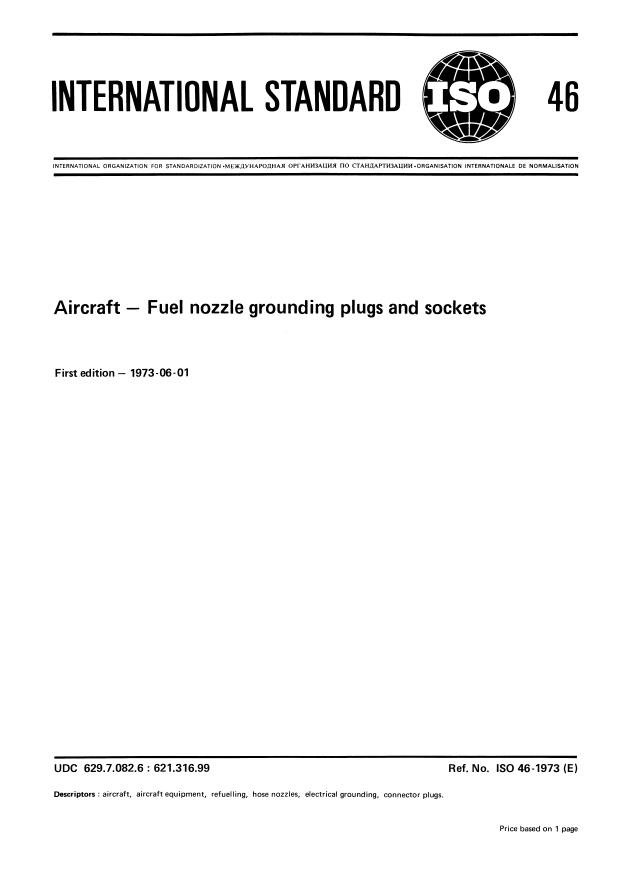
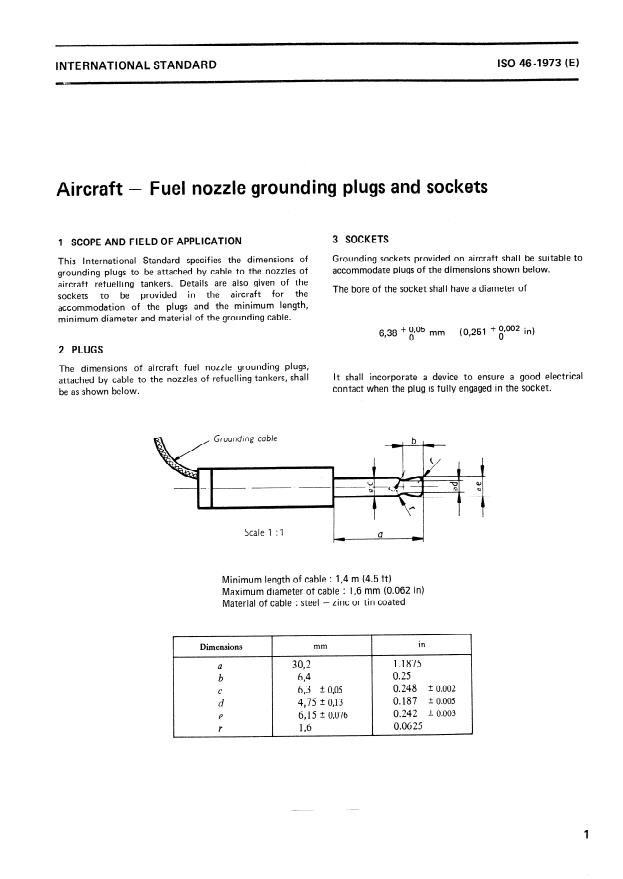
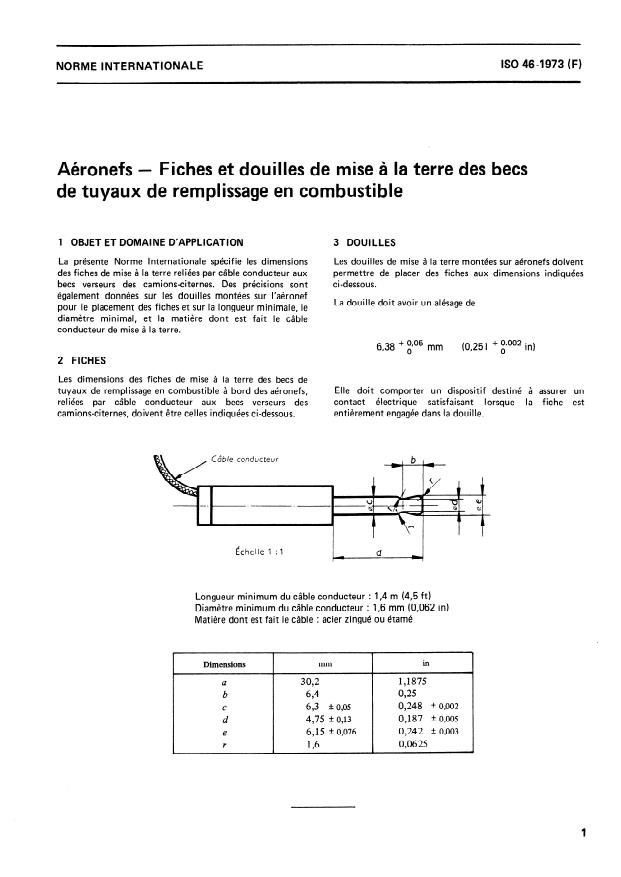
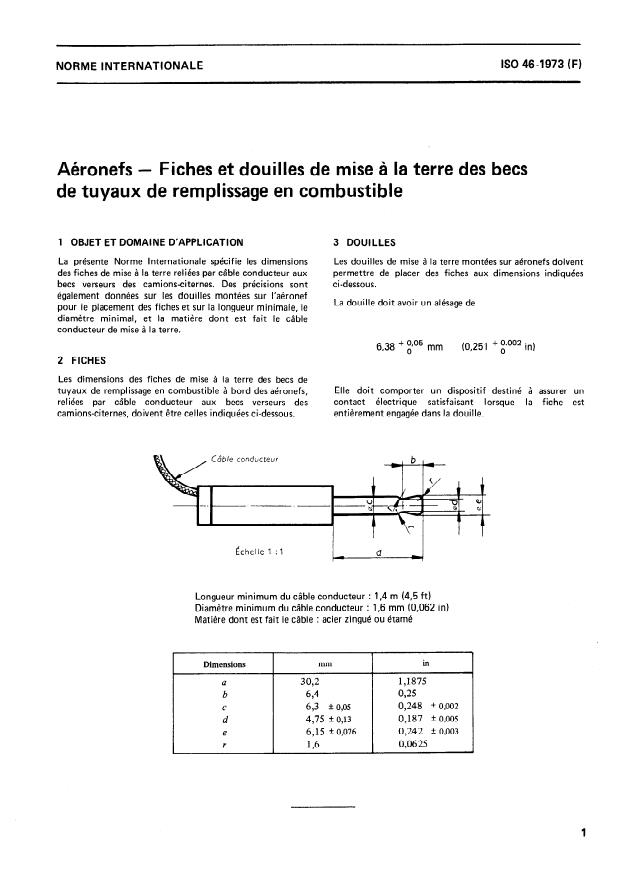
Includes the dimensions of grounding plugs to be attached by cable to the nozzles of aircraft refuelling tankers. Details are also given of the sockets to be provided in the aircraft for the accomodation of the plugs and the minimum length, minimum diameter and material of the grounding cable.
- Status
- Published
- Publication Date
- 31-May-1973
- Technical Committee
- ISO/TC 20/SC 9 - Air cargo and ground equipment
- Drafting Committee
- ISO/TC 20/SC 9 - Air cargo and ground equipment
- Current Stage
- 9093 - International Standard confirmed
- Start Date
- 05-Sep-2024
- Completion Date
- 29-Aug-2026
Buy Documents
ISO 46:1973 - Aircraft — Fuel nozzle grounding plugs and sockets Released:6/1/1973
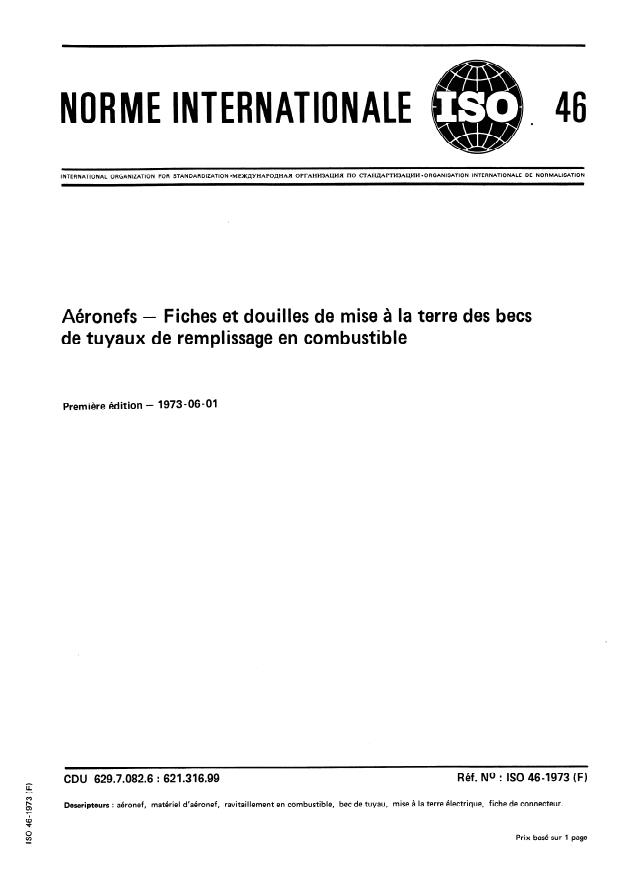
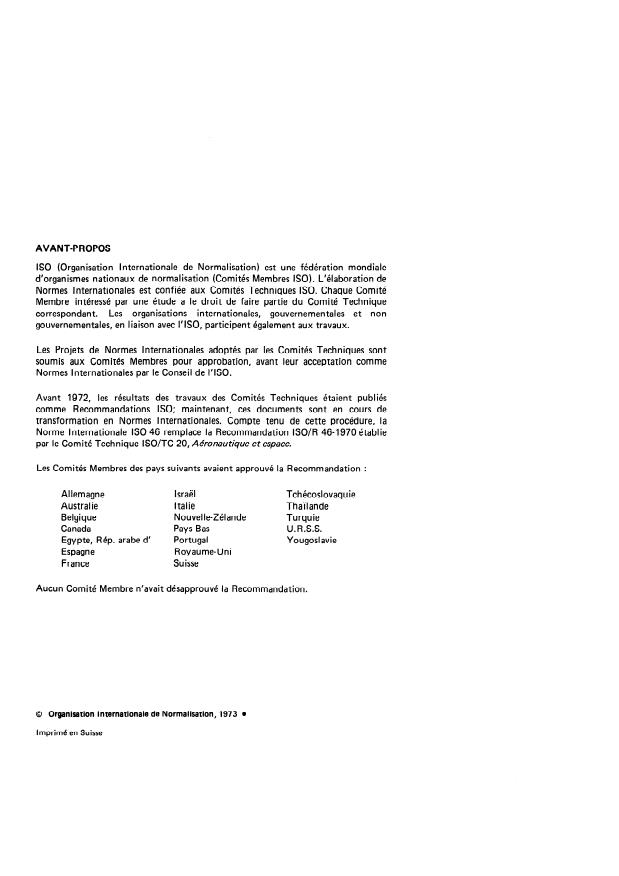

ISO 46:1973 - Aéronefs — Fiches et douilles de mise a la terre des becs de tuyaux de remplissage en combustible Released:6/1/1973

ISO 46:1973 - Aéronefs — Fiches et douilles de mise a la terre des becs de tuyaux de remplissage en combustible Released:6/1/1973
Overview
ISO 46:1973 is an international standard established by the International Organization for Standardization (ISO) that defines the specifications for fuel nozzle grounding plugs and sockets used in aircraft refuelling systems. This standard ensures that grounding plugs attached to the nozzles of aircraft refuelling tankers and the corresponding sockets on the aircraft provide a secure and reliable electrical grounding connection to prevent static electricity hazards during refuelling operations. The document specifies exact dimensions, cable length, diameter, and material requirements for grounding cables, promoting safety and uniformity across the aerospace industry.
Key Topics
- Plug Dimensions: The standard details precise measurements for the grounding plugs to ensure compatibility and secure fit into aircraft sockets.
- Socket Specifications: The grounding sockets installed on aircraft must accommodate plugs as specified, with a bore diameter ensuring proper insertion and electrical contact.
- Grounding Cable Requirements:
- Minimum Length: 1.4 meters (4.5 feet) to provide sufficient flexibility.
- Maximum Diameter: 1.6 mm (0.062 inches) to maintain compatibility with connectors.
- Material: Steel wire coated with zinc or tin to ensure durability and reliable conductivity.
- Electrical Contact Assurance: The plug design incorporates a mechanism to guarantee good electrical contact when fully engaged, reducing risks associated with static discharge.
Applications
ISO 46:1973 plays a crucial role in aerospace safety and refuelling operations by standardizing components essential for maintaining proper static grounding during aircraft refuelling. Common applications include:
- Grounding systems for aircraft refuelling tankers and refuelling nozzles.
- Installation of grounding sockets on various types of aircraft to ensure compatibility with tanker plugs.
- Enhancing static electricity mitigation to prevent sparks that could cause fires or explosions.
- Use in airport fuel handling infrastructure to maintain standardized safety protocols internationally.
This standard is especially relevant for aerospace engineers, safety officers, refuelling personnel, and manufacturers of aircraft refuelling equipment.
Related Standards
- ISO/TC 20: The Technical Committee responsible for standards related to aircraft and space vehicles, including accessories and safety equipment.
- ANSI/ISA Standards: Related to electrical grounding and bonding in industrial applications, providing complementary guidance.
- ASTM Aircraft Fueling Standards: Provide additional guidelines on safe fuel handling and equipment compatibility.
- International Civil Aviation Organization (ICAO) Regulations: Cover broader fuel safety and operational guidelines that complement grounding standards.
Conclusion
ISO 46:1973 is a foundational standard in the aerospace industry that enhances safety by specifying the precise requirements for aircraft fuel nozzle grounding plugs and sockets. By ensuring consistent dimensions, material quality, and electrical contact performance, this standard helps mitigate the risk of static-related incidents during aircraft refuelling worldwide. Compliance with ISO 46 supports international interoperability and safe refuelling practices crucial for aircraft maintenance and operation safety.
Relations
- Effective Date
- 25-Aug-2026
- Effective Date
- 25-Aug-2026
- Effective Date
- 22-Apr-2026
Buy Documents
ISO 46:1973 - Aircraft — Fuel nozzle grounding plugs and sockets Released:6/1/1973
ISO 46:1973 - Aéronefs — Fiches et douilles de mise a la terre des becs de tuyaux de remplissage en combustible Released:6/1/1973
ISO 46:1973 - Aéronefs — Fiches et douilles de mise a la terre des becs de tuyaux de remplissage en combustible Released:6/1/1973
Get Certified
Connect with accredited certification bodies for this standard

BUREAU VERITAS Certification Germany
Bureau Veritas certification in Germany.

Element Materials Technology
Materials testing and product certification.

AQMS Ltd.
AQMS provides ISO certification to SMEs across the UK.
Sponsored listings
Frequently Asked Questions
ISO 46:1973 is a standard published by the International Organization for Standardization (ISO). Its full title is "Aircraft — Fuel nozzle grounding plugs and sockets". This standard covers: Includes the dimensions of grounding plugs to be attached by cable to the nozzles of aircraft refuelling tankers. Details are also given of the sockets to be provided in the aircraft for the accomodation of the plugs and the minimum length, minimum diameter and material of the grounding cable.
Includes the dimensions of grounding plugs to be attached by cable to the nozzles of aircraft refuelling tankers. Details are also given of the sockets to be provided in the aircraft for the accomodation of the plugs and the minimum length, minimum diameter and material of the grounding cable.
ISO 46:1973 is classified under the following ICS (International Classification for Standards) categories: 49.100 - Ground service and maintenance equipment. The ICS classification helps identify the subject area and facilitates finding related standards.
ISO 46:1973 has the following relationships with other standards: It is inter standard links to EN 12312-5:2021, EN 12312-5:2005+A1:2009, EN 12312-5:2021+A1:2025. Understanding these relationships helps ensure you are using the most current and applicable version of the standard.
ISO 46:1973 is available in PDF format for immediate download after purchase. The document can be added to your cart and obtained through the secure checkout process. Digital delivery ensures instant access to the complete standard document.
Standards Content (Sample)
FOREWORD
IS0 (the International Organization for Standardization) is a worldwide federation
of national standards institutes (IS0 Member Bodies). The work of developing
International Standards is carried out through IS0 Technical Committees. Every
Member Body interested in a subject for which a Technical Committee has been set
up has the right to be represented on that Committee. International organizations,
governmental and non-governmental, in liaison with ISO, also take part in the work.
Draft International Standards adopted by the Technical Committees are circulated
to the Member Bodies for approval before their acceptance as International
Standards by the IS0 Council.
Prior to 1972, the results of the work of the Technical Committees were published
as IS0 Recommendations; these documents are now in the process of being
transformed into International Standards. As part of this process, International
Standard IS0 46 replaces IS0 Recommendation R 46-1970 drawn up by Technical
Committee ISO/TC 20, Aircraft and space vehicles.
The Member Bodies of the following countries approved the Recommendation :
Australia Israel Thailand
Belgium Italy Turkey
Canada Netherlands United Kingdom
Czechoslovakia New Zealand U.S.S.R.
Egypt, Arab Rep. of Portugal Yugoslavia
France Spain
Germany Switzerland
No Member Body expressed disapproval of the Recommendation.
0 International Organization for Standardization, 1973 l
Printed in Switzerland
IS0 46-1973 (E)
INTERNAT
...
NORME INTERNATIONALE
INTERNATIONAL ORGANIZATION FOR STANDARDIZATION l MEXflYHAPOJJHAII OPI-AHW3ALWX II0 CTAH~APTM3AIJIWICII *ORGANISATION INTERNATIONALE DE NORMALISATION
Aéronefs - Fiches et douilles de mise à la terre des becs
de tuyaux de remplissage en combustible
Première édition - 1973-06-01
~~
CDU 629.7.082.6 : 621.316.99 Réf. No : ISO 46-1973 (F)
mise à la terre électrique, fiche de connecteur.
Descripteurs : aéronef, matériel d’aéronef, ravitaillement en combustible, bec de tuyau,
Prix basé sur 1 page
AVANT-PROPOS
ISO (Organisation Internationale de Normalisation) est une fédération mondiale
d’organismes nationaux de normalisation (Comités Membres ISO). L’élaboration de
Normes Internationales est confiée aux Comités Techniques ISO. Chaque Comité
Membre intéressé par une étude a le droit de faire partie du Comité Technique
Les organisations internationales, gouvernementales et non
correspondant.
gouvernementales, en liaison avec I’ISO, participent également aux travaux.
Les Projets de Normes Internationales adoptés par les Comités Techniques sont
soumis aux Comités Membres pour approbation, avant leur acceptation comme
Normes Internationales par le Conseil de I’ISO.
Avant 1972, les résultats des travaux des Comités Techniques étaient publiés
comme Recommandations ISO; maintenant, ces documents sont en cours de
transformation en Normes Internationales. Compte tenu de cette procédure, la
Norme Internationale ISO 46 remplace la Recommandation lSO/R 46-1970 établie
par le Comité Technique ISO/TC 20, Aéronautique et espace.
Les Comités Membres des pays suivants avaient approuvé la Recommandation :
Allemagne Israël Tchécoslovaquie
Austral ie Italie
Thaïlande
Belgique Nouvelle-Zélande
Turquie
Canada Pays-Bas
U.R.S.S.
Egypte, Rép. arabe d’ Portugal Yougoslavi
...
NORME INTERNATIONALE
INTERNATIONAL ORGANIZATION FOR STANDARDIZATION l MEXflYHAPOJJHAII OPI-AHW3ALWX II0 CTAH~APTM3AIJIWICII *ORGANISATION INTERNATIONALE DE NORMALISATION
Aéronefs - Fiches et douilles de mise à la terre des becs
de tuyaux de remplissage en combustible
Première édition - 1973-06-01
~~
CDU 629.7.082.6 : 621.316.99 Réf. No : ISO 46-1973 (F)
mise à la terre électrique, fiche de connecteur.
Descripteurs : aéronef, matériel d’aéronef, ravitaillement en combustible, bec de tuyau,
Prix basé sur 1 page
AVANT-PROPOS
ISO (Organisation Internationale de Normalisation) est une fédération mondiale
d’organismes nationaux de normalisation (Comités Membres ISO). L’élaboration de
Normes Internationales est confiée aux Comités Techniques ISO. Chaque Comité
Membre intéressé par une étude a le droit de faire partie du Comité Technique
Les organisations internationales, gouvernementales et non
correspondant.
gouvernementales, en liaison avec I’ISO, participent également aux travaux.
Les Projets de Normes Internationales adoptés par les Comités Techniques sont
soumis aux Comités Membres pour approbation, avant leur acceptation comme
Normes Internationales par le Conseil de I’ISO.
Avant 1972, les résultats des travaux des Comités Techniques étaient publiés
comme Recommandations ISO; maintenant, ces documents sont en cours de
transformation en Normes Internationales. Compte tenu de cette procédure, la
Norme Internationale ISO 46 remplace la Recommandation lSO/R 46-1970 établie
par le Comité Technique ISO/TC 20, Aéronautique et espace.
Les Comités Membres des pays suivants avaient approuvé la Recommandation :
Allemagne Israël Tchécoslovaquie
Austral ie Italie
Thaïlande
Belgique Nouvelle-Zélande
Turquie
Canada Pays-Bas
U.R.S.S.
Egypte, Rép. arabe d’ Portugal Yougoslavi
...