


EN 14887:2005
(Main)Glass packaging - Cork removal devices - General requirements
Glass packaging - Cork removal devices - General requirements
This European Standard gives general requirements for the design of all types of cork removal devices.
Verpackungen aus Glas - Korkenzieher - Allgemeine Anforderungen
Diese Europäische Norm legt allgemeine Anforderungen für die Gestaltung von Korkenziehern fest.
Emballages en verre - Tire-bouchons - Exigences générales
La présente Norme européenne traite des exigences générales relatives à la conception des tire bouchons.
Steklena embalaža - Odpirači za steklenice s plutovinastimi zamaški - Splošne zahteve
General Information
Overview
EN 14887:2005 is a European Standard developed by CEN that defines the general requirements for the design and functionality of cork removal devices used with glass packaging. This standard specifically targets tools intended for extracting corks-both natural cork and synthetic-from wine bottles. It aims to ensure safety, efficiency, and protection of the glass bottle during cork removal. The standard is applicable across all CEN member countries and harmonizes the design criteria for cork removal devices to enhance user experience and prevent damage to bottles.
Key Topics
Scope of Cork Removal Devices
EN 14887:2005 focuses on devices designed to extract corks from standard wine bottles. It addresses corks made from natural and synthetic materials, ensuring applicability for a variety of wine packaging.Material Requirements
- No metallic part of the cork removal device may contact the inside or outside surfaces of the bottle. Contact with metal can scratch or weaken the glass, risking bottle breakage during extraction.
- Contact points must be made of non-metallic, non-abrasive materials such as wood or plastic to prevent damage.
Design Features
- Devices must include a centering mechanism to ensure that the corkscrew or insertion component enters the cork vertically and centrally, preventing cork damage or slippage.
- The cork removal device should fully extract the cork with minimal applied force, so users are not required to grip the bottle neck excessively.
Safety Labels and Warnings
- Devices using pumping actions or CO2 cylinders should carry warnings against their use on wine bottles with non-circular cross-sections or non-standard designs, which may not handle internal pressure safely.
- The standard advises against using cork removal devices on pressurized bottles with wired corks, such as champagne bottles.
User Guidance
Included annex provides practical advice on cork removal to prevent bottle damage and ensure user safety, such as stopping attempts if the glass is damaged and avoiding incompatible bottle shapes for certain devices.
Applications
EN 14887:2005 applies broadly to cork removal devices used in:
- Wine Industry – Enhances product safety by ensuring cork removal tools do not compromise bottle integrity or wine quality.
- Packaging Equipment Manufacturers – Provides design guidelines to develop safe and reliable cork extraction devices.
- Retail and Hospitality Sectors – Ensures that staff use standardized tools that minimize bottle damage and improve customer experience.
- Consumer Safety – Offers guidance to consumers for selecting and safely using cork removal devices.
- Quality Control – Aids quality assurance teams in verifying compliance of cork removal devices with safety and durability standards.
Related Standards
- CEN/TC 261 Packaging Standards – EN 14887 is part of a wider portfolio of packaging-related European standards addressing materials, design, and safety issues for containers and closure systems.
- ISO Packaging Standards – Several ISO standards cover packaging and bottling processes, complementing EN 14887 by focusing on different aspects of the wine bottling and packaging chain.
- International Technical Centre for Bottling and Packaging (CE.T.I.E.) Documentation – EN 14887 is based on CE.T.I.E. datasheet DT 25, which provides foundational technical guidelines related to bottling equipment.
By adhering to EN 14887:2005, manufacturers and users of cork removal devices can ensure safety, bottle preservation, and consistency across the European market. It serves as an essential reference for improving packaging interaction, reducing breakage risks, and maintaining high standards in the glass packaging and wine industries.
Frequently Asked Questions
EN 14887:2005 is a standard published by the European Committee for Standardization (CEN). Its full title is "Glass packaging - Cork removal devices - General requirements". This standard covers: This European Standard gives general requirements for the design of all types of cork removal devices.
This European Standard gives general requirements for the design of all types of cork removal devices.
EN 14887:2005 is classified under the following ICS (International Classification for Standards) categories: 55.100 - Bottles. Pots. Jars; 97.180 - Miscellaneous domestic and commercial equipment. The ICS classification helps identify the subject area and facilitates finding related standards.
You can purchase EN 14887:2005 directly from iTeh Standards. The document is available in PDF format and is delivered instantly after payment. Add the standard to your cart and complete the secure checkout process. iTeh Standards is an authorized distributor of CEN standards.
Standards Content (Sample)
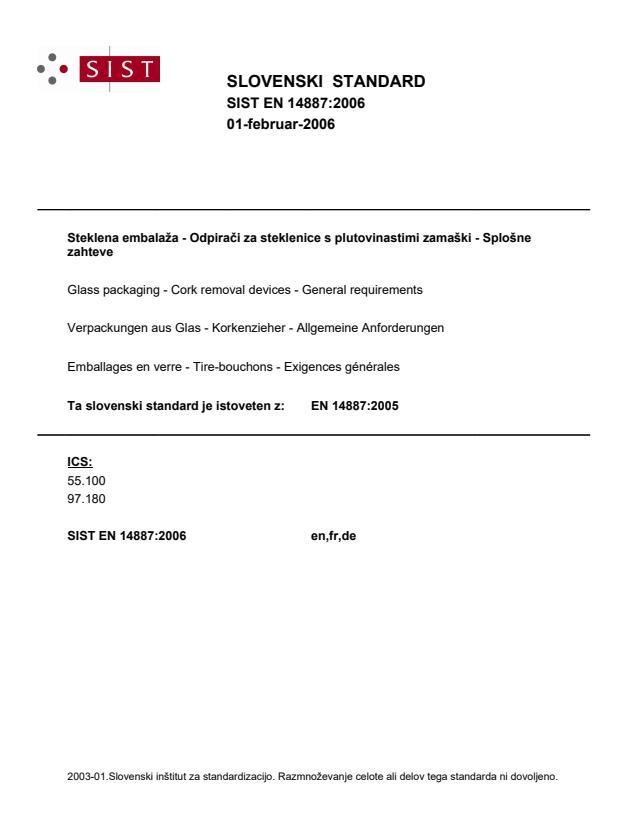
2003-01.Slovenski inštitut za standardizacijo. Razmnoževanje celote ali delov tega standarda ni dovoljeno.Glass packaging - Cork removal devices - General requirements]DKWHYHEmballages en verre - Tire-bouchons - Exigences généralesVerpackungen aus Glas - Korkenzieher - Allgemeine AnforderungenTa slovenski standard je istoveten z:EN 14887:2005SIST EN 14887:2006en,fr,de97.18055.100ICS:SLOVENSKI
STANDARDSIST EN 14887:200601-februar-2006
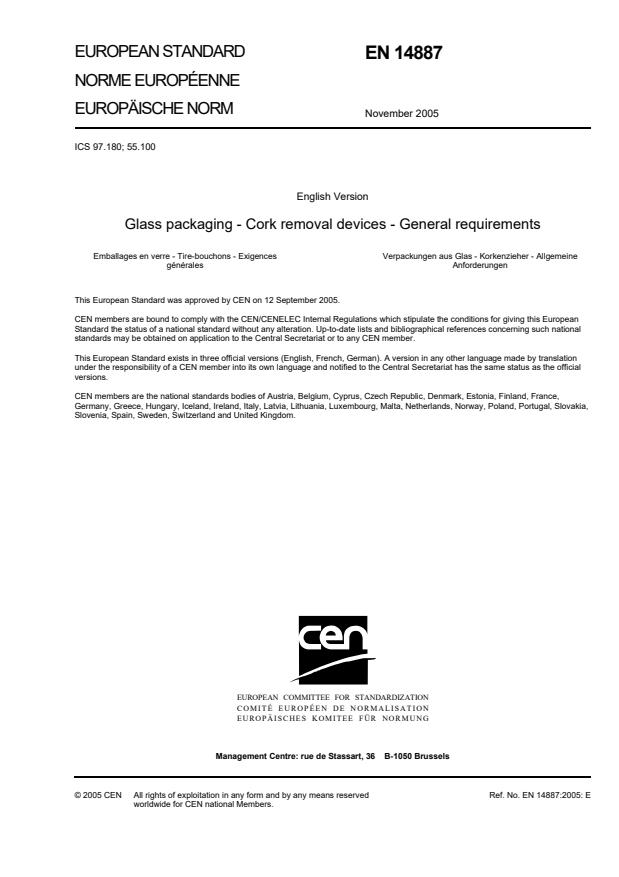
EUROPEAN STANDARDNORME EUROPÉENNEEUROPÄISCHE NORMEN 14887November 2005ICS 97.180; 55.100 English VersionGlass packaging - Cork removal devices - General requirementsEmballages en verre - Tire-bouchons - ExigencesgénéralesVerpackungen aus Glas - Korkenzieher - AllgemeineAnforderungenThis European Standard was approved by CEN on 12 September 2005.CEN members are bound to comply with the CEN/CENELEC Internal Regulations which stipulate the conditions for giving this EuropeanStandard the status of a national standard without any alteration. Up-to-date lists and bibliographical references concerning such nationalstandards may be obtained on application to the Central Secretariat or to any CEN member.This European Standard exists in three official versions (English, French, German). A version in any other language made by translationunder the responsibility of a CEN member into its own language and notified to the Central Secretariat has the same status as the officialversions.CEN members are the national standards bodies of Austria, Belgium, Cyprus, Czech Republic, Denmark, Estonia, Finland, France,Germany, Greece, Hungary, Iceland, Ireland, Italy, Latvia, Lithuania, Luxembourg, Malta, Netherlands, Norway, Poland, Portugal, Slovakia,Slovenia, Spain, Sweden, Switzerland and United Kingdom.EUROPEAN COMMITTEE FOR STANDARDIZATIONCOMITÉ EUROPÉEN DE NORMALISATIONEUROPÄISCHES KOMITEE FÜR NORMUNGManagement Centre: rue de Stassart, 36
B-1050 Brussels© 2005 CENAll rights of exploitation in any form and by any means reservedworldwide for CEN national Members.Ref. No. EN 14887:2005: E
Guidance on cork removal.5
...
The EN 14887:2005 standard, titled "Glass packaging - Cork removal devices - General requirements," presents a comprehensive framework for the design and functionality of cork removal devices used in glass packaging. Its scope is notably clear and essential, offering guidelines that encompass various types of cork removal mechanisms, ensuring compatibility and efficiency across the industry. One of the strengths of the standard is its inclusive approach to all types of cork removal devices. This flexibility allows manufacturers to innovate while adhering to established guidelines, promoting safety and efficiency in the cork removal process. The standard outlines specific design requirements that safeguard user safety and enhance the overall performance of these devices, emphasizing ergonomics and operational effectiveness. Moreover, the relevance of EN 14887:2005 is underscored by its alignment with industry best practices. By providing a unified set of standards, it facilitates interoperability among different manufacturers, streamlining production and ensuring that consumers receive reliable products. In an era where quality and consistency are paramount, this standard serves as a cornerstone in establishing trust in glass packaging solutions. Overall, the EN 14887:2005 standard not only enhances the safety and functionality of cork removal devices but also supports innovation and quality assurance within the glass packaging sector. Its well-defined general requirements make it an essential reference for manufacturers aiming to meet industry standards while providing effective cork removal solutions.
SIST EN 14887:2006は、ガラス包装のコルク除去装置に関する欧州標準であり、特にその設計に関する一般的な要件を定めています。この標準は、さまざまなタイプのコルク除去装置に適用され、業界において高い信頼性と一貫性を提供します。 この標準の強みは、包括的なガイドラインを提供している点です。具体的には、コルク除去装置の設計における安全性、効率性、および使用者の利便性を考慮した要件が含まれています。これにより、製品が市場に出る際に求められる品質基準を確保することができ、製品の競争力を高める要因となります。また、これらの要件は、ユーザーが製品を正しく安全に使用できるように設計されているため、消費者の信頼を獲得する上でも重要です。 さらに、EN 14887:2005の関連性は、国際的な市場におけるガラス包装の重要性を反映しています。ガラス包装業界は、環境への配慮が高まる中で、持続可能性と安全性が求められています。この標準は、こうしたニーズに応える形で、コルク除去装置の設計基準を統一し、業界全体の品質向上に寄与します。 このように、SIST EN 14887:2006は、ガラス包装のコルク除去装置に必要な一般的要件を詳細に定義することで、業界のスタンダードを守り、製品の安全性と効果を高める基盤を提供しています。
SIST EN 14887:2006은 유리 포장 산업에서 코르크 제거 장치의 설계에 대한 일반 요구사항을 제시하는 중요한 표준입니다. 이 표준은 다양한 유형의 코르크 제거 장치에 적용되며, 유럽 전역의 제조업체와 소비자에게 필수적인 기준을 제공합니다. 첫째, 이 표준의 범위는 매우 광범위하여 다양한 형태와 크기의 코르크 제거 장치가 포함됩니다. 이는 사용자가 필요로 하는 다양한 요구를 충족할 수 있도록 설계된 포괄적인 가이드라인을 제공합니다. 이러한 점에서 SIST EN 14887:2006은 생산자들이 안전하고 효율적인 제품을 개발하는 데 필요한 기반을 마련합니다. 둘째, 이 표준은 제품의 안전성과 사용성을 극대화하는 데 기여합니다. 코르크 제거 장치의 효율적이고 안전한 작동은 유리 포장 제품을 사용하는 소비자에게 중요한 요소이며, 이 표준에 명시된 요구사항들은 이러한 안전성을 보장합니다. 예를 들어, 인체공학적 설계와 사용자의 편의성이 강조되어 있어, 다양한 사용자가 손쉽게 사용할 수 있도록 하고 있습니다. 셋째, SIST EN 14887:2006은 환경적 지속 가능성에 대한 고려도 포함합니다. 현대의 소비자들은 환경 친화적인 제품을 선호하는 경향이 있으며, 이 표준은 제조업체들에게 지속 가능한 개발 목표를 따를 것을 촉구합니다. 코르크 제거 장치를 설계할 때 재료 선택과 에너지 효율성을 고려함으로써, 기업은 환경 보호에 기여할 수 있습니다. 결론적으로, SIST EN 14887:2006은 유리 포장 산업에서 필수적인 코르크 제거 장치의 설계에 대한 포괄적이고 실용적인 지침을 제공합니다. 그 범위와 강점은 안전성과 사용자 편의를 강조하며, 환경적 지속 가능성과도 연결되어 있어, 이 표준은 현대 산업의 니즈에 부합하는 매우 중요한 문서입니다. 이러한 특성들은 코르크 제거 장치의 품질을 향상시키고, 궁극적으로 소비자의 신뢰를 높이는 데 기여할 것입니다.
La norme EN 14887:2005, intitulée "Emballages en verre - Dispositifs de retrait de bouchon - Exigences générales", présente un cadre crucial pour le développement et la mise en œuvre de dispositifs de retrait de bouchon utilisés dans les emballages en verre. Cette norme européenne définit des exigences générales qui assurent la sécurité et l'efficacité de ces dispositifs, ce qui est essentiel pour les producteurs et les consommateurs. L'un des points forts de cette norme réside dans son approche systématique des exigences de conception, garantissant ainsi que tous les types de dispositifs de retrait de bouchon respectent des critères de sécurité rigoureux. Cela favorise non seulement une utilisation pratique, mais contribue aussi à minimiser le risque d'accidents lors de l'ouverture des bouteilles, un aspect crucial dans l'industrie des boissons. La norme EN 14887:2005 est particulièrement pertinente dans le contexte actuel où la qualité et la durabilité des matériaux d'emballage sont de plus en plus scrutées. En fournissant des lignes directrices précises pour la conception des dispositifs de retrait, elle permet aux fabricants d'innover tout en maintenant un standard élevé de sécurité et de fonctionnalité. Cette standardisation améliore également la confiance des consommateurs envers les produits emballés dans du verre, sachant qu’ils utilisent des dispositifs conformes aux exigences européennes. Enfin, la pertinence de cette norme ne peut être sous-estimée dans un marché en constante évolution. Avec l'essor des préoccupations environnementales et la recherche de solutions durables, la norme EN 14887:2005 aide les fabricants à aligner leurs produits avec les attentes des consommateurs tout en respectant les réglementations en vigueur. Ainsi, cette norme joue un rôle critique dans l'amélioration de l'industrie de l'emballage en verre, facilitant le développement de produits sûrs, efficaces et responsables.
Die EN 14887:2005 ist ein bedeutendes Dokument, das allgemeine Anforderungen für die Gestaltung aller Arten von Korkentfernungsvorrichtungen festlegt. Der Standard ist entscheidend für die Herstellung und Verwendung von Glasverpackungen, da er sicherstellt, dass die entsprechenden Geräte effizient und sicher im Einsatz sind. Ein wesentlicher Schwerpunkt der EN 14887:2005 liegt auf der Benutzerfreundlichkeit der Korkentfernungsvorrichtungen. Der Standard gibt klare Richtlinien, die es Herstellern ermöglichen, Geräte zu entwickeln, die sowohl ergonomisch als auch funktional sind. Dies fördert nicht nur die Sicherheit der Anwender, sondern minimiert auch das Risiko von Beschädigungen an den Glasverpackungen während des Öffnungsprozesses. Die Relevanz dieser Norm ist in der heutigen Industrie von großer Bedeutung, da sie die Anforderungen an Qualität und Sicherheit in der Glasverpackungsindustrie adressiert. Die Standardisierung ermöglicht eine einheitliche Kontrolle und verbessert die Verlässlichkeit der Produkte auf dem Markt. Hersteller können durch die Einhaltung der EN 14887:2005 sicherstellen, dass ihre Produkte den europäischen Richtlinien entsprechen und somit international wettbewerbsfähig bleiben. Des Weiteren bietet der Standard eine umfangreiche Basis für die Führung von Qualitätskontrollen und Tests, was für die kontinuierliche Verbesserung der Korkentfernungsvorrichtungen unverzichtbar ist. Die Vorgaben der EN 14887:2005 leisten nicht nur einen Beitrag zur Effizienzsteigerung, sondern fördern auch innovative Lösungen in der Branche. Insgesamt zeigt die EN 14887:2005 durch ihr umfassendes und gut strukturiertes Vorgehen, dass sie einen wesentlichen Beitrag zur Verbesserung der Produkte im Bereich der Glasverpackungen leistet. Die generell formulierten Anforderungen sind darauf ausgelegt, ein hohes Niveau an Sicherheit und Benutzerfreundlichkeit zu gewährleisten und somit die Erwartungen der Verbraucher und der Industrie zu erfüllen.
Questions, Comments and Discussion
Ask us and Technical Secretary will try to provide an answer. You can facilitate discussion about the standard in here.
Loading comments...