

EN 9276:2025
(Main)Aerospace series - Programme management - Recommendations for the implementation of the integrated logistic support
- Abstract
The purpose of this document is to:
— identify and describe, in a structured way, the principles of the integrated logistic support (ILS) activities and tasks for the main types of stakeholders in the system life cycle, from the expression of need to disposal;
— place the activities, tasks and ILS deliverables within the programme execution;
— identify the main selection and sizing of activities and tasks criteria according to the nature and the requirements of the programme;
— control the relations with the other aspects of programme management.
This document covers the following subjects:
— management of ILS (definition, implementation and running of the processes);
— expression of the support requirements;
— elaboration of the contracts (e.g. for development, maintenance, supply);
— implementation of the tasks and processes.
This document is also related to the following subjects:
— relations with costs and lead times control, configuration management, performance and RAMS management, quality assurance, documentation management;
— regulations (e.g. information system security, export controls, safety at work);
— human and organizational factors (HOF);
— environment (e.g. RoHS, REACh);
— information systems (IS) and the links between them;
— logistics information systems (LIS);
— in-service support (ISS) activities;
— configuration management of ILS objects;
— life cycle.
The following stakeholders are concerned by ILS:
— users in the broadest sense: operators, maintenance operators, administrators, dismantlers of the system, trainers;
— the customer, who:
— prepares technical and contractual specifications of need with which the system will comply;
— sets up the funding of the programme;
— oversees the realization and commissioning of the main system and of the support system;
— facilitates the feedback.
NOTE 1 At the highest level of the system, the customer can also be referred to as the “project owner”.
NOTE 2 The “main system” can also be referred to as the “system of interest”.
— the supplier(s) who deliver a system (main and support) to the customer, which meets the performance specifications on time and for the agreed cost, throughout the system life cycle;
NOTE 3 At the highest level of the system, the supplier can also be referred to as the “industrial prime contractor”.
— the regulatory authorities that supervise and approve the support processes and equipment, as needed.
The principles laid down in this document can be applied, after adaptation, to all the customer/supplier relations resulting from the breakdown of the main contract into sub-contracts.
- Status
- Published
- Publication Date
- 16-Dec-2025
- Technical Committee
- ASD-STAN - Aerospace
- Drafting Committee
- ASD-STAN/D 1/WG 15 - ILS and obsolescence management
- Current Stage
- 6060 - Definitive text made available (DAV) - Publishing
- Start Date
- 17-Dec-2025
- Completion Date
- 17-Dec-2025

Overview
EN 9276:2025 - Aerospace series: Programme management - Recommendations for the implementation of the integrated logistic support (ILS) provides a structured, lifecycle-focused framework for planning, implementing and running Integrated Logistic Support in aerospace programmes. Published by CEN (prepared by ASD‑STAN), the standard defines ILS principles from expression of need through disposal, positions ILS activities within programme execution and clarifies selection/sizing criteria for ILS tasks while controlling interfaces with other programme management domains.
Key topics and technical requirements
- ILS management and processes - definition, implementation and execution of ILS processes and roles (including programme management responsibilities and the Integrated Logistic Support Plan - ILSP).
- Expression of support requirements - how to capture and document support needs, engineering requirements for support, and the logistics data reference to be exchanged.
- Contractual interfaces - guidance for embedding ILS in development, maintenance and supply contracts (customer/supplier and subcontractor relationships).
- ILS functions and lifecycle tasks - activities across programme phases: expression of need, feasibility, definition and development, industrialisation/production, handover to in‑service support (ISS), use and disposal.
- Logistics analysis tools - use of Logistic Support Analysis (LSA) and related iterative methods to optimise availability and life cycle cost (LCC).
- Relations with other programme domains - explicit links to cost and lead‑time control, configuration management, RAMS (reliability, availability, maintainability, safety), quality assurance, documentation management, human and organisational factors (HOF), cybersecurity and regulatory constraints.
- Information systems - interoperability requirements and the role of Logistics Information Systems (LIS) and wider Information Systems (IS).
- Environmental and regulatory considerations - references to requirements such as RoHS/REACh, export controls and workplace safety.
Practical applications and users
EN 9276:2025 is intended for stakeholders involved in aerospace programme logistics and lifecycle support, including:
- Customers / project owners preparing technical and contractual support specifications and funding programmes.
- Prime contractors and suppliers designing, delivering and supporting systems to meet agreed performance and regulatory requirements.
- In‑service support (ISS) teams, maintainers and logistics planners responsible for operational availability, spares, maintenance policy and training.
- Programme managers, configuration and quality teams coordinating ILS with RAMS, cost control and documentation.
Use cases include designing support solutions early in system development, drafting ILSPs/LSAs, defining contractual service levels and establishing LIS interoperability.
Related standards
- EN 9200 (programme management specification) - EN 9276 is an accompanying document.
- EN 13306 (maintenance terminology) - referenced for terms such as availability.
Keywords: EN 9276:2025, integrated logistic support, ILS, aerospace programme management, logistic support analysis, ILSP, life cycle cost, RAMS, configuration management, logistics information systems.
Get Certified
Connect with accredited certification bodies for this standard

BSI Group
BSI (British Standards Institution) is the business standards company that helps organizations make excellence a habit.

Bureau Veritas
Bureau Veritas is a world leader in laboratory testing, inspection and certification services.

DNV
DNV is an independent assurance and risk management provider.
Sponsored listings
Frequently Asked Questions
EN 9276:2025 is a standard published by the European Committee for Standardization (CEN). Its full title is "Aerospace series - Programme management - Recommendations for the implementation of the integrated logistic support". This standard covers: The purpose of this document is to: — identify and describe, in a structured way, the principles of the integrated logistic support (ILS) activities and tasks for the main types of stakeholders in the system life cycle, from the expression of need to disposal; — place the activities, tasks and ILS deliverables within the programme execution; — identify the main selection and sizing of activities and tasks criteria according to the nature and the requirements of the programme; — control the relations with the other aspects of programme management. This document covers the following subjects: — management of ILS (definition, implementation and running of the processes); — expression of the support requirements; — elaboration of the contracts (e.g. for development, maintenance, supply); — implementation of the tasks and processes. This document is also related to the following subjects: — relations with costs and lead times control, configuration management, performance and RAMS management, quality assurance, documentation management; — regulations (e.g. information system security, export controls, safety at work); — human and organizational factors (HOF); — environment (e.g. RoHS, REACh); — information systems (IS) and the links between them; — logistics information systems (LIS); — in-service support (ISS) activities; — configuration management of ILS objects; — life cycle. The following stakeholders are concerned by ILS: — users in the broadest sense: operators, maintenance operators, administrators, dismantlers of the system, trainers; — the customer, who: — prepares technical and contractual specifications of need with which the system will comply; — sets up the funding of the programme; — oversees the realization and commissioning of the main system and of the support system; — facilitates the feedback. NOTE 1 At the highest level of the system, the customer can also be referred to as the “project owner”. NOTE 2 The “main system” can also be referred to as the “system of interest”. — the supplier(s) who deliver a system (main and support) to the customer, which meets the performance specifications on time and for the agreed cost, throughout the system life cycle; NOTE 3 At the highest level of the system, the supplier can also be referred to as the “industrial prime contractor”. — the regulatory authorities that supervise and approve the support processes and equipment, as needed. The principles laid down in this document can be applied, after adaptation, to all the customer/supplier relations resulting from the breakdown of the main contract into sub-contracts.
The purpose of this document is to: — identify and describe, in a structured way, the principles of the integrated logistic support (ILS) activities and tasks for the main types of stakeholders in the system life cycle, from the expression of need to disposal; — place the activities, tasks and ILS deliverables within the programme execution; — identify the main selection and sizing of activities and tasks criteria according to the nature and the requirements of the programme; — control the relations with the other aspects of programme management. This document covers the following subjects: — management of ILS (definition, implementation and running of the processes); — expression of the support requirements; — elaboration of the contracts (e.g. for development, maintenance, supply); — implementation of the tasks and processes. This document is also related to the following subjects: — relations with costs and lead times control, configuration management, performance and RAMS management, quality assurance, documentation management; — regulations (e.g. information system security, export controls, safety at work); — human and organizational factors (HOF); — environment (e.g. RoHS, REACh); — information systems (IS) and the links between them; — logistics information systems (LIS); — in-service support (ISS) activities; — configuration management of ILS objects; — life cycle. The following stakeholders are concerned by ILS: — users in the broadest sense: operators, maintenance operators, administrators, dismantlers of the system, trainers; — the customer, who: — prepares technical and contractual specifications of need with which the system will comply; — sets up the funding of the programme; — oversees the realization and commissioning of the main system and of the support system; — facilitates the feedback. NOTE 1 At the highest level of the system, the customer can also be referred to as the “project owner”. NOTE 2 The “main system” can also be referred to as the “system of interest”. — the supplier(s) who deliver a system (main and support) to the customer, which meets the performance specifications on time and for the agreed cost, throughout the system life cycle; NOTE 3 At the highest level of the system, the supplier can also be referred to as the “industrial prime contractor”. — the regulatory authorities that supervise and approve the support processes and equipment, as needed. The principles laid down in this document can be applied, after adaptation, to all the customer/supplier relations resulting from the breakdown of the main contract into sub-contracts.
EN 9276:2025 is classified under the following ICS (International Classification for Standards) categories: 03.100.10 - Purchasing. Procurement. Logistics; 49.020 - Aircraft and space vehicles in general. The ICS classification helps identify the subject area and facilitates finding related standards.
EN 9276:2025 is available in PDF format for immediate download after purchase. The document can be added to your cart and obtained through the secure checkout process. Digital delivery ensures instant access to the complete standard document.
Standards Content (Sample)
SLOVENSKI STANDARD
01-februar-2026
Aeronavtika - Vodenje programov - Priporočila za izvajanje integrirane logistične
podpore
Aerospace series - Programme management - Recommendations for the implementation
of the integrated logistic support
Luft- und Raumfahrt - Programm-Management - Empfehlungen zur Durchführung der
integrierten logistischen Unterstützung
Série aérospatiale - Management de programme - Recommandations pour la mise en
œuvre du soutien logistique intégré
Ta slovenski standard je istoveten z: EN 9276:2025
ICS:
03.100.10 Nabava. Dobava. Logistika Purchasing. Procurement.
Logistics
49.020 Letala in vesoljska vozila na Aircraft and space vehicles in
splošno general
2003-01.Slovenski inštitut za standardizacijo. Razmnoževanje celote ali delov tega standarda ni dovoljeno.
EN 9276
EUROPEAN STANDARD
NORME EUROPÉENNE
December 2025
EUROPÄISCHE NORM
ICS 49.020
English Version
Aerospace series - Programme management -
Recommendations for the implementation of the
integrated logistic support
Série aérospatiale - Management de programme - Luft- und Raumfahrt - Programm-Management -
Recommandations pour la mise en œuvre du soutien Empfehlungen für die Implementierung der
logistique intégré integrierten logistischen Unterstützung
This European Standard was approved by CEN on 19 October 2025.
CEN members are bound to comply with the CEN/CENELEC Internal Regulations which stipulate the conditions for giving this
European Standard the status of a national standard without any alteration. Up-to-date lists and bibliographical references
concerning such national standards may be obtained on application to the CEN-CENELEC Management Centre or to any CEN
member.
This European Standard exists in three official versions (English, French, German). A version in any other language made by
translation under the responsibility of a CEN member into its own language and notified to the CEN-CENELEC Management
Centre has the same status as the official versions.
CEN members are the national standards bodies of Austria, Belgium, Bulgaria, Croatia, Cyprus, Czech Republic, Denmark, Estonia,
Finland, France, Germany, Greece, Hungary, Iceland, Ireland, Italy, Latvia, Lithuania, Luxembourg, Malta, Netherlands, Norway,
Poland, Portugal, Republic of North Macedonia, Romania, Serbia, Slovakia, Slovenia, Spain, Sweden, Switzerland, Türkiye and
United Kingdom.
EUROPEAN COMMITTEE FOR STANDARDIZATION
COMITÉ EUROPÉEN DE NORMALISATION
EUROPÄISCHES KOMITEE FÜR NORMUNG
CEN-CENELEC Management Centre: Rue de la Science 23, B-1040 Brussels
© 2025 CEN All rights of exploitation in any form and by any means reserved Ref. No. EN 9276:2025 E
worldwide for CEN national Members.
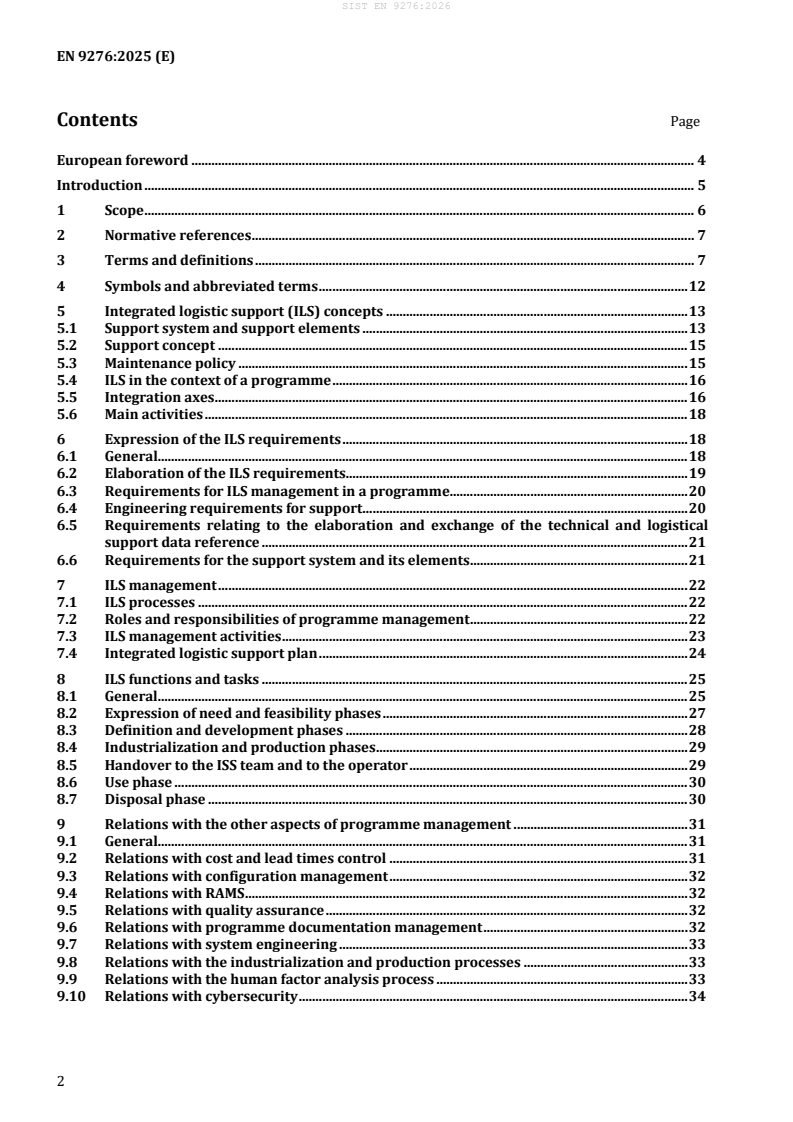
Contents Page
European foreword . 4
Introduction . 5
1 Scope . 6
2 Normative references . 7
3 Terms and definitions . 7
4 Symbols and abbreviated terms . 12
5 Integrated logistic support (ILS) concepts . 13
5.1 Support system and support elements . 13
5.2 Support concept . 15
5.3 Maintenance policy . 15
5.4 ILS in the context of a programme . 16
5.5 Integration axes . 16
5.6 Main activities . 18
6 Expression of the ILS requirements . 18
6.1 General. 18
6.2 Elaboration of the ILS requirements. 19
6.3 Requirements for ILS management in a programme . 20
6.4 Engineering requirements for support . 20
6.5 Requirements relating to the elaboration and exchange of the technical and logistical
support data reference . 21
6.6 Requirements for the support system and its elements . 21
7 ILS management . 22
7.1 ILS processes . 22
7.2 Roles and responsibilities of programme management . 22
7.3 ILS management activities . 23
7.4 Integrated logistic support plan . 24
8 ILS functions and tasks . 25
8.1 General. 25
8.2 Expression of need and feasibility phases . 27
8.3 Definition and development phases . 28
8.4 Industrialization and production phases . 29
8.5 Handover to the ISS team and to the operator . 29
8.6 Use phase . 30
8.7 Disposal phase . 30
9 Relations with the other aspects of programme management . 31
9.1 General. 31
9.2 Relations with cost and lead times control . 31
9.3 Relations with configuration management . 32
9.4 Relations with RAMS . 32
9.5 Relations with quality assurance . 32
9.6 Relations with programme documentation management . 32
9.7 Relations with system engineering . 33
9.8 Relations with the industrialization and production processes . 33
9.9 Relations with the human factor analysis process . 33
9.10 Relations with cybersecurity . 34
Annex A (informative) Examples of ILS requirements . 35
Annex B (informative) Example of an ILSP template . 36
Annex C (informative) Example of an LSA template. 37
Annex D (informative) Examples of levels of intervention. 38
Bibliography . 40
European foreword
This document (EN 9276:2025) has been prepared by ASD-STAN.
After enquiries and votes carried out in accordance with the rules of this Association, this document has
received the approval of the National Associations and the Official Services of the member countries of
ASD-STAN, prior to its presentation to CEN.
This document shall be given the status of a national standard, either by publication of an identical text
or by endorsement, at the latest by June 2026, and conflicting national standards shall be withdrawn at
the latest by June 2026.
Attention is drawn to the possibility that some of the elements of this document may be the subject of
patent rights. CEN shall not be held responsible for identifying any or all such patent rights.
According to the CEN-CENELEC Internal Regulations, the national standards organizations of the
following countries are bound to implement this document: Austria, Belgium, Bulgaria, Croatia, Cyprus,
Czech Republic, Denmark, Estonia, Finland, France, Germany, Greece, Hungary, Iceland, Ireland, Italy,
Latvia, Lithuania, Luxembourg, Malta, Netherlands, Norway, Poland, Portugal, Republic of North
Macedonia, Romania, Serbia, Slovakia, Slovenia, Spain, Sweden, Switzerland, Türkiye and the
United Kingdom.
Introduction
In a very restrictive economic context, the technical performance of the system is not the only objective
assigned to large aeronautic, space or weapons programmes. The quality of the expected service, the cost
of implementation and support, the sustainability of equipment goods are now at the same level of
requirements.
In a programme, the quest for efficiency goes through the common will of all the stakeholders to serve a
common objective that is to satisfy the system user. In this respect, satisfying the need of the user as
regards logistic support and the control of usage costs is essential to ensure the availability and
sustainability of the system he will operate.
In order to optimize the compromise between performance, costs and lead times over the entire life cycle,
it is necessary to consider the support needs from the beginning of the programme and to develop
solutions closely linked to system development, its service phase and its disposal. The failure of
programme management to take the life cycle cost into consideration can have consequences for the
users in the operational phase.
This document specifies the integrated logistic support (ILS) application procedures and constitutes one
of the accompanying documents of EN 9200 on the specification of programme management.
1 Scope
The purpose of this document is to:
— identify and describe, in a structured way, the principles of the integrated logistic support (ILS)
activities and tasks for the main types of stakeholders in the system life cycle, from the expression of
need to disposal;
— place the activities, tasks and ILS deliverables within the programme execution;
— identify the main selection and sizing of activities and tasks criteria according to the nature and the
requirements of the programme;
— control the relations with the other aspects of programme management.
This document covers the following subjects:
— management of ILS (definition, implementation and running of the processes);
— expression of the support requirements;
— elaboration of the contracts (e.g. for development, maintenance, supply);
— implementation of the tasks and processes.
This document is also related to the following subjects:
— relations with costs and lead times control, configuration management, performance and RAMS
management, quality assurance, documentation management;
— regulations (e.g. information system security, export controls, safety at work);
— human and organizational factors (HOF);
— environment (e.g. RoHS, REACh);
— information systems (IS) and the links between them;
— logistics information systems (LIS);
— in-service support (ISS) activities;
— configuration management of ILS objects;
— life cycle.
The following stakeholders are concerned by ILS:
— users in the broadest sense: operators, maintenance operators, administrators, dismantlers of the
system, trainers;
— the customer, who:
— prepares technical and contractual specifications of need with which the system will comply;
— sets up the funding of the programme;
— oversees the realization and commissioning of the main system and of the support system;
— facilitates the feedback.
NOTE 1 At the highest level of the system, the customer can also be referred to as the “project owner”.
NOTE 2 The “main system” can also be referred to as the “system of interest”.
— the supplier(s) who deliver a system (main and support) to the customer, which meets the
performance specifications on time and for the agreed cost, throughout the system life cycle;
NOTE 3 At the highest level of the system, the supplier can also be referred to as the “industrial prime
contractor”.
— the regulatory authorities that supervise and approve the support processes and equipment, as
needed.
The principles laid down in this document can be applied, after adaptation, to all the customer/supplier
relations resulting from the breakdown of the main contract into sub-contracts.
2 Normative references
There are no normative references in this document.
3 Terms and definitions
For the purposes of this document, the following terms and definitions apply.
ISO and IEC maintain terminology databases for use in standardization at the following addresses:
— ISO Online browsing platform: available at https://www.iso.org/obp/
— IEC Electropedia: available at https://www.electropedia.org/
3.1
logistic support analysis
LSA
structured and iterative method that helps to optimize the operational availability and operating costs
(operation and maintenance) of the system, on the basis of the expression of needs and the planned
operational concepts, by pre-planning all aspects of integrated logistics support
3.2
life cycle cost
LCC
total cost of a product throughout its life cycle, from the initial expression of needs to its disposal
Note 1 to entry: In certain programmes, the life cycle cost is called the global cost.
3.3
product life cycle
set of successive maturity states that the product takes during the different phases of a programme
Note 1 to entry: States of maturity during which the product is gradually processed are typically:
— concept;
— development;
— realization;
— use, including in-service support;
— disposal.
Note 2 to entry: The life cycle of a product takes into account all the activities involved in the manufacture, use,
transport, recycling and disposal of the product. This is the basis of eco-design.
Note 3 to entry: The life cycle is generally illustrated as a series of stages, from production (extraction and
harvesting of raw materials) to final disposal (disposal or recovery), including manufacturing, packaging, transport,
use and recycling or disposal.
Note 4 to entry: Notion not to be confused with life profile.
3.4
availability
aptitude of a product to be ready to perform a required function under given conditions, at a given
moment
Note 1 to entry: This aptitude depends on the combined aspects of reliability performance, maintainability
performance and maintenance support performance.
3.5
support elements
constitutive elements of the support system
Note 1 to entry: Support elements cover the means and services provided by the different stakeholders: industrials,
organizations and end users.
Note 2 to entry: See 5.1 for more information.
3.6
maintenance
all the actions required to maintain a product or restore a product to a specified condition, in which it can
realize the required function(s)
Note 1 to entry: Maintenance includes the support management and supervision activities.
Note 2 to entry: In the operating phase, maintenance helps to preserve the safety, security and availability of the
product.
Note 3 to entry: Maintenance includes corrective or preventive maintenance.
3.7
in-service support
ISS
all the tasks that guarantee the capacity of the equipment to function and to be available within an
imposed budgetary framework
Note 1 to entry: ISS includes the following main functions:
— maintenance and security maintenance (hardware and software);
— adaptability and upgradability of the equipment in relation to the physical or strategic environment;
— technical assistance;
— repairs;
— logistics (supplies, storage and distribution of spares);
— availability of operational personnel (use and maintenance).
Note 2 to entry: ISS also includes associated but essential functions, such as:
— stock management;
— maintenance of the support infrastructures;
— keeping the documentation up to date;
— maintenance of skills;
— management of the configuration and technical incidents;
— document management;
— management of all the above-mentioned activities.
Note 3 to entry: The implementation of ISS is conditional on the consideration of a maintenance plan which more
particularly defines the main functions of ISS. Constraints, in particular budgetary ones, and agreements contribute
to validating a gap between this maintenance plan and the ISS actually carried out.
Note 4 to entry: The ILS team analyses the support in the development phase and produces the maintenance plan,
which remains a reference document throughout the ISS (with foreseeable changes during the operational phase).
3.8
level of intervention
NTI
maintenance operations execution level defined within the general framework of a maintenance policy,
taking into account the operational availability objective and specific constraints
Note 1 to entry: Specific constraints include but are not limited to:
— complexity of the equipment;
— qualification of the personnel;
— logistic and geographical organization (e.g. place of intervention);
— costs;
— intervention times;
— means, infrastructures.
Note 2 to entry: There are various typologies, such as those defined in Annex D: technical level of intervention
(NTI1, NTI2, NTI3) and the level of industrial support/level of operational support.
3.9
life profile
chronological description of the situations in which a physical product is expected to be found, from ex-
factory to disposal
Note 1 to entry: By situation, we mean: transport, handling, storage, maintenance, preparation to use, operational
use, with all environmental conditions, durations and respective occurrences.
Note 2 to entry: The life profile is described for product/customer or product/job couples. For a given product,
there can be several life profiles depending on the considered concepts of use or deployments.
Note 3 to entry: The life profile is not to be confused with life cycle (which includes life profile).
Note 4 to entry: The disposal phase is part of the life cycle but is not part of the life profile.
3.10
safety
aptitude of a product to respect, in all the phases of its life, an acceptable level of accident risk liable to
cause harm to the personnel or serious damage to the product or its environment
Note 1 to entry: Safety is meant in the sense of unintentional events, unlike the notion of security. Malevolence is
therefore excluded from this definition.
Note 2 to entry: This definition is consistent with the definition in ISO 9000:2015.
3.11
support
process that allows the main system to be used and maintained by implementing a suitable organization
and the support system, throughout the operational phase, and even disposal
Note 1 to entry: See support system (5.1).
3.12
integrated logistic support
ILS
coordinated and iterative set of both management and technical tasks necessary to:
— ensure that support is taken into account when stating the requirements related to the main system
within the different scenarios of use and its definition;
— specify and define the support system by optimizing the main system/support system couple;
— realize and implement the support system defined in this way;
— maintain and optimize it during the life cycle of the main system
Note 1 to entry: Integrated product support (IPS), notably used in ASD specifications, is the combination of ILS
and ISS, but in some contexts IPS and ILS can be synonymous.
3.13
security
aptitude of a product to guarantee, in all the phases of its life, an acceptable level of risk, following a
malicious act, in order to prevent:
— an attack on the personnel;
— serious damage to the product or its environment;
— a loss of the confidentiality, availability or integrity of data
Note 1 to entry: Cybersecurity is a subset of security, particularly with regard to the above aspects related to “data”.
3.14
system
arrangement of parts or elements that together exhibit a stated behaviour or meaning that the individual
constituents do not have
Note 1 to entry: A system is sometimes considered as a product or as the services it provides.
Note 2 to entry: In practice, the interpretation of its meaning is frequently clarified by the use of an associative
noun, e.g. aircraft system, weapon system.
Note 3 to entry: A complete system includes all of the associated equipment, facilities, hardware, computer
programmes, firmware, technical documentation, services, and personnel required for operations and support to
the degree necessary for self-sufficient use in its intended environment.
[SOURCE: ISO/IEC/IEEE 15288:2023, modified – note 2 to entry incomplete]
3.15
information system
organized set of resources (e.g. hardware, software, personnel, data, procedures) allowing the collection,
storage, processing and distribution of information in all forms within and between organizations
Note 1 to entry: The computer system is only a subset of the information system.
3.16
logistics information system
LIS
computer system processing the technical and logistics data necessary for the management of equipment
and its support system over the life cycle (e.g. supply management, stock management, maintenance
operations management)
Note 1 to entry: The LIS is generally based on a modular architecture built from computer systems.
Note 2 to entry: The LIS is fed with data from the support technical-logistics data reference (see STANREC 4661
– ALP 20).
3.17
computer system
information system support that takes care of digitized information and automated processing
Note 1 to entry: The computer system can be an application of the following types:
— SCM (supply chain management);
— EDM (electronic document management);
— CMMS (computerized maintenance management system);
— CRM (customer relationship management);
— HRM (human resource management);
— ERP (enterprise resource planning);
— PDM (product data management).
4 Symbols and abbreviated terms
For the purposes of this document, the following symbols and abbreviations apply:
ANSSI French Information System Security Agency (Agence nationale de la sécurité des systèmes
d'information)
ASD AeroSpace and Defence industries association of Europe
CMMS Computerized maintenance management system
CRM Customer relationship management
DDF Definition data file
DJD Definition justification dossier
FMECA Failure modes, effects and criticality analysis
HOF Human and organizational factors
ILS Integrated logistic support
ILSP Integrated logistic support plan
IPC Illustrated parts catalogue
IPL Initial provisioning list
IPS Integrated product support
IS Information system
ISP Integrated support plan
ISS In-service support
IT Information technology
LCC Life cycle cost
LIS Logistics information system
LRU Line replaceable unit
LSA Logistic support analysis
LSA DB Logistic support analysis database
ML Maintenance levels
NATO North Atlantic Treaty Organization
NTI Technical level of intervention (Niveau technique d’intervention)
PMHST Packaging, marking, handling, storage, transport
RAMS Reliability, availability, maintainability and safety
REACh Registration, evaluation, authorization and restriction of chemicals
RoHS Restriction of hazardous substances in electrical and electronic equipment
SPL Spare parts list
SRU Shop replaceable unit
TNA Training need analysis
5 Integrated logistic support (ILS) concepts
5.1 Support system and support elements
The purpose of ILS is to design, build, qualify and deliver a support system, and to prepare its
implementation. The support system is made up of several support elements (see Figure 1):
Figure 1 — Support elements
The support elements meet the relative needs, particularly in the following areas:
— maintenance concepts and plans based on a concept of operation, including the IT data loaded for
computerized maintenance management system (CMMS);
— procurement and supplies;
EXAMPLE 1 Initial provisioning list (IPL), the spare parts list (SPL), the illustrated parts catalogue (IPC),
replacement articles, spare items, spare parts, consumables;
— support infrastructures (e.g. warehouses, buildings, workshops), including the IT infrastructures
necessary for the LIS;
— technical data (operations and maintenance documentation);
EXAMPLE 2 Manuals and operating instructions;
— test and support equipment;
EXAMPLE 3 Test benches, simulators, special lifting and handling equipment, test equipment, tooling for
implementation;
— personnel and technical assistance, services and logistic assistance;
EXAMPLE 4 Phone support, supply of equipment, augmented reality, management of anomaly/technical
event tickets, customer portal (CRM – customer relationship management);
— training in use and maintenance (basic and recurrent);
EXAMPLE 5 Training plans, based on the training need analysis (TNA), with the educational path and
evaluation tests, practice, instructions, training materials (e.g. videos), pedagogical models, 3D augmented
reality models, simulators, e-learning;
— packaging, marking, handling, storage, transport (PMHST);
EXAMPLE 6 Containers of systems and spare parts, stowage recommendations for transport by land, air or
sea, storage recommendations (e.g. temperature, hygrometry), label format;
— IT ressources and information system support, for the software of the main system and the support
system.
EXAMPLE 7 Security maintenance of the software, homologation, update process.
The support system is implemented for the purposes of ISS.
The LIS is built and adapted to accept and manage all the data that makes up the support elements. It is
made up of the following main elements:
— the LSA DB (LSA database) to analyse the support using a logistic tree structure, the maintenance
plan and the lists of spare parts and tooling (implementation and maintenance);
— the documentary database, with all the manuals and procedures for maintenance, operations and
supplies;
— the CMMS, which contains the full traceability of the information on the interventions and, therefore,
is the means of controlling maintenance. The CMMS is installed at the beginning of the operation
phase. At this point, a part of the data in the LSA DB (engineering tool) is integrated in the CMMS
(operational tool). The consistency between the data in the LSA DB and the CMMS is maintained
according to the contractual requirements;
— the configuration of each system and each spare (e.g. serial number, date of manufacture, possible
expiry date, for each equipment).
5.2 Support concept
The support concept is an input and is therefore a prerequisite of the support analyses, the definition of
the maintenance policy (see 5.3) and all the other support elements. It is based on the feedback.
The support concept is either present right from the start of a development contract or is built at the
beginning of the development in order to start the support analyses. It is advisable that the concept be
initiated by the customer on the basis of the use and the policy derived from the user’s needs. The support
concept is fine-tuned as the solution gains maturity.
The support concept covers the requirements of the customer and the user, the requirements of the
authorities (regulatory constraints), where applicable, and the hypotheses of the realization of the
support.
This consists in defining the constraints already in place, or desired, for operations and maintenance,
while taking account of the geographic location (“what” and “where”), such as:
— the required teams of operators, in terms of numbers, skills and management structure;
— the existing material means;
— the constraints applying to working hours and work days;
— the conditions of the interventions (limitations often related to risks to the personnel and/or
property).
5.3 Maintenance policy
The maintenance policy constitutes a response to the support concept. It takes the operational and
technical requirements and converts them into maintainability objectives.
The maintenance policy particularly defines:
— the levels of intervention;
— the repair criteria;
— the division between corrective and preventive maintenance (including the choice criteria);
— the justifications of the above-mentioned elements.
NOTE Refer to the definitions in EN 13306 for the different maintenance typologies.
The maintenance policy is updated according to changes to the support concept and may also lead to
updating the support concept.
5.4 ILS in the context of a programme
The definition of a programme is given in EN 9200. The management activities of ILS form an integral
part of the programme and, as such, shall be taken into account from the initial phase of expression of
needs and maintained throughout the life cycle of the system. In this respect, the ILS plan (see 7.4) is part
of, refers to, or is referenced to the programme management plan.
All programme management methodologies apply to ILS, particularly configuration management
(see EN 9223-100), risk control (see EN 9239), programme execution logic (see EN 9241) and cost and
lead time control (see RG.Aero 000 61).
ILS is an integral part of the different programme reviews (see RG.Aero 000 67) and can produce specific
reviews, whose conclusion is the support readiness review, which allows the support system to be
delivered to ISS. The logic of the reviews is applied to the various support elements, according to the need.
This overall and integrated approach involves permanent interaction between all the actors of the
programme (including the users and/or their representatives). This effort is evidenced in various
disciplines to define, develop, produce, maintain and use the main system and the support system.
It is advisable that the system contract should also cover the ILS aspects.
5.5 Integration axes
Logistic support integration aims at ensuring the optimal conduct of study, realization and resource
management activities for support throughout the system life cycle. It involves all the actors of the
programme and needs task coordination and exchange of data related to support.
The integration axes are:
— “user needs” axe, which allows the following items to be integrated into system support and
availability requirements: e.g. mission profiles, operational environment and the budget of the user;
— “programme management” axe, which allows integrating the ILS objectives, the definition of the
logistic support activities and the identification of the interfaces regarding programme functions and
activities. It also allows ensuring the collection and distribution of the information necessary for
support control on the whole programme;
— “design” axe, which allows elaborating the support elements and the main system elements in close
synergy and consistency, while favouring a design interface between RAMS and technical studies;
— “support elements” axe, which allows ensuring the mutual integration of the support elements;
— “costs” axe, which allows integrating the different costs, in particular those related to acquisition, use
and disposal, in order to control the life cycle cost (LCC) (see Figure 2).
NOTE 1 The use cost shown in Figure 2 corresponds to the cost of ownership, as defined in the ASD (AeroSpace
and Defence industries association of Europe) specifications.
NOTE 2 Items quoted in parentheses are examples.
Figure 2 — Breakdown of life cycle cost (LCC)
5.6 Main activities
The ILS activities are distributed throughout the life cycle of the system.
The main activities are:
— participation in needs study and system design studies;
— conduct of ILS studies, in close contact with technical studies (e.g. design, RAMS [see 9.4], industrial
processes) and economic studies;
— development of support elements and production of initial support elements;
— evaluation and validation of support system performance;
— realization of reception, delivery, installation, and commissioning processes;
— availability of all system support elements at the point of use according to the needs for performing
the support tasks;
— renewal of support elements whose supply shall be produced and delivered in due time to reach and
maintain the availability and life cycle cost;
— in-service maintenance and monitoring of the main system and the support system;
— optimization of the support performance;
— taking the feedback into account;
— realization of tasks related to the disposal of the system.
Clause 8 specifies the support-related activities by programme phase.
6 Expression of the ILS requirements
6.1 General
This Clause 6 deals with the requirements for logistic support that may be expressed by an ordering party
to ensure the integration of ILS in a programme.
Five types of requirements are to be considered for logistic support:
— requirements for management;
— requirements for the support system;
— requirements for the sharing of data/choice of exchange models;
— support engineering requirements;
— requirements for the support elements.
It is essential to specify these requirements according to several criteria:
— the phase of the programme (objective, scope and depth of studies);
— the user's organization and logistic support means;
— the level of reuse of stock in hand;
— the visibility desired by the ordering party on the support system elaboration process;
— the necessary and sufficient data for the realization of the support tasks by the user;
— the financial resources.
It is recommended to limit the expression of constraints to a strict minimum in order to leave sufficient
freedom to the supplier in his search for the optimization of the performance-cost-lead time compromise.
It is also advisable to be able to assess the feasibility of these requirements at the earliest possible stage.
At all levels of the industrial organization of the programme, each actor ensures, with regard to their
specified requirements, the full consistency and allocation of the requirements under their responsibility,
or those they specify for all their suppliers and service providers.
Examples for each type of requirement described below can be found in Annex A.
6.2 Elaboration of the ILS requirements
The ILS requirements form an integral part of the overall requirements for the system and are described
in the following sections. They are elaborated throughout the programme and are usually the result of a
dialogue between the customer and the supplier, with an allocation process intended for the various
suppliers.
This is a genuine engineering process, which involves, as far as possible, the future users/operators of
the system, or the entities that represent them. This process justifies the implementation of a traceability
of the requirements.
The general principle of elaboration is essentially based of three phases:
a) identification of the requirements of the main system: e.g. use profile, operational concept,
availability objectives, even use costs objectives (responsibility of the customer);
b) support analysis, including the optimization iterations (e.g. analysis of alternative scenarios,
maintenance concepts), with the prime contractor, and then with the various suppliers;
c) specifications of the various elements of the support system that are the result of the logistic support
analysis (LSA).
All these steps are coordinated by the management requirements related to LSA/ILS process itself, and
by the data format requirements that are necessary for the exchanges between customers and suppliers.
This process is iterative until an agreement is reached between the customer and the supplier on these
requirements.
6.3 Requirements for ILS management in a programme
The general requirements for programme management are applicable to the implementation of ILS in the
programme. These requirements concern especially:
— the management and the organization to be set up by the customer and by the supplier/service
provider. These requirements can apply to:
— the desired level of visibility;
— the allocation of the requirements and the monitoring of sub-tier suppliers and service providers;
— the designation of contacts (roles and responsibilities).
NOTE 1 For smooth programme execution, it can be useful to carry out a mutual analysis of the organization
and the terms and conditions set up by the ordering party.
— identification, prioritization and integration of ILS and LSA in the task work breakdown structure of
the programme (see Clause 8);
— execution of activities and their structuring;
— contractual deliverables (e.g. plans, progress reports, review reports).
NOTE 2 The ILS management requirements can be the subject of a dedicated paragraph of the management
specification or of a dedicated document.
6.4 Engineering requirements for support
Engineering studies for ILS define the strategies and objectives of support by level, consistent with the
operational concept and the customer's organization (e.g. personnel, infrastructures, means).
The requirements are dimensioned by:
— the life profile of the envisaged system;
— the operation concept and support concept of the system;
— the using environment;
— the analysis level to be achieved in terms of depth and scope.
The formulation, by the ordering party, of requirements for the logistic support engineering studies, can
address:
— the identification and analyses of support alternatives which are coherent with the definition of the
main system and which take the organization and the logistic means of the end user into account;
— the criteria for choosing a solution;
— the establishment and maintenance of a logistic database;
— the production of contractual data and delivery terms and conditions.
The ILS studies shall consider the other studies carried out, particularly the RAMS studies.
The logistic support studies are conducted according to the activities and processes described in Clause 8
of this recommendation.
6.5 Requirements relating to the elaboration and exchange of the technical and
logistical support data reference
Before sharing the support data reference between the different actors (customers and partners):
— an application map shall be realized to represent the computer systems involved as well as the data
flows exchanged between these computer systems;
— each of the interfaces (data flows identified on the map) shall be characterized by:
— the standard implemented with the elaboration of its application document (guidance document),
including the data dictionary which defines: the objects, the data and the associated values;
— the nature of the exchanges (synchronous or asynchronous);
— the frequency of exchanges;
— the technical architecture used (e.g. file exchange directories, secure gateways between
two computer systems).
In order to ensure the consistency of ILS/ISS data processes on the life cycle of a system, it is
recommended to use the ASD specifications corpus, also referred to as “the S-Series”, for realizing the
interfaces needed to share the two data references (see STANREC 4661).
The use of a digital spreadsheet may be accepted if it is structured.
6.6 Requirements for the support system and its elements
The requirements for the support system are requirements that involve engineering activities (design,
support) and that depend on the organization, means and implementation of the solution by the user,
such as:
— supply and maintenance of a communication capacity on the battlefield;
...