EN 1217:1997
(Main)Materials and articles in contact with foodstuffs - Test methods for water absorption of ceramic articles
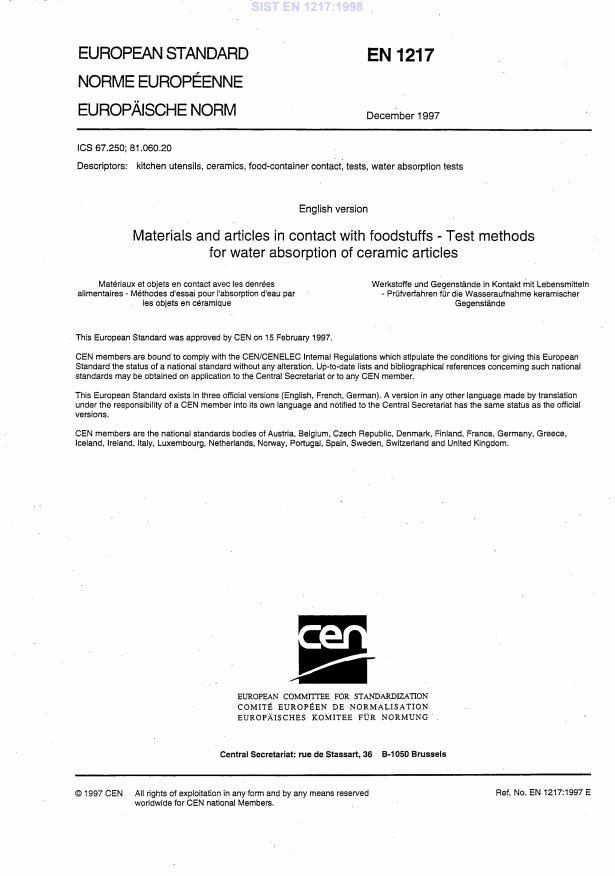
Materials and articles in contact with foodstuffs - Test methods for water absorption of ceramic articles
This European Standard specifies test methods for the determination of the water absorption of ceramic articles. Three test methods are desribed: - Test method A, based on the increase in mass of test specimens after immersion in boiling water under defined conditions, requiring test specimens with not more than one glazed surface. - Test method B, based on the same principle and general procedure as method A but with a longer period of immersion in boiling water.
Werkstoffe und Gegenstände in Kontakt mit Lebensmitteln - Prüfverfahren für die Wasseraufnahme keramischer Gegenstände
Diese Europäische Norm legt Prüfverfahren zur Bestimmung der Wasseraufnahme von keramischen Gegenständen fest. Drei Verfahren sind beschrieben.
Matériaux et objets en contact avec les denrées alimentaires - Méthodes d'essai pour l'absorption d'eau par les objets en céramique
La présente norme européenne décrit les méthodes pour déterminer l'absorption d'eau par les articles céramiques. Trois méthodes sont décrites.
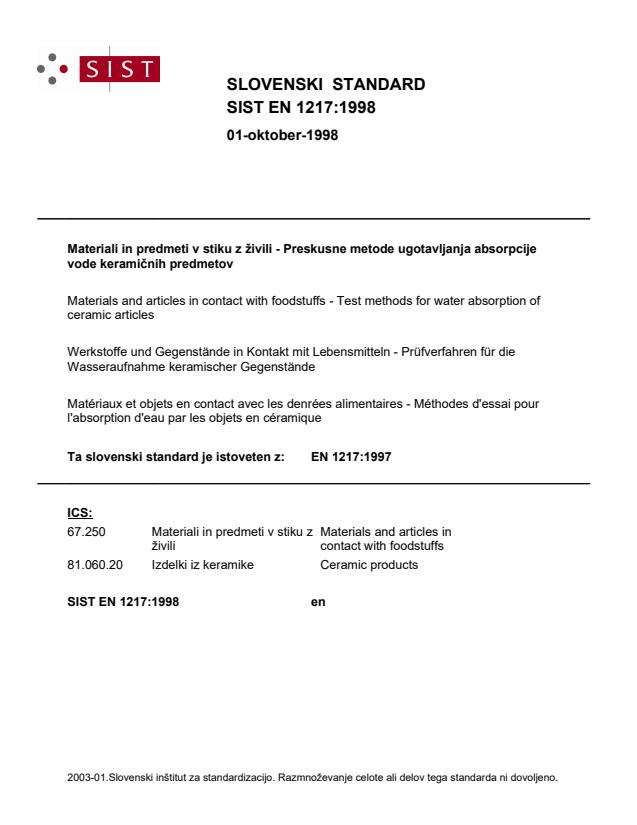
Materiali in predmeti v stiku z živili - Preskusne metode ugotavljanja absorpcije vode keramičnih predmetov
General Information
- Status
- Published
- Publication Date
- 16-Dec-1997
- Withdrawal Date
- 29-Jun-1998
- Technical Committee
- CEN/TC 194 - Utensils in contact with food
- Drafting Committee
- CEN/TC 194/WG 3 - Non-metallic tableware
- Current Stage
- 9060 - Closure of 2 Year Review Enquiry - Review Enquiry
- Start Date
- 04-Mar-2023
- Completion Date
- 04-Mar-2023
Overview
EN 1217:1997 is a European Standard developed by CEN that specifies precise test methods for determining water absorption of ceramic articles. This standard is crucial for assessing the quality and suitability of ceramic materials and articles used in contact with foodstuffs. Water absorption is a key property affecting the durability, hygiene, and safety of ceramic products used in food preparation, storage, and serving.
The standard outlines two primary test methods that measure the increase in mass of ceramic specimens after immersion in boiling water under controlled conditions:
- Test method A: Requires ceramic test specimens with no more than one glazed surface and involves a shorter immersion time.
- Test method B: Similar procedure to method A but with a longer immersion period.
These validated test approaches ensure accurate, reliable, and reproducible assessments of how much water ceramics absorb during use.
Key Topics
Water Absorption Testing
EN 1217:1997 focuses on quantifying water uptake in ceramic objects, a critical factor influencing the product's mechanical strength, resistance to staining, and potential for microbial contamination.Boiling Water Immersion
Both test methods involve immersion of the ceramic specimens in boiling water, simulating extreme usage conditions to assess material performance.Glazing Limitation
The requirement for test specimens to have at most one glazed surface ensures consistent measurement of water absorption in the ceramic body rather than the glaze layer.Standardized Procedure
The document provides detailed instructions on specimen preparation, immersion timing, weighing, and calculation methods to produce comparable results across different laboratories and manufacturers.Material Safety
By assessing water absorption, the standard helps indirectly evaluate the potential for chemical migration during food contact, contributing to food safety compliance.
Applications
EN 1217:1997 is widely applicable in the ceramics industry, especially where products are intended for contact with foodstuffs. Key applications include:
Quality Control in Manufacturing
Ceramic factories implement these test methods to ensure their products meet standards for low water absorption, indicating durability and resistance to liquid penetration.Product Certification and Compliance
Regulatory bodies and certification organizations use EN 1217 to verify that ceramic tableware, cookware, and storage containers conform to European safety and hygiene requirements.Research and Development
Material scientists and engineers rely on EN 1217 to evaluate new ceramic formulations and glazing techniques intended to improve water resistance and longevity.Import and Export Verification
Traders and customs authorities use the standard to validate that imported ceramic food-contact items comply with European market regulations.
Related Standards
To complement EN 1217:1997, several other standards address materials in contact with foodstuffs and ceramic properties:
EN 1388 Series – Ceramic tiles – Methods of test for water absorption, mechanical properties, and resistance to chemicals.
EN 1183 – Ceramic articles for domestic use – Determination of resistance to thermal shock.
EN 13697 – Chemical resistance tests for materials in contact with foodstuffs.
ISO 10545 Series – International tests for ceramic tiles, including water absorption and mechanical strength.
Adhering to EN 1217 alongside these standards ensures comprehensive evaluation of ceramic articles to guarantee safety, durability, and performance in food-related applications.
Keywords: EN 1217, water absorption test, ceramic articles, ceramics in contact with food, boiling water immersion, ceramic quality control, food safety, ceramic standards, European Standard, CEN, glazing ceramics, test methods for ceramics.
Frequently Asked Questions
EN 1217:1997 is a standard published by the European Committee for Standardization (CEN). Its full title is "Materials and articles in contact with foodstuffs - Test methods for water absorption of ceramic articles". This standard covers: This European Standard specifies test methods for the determination of the water absorption of ceramic articles. Three test methods are desribed: - Test method A, based on the increase in mass of test specimens after immersion in boiling water under defined conditions, requiring test specimens with not more than one glazed surface. - Test method B, based on the same principle and general procedure as method A but with a longer period of immersion in boiling water.
This European Standard specifies test methods for the determination of the water absorption of ceramic articles. Three test methods are desribed: - Test method A, based on the increase in mass of test specimens after immersion in boiling water under defined conditions, requiring test specimens with not more than one glazed surface. - Test method B, based on the same principle and general procedure as method A but with a longer period of immersion in boiling water.
EN 1217:1997 is classified under the following ICS (International Classification for Standards) categories: 67.250 - Materials and articles in contact with foodstuffs; 81.060.20 - Ceramic products. The ICS classification helps identify the subject area and facilitates finding related standards.
You can purchase EN 1217:1997 directly from iTeh Standards. The document is available in PDF format and is delivered instantly after payment. Add the standard to your cart and complete the secure checkout process. iTeh Standards is an authorized distributor of CEN standards.
Standards Content (Sample)
2003-01.Slovenski inštitut za standardizacijo. Razmnoževanje celote ali delov tega standarda ni dovoljeno.Werkstoffe und Gegenstände in Kontakt mit Lebensmitteln - Prüfverfahren für die Wasseraufnahme keramischer GegenständeMatériaux et objets en contact avec les denrées alimentaires - Méthodes d'essai pour l'absorption d'eau par les objets en céramiqueMaterials and articles in contact with foodstuffs - Test methods for water absorption of ceramic articles81.060.20Izdelki iz kera
...
The standard EN 1217:1997, titled "Materials and articles in contact with foodstuffs - Test methods for water absorption of ceramic articles," presents a comprehensive framework for evaluating the water absorption properties of ceramic materials used for food contact. This standard delineates three specific test methods designed to quantify the water absorption, ensuring that ceramic articles meet safety and performance criteria essential for food applications. The scope of the standard is particularly significant, as it addresses a critical aspect of ceramic article performance - the water absorption rate, which can directly influence the durability and safety of materials in contact with foodstuffs. By specifying the conditions under which these tests must be executed, it lays down a consistent approach that enhances the reliability of results across different laboratories and manufacturers. The strengths of EN 1217:1997 include the clear, methodical layout of the three test procedures. Test method A focuses on the change in mass of the ceramic specimens following immersion in boiling water, ensuring that the results are objective and reproducible. The requirement of using test specimens with no more than one glazed surface is a thoughtful inclusion, as it helps to isolate variables that could skew absorption measurements. Test method B expands on this by allowing for an extended immersion time, providing manufacturers with flexibility in their testing while still adhering to a robust evaluation protocol. Furthermore, the relevance of this standard cannot be overstated as food safety is paramount in consumer goods. By adhering to these test methods, manufacturers can assure compliance with regulatory requirements and bolster consumer confidence in the safety of ceramic articles. The standard thus serves not only as a method for assessment but also as a vital tool for enhancing product quality in the food industry. In summary, EN 1217:1997 effectively defines the key procedures for evaluating the water absorption of ceramic articles, positioning itself as an essential reference for manufacturers committed to producing safe and reliable materials for food contact applications. Its focus on rigorous testing and standardization solidifies its importance in the broader context of food safety and material compliance.
La norme EN 1217:1997 est cruciale dans le domaine de la sécurité alimentaire, car elle établit des méthodes d'essai pour déterminer l'absorption d'eau des articles en céramique en contact avec des denrées alimentaires. Son champ d'application se concentre sur les moyens de garantir que ces matériaux ne compromettent pas la santé des consommateurs en raison de l'humidité qu'ils peuvent absorber. Parmi les forces de cette norme, on note la clarté et la rigueur des méthodes d'essai décrites. La méthode A, qui examine l'augmentation de la masse des échantillons après immersion dans de l'eau bouillante, est particulièrement utile pour évaluer rapidement les propriétés d'absorption des articles en céramique. Cette méthode exige des spécimens de test dotés d'une surface émaillée unique, ce qui simplifie la préparation des échantillons et garantit la précision des résultats. La méthode B, tout en se basant sur le même principe que la méthode A, propose une période d'immersion prolongée, ce qui permet d'obtenir une évaluation plus complète de l'absorption d'eau. Cela donne aux fabricants et aux laboratoires la flexibilité nécessaire pour choisir la méthode qui correspond le mieux à leurs besoins spécifiques. La pertinence de la norme EN 1217:1997 dans le cadre réglementaire actuel ne saurait être sous-estimée. Elle répond à un besoin essentiel de garantir la sécurité des articles céramiques en contact avec les aliments, en fournissant des directives pratiques et normalisées. En facilitant l'évaluation de l'absorption d'eau, cette norme contribue non seulement à la qualité des produits mais aussi à la protection des consommateurs. En résumé, la norme SIST EN 1217:1998 constitue une référence essentielle pour les fabricants et les laboratoires, leur permettant de s'assurer que les articles en céramique respectent des critères de sécurité stricts concernant l'absorption d'eau. Sa structure méthodologique bien définie et ses approches flexibles en font un document incontournable pour toute entreprise œuvrant dans le secteur des matériaux en contact avec des aliments.
EN 1217:1997 は、食品と接触する材料および器具に関する標準であり、セラミック製品の水分吸収性能を評価するための試験方法を明確に定義しています。この標準のスコープは、セラミック製品が食品と接触する際の安全性を確保するための重要な指針を提供します。 この標準の強みは、セラミック製品の製造業者が遵守すべき具体的な試験方法を提案している点です。試験方法Aおよび試験方法Bは、異なる浸漬期間に基づいており、これによりさまざまな製品特性に応じた柔軟なテストが可能です。試験方法Aでは、一定の条件下で沸騰水に浸漬し、質量の増加を測定することで水分吸収を評価します。一方、試験方法Bでは、同様の原則に基づきながら、より長い浸漬期間を設けることで、より詳細なデータ収集を可能にします。 さらに、この標準は、セラミック製品における食品安全性の向上に貢献するとともに、規制機関や消費者が安心して使用できる基準を提供します。EN 1217:1997 の適用により、製品の品質保証が行われるため、リスクを最小限に抑えることができます。 このように、EN 1217:1997 は、食品接触製品における水分吸収に関する重要な標準として、業界内での関連性を高めており、セラミック製品の製造およびTestingプロセスにおいて欠かせない指標となっています。
표준 EN 1217:1997은 식품에 접촉하는 자재 및 기기와 관련된 시험 방법을 규명하는 유럽 표준으로, 도자기 제품의 수분 흡수량을 측정하기 위한 시험 방법을 제공합니다. 이 표준은 도자기 기기의 물리적 특성과 안전성을 평가하는 데 있어서 매우 중요한 역할을 하며, 특히 식품 안전성 관련 규정 준수에 필수적입니다. EN 1217:1997은 두 가지 시험 방법, 즉 시험 방법 A와 시험 방법 B를 제시하고 있습니다. 시험 방법 A는 정의된 조건 하에 끓는 물에 담금으로써 시험 시료의 질량 증가를 측정하는 방식으로, 유리 표면이 하나 이하인 시료를 요구합니다. 반면, 시험 방법 B는 동일한 원리와 절차를 따르되, 더 긴 담금 시간을 적용하여 수분 흡수 결과의 신뢰성을 향상시킵니다. 이 두 가지 방법은 다양한 도자기 제품의 수분 흡수 특성을 과학적으로 분석하고 비교할 수 있도록 합니다. EN 1217:1997의 강점은 이러한 명확한 시험 방법의 규정이 도자기 제품의 품질 관리와 개선에 기여할 뿐만 아니라, 유럽 시장에서 경쟁력을 확보하는 데에서 중요한 기준으로 작용한다는 점입니다. 또한, 이 표준은 도자기 제품 제조자, 수입업체 및 소비자에게 안정성과 품질을 보장하여 식품 안전성 기준을 충족할 수 있는 중요한 도구로 기능합니다. 결론적으로, EN 1217:1997은 도자기 제품의 물리적 안전성을 평가하고 보장하는 데 있어 필수적인 표준이며, 특히 식품과의 접촉이 우려되는 제품에 대해 매우 중요한 역할을 수행합니다.
Die Norm EN 1217:1997 beschäftigt sich mit den Materialien und Artikeln, die mit Lebensmittel in Kontakt kommen, und legt Testmethoden zur Bestimmung der Wasseraufnahme keramischer Artikel fest. Die Relevanz dieser Norm ist hoch, da sie sicherstellt, dass keramische Produkte, die im Lebensmittelbereich eingesetzt werden, hinsichtlich ihrer Wasseraufnahmefähigkeit auf bestimmte Standards getestet werden. Dies ist entscheidend für die Gewährleistung der Qualität und Sicherheit von Lebensmitteln. Der Umfang der Norm umfasst spezifische Testmethoden, die zur Bewertung der Wasseraufnahme von Keramikartikeln eingesetzt werden können. Insbesondere werden drei Testmethoden detailliert beschrieben: Die Testmethode A, die auf der Massenzunahme der Proben nach dem Eintauchen in kochendes Wasser basiert, wobei definierten Bedingungen zu folgen ist. Diese Methode setzt voraus, dass die Prüfproben nicht mehr als eine glasierte Oberfläche aufweisen. Die Methode B hingegen basiert auf denselben Prinzipien wie die Methode A, jedoch mit einer längeren Eintauchzeit in kochendem Wasser. Diese unterschiedlichen Methoden bieten eine flexible Herangehensweise, die es erlaubt, die Wasseraufnahme für verschiedene keramische Artikel zu überprüfen. Ein herausragendes Merkmal der EN 1217:1997 ist ihre enge Verbindung zu den europäischen Vorschriften für Lebensmittelsicherheit. Durch die vorgeschlagenen Testmethoden wird gewährleistet, dass die keramischen Artikel keine schädlichen Substanzen abgeben, die die Lebensmittelsicherheit gefährden könnten. Dies macht die Norm besonders relevant für Hersteller, die in der Lebensmittelindustrie tätig sind, da sie rechtliche Anforderungen erfüllen und gleichzeitig die Qualität ihrer Produkte sichern müssen. Zusammenfassend ist die Norm EN 1217:1997 ein wesentlicher Bestandteil der Qualitätskontrolle für keramische Artikel im Kontakt mit Lebensmitteln. Ihre klaren und gründlichen Testmethoden zur Bestimmung der Wasseraufnahme bieten sowohl den Herstellern als auch den Verbrauchern Vertrauen in die Sicherheit und Qualität der Produkte.


Questions, Comments and Discussion
Ask us and Technical Secretary will try to provide an answer. You can facilitate discussion about the standard in here.
Loading comments...