

SIST EN 1217:1998
(Main)Materials and articles in contact with foodstuffs - Test methods for water absorption of ceramic articles
General Information
- Abstract
This European Standard specifies test methods for the determination of the water absorption of ceramic articles. Three test methods are desribed: - Test method A, based on the increase in mass of test specimens after immersion in boiling water under defined conditions, requiring test specimens with not more than one glazed surface. - Test method B, based on the same principle and general procedure as method A but with a longer period of immersion in boiling water.
- Status
- Published
- Publication Date
- 30-Sep-1998
- Technical Committee
- EPO - Packaging - sales and grouped
- Current Stage
- 6060 - National Implementation/Publication (Adopted Project)
- Start Date
- 01-Oct-1998
- Due Date
- 01-Oct-1998
- Completion Date
- 01-Oct-1998

Overview
SIST EN 1217:1998 is a European Standard developed by CEN that specifies precise test methods for determining water absorption of ceramic articles. This standard is crucial for assessing the quality and suitability of ceramic materials and articles used in contact with foodstuffs. Water absorption is a key property affecting the durability, hygiene, and safety of ceramic products used in food preparation, storage, and serving.
The standard outlines two primary test methods that measure the increase in mass of ceramic specimens after immersion in boiling water under controlled conditions:
- Test method A: Requires ceramic test specimens with no more than one glazed surface and involves a shorter immersion time.
- Test method B: Similar procedure to method A but with a longer immersion period.
These validated test approaches ensure accurate, reliable, and reproducible assessments of how much water ceramics absorb during use.
Key Topics
Water Absorption Testing
SIST EN 1217:1998 focuses on quantifying water uptake in ceramic objects, a critical factor influencing the product's mechanical strength, resistance to staining, and potential for microbial contamination.Boiling Water Immersion
Both test methods involve immersion of the ceramic specimens in boiling water, simulating extreme usage conditions to assess material performance.Glazing Limitation
The requirement for test specimens to have at most one glazed surface ensures consistent measurement of water absorption in the ceramic body rather than the glaze layer.Standardized Procedure
The document provides detailed instructions on specimen preparation, immersion timing, weighing, and calculation methods to produce comparable results across different laboratories and manufacturers.Material Safety
By assessing water absorption, the standard helps indirectly evaluate the potential for chemical migration during food contact, contributing to food safety compliance.
Applications
SIST EN 1217:1998 is widely applicable in the ceramics industry, especially where products are intended for contact with foodstuffs. Key applications include:
Quality Control in Manufacturing
Ceramic factories implement these test methods to ensure their products meet standards for low water absorption, indicating durability and resistance to liquid penetration.Product Certification and Compliance
Regulatory bodies and certification organizations use EN 1217 to verify that ceramic tableware, cookware, and storage containers conform to European safety and hygiene requirements.Research and Development
Material scientists and engineers rely on EN 1217 to evaluate new ceramic formulations and glazing techniques intended to improve water resistance and longevity.Import and Export Verification
Traders and customs authorities use the standard to validate that imported ceramic food-contact items comply with European market regulations.
Related Standards
To complement SIST EN 1217:1998, several other standards address materials in contact with foodstuffs and ceramic properties:
EN 1388 Series – Ceramic tiles – Methods of test for water absorption, mechanical properties, and resistance to chemicals.
EN 1183 – Ceramic articles for domestic use – Determination of resistance to thermal shock.
EN 13697 – Chemical resistance tests for materials in contact with foodstuffs.
ISO 10545 Series – International tests for ceramic tiles, including water absorption and mechanical strength.
Adhering to EN 1217 alongside these standards ensures comprehensive evaluation of ceramic articles to guarantee safety, durability, and performance in food-related applications.
Keywords: EN 1217, water absorption test, ceramic articles, ceramics in contact with food, boiling water immersion, ceramic quality control, food safety, ceramic standards, European Standard, CEN, glazing ceramics, test methods for ceramics.
Relations
- Effective Date
- 28-Jan-2026
- Effective Date
- 28-Jan-2026
- Effective Date
- 28-Jan-2026
Get Certified
Connect with accredited certification bodies for this standard

BSI Group
BSI (British Standards Institution) is the business standards company that helps organizations make excellence a habit.

Bureau Veritas
Bureau Veritas is a world leader in laboratory testing, inspection and certification services.

DNV
DNV is an independent assurance and risk management provider.
Sponsored listings
Frequently Asked Questions
SIST EN 1217:1998 is a standard published by the Slovenian Institute for Standardization (SIST). Its full title is "Materials and articles in contact with foodstuffs - Test methods for water absorption of ceramic articles". This standard covers: This European Standard specifies test methods for the determination of the water absorption of ceramic articles. Three test methods are desribed: - Test method A, based on the increase in mass of test specimens after immersion in boiling water under defined conditions, requiring test specimens with not more than one glazed surface. - Test method B, based on the same principle and general procedure as method A but with a longer period of immersion in boiling water.
This European Standard specifies test methods for the determination of the water absorption of ceramic articles. Three test methods are desribed: - Test method A, based on the increase in mass of test specimens after immersion in boiling water under defined conditions, requiring test specimens with not more than one glazed surface. - Test method B, based on the same principle and general procedure as method A but with a longer period of immersion in boiling water.
SIST EN 1217:1998 is classified under the following ICS (International Classification for Standards) categories: 67.250 - Materials and articles in contact with foodstuffs; 81.060.20 - Ceramic products. The ICS classification helps identify the subject area and facilitates finding related standards.
SIST EN 1217:1998 has the following relationships with other standards: It is inter standard links to SIST EN 14020-3:2003, SIST EN 1900:2000, SIST EN 14020-2:2003. Understanding these relationships helps ensure you are using the most current and applicable version of the standard.
SIST EN 1217:1998 is available in PDF format for immediate download after purchase. The document can be added to your cart and obtained through the secure checkout process. Digital delivery ensures instant access to the complete standard document.
Standards Content (Sample)
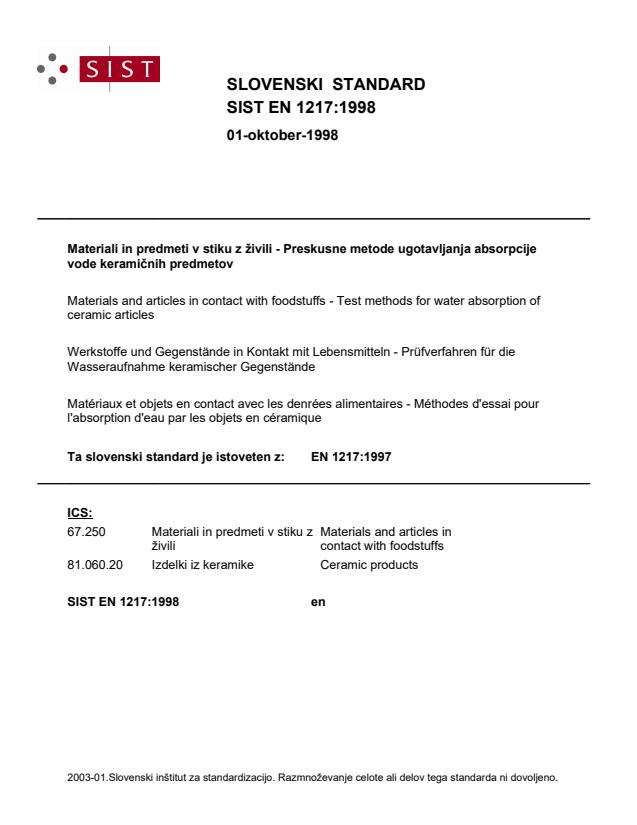
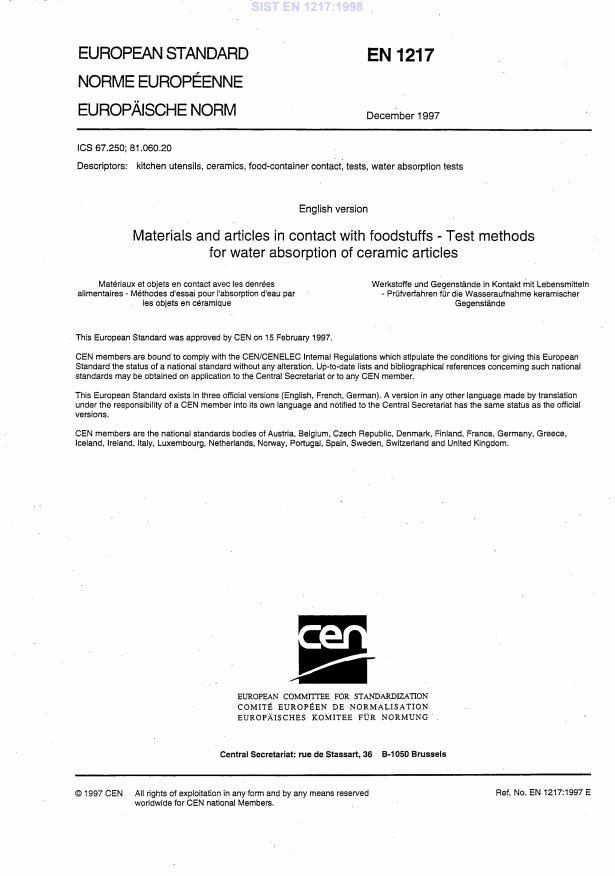
2003-01.Slovenski inštitut za standardizacijo. Razmnoževanje celote ali delov tega standarda ni dovoljeno.Werkstoffe und Gegenstände in Kontakt mit Lebensmitteln - Prüfverfahren für die Wasseraufnahme keramischer GegenständeMatériaux et objets en contact avec les denrées alimentaires - Méthodes d'essai pour l'absorption d'eau par les objets en céramiqueMaterials and articles in contact with foodstuffs - Test methods for water absorption of ceramic articles81.060.20Izdelki iz kera
...