

EN 13616:2004
(Main)Overfill prevention devices for static tanks for liquid petroleum fuels
- Abstract
This standard specifies the minimum performance and construction requirements for various types of overfill prevention devices which are limited to static tanks of shop fabricated manufacture both metallic and non metallic. It covers devices for underground tanks and also above ground tanks with a maximum height of 5 m.
To cover the different types of overfill prevention devices, two types have been developed:
¾ Type A: An overfill prevention device where the operation does not depend on the road tank vehicle or supply system;
¾ Type B: An overfill prevention device where the operation depends on the road tank vehicle or the supply system.
This standard applies to overfill prevention devices for liquid petroleum fuels, having a flash point up to but not exceeding 100 °C. The requirements apply to overfill prevention devices suitable for use at ambient temperatures in the range from -25°C to +60°C, and subject to normal operational pressure variations.
- Status
- Withdrawn
- Publication Date
- 06-Jul-2004
- Withdrawal Date
- 06-Oct-2026
- Technical Committee
- CEN/TC 393 - Equipment for storage tanks and for service stations
- Current Stage
- 9960 - Withdrawal effective - Withdrawal
- Start Date
- 08-Jun-2016
- Completion Date
- 07-Oct-2026
- Directive
- 2014/34/EU - Directive 2014/34/EU Of The European Parliament And Of The Council of 26 February 2014 on the harmonisation of the laws of the Member States relating to equipment and protective systems intended for use in potentially explosive atmospheres (recast)OJ Ref: C, C 126, HARMONIZIRAN OJ Date: 08-Apr-2016
305/2011 - Regulation (eu) No 305/2011 of the European Parliament and of the Council of 9 march 2011 laying down harmonised conditions for the marketing of construction products and repealing council directive 89/106/eecOJ Ref: C, C 259 OJ Date: 08-Aug-2014
89/106/EEC - Construction productsOJ Ref: C, C 139, C 263, C 319 OJ Date: 26-Oct-2004
94/9/EC - Equipment and protective systems intended for use in potentially explosive atmospheres (ATEX)OJ Ref: C, C 57 OJ Date: 09-Mar-2006


Relations
- Effective Date
- 08-Jun-2022
- Effective Date
- 08-Jun-2022
- Effective Date
- 08-Jun-2022
- Effective Date
- 02-Jun-2026
- Effective Date
- 09-Feb-2026
- Effective Date
- 09-Feb-2026
- Refers
EN IEC 60079-11:2024 - Explosive atmospheres - Part 11: Equipment protection by intrinsic safety "i" - Effective Date
- 09-Feb-2026
- Effective Date
- 09-Feb-2026
- Effective Date
- 09-Feb-2026
- Effective Date
- 09-Feb-2026
- Effective Date
- 09-Feb-2026
- Effective Date
- 28-Jan-2026
- Effective Date
- 28-Jan-2026
- Effective Date
- 28-Jan-2026
- Effective Date
- 28-Jan-2026
Get Certified
Connect with accredited certification bodies for this standard

Element Materials Technology
Materials testing and product certification.

ABS Group Brazil
ABS Group certification services in Brazil.

ABS Quality Evaluations Inc.
American Bureau of Shipping quality certification.
Sponsored listings
Frequently Asked Questions
EN 13616:2004 is a standard published by the European Committee for Standardization (CEN). Its full title is "Overfill prevention devices for static tanks for liquid petroleum fuels". This standard covers: This standard specifies the minimum performance and construction requirements for various types of overfill prevention devices which are limited to static tanks of shop fabricated manufacture both metallic and non metallic. It covers devices for underground tanks and also above ground tanks with a maximum height of 5 m. To cover the different types of overfill prevention devices, two types have been developed: ¾ Type A: An overfill prevention device where the operation does not depend on the road tank vehicle or supply system; ¾ Type B: An overfill prevention device where the operation depends on the road tank vehicle or the supply system. This standard applies to overfill prevention devices for liquid petroleum fuels, having a flash point up to but not exceeding 100 °C. The requirements apply to overfill prevention devices suitable for use at ambient temperatures in the range from -25°C to +60°C, and subject to normal operational pressure variations.
This standard specifies the minimum performance and construction requirements for various types of overfill prevention devices which are limited to static tanks of shop fabricated manufacture both metallic and non metallic. It covers devices for underground tanks and also above ground tanks with a maximum height of 5 m. To cover the different types of overfill prevention devices, two types have been developed: ¾ Type A: An overfill prevention device where the operation does not depend on the road tank vehicle or supply system; ¾ Type B: An overfill prevention device where the operation depends on the road tank vehicle or the supply system. This standard applies to overfill prevention devices for liquid petroleum fuels, having a flash point up to but not exceeding 100 °C. The requirements apply to overfill prevention devices suitable for use at ambient temperatures in the range from -25°C to +60°C, and subject to normal operational pressure variations.
EN 13616:2004 is classified under the following ICS (International Classification for Standards) categories: 23.020.10 - Stationary containers and tanks; 75.200 - Petroleum products and natural gas handling equipment. The ICS classification helps identify the subject area and facilitates finding related standards.
EN 13616:2004 has the following relationships with other standards: It is inter standard links to EN 13616-1:2016, EN 16657:2016, EN 13616-2:2016, EN IEC 61000-6-3:2026, EN IEC 61000-6-3:2021, EN IEC 61000-6-1:2019, EN IEC 60079-11:2024, EN IEC 61000-6-2:2019, EN 60529:1991, EN IEC 60079-0:2018, EN IEC 61000-6-4:2019, EN 590:2025, EN ISO 13849-1:2023, EN 14116:2012, EN 14116:2012+A2:2018. Understanding these relationships helps ensure you are using the most current and applicable version of the standard.
EN 13616:2004 is associated with the following European legislation: EU Directives/Regulations: 2014/34/EU, 305/2011, 89/106/EEC, 94/9/EC; Standardization Mandates: M/131, M/BC/CEN/92/46. When a standard is cited in the Official Journal of the European Union, products manufactured in conformity with it benefit from a presumption of conformity with the essential requirements of the corresponding EU directive or regulation.
EN 13616:2004 is available in PDF format for immediate download after purchase. The document can be added to your cart and obtained through the secure checkout process. Digital delivery ensures instant access to the complete standard document.
Standards Content (Sample)
2003-01.Slovenski inštitut za standardizacijo. Razmnoževanje celote ali delov tega standarda ni dovoljeno.Overfill prevention devices for static tanks for liquid petroleum fuelsDispositifs limiteurs de remplissage pour réservoirs statiques pour carburants pétroliers liquidesÜberfüllsicherungen für ortsfeste Tanks für flüssige Brenn- und KraftstoffeTa slovenski standard je istoveten z:EN 13616:2004SIST EN 13616:2004en75.20023.020.10ICS:SLOVENSKI
STANDARDSIST EN 13616:200401-november-2004
EUROPEAN STANDARDNORME EUROPÉENNEEUROPÄISCHE NORMEN 13616July 2004ICS 23.020.10; 75.200English versionOverfill prevention devices for static tanks for liquid petroleumfuelsDispositifs limiteurs de remplissage pour réservoirsstatiques pour carburants pétroliers liquidesÜberfüllsicherungen für ortsfeste Tanks für flüssige Brenn-und KraftstoffeThis European Standard was approved by CEN on 8 April 2004.CEN members are bound to comply with the CEN/CENELEC Internal Regulations which stipulate the conditions for giving this EuropeanStandard the status of a national standard without any alteration. Up-to-date lists and bibliographical references concerning such nationalstandards may be obtained on application to the Central Secretariat or to any CEN member.This European Standard exists in three official versions (English, French, German). A version in any other language made by translationunder the responsibility of a CEN member into its own language and notified to the Central Secretariat has the same status as the officialversions.CEN members are the national standards bodies of Austria, Belgium, Cyprus, Czech Republic, Denmark, Estonia, Finland, France,Germany, Greece, Hungary, Iceland, Ireland, Italy, Latvia, Lithuania, Luxembourg, Malta, Netherlands, Norway, Poland, Portugal, Slovakia,Slovenia, Spain, Sweden, Switzerland and United Kingdom.EUROPEAN COMMITTEE FOR STANDARDIZATIONCOMITÉ EUROPÉEN DE NORMALISATIONEUROPÄISCHES KOMITEE FÜR NORMUNGManagement Centre: rue de Stassart, 36
B-1050 Brussels© 2004 CENAll rights of exploitation in any form and by any means reservedworldwide for CEN national Members.Ref. No. EN 13616:2004: E
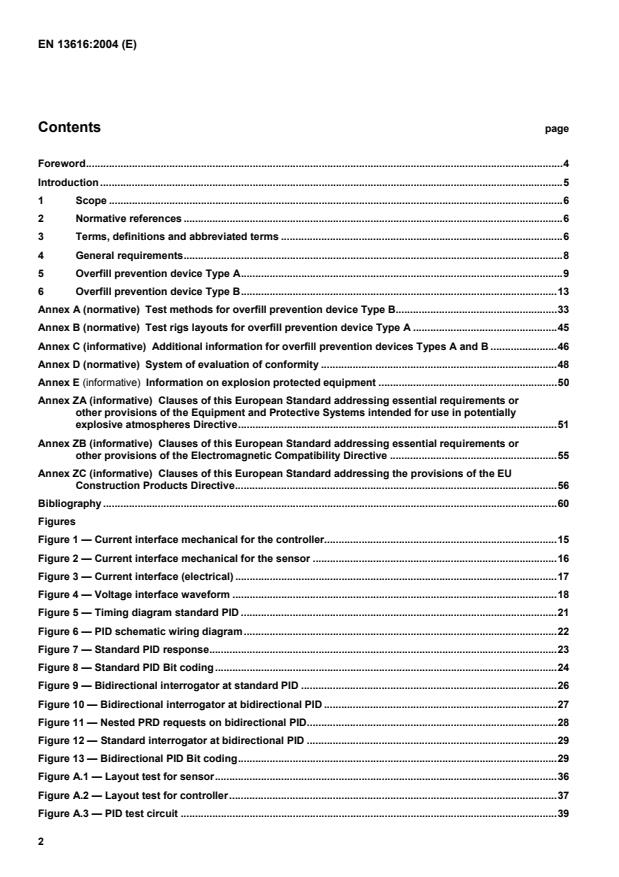
page Foreword.4 Introduction.5 1 Scope.6 2 Normative references.6 3 Terms, definitions and abbreviated terms.6 4 General requirements.8 5 Overfill prevention device Type A.9 6 Overfill prevention device Type B.13 Annex A (normative)
Test methods for overfill prevention device Type B.33 Annex B (normative)
Test rigs layouts for overfill prevention device Type A.45 Annex C (informative)
Additional information for overfill prevention devices Types A and B.46 Annex D (normative)
System of evaluation of conformity.48 Annex E (informative)
Information on explosion protected equipment.50 Annex ZA (informative)
Clauses of this European Standard addressing essential requirements or other provisions of the Equipment and Protective Systems intended for use in potentially explosive atmospheres Directive.51 Annex ZB (informative)
Clauses of this European Standard addressing essential requirements or other provisions of the Electromagnetic Compatibility Directive.55 Annex ZC (informative)
Clauses of this European Standard addressing the provisions of the EU Construction Products Directive.56 Bibliography.60 Figures Figure 1 — Current interface mechanical for the controller.15 Figure 2 — Current interface mechanical for the sensor.16 Figure 3 — Current interface (electrical).17 Figure 4 — Voltage interface waveform.18 Figure 5 — Timing diagram standard PID.21 Figure 6 — PID schematic wiring diagram.22 Figure 7 — Standard PID response.23 Figure 8 — Standard PID Bit coding.24 Figure 9 — Bidirectional interrogator at standard PID.26 Figure 10 — Bidirectional interrogator at bidirectional PID.27 Figure 11 — Nested PRD requests on bidirectional PID.28 Figure 12 — Standard interrogator at bidirectional PID.29 Figure 13 — Bidirectional PID Bit coding.29 Figure A.1 — Layout test for sensor.36 Figure A.2 — Layout test for controller.37 Figure A.3 — PID test circuit.39
Table 1 — DC electrical characteristics of PRD.19 Table 2 — AC electrical characteristics of PRD (bidirectional PRD only).20 Table 3 — Operating conditions of PID.20 Table 4 — DC electrical characteristics of PID.20 Table 5 — AC electrical characteristics of PID.21 Table 6 — Diode and electro-static discharge protection.22 Table 7 — Standard PID Byte framing.24 Table 8 — Standard PID telegram.24 Table 9 — Standard PID message format.25 Table 10 — Standard PID message #1.26 Table 11 — Bidirectional PID Byte framing.30 Table 12 — Bidirectional PID request message format.30 Table 13 — Bidirectional PID response message format.31 Table 14 — Bidirectional PID data identifier.32 Table 15 — Classification.32 Table A.1 — Connection.38 Table A.2 — Dynamic tests.40 Table A.3 — PID simulator settings.43 Table C.1 — Diameter and flow rate.46 Table E.1 — Standard protection concepts allowed.50 Table ZA.1 — Comparison between Directive 94/9/EC and this European Standard.51 Table ZB.1 — Comparison between Directive 89/336/EEC and this European Standard.55 Table ZC.1 — Relevant clauses for product and intended use.56 Table ZC.2 — Attestation of conformity systems.57 Table ZC.3 — Assignment of evaluation of conformity tasks under system 3 for overfill prevention devices used for storage of fuel.57 Table ZC.4 — Assignment of evaluation of conformity tasks under system 4 for overfill prevention devices used for storage of water not intended for human consumption.58
This document (EN 13616:2004) has been prepared by Technical Committee CEN/TC 221 “Shop fabricated metallic tanks and equipment for storage tanks and for service stations”, the secretariat of which is held by DIN. This European Standard shall be given the status of a national standard, either by publication of an identical text or by endorsement, at the latest by January 2005, and conflicting national standards shall be withdrawn at the latest by April 2006. This European Standard has been prepared under a mandate given to CEN by the European Commission and the European Free Trade Association and supports essential requirements of the Equipment and protective systems intended for use in potentially explosive atmospheres Directive (ATEX)1), Electromagnetic Compatibility Directive (EMC)2) and Construction Products Directive (CPD)3).
For the relationship with the Directives 94/9/EC, 89/336/EEC and 89/106/EEC, respectively see informative annexes ZA, ZB and ZC which are an integral part of this document. By application of this European Standard presumption is given, that the Essential Safety Requirements of the ATEX, EMC and CPD Directives are met. According to the CEN/CENELEC Internal Regulations, the national standards organizations of the following countries are bound to implement this European Standard: Austria, Belgium, Cyprus, Czech Republic, Denmark, Estonia, Finland, France, Germany, Greece, Hungary, Iceland, Ireland, Italy, Latvia, Lithuania, Luxembourg, Malta, Netherlands, Norway, Poland, Portugal, Slovakia, Slovenia, Spain, Sweden, Switzerland and United Kingdom.
1) Directive 94/9/EC of the European Parliament and of the Council of 23 March 1994 on the approximation of the laws of the Member States concerning Equipment and protective systems intended for use in potentially explosive atmospheres (OJEC L 100). 2) Directive 89/336/EEC of the European Parliament and of the Council of 03 May 1989 on the approximation of the laws of the Member States concerning Electromagnetic compatibility (OJEC L 139). 3) Directive 89/106/EEC of the European Parliament and the Council of 21 December 1988 on the approximation of the laws of the Member States concerning Construction products (OJEC L 40).
EN 590, Automotive fuels — Diesel – Requirements and test methods EN 954–1, Safety of machinery — Safety-related parts of control systems — Part 1: General principles for design EN 50014, Electrical apparatus for potentially explosive atmospheres — General requirements EN 50020, Electrical apparatus for potentially explosive atmospheres — Intrinsic safety « i » EN 60204-1, Safety of machinery – Electrical equipment of machines – Part 1: General requirements (IEC 60204-1:1997) EN 60529, Degrees of protection provided by enclosures (IP code) (IEC 60529:1989) EN 61000-6-1, Electromagnetic compatibility (EMC) - Part 6-1: Generic standards; Immunity for residential, commercial and light-industrial environments (IEC 61000-6-1:1997, modified) EN 61000-6-2, Electromagnetic compatibility (EMC) - Part 6-2: Generic standards; Immunity for industrial environments (IEC 61000-6-2:1999, modified) EN 61000-6-3, Electromagnetic compatibility (EMC) - Part 6-3: Generic standards; Emission standard for residential, commercial and light-industrial environments (IEC 61000-6-3:1996, modified) EN 61000-6-4, Electromagnetic compatibility (EMC) - Part 6-4: Generic standards; Emission standard for industrial environments (IEC 61000-6-4:1997, modified) 3 Terms, definitions and abbreviated terms For the purposes of this document the following terms, definitions and abbreviated terms apply.
level at which the overfill prevention device prevents any further product, apart from a permissible leak rate, entering the storage tank at, or prior to, the maximum filling level 3.7 leak rate permitted rate of liquid allowed to pass through the overfill prevention device after final closure 3.8 overfill prevention controller connects to sensors mounted in or on the storage tank and provides a permissive or non permissive output, hereinafter referred to as a controller 3.9 liquid level detection device device mounted in a storage tank for detecting liquid at a predetermined level and connected to a controller, hereinafter referred to as a sensor 3.10 permissive output state of the overfill prevention controller fitted to the road tank vehicle or supply system which permits liquid delivery 3.11 non-permissive output state of the overfill prevention controller fitted to the road tank vehicle or supply system which does not permit liquid delivery 3.12 shutdown volume volume of liquid which will flow into the storage tank after the detection of the potential overfill, and before the complete shutoff 3.13 residual volume amount of liquid which is in the supply system at the moment of shutdown. This extra volume shall be taken into account when setting the sensor level to avoid filling above the maximum filling level
3.17 PRD - Product Recognition Device 4 General requirements 4.1 Functional criteria
4.1.1 On filling the storage tank to a level L1, at this level, a complete and automatic closure or automatic severe restriction of the flow shall be effected. 4.1.2 After initial closure, if provided, the contents of the delivery hose and preferably the delivery pipe shall be emptied into the storage tank. 4.1.3 Final automatic closure shall occur once level L2 has been reached (final closure may be achieved at level L1). At level L2, no further liquid other than the allowable leak rate (see 5.4) shall enter the tank. 4.1.4 The performance of the overfill prevention device shall not be adversely affected by the flow rate taking into account the following: a) the liquid level in the storage tank before and during delivery; or b) the level of liquid in the road tank vehicle or the supply system before and during delivery. 4.1.5 Where the overfill prevention device requires an auxiliary energy source, the filling process shall not commence or shall automatically stop in the event of failure of that energy source. 4.1.6 The operation of the overfill prevention device shall not generate pressure in excess of the designed criteria for the supply system. 4.2 Construction 4.2.1 All construction materials shall be compatible with the temperature range of –25 °C to +60 °C and with the liquid and its vapour phase being stored, the manufacturer shall specify all materials in contact with the liquid. 4.2.2 When the overfill prevention device forms part of an earth continuity path it shall be conductive. 4.2.3 The overfill prevention device shall be of a durable construction. Durability shall be tested in accordance with 5.5.4.7 and annex A. 4.2.4 All parts of the overfill prevention device situated either internally or externally on the tank shall withstand static negative and positive pressure test to comply with 5.5.3. Any resultant deformation shall not prevent the device fully functioning. 4.2.5 The overfill prevention device shall prevent or severely restrict vapour flowing from the ullage space into the fill pipe.
Any electrical equipment, intended for use in potentially explosive atmospheres, shall comply with the requirements according to EN 50014 and, where relevant, the European Standard for the specific type of ignition protection selected, see Table E.1.
4.3.3 Non-electrical equipment
Any non-electrical equipment, intended for use in potentially explosive atmospheres, shall comply with the requirements of EN 13463-1 and, where relevant, the European Standard for the specific type of ignition protection selected. 5 Overfill prevention device Type A 5.1 Classification Two subtypes of devices are defined for Type A: Overfill prevention device by gravity fill only: Subtype A1; Overfill prevention device by gravity or pump fill: Subtype A2. 5.2 Flow rate 5.2.1 Overfill prevention device by gravity fill only (see annex C.1) The device shall work at 0,2 m/s minimum linear velocity and 15 kPa static pressure after closure. The device shall work at 3 m/s maximum linear velocity and 200 kPa static pressure after closure. 5.2.2 Overfill prevention device by gravity or pump fill (see annex C.1) The device shall work at 0,2 m/s minimum linear velocity and 15 kPa static pressure after closure. The device shall work at 3 m/s maximum linear velocity and 400 kPa or 800 kPa static pressure after closure. 5.3 Pressure surge 5.3.1 Overfill prevention device by gravity fill Any pressure surge created by the overfill prevention device at closure exceeding 300 kPa shall not exceed a period of more than 10 ms. 5.3.2 Overfill prevention device by gravity or pump fill For pump with a performance of 400 kPa any pressure surge created by the overfill prevention device at closure exceeding 600 kPa shall not exceed a period of more than 10 ms.
Testing shall be carried out at the following level: raw material checks: 5 % ; components production checks: 5 %; manufactured product checks: 100 %.
Each overfill prevention device shall be tested 5 times in accordance with 5.5.4.2, 5.5.4.3 and once in accordance with 5.5.4.4. 5.6 Test report Test results shall be recorded in a report. 5.7 Marking 5.7.1 Identification The device shall be permanently marked with the following information:
Socket type F 903
material plastic (e. g. Polyamide) resistant to liquid petroleum products temperature range of –25 °C to +60 °C Key 1 Contact tractive power of the spring
sleeve min. 2,5 N 2 Material: brass nickel plated 3 Cable strain relief Figure 1 — Current interface mechanical for the controller
Plug insert
Key 1 G1 ½
(ISO 228) 2 Contact pin
Material: brass nickel plated 3 Terminal Figure 2 — Current interface mechanical for the sensor Plug type 907 W material brass
Key 1 Signal "filling permitted" 2 Signal "filling not permitted" Figure 3 — Current interface (electrical) 41 mA < I1 < 49,5 mA38 mA < I2 < 44 mA 2,0 mA < I3 < 10 mA I1 > I2 0,5 s < x < 180 s
U0 ≤ 25 V Maximum output current
I0 ≤ 165 mA Maximum output power
P0 ≤ 1 W. 6.4.3 Voltage interface 6.4.3.1 Connection characteristics The overfill prevention sensor has two wires. One wire is the power/signal wire and the other wire is the earth (circuit return) wire. The power/signal connection from the control unit to the sensor is made via the hoses used for delivery of products. The earth/circuit return connection for all sensors at a site to the controller is made via the vapour recovery hose or by a direct cable connection to the truck chassis. The maximum resistance of the controller to sensor(s) connections shall be less than 10 Ω. The circuit design shall be able to function with a connection resistance of 50 Ω. The insulation resistance of the connection shall be greater than 15 KΩ. Fail-safe properties of the sensor and controller shall be in accordance with EN 954-1 category 3. Figure 4 defines the waveform limits for the signal that is generated when an overfill prevention sensor is connected to a controller. This waveform is for a "dry" sensor. When the sensor becomes wet, the waveform signal ceases. The various states are outlined in the test procedure for the sensor. The explosion-technical parameters for the interface shall be at least EEx ib IIB T4 according to EN 50014 and EN 50020. 6.4.3.2 Waveform The sensor is powered by the controller with a supply voltage of 7 V to 12 V (tolerances are the same as for V2 in Figure 4). The sensor draws less than 2 mA current in high state and is capable of sinking greater than 10 mA in low state of the waveform.
Tolerances T2 : 10 ms to 100 ms T2 - T1 ≥ (2 + 0,2) ms T1 ≥ (6 + 0,6) ms Figure 4 — Voltage interface waveform
Standard (unidirectional) PID;
Bidirectional PID. The explosion-technical parameters for the interface shall be at least EEx ib IIB T4 according to EN 50014 and EN 50020. 6.4.4.3 PRD Table 1 — DC electrical characteristics of PRD Parameter Operational minimum value Nominal value Explosion-technical maximum value Units Open-circuit voltage 11 12 U0 ≤ 15 V Short-circuit current - - I0 ≤ 300 mA Output power - - P0 ≤1,1 W
6.4.4.4 PID (electrical data interface) Table 3 — Operating conditions of PID Parameter SymbolMinimum valueMaximum value Units Ambient temperature range TA -25 +60 ºC IP-Code according to EN 60529 - 20 - -
Table 4 — DC electrical characteristics of PID The electrical specification is valid over the whole ambient temperature range. Parameter Symbol Minimum value Nominal value Maximum value Units Supply voltage U+ 6 12 15 V Supply currenta
IL 0 5 10 mA Supply current at U+ < 3 V IOFF - - 5 mA Maximum internal capacitance Ci - - 600 nF Maximum internal inductanceb
Li - 0 - mH a Without current modulation. No low limit specified. b Neglectable small.
Standard PID
Bidirectional PIDa
tTds tTdb
0 2,2
- -
0,9 4,5
ms ms Response delay bidirectional PIDa (after a request) tTrd 2,2 - 4,5 ms Bidirectional Byte delayb tTbd - - 0,4 ms a 1 Byte time ≤ t ≤ 2 Byte time. b between end of stop Bit and begin of start Bit. The timing diagrams for the standard and the bidirectional PIDs are very similar, therefore only the standard PID waveform is shown in Figure 5.
Key
fTC clock rate = 2 x baud rate (fBit)
tTds Transmission delay after power-on Standard PID
tTr Pulse rise time tTf Pulse fall time ITD Supply current amplitude
t0 t at power on
t1, t4, t5 = t at I = IL + 10% ITD
t2, t3 = t at I = IL + 90% ITD Figure 5 — Timing diagram standard PID
Key
1 + 2 - 3 Electronic circuit
D Diode R ESD Resistor Figure 6 — PID schematic wiring diagram Table 6 — Diode and electro-static discharge protection The specification is valid over the whole ambient temperature range. Parameter SymbolMinimum value Maximum value Units Resistance of ESD resistor R 100 300 kΩ Diode D forward current ID 300 - mA Diode D forward voltage at ID < 50 mA UD - 1 V
6.4.4.6 Hoses In the case that the PID is connected to the PRD using one or more hoses as wires, the hoses shall meet following requirements: The maximum resistance of the hose including the electrical contacts of the hose couplings shall be RH ≤ 10 Ω. The interrogator electronics on the other hand, shall be able to cope with a connection resistance (simulated hose) of Rcon = 100 Ω. The insulation resistance of the hose, measured between ground and the hose or between crossing hoses shall be Rins ≥ 15 kΩ.
The standard PID sends its data using messages, which are numbered from 1 to 255. The standard PID always contains "message #1" according to Table 7. By implementing more messages, it is possible to program the PID with other types of information (e.g. specific information for certain customers). Since the PID modulates the supply current as long as it is powered, PIDs cannot be connected in parallel. 6.4.4.7.2 Message exchange sequences The standard PID shall start sending its message(s) after a nominal delay after power-up (tTDS), see Figure 7. The data shall be sent out as a burst.
Key 1 Supply voltage 2 Modulation through PID tTDS = Transmission delay after power-on standard PID Figure 7 — Standard PID response
6.4.4.7.3 Bit coding The standard (unidirectional) PID shall send out asynchronous serial data stream by modulating the supply current. The signal shall be a square wave, each logical data Bit is sent as two physical Bits where a logic 1 is sent as a transition f
...