

EN 15208:2007
(Main)Tanks for transport of dangerous goods - Sealed parcel delivery systems - Working principles and interface specifications
- Abstract
This European Standard is applicable to sealed parcel delivery systems used with transport tanks and specifies the performance requirements, critical safety aspects, data transfer methods between loading gantries and transport tank, transport tank and delivery points, other optional communications and tests to provide functional and compatible systems.
Sealed parcel delivery systems covered by this European Standard is for bottom loaded transport tanks.
The systems specified by this European Standard are suitable for use with liquid petroleum products and other dangerous substances of Class 3 of ADR which have a vapour pressure not exceeding 110 kPa at 50 °C and petrol, and which have no sub classification as toxic or corrosive.
- Status
- Withdrawn
- Publication Date
- 10-Apr-2007
- Withdrawal Date
- 06-May-2014
- Technical Committee
- CEN/TC 296 - Tanks for transport of dangerous goods
- Drafting Committee
- CEN/TC 296 - Tanks for transport of dangerous goods
- Current Stage
- 9960 - Withdrawal effective - Withdrawal
- Start Date
- 07-May-2014
- Completion Date
- 07-May-2014

Relations
- Effective Date
- 30-Apr-2011
- Effective Date
- 25-Aug-2026
- Effective Date
- 25-Aug-2026
- Effective Date
- 25-Aug-2026
- Effective Date
- 25-Aug-2026
- Effective Date
- 28-Jan-2026
- Effective Date
- 28-Jan-2026
- Effective Date
- 28-Jan-2026
- Effective Date
- 28-Jan-2026
- Effective Date
- 28-Jan-2026
- Effective Date
- 28-Jan-2026
- Effective Date
- 28-Jan-2026
- Effective Date
- 28-Jan-2026
- Effective Date
- 28-Jan-2026
- Effective Date
- 28-Jan-2026
Get Certified
Connect with accredited certification bodies for this standard

BSI Group
BSI (British Standards Institution) is the business standards company that helps organizations make excellence a habit.

CIS Institut d.o.o.
Personal Protective Equipment (PPE) certification body. Notified Body NB-2890 for EU Regulation 2016/425 PPE.
Institut za varilstvo d.o.o. (Welding Institute)
Slovenia's leading welding institute since 1952. ISO 3834, EN 1090, pressure equipment certification, NDT personnel, welder qualification. Only IIW Au
Sponsored listings
Frequently Asked Questions
EN 15208:2007 is a standard published by the European Committee for Standardization (CEN). Its full title is "Tanks for transport of dangerous goods - Sealed parcel delivery systems - Working principles and interface specifications". This standard covers: This European Standard is applicable to sealed parcel delivery systems used with transport tanks and specifies the performance requirements, critical safety aspects, data transfer methods between loading gantries and transport tank, transport tank and delivery points, other optional communications and tests to provide functional and compatible systems. Sealed parcel delivery systems covered by this European Standard is for bottom loaded transport tanks. The systems specified by this European Standard are suitable for use with liquid petroleum products and other dangerous substances of Class 3 of ADR which have a vapour pressure not exceeding 110 kPa at 50 °C and petrol, and which have no sub classification as toxic or corrosive.
This European Standard is applicable to sealed parcel delivery systems used with transport tanks and specifies the performance requirements, critical safety aspects, data transfer methods between loading gantries and transport tank, transport tank and delivery points, other optional communications and tests to provide functional and compatible systems. Sealed parcel delivery systems covered by this European Standard is for bottom loaded transport tanks. The systems specified by this European Standard are suitable for use with liquid petroleum products and other dangerous substances of Class 3 of ADR which have a vapour pressure not exceeding 110 kPa at 50 °C and petrol, and which have no sub classification as toxic or corrosive.
EN 15208:2007 is classified under the following ICS (International Classification for Standards) categories: 13.300 - Protection against dangerous goods; 23.020.20 - Vessels and containers mounted on vehicles; 35.240.60 - IT applications in transport. The ICS classification helps identify the subject area and facilitates finding related standards.
EN 15208:2007 has the following relationships with other standards: It is inter standard links to EN 15208:2014, ISO/IEC 7816-2:1999, ISO/IEC 7816-3:2006, ISO/IEC 7816-1:1998, ISO/IEC 7816-4:2005, CEN/TS 14159:2007, EN 13094:2020+A1:2022, EN 14116:2012+A2:2018, EN 13082:2008+A1:2012, EN 12266-2:2012, EN 13616:2004, EN 13922:2020+A1:2022, EN ISO 3166-1:2020, EN 14564:2019, EN 4160:2011. Understanding these relationships helps ensure you are using the most current and applicable version of the standard.
EN 15208:2007 is available in PDF format for immediate download after purchase. The document can be added to your cart and obtained through the secure checkout process. Digital delivery ensures instant access to the complete standard document.
Standards Content (Sample)
2003-01.Slovenski inštitut za standardizacijo. Razmnoževanje celote ali delov tega standarda ni dovoljeno.Tanks for transport of dangerous goods - Sealed parcel delivery systems - Working principles and interface specificationsCiternes destinées au transport de matieres dangereuses - Systemes de livraison par cargaisons scellées - Principes de fonctionnement et spécifications des interfacesTanks für die Beförderung gefährlicher Güter - Versiegelte Transportsysteme - Arbeitsgrundlagen und SchnittstellenfestlegungenTa slovenski standard je istoveten z:EN 15208:2007SIST EN 15208:2007en,fr,de23.020.20Posode in vsebniki, montirani na vozilaVessels and containers mounted on vehicles13.300Varstvo pred nevarnimi izdelkiProtection against dangerous goodsICS:SLOVENSKI
STANDARDSIST EN 15208:200701-september-2007
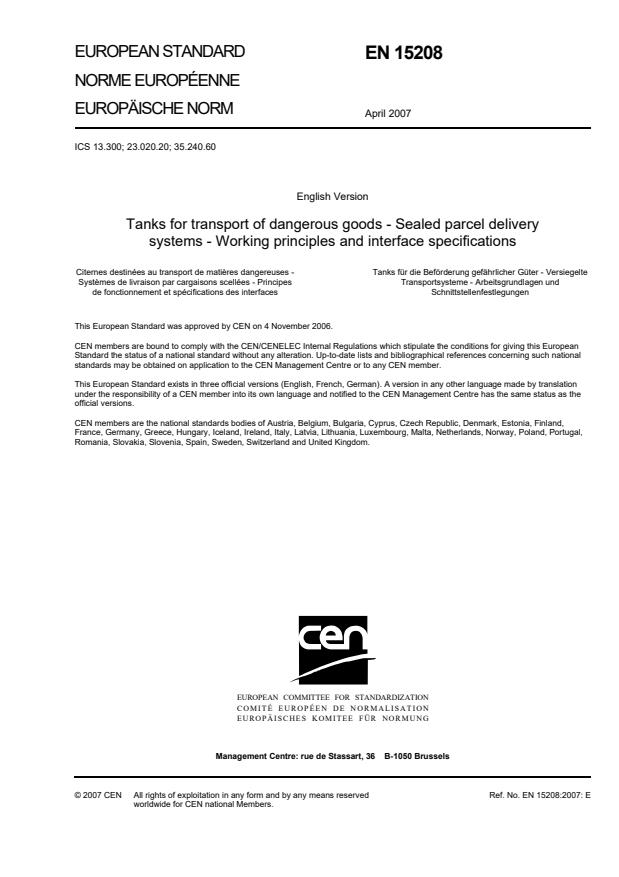
EUROPEAN STANDARDNORME EUROPÉENNEEUROPÄISCHE NORMEN 15208April 2007ICS 13.300; 23.020.20; 35.240.60 English VersionTanks for transport of dangerous goods - Sealed parcel deliverysystems - Working principles and interface specificationsCiternes destinées au transport de matières dangereuses -Systèmes de livraison par cargaisons scellées - Principesde fonctionnement et spécifications des interfacesTanks für die Beförderung gefährlicher Güter - VersiegelteTransportsysteme - Arbeitsgrundlagen undSchnittstellenfestlegungenThis European Standard was approved by CEN on 4 November 2006.CEN members are bound to comply with the CEN/CENELEC Internal Regulations which stipulate the conditions for giving this EuropeanStandard the status of a national standard without any alteration. Up-to-date lists and bibliographical references concerning such nationalstandards may be obtained on application to the CEN Management Centre or to any CEN member.This European Standard exists in three official versions (English, French, German). A version in any other language made by translationunder the responsibility of a CEN member into its own language and notified to the CEN Management Centre has the same status as theofficial versions.CEN members are the national standards bodies of Austria, Belgium, Bulgaria, Cyprus, Czech Republic, Denmark, Estonia, Finland,France, Germany, Greece, Hungary, Iceland, Ireland, Italy, Latvia, Lithuania, Luxembourg, Malta, Netherlands, Norway, Poland, Portugal,Romania, Slovakia, Slovenia, Spain, Sweden, Switzerland and United Kingdom.EUROPEAN COMMITTEE FOR STANDARDIZATIONCOMITÉ EUROPÉEN DE NORMALISATIONEUROPÄISCHES KOMITEE FÜR NORMUNGManagement Centre: rue de Stassart, 36
B-1050 Brussels© 2007 CENAll rights of exploitation in any form and by any means reservedworldwide for CEN national Members.Ref. No. EN 15208:2007: E
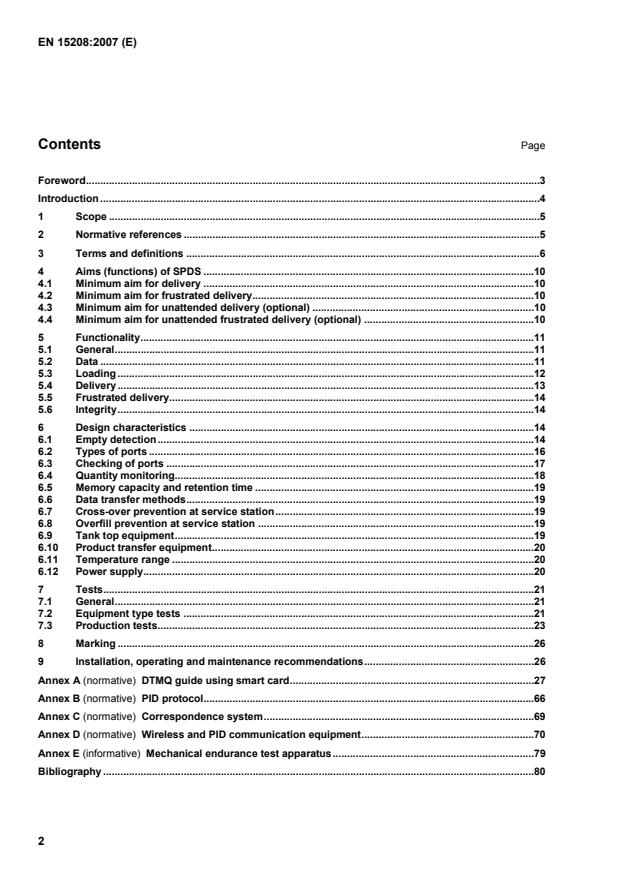
DTMQ guide using smart card.27 Annex B (normative)
PID protocol.66 Annex C (normative)
Correspondence system.69 Annex D (normative)
Wireless and PID communication equipment.70 Annex E (informative)
Mechanical endurance test apparatus.79 Bibliography.80
equipment for tanks — Pressure balanced foot valve EN 13317, Tanks for transport of dangerous goods — Service equipment for tanks — Manhole cover assembly EN 13616:2004, Overfill prevention devices for static tanks for liquid petroleum fuels EN 13922, Tanks for transport of dangerous goods — Service equipment for tanks — Overfill prevention systems for liquid fuels EN 14025, Tanks for the transport of dangerous goods — Metallic pressure tanks — Design and construction EN 14116, Tanks for transport of dangerous goods — Digital interface for the product recognition device EN 14564, Tanks for transport of dangerous goods — Terminology
maximum volume capable of being loaded into the compartment without any product release or escape 4 Aims (functions) of SPDS 4.1 Minimum aim for delivery Check status of each parcel before loading; secure the transfer of product from the measuring set to each relevant parcel; acquire and transmit to receiver the product grades and quantities loaded per parcel; control the sealed status of each parcel during transport; confirm emptiness of each parcel after delivery or follow procedure of frustrated delivery. 4.2 Minimum aim for frustrated delivery The aim of 4.1 plus: secure the return of non-delivered product to return facility; acquire and transmit to receiver the quantities of non-delivered product per parcel, if required. 4.3 Minimum aim for unattended delivery (optional) The aim of 4.1 plus: give suitable insurance that the quantity is fairly delivered (e.g. location of petrol station or tank within the petrol station, product grade); minimise the risk of accidental or fraudulent withdrawal of liquid; allow the retrieval of measuring data until the settlement of the transaction. 4.4 Minimum aim for unattended frustrated delivery (optional) The aim of 4.2 and 4.3 plus: automatic recognition of the end of delivery.
Functions Annex A DTMQ 4.1 to 4.4 and Welmec [3] Annex B PID/PRD 4.1 to 4.4 Welmec optional [3] Annex C Paper 4.1 and 4.2 no Welmec [3] Annex D Radio stuff 4.1 to 4.4 Welmec optional [3] Measuring results indication yes option no option Seal breakage yes yes yes yes Loading arm identification yes yes no
option Receiver tank identification option yes no
option Location device option option no
option Product grade at loading yes yes no
option Product grade at discharge option yes no
yes Guaranteed volume option option no
yes
Receiver loading data yes option no
yes Data transfer receiver option option no
option Transaction recording yes option no option Non transaction event recording yes yes yes option Volume change detection option option no option This clause describes the requirements of the different functions that can be provided by a SPDS. 5.2 Data 5.2.1 Recording 5.2.1.1 Transaction recording The SPDS shall be provided with a means of keeping track of all transactions. This recording shall be available until the settlement of the transaction has been completed, but for a minimum time period of 15 days. As a minimum, the following transaction data per parcel shall be recorded:
Yes, at least if cargo is present yes yes access Yes, continuously Yes, continuously yes yes
...