

EN 13094:2020+A1:2022
(Main + Amendment)Tanks for the transport of dangerous goods - Metallic gravity-discharge tanks - Design and construction
- Abstract
This document specifies requirements for the design and construction of metallic gravity-discharge tanks intended for the carriage of substances having a vapour pressure not exceeding 110 kPa (1,1 bar) (absolute pressure) at 50 °C.
NOTE 1 Gravity-discharge tanks have no maximum working pressure. However, during operation, pressure in the shell may occur, for example due to flow restrictions in vapour recovery systems or opening pressures of breather devices. It is important that these operating pressures do not exceed the test pressure of the tank or 0,5 bar, whichever is the highest.
This document specifies requirements for openings, closures, pipework, mountings for service equipment and structural equipment.
NOTE 2 This document does not specify requirements for items of service equipment other than pipes passing through the shell.
This document is applicable to aircraft refuelers that are used on public roads. It is also applicable to inter-modal tanks (e.g. tank containers and tank swap bodies) for the transport of dangerous goods by road and rail.
NOTE 3 This document is not applicable to fixed rail tank wagons.
- Status
- Published
- Publication Date
- 17-May-2022
- Withdrawal Date
- 29-Nov-2022
- Technical Committee
- CEN/TC 296 - Tanks for transport of dangerous goods
- Drafting Committee
- CEN/TC 296/WG 2 - Low pressure metalic tanks - Design and construction
- Current Stage
- 9093 - Decision to confirm - Review Enquiry
- Start Date
- 27-Mar-2026
- Completion Date
- 07-Oct-2026


Overview
EN 13094:2020+A1:2022 - "Tanks for the transport of dangerous goods - Metallic gravity-discharge tanks - Design and construction" - is a CEN European Standard adopted by SIST. It specifies requirements for the design, construction and manufacture of metallic gravity-discharge tanks intended to carry substances with a vapour pressure not exceeding 110 kPa (1.1 bar) absolute at 50 °C. The standard covers shell design, openings, closures, pipework passing through the shell, mountings and structural attachments and includes Amendment A1 (2022).
Key technical topics and requirements
- Scope and applicability
- Applies to metallic gravity-discharge tanks used in road and rail transport, including aircraft refuelers used on public roads and inter-modal tanks (tank containers, swap bodies).
- Not applicable to fixed rail tank wagons.
- Pressure and operating limits
- Tanks are gravity-discharge type and have no fixed maximum working pressure, but operating pressures (e.g., from vapour recovery systems) must not exceed the tank test pressure or 0.5 bar, whichever is higher (as noted in the standard).
- Materials and mechanical properties
- Requirements for materials selection, impact strength, yield/tensile strength and compatibility with carried substances.
- Design and verification
- Shell cross-section rules (including non-circular shapes), design stress and minimum shell thickness provisions.
- Design verification methods: dynamic testing, finite element method (FEM), reference design and calculation worksheets (normative annexes).
- Dynamic, pressure and vacuum conditions
- Provisions for dynamic loads (transport and overturning), internal pressure conditions and partial vacuum situations.
- Openings, closures and pipework
- Detailed requirements for neck rings, manholes, inspection openings, closures and pipes that pass through the shell; limitations on service equipment requirements (only pipes through shell are specified).
- Manufacture and welding
- Welding qualifications, joint types, testing and rectification of defects; forming, cutting, tolerances and marking requirements.
- Annexes
- Normative annexes include methods for design verification, resilience testing, and detailed guidance on neck rings, flanges and welding details.
Practical applications and users
EN 13094:2020+A1:2022 is essential for:
- Tank designers and engineering firms creating metallic gravity-discharge tanks
- Manufacturers and fabricators of road/rail tank containers and aircraft refuelers
- Certification and inspection bodies verifying compliance and issuing approvals
- Fleet operators, transport safety officers and regulatory authorities managing hazardous goods logistics
Using this standard helps ensure safe mechanical design, regulatory compliance and reliable operation for low‑pressure hazardous‑goods tanks.
Related standards and context
- Amendment: A1:2022 incorporated into EN 13094
- Prepared by CEN/TC 296 (“Tanks for the transport of dangerous goods”)
- Supersedes earlier EN 13094 editions; national adoption required by CEN members
Keywords: EN 13094:2020+A1:2022, metallic gravity-discharge tanks, tank design, dangerous goods transport, shell thickness, pressure conditions, service equipment, tank manufacture.
Relations
- Effective Date
- 18-Jan-2023
- Effective Date
- 18-Jan-2023
- Effective Date
- 11-Mar-2026
- Effective Date
- 28-Jan-2026
- Effective Date
- 28-Jan-2026
- Effective Date
- 28-Jan-2026
- Effective Date
- 28-Jan-2026
- Effective Date
- 28-Jan-2026
- Effective Date
- 28-Jan-2026
- Effective Date
- 28-Jan-2026
- Effective Date
- 28-Jan-2026
- Effective Date
- 28-Jan-2026
- Effective Date
- 28-Jan-2026
- Effective Date
- 28-Jan-2026
- Effective Date
- 28-Jan-2026
Get Certified
Connect with accredited certification bodies for this standard

CIS Institut d.o.o.
Personal Protective Equipment (PPE) certification body. Notified Body NB-2890 for EU Regulation 2016/425 PPE.
Institut za varilstvo d.o.o. (Welding Institute)
Slovenia's leading welding institute since 1952. ISO 3834, EN 1090, pressure equipment certification, NDT personnel, welder qualification. Only IIW Au

Kiwa BDA Testing
Building and construction product certification.
Sponsored listings
Frequently Asked Questions
EN 13094:2020+A1:2022 is a standard published by the European Committee for Standardization (CEN). Its full title is "Tanks for the transport of dangerous goods - Metallic gravity-discharge tanks - Design and construction". This standard covers: This document specifies requirements for the design and construction of metallic gravity-discharge tanks intended for the carriage of substances having a vapour pressure not exceeding 110 kPa (1,1 bar) (absolute pressure) at 50 °C. NOTE 1 Gravity-discharge tanks have no maximum working pressure. However, during operation, pressure in the shell may occur, for example due to flow restrictions in vapour recovery systems or opening pressures of breather devices. It is important that these operating pressures do not exceed the test pressure of the tank or 0,5 bar, whichever is the highest. This document specifies requirements for openings, closures, pipework, mountings for service equipment and structural equipment. NOTE 2 This document does not specify requirements for items of service equipment other than pipes passing through the shell. This document is applicable to aircraft refuelers that are used on public roads. It is also applicable to inter-modal tanks (e.g. tank containers and tank swap bodies) for the transport of dangerous goods by road and rail. NOTE 3 This document is not applicable to fixed rail tank wagons.
This document specifies requirements for the design and construction of metallic gravity-discharge tanks intended for the carriage of substances having a vapour pressure not exceeding 110 kPa (1,1 bar) (absolute pressure) at 50 °C. NOTE 1 Gravity-discharge tanks have no maximum working pressure. However, during operation, pressure in the shell may occur, for example due to flow restrictions in vapour recovery systems or opening pressures of breather devices. It is important that these operating pressures do not exceed the test pressure of the tank or 0,5 bar, whichever is the highest. This document specifies requirements for openings, closures, pipework, mountings for service equipment and structural equipment. NOTE 2 This document does not specify requirements for items of service equipment other than pipes passing through the shell. This document is applicable to aircraft refuelers that are used on public roads. It is also applicable to inter-modal tanks (e.g. tank containers and tank swap bodies) for the transport of dangerous goods by road and rail. NOTE 3 This document is not applicable to fixed rail tank wagons.
EN 13094:2020+A1:2022 is classified under the following ICS (International Classification for Standards) categories: 13.300 - Protection against dangerous goods; 23.020.20 - Vessels and containers mounted on vehicles. The ICS classification helps identify the subject area and facilitates finding related standards.
EN 13094:2020+A1:2022 has the following relationships with other standards: It is inter standard links to EN 13094:2020, EN 13094:2020/prA1, ISO 1496-3:2019, EN ISO 15614-7:2019, EN 14564:2019, EN ISO 15614-6:2006, EN ISO 15614-5:2024, EN ISO 9606-1:2017, EN ISO 15614-2:2025, EN ISO 15614-12:2021, EN ISO 7500-1:2018, EN ISO 15614-8:2016, EN ISO 6892-1:2019, EN 10204:2004, EN ISO 3834-1:2021. Understanding these relationships helps ensure you are using the most current and applicable version of the standard.
EN 13094:2020+A1:2022 is associated with the following European legislation: EU Directives/Regulations: 2008/68/EC. When a standard is cited in the Official Journal of the European Union, products manufactured in conformity with it benefit from a presumption of conformity with the essential requirements of the corresponding EU directive or regulation.
EN 13094:2020+A1:2022 is available in PDF format for immediate download after purchase. The document can be added to your cart and obtained through the secure checkout process. Digital delivery ensures instant access to the complete standard document.
Standards Content (Sample)
SLOVENSKI STANDARD
01-september-2022
Nadomešča:
SIST EN 13094:2020
Cisterne za prevoz nevarnega blaga - Kovinske cisterne z gravitacijskim
praznjenjem - Konstruiranje in izdelava (vključuje dopolnilo A1)
Tanks for the transport of dangerous goods - Metallic gravity-discharge tanks - Design
and construction
Tanks für die Beförderung gefährlicher Güter - Metalltanks mit Entleerung durch
Schwerkraft - Auslegung und Bau
Citernes pour le transport de matières dangereuses - Citernes métalliques à vidange par
gravité - Conception et construction
Ta slovenski standard je istoveten z: EN 13094:2020+A1:2022
ICS:
13.300 Varstvo pred nevarnimi Protection against dangerous
izdelki goods
23.020.20 Posode in vsebniki, montirani Vessels and containers
na vozila mounted on vehicles
2003-01.Slovenski inštitut za standardizacijo. Razmnoževanje celote ali delov tega standarda ni dovoljeno.
EN 13094:2020+A1
EUROPEAN STANDARD
NORME EUROPÉENNE
May 2022
EUROPÄISCHE NORM
ICS 13.300; 23.020.20 Supersedes EN 13094:2020
English Version
Tanks for the transport of dangerous goods - Metallic
gravity-discharge tanks - Design and construction
Citernes pour le transport de matières dangereuses - Tanks für die Beförderung gefährlicher Güter -
Citernes métalliques à vidange par gravité - Conception Metalltanks mit Entleerung durch Schwerkraft -
et construction Auslegung und Bau
This European Standard was approved by CEN on 1 June 2020 and includes Amendment 1 approved by CEN on 28 April 2022.
CEN members are bound to comply with the CEN/CENELEC Internal Regulations which stipulate the conditions for giving this
European Standard the status of a national standard without any alteration. Up-to-date lists and bibliographical references
concerning such national standards may be obtained on application to the CEN-CENELEC Management Centre or to any CEN
member.
This European Standard exists in three official versions (English, French, German). A version in any other language made by
translation under the responsibility of a CEN member into its own language and notified to the CEN-CENELEC Management
Centre has the same status as the official versions.
CEN members are the national standards bodies of Austria, Belgium, Bulgaria, Croatia, Cyprus, Czech Republic, Denmark, Estonia,
Finland, France, Germany, Greece, Hungary, Iceland, Ireland, Italy, Latvia, Lithuania, Luxembourg, Malta, Netherlands, Norway,
Poland, Portugal, Republic of North Macedonia, Romania, Serbia, Slovakia, Slovenia, Spain, Sweden, Switzerland, Turkey and
United Kingdom.
EUROPEAN COMMITTEE FOR STANDARDIZATION
COMITÉ EUROPÉEN DE NORMALISATION
EUROPÄISCHES KOMITEE FÜR NORMUNG
CEN-CENELEC Management Centre: Rue de la Science 23, B-1040 Brussels
© 2022 CEN All rights of exploitation in any form and by any means reserved Ref. No. EN 13094:2020+A1:2022 E
worldwide for CEN national Members.
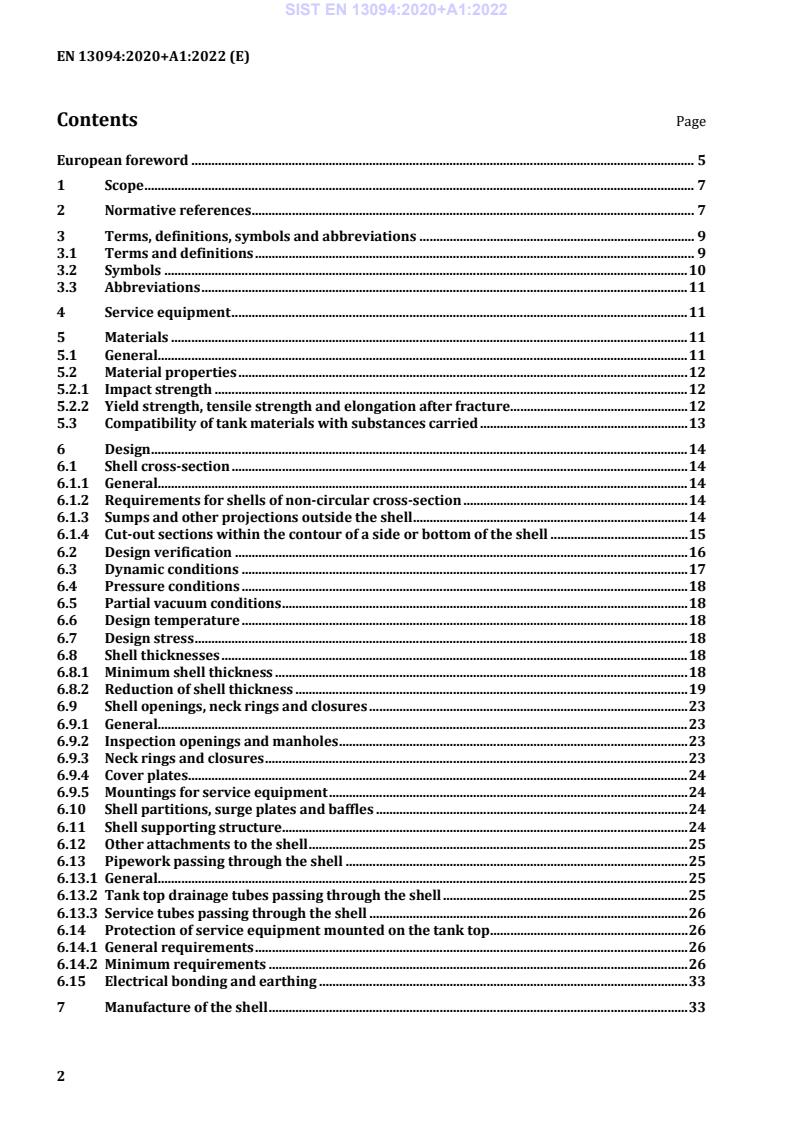
Contents Page
European foreword . 5
1 Scope . 7
2 Normative references . 7
3 Terms, definitions, symbols and abbreviations . 9
3.1 Terms and definitions . 9
3.2 Symbols . 10
3.3 Abbreviations . 11
4 Service equipment . 11
5 Materials . 11
5.1 General. 11
5.2 Material properties . 12
5.2.1 Impact strength . 12
5.2.2 Yield strength, tensile strength and elongation after fracture . 12
5.3 Compatibility of tank materials with substances carried . 13
6 Design . 14
6.1 Shell cross-section . 14
6.1.1 General. 14
6.1.2 Requirements for shells of non-circular cross-section . 14
6.1.3 Sumps and other projections outside the shell . 14
6.1.4 Cut-out sections within the contour of a side or bottom of the shell . 15
6.2 Design verification . 16
6.3 Dynamic conditions . 17
6.4 Pressure conditions . 18
6.5 Partial vacuum conditions . 18
6.6 Design temperature . 18
6.7 Design stress . 18
6.8 Shell thicknesses . 18
6.8.1 Minimum shell thickness . 18
6.8.2 Reduction of shell thickness . 19
6.9 Shell openings, neck rings and closures . 23
6.9.1 General. 23
6.9.2 Inspection openings and manholes . 23
6.9.3 Neck rings and closures . 23
6.9.4 Cover plates. 24
6.9.5 Mountings for service equipment . 24
6.10 Shell partitions, surge plates and baffles . 24
6.11 Shell supporting structure . 24
6.12 Other attachments to the shell . 25
6.13 Pipework passing through the shell . 25
6.13.1 General. 25
6.13.2 Tank top drainage tubes passing through the shell . 25
6.13.3 Service tubes passing through the shell . 26
6.14 Protection of service equipment mounted on the tank top . 26
6.14.1 General requirements . 26
6.14.2 Minimum requirements . 26
6.15 Electrical bonding and earthing . 33
7 Manufacture of the shell . 33
7.1 General . 33
7.2 Cutting and edge preparation . 33
7.3 Forming . 34
7.3.1 General . 34
7.3.2 Hot forming — additional requirements . 34
7.4 Welding . 34
7.4.1 Qualification . 34
7.4.2 Welded joints . 35
7.4.3 Temporary attachments . 35
7.4.4 Examination and testing of welds . 35
7.5 Manufacturing tolerances . 36
7.5.1 General . 36
7.5.2 Plate alignment . 36
7.5.3 Defects of form . 36
7.5.4 Thickness . 36
7.5.5 Ends . 36
7.6 Rectification of defects . 37
7.6.1 General requirements . 37
7.6.2 Rectification of weld defects . 37
8 Marking . 37
Annex A (!normative") Methods of design verification . 38
A.1 General . 38
A.2 Dynamic testing . 38
A.3 Finite element method . 39
A.4 Reference design . 45
A.5 Calculation method — worksheet . 46
Annex B (normative) Method of measurement of specific resilience . 66
B.1 Principle . 66
B.2 Apparatus . 66
B.3 Samples of materials to be tested . 70
B.4 Procedure . 71
B.5 Results . 72
B.6 Global resilience [see 6.8.2.2 i)] . 73
B.7 Comparative methods to calculate the energy absorbed during an overturning or
impact [see 6.8.2.2 j)] . 73
Annex C (normative) Design of neck rings, flanges and closures . 75
Annex D (informative) Examples of welding details . 76
D.1 General . 76
D.2 Shell construction . 76
D.3 Attachment of reinforcements . 89
D.4 Attachment of branches . 90
D.5 Attachment of flanges, collars and reinforcing pads to the shell . 92
D.6 Attachment of flanges onto branches . 94
D.7 Attachment of heating channels to shells . 94
Bibliography . 96
European foreword
This document (EN 13094:2020+A1:2022) has been prepared by Technical Committee CEN/TC 296
“Tanks for the transport of dangerous goods”, the secretariat of which is held by AFNOR.
This European Standard shall be given the status of a national standard, either by publication of an
identical text or by endorsement, at the latest by November 2022, and conflicting national standards
shall be withdrawn at the latest by November 2022.
Attention is drawn to the possibility that some of the elements of this document may be the subject of
patent rights. CEN shall not be held responsible for identifying any or all such patent rights.
This document includes Amendment 1 approved by CEN on 28 April 2022.
This document supersedes !EN 13094:2020".
The start and finish of text introduced or altered by amendment is indicated in the text by tags !".
Compared with EN 13094:2015, the following are the principal changes that have been made:
a) changes to reflect the change in scope from low pressure to gravity-discharge applications;
b) updates to the normative references;
c) changes to the terms, definitions, symbols and abbreviations;
d) simplification of service equipment requirements by reference to regulatory requirements;
e) clarification of impact strength required at lower design temperatures;
f) new requirements on the cross-sectional shapes of shells for non-circular cross-sections, sumps
and other external projections and cut-outs within the contour of a side or bottom of the shell;
g) clearer requirements on design verification;
h) expansion of provisions for the dynamic conditions used for tank design;
i) provisions for pressure conditions revised to reflect the change in scope;
j) clarification that maximum stress refers to maximum membrane stress;
k) expansion of requirements on shell thickness to clarify and include cut-outs;
l) addition of preferred location of tank top service equipment;
m) partial easing of restriction on longitudinal partitions;
n) additional requirements on pipes passing through the shell;
o) general revisions on the protection of service equipment mounted on the top of the tank;
p) new requirements for electrical bonding and earthing;
q) changes to the assessment criteria for welds not covered by either Annex D or EN 14025;
r) !examination and testing of welds referred to EN 12972:2018;
NOTE 1 Acceptable equivalent requirements for the examination and testing of welds are given in
subclause 7.4.4 of this document.
s) manufacturing tolerances referred to EN 12972:2018";
t) new requirements for minimum shell marking;
u) tank plate requirements addressed by reference to regulatory requirements;
v) clarification and revision of the application of the different methods of design verification
in Annex A;
w) addition of finite element analysis as a method of measurement of specific resilience in Annex B;
x) changes to clarify the informative examples of welding details in Annex D; and
y) an addition to the bibliography.
This document has been submitted for reference in:
— the RID; and
— the technical annexes of the ADR.
NOTE 2 These regulations take precedence over any clause of this document. It is emphasized that RID/ADR
are being revised regularly at intervals of two years which may lead to temporary non-compliances with the
clauses of this document.”
!deleted text"
Any feedback and questions on this document should be directed to the users’ national standards body.
A complete listing of these bodies can be found on the CEN website.
According to the CEN-CENELEC Internal Regulations, the national standards organisations of the
following countries are bound to implement this European Standard: Austria, Belgium, Bulgaria,
Croatia, Cyprus, Czech Republic, Denmark, Estonia, Finland, France, Germany, Greece, Hungary, Iceland,
Ireland, Italy, Latvia, Lithuania, Luxembourg, Malta, Netherlands, Norway, Poland, Portugal, Republic of
North Macedonia, Romania, Serbia, Slovakia, Slovenia, Spain, Sweden, Switzerland, Turkey and the
United Kingdom.
1 Scope
This document specifies requirements for the design and construction of metallic gravity-discharge
tanks intended for the carriage of substances having a vapour pressure not exceeding 110 kPa (1,1 bar)
(absolute pressure) at 50 °C.
NOTE 1 Gravity-discharge tanks have no maximum working pressure. However, during operation, pressure in
the shell may occur, for example due to flow restrictions in vapour recovery systems or opening pressures of
breather devices. It is important that these operating pressures do not exceed the test pressure of the tank
or 0,5 bar, whichever is the highest.
This document specifies requirements for openings, closures, pipework, mountings for service
equipment and structural equipment.
NOTE 2 This document does not specify requirements for items of service equipment other than pipes passing
through the shell.
This document is applicable to aircraft refuelers that are used on public roads. It is also applicable to
inter-modal tanks (e.g. tank containers and tank swap bodies) for the transport of dangerous goods by
road and rail.
NOTE 3 This document is not applicable to fixed rail tank wagons.
2 Normative references
The following documents are referred to in the text in such a way that some or all of their content
constitutes requirements of this document. For dated references, only the edition cited applies. For
undated references, the latest edition of the referenced document (including any amendments) applies.
EN 10204, Metallic products - Types of inspection documents
EN 10028-2, Flat products made of steels for pressure purposes - Part 2: Non-alloy and alloy steels with
specified elevated temperature properties
!EN 12972:2018", Tanks for transport of dangerous goods - Testing, inspection and marking of
metallic tanks
EN 13317, Tanks for transport of dangerous goods - Service equipment for tanks - Manhole cover assembly
EN 14025, Tanks for the transport of dangerous goods - Metallic pressure tanks - Design and construction
EN 13445-3:2014, Unfired pressure vessels - Part 3: Design
EN 14564, Tanks for transport of dangerous goods - Terminology
EN ISO 3834-1, Quality requirements for fusion welding of metallic materials - Part 1: Criteria for the
selection of the appropriate level of quality requirements (ISO 3834-1)
EN ISO 3834-2, Quality requirements for fusion welding of metallic materials - Part 2: Comprehensive
quality requirements (ISO 3834-2)
EN ISO 5817, Welding - Fusion-welded joints in steel, nickel, titanium and their alloys (beam welding
excluded) - Quality levels for imperfections (ISO 5817)
EN ISO 6892-1, Metallic materials - Tensile testing - Part 1: Method of test at room temperature (ISO
6892-1)
EN ISO 7500-1, Metallic materials - Calibration and verification of static uniaxial testing machines - Part
1: Tension/compression testing machines - Calibration and verification of the force-measuring system (ISO
7500-1)
EN ISO 9606-1, Qualification testing of welders - Fusion welding - Part 1: Steels (ISO 9606-1)
EN ISO 9606-2, Qualification test of welders - Fusion welding - Part 2: Aluminium and aluminium alloys
(ISO 9606-2)
EN ISO 10042, Welding - Arc-welded joints in aluminium and its alloys - Quality levels for imperfections
(ISO 10042)
EN ISO 14732, Welding personnel - Qualification testing of welding operators and weld setters for
mechanized and automatic welding of metallic materials (ISO 14732)
EN ISO 15607, Specification and qualification of welding procedures for metallic materials - General rules
(ISO 15607)
EN ISO 15609-1, Specification and qualification of welding procedures for metallic materials - Welding
procedure specification - Part 1: Arc welding (ISO 15609-1)
EN ISO 15609-2, Specification and qualification of welding procedures for metallic materials - Welding
procedure specification - Part 2: Gas welding (ISO 15609-2)
EN ISO 15613, Specification and qualification of welding procedures for metallic materials - Qualification
based on pre-production welding test (ISO 15613)
EN ISO 15614 (all parts), Specification and qualification of welding procedures for metallic materials -
Welding procedure test (ISO 15614, all parts)
EN ISO 17635, Non-destructive testing of welds - General rules for metallic materials (ISO 17635)
EN ISO 17636-1, Non-destructive testing of welds - Radiographic testing - Part 1: X- and gamma-ray
techniques with film (ISO 17636-1)
EN ISO 17637, Non-destructive testing of welds - Visual testing of fusion-welded joints (ISO 17637)
EN ISO 17640, Non-destructive testing of welds - Ultrasonic testing - Techniques, testing levels, and
assessment (ISO 17640)
ISO 1496-3, Series 1 freight containers - Specification and testing - Part 3: Tank containers for liquids,
gases and pressurized dry bulk
3 Terms, definitions, symbols and abbreviations
3.1 Terms and definitions
For the purposes of this document, the terms and definitions given in EN 14564, EN 13445 and the
following apply.
ISO and IEC maintain terminological databases for use in standardization at the following addresses:
— IEC Electropedia: available at https://www.electropedia.org/
— ISO Online browsing platform: available at https://www.iso.org/obp/ui
NOTE See also Figure A.1.
3.1.1
section modulus
second moment of area of a structure (and, where appropriate, its associated shell) about its neutral
axis divided by the maximum distance from the neutral axis to the extreme fibre of the section used in
the calculation
3.1.2
specific resilience
integral of the applied force and the measured deflection of a test piece up to the point at which the test
bar punctures the test piece, as indicated by the point of maximum force
3.1.3
global resilience
ability of a shell with reinforcement(s) to withstand a sideways impact with a beam
3.1.4
mild steel
2 2
steel which has a minimum tensile strength between 360 N/mm and 440 N/mm , and a steel referred
to in EN material standards as “mild steel”, with a minimum tensile strength between 360 N/mm and
490 N/mm and a minimum elongation at fracture conforming to 5.2.2.3.1 calculated using the formula
in 5.2.2.3.2
3.1.5
maximum design mass
sum of the unladen mass of the tank and the mass of the maximum permissible load for which the tank
is designed
!3.1.6
reference steel
steel which has the properties defined in EN 14564"
3.2 Symbols
For the purposes of this document, the following symbols apply.
A percentage (%) elongation after fracture
A minimum percentage (%) elongation after fracture of the metal used (see 6.8.1)
B pitch circle diameter or, if elliptical, average of major and minor diameters, in millimetres
(mm)
c distance from the start of a knuckle bend to the edge of a shell, in millimetres (mm)
NOTE 1 This is used for the attachment of a dished end to a shell.
e shell thickness, in millimetres (mm)
e thickness of a flat closure, in millimetres (mm)
c
e thickness of a domed closure, in millimetres (mm)
d
e thickness of an end or partition, in millimetres (mm)
f
e thickness of a reinforcing section, in millimetres (mm)
rs
e thickness of an opening flange, in millimetres (mm)
r
e thickness of a domed closure flange, in millimetres (mm)
rd
e adopted thickness(es) of a shell, in millimetres (mm)
vn
e minimum thickness of a shell according to 6.8.1, in millimetres (mm)
v, min
e0 minimum thickness of shell in reference steel, in millimetres (mm)
e thickness of the thickest part of a shell, in millimetres (mm)
e thickness of the thinner part of the metal used, in millimetres (mm)
g acceleration due to gravity, in metres per second squared (m/s )
NOTE 2 The value of g is 9,81 m/s .
L overlap of a lapped joint, in millimetres (mm)
L length of reinforcing piece, in millimetres (mm)
c
L length of reinforcing ring, in millimetres (mm)
r
L0 initial gauge length of the test piece used in the tensile test, in millimetres (mm)
l length of transition between plates of different thickness, in millimetres (mm)
l length of overlap of swaged edge, in millimetres (mm)
l length of weld at base of swaged joint, in millimetres (mm)
N safety factor
P static pressure (gauge pressure), in MegaPascals (MPa)
ta
P tank test pressure, in MegaPascals (MPa)
e
P compartment test pressure, in MegaPascals (MPa)
ec
P calculation pressure of the tank, in MegaPascals (MPa)
c
P dynamic pressure, in MegaPascals (MPa)
dyn
Pts opening pressure of the breather device, in MegaPascals (MPa)
R internal radius of a domed closure, in millimetres (mm)
R determined tensile strength, in Newtons per square millimetre (N/mm )
d
R apparent yield strength for steels having a clearly defined yield point or guaranteed 0,2 %
e
proof strength for steels with no clearly defined yield point (1 % proof strength for
austenitic steels) Newtons per square millimetre (N/mm )
R apparent yield strength for steels having a clearly defined yield point or guaranteed 0,2 %
et
proof strength for steels with no clearly defined yield point (1 % proof strength for
austenitic steels) at minimum design temperature Newtons per square millimetre (N/mm )
Rm tensile strength, in Newtons per square millimetre (N/mm )
R tensile strength at minimum design temperature, in Newtons per square millimetre
mt
(N/mm )
R minimum tensile strength of the metal used, in Newtons per square millimetre (N/mm )
m1
S total tensile area, in square millimetres (mm )
B
S initial cross-sectional area of a test piece used in the tensile test, in square millimetres
(mm )
w effective depth of fillet weld (i.e. distance from the surface of the weld to the minimum
penetration point of the molten metal into the base material)
Z minimum section modulus in reference steel, in cubic centimetres (cm )
Z1 minimum section modulus in the metal used, in cubic centimetres (cm )
σ design stress for cover material, according to 6.8, in newtons per square millimetre
c
(N/mm )
σ design stress for flange material, according to 6.8, in newtons per square millimetre
r
(N/mm )
3.3 Abbreviations
FEM Finite element method
4 Service equipment
As a minimum, the service equipment shall be in conformance with the relevant regulations.
!Tanks shall be equipped with a breather device and a safety device to prevent the contents from
spilling out if the tank overturns. For compartmented tanks, each compartment shall be so equipped.
NOTE 1 Referenced standards for service equipment are listed in ADR 6.8.2.6."
NOTE 2 For pipework passing through the shell, see 6.13.
5 Materials
5.1 General
5.1.1 The designer shall select the materials to be used in the construction of the shell using ferritic
steel, austenitic steel, austenitic-ferritic stainless steel or aluminium alloy material standards published
by a national or international standards body or otherwise approved by the competent authority. The
material shall in any case meet the requirements specified in 5.2.
5.1.2 Materials used in the construction of shells shall be suitable for shaping. Materials shall be
deemed unsuitable if, even though they meet the material requirements of this document, the degree of
shaping required by a particular shell design generates cracking or other signs of distress in the shell
material.
5.1.3 Materials shall be used that are known to be resistant to brittle fracture and to stress corrosion
cracking.
5.1.4 When tested in accordance with the appropriate clauses of EN ISO 15614-1, the properties of
materials used in the fabrication of welded shells shall not be less than the minimum values specified
for the material selected in accordance with 5.1.1 throughout the welded area after welding without
post-weld heat treatment.
5.2 Material properties
5.2.1 Impact strength
Ferritic steel materials shall only be used when the material standard (e.g. EN 10028-2) guarantees an
impact strength of at least 34 J/cm at −20 °C. If a lower design temperature is prescribed, this strength
shall be achieved at the lower temperature.
5.2.2 Yield strength, tensile strength and elongation after fracture
5.2.2.1 General
5.2.2.1.1 The values of A, R and R to be used shall be the minimum values specified for the material
e m
selected in accordance with the relevant standard for the material with the exception of 5.2.2.1.2 and
5.2.2.1.3.
5.2.2.1.2 When austenitic steels are used, the value of R and R used in the calculation may exceed
e m
the minimum value in accordance with the relevant standard for the material specified for the material
selected provided that:
— the higher values are attested in a certificate 3.1 or 3.2 issued in accordance with EN 10204; and
— the value of R and R used in the calculation does not exceed 1,15 multiplied by the value of R
e m e
!and R " as specified for the material selected in accordance with the relevant standard for the
m
material.
5.2.2.1.3 When fine-grained steels are used, the value of R shall not exceed 460 N/mm and the value
e
of R shall not exceed 725 N/mm in accordance with the specifications of the relevant standard for the
m
material.
5.2.2.2 Yield strength and tensile strength
Steels with a ratio of R /R exceeding 0,85 shall not be used in the construction of welded shells. The
e m
values specified in certificate 3.1 or 3.2 issued in accordance with EN 10204 shall be used to determine
the R /R ratio.
e m
5.2.2.3 Elongation after fracture
5.2.2.3.1 The material shall be tested in accordance with EN ISO 6892-1. The percentage elongation
after fracture, A, shall be not less than:
— 16 % for fine grained steels;
— 20 % for other steels; and
— 12 % for aluminium alloys.
5.2.2.3.2 Additionally, for steel, the percentage elongation after fracture, A, shall not be less than the
value calculated using Formula (1):
10 000N/ mm
(1)
A=
R
d
NOTE For A and Rd only the numerical value with the unit according to 3.2 is given.
5.2.2.3.3 For sheet metal, when measuring the percentage elongation after fracture in accordance
with EN ISO 6892-1, the axis of the tensile test piece shall be at right angles to the direction of rolling;
where the material standard gives lower values in the direction of rolling, these values shall be used in
the calculation.
5.2.2.3.4 When measuring the percentage elongation after fracture, a test piece of circular cross-
section shall be used in which the initial gauge length is equal to five times the diameter. If test pieces of
rectangular section are used, the gauge length shall be calculated using Formula (2):
Ls= 5,65 (2)
NOTE Elongations based on fixed lengths can be converted to proportional elongations using EN ISO 2566-1
or EN ISO 2566-2 as applicable.
5.3 Compatibility of tank materials with substances carried
5.3.1 The manufacturer shall make available a list of the dangerous goods that may be carried
without damage to the tank, or as applicable, its lining. The substances or group of substances approved
in the certificate shall be compatible with the characteristics of the tank.
NOTE RID/ADR (4.3.4.1.2) states that the listing of approved substances may be replaced by groups of
substances according to the tank code taking into account any relevant special provision.
5.3.2 If contact between the substance carried and the material used for the construction of the shell
is deemed likely to entail a progressive decrease in the thickness of the shell, this thickness shall be
increased at manufacture by an appropriate amount.
NOTE This additional thickness, to allow for corrosion, is not taken into consideration in determining the
minimum shell thickness (see 6.8.1).
5.3.3 If the shell is fitted with a non-metallic protective lining, only materials and their means of
bonding to the shell that are known to remain leakproof, whatever the deformation liable to occur in
normal conditions of carriage, shall be used.
5.3.4 If shells intended for the carriage of liquids having a flash-point of not more than 60 °C are fitted
with non-conductive protective linings, precautions shall be taken to prevent the accumulation of
electrostatic charges that could present a danger of ignition.
NOTE !In RID/ADR (7.5.10), this requirement is also applicable to UN No. 1361 carbon and UN No. 1361
carbon black, packing group II."
6 Design
6.1 Shell cross-section
6.1.1 General
A shell may have a circular, elliptical or other cross-section shape (including box-shaped) or
combinations thereof.
Where a combination of shapes is used for a cross-section, the required minimum thickness for the
whole cross-section at that point according to 6.8.1 shall be the greatest minimum thickness required
for the shapes used.
6.1.2 Requirements for shells of non-circular cross-section
For shells of non-circular cross-section:
a) the radius of convexity of the shell wall shall not exceed 2 m at the sides and 3 m radius at the top
and the bottom;
b) there shall be a minimum radius of 200 mm linking the top/bottom and side convexities.
NOTE A.5.2.2.2, Table A.4, footnote a provides a calculation for an equivalent diameter to be calculated.
6.1.3 Sumps and other projections outside the shell
6.1.3.1 Projections outside the basic cross-section of a shell shall be kept to a minimum and
protection shall be provided from all directions on the shell unless it is provided by vehicle components
(e.g. chassis members, suspension components, axles, etc.).
The cross-sectional area of each projection shall not exceed 10 % of the cross-sectional area of the shell
at that point without the projection.
When the projection is not protected, the thickness shall not be less than the thickness specified for the
shell given in 6.8.1.
When the projection is protected, the thickness shall be the same thickness as the shell.
6.1.3.2 Shells and their compartments may be provided with sumps and/or internal channelling in
order to:
— assist the complete discharge of the substance carried;
— facilitate the removal of entrained water from the substance carried; or
— locate a foot valve away from an area where there exists a risk of damage, for example near the
coupling section on a semi-trailer.
Sumps shall not protrude more than 150 mm from the contour of the shell.
Internal channelling and sumps shall be manufactured from the same material as the shell to which
they are fitted; flat material may be used. Their minimum thickness shall be at least equal to that of the
shell.
A sump may consist of a vertical cylindrical section combined with internal or external channelling
sections to lower the mounting flange of the foot valve.
6.1.4 Cut-out sections within the contour of a side or bottom of the shell
6.1.4.1 Side cut-outs to accommodate service equipment
Side cut-outs to provide space for service equipment such as flow meters shall be designed in
accordance with the following criteria:
— the total cross-sectional area of cut-outs at any point shall not exceed 20 % of the total cross-
sectional area of the shell without cut-outs where the cut-outs are located;
— the length of the cut-out shall not exceed 40 % of the length of the shell and in any case not exceed
1 400 mm;
— the minimum distance from the sides of the cut-outs to the ends shall be at least 200 mm;
— the height and depth of the cut-out shall be such that it does not encroach within 50 mm of the
centre lines of the shell;
— the thickness shall not be less than the thickness specified in 6.8.1;
— the welds shall be fully penetrated (or made of lap joints);
— the cut-out shall not extend beyond one compartment or a section of shell.
See Figure 1 for examples of side cut-outs.
Key
1 shell wall
2 side cut-out
Figure 1 — Examples of side cut-outs
6.1.4.2 Cut-outs to accommodate tank mountings or other structural equipment
Cut-outs to accommodate structural equipment (e.g. coupling devices for trailers or semi-trailers), shall
be designed in accordance with the following criteria:
— the cross-sectional area of the cut-out shall not exceed 30 % of the total cross-sectional area of the
shell without cut-out, where it is located;
— the length of the cut-out shall not exceed 35 % of the length of the tank;
— service equipment shall not be welded directly to a concave surface within the cut-out;
— the weld shall be fully penetrated;
— the minimum thickness shall not be less than the thickness specified in 6.8.1;
— the joint of the end of the structural plate to the shell shall be to a partition or surge plate whose
design complies with that for an end;
— the design shall not compromise complete drainage of the product to be carried.
See Figure 2 for example of a bottom cut-out.
Key
1 shell wall
2 cut-out of bottom of the shell
NOTE Full-penetration welds are used.
Figure 2 — Example of a bottom cut-out
6.2 Design verification
The minimum thickness of the shell shall conform to:
a) Annex A, A.5 for:
— cylindrical parts;
— parts other than cylindrical taken as an equivalent diameter;
— spherical parts;
— ends and conical parts.
b) Annex C
— for neck rings, flanges and closures.
When Annex A, A.5, Annex C and Annex D cannot be fully applied, and for other aspects of the design of
the tank (for example attachments, structural equipment, projections and cut-outs), Annex A, A.2 to A.4
or an analytical method or a combination of these methods shall be used in addition to Annex A, A.
...