

EN 845-1:2003+A1:2008
(Main + Amendment)Specification for ancillary components for masonry - Part 1: Ties, tension straps, hangers and brackets
- Abstract
This EN specifies requirements for ties, tension straps, hangers and brackets for interconnecting masonry and for connecting masonry to other parts of works and buildings including walls, floors, beams, and columns. Where anchors or fasteners are supplied or specified as part of an ancillary component, the requirements including performance requirements apply to the complete product.
- Status
- Withdrawn
- Publication Date
- 19-Feb-2008
- Withdrawal Date
- 25-Jun-2013
- Technical Committee
- CEN/TC 125 - Masonry
- Drafting Committee
- CEN/TC 125 - Masonry
- Current Stage
- 9960 - Withdrawal effective - Withdrawal
- Start Date
- 26-Jun-2013
- Completion Date
- 26-Jun-2013
89/106/EEC - Construction productsOJ Ref: C, C 321 OJ Date: 16-Dec-2008

Relations
- Effective Date
- 19-Jan-2023
- Effective Date
- 08-Jun-2022
- Effective Date
- 03-Jun-2026
- Effective Date
- 03-Jun-2026
- Effective Date
- 03-Jun-2026
- Effective Date
- 03-Jun-2026
- Effective Date
- 03-Jun-2026
- Refers
ISO 428:1983 - Wrought copper-aluminium alloys — Chemical composition and forms of wrought products - Effective Date
- 03-Jun-2026
- Effective Date
- 03-Jun-2026
- Effective Date
- 03-Jun-2026
- Effective Date
- 03-Jun-2026
- Effective Date
- 03-Jun-2026
- Effective Date
- 03-Jun-2026
- Effective Date
- 03-Jun-2026
- Effective Date
- 09-Feb-2026
Get Certified
Connect with accredited certification bodies for this standard

DIBt (Deutsches Institut für Bautechnik)
German Institute for Building Technology.
DIN CERTCO
DIN Group product certification.

Aboma Certification B.V.
Specialized in construction, metal, and transport sectors.
Sponsored listings
Frequently Asked Questions
EN 845-1:2003+A1:2008 is a standard published by the European Committee for Standardization (CEN). Its full title is "Specification for ancillary components for masonry - Part 1: Ties, tension straps, hangers and brackets". This standard covers: This EN specifies requirements for ties, tension straps, hangers and brackets for interconnecting masonry and for connecting masonry to other parts of works and buildings including walls, floors, beams, and columns. Where anchors or fasteners are supplied or specified as part of an ancillary component, the requirements including performance requirements apply to the complete product.
This EN specifies requirements for ties, tension straps, hangers and brackets for interconnecting masonry and for connecting masonry to other parts of works and buildings including walls, floors, beams, and columns. Where anchors or fasteners are supplied or specified as part of an ancillary component, the requirements including performance requirements apply to the complete product.
EN 845-1:2003+A1:2008 is classified under the following ICS (International Classification for Standards) categories: 91.060.10 - Walls. Partitions. Facades; 91.080.30 - Masonry. The ICS classification helps identify the subject area and facilitates finding related standards.
EN 845-1:2003+A1:2008 has the following relationships with other standards: It is inter standard links to EN 845-1:2003, EN 845-1:2013, ISO 527-2:1993, ISO 75-1:2004, ISO 75-2:2004, ISO 2039-2:1987, ISO 178:2001, ISO 428:1983, ISO 431:1981, ISO 1133:2005, ISO 306:2004, ISO 1183:1987, ISO 427:1983, ISO 180:2000, ISO 527-1:1993. Understanding these relationships helps ensure you are using the most current and applicable version of the standard.
EN 845-1:2003+A1:2008 is associated with the following European legislation: EU Directives/Regulations: 305/2011, 89/106/EEC; Standardization Mandates: M/116. When a standard is cited in the Official Journal of the European Union, products manufactured in conformity with it benefit from a presumption of conformity with the essential requirements of the corresponding EU directive or regulation.
EN 845-1:2003+A1:2008 is available in PDF format for immediate download after purchase. The document can be added to your cart and obtained through the secure checkout process. Digital delivery ensures instant access to the complete standard document.
Standards Content (Sample)
SLOVENSKI STANDARD
01-julij-2008
Specifikacija za dodatne komponente zidovja - 1. del: Vezna stremena, sidrni
trakovi, obešala in konzole
Specification for ancillary components for masonry - Part 1: Ties, tension straps, hangers
and brackets
Festlegungen für Ergänzungsbauteile für Mauerwerk - Teil 1: Maueranker, Zugbänder,
Auflager und Konsolen
Spécification pour composants accessoires de maçonnerie - Partie 1: Attaches, brides
de fixation, étriers de support et consoles
Ta slovenski standard je istoveten z: EN 845-1:2003+A1:2008
ICS:
91.060.10 Stene. Predelne stene. Walls. Partitions. Facades
Fasade
91.080.30 Zidane konstrukcije Masonry
2003-01.Slovenski inštitut za standardizacijo. Razmnoževanje celote ali delov tega standarda ni dovoljeno.
EUROPEAN STANDARD
EN 845-1:2003+A1
NORME EUROPÉENNE
EUROPÄISCHE NORM
February 2008
ICS 91.060.10; 91.080.30 Supersedes EN 845-1:2003
English Version
Specification for ancillary components for masonry - Part 1: Ties,
tension straps, hangers and brackets
Spécification pour composants accessoires de maçonnerie Festlegungen für Ergänzungsbauteile für Mauerwerk - Teil
- Partie 1: Attaches, brides de fixation, étriers de support et 1: Maueranker, Zugbänder, Auflager und Konsolen
consoles
This European Standard was approved by CEN on 2 October 2002 and includes Amendment 1 approved by CEN on 2 December 2007.
CEN members are bound to comply with the CEN/CENELEC Internal Regulations which stipulate the conditions for giving this European
Standard the status of a national standard without any alteration. Up-to-date lists and bibliographical references concerning such national
standards may be obtained on application to the CEN Management Centre or to any CEN member.
This European Standard exists in three official versions (English, French, German). A version in any other language made by translation
under the responsibility of a CEN member into its own language and notified to the CEN Management Centre has the same status as the
official versions.
CEN members are the national standards bodies of Austria, Belgium, Bulgaria, Cyprus, Czech Republic, Denmark, Estonia, Finland,
France, Germany, Greece, Hungary, Iceland, Ireland, Italy, Latvia, Lithuania, Luxembourg, Malta, Netherlands, Norway, Poland, Portugal,
Romania, Slovakia, Slovenia, Spain, Sweden, Switzerland and United Kingdom.
EUROPEAN COMMITTEE FOR STANDARDIZATION
COMITÉ EUROPÉEN DE NORMALISATION
EUROPÄISCHES KOMITEE FÜR NORMUNG
Management Centre: rue de Stassart, 36 B-1050 Brussels
© 2008 CEN All rights of exploitation in any form and by any means reserved Ref. No. EN 845-1:2003+A1:2008: E
worldwide for CEN national Members.
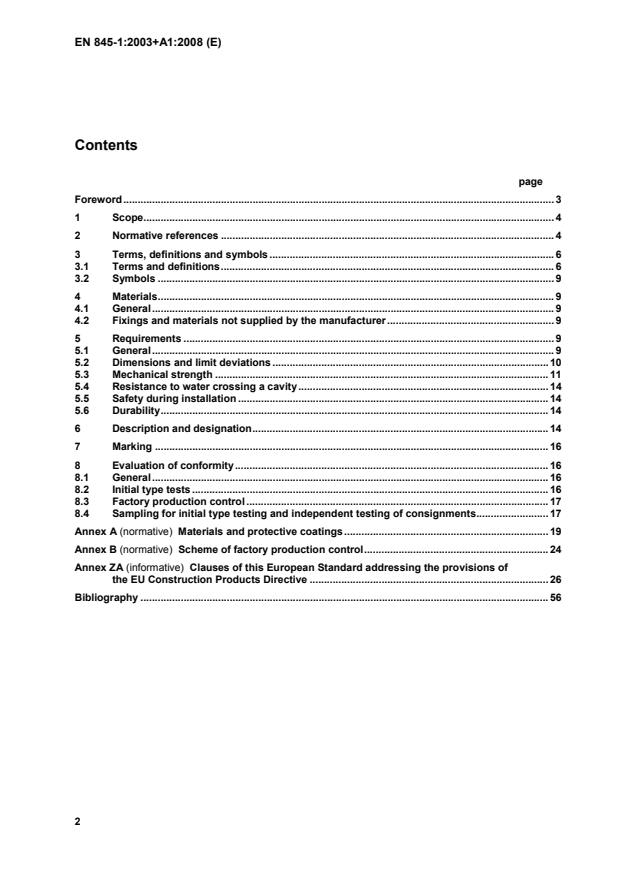
Contents
page
Foreword. 3
1 Scope. 4
2 Normative references . 4
3 Terms, definitions and symbols . 6
3.1 Terms and definitions. 6
3.2 Symbols . 9
4 Materials. 9
4.1 General. 9
4.2 Fixings and materials not supplied by the manufacturer. 9
5 Requirements . 9
5.1 General. 9
5.2 Dimensions and limit deviations .10
5.3 Mechanical strength . 11
5.4 Resistance to water crossing a cavity. 14
5.5 Safety during installation . 14
5.6 Durability. 14
6 Description and designation. 14
7 Marking . 16
8 Evaluation of conformity. 16
8.1 General. 16
8.2 Initial type tests . 16
8.3 Factory production control . 17
8.4 Sampling for initial type testing and independent testing of consignments. 17
Annex A (normative) Materials and protective coatings. 19
Annex B (normative) Scheme of factory production control. 24
Annex ZA (informative) Clauses of this European Standard addressing the provisions of
the EU Construction Products Directive . 26
Bibliography . 56
Foreword
This document (EN 845-1:2003+A1:2008) has been prepared by Technical Committee CEN/TC 125
"Masonry", the secretariat of which is held by BSI.
This document shall be given the status of a national standard, either by publication of an identical
text or by endorsement, at the latest by August 2008 and conflicting national standards shall be
withdrawn at the latest by August 2008.
This document has been prepared under a mandate given to CEN by the European Commission and
the European Free Trade Association and supports the essential requirements of the EU Construction
Products Directive (89/106/EEC).
For relationship with EU Directives, see informative Annex ZA which is an integral part of this
document.
This document includes Amendment 1 approved by CEN on 2007-12-02.
This document supersedes !EN 845-1:2003".
The start and finish of text introduced or altered by amendment is indicated in the text by tags ! ".
In this European Standard the Annexes A and B are normative.
This Part has been modified, including the introduction of additional requirements, taking into account
the detailed answer by CEN/TC 125 to EC mandate M116 for masonry as well as details of the
relationship of this new harmonized European Standard with the EU Directives.
EN 845 “Specification for ancillary components for masonry” consists of the following Parts:
— Part 1: Wall ties, tension straps, hangers and brackets.
— Part 2: Lintels.
— Part 3: Bed joint reinforcement of steel meshwork.
According to the CEN/CENELEC Internal Regulations, the national standards organizations of the
following countries are bound to implement this European Standard: Austria, Belgium, Bulgaria,
Cyprus, Czech Republic, Denmark, Estonia, Finland, France, Germany, Greece, Hungary, Iceland,
Ireland, Italy, Latvia, Lithuania, Luxembourg, Malta, Netherlands, Norway, Poland, Portugal, Romania,
Slovakia, Slovenia, Spain, Sweden, Switzerland and United Kingdom.
1 Scope
This European Standard specifies requirements for wall ties, tension straps, hangers and brackets for
interconnecting masonry and for connecting masonry to other parts of works and buildings including
walls, floors, beams, and columns. Where anchors or fasteners are supplied or specified as part of an
ancillary component, the requirements including performance requirements apply to the complete
product.
This European Standard is not applicable to:
a) anchors and fasteners other than as part of an ancillary component;
b) shelf angles;
c) wall starter plates for tying into existing walls;
d) products formed from materials other than:
1) austenitic stainless steel (molybdenum chrome nickel alloys or chrome nickel alloys);
2) ferritic stainless steel;
3) copper;
4) phosphor bronze;
5) aluminium bronze;
6) zinc-coated-steel with or without organic coating;
7) polypropylene;
8) polyamide (for expansion plugs only).
NOTE The resistance fire performance of the products included herein cannot be assessed separately from
the masonry element of which they are part and is therefore not covered under the scope of this part of this
European Standard.
2 Normative references
The following referenced documents are indispensable for the application of this document. For dated
references, only the edition cited applies. For undated references, the latest edition of the referenced
document (including any amendments) applies.
EN 846-4, Methods of test for ancillary components for masonry — Part 4: Determination of load
capacity and load-deflection characteristics of straps
EN 846-5, !Methods of test for ancillary components for masonry — Part 5: Determination of tensile
and compressive load capacity and load displacement characteristics of wall ties (couple test)"
EN 846-6, !Methods of test for ancillary components for masonry — Part 6: Determination of tensile
and compressive load capacity and load displacement characteristics of wall ties (single end test)"
EN 846-7, Methods of test for ancillary components for masonry — Part 7: Determination of shear
load capacity and load displacement characteristics of shear ties and slip ties (couplet test for mortar
joint connections)
EN 846-8, Methods of test for ancillary components for masonry — Part 8: Determination of load
capacity and load-deflection characteristics of joist hangers
EN 846-10, Methods of test for ancillary components for masonry — Part 10: Determination of load
capacity and load-deflection characteristics of brackets
EN 846-13:2001, Methods of test for ancillary components for masonry — Part 13: Determination of
resistance to impact, abrasion and corrosion of organic coatings
EN 10020, Definitions and classification of grades of steel
EN 10088-1, Stainless steels — Part 1: List of stainless steels
EN 10088-2, !Stainless steels — Part 2: Technical delivery conditions for sheet/plate and strip of
corrosion resisting steels for general purposes"
EN 10088-3, !Stainless steels — Part 3: Technical delivery conditions for semi-finished products,
bars, rods, wire, sections and bright products of corrosion resisting steels for general purposes"
!deleted text"
!EN 10143:2006, Continuously hot-dip coated steel sheet and strip — Tolerances on dimensions
and shape"
!deleted text"
EN 10244-1, Steel wire and wire products — Non-ferrous metallic coatings on steel wire —
Part 1: General principles
EN 10244-2, !Steel wire and wire products — Non-ferrous metallic coatings on steel wire — Part 2:
Zinc or zinc alloy coatings"
EN 10245-1, !Steel wire and wire products — Organic coatings on steel wire — Part 1: General
rules"
EN 10245-2, !Steel wire and wire products — Organic coatings on steel wire — Part 2: PVC
finished wire"
EN 10245-3, !Steel wire and wire products — Organic coatings on steel wire — Part 3: PE coated
wire"
!EN 10326, Continuously hot-dip coated strip and sheet of structural steels — Technical delivery
conditions"
!EN 10327, Continuously hot-dip coated strip and sheet of low carbon steels for cold forming —
Technical delivery conditions"
EN ISO 1461, !Hot dip galvanized coatings on fabricated iron and steel articles — Specifications
and test methods (ISO 1461:1999)"
EN ISO 1463, !Metallic and oxide coatings — Measurement of coating thickness — Microscopical
method (ISO 1463:2003)"
ISO 75-1, Plastics — Determination of temperature of deflection under load — Part 1: General test
method
ISO 75-2, !Plastics — Determination of temperature of deflection under load — Part 2: Plastics and
ebonite"
ISO 178, Plastics — Determination of flexural properties
!ISO 180:2000", Plastics — Determination of Izod impact strength
ISO 306, Plastics — Thermoplastic materials — Determination of Vicat Softening Temperature (VST)
ISO 427, Wrought copper-tin alloys — Chemical composition and forms of wrought products
ISO 428, Wrought copper-aluminium alloys — Chemical composition and forms of wrought products
ISO 431, Copper refinery shapes
ISO 527-1, Plastics — Determination of tensile properties — Part 1: General principles
ISO 527-2, Plastics — Determination of tensile properties — Part 2: Test conditions for moulding and
extrusion plastics
ISO 1133, Plastics — Determination of the melt mass-flow rate (MFR) and the melt volume-flow rate
(MVR) of thermoplastics
ISO 1183, !Plastics — Methods for determining the density of non-cellular plastics"
ISO 2039-2, Plastics — Determination of hardness — Part 2: Rockwell hardness
3 Terms, definitions and symbols
3.1 Terms and definitions
For the purposes of this European Standard the following terms and definitions apply.
NOTE Dimensions and terms relating to wall ties are given in Figure 1.
3.1.1
asymmetrical tie
1) wall tie which is of a different physical design at either end over its embedment depth (or end
fixing). The centre section may be symmetrical or asymmetrical in detail
NOTE 1 Examples are given in Figure 2 a).
2) wall tie which is physically identical at either end over its embedment depth (or end fixing) but
which is fixed in a different manner at each end is also defined as asymmetrical for the purposes
of the test procedure
NOTE 2 Examples are given in Figure 2 b).
3.1.2
bracket
device attached to structural elements, comprising an individual support for two adjacent masonry
units, which form part of a masonry wall
NOTE Examples are given in Figure 3.
3.1.3
cavity wall tie
device for connecting a masonry leaf across a cavity to another masonry leaf or to a structural frame
to resist tension and compression forces while allowing limited differential movement in the plane of
the wall
NOTE 1 Examples are given in Figures 2 and 4.
NOTE 2 Wall ties are further sub classified as asymmetrical or symmetrical and as horizontal, slope-tolerant
or movement-tolerant. Examples are given in Figures 2, 4 and 5 respectively.
3.1.4
cavity width
distance between the cavity faces of the masonry leaves of a cavity wall, measured perpendicular to
the plane of the wall
3.1.5
declared value
value for a product property, determined in accordance with this standard, that a manufacturer is
confident of achieving bearing in mind the variability of the manufacturing process
3.1.6
design embedment length
length of a wall tie, strap or hanger designed to be embedded in mortar (see Figure 1)
3.1.7
fixing
device, (e.g. a nail, screw, screw/plug, anchor or bolt) used to connect ancillary components to
masonry or to supporting structures to resist tension and shear forces
3.1.8
horizontal wall tie
cavity wall tie which is designed to be installed approximately horizontally and in the plane of the
mortar joint across a cavity
NOTE Examples are given in Figures 2, and 4.
3.1.9
joist hanger (face fixing type)
device for supporting a joist, beam, truss or rafter on a masonry wall via fixing bolts or screws
NOTE Examples are given in Figure 6.
3.1.10
joist hanger (joint fixing type)
device for supporting a joist, beam, truss or rafter on a masonry wall by direct loading via a flange
which is embedded in a mortar joint
NOTE Examples are given in Figure 7.
3.1.11
1)
load capacity
individual value of the failure load, or load at an extreme displacement, given in the appropriate test
method, whichever is the lesser
3.1.12
tensile/compressive/shear load capacity
mean of the load capacities of the wall ties when tested in tension/compression/shear
1) A convention has been adopted in this standard for terminology relating to the term ‘load capacity’. It is also used in the
EN 846 test methods which support EN 845. This term without a preceding qualifying adjective as shown in 3.1.11 denotes an
individual value of ‘load capacity’, i.e. the result of one measurement on one specimen. Where the term is used with a
preceding qualifying adjective e.g. ‘tensile load capacity’ (see 3.1.12) this relates to the mean of the load capacities from a
number of specimens tested.
3.1.13
vertical load capacity
mean of the load capacities of the joist hangers/brackets when tested
3.1.14
movement-tolerant cavity wall tie
cavity wall tie which is designed to allow large in-plane differential movements of the walls, without
generating large shear stresses, by the use of flexible body materials, free-running slot systems,
articulated joints or other means
NOTE Examples are given in Figures 8 and 9 c).
3.1.15
profile height
maximum overall height (distance between the upper and lower surface at right angles to the length
and width of the joint) of the embedded portion of a wall tie, strap or hanger (see Figure 1)
3.1.16
shear tie
wall tie designed to transmit shear, tension and compression forces between two adjacent sections of
masonry or between structural frames and masonry
NOTE Shear ties are sub-classified as symmetrical or asymmetrical. (Examples are given in Figure 10).
3.1.17
slip tie (general purpose)
wall tie designed to transmit only shear forces between two adjacent sections of masonry or between
masonry and structural frames while allowing in-plane movement
NOTE Examples are given in Figure 11.
3.1.18
slip tie (wall-head restraint type)
wall tie designed to transmit shear forces between masonry and structural frames while allowing
vertical in-plane movement
NOTE Examples are given in Figure 12.
3.1.19
slope-tolerant tie
cavity wall tie designed to function satisfactorily with a significant slope from the horizontal
NOTE Examples are given in Figure 5.
3.1.20
slot tie
wall tie whose end fixing (at one end) is by means of engaging a re-entrant key (e.g. dovetail) into a
slot either embedded in a concrete wall or surface fixed to concrete, steel or masonry walls or frame
elements and which is free to slide in the slot either only during installation (for adjustment purposes)
or both during installation and while in service (to allow differential movement)
NOTE Examples are given in Figure 9.
3.1.21
symmetrical tie
wall tie which is physically identical at each end over its embedment depth (or end fixing) and which is
fixed in an identical manner at each end
NOTE 1 The centre section may be symmetrical or asymmetrical in detail.
NOTE 2 Examples are given in Figure 4.
3.1.22
tension strap
device for connecting masonry walls to other adjacent components such as floors and roofs and
which resists tension forces
NOTE Examples are given in Figure 13.
3.1.23
wall tie
device capable of transferring loads between masonry leaves or between masonry and other
structures, in order to limit their relative movement in purely one or more planes, as required
NOTE Examples are given in Figures 1, 2, 4, 8, and 10.
3.2 Symbols
L the overall perpendicular length of a bracket from the fixing surface to the extremity of the
support flange, in mm.
NOTE Examples are given in Figure 3.
4 Materials
4.1 General
Materials for the manufacture of components covered by this standard shall be selected from Annex A
and the material/coating reference shall be declared. The materials within a product, including those
for any fixings, shall be compatible and stainless steel shall not be in contact with other types of steel.
4.2 Fixings and materials not supplied by the manufacturer
The manufacturer shall declare the combinations of masonry units, mortars and fixings (where
appropriate) for which the relevant declared values of product performance characteristics are valid.
Unless otherwise chosen by the manufacturer, the products shall be tested using masonry units
conforming to EN 771 with a normalized compressive strength of not greater than 5 N/mm and
general purpose mortar conforming to EN 998-2 with a compressive strength not greater than
1,5 N/mm .
Where the fixings are not supplied as part of the product, fixings in accordance with a European
Standard or European Technical Approval shall be specified. The materials for such fixings shall be
compatible with that of the component.
5 Requirements
5.1 General
The requirements and properties specified in this standard shall be defined in terms of the test
methods and procedures referred to in this European Standard.
NOTE The conformity criteria given in 5.2 to 5.6 inclusive relate to initial type tests (see 8.2) and when
relevant consignment testing (see 8.4).
For production evaluation, conformity criteria in the factory production control documentation shall be
defined.
5.2 Dimensions and limit deviations
5.2.1 Method of measurement and accuracy
Dimensions shall be measured using a calibrated device capable of achieving an error limit of ± 1 %.
5.2.2 Length, applicable cavity width, embedment and fixings (number, size and location)
5.2.2.1 Wall ties
The design embedment length of wall ties shall be at least 40 mm.
The overall length of wall ties shall be declared. When sampled in accordance with clause 8 and
measured, the overall length of wall ties shall be within ± 2,5 % of the declared value.
For cavity wall ties, the range of cavity widths over which the declared values of product performance
characteristics are valid shall be declared.
For each end of a wall tie, the design embedment length, or details and instructions for fixing shall be
declared.
NOTE The requirements of this standard may be applied to some component parts of more complex tying
systems (e.g. head restraint slip ties of the types shown in Figure 12).
5.2.2.2 Tension straps
The overall dimensions of each length of a strap together with details of the number, size and location
of fixings as appropriate shall be declared. When sampled in accordance with clause 8 and
measured, dimensions shall be within ± 5 % or 3 mm of the declared values whichever is the lesser.
5.2.2.3 Joist hangers
The design embedment length of joist hangers (joint fixing type) shall be at least 60 mm. The clear
length of the joist flange (all types) shall be at least 75 mm.
The following dimensions shall be declared. When sampled in accordance with clause 8 and
measured these dimensions shall be within ± 5 % or 3 mm of the declared values whichever is the
lesser:
the clear length of the masonry flange;
the clear length of the joist flange;
the perpendicular distance between the bearing surface of the masonry flange and the bearing
surface of the joist flange (joint fixing type only);
the width of the joist for which the hanger is intended.
5.2.2.4 Brackets
The overall perpendicular length, L (see Figure 3), from the fixing surface to the extremity of the
support flange shall be declared. When sampled in accordance with clause 8 and measured, L shall
be within ± 5 % or ± 3 mm of the declared value, whichever is the lesser.
5.2.3 Thickness or diameter
5.2.3.1 Wall ties, tension straps and joist hangers
The minimum thickness of mortar joint for which the component is suitable shall be declared. This
declared thickness shall be not less than the thickness of the joint as used in the tests carried out in
accordance with EN 846.
5.2.3.2 Brackets
The minimum thickness of the material shall be declared. When sampled in accordance with clause 8
and measured, the minimum thickness shall be equal to or greater than the declared value.
The permissible deviations on thickness for coated steel flat materials shall be in accordance with
Tables 1 and 2 of !EN 10143:2006".
5.2.4 Other dimensions
5.2.4.1 General
Any other dimensions, including the number, size and location of fixings, which affect the structural
performance of a product or which co-ordinate with other components shall be declared. When
sampled in accordance with clause 8 and measured, these dimensions shall be within ± 5 % of the
declared values.
5.2.4.2 Movement-tolerant cavity wall ties
For movement-tolerant cavity wall ties the maximum permissible range of movement shall be
declared.
5.2.4.3 Slope-tolerant cavity wall ties
For slope-tolerant ties the maximum and minimum permissible slopes shall be declared.
5.3 Mechanical strength
5.3.1 Wall ties and associated fixings
5.3.1.1 General
Wall ties shall be designated as either symmetrical or asymmetrical and either horizontal, slope-
tolerant or movement-tolerant. The mechanical performance of slope-tolerant and movement-tolerant
ties at all points of their ranges of slope or movement shall be equal to or greater than the declared
values.
NOTE 1 See 3.1.5 for definition of the term ‘declared value’.
Where cavity wall ties are declared to be movement-tolerant and/or slope-tolerant then their
mechanical strength shall be determined for the maximum condition of movement and/or maximum
slope.
NOTE 2 The term ‘load capacity’ relates to test values for individual specimens whereas the terms
‘compressive load capacity’, ‘shear load capacity’ and ‘vertical load capacity’ relate to the mean of the test values
for a sample.
5.3.1.2 Tensile load capacity
The tensile load capacity of the wall ties shall be declared. When sampled in accordance with
clause 8 and tested by the method of EN 846-5 or EN 846-6 as appropriate, the tensile load capacity
shall be equal to or greater than the declared value and additionally no load capacity of a specimen in
tension shall be less than 70 % of the declared value. For asymmetrical ties, where the ends are
tested separately, the tensile load capacity shall be that of the weaker end. Each of the two
supplementary tests over the 15 mm wider cavity shall not give load capacities in tension less than
50 % of the declared value.
5.3.1.3 Compressive load capacity
The compressive load capacity of the wall ties shall be declared. When sampled in accordance with
clause 8 and tested by the method of EN 846-5 or EN 846-6 as appropriate, the compressive load
capacity shall be equal to or greater than the declared value and additionally no load capacity of a
specimen in compression shall be less than 70 % of the declared value. For asymmetrical ties, where
the ends are tested separately, the load capacity of a specimen in compression shall be that of the
weaker end. Each of the two supplementary tests over the 15 mm wider cavity shall not give load
capacities in compression less than 50 % of the declared value.
5.3.1.4 Displacement under load
When measured in accordance with EN 846-5 or EN 846-6 as appropriate, the displacement of any
individual wall tie at one third of the declared value of tensile load capacity or compressive load
capacity shall not exceed 1 mm. In each of the two supplementary tests over a 15 mm wider cavity
the displacement of the wall tie at one sixth of the declared value shall not exceed 1 mm.
5.3.2 Shear ties
5.3.2.1 Shear load capacity
Shear ties shall be designated as either symmetrical or asymmetrical. Shear ties shall comply with the
requirements of 5.3.1 and this sub-clause.
The shear load capacity of the shear ties shall be declared. When sampled in accordance with
clause 8 and tested by the method of EN 846-7, the shear load capacity shall be equal to or greater
than the declared value for either the horizontal or the vertical direction or for both directions.
Additionally no load capacity of a specimen under shear shall be less than 70 % of the declared
value.
5.3.2.2 Displacement under load
When measured in accordance with EN 846-7, the displacement of any individual wall tie at one third
of the declared value of shear load capacity shall not exceed 1 mm.
5.3.3 Slip ties (general purpose)
5.3.3.1 General
Slip ties shall be designated as either symmetrical or asymmetrical.
5.3.3.2 Shear load capacity
The shear load capacity of the slip ties shall be declared. When sampled in accordance with clause 8
and tested by the method of EN 846-7, the shear load capacity shall be equal to or greater than the
declared value for either the horizontal or the vertical direction or for both directions. Additionally no
load capacity of a specimen under shear shall be less than 70 % of the declared value.
5.3.3.3 Displacement under load
When measured in accordance with EN 846-7, the displacement of any individual wall tie at one third
of the declared value of shear load capacity shall not exceed 2 mm.
5.3.4 Slip ties (head restraint type)
The shear load capacity of the slip ties shall be declared. When calculated in accordance with
accepted engineering principles, the predicted shear load capacity shall be not less than the declared
value.
5.3.5 Joist hangers
5.3.5.1 Vertical load capacity
The vertical load capacity of the joist hangers shall be declared. When sampled in accordance with
clause 8 and tested by the method of EN 846-8, the vertical load capacity shall be equal to or greater
than the declared value. Additionally, no load capacity of a specimen shall be less than 90 % of the
declared value.
5.3.5.2 Deflection under load
!When measured in accordance with EN 846-8, the mean deflection of a sample of joist hangers at
one third of the declared value of their vertical load capacity shall be declared."
5.3.6 Brackets
5.3.6.1 Vertical load capacity
The vertical load capacity in normal loading format shall be declared. When sampled in accordance
with clause 8 and tested by the method of EN 846-10, the vertical load capacity in normal loading
format shall be equal to or greater than the declared value. Additionally no load capacity of a
specimen shall be less than 90 % of the declared value.
5.3.6.2 Deflection under load
!When measured in accordance with EN 846-10, the mean deflection of a sample of brackets at
one third of the declared value of their vertical load capacity shall be declared.
NOTE When tested the deflection of the bracket is measured at 10 mm ± 0,5 mm from the free edge and
the value obtained will, therefore, be much greater than the deflection of masonry supported by the product
type."
5.3.7 Tension straps
5.3.7.1 Tensile load capacity
The tensile load capacity shall be declared. When sampled in accordance with clause 8 and tested by
the method of EN 846-4, the tensile load capacity shall be equal to or greater than the declared value.
Additionally no load capacity of a specimen shall be less than 90 % of the declared value. For
asymmetrical straps, where the ends are tested separately, the tensile load capacity shall be that of
the weaker end.
5.3.7.2 Displacement under load
!When measured in accordance with EN 846-4, the mean displacement of a sample of tension
straps at one third of the declared value of their tensile load capacity shall be declared."
5.4 Resistance to water crossing a cavity
It shall be declared whether wall ties are resistant to water crossing a cavity. Cavity wall ties and head
restraint slip ties for external cavity walls shall be designed to prevent water from crossing from an
external to an internal leaf.
NOTE This can be achieved by design of the central section (e.g. by the use of a shaped section of the wall
tie ("drip"), a clip-on device or by the wall tie sloping downwards from inner to outer leaf).
The range of difference in level from the outer to the inner leaf over which slope tolerant ties may be
used, shall be declared. Within this range slope tolerant ties for external cavity walls shall prevent
water crossing the cavity.
5.5 Safety during installation
The product design shall minimize the danger to persons handling the product through either;
a) the use of sharp edges and pointed ends;
b) Alternatively, suitable protective equipment supplied with the product or specified on the product
label (e.g. gloves and/or eye protectors).
5.6 Durability
The materials for the manufacture of the products and their corrosion protection systems shall be
selected in accordance with the requirements of 4.1 and 4.2.
NOTE The durability of performance characteristics against corrosion is dependent on both the condition of
exposure of the masonry and the material/coating specification. This European Standard follows the state of the
art by giving material/coating specifications for use with !EN 1996-2" or regulatory requirements.
6 Description and designation
The information to be supplied, indicated by a tick (9), shall be as given in Table 1.
Table 1 — Information to be provided
a
Information Information to be supplied Cavity Shear Slip Tension Joist Brackets
reference wall ties ties straps hangers
number ties
1. Material/coating specification in 9 9 9 9 9 9
accordance with Table A.1
2. Dimensions in accordance with 5.2 9 9 9 9 9 9
3. Declared value of tensile load capacity - - -
9 9 9
4. Declared value of compressive load - - - -
9 9
capacity
5. Declared value of shear load capacity - - - -
9 9
6. Declared value of vertical load capacity - - - -
9 9
-
!7 Declared mean displacement /deflection - - 9 9 9"
8 Whether the component is symmetrical 9 9 9 9 - -
or asymmetrical
9 Whether the component is slope- 9 - - - - -
tolerant , and if it is, the range of
difference in level from the outer leaf
down to the inner leaf, over which it
may be used
10 Whether the component is movement 9 - - - - -
tolerant together with the maximum
permissible movement range
b
11 Whether a component is intended to be - - - -
resistant to water crossing a cavity
!12 Specification for use, including limiting 9 9 9 9 9 9"
requirements on compressive strength
and types of masonry units and
mortars, the type, size, number and
location of any fixings and any particular
assembly or installation instructions in
accordance with 4.2
13 Product identity (see clause 7 c))
9 9 9 9 9 9
14 Minimum mortar joint thickness for -
9 9 9 9 9
which the component is suitable (where
relevant)
15 The specification of any fixing devices
9 9 9 9 9 9
not provided by the manufacturer and
not packaged with the product
a
Additional information may include sound attenuation, thermal characteristics and instructions regarding safety during
installation.
b
Required for head restraint only.
Key
9 To be provided
- Not required
7 Marking
The following information shall be clearly and indelibly marked on the product or on its packaging,
delivery note, invoice or in the accompanying documentation, supplied with the product:
a) the number and date of issue of this European Standard EN 845-1;
b) the name or identifying mark and registered address of the manufacturer, or the manufacturer’s
authorized representative;
c) a unique reference number, name or code which will identify the product type and relate it to its
description and designation.
NOTE For CE marking and labelling, ZA.3 applies . When annex ZA.3 requires the CE marking to be
accompanied by the same information as required by this clause the requirements of this clause can be
considered to have been met.
8 Evaluation of conformity
8.1 General
The manufacturer or his agent shall demonstrate compliance for his product with the requirements of
this European Standard and with the declared values for the product properties by carrying out both:
initial type testing of the product (see 8.2);
factory production control (see 8.3).
Alternative methods of test to the methods specified in this European Standard may be adopted
except for the initial type tests and in case of dispute, provided that these alternative methods satisfy
the following:
a) a relationship can be shown to exist between the results from the specified test and those from
the alternative test; and
b) the information on which the relationship is based is available.
8.2 Initial type tests
After completion of the development of a new product type and before commencement of
manufacture and offering for sale, appropriate initial type tests shall be carried out to confirm that the
properties predicted from the development meet the requirements of this standard and the values to
be declared for the product. The manufacturer shall also consider what constitutes a product type and
whether variations in certain dimensions in a specific range of products can be encompassed within
that product type for the purposes of determining the relevant product performance characteristics.
Whenever a change in the basic materials or manufacturing procedures occurs, leading to what is
considered to constitute a new product type being produced, the appropriate initial type tests shall be
repeated.
The tests to be conducted shall be the tests and/or calculations as described in this standard for the
properties selected from the following list consistent with the product type's intended use:
a) material properties (Organic coating impact, abrasion and corrosion resistance only)
(see Table A.2);
b) dimensions and permissible deviations in accordance with 5.2;
c) tensile load capacity (see 5.3.1 and 5.3.7);
d) compressive load capacity (see 5.3.1);
e) shear load capacity (see 5.3.2, 5.3.3 and 5.3.4);
f) vertical load capacity according to product type (see 5.3.5and 5.3.6);
g) !Displacement/Deflection (as appropriate) of 1 mm or 2 mm or a declared value, specified
according to product type, at one third of the declared value of load capacity (see 5.3.1.4, 5.3.2.2,
5.3.3.3, 5.3.5.2, 5.3.6.2 and 5.3.7.2)."
The results of initial type tests shall be recorded and be available for inspection. Sampling for initial
type testing shall be in accordance with 8.4.
NOTE For the performance characteristics to be determined in order to address the CE marking provisions
(see Tables ZA.1a to ZA.1f).
8.3 Factory production control
A factory production control scheme shall be established and documented in a manual prior to a new
product type being offered for sale. Subsequently, any fundamental changes in basic materials,
manufacturing procedures or the control scheme that affects the properties or use of a product shall
be recorded in the manual.
The manual shall include the factory production control procedures relevant to the declared values for
the properties, as confirmed by the initial type tests.
The factory production control procedures shall consist of a system for the permanent internal control
of the production of the products to ensure that such products subsequently offered for sale conform
with this standard and the declared values.
The permanent internal control will consist of one or more of the following:
a) inspections and checks on the design of the product;
b) inspections, checks and tests and the utilisation of the results to control equipment, raw or
incoming materials and the production process;
c) inspections, checks and tests on the finished product itself.
The manufacturer shall choose a), if applicable, b) and/or c) and record it in the factory production
control manual. Annex B lists all the items that shall be examined to determine which is appropriate
for the control exercised for a product.
NOTE A manufacturer operating a Quality System conforming to with EN ISO 9001 should meet the
requirements of this sub-clause and Annex B.
8.4 Sampling for initial type testing and independent testing of consignments
The minimum sample size for a single test shall be as given in Table 2 and shall be drawn at random.
For initial type testing the batch from which the sample is drawn shall be of a size of at least 100 times
the number of specimens taken. Pre-production samples may be used for initial type tests where it is
possible to demonstrate that the characteristics of performance are representative of products from
the full production process.
Table 2 — Sampling — Numbers of specimens
a
Product Minimum number per single test
b
Wall ties designed to link two leaves of a cavity wall or 10
cladding to a frame
a
plus 2 over 15 mm wider cavity (see 5.3.1)
b
Shear ties
b
Slip ties
Joist hangers 5
Brackets 5
Tension-straps 5 per end
a
For testing organic coatings, see sampling requirements of EN 846-13.
b
These quantities will be doubled where both ends of asymmetrical wall ties are tested separately.
In the event of the need to check the compliance of a lot or consignment of a product supplied to site
or installed, a sample shall be taken at random from the lot or consignment and tested. The sample
sizes shall be not less than those given in Table 2.
Annex A
(normative)
Materials and protective coatings
Materials for ancillary components and the appropriate protective coatings shall be selected from
Tables A.1, A.2 and/or A.3.
Table A.1 — Materials and corrosion protection systems
a
Material Specifications for material Minimum coating specification Organic Material/coating
e
coating reference
d
Mass per Mass per two Thickness Thickness
b c
side sides
g/m g/m2 µm µm
Austenitic stainless steel EN 10088 - - - - 1
(molybdenum chrome nickel alloys)
Plastic used for the body of wall ties Polypropylene in accordance with Table A.3 - - - - 2
Austenitic stainless steel (chrome nickel alloys) EN 10088 - - - - 3
Ferritic stainless steel EN 10088 - - - - 4
Phosphor bronze ISO427 – CuSn4.CuSn5.CuSn7 - - - - 5
Aluminium bronze ISO428 – CuAl7 - - - - 6
Copper ISO431 – Cu-ETP, Cu-FRTP, Cu-OF, - - - - 7
Cu-DHP
Zinc coated steel wire EN 10020 with EN 10244 zinc coating 940 - - - 8
Zinc coated steel component ISO 1461 zinc coated steel
...