

EN 13557:2003+A2:2008
(Main + Amendment)Cranes - Controls and control stations
- Abstract
This European Standard specifies health and safety design requirements for controls and control stations for all types of crane.
NOTE 1 Control systems are covered by other standards e.g. EN 60204-32, prEN 13135-1 and prEN 13135-2.
Annex C provides additional value to the requirements for cableless control systems as specified in EN 60204-32.
NOTE 2 Annex C will be deleted after WG 3 agreed to introduce it into their document prEN 13135-1.
NOTE 3 Specific requirements for particular types of crane are given in the appropriate European Standard for the particular crane type.
This standard does not deal with noise hazards because these are dealt with in safety standards for specific types of cranes. It also does not address the design of the cabin with regard to its sound insulation properties.
This European Standard covers specific hazards which could occur during the use of controls and control stations. It does not cover hazards which could occur during transport, construction, commissioning, modification, maintenance, de-commissioning or disposal.
The hazards covered by this standard are identified in clause 4.
This European Standard is applicable after the date of approval by CEN of this standard.
- Status
- Withdrawn
- Publication Date
- 15-Apr-2008
- Withdrawal Date
- 06-Oct-2026
- Technical Committee
- CEN/TC 147 - Cranes - Safety
- Drafting Committee
- CEN/TC 147/WG 4 - Design - Requirements for health and safety
- Current Stage
- 9960 - Withdrawal effective - Withdrawal
- Start Date
- 20-Mar-2024
- Completion Date
- 07-Oct-2026
- Directive
- 2006/42/EC - Directive 2006/42/EC of the European Parliament and of the Council of 17 May 2006 on machinery, and amending Directive 95/16/EC (recast)OJ Ref: C, C 214 OJ Date: 08-Sep-2009
98/37/EC - MachineryOJ Ref: C, C 22 OJ Date: 28-Jan-2009

Relations
- Effective Date
- 18-Jan-2023
- Effective Date
- 18-Jan-2023
- Effective Date
- 25-Aug-2026
- Effective Date
- 25-Aug-2026
- Effective Date
- 25-Aug-2026
- Effective Date
- 09-Feb-2026
- Effective Date
- 09-Feb-2026
- Effective Date
- 09-Feb-2026
- Effective Date
- 09-Feb-2026
- Effective Date
- 28-Jan-2026
- Effective Date
- 28-Jan-2026
- Effective Date
- 28-Jan-2026
- Effective Date
- 28-Jan-2026
- Effective Date
- 28-Jan-2026
- Effective Date
- 28-Jan-2026
Frequently Asked Questions
EN 13557:2003+A2:2008 is a standard published by the European Committee for Standardization (CEN). Its full title is "Cranes - Controls and control stations". This standard covers: This European Standard specifies health and safety design requirements for controls and control stations for all types of crane. NOTE 1 Control systems are covered by other standards e.g. EN 60204-32, prEN 13135-1 and prEN 13135-2. Annex C provides additional value to the requirements for cableless control systems as specified in EN 60204-32. NOTE 2 Annex C will be deleted after WG 3 agreed to introduce it into their document prEN 13135-1. NOTE 3 Specific requirements for particular types of crane are given in the appropriate European Standard for the particular crane type. This standard does not deal with noise hazards because these are dealt with in safety standards for specific types of cranes. It also does not address the design of the cabin with regard to its sound insulation properties. This European Standard covers specific hazards which could occur during the use of controls and control stations. It does not cover hazards which could occur during transport, construction, commissioning, modification, maintenance, de-commissioning or disposal. The hazards covered by this standard are identified in clause 4. This European Standard is applicable after the date of approval by CEN of this standard.
This European Standard specifies health and safety design requirements for controls and control stations for all types of crane. NOTE 1 Control systems are covered by other standards e.g. EN 60204-32, prEN 13135-1 and prEN 13135-2. Annex C provides additional value to the requirements for cableless control systems as specified in EN 60204-32. NOTE 2 Annex C will be deleted after WG 3 agreed to introduce it into their document prEN 13135-1. NOTE 3 Specific requirements for particular types of crane are given in the appropriate European Standard for the particular crane type. This standard does not deal with noise hazards because these are dealt with in safety standards for specific types of cranes. It also does not address the design of the cabin with regard to its sound insulation properties. This European Standard covers specific hazards which could occur during the use of controls and control stations. It does not cover hazards which could occur during transport, construction, commissioning, modification, maintenance, de-commissioning or disposal. The hazards covered by this standard are identified in clause 4. This European Standard is applicable after the date of approval by CEN of this standard.
EN 13557:2003+A2:2008 is classified under the following ICS (International Classification for Standards) categories: 53.020.20 - Cranes. The ICS classification helps identify the subject area and facilitates finding related standards.
EN 13557:2003+A2:2008 has the following relationships with other standards: It is inter standard links to EN 13557:2003, EN 13557:2024, ISO 105-Z06:1998, ISO 5006-1:1991, ISO 3795:1989, ISO 11112:1995, EN 60068-2-64:2008, EN 60204-32:1998, EN 60068-2-31:2008, EN ISO 13850:2015, EN ISO 5353:1998, EN 292-2:1991, EN 292-1:1991, EN 20594-1:1993, EN 954-1:1996. Understanding these relationships helps ensure you are using the most current and applicable version of the standard.
EN 13557:2003+A2:2008 is associated with the following European legislation: EU Directives/Regulations: 2006/42/EC, 98/37/EC; Standardization Mandates: M/079, M/396. When a standard is cited in the Official Journal of the European Union, products manufactured in conformity with it benefit from a presumption of conformity with the essential requirements of the corresponding EU directive or regulation.
EN 13557:2003+A2:2008 is available in PDF format for immediate download after purchase. The document can be added to your cart and obtained through the secure checkout process. Digital delivery ensures instant access to the complete standard document.
Standards Content (Sample)
2003-01.Slovenski inštitut za standardizacijo. Razmnoževanje celote ali delov tega standarda ni dovoljeno.Cranes - Controls and control stationsDvigala (žerjavi) - Upravljala in upravljalna mestaAppareils de levage à charge suspendue - Commandes et postes de conduiteKrane - Stellteile und Steuerstände53.020.20DvigalaCranesICS:SIST EN 13557:2004+A2:2008en,frTa slovenski standard je istoveten z:EN 13557:2003+A2:200801-julij-2008SIST EN 13557:2004+A2:2008SLOVENSKI
STANDARD
EUROPEAN STANDARD NORME EUROPÉENNE EUROPÄISCHE NORM
EN 13557:2003+A2
April 2008 ICS 53.020.20 Supersedes EN 13557:2003 English Version
Cranes - Controls and control stations
Appareils de levage à charge suspendue - Commandes et postes de conduite
Krane - Stellteile und Steuerstände This European Standard was approved by CEN on 1 September 2003 and includes Amendment 1 approved by CEN on 26 September 2005 and Amendment 2 approved by CEN on 4 March 2008.
CEN members are bound to comply with the CEN/CENELEC Internal Regulations which stipulate the conditions for giving this European Standard the status of a national standard without any alteration. Up-to-date lists and bibliographical references concerning such national standards may be obtained on application to the CEN Management Centre or to any CEN member.
This European Standard exists in three official versions (English, French, German). A version in any other language made by translation under the responsibility of a CEN member into its own language and notified to the CEN Management Centre has the same status as the official versions.
CEN members are the national standards bodies of Austria, Belgium, Bulgaria, Cyprus, Czech Republic, Denmark, Estonia, Finland, France, Germany, Greece, Hungary, Iceland, Ireland, Italy, Latvia, Lithuania, Luxembourg, Malta, Netherlands, Norway, Poland, Portugal, Romania, Slovakia, Slovenia, Spain, Sweden, Switzerland and United Kingdom.
EUROPEAN COMMITTEE FOR STANDARDIZATION
COMITÉ EUROPÉEN DE NORMALISATION EUROPÄISCHES KOMITEE FÜR NORMUNG
Management Centre: rue de Stassart, 36
B-1050 Brussels © 2008 CEN All rights of exploitation in any form and by any means reserved worldwide for CEN national Members. Ref. No. EN 13557:2003+A2:2008: E
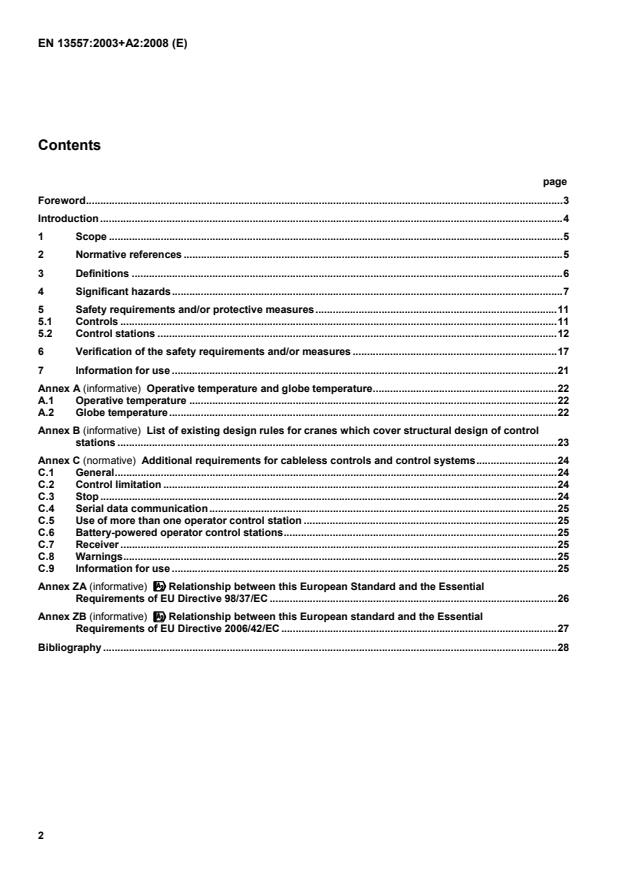
Operative temperature and globe temperature.22 A.1 Operative temperature.22 A.2 Globe temperature.22 Annex B (informative)
List of existing design rules for cranes which cover structural design of control stations.23 Annex C (normative)
Additional requirements for cableless controls and control systems.24 C.1 General.24 C.2 Control limitation.24 C.3 Stop.24 C.4 Serial data communication.25 C.5 Use of more than one operator control station.25 C.6 Battery-powered operator control stations.25 C.7 Receiver.25 C.8 Warnings.25 C.9 Information for use.25 Annex ZA (informative)
####Relationship between this European Standard and the Essential Requirements of EU Directive 98/37/EC.26 Annex ZB (informative)
####Relationship between this European standard and the Essential Requirements of EU Directive 2006/42/EC.27 Bibliography.28
1 Scope This European Standard specifies health and safety design requirements for controls and control stations for all types of crane. NOTE 1 Control systems are covered by other standards
e.g. EN 60204-32, EN 13135-1 and prEN 13135-2.
Annex C provides additional value to the requirements for cableless control systems as specified in EN 60204-32. NOTE 2 Annex C will be deleted after WG 3 agreed to introduce it into their document EN 13135-1. NOTE 3 Specific requirements for particular types of crane are given in the appropriate European Standard for the particular crane type. This standard does not deal with noise hazards because these are dealt with in safety standards for specific types of cranes. It also does not address the design of the cabin with regard to its sound insulation properties. This European Standard covers specific hazards which could occur during the use of controls and control stations. It does not cover hazards which could occur during transport, construction, commissioning, modification, maintenance, de-commissioning or disposal. The hazards covered by this standard are identified in clause 4. This European Standard is applicable after the date of approval by CEN of this standard. 2 Normative references This European Standard incorporates by dated or undated reference, provisions from other publications. These normative references are cited at the appropriate places in the text and the publications are listed hereafter. For dated references, subsequent amendments to or revisions of any of these publications apply to this European Standard only when incorporated in it by amendment or revision. For undated references the latest edition of the publication referred to applies (including amendments). EN 292-1:1991, Safety of machinery – Basic concepts, general principles for design - Part 1: Basic terminology, methodology. EN 292-2:1991, Safety of machinery – Basic concepts, general principles for design - Part 2: Technical principles and specifications. EN 418, Safety of machinery - Emergency stop equipment, functional aspects - Principles for design. EN 954-1:1996, Safety of machinery - Safety-related parts of control systems - Part 1: General principles for design. EN 1070:1998, Safety of machinery – Terminology. EN ISO 5353:1998, Earth-moving machinery and tractors and machinery for agriculture and forestry - Seat index point (ISO 5353:1995). EN 60068-2-27, Basic environmental testing procedures - Part 2: Tests; test Ea and guidance: Shock (IEC 60068-2-27:1987). EN 60068-2-32, Basic environmental testing procedures – Part 2: Tests; test Ed: Free fall (IEC 60068-2-32:1975). EN 60068-2-64, Environmental testing - Part 2: Test methods; test Fh. Vibration, broad-band random (digital control) and guidance (IEC 60068-2-64:1993).
(IEC/TR3 60870-1-3) 3.10 hatch aperture fitted with a cover and used for access purposes 3.11 operating command control signal which is intended to initiate, modify or maintain a crane function / movement 3.12 operative temperature (t0) uniform temperature of an imaginary black enclosure in which an occupant would exchange the same amount of heat by radiation plus convection as in the actual non-uniform environment (see annex A) 3.13 receiver part of a cable-less control system which receives the commands from the transmitter 3.14 transmitter part of a cable-less control system which sends the crane driver's commands to the receiver 4 Significant hazards Table 1 contains all the significant hazards, hazardous situations and events, as far as they are dealt with in this standard, identified by risk assessment as significant for this type of machinery and which require action to eliminate or reduce the risk. NOTE Numbering of hazards follows annex A of EN 1050: 1996. Table 1 — List of significant hazards and associated requirements N° Hazards EN 292-1 : 1991EN 292-2 : 1991 Annex A of EN 292-2:1991 A1 : 1995 Relevant clause(s) in this standard1 Mechanical hazards
1.1 Generated by machine parts of workpieces caused, for example, by 4.2 3.1, 3.2, 4 1.3
1.1.1 Shape
5.2.1.9, 5.2.2.3.1.5 / 6
Table 1 — List of significant hazards and associated requirements (Continued) N° Hazards EN 292-1 : 1991EN 292-2 : 1991 Annex A of EN 292-2:1991 A1 : 1995 Relevant clause(s) in this standard1.1.5 Inadequacy of mechanical strength
5.2.1.4 / 5 / 8 5.2.2.2.1 / 3 5.2.2.2.2, 5.2.2.2.4, 5.2.3.1.4 1.3 Elementary forms of mechanical hazards 4.2
1.3
1.3.1 Crushing hazard
5.2.2.3.1.1,
1.3.3 Cutting or severing hazard
5.2.1.9 1.4 Entanglement
5.2.2.3.1.10 1.6 Impact hazard
5.2.2.2.5, 5.2.2.3.1.7 2 Electrical hazards
2.1 Contact of persons with live parts (direct contact) 4.3 3.9, 6.2.2 1.5.1, 1.6.3 5.2.1.10, 5.1.8 2.2 Contact of persons with live parts (indirect contact) 4.3 3.9 1.5.1 5.2.1.10, 5.1.8 3 Thermal hazards
3.1 Burns and scalds by contact with objects/materials with an extreme temperature 4.4
1.5.5, 1.5.6, 1.5.7 5.1.5 3.2 Health damaging effects by hot or cold environment 4.4
1.5.5 5.2.2.6, 5.2.2.6.3 7 Hazards generated by materials and substances processed
7.1 Hazards from contact with or inhalation of harmful fluids, gases, mists, fumes and dusts 4.8 3.3b, 3.4 1.1.3, 1.5.13, 1.6.5
5.2.2.6.4 7.2 Fire or explosion hazard 4.8 3.4 1.5.6, 1.5.7 5.2.2.3.2.1
Table 1 — List of significant hazards and associated requirements (Continued) N° Hazards EN 292-1 : 1991EN 292-2 : 1991 Annex A of EN 292-2:1991 A1 : 1995 Relevant clause(s) in this standard8 Hazards generated by neglecting ergonomic principles in machinery design as, e.g. hazards from :
8.1 Unhealthy postures or excessive effort 4.9 3.6.1, 6.2.1, 6.2.3, 6.2.4, 6.2.6 1.1.2d, 1.1.5, 1.6.2, 1.6.4 5.1.3, 5.1.4, 5.1.9, 5.2.1.2, 5.2.1.3, 5.2.2.5, 5.2.2.3.1.8 5.2.3.1.4, 5.2.3.2.4 8.2 Inadequate consideration of hand-arm or foot-leg anatomy 4.9 3.6.2 1.1.2d, 2.2 5.1.4, 5.2.2.5, 5.2.2.3.1.2 8.6 Human error, human behaviour
3.6, 3.7.8, 3.7.9, 6.1.1 1.1.2d, 1.2.2, 1.2.5, 1.2.8,1.5.4, 1.7 5.1.2, 5.1.3,
5.2.3.1.1, 5.2.3.1.2, 5.2.3.2.1, C1 8.7 Inadequate design, location or identification of manual controls
3.6.6, 3.7.8 1.2.2 5.1.3, 5.2.3.1.1, 5.2.3.1.2, 5.2.3.2.1, 5.2.3.2.3 10 Unexpected start-up unexpected overrun/overspeed
10.1 Failure/disorder of control system
3.7, 6.2.2 1.2.7, 1.6.3 5.2.3.1.2, 5.2.3.1.5, 5.2.3.2.2, C1 10.2 Restoration of energy supply after an interruption
3.7.2 1.2.6 C2 10.3 External influences on electrical equipment
3.7.11 1.2.1, 1.5.11, 4.1.2.8 C2 10.4 Other external influences (gravity wind etc)
3.7.3 1.2.1 C7 10.5 Errors in
the software
3.7.7 1.2.1 C2, C3, C4 11 Impossibility of stopping machine in the best possible conditions
3.7, 3.7.1 6.1.1 1.2.4, 1.2.6, 1.2.7 5.1.7, C3 13 Failure of the power supply
3.7, 3,7.2
1.2.6 5.2.3.2.5, C2 14 Failure of the control circuit
3.7, 6.2.2 1.2.1,1.2.3, 1.2.4, 1.2.5, 1.2.7, 1.6.3
5.2.3.1.2, 5.2.3.2.2, 5.2.3.2.5, C6, C7
20.4 Excessive speed of pedestrian controlled machinery
3.3.4 5.1.9 20.6 Insufficient ability of machine to be stopped, immobilised
3.3.3, 3.3.5 5.1.6, 5.1.7, C3 21
Additional hazards linked to the work position (including driving station) on the machine
21.2 Exhaust gases/lack of oxygen at the work position
3.2.1 5.2.2.6.1, 5.2.2.6.4 !21.3 Fire (flammability of the cab, lack of extinguishing Means)
3.2.1 3.5.2 5.2.1.5 5.2.2.7" 21.5 Insufficient visibility from the work position
3.2.1 5.2.1.1, 5.2.2.1, 5.2.2.2.2, 5.2.2.2.6, 5.2.2.2.7 21.10 Insufficient means for evacuation/emergency exit
3.2.1 5.2.2.3.2, 5.2.3.2.3, 5.2.2.3.1.3, 5.2.2.3.1.4 25 From / to third parties
25.1 Unauthorised start up / use
3.3.2 5.1.6, C2 25.3 Lack or inadequacy of visual or acoustic warning means
1.7.4, 3.6.1 5.2.3.1.3, C8 26 Insufficient instructions for the driver / operator
3.6 5.2.3.1, 5.1.2, 5.1.3, C.2.1, C8, C9
double-action push-buttons ( in this case the force to maintain the “on”-position shall not exceed 10 N ); emergency push-buttons; button for direct control of power. For push-buttons actuated by the foot the force shall not exceed a value of 100 N. The maximum force required to operate hand-driven movements shall not exceed the following figures: vertical force on a hauling chain: 250 N; horizontal force when pushing against or hauling on the load: 250 N; force applied to the handle of a crank or hand-wheel: 150 N; force applied to a lever with horizontal movement: 250 N. 5.1.5 The temperature of controls, as generated by the crane's operation, shall not exceed 43 °C. 5.1.6 In order to prevent unintended movement of a crane motion, the motion shall only be able to be initiated from the neutral position of the control. Where this is not practicable, other means shall be provided as specified in the European Standards for particular crane types.
Minimum dimensions to permit ergonomically good working conditions and movements for the crane driver shall be as specified in the European Standards for particular crane types. 5.2.1.3 Those parts of the control station where no seat is provided, or where the crane driver is required to work in a standing position, shall have a minimum free standing height of 2 m. 5.2.1.4 Where vibration damping elements are also used as mountings for a control station, means shall be provided to prevent detachment of the control station in the event of failure of the damping elements. 5.2.1.5 Fixings used for mounting the control station shall be of a type which prevent unintentional loosening. !Fixings, excluding vibration damping elements, shall be made from fire retardant materials." 5.2.1.6 All standing areas shall be free of tripping hazards. 5.2.1.7 All standing and walking areas shall be slip resistant. 5.2.1.8 The strength of all parts of control stations and their supporting structure shall be considered as part of the crane structural design. NOTE See annex B. The rated capacity of the elevating control station shall include : — at least 80 kg for each person; — at least 40 kg of personal equipment for each person; — tools and equipment other than personal equipment.
The minimum rated capacity shall be 150 kg.
5.2.1.9 The control station shall be free of projecting parts. Edges shall have radii (minimum 2 mm) or be chamfered (minimum 2 mm x 2 mm). 5.2.1.10 Protection against electric shock for direct or indirect contact shall be as specified in clause 6 of EN 60204-32:1998.
b) be provided with protection up to a minimum height of 1 m from the cabin floor level. Where the protection is by means of horizontal bars, these shall have spaces between the bars not exceeding 0,4 m and the height between the cabin and the lowest bar shall not exceed 0,25 m. Where the protection is by means of vertical bars, these shall have spaces between the bars no
...