


EN 21942-3:1993
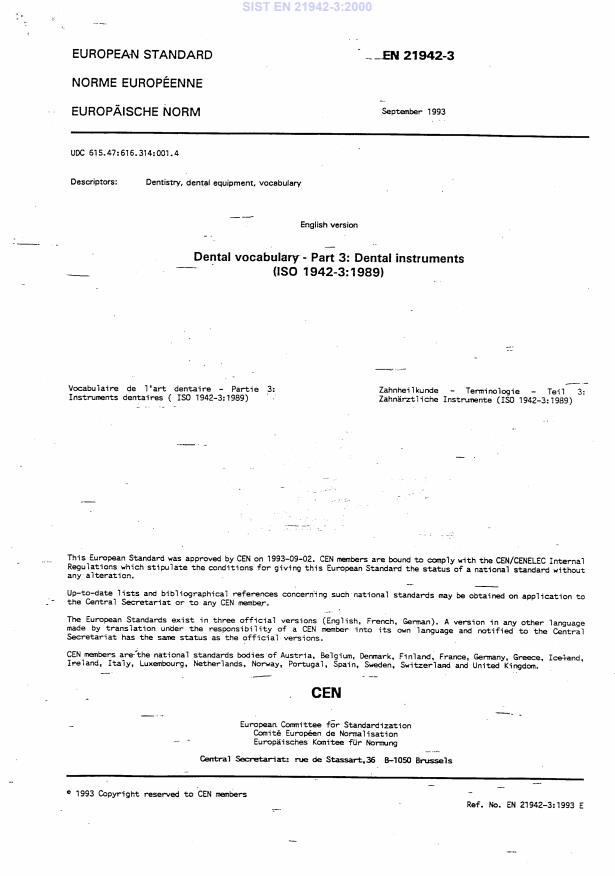
(Main)Dental vocabulary - Part 3: Dental instruments (ISO 1942-3:1989)
Dental vocabulary - Part 3: Dental instruments (ISO 1942-3:1989)
Text was withdrawn on 2010-04-16 by TC resolution.
Zahnheilkunde - Terminologie - Teil 3: Zahnärztliche Instrumente (ISO 1942-3:1989)
Vocabulaire de l'art dentaire - Partie 3: Instruments dentaires (ISO 1942-3:1989)
Dental vocabulary - Part 3: Dental instruments (ISO 1942-3:1989)
General Information
- Status
- Withdrawn
- Publication Date
- 14-Sep-1993
- Withdrawal Date
- 15-Apr-2010
- Technical Committee
- CEN/TC 55 - Dentistry
- Drafting Committee
- CEN/TC 55 - Dentistry
- Current Stage
- 9960 - Withdrawal effective - Withdrawal
- Start Date
- 16-Apr-2010
- Completion Date
- 16-Apr-2010
Relations
- Effective Date
- 15-Feb-2010
- Effective Date
- 28-Jan-2026

Get Certified
Connect with accredited certification bodies for this standard

BSI Group
BSI (British Standards Institution) is the business standards company that helps organizations make excellence a habit.

TÜV Rheinland
TÜV Rheinland is a leading international provider of technical services.

TÜV SÜD
TÜV SÜD is a trusted partner of choice for safety, security and sustainability solutions.
Sponsored listings
Frequently Asked Questions
EN 21942-3:1993 is a standard published by the European Committee for Standardization (CEN). Its full title is "Dental vocabulary - Part 3: Dental instruments (ISO 1942-3:1989)". This standard covers: Text was withdrawn on 2010-04-16 by TC resolution.
Text was withdrawn on 2010-04-16 by TC resolution.
EN 21942-3:1993 is classified under the following ICS (International Classification for Standards) categories: 01.040.11 - Health care technology (Vocabularies); 11.060.20 - Dental equipment. The ICS classification helps identify the subject area and facilitates finding related standards.
EN 21942-3:1993 has the following relationships with other standards: It is inter standard links to EN ISO 1942:2010, EN 1639:2009. Understanding these relationships helps ensure you are using the most current and applicable version of the standard.
EN 21942-3:1993 is available in PDF format for immediate download after purchase. The document can be added to your cart and obtained through the secure checkout process. Digital delivery ensures instant access to the complete standard document.
Standards Content (Sample)
2003-01.Slovenski inštitut za standardizacijo. Razmnoževanje celote ali delov tega standarda ni dovoljeno.Dental vocabulary - Part 3: Dental instruments (ISO 1942-3:1989)Zahnheilkunde - Terminologie - Teil 3: Zahnärztliche Instrumente (ISO 1942-3:1989)Vocabulaire de l'art dentaire - Partie 3: Instruments dentaires (ISO 1942-3:1989)Dental vocabulary - Part 3: Dental instruments (ISO 1942-3:1989)11.060.25Dental instruments01.040.11Zdravstveno varstvo (Slovarji)Health care technology (Vocabularies)ICS:Ta slovenski standard je istoveten z:EN 21942-3:1993SIST EN 21942-3:2000en,fr01-januar-2000SIST EN 21942-3:2000SLOVENSKI
STANDARD
INTERNATIONAL STANDARD NORME INTERNATIONALE Is0 1942-3 Second edition Deuxieme 6dition 1989-07-01 Dental vocabulary - Part 3 : Dental instruments Vocabulaire de l’art dentaire - Partie 3 : Instruments dentaires Reference number Numhro de rkfkence IS0 1942-3 : 1989 (E/F) SIST EN 21942-3:2000
IS0 1942-3 : 1989 (E/F) Contents Page Foreword. iv 1 Scope . 1 2 Use of terms printed in italic typeface in definitions . 1 Alphabetical indexes English . 22 French . 24 0 IS0 1989 All rights reserved. No part of this publication may be reproduced or utilized in any form or by any means, electronic or mechanical, including photocopying and microfilm, without permission in writing from the publisher./Droits de reproduction reserves. Aucune partie de cette publication ne peut etre reproduite ni utilisee sous quelque forme que ce soit et par aucun procede, electroni- que ou mecanique, y compris la photocopie et les microfilms, sans I’accord ecrit de I’editeur. International Organization for Standardization Case postale 56 l CH-1211 Geneve 20 l Switzerland Printed in Switzerland/lmprime en Suisse ii SIST EN 21942-3:2000
IS0 1942-3 : 1989 (E/F) Sommaire Page Avant-propos.~ . v 1 Domaine d’application . 1 2 Emploi dans les definitions de termes 6crits en caractkes italiques . 1 Index alphabetiques Anglais . 22 Francais . . . . . . . . . . . . . . . . . . . . . . . . . . . . . . . . . . . . . . . . . . . . . . . . . . . . . . . . . . . . . . 24 I . . . III SIST EN 21942-3:2000
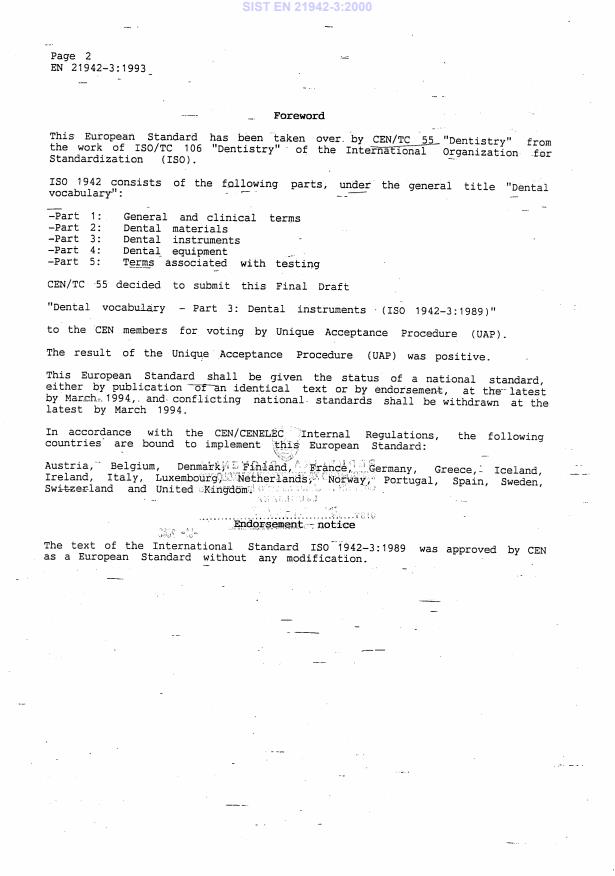
IS0 1942-3 : 1989 (E/F) Foreword IS0 (the International Organization for Standardization) is a worldwide federation of national standards bodies (IS0 member bodies). The work of preparing International Standards is normally carried out through IS0 technical committees. Each member body interested in a subject for which a technical committee has been established has the right to be represented on that committee. International organizations, govern- mental and non-governmental, in liaison with ISO, also take part in the work. IS0 collaborates closely with the International Electrotechnical Commission (IEC) on all matters of electrotechnical standardization. Draft International Standards adopted by the technical committees are circulated to the member bodies for approval before their acceptance as International Standards by the IS0 Council. They are approved in accordance with IS0 procedures requiring at least 75 % approval by the member bodies voting. International Standard IS0 1942-3 was prepared by Technical Committee ISO/TC 106, Dentistry. This second edition together with parts 1, 2, 4 and 5 of IS0 1942 cancel and replace the first edition (IS0 1942 : 1983), of which they constitute a technical revision. IS0 1942-3 specifically replaces a) Section 3 of IS0 1942 : 1983; b) three addenda to Section 3 of IS0 1942 : 1983, i.e. : - IS0 1942 : 1977/ADD 3 : 1982, - IS0 1942 : 1983/ADD 3 : 1983, - IS0 1942 : 1983/ADD 5 : 1985. IS0 1942 consists of the following parts, under the general title Dental vocabulary : - - - Part I: General and clinical terms Part 2: Dental materials Part 3: Dental instruments - Part 4: Dental equipment - Part 5: Terms associated with testing iv SIST EN 21942-3:2000
IS0 1942-3 : 1989 (E/F) Avant-propos L’ISO (Organisation internationale de normalisation) est une federation mondiale d’organismes nationaux de normalisation (comites membres de I’ISO). L’elaboration des Normes internationales est en general confide aux comites techniques de I’ISO. Chaque comite membre interesse par une etude a le droit de faire partie du comite technique tree a cet effet. Les organisations internationales, gouvernementales et non gouvernementales, en liaison avec I’ISO participent egalement aux travaux. L’ISO col- labore etroitement avec la Commission electrotechnique internationale KEI) en ce qui concerne la normalisation electrotechnique. Les projets de Normes internationales adopt& par les comites techniques sont soumis aux comites membres pour approbation, avant leur acceptation comme Normes inter- nationales par le Conseil de I’ISO. Les Normes internationales sont approuvees confor- mement aux procedures de I’ISO qui requierent I’approbation de 75 % au moins des comites membres votants. La Norme internationale IS0 1942-3 a ete elaboree par le comite technique I SO /TC 106, Produits et ma thriel pour l’art den taire. Cette deuxieme edition, avec les parties l,2,4 et 5 de I’ISO 1942, annule et remplace la premiere edition (IS0 1942 : 1983), dont elle constitue une revision technique. L’ISO 1942-3 remplace plus particulierement a) le chapitre 3 de I’ISO 1942 : 1983; b) trois additifs au chapitre 3 de I’ISO 1942 : 1983, a savoir: - IS0 1942 : 1977/ADD 3 : 1982, - IS0 1942 : 1983/ADD 3 : 1983, - IS0 1942 : 1983/ADD 5 : 1985. L’ISO 1 942 comprend de l’art den taire : les parties suivantes, presentees sous le titre general Vocabulaire - - Partie 7 : Termes g&Graux et cliniques Partie 2: Produits dentaires Partie 3: Instruments den taires - Partie 4: Matkriel dentaire Partie 5: Termes associ’e’s aux essais SIST EN 21942-3:2000
This page intentionally left blank SIST EN 21942-3:2000
INTERNATIONAL STANDARD NORME INTERNATIONALE IS0 1942-3 : 1989 (E/F) Dental vocabulary - Part 3: Dental instruments Vocabulaire de l’art dentaire - Partie 3: Instruments dentaires 1 Scope 1 Domaine d’application This part of IS0 1942 defines terms used in dentistry, par- titularly those relating to dental instruments. General and clinical terms, and terms concerning dental materials and equipment, and those terms associated with the testing of such products are incorporated in the four other parts of this Inter- national Standard. Equivalent terms and definitions are given in both English and French. La presente partie de I’ISO 1942 definit les termes utilises en art dentaire, en particulier ceux se rapportant aux instruments den- taires. Les termes generaux et cliniques, ainsi que ceux relatifs aux produits et au materiel dentaires, de meme que les termes associes aux essais de ces fournitures dentaires font I’objet des quatre autres parties de la presente Norme internationale. Les termes equivalents et leurs definitions sont don& en anglais et en francais. This International Standard is intended to provide accepted definitions for a number of terms used in dentistry that could prove useful for the comprehension of documents aiming at the preparation and implementation of Standards, and to improve communication, through close cooperation with the Federation dentaire internationale, the World Health Organization and other national or international interested organizations. Le but de la presente Norme internationale est de definir une liste de termes utilises en art dentaire et necessaires a la com- prehension des travaux visant a I’etablissement et a I’applica- tion des normes et 8 ameliorer la communication, ceci par une etroite collaboration avec la Federation dentaire internationale, I’Organisation mondiale de la Sante, et les autres Organisations nationales ou internationales interessees. 2 Use of terms printed in italic typeface in definitions 2 Emploi dans les dhfinitions de termes krits en caracthes italiques A term printed in italic typeface in a definition, an example or a note has the meaning given to it in another entry of the Vocabulary, and may be found in any part of IS0 1942. The term is only printed in italic typeface the first time it occurs in each entry. Dans le texte d’une definition, d’un exemple ou d’une note, tout terme imprime en caracteres italiques a le sens defini dans un autre article du Vocabulaire et peut etre trouve dans I’une ou l’autre partie de I’ISO 1942. Le terme n’est imprime en caracte- res italiques que la premiere fois ou il apparait dans chaque article. Other grammatical forms of the term, for example plurals of nouns and participles of verbs, are printed in the same way as the basic form. Les autres formes grammaticales du terme, par exemple le plu- riel des noms et le participe des verbes, sont imprimees de la meme maniere que la forme de base. 3.001 dentistry’): Science and art of preventing, diagnosing and treating diseases and malformations of and injuries to the teeth, mouth and jaws, and of replacing lost teeth and associated tissues. 3.001 art dentaire; dentisterie? Science et art de prevenir, diagnostiquer et traiter les maladies, les malformations et les lesions des dents, de la bouche et des maxillaires ainsi que de remplacer les dents manquantes et les tissus associes. 1) The designation of “dentistry” may vary according to the usage of the term in the country concerned. I) La dhnomination de I’art dentaire (mkdecine dentaire, chirurgie dentaire, etc.) peut varier selon les pays et les habitudes. 1 SIST EN 21942-3:2000
IS0 1942-3 :1989(E/F) 3.002 dentistl): Person who after completing secondary education, or equivalent, follows a prescribed course in dentistry, at a recognized (or accredited) university or dental school, at the successful completion of which, he (or she) is qualified to be legally licensed (or registered) to practise den- tistry, by the responsible body in the country and is capable of undertaking the prevention, diagnosis and treatment of orodental conditions at the community and individual levels by exercising independent judgement without supervision. 3.002 dentiste; praticien de l’art dentairel): Personne qui, ayant et6 regulierement admise dans un etablissement d’enseignement de I’art dentaire dument reconnu dans le pays ou il (ou elle) se trouve, a suivi avec succes le programme prescrit d’etudes dentaires ou stomatologiques et a ainsi acquis la qualification necessaire pour etre Iegalement autorisee a exercer l’art dentaire selon son propre jugement, sans super- vision. 3.003 dental office; dental surgery: Location where dental patients are received and treated by the dentist. 3.003 cabinet dentaire: Local dans lequel les patients sont recus et trait& par le dentiste. 3.004 working space of the dentist: Space organized 3.004 poste de travail du praticien dentaire: Espace orga- around the dentist and equipped for the positioning and treat- nise autour du praticien dentaire et equip6 pour le positionne- ment of the patient. ment et le traitement des patients. 3.005 dental laboratory: Workshop where technical pro- cedures prescribed by the dentist, and not requiring the presence of the patient, are carried out. 3.005 laboratoire dentaire : Local ou sont effect&s, sur prescription du dentiste, des travaux techniques ne necessitant pas la presence du patient. 3.006 dental technician2) : Dental auxiliary competent to perform under the prescription of the dentist, the dental laboratory work. 3.006 technicien dentairez) : Auxiliaire dentaire qualifie pour effectuer, sur prescription du dentiste, le travail au labora- toire den taire. 3.007 orthodontics: Branch of dentistry concerned with the study of craniofacial growth and development, the treatment or prevention of malocclusion and other dentofacial anomalies. 3.007 orthodontie; orthopedic dento-faciale : Partie de la dentisterie concernant l’etude des conditions de la croissance et du developpement des structures crania-dento-faciales, et la prevention et le traitement des malocclusions et autres anoma- lies dento-faciales. 3.003 periodontics; periodontia: That branch of dentistry concerned with the study, prevention and treatment of diseases affecting the periodontium. 3.008 parodontologie; parodontie : Branche de la dentiste- rie qui a trait 5 I’etude du parodonte et a la prevention et au trai- tement de ses affections. 3.009 restorative dentistry : Comprehensive term covering dental procedures in the dentulous or partially edentulous mouth; these may include operative, endodontic, periodontic, orthodontic and prosthetic procedures. 3.009 medecine dentaire restauratrice : Terme general qui recouvre les interventions dentaires que I’on pratique dans une bouche dentee ou partiellement edentee; ces interventions peuvent comprendre les actes d’endodontie, de periodontie (parodontie), d’orthodontie, de dentisterie restauratrice et de prothese. 3.010 conservative dentistry: That part of dentistry which is concerned with the treatment and restoration of individual teeth. 3.010 dentisterie conservatrice : Partie de I’art dentaire concernant le traitement et la restauration de la dent. 3.011 .*. : That part of conservative dentistry which is con- cerned with the functional restoration of the tooth. 3.011 dentisterie restauratrice : Pa rtie de la dentisterie con- servatrice concernant la reconstitution fonctionnelle de la dent. 2) The designation “dental technician” and his technical qualification may vary according to the countries concerned. 2) La denomination du technicien dentaire (technicien de laboratoire dentaire, odonto-technicien, prothesiste de laboratoire dentaire, etc. 1 et sa qualification technique peuvent varier selon les pays concern&. 2 SIST EN 21942-3:2000
IS0 1942-3 : 1989 (E/F) 3.012 paedodontics; pedodontics/USA/ : That branch of 3.012 dentistry which is concerned with the diagnosis, treatment and pedodontie: Partie de la dentisterie qui a trait a la pre- prevention of oral anomalies, conditions and injuries in vention, au diagnostic et au traitement des maladies, des ano- malies et des lesions bucco-dentaires chez les enfants. children. 3.013 endodontics: That branch of dentistry concerned with the diagnosis and treatment of the diseases of the pulp and the contiguous periapical tissues. 3.013 endodontie: Partie de la dentisterie qui a trait au dia- gnostic et au traitement des affections de la pulpe dentaire et des tissus periapicaux. 3.014 prosthodontics; prosthetic dentistry: That branch of dentistry which is concerned with the functional and aesthetic rehabilitation of the masticatory system by artificial replacement of missing teeth and associated tissues. 3.014 dentisterie prothetique; art de la prothese den- taire: Partie de la dentisterie qui a trait a la restauration fonc- tionnelle et esthetique de I’appareil manducateur par remplace- ment artificiel des dents manquantes et des tissus associes. 3.015 dental material : Substance or combination of substances specially prepared and/or presented for the use of authorized persons in the practice of dentistry and/or its associated procedures. 3.015 produit dentaire: Substance ou combinaison de subs- tances specialement preparee et/au presentee pour utilisation par les personnes autorisees a la pratique de (‘art dentaire et/au des techniques associees. 3.016 dental equipment: Furniture, machines, apparatus and accessories thereto, specially manufactured and/or presented for the use of authorized persons in the practice of dentistry and/or its associated procedures. 3.016 materiel dentaire : Mobilier, machines, appareillage et leurs accessoires, specialement fabriques et/au present& pour utilisation par les personnes autorisees a la pratique de I’art dentaire et/au des techniques associees. 3.017 dental instruments: designed for use in dentistry. Small hand-tools specially 3.017 instruments dentaires: Petits outils a main speciale- ment concus pour Gtre utilises en art dentaire. 3.018 dental product: Any product specially manufactured, prepared and/or presented for the use of authorized persons in the practice of dentistry and/or its associated procedures. 3.018 fournitures dentaires: Tout ce qui est specialement fabrique, prepare et/au present6 pour utilisation par les person- nes autorisees a la pratique de I’art dentaire et/au des techni- ques associees. 3.019 dental device: Any article, instrument or appliance, specially manufactured and/or presented for the use of authorized persons in the practice of dentistry and/or its associated procedures, which is neither a dental material, nor an item of dentalequipment, nor has been made specifically for an individual patient. 3.019 instrumentation dentaire: Instruments, dispositifs ou autres objets manufactures, specialement fabriques et/au presentes pour utilisation par les personnes autorisees a la pra- tique de l’art dentaire et/au des techniques associees, a I’exclu- sion de ceux classes dans les produits dentaires ou dans le matkiel dentaire et des appareils realises pour un patient parti- culier. 3.020 dental pharmacological materials: Those dental materials which carry out their intended function by actively affecting, either locally or systemically, the normal physiological behaviour of the tissues or any pathological changes taking place in them, or by modifying the normal metabolism of cells or of invading micro-organisms. (Such pharmacological action may also be a secondary function of certain other dental materials.) 3.020 produits pharmacologiques dentaires: Produits dentaires dont l’effet desire est une action, par voie locale ou g&&ale, sur le comportement physiologique des tissus ou sur des processus pathologiques qui s’y manifestent, ou une modi- fication du metabolisme de cellules ou de micro-organismes. (Une telle action pharmacologique peut egalement etre un effet secondaire de certains autres produits dentaires.) 3.021 desig instrument ned to be held hand1 during nstrument e: That part of an i use. 3.021 manche d’instrument : Pa pour etre tenue durant I’utilisation. rtie d’un instrument concue 3.022 interchangeable instrument holder: Handle equipped with a retention device providing easy interchangeability of the in- strument it is designed to hold. 3.022 manche pour instruments interchangeables: Man- the pourvu d’un dispositif de retention permettant la fixation aisle d’instruments interchangeables. 3 SIST EN 21942-3:2000
IS0 1942-3 : 1989 (E/F) 3.023 dental mirror: Intra-oral inspection or inspection and retraction instrument generally consisting of two main, often separable parts : 3.023 miroir dentaire: Instrument pour I’inspection endo- buccale ou pour I’inspection et I’ecartement endobuccaux, generalement compose de deux parties principales souvent ¶bles : a) a handle; a) un manche; b) a mirror attached or not to a stem, to join the handle to the mirror. the function of which b) un miro Iir solidaire ou non de la tige rattacher au manche. concue pour le IS 3.024 plane dental mirror: Dental mirror the face of which is flat. reflective sur- 3.024 miroir dentaire reflechissante est plane. plan: Miroir dentaire dont la surface 3.026 concave [magnifying] dental mirror: Dental mirror the reflective surface of which is concave to produce an enlarged image of the objects observed. 3.025 miroir dentaire concave (grossissant) : Miroir dentaire dont la surface reflechissante presente une concavite destinee a produire un grossissement apparent des objets observes. 3.026 miroir dentaire ti deux faces: Miroir dentaire dont les deux faces sont reflechissantes. 3.026 double-sided dental mirror: Dental mirror where the two surfaces are reflective. 3.027 double separator mirror: Instrument comprising two mirrors joined by a stem which holds them at such a distance and direction in order that there will simultaneously be retrac- tion of the soft tissues and observation of lingual and vestibular surfaces. 3.027 miroir ecarteur double: Instrument compose de deux miroirs unis par une tige qui les maintient a une distance et dans une direction telles qu’elles permettent simultanement l’ecarte- ment des tissus mous et I’observation des faces vestibulaires et linguales. 3.028 dental probe; explorer: Hand-held tactile instrument with a stem terminating in a thin working part which may be needle-like, hooked, or blunt according to the intended use. 3.028 sonde exploratrice dentaire: Instrument a main d’exploration tactile, dont la tige Porte une partie active, fine, qui peut etre en forme d’aiguille, de crochet ou emoussee selon I’usage envisage. 3.029 forceps, dental extraction of teeth. extraction : Type of pincers for the 3.029 davier : des dents. Tenaille specialement concue pour I’avu lsion 3.030 elevator, dental: Type of lever during the extraction of teeth or roots. designed for use 3.030 elevateur den taire : Type sion des dents ou des racines. de levier concu pour I’avu I- 3.031 syndesmotome : Dental surgical instrument for cut- ting desmodontal fibres and detaching the alveolo-dental ligaments. 3.031 syndesmotome : Instrument de chirurgie dentaire des- tine a la section des fibres desmodontales et a la rupture des ligaments alveolo-dentaires. 3.032 root separator: Surgical instrument specially designed for wedging apart the roots of a multiradicular tooth. 3.032 separateur de racine: Instrument chirurgical speciale- ment concu pour &parer par effet-coin les racines d’une dent multi-radiculaire. 3.033 teeth separator: Instrument adjacent teeth out of normal contact. or device used to move 3.033 ecarteur Gnterdentairelj : Instrument ou petit appa- reil utilise pour ecarter deux dents adjacentes de leur contact normal. 3.034 dental scaler: Hand- or power-operated dental instru- ment specially designed and/or presented for the removal of calculus from the surface of teeth. 3.034 instrument dentaire pour detartrage: Instrument a main ou a machine specialement concu et/au present6 pour enlever le tartre de la surface des dents. 3.035 spatula: Hand instrument used to mix and manipulate liquids, powders and semi-solids. The working part or blade must be non-reactive to the materials for which is it used. 3.035 spatule: Instrument a main utilise pour melanger et manipuler des liquides, des poudres ou des semi-solides. La partie active, ou lame, doit etre inerte vis-a-vis des produits pour lesquels elle est utilisee. SIST EN 21942-3:2000
IS0 1942-3 : 1989 (E/F) 3.036 hand-held cutting instrum dentistry: Instrument comprising : ent for restorative 3.036 instrument de coupe 8 main pour la dentisterie restauratrice (en abrege: I.C.M.D.R.): Instrument compose de: - a working part or blade with a cutting edge; partie - une pante; active ou lame possedant une a&e cou- - a handle manipulated; by which the instrument is held and - un manche concu pour la prehension la force par la main de I’operateur; et I’ ‘application de - a connecting blade; part or shank which unites the handle to - une manche; ou tige unissant la lame au the - in the case of contra-angle biplane discoids, cleoids, and pear-shaped excavators, a stem connecting the blade to the shank. - dans le cas des excavateurs biplanaires et a contre- angle de type disco’ide, bet-de-corbin et piriforme, un col unissant la lame a la tige. 3.037 straight hand-held cutting instrument: Hand-held cutting instrument, the handle, blade and shank of which are in the same axis. 3.037 I.C.M.D.R. rectiligne: I.C.M.D.R. dont le manche, la lame et la tige sont sur le meme axe. 3.036 curved hand-held cutting instrument: Hand-held cutting instrument, the blade of which is curved towards one of its two flat sides. 3.036 I.C.M.D.R. courbe: I.C.M.D.R. dont la lame est cour- bee sur plat. 3.039 angled hand-held cutting instrument: Hand-held in- strument the blade of which is at an angle to the long axis of the handle. 3.039 I.C.M.D.R.angulaire: I.C.M.D.R.dontlalamefaitun angle avec I’axe general du manche. 3.040 contra-angled hand-held cutting instrument: Hand-held cutting instrument having a long blade at a sharp angle to the long axis of the instrument, and a shank which has two or more angles or bends which bring the cutting edge within the axial projection of the handle. 3.040 I.C.M.D.R. a contre-angle: I.C.M.D.R. ayant une longue lame faisant un angle marque avec I’axe general de I’ins- trument, et dont la tige comporte un ou plusieurs angles ou courbures destines a ramener I’arete de coupe a l’interieur de la projection axiale du manche. 3.041 hatchet: Angled hand-held cutting instrument the cut- ting edge of which is in the same plane as the long axis of the handle. 3.041 hachette : /. C. M. D. R. angulaire dont I’arete coupante est dans le meme plan que I’axe general du manche. 3.042 hoe: Angled hand-held cutting instrument the cutting edge of which is in a plane perpendicular to the long axis of the handle. 3.042 dans houe n plan U : I. C. M.D. R. angulaire perpendiculaire a I’axe dont l’arete du manche. coupante est 3.043 biplane curved hand-held cutting instrument: Hatchet-type instrument the blade of which is curved so that the concavity is on the same side of the blade as the cutting edge. Spoon, cleoid, discoid and pear-shaped hand-held cut- ting instruments are so called when the stem is similarly curved. 3.043 I.C.M.D.R. courbe biplanaire: I.C.M.D.R. de type hachette dont la lame est courbee de telle facon que sa conca- vite est sur la face de la lame qui Porte I’arete coupante. Les excavateurs cuiller, bet-de-corbin, piriforme et discoi’de sont ainsi appeles quand leur col est courbe de cette facon. 3.044 chisel: Hand-he/d cutting instrument the blade of which is rectangular in cross-section and bevelled to provide a straight cutting edge perpendicular to the long axis of the blade. 3.044 ciseau: /.C.M.D. R. dont la lame de section rectangu- laire, est biseautee de facon a former une arete coupante rectili- gne perpendiculaire a I’axe longitudinal de la lame. The blade is on the flat. usually straight (parallelepipedic) but may be curved La lame est habituellement peut etre courbee sur plat. rectiligne (parallelepiped ique) mais 3.045 angle-forming chisel: Chisel the cutting edge of which is not perpendicular to the long axis of the blade. 3.046 ciseau formeur d’anglels): Ciseau dont l’arete cou- pante n’est pas perpendiculaire a l’axe longitudinal de la lame. SIST EN 21942-3:2000
IS0 1942-3 : 1989 (E/F) 3.046 dental excavator: Hand-held cutting instrument the cutting edge of which is curved. 3.047 standard position for identification of hand-held cutting instrument: Position in which an instrument should be viewed by an operator in order to identify it, namely with its handle towards the operator and its working part upwards. 3.043 left: Classifies a hatchet-type instrument the cutting edge of which is on the left side of the blade when the instru- ment is viewed in the standard position. Also classifies an angle-forming straight chisel instrument the acute angle of which is on the left side of the blade and the bevel of which is on the far side of the blade when the instru- ment is viewed in the standard position. 3.049 right: Classifies a hatchet-type instrument, the cutting edge of which is on the right side of the blade when the instru- ment is viewed in the standard position. Also classifies an angle-forming straight chisel instrument the acute angle of which is on the right side of the blade and the bevel of which is on the far side of the blade when the instru- ment is viewed in the standard position. 3.050 distal: Classifies a hoe-type instrument the cutting edge of which is on the far side of the blade when viewed in the standard position. Also classifies a gingival margin trimmer the acute angle of which is on the far edge of the blade when viewed in the stan- dard position. 3.051 proximal; mesial: Classifies a hoe-type instrument the cutting edge of which is on the near side of the blade when viewed in the standard position. Also classifies a gingival margin trimmer the acute angle of which is on the far edge of the blade when viewed in the stan- dard position. 3.052 spoon excavator: Dental excavator the blade of which is curved so that the cutting edge is on.the concave side of the blade. The cross-section of the blade is approximately semi-circular. 3.053 pear-shaped excavator: Curved dental excavator the blade of which has a pear-shaped profile and is joined to the shank at its narrowest portion. 3.054 cleoid excavator: Dental excavator the blade of which is pointed and approximately triangular in cross-section, and has two cutting edges. 3.046 excavateur dentaire: /. C. M. D. R. dont I’arete cou- pante est curviligne. 3.047 position normalisee d’identification des I.C.M.D.R.: Position dans laquelle un instrument doit etre observe par un operateur en vue de I’identifier, c’est-a-dire son manche oriente vers I’operateur et sa partie active dirigee vers le haut. 3.048 gauche: Qualifie un instrument de type hachette quand, l’instrument etant tenu dans la position normalisee d’identification, I’arete coupante est sur la face gauche de la lame. Qualifie aussi un ciseau formeur d’angle rectiligne quand, I’ins- trument etant tenu dans la position normalisee d’identification et la face de la lame portant le biseau etant la plus Bloignee de I’observateur, I’angle aigu est du c&e gauche de la lame. Qualifie aussi un ciseau formeur d’angle rectiligne quand, I’ins- trument etant tenu dans la position normalisee d’identification et la face de la lame portant le biseau &ant la plus eloignee de I’observateur, I’angle aigu est du cot6 droit de la lame. 3.050 distal: Qualifie un instrument de type houe quand, l’instrument etant tenu dans la position normalisee d’identifica- tion, I’arete coupante est sur la face de la lame la plus eloignee de I’observateur. Qualifie egalement un formeur d’angle gingival quand, I’instru- ment etant tenu dans la position normalisee d’identification, I’angle aigu de la lame est sur le bord le plus eloigne de l’obser- vateur. 3.051 proximal; mesial : Qualifie un instrument de type houe quand, /‘instrument etant tenu dans la position normalisee d’identification, I’arete coupante est sur la face de la lame la plus proche de I’observateur. Qualifie egalement un formeur d’angle gingival quand, I’instru- ment etant tenu dans la position normalisee d’identification, I’angle aigu de la lame est sur le bord le plus eloigne de l’obser- vateur. 3.052 excavateur-cuiller; cuiller : Excavateur dentaire dont la lame est courbee de telle facon que I’arete coupante se trouve sur la face concave de la iame. La section de la lame est approximativement semi-circulaire. 3.053 excavateur piriforme; piriforme: Excavateur den- taire courbe dont la lame est en profil de poire et est reliee a la tige par sa partie la plus etroite. 3.054 excavateur-bet-de-corbin; bet-de-corbin : Excava- teur dentaire dont la lame pointue et de section approximative- ment triangulaire a deux bords tranchants. 6 SIST EN 21942-3:2000
IS0 1942-3 : 1989 (E/F) 3.055 discoid excavator: Dental excavator the blade of which is a segment of a sphere with a circumferential cutting edge. , 3.056 gingival margin trimmer: Biplane-angle-forming chisel. 3.057 slip-joint: Device for coupling the drive-shaft to the handpiece, consisting of two co-axial cylinders slipped one upon the other and secured by a retaining device. 3.058 wrist-joint: System consisting of hinges, rotating joints and pulleys, which allows the rotary movement to be transmitted through a cord drive to a freely movable s/ip-joint. 3.059 externally locking slip-joint: Slip-joint characterized by an external locking device intended to engage in a slot in the proximal part of the body of the handpiece where it locks in a groove adjacent to and in line with the slot. 3.090 internally locking slip-joint; connection to micromotor: Slip-joint in which the retention of the handpiece is effected by means of a retractable bolt projecting from the in- ternal cylinder and intended to engage in an annular groove machined in the inside of the proximal part of the dental hand- piece. NOTE - This micromotor. joint permits rotation of the handpiece on the 3.061 handpiece, dental (general term): Hand-held tool holder designed to transmit with or without transformation the energy necessary for the operation of dental tools or in- struments. 3.092 dental handpiece for rotary movement: Dental handpiece designed to transmit or transform rotary movements. NOTE - Most of these are designed as short tool holders to be directly coupled to a dental electric or air-driven micromotor. Such a formed unit may be considered as the handpiece, and can even be an in- tegrated device comprising a micromotor, the transmission and the chuck. Dental handpieces may be fitted with air and water ducts to cool and/or clean the operating field and or fibre optics to illuminate it. 3.093 handpiece, straight: Handpiece designed to transform and/or transmit rotary movements to a tool, the axis of which coincides with the main axis of the handpiece. 3.064 handpiece, angled (general term): Handpiece of which the main axis is at an angle with that of the instrument or tool which it carries. 3.055 excavateur discoi’de; discoi’de: Excavateur dentaire dont la lame est un segment de sphere ayant un bord circonfe- rentiel tranchant. 3.056 formeur d’angle gingival: Formeur d’angle bi- planaire. 3.057 accouplement 6 glissement: Raccord de transmis- sion dont la mise en place sur la piece a main s’effectue par glis- sement de deux pieces cylindriques co-axiales I’une dans I’autre. Ces deux pieces sont solidarisees par un systeme de verrouillage. 3.058 renvoi d’angle orientable: Double renvoi d’angle, comportant les charnieres et articulations necessaires pour qu’une transmission par corde puisse communiquer le mouve- ment rotatif ZI un accouplement 2 glissement orientable en tou- tes directions. 3.059 accouplement 6 glissement, a enclenchement externe : Accouplement a glissement, caracterise par un loquet a enclenchement externe destine a s’engager dans une fente menagee a la partie proximale du corps de la piece a main ou il se bloque dans une gorge sit&e a proximite et dans le pro- longement de la fente. 3.060 accouplement a glissement, a enclenchement interne (accouplement sur micromoteur) : Accouplement a glissement sur lequel la retention de la pike B main est assuree par un p&e escamotable, faisant saillie sur le cylindre interne, et destine a s’engager dans une gorge annulaire usinee a I’inte- rieur de la partie proximale de la piece a main dentaire. NOTE - Cet micromoteur. accouplement permet la rotation de la piece 5 main sur le 3.091 piece 6 main dentaire (terme general): Porte-outil, tenu a la main, destine a transmettre avec ou sans transforma- tion I’energie necessaire a I’action d’outils ou d’instruments dentaires. 3.092 piece 6 main dentaire pour mouvement rotatif: Pike ;i main dentaire destinee 8 transmettre ou a transformer un mouvement rotatif. NOTE - La plupart sont conques comme un court Porte-outil s’enclen- chant directement sur un micromoteur electrique ou 5 air cornprime. Un tel ensemble peut, des lors, etre consider6 comme constitutif de la piece a main qui peut meme devenir une unite integree comprenant le micromoteur, la transmission et le mandrin. Frequemment, elles sont equipees de distributions de fluides (air-eau) destines 8 remplir des fonctions de refroidissement et/au nettoyage du champ operatoire et/au de fibres optiques pour I’eclairer. 3.093 piece 8 main rectiligne: Pike ;i main destinee a transformer et/au transmettre un mouvement rotatif a un outil dont I’axe coincide avec I’axe principal de la piece a main. 3.064 piece a main angulee (terme general): Pike ;i main dont I’axe principal fait un angle avec celui de I’outil ou instru- ment. 7 SIST EN 21942-3:2000
IS0 1942-3 : 1989 (E/F) 3.065 handpiece, obtuse-angled : Mono-angled handpiece of which the main axis is at an obtuse angle with that of the in- strument or tool which it carries. 3.066 handpiece, right-angled : Mono-angled handpiece of which the main axis is at a right angle with that of the instru- ment or tool which it carries. 3.067 handpiece, contra-angled : Right-angled handpiece with one or more additional angles so placed as to bring the working part of the instrument or tool approximately into line with the main axis of the handpiece. 3.068 handpiece, contra-angled, adjustable : Type of contra-angled handpiece in which that part carrying the right- angled head can be rotated about its own axis. 3.069 right-angled head: Distal part of a handpiece which retains and/or drives the instrument at right-angles to the long axis of the neck of the handpiece. 3.070 neck of a dental handpiece: That part of an angled handpiece which unites the head to the body (or handle). 3.071 handpiece, adjustable, angled: Type of angled handpiece in which the angle of the neck to the body can be changed. 3.072 miniature right-angled head : Right-angled head of small dimensions specially designed to accommodate miniature burs. 3.073 handpiece, endodontic : Type of contra-angled hand- piece, for use in endodontics, designed to transform a con- tinuous rotary movement into an alternate semirotary one and/or axial alternate movement, irrespective whether they are combined or not. 3.074 handpiece, Doriot type: Straight handpiece with an integral wrist-joint. At its proximal end it has a knurled button for securing, by means of a chuck, instruments or specially designed angled heads. 3.075 micromotor, dental: Small motor, electric or air- driven, which is directly coupled to or an integral part of the handpiece. 3.076 air turbine, dental : Air-driven high-speed small turbine which is designed to be integrated into the head of a dental handpiece. The chucking device is co-axial to the turbine. 3.077 miniature dental air turbine: Small dentalair turbine, the head of which is designed to accommodate miniature FG burs. 3.065 piece 8 main a angle obtus: Pike ;i main mono- angulee dont I’axe principal fait un angle obtus avec celui de I’outil ou instrument. 3.066 piece a main a angle droit: (dite ccangle droitll) : Pike ;i main monoangulee dont I’axe principal est perpendiculaire a celui de I’outil ou instrument. 3.067 piece a main a contre-angle (dite wontre-angle))): Piece a main a angle droit comportant, en outre, un ou plu- sieurs angle(s) dispose(s) de facon a ramener approximative- ment la partie active de I’outil ou instrument dans le prolonge- ment de I’axe principal de la piece a main. 3.068 piece B main a contre-angle 8 t&e orientable: Cate- gorie de pike ;5 main ;i contre-angle dans laquelle la partie por- tant la tete a angle droit peut etre orientee autour de son axe propre. 3.069 t&e a angle droit: Partie distale de la pi&e ;i main qui permet la fixation et/au I’entra’inement de I’outil perpendiculai- rement a I’axe du col de la piece a main. 3.070 col de piece 8 main dentaire : Partie d une p&e 9 main angulee qui unit la tete a u corps de la piece 2 main. 3.071 piece 8 main angulee a col orientable: Categoric de pike 6 main angulhe dans laquelle on peut faire varier I’angle fait par le col sur le manche. 3.072 t&e a angle droit miniature: Me ;i angle droit, de petites dimensions, specialement concue pour recevoir des frai- ses miniatures. 3.073 piece a main pour I’endodontie: Pike ;i main ;i contre-angle concue pour etre utilisee en endodontie et desti- nee a transformer un mouvement rotatif uniforme en un mou- vement semi-rotatif alternatif et/au en des deplacements axiaux alternatifs, combines ou non. 3.074 piece a main, type Doriot: Pike ;i main rectiligne solidaire d’un renvoi d’angle orientable. Elle est munie a son extremite proximale d’un bouton molete permettant le serrage, par un mandrin, des instruments ou de tetes angulees speciale- ment concues. 3.075 micromoteur dentaire: Petit moteur electrique ou 6 air muni d’un systeme d’accouplement direct de la piece a main. II peut egalement faire partie integrante de la piece a main. 3.076 turbine dentaire: Petite turbine a air cornprime et 8 tres haute vitesse, concue pour etre integree dans la tete d’une pi&e ;i main dentaire. Le mandrin est co-axial. 3.077 turbine dentaire miniature: Petite turbine dentaire ;i air comprimk, dont la tete est specialement concue pour I’utili- sation de fraises miniatures FG. SIST EN 21942-3:2000
IS0 1942-3 : 1989 (E/F) 3.078 friction grip shank of a rotary instrument (FG): Shank designed to fit into a friction grip chuck. 3.079 friction grip chuck of a rotary handpiece: Tool holder in which instrument fixation, centring and driving are achieved through deformation of an elastic system when the in- strument shank is inserted. 3.079 mandrin de serrage par friction d’une piece a main rotative: Porte-outil dans lequel la fixation, le centrage et I’entraTnement de I’instrument sont obtenus par deformation d’un systeme elastique lors de la mise en place de la queue de I’instrument. 3.080 latch-type retainer: Device designed to retain rotary instruments by engaging the groove in the instrument shank. 3.080 guillotine de piece a main dentaire: Systeme de retention d’un instrument dentaire comportant une lame echancree de maniere a s’engager dans la gorge annulaire de I’extremite proximale de la queue de l’instrument. 3.081 latch-type shank: Rotary instrument shank having an annular groove for retention by a latch-type retainer and a flat which engages the driving component of the handpiece. 3.081 queue pour piece a main a guillotine: Queue d’ins- trument rotatif portant une gorge annulaire, destinee a sa retention dans une piece a main a guillotine, et un meplat des- tine a son entrainement. 3.082 rotary instrument (general term): Hand- or power- operated instrument designed to be used with a rotary move- ment reversing or combined with other types of movements. It consists of a working part, sometimes called the head and a shaft. The rotary movement may be complete, partial, revers- ing or combined with other types of movements. 3.082 instrument rotatif (terme general) : Instrument a main ou a machine concu pour etre utilise selon un mouvement de rotation. II est compose d’une partie active, appelee parfois tete, et d’une tige. Le mouvement rotatif peut etre complet, partiel, reversible ou combine avec d’autres types de mouve- ments. 3.083 shank of a rotary instrument: That part of the shaft of a rotary instrument which is designed to fit into a handpiece or other tool holder. 3.083 queue d’un instrument rotatif: Partie de la tige d’un instrument rotatif concue pour s’adapter dans une piece a main ou un autre Porte-outil. 3.084 neck of a rotary instrument: That part of the shaft of a rotary instrument which unites the working part to the shank. It is usually tapered. 3.084 col d’un instrument rotatif: Partie de la tige d’un ins- trument rotatif qui unit la partie active a la queue. Elle est le plus souvent amincie. 3.085 type of shank: That designation by which the shank of a rotary instrument is identified according to its shape and dimensions. 3.085 type de queue: Designation par laquelle la queue d’un instrument rotatif est identifiee suivant sa forme et ses dimen- sions. 3.086 shape of the working part of a rotary instrument: Geometrical outline of the envelope of revolution described by the working part of a rotary instrument during its axial rotation. 3.086 forme de la partie active d’un instrument rotatif: Figure geometrique de I’enveloppe de revolution d&rite par la partie active d’un instrument rotatif au tours de sa rotation axiale. NOTE - Where there is more than one geometrical outline produced by the rotating working part, each outline shall be successively described from the distal end. NOTE - Cette forme peut etre simple ou composee de plusieurs par- ties. Dans ce dernier cas, on designe successivement ces parties 8 par- tir de I’extremite distale. EXAMPLES EXEMPLES Domed truncated conical head. Tete hemispherico-tronconique. Inverted truncated conical cylindrical head. Tete cylindrique tronconique inversee. Conical inverted hemispherical head. Tete conico-hemispherique inversee. Conical truncated inverted conical head. Tete conico-tronconique inversee. 3.087 characterization of a rotary instrument: Detailed characteristics of the working part of an instrument, for in- stance the number, dimensions and geometry of the blades, or the size and distribution of the abrasive particles. 3.087 realisation de la t&e d’un instrument rotatif: Caracteristiques detaillees de la partie ac
...
Questions, Comments and Discussion
Ask us and Technical Secretary will try to provide an answer. You can facilitate discussion about the standard in here.
Loading comments...