

EN 17460:2022
(Main)Railway applications - Adhesive bonding of rail vehicles and their components
General Information
- Abstract
This document defines terms and specifies requirements for adhesive bonding and sealing work in rail vehicles and their components independent of the material of the adherend and the solidification mechanism, strength, and deformation properties of the adhesives.
This document is applicable to adhesive bonding and sealing adherends in the:
- development (pre-production);
- production (in-production);
- maintenance including repair (post-production);
- quality assurance of production, inspection, maintenance including repair of rail vehicles and their components.
This document is not applicable to:
- screw retention by the usage of adhesives, if a screw assembly without further safeguard of identical joint design is sufficient for the purpose;
- hybrid joints, if the expected function is given exclusively by another joining technology e.g. welding, screwing, riveting;
- production of vulcanizates;
- production of plywood;
- production of fibre reinforced plastic composites (FRP-composites);
- production of laminated safety glass;
- pure encapsulating of electronic parts;
- application of single-sided adhesive decorative films.
- Status
- Published
- Publication Date
- 19-Jul-2022
- Technical Committee
- CEN/TC 256 - Railway applications
- Drafting Committee
- CEN/TC 256/SC 2 - Wheelsets - Bogies
- Current Stage
- 6060 - Definitive text made available (DAV) - Publishing
- Start Date
- 20-Jul-2022
- Due Date
- 08-Dec-2021
- Completion Date
- 20-Jul-2022


Overview
EN 17460:2022 - published by CEN - is the European standard for adhesive bonding of rail vehicles and their components. It defines terms and specifies requirements for adhesive bonding and sealing work regardless of adherend material or adhesive chemistry. The standard applies across the product lifecycle: development (pre-production), production (in-production), maintenance and repair (post-production), and quality assurance and inspection of rail vehicles and components.
EN 17460:2022 is intended to ensure consistent, safe, and verifiable adhesive joints in railway applications while clarifying what is out of scope (see exclusions).
Key topics and technical requirements
- Terminology and definitions: standardized terms for adhesives, bonds, and processes.
- Competence requirements: roles and minimum competencies for adhesive bonding coordinators and operators (detailed in informative Annexes A and B).
- Design and verification: stepwise design process, risk analysis and safety classification, joint listing, qualification of adhesives, validation via calculation, testing, and proven design routes.
- Workmanship and production controls: handling, storage, environmental control, surface preparation, dosing/mixing, application, joining, fixing, solidification/curing, packaging, and transport.
- Quality assurance: quality planning, inspection, production-accompanying samples, rework procedures and corrective actions.
- Maintenance and repair: documentation, execution rules and repair instructions appropriate for in-service adhesive joints.
- Testing and limits: annexes cover stress-limit determination, tests for low- and high-modulus adhesives, creep, fatigue, and pH measurement.
- Non‑destructive and destructive testing: visual inspection, ultrasonic testing, thermography, shearography, tap tests and other methods (Annex F).
- Guidance for choosing adhesive systems: informative criteria to select adhesives and systems (Annex E).
Important exclusions (not covered): screw retention by adhesives where a simple screw is sufficient, hybrid joints where another joining tech controls function, production of vulcanizates, plywood, FRP composites, laminated safety glass, pure encapsulation of electronics, and single-sided decorative films.
Practical applications
EN 17460:2022 is used to:
- Guide design engineers in specifying adhesive joints and verification routes
- Define production processes and work instructions for manufacturers
- Set qualification, inspection and acceptance criteria for QA teams
- Support maintenance teams and repair shops with repair and documentation rules
- Inform procurement and subcontracting decisions where adhesive bonding is involved
Who should use this standard
- Railway rolling stock designers and structural engineers
- Adhesive bonding coordinators and production managers
- Quality assurance, inspection and testing personnel
- Maintenance organizations and repair workshops
- Suppliers and subcontractors of bonded components
Related standards
EN 17460 complements other EN/ISO standards for adhesives, materials testing and railway safety. Users should consult applicable EN/ISO test methods and CEN railway standards for harmonized requirements and interoperability.
Relations
- Effective Date
- 09-Feb-2026
- Refers
ISO 12107:2012 - Metallic materials — Fatigue testing — Statistical planning and analysis of data - Effective Date
- 09-Feb-2026
- Effective Date
- 28-Jan-2026
- Effective Date
- 28-Jan-2026
- Effective Date
- 28-Jan-2026
- Effective Date
- 28-Jan-2026
Get Certified
Connect with accredited certification bodies for this standard

DIN CERTCO
DIN Group product certification.
IRIS Certification (UNIFE)
International Railway Industry Standard certification.

TÜV SÜD Rail GmbH
TÜV SÜD railway certification services.
Sponsored listings
Frequently Asked Questions
EN 17460:2022 is a standard published by the European Committee for Standardization (CEN). Its full title is "Railway applications - Adhesive bonding of rail vehicles and their components". This standard covers: This document defines terms and specifies requirements for adhesive bonding and sealing work in rail vehicles and their components independent of the material of the adherend and the solidification mechanism, strength, and deformation properties of the adhesives. This document is applicable to adhesive bonding and sealing adherends in the: - development (pre-production); - production (in-production); - maintenance including repair (post-production); - quality assurance of production, inspection, maintenance including repair of rail vehicles and their components. This document is not applicable to: - screw retention by the usage of adhesives, if a screw assembly without further safeguard of identical joint design is sufficient for the purpose; - hybrid joints, if the expected function is given exclusively by another joining technology e.g. welding, screwing, riveting; - production of vulcanizates; - production of plywood; - production of fibre reinforced plastic composites (FRP-composites); - production of laminated safety glass; - pure encapsulating of electronic parts; - application of single-sided adhesive decorative films.
This document defines terms and specifies requirements for adhesive bonding and sealing work in rail vehicles and their components independent of the material of the adherend and the solidification mechanism, strength, and deformation properties of the adhesives. This document is applicable to adhesive bonding and sealing adherends in the: - development (pre-production); - production (in-production); - maintenance including repair (post-production); - quality assurance of production, inspection, maintenance including repair of rail vehicles and their components. This document is not applicable to: - screw retention by the usage of adhesives, if a screw assembly without further safeguard of identical joint design is sufficient for the purpose; - hybrid joints, if the expected function is given exclusively by another joining technology e.g. welding, screwing, riveting; - production of vulcanizates; - production of plywood; - production of fibre reinforced plastic composites (FRP-composites); - production of laminated safety glass; - pure encapsulating of electronic parts; - application of single-sided adhesive decorative films.
EN 17460:2022 is classified under the following ICS (International Classification for Standards) categories: 45.060.01 - Railway rolling stock in general; 83.180 - Adhesives. The ICS classification helps identify the subject area and facilitates finding related standards.
EN 17460:2022 has the following relationships with other standards: It is inter standard links to ISO 16269-6:2014, ISO 12107:2012, EN 923:2015, EN ISO 10365:2022, EN 1465:2009, EN 14869-2:2011. Understanding these relationships helps ensure you are using the most current and applicable version of the standard.
EN 17460:2022 is associated with the following European legislation: EU Directives/Regulations: 2016/797/EU, 2016/797/EU, 2016/797/EU, 2016/797/EU, 2016/797/EU, 2016/797/EU, 2016/797/EU, 2016/797/EU, 2016/797/EU, 2016/797/EU, 2016/797/EU, 2016/797/EU, 2016/797/EU. When a standard is cited in the Official Journal of the European Union, products manufactured in conformity with it benefit from a presumption of conformity with the essential requirements of the corresponding EU directive or regulation.
EN 17460:2022 is available in PDF format for immediate download after purchase. The document can be added to your cart and obtained through the secure checkout process. Digital delivery ensures instant access to the complete standard document.
Standards Content (Sample)
SLOVENSKI STANDARD
01-september-2022
Železniške naprave - Lepilno spajanje za železniška vozila in njihove komponente
Railway applications - Adhesive bonding of rail vehicles and their components
Bahnanwendungen - Kleben von Schienenfahrzeugen und deren Komponenten
Applications ferroviaires - Collage par collage de véhicules et de pièces ferroviaires
Ta slovenski standard je istoveten z: EN 17460:2022
ICS:
45.060.01 Železniška vozila na splošno Railway rolling stock in
general
83.180 Lepila Adhesives
2003-01.Slovenski inštitut za standardizacijo. Razmnoževanje celote ali delov tega standarda ni dovoljeno.
EN 17460
EUROPEAN STANDARD
NORME EUROPÉENNE
July 2022
EUROPÄISCHE NORM
ICS 45.060.01; 83.180
English Version
Railway applications - Adhesive bonding of rail vehicles
and their components
Applications ferroviaires - Collage par collage de Bahnanwendungen - Kleben von Eisenbahnfahrzeugen
véhicules et de pièces ferroviaires und deren Teilen
This European Standard was approved by CEN on 22 May 2022.
CEN members are bound to comply with the CEN/CENELEC Internal Regulations which stipulate the conditions for giving this
European Standard the status of a national standard without any alteration. Up-to-date lists and bibliographical references
concerning such national standards may be obtained on application to the CEN-CENELEC Management Centre or to any CEN
member.
This European Standard exists in three official versions (English, French, German). A version in any other language made by
translation under the responsibility of a CEN member into its own language and notified to the CEN-CENELEC Management
Centre has the same status as the official versions.
CEN members are the national standards bodies of Austria, Belgium, Bulgaria, Croatia, Cyprus, Czech Republic, Denmark, Estonia,
Finland, France, Germany, Greece, Hungary, Iceland, Ireland, Italy, Latvia, Lithuania, Luxembourg, Malta, Netherlands, Norway,
Poland, Portugal, Republic of North Macedonia, Romania, Serbia, Slovakia, Slovenia, Spain, Sweden, Switzerland, Turkey and
United Kingdom.
EUROPEAN COMMITTEE FOR STANDARDIZATION
COMITÉ EUROPÉEN DE NORMALISATION
EUROPÄISCHES KOMITEE FÜR NORMUNG
CEN-CENELEC Management Centre: Rue de la Science 23, B-1040 Brussels
© 2022 CEN All rights of exploitation in any form and by any means reserved Ref. No. EN 17460:2022 E
worldwide for CEN national Members.
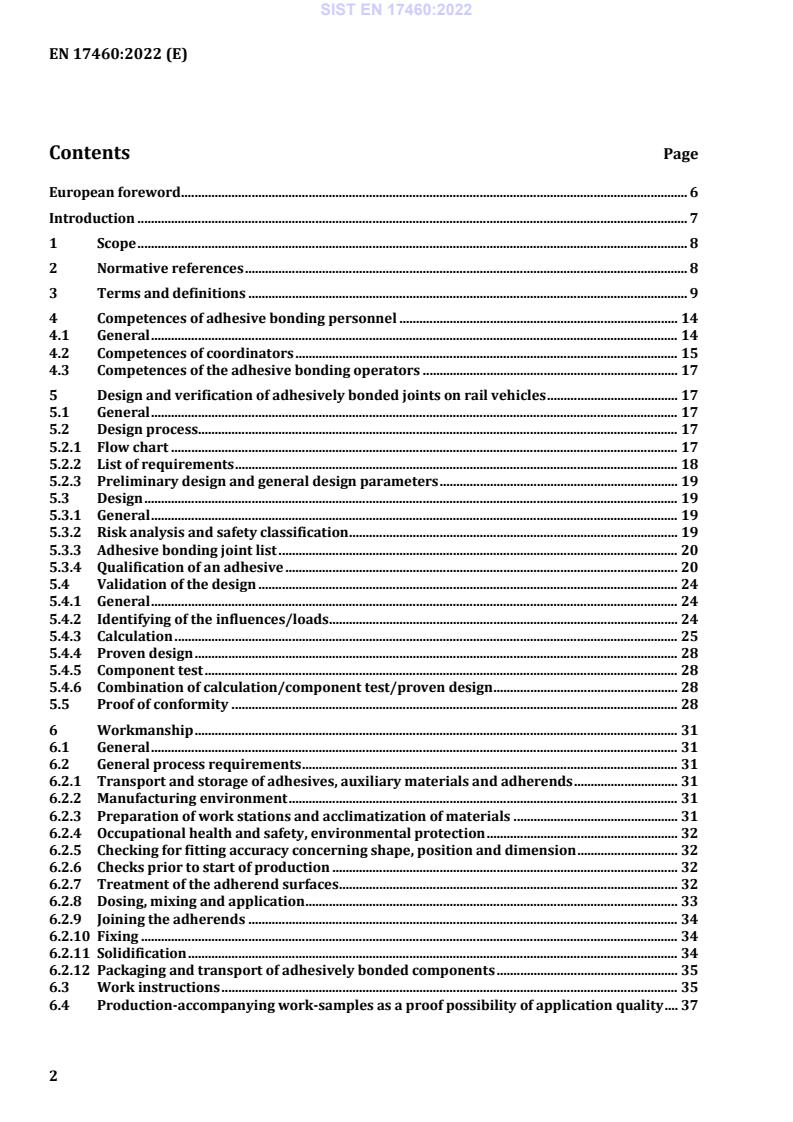
Contents Page
European foreword . 6
Introduction . 7
1 Scope . 8
2 Normative references . 8
3 Terms and definitions . 9
4 Competences of adhesive bonding personnel . 14
4.1 General . 14
4.2 Competences of coordinators . 15
4.3 Competences of the adhesive bonding operators . 17
5 Design and verification of adhesively bonded joints on rail vehicles . 17
5.1 General . 17
5.2 Design process. 17
5.2.1 Flow chart . 17
5.2.2 List of requirements . 18
5.2.3 Preliminary design and general design parameters . 19
5.3 Design . 19
5.3.1 General . 19
5.3.2 Risk analysis and safety classification . 19
5.3.3 Adhesive bonding joint list . 20
5.3.4 Qualification of an adhesive . 20
5.4 Validation of the design . 24
5.4.1 General . 24
5.4.2 Identifying of the influences/loads. 24
5.4.3 Calculation . 25
5.4.4 Proven design . 28
5.4.5 Component test . 28
5.4.6 Combination of calculation/component test/proven design . 28
5.5 Proof of conformity . 28
6 Workmanship . 31
6.1 General . 31
6.2 General process requirements . 31
6.2.1 Transport and storage of adhesives, auxiliary materials and adherends . 31
6.2.2 Manufacturing environment . 31
6.2.3 Preparation of work stations and acclimatization of materials . 31
6.2.4 Occupational health and safety, environmental protection . 32
6.2.5 Checking for fitting accuracy concerning shape, position and dimension . 32
6.2.6 Checks prior to start of production . 32
6.2.7 Treatment of the adherend surfaces . 32
6.2.8 Dosing, mixing and application . 33
6.2.9 Joining the adherends . 34
6.2.10 Fixing . 34
6.2.11 Solidification . 34
6.2.12 Packaging and transport of adhesively bonded components . 35
6.3 Work instructions . 35
6.4 Production-accompanying work-samples as a proof possibility of application quality . 37
6.5 Rework . 38
6.6 Quality assurance . 38
6.6.1 General . 38
6.6.2 Quality planning . 38
6.6.3 Quality inspection. 39
6.6.4 Corrective action . 40
6.6.5 Imperfections in adhesive bonds . 40
7 Maintenance and repair . 40
7.1 General . 40
7.2 Documentation . 41
7.3 Execution rules . 41
7.4 Maintenance and repair instructions . 41
8 Subcontracting . 41
Annex A (informative) Adhesive bonding personnel . 42
A.1 Personnel . 42
A.1.1 Competencies of adhesive bonding operators . 42
A.1.2 (Responsible) Adhesive Bonding Coordinator (rABC/ABC) . 42
A.2 Organizational integration of adhesive bonding coordination - further details in
addition to 4.2 . 45
A.3 Monitoring and testing personnel . 45
Annex B (informative) Explanation of comprehensive, specific and basic competencies,
knowledge application, practical application, and experiences . 46
B.1 Competence - subject . 46
B.2 General definitions of competencies, knowledge application, practical application,
and experiences defined in Table 1 of this document . 47
B.2.1 Comprehensive . 47
B.2.2 Specific . 47
B.2.3 Basic. 48
B.3 Detailed definitions of competencies, knowledge application, practical application,
and experiences with respect to the subject contents defined in Table B.1 of this
annex . 48
B.3.1 Comprehensive: detailed definitions . 48
B.3.2 Specific: detailed definitions . 55
B.3.3 Basic: detailed definitions . 61
Annex C (informative) List of requirements . 65
Annex D (normative) Determining the stress limit . 67
D.1 General . 67
D.2 Characteristic values and the permissible stress limit . 67
D.3 Testing low-modulus (flexible) adhesives. 69
D.3.1 General . 69
D.3.2 Determining the modulus of elasticity, the Poisson’s ratio and the stress/strain
characteristic using adhesive test pieces . 69
D.3.3 Testing the quasi-static adhesive bond strength for adhesive bonds formed with low-
modulus adhesives . 69
D.3.4 Testing the compression of adhesive bonds using low-modulus adhesives . 70
D.3.5 Testing the elongation at break after relaxation of adhesive bonds using flexible
adhesive . 71
D.3.6 Testing the creep behaviour of adhesive bonds using low-modulus adhesives . 71
D.3.7 Testing the fatigue strength of adhesive bonds using low-modulus adhesives . 72
D.3.8 Measurement of pH value of cured adhesives exposure to moisture . 72
D.4 Testing high-modulus (very stiff) adhesives . 72
D.4.1 Determining the modulus of elasticity, the Poisson’s ratio and the stress/strain
characteristic using adhesive test pieces . 72
D.4.2 Testing lap shear strength . 72
D.4.3 Testing the creep behaviour of adhesive bonds using high-modulus adhesives . 73
D.4.4 Testing the fatigue strength of adhesive bonds using high-modulus adhesives . 73
D.4.5 Other tests: measurement of pH value of cured adhesives exposure to moisture . 73
Annex E (informative) Criteria for choosing an adhesive bonding system . 74
Annex F (informative) Description of non-destructive and destructive testing methods . 78
F.1 General . 78
F.2 Non-destructive testing. 78
F.2.1 Preliminary remark . 78
F.2.2 Visual inspection . 78
F.2.3 Ultrasonic testing . 78
F.2.4 Thermography . 78
F.2.5 Shearography . 79
F.2.6 Tap test . 79
F.2.7 Water drop test . 79
F.2.8 Ink test . 79
F.2.9 Test for adhesion at edges or flanks . 79
F.2.10 Suction cup test . 79
F.2.11 Test using a feeler gauge . 79
F.3 Destructive testing . 79
F.3.1 Preliminary remark . 79
F.3.2 Fracture patterns . 79
F.3.3 Lap shear test (EN 1465) . 80
F.3.4 Floating roller peel test (ISO 4578 [55]) . 80
F.3.5 Bead peel test (ISO 21194) [54] . 80
Annex G (informative) Description of accelerated ageing tests . 81
G.1 General . 81
G.2 Ageing factors and its effects . 81
G.3 Selection of accelerated ageing test . 82
G.4 Examples of accelerated ageing tests . 82
G.4.1 General . 82
G.4.2 Constant climatic conditions . 82
G.4.3 Alternating climate test . 82
G.4.4 Salt spray test . 83
G.4.5 Cataplasma test . 83
G.4.6 Exposure to light respectively UV radiation . 83
G.4.7 Exposure to contaminants and media . 83
G.4.8 Appropriate combined test . 83
G.4.9 Weathering . 84
Annex H (informative) Examples of non-decorative and decorative imperfections of
adhesive bonds . 85
H.1 General . 85
H.2 Examples of non-decorative imperfections . 85
H.3 Criteria and different decorative areas . 86
Annex I (informative) Adhesive bonding symbols. 87
I.1 Assemblies information on drawings. 87
Annex J (informative) Clarification of further vocabulary associated with adhesive bonding
technology . 88
J.1 General . 88
J.2 Vocabulary . 88
Bibliography . 97
European foreword
This document (EN 17460:2022) has been prepared by Technical Committee CEN/TC 256 “Railway
applications”, the secretariat of which is held by DIN.
This European Standard shall be given the status of a national standard, either by publication of an
identical text or by endorsement, at the latest by January 2023, and conflicting national standards shall
be withdrawn at the latest by January 2027.
Attention is drawn to the possibility that some of the elements of this document may be the subject of
patent rights. CEN shall not be held responsible for identifying any or all such patent rights.
Any feedback and questions on this document should be directed to the users’ national standards body.
A complete listing of these bodies can be found on the CEN website.
According to the CEN-CENELEC Internal Regulations, the national standards organisations of the
following countries are bound to implement this European Standard: Austria, Belgium, Bulgaria, Croatia,
Cyprus, Czech Republic, Denmark, Estonia, Finland, France, Germany, Greece, Hungary, Iceland, Ireland,
Italy, Latvia, Lithuania, Luxembourg, Malta, Netherlands, Norway, Poland, Portugal, Republic of North
Macedonia, Romania, Serbia, Slovakia, Slovenia, Spain, Sweden, Switzerland, Turkey and the United
Kingdom.
Introduction
Historically, the production of railway vehicles and their components, for the main part, comprises such
materials as steels and aluminium alloys. Their methods of construction and assembly include such
processes as bolting, riveting, and welding.
Railway vehicles within the meaning of this document are defined in EN 15380-1 [47].
Technological developments have led to the availability of other materials, e.g. composites, and some of
these traditional methods of construction as bolting, riveting, and welding and assembly are not
necessarily appropriate or suitable for such materials.
For this reason, a process of adhesive bonding can be essential for the production of certain railway
vehicles and their components, not only in the case of composites but for steels and aluminium alloys as
well as glass and other materials.
The confirmation of the quality and integrity of the final adhesively bonded joints do not readily lend
themselves to traditional inspection and testing techniques such as non-destructive testing.
Therefore, it is essential that the quality and control of the adhesively bonded joints of assemblies and
components is managed to the best possible level by means of an appropriate process control procedure.
Whilst there are standards that deal with Quality Control and are taken into account, this document aims
to give the correct framework and includes additional detail necessary for all adhesive bonding and
sealing activities performed on railway vehicles and its components as a special process.
NOTE EN ISO 9001 [41] is such an example.
Against this background, this document refers to definitions as well as organisational, management,
contractual and technical principles to be followed in production of adhesively bonded joints in analogy
to welding technology. Thus, comparable focal points are also the focus here:
Focal point 1: Classification of each adhesively bonded joint according to safety requirements (see
5.3.2).
Focal point 2: Designation of supervisory personnel (Adhesive Bonding Coordinators - ABCs) and
execution personnel (Adhesive Bonding Operators) who can objectively demonstrate
that they have the necessary and required skills, knowledge, and experience in the field
of adhesive bonding (see Clause 4).
Focal point 3: Verification that the actual loading (stress, strain, and strain energy) of an adhesively
bonded joint during the use of an adhesively bonded product is in any case less than the
maximum load capacity (see 5.4 and Annex D).
Another focus of this document are the principles of workmanship of adhesively bonded joints (see
Clause 6).
1 Scope
This document defines terms and specifies requirements for adhesive bonding and sealing work in rail
vehicles and their components independent of the material of the adherend and the solidification
mechanism, strength, and deformation properties of the adhesives.
This document is applicable to adhesive bonding and sealing adherends in the:
— development (pre-production);
— production (in-production);
— maintenance including repair (post-production);
— quality assurance of production, inspection, maintenance including repair of rail vehicles and their
components.
This document is not applicable to:
— screw retention by the usage of adhesives, if a screw assembly without further safeguard of identical
joint design is sufficient for the purpose;
— hybrid joints, if the expected function is given exclusively by another joining technology e.g. welding,
screwing, riveting;
— production of vulcanizates;
— production of plywood;
— production of fibre reinforced plastic composites (FRP-composites);
— production of laminated safety glass;
— pure encapsulating of electronic parts;
— application of single-sided adhesive decorative films.
2 Normative references
The following documents are referred to in the text in such a way that some or all of their content
constitutes requirements of this document. For dated references, only the edition cited applies. For
undated references, the latest edition of the referenced document (including any amendments) applies.
EN 1465, Adhesives — Determination of tensile lap-shear strength of bonded assemblies
EN 923, Adhesives — Terms and definitions
EN ISO 10365, Adhesives — Designation of main failure patterns
ISO 16269-6:2014, Statistical interpretation of data — Part 6: Determination of statistical tolerance
intervals
EN 14869-2, Structural adhesives — Determination of shear behaviour of structural bonds — Part 2: Thick
adherends shear test (ISO 11003-2)
ISO 12107, Metallic materials — Fatigue testing — Statistical planning and analysis of data
3 Terms and definitions
For the purposes of this document, the terms and definitions given in EN 923, and the following apply.
NOTE An additional clarification of vocabulary associated with adhesive bonding technology is given in
Annex J.
ISO and IEC maintain terminological databases for use in standardization at the following addresses:
— ISO Online browsing platform: available at https://www.iso.org/obp
— IEC Electropedia: available at https://www.electropedia.org/
3.1
adhesion
technical term for the interactions between the adhesive polymers and the adherend/substrate surface
Note 1 to entry: Adhesion occurs in nm-dimensions.
3.2
cohesion
internal strength of a material, e.g. an adhesive
Note 1 to entry: Cohesion forces keep for example the molecules of an adhesive together and are based on
attractive physical forces between the polymer chains, entanglement of the polymer chains, and chemical bonds
inside and between the adhesive polymer chains.
3.3
adhesive
non-metallic material which bonds two adherends/substrates together via adhesion and cohesion
3.4
adherend
substrate
object or semi-finished product (e.g., sheet metal, wires, metal extruded, moulded plastic, fabrics, glass,
coated substrate, etc.) on which an adhesive is applied
Note 1 to entry: In adhesive bonding processes, the term adherend is often used as a synonym for substrate.
3.5
adhesion promotor
liquid used in surface treatment to improve the adhesion of the adhesive to the adherend
Note 1 to entry: Adhesion promotors often are named as primers, accelerators, or activators (see also J.2.2).
3.6
adhesive bonding
process of joining together the adherends by an adhesive or sealant
Note 1 to entry: The adherends/substrates can be made of the same as well as of different materials and can have
different surface characteristics.
3.7
adhesive bonding area
area which is used to join one or more adherends/substrates using an adhesive
Note 1 to entry: The adhesive bonding area is usually the product of the overlap length and overlap width of the
adherends/substrates.
3.8
Adhesive Bonding Coordinator
ABC
qualified person with proven expertise in adhesive bonding technology responsible for the supervision
of the adhesive bonding processes and for all linked activities
Note 1 to entry: The responsibilities of the Adhesive Bonding Coordinators (ABCs) are shown in Table 1.
3.9
responsible Adhesive Bonding Coordinator/deputy
rABC/d
qualified person with level of competence according to Table 1 in adhesive bonding technology to
supervise the full scope or a part of the full scope as the highest instance regarding bonding technology
including announcements of deputies according to scope and class
3.10
adhesive bonder
personnel with proven corresponding knowledge applying or executing the adhesive bonding process to
manufacture, maintain, or repair components
3.11
adhesive bonding personnel
personnel involved in the design, planning, manufacturing, and maintenance/repair related to the
adhesive bonding process
3.12
adhesive bonding procedure
all associated processes concerned with adhesive bonding such as conditioning of substrates and
adhesive, surface treatment, processing the adhesive, application of the adhesive, joining the
adherends/substrates and solidification (curing/hardening)
3.13
adhesively bonded joint
connection of two or more substrates (adherends) from the same material or different materials with the
use of an adhesive
Note 1 to entry: An adhesively bonded joint can be defined as rigid coupling, flexible coupling, or joint sealing. All
three types of junction are based on the same principles of operation.
3.14
structural adhesively bonded joint
adhesively bonded joint in which the adhesive bond makes a significant contribution to guarantee the
load-transferring between the adherends
3.15
component
one part of an adhesive
Note 1 to entry: In adhesive bonding technology, the parts of an adhesive system (resin and hardener) are called
components (component A and component B).
3.16
ageing
changes in adhesively bonded joints and their properties over time
Note 1 to entry: Ageing can be simulated by storage of laboratory test samples under special climatic conditions
in order to mimic, over a short period of time, the effects to which adhesives/adhesively bonded joints are exposed
during their whole real lifetime.
Note 2 to entry: Adhesives can age due to the effect of moisture, chemicals, oxygen, heat, light, mechanical stress,
etc.
3.17
application
place adhesive on an adherend during the adhesive bonding procedure
3.18
curing
chemical solidification of the adhesive
chemical reactions leading to adhesive solidification (thermoplastic, elastomeric, or thermoset polymers)
Note 1 to entry: This refers to chemically curing adhesives.
3.19
curing time
period of time required to solidify a chemically curing adhesive until final strength
3.20
technical data sheet
technical information sheet about an adhesive written by the adhesive manufacturer
Note 1 to entry: It gives information about the adhesive and how to process and apply the adhesive (also called:
TDS).
3.21
safety data sheet
information sheet about product-related important safety instructions
Note 1 to entry: Also called Material Safety Data Sheet (MSDS).
3.22
destructive testing
analyses, tests, or surveys carried out on a test sample or system for getting qualitative/quantitative
specific properties
Note 1 to entry: The test sample cannot be used afterwards.
3.23
non-destructive testing
NDT
analyses, tests, and measurements performed using methods which do not unduly alter the material and
do not damage or destroy the sample in the test system, aimed at the investigation and identification of
defects of the structure itself
Note 1 to entry: Each test sample can be used afterwards without compromising the functioning of the product.
3.24
handling time
time which is reached when the solidification of the adhesive in the adhesively bonded joint has
progressed to such an extent that - without impairing the quality of the respective adhesively bonded
joint in any way - the next work step including the resulting loading can be initiated, the rail vehicle or
rail vehicle part can be delivered or its commissioning can take place
3.25
hot spot
FEM
small region or area with a high value of a quantity (e.g., stress, strain, energy)
3.26
influence
non-mechanical parameters that are applied to a material and change its properties
Note 1 to entry: The nature of the non-mechanical parameters influences the material behaviour(loading) and
the load capacity to be selected. Further influences can have an impact of the adhesive selection.
3.27
joining
assembling of substrates/adherends (3.1) to become a whole
Note 1 to entry: Adhesive bonding is just one joining method. Others are welding, screwing, and riveting.
3.28
load
mechanical parameters that are applied to a material and lead to stresses and strains (deformations) in
the material
Note 1 to entry: The type of mechanical parameters influences the material behaviour(loading) and the load
capacity (see 3.29) to be selected.
3.29
load capacity
limit of the adhesively bonded joint to withstand stress, strain and strain energy
3.30
load case
combinations of loads and influences applied to an adhesively bonded joint at the same time
Note 1 to entry: Usually there are several load cases which describe different states in vehicle operation as well
as in the manufacturing/repair process. Manufacturing/repair load cases are always to be evaluated in combination
with the solidification state of the adhesive and are the basis for the determination of handling strength or
commissioning times.
3.31
non-mechanical load
different types of external influences, which can act on an adhesively bonded joint, e.g. heat, moisture,
and chemical effects (water, solvents, etc.)
3.32
mechanical property
property related to the behaviour of an adhesive or adhesively bonded joint when subjected to external
physical forces (tensile forces, shear forces, abrasive forces, compressive forces, torque, lap shear forces,
etc.)
3.33
pot life
period of time in which a reactive 2C adhesive shall be applied after putting together and mixing its
components until the maximum permissible viscosity for still sufficient wetting is reached (the maximum
processing time)
Note 1 to entry: This time depends on the speed and the rate of the chemical reactions responsible for the
polymer formation (curing rate) and also on the external boundary conditions (e.g. temperature, quantity of mixture
prepared). In order to create high-quality adhesively bonded joints the pot life is strictly observed. Chemically
curing adhesives which have exceeded their pot life cannot be applied any longer on the adherend’s surface and are
disposed.
Note 2 to entry: In some Technical Datasheets instead of the term "pot life" the term "work life" is used.
3.34
qualification of an adhesive
process for proving that the adhesive meets the requirements placed on it
3.35
safety class
performance requirements of the adhesively bonded joint defined on the basis of the potential of damage
effect that the failure of the joint can cause
3.36
special process
process where the conformity of the resulting output cannot be validated easily, i.e. usually non-
destructively with one hundred percent certainty, or economically
3.37
stress cracking
crack development in plastics as a consequence of the simultaneous action of chemicals (e.g., solvents)
and mechanical stress
Note1 to entry: The residual stress of a material often suffices for stress cracks to develop.
3.38
surface treatment
treatment of the surfaces of parts to be joined in order to optimise wettability and adhesion and to achieve
reproducible adhesively bonded joints with a stability that meets the requirements
3.39
test sample
specially prepared specimen which is the subject of destructive or non-destructive testing
3.40
thermoplastic polymer
class of plastic which can be deformed in any desired way within a specific temperature range, without
undergoing a chemical change
Note 1 to entry: These deformation properties are due to the fact that the polymers are not chemically
crosslinked.
3.41
thermoset
type of plastic with polymer chains chemically crosslinked in a narrow-mesh which cannot be deformed
in any desired way, without undergoing a chemical change
3.42
user-company
adhesive user
company that uses adhesives and adhesive bonding technology for their production, maintenance and
repair
3.43
wettability
ability of a liquid (for example an adhesive) to spread itself on a solid surface so that the adhesive is
distributed over as large an area as possible on the adhesive bonding surface and comes so close to the
surface that the interaction can take place
Note 1 to entry: Even though the adhesion is also dependent on other factors, the wetting of the surface is an
absolutely necessary condition in order to obtain adhesion between adherend and adhesive, but not the only one.
4 Competences of adhesive bonding personnel
4.1 General
The adhesive user-company shall have at their disposal adhesive bonding personnel with appropriate
competences for Adhesive Bonding Operators and Adhesive Bonding Coordinators (rABC/d). Personnel
performing adhesive bonding work shall have the necessary competencies, knowledge and experiences
for planning, designing, supervising, testing and workmanship in adhesive bonding technology. See also
Annex A for further details.
The work performed by the subcontractor shall also be executed following the requirements of this
document.
In case of subcontracting, an external rABC/d of the ordering company shall not work for the
subcontracting party.
There are three levels of competencies 1, 2 and 3, see Table 1.
Table 1 — Levels of competencies, knowledge and experiences for adhesive bonding personnel
Level Scope of competencies, knowledge and experiences
1 Comprehensive technological competences, knowledge and experiences in adhesive
bonding technology are fulfilled by the state-of-the-art skills and advanced skills
(minimum one-year suitable experience in adhesive bonding technology)
Examples in informative Annex B
2 Specific technological competences, knowledge and experiences in adhesive
bonding technology are fulfilled by the state-of-the-art skills and advanced skills
(minimum one-year suitable experience in adhesive bonding technology)
Examples in informative Annex B
3 Basic technological competences, knowledge and experi
...