

ISO 12107:2012
(Main)Metallic materials — Fatigue testing — Statistical planning and analysis of data
General Information
- Abstract
ISO 12107:2012 presents methods for the experimental planning of fatigue testing and the statistical analysis of the resulting data. The purpose is to determine the fatigue properties of metallic materials with both a high degree of confidence and a practical number of specimens.
- Status
- Published
- Publication Date
- 13-Aug-2012
- Technical Committee
- ISO/TC 164/SC 4 - Fatigue, fracture and toughness testing
- Drafting Committee
- ISO/TC 164/SC 4 - Fatigue, fracture and toughness testing
- Current Stage
- 9093 - International Standard confirmed
- Start Date
- 26-Sep-2026
- Completion Date
- 03-Oct-2026



Overview
ISO 12107:2012 - "Metallic materials - Fatigue testing - Statistical planning and analysis of data" provides standardized methods for planning fatigue experiments and for statistically analysing fatigue test results so that material fatigue properties can be determined with high confidence using a practical number of specimens. The standard targets metallic materials and covers both fatigue life (N) at a given stress (S) and fatigue strength (S) at a given life. It emphasises reliable experimental design, appropriate statistical models (e.g., log‑normal life distributions), and reproducible reporting of S‑N curves and tolerance limits.
Key technical topics and requirements
- Statistical planning of fatigue tests
- Sampling strategies and allocation of specimens across stress levels to obtain representative data with efficient specimen counts.
- Distributions and modelling
- Common assumptions: logarithm of fatigue life often follows a normal (log‑normal) distribution; fatigue strength at a given life is often normally distributed. Alternative models (e.g., Weibull) are acknowledged for skewed cases.
- The standard includes methodology for the Bastenaire model and other regression approaches for S‑N behaviour.
- Data analysis methods
- Plotting on normal probability paper and estimating distribution parameters (mean, standard deviation).
- Quantitative tests for normality and estimation of lower tolerance limits for life or strength at chosen confidence levels.
- Procedures for estimating regression parameters of the S‑N curve, calculation of lower tolerance limits, and experimental planning for S‑N curve development.
- Censoring and runouts
- ISO 12107 addresses analysis of runout (censored) data in general, but for the S‑N curve estimation (Clause 8) it applies only to complete (uncensored) data-mixed or multi‑mechanism failure populations are outside scope.
- Reporting
- Prescribed content for the test report, including presentation of results, estimated fatigue strength at given lives, and S‑N curve parameters.
Practical applications and users
ISO 12107:2012 is intended for:
- Fatigue test laboratories establishing material S‑N data and tolerance limits.
- Materials and mechanical engineers evaluating fatigue life or strength for design validation.
- Quality assurance teams comparing batches or processes for consistent fatigue behaviour.
- Researchers developing fatigue-resistant alloys or validating statistical fatigue models.
Practical benefits include optimized specimen counts, statistically defensible design values (lower tolerance limits), and consistent reporting that supports design safety margins and material comparisons.
Related standards
- ISO 3534 (all parts) - Statistics: vocabulary and symbols (normative reference used in ISO 12107).
- ISO 12107 was prepared under ISO/TC 164 (Mechanical testing of metals), and should be used alongside other fatigue and material testing standards as appropriate.
Keywords: ISO 12107:2012, fatigue testing, statistical planning, statistical analysis, S‑N curve, fatigue life, fatigue strength, metallic materials, runout, censored data.
Relations
- Effective Date
- 20-Feb-2026
- Referred By
EN 17460:2022 - Railway applications - Adhesive bonding of rail vehicles and their components - Effective Date
- 09-Feb-2026
- Revises
ISO 12107:2003 - Metallic materials — Fatigue testing — Statistical planning and analysis of data - Effective Date
- 15-Apr-2008
Get Certified
Connect with accredited certification bodies for this standard

Element Materials Technology
Materials testing and product certification.

Inštitut za kovinske materiale in tehnologije
Institute of Metals and Technology. Materials testing, metallurgical analysis, NDT.
Sponsored listings
Frequently Asked Questions
ISO 12107:2012 is a standard published by the International Organization for Standardization (ISO). Its full title is "Metallic materials — Fatigue testing — Statistical planning and analysis of data". This standard covers: ISO 12107:2012 presents methods for the experimental planning of fatigue testing and the statistical analysis of the resulting data. The purpose is to determine the fatigue properties of metallic materials with both a high degree of confidence and a practical number of specimens.
ISO 12107:2012 presents methods for the experimental planning of fatigue testing and the statistical analysis of the resulting data. The purpose is to determine the fatigue properties of metallic materials with both a high degree of confidence and a practical number of specimens.
ISO 12107:2012 is classified under the following ICS (International Classification for Standards) categories: 77.040.10 - Mechanical testing of metals. The ICS classification helps identify the subject area and facilitates finding related standards.
ISO 12107:2012 has the following relationships with other standards: It is inter standard links to EN IEC 61400-8:2024, EN 17460:2022, ISO 12107:2003. Understanding these relationships helps ensure you are using the most current and applicable version of the standard.
ISO 12107:2012 is available in PDF format for immediate download after purchase. The document can be added to your cart and obtained through the secure checkout process. Digital delivery ensures instant access to the complete standard document.
Standards Content (Sample)
INTERNATIONAL ISO
STANDARD 12107
Second edition
2012-08-15
Metallic materials — Fatigue testing —
Statistical planning and analysis of data
Matériaux métalliques — Essais de fatigue — Programmation et
analyse statistique de données
Reference number
©
ISO 2012
All rights reserved. Unless otherwise specified, no part of this publication may be reproduced or utilized in any form or by any means,
electronic or mechanical, including photocopying and microfilm, without permission in writing from either ISO at the address below or ISO’s
member body in the country of the requester.
ISO copyright office
Case postale 56 • CH-1211 Geneva 20
Tel. + 41 22 749 01 11
Fax + 41 22 749 09 47
E-mail copyright@iso.org
Web www.iso.org
Published in Switzerland
ii © ISO 2012 – All rights reserved
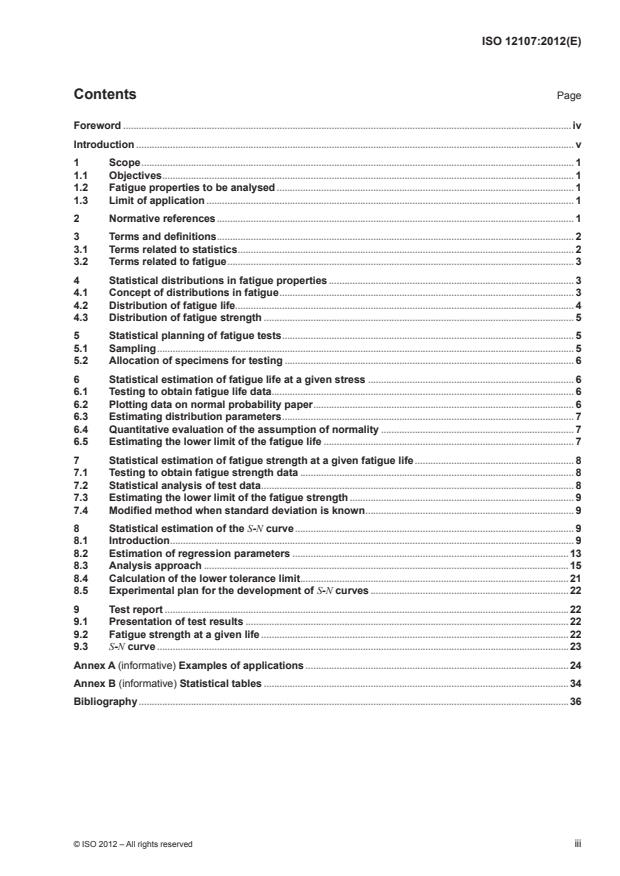
Contents Page
Foreword .iv
Introduction . v
1 Scope . 1
1.1 Objectives . 1
1.2 Fatigue properties to be analysed . 1
1.3 Limit of application . 1
2 Normative references . 1
3 Terms and definitions . 2
3.1 Terms related to statistics . 2
3.2 Terms related to fatigue . 3
4 Statistical distributions in fatigue properties . 3
4.1 Concept of distributions in fatigue . 3
4.2 Distribution of fatigue life. 4
4.3 Distribution of fatigue strength . 5
5 Statistical planning of fatigue tests . 5
5.1 Sampling . 5
5.2 Allocation of specimens for testing . 6
6 Statistical estimation of fatigue life at a given stress . 6
6.1 Testing to obtain fatigue life data . 6
6.2 Plotting data on normal probability paper . 6
6.3 Estimating distribution parameters . 7
6.4 Quantitative evaluation of the assumption of normality . 7
6.5 Estimating the lower limit of the fatigue life . 7
7 Statistical estimation of fatigue strength at a given fatigue life . 8
7.1 Testing to obtain fatigue strength data . 8
7.2 Statistical analysis of test data . 8
7.3 Estimating the lower limit of the fatigue strength . 9
7.4 Modified method when standard deviation is known . 9
8 Statistical estimation of the S-N curve . 9
8.1 Introduction . 9
8.2 Estimation of regression parameters .13
8.3 Analysis approach .15
8.4 Calculation of the lower tolerance limit .21
8.5 Experimental plan for the development of S-N curves .22
9 Test report .22
9.1 Presentation of test results .22
9.2 Fatigue strength at a given life .22
9.3 S-N curve .23
Annex A (informative) Examples of applications .24
Annex B (informative) Statistical tables .34
Bibliography .36
Foreword
ISO (the International Organization for Standardization) is a worldwide federation of national standards bodies
(ISO member bodies). The work of preparing International Standards is normally carried out through ISO
technical committees. Each member body interested in a subject for which a technical committee has been
established has the right to be represented on that committee. International organizations, governmental and
non-governmental, in liaison with ISO, also take part in the work. ISO collaborates closely with the International
Electrotechnical Commission (IEC) on all matters of electrotechnical standardization.
International Standards are drafted in accordance with the rules given in the ISO/IEC Directives, Part 2.
The main task of technical committees is to prepare International Standards. Draft International Standards
adopted by the technical committees are circulated to the member bodies for voting. Publication as an
International Standard requires approval by at least 75 % of the member bodies casting a vote.
Attention is drawn to the possibility that some of the elements of this document may be the subject of patent
rights. ISO shall not be held responsible for identifying any or all such patent rights.
ISO 12107 was prepared by Technical Committee ISO/TC 164, Mechanical testing of metals, Subcommittee
SC 5, Fatigue testing.
This second edition cancels and replaces the first edition (ISO 12107:2003), which has been technically revised.
iv © ISO 2012 – All rights reserved
Introduction
It is known that the results of fatigue tests display significant variations even when the test is controlled very
accurately. In part, these variations are attributable to non-uniformity of test specimens. Examples of such non-
uniformity include slight differences in chemical composition, heat treatment, surface finish, etc. The remaining
part is related to the stochastic process of fatigue failure itself that is intrinsic to metallic engineering materials.
Adequate quantification of this inherent variation is necessary to evaluate the fatigue property of a material
for the design of machines and structures. It is also necessary for test laboratories to compare materials
in fatigue behaviour, including its variation. Statistical methods are necessary to perform these tasks. This
International Standard includes a full methodology for application of the Bastenaire model as well as other
more sophisticated relationships. It also addresses the analysis of runout (censored) data.
INTERNATIONAL STANDARD ISO 12107:2012(E)
Metallic materials — Fatigue testing — Statistical planning and
analysis of data
1 Scope
1.1 Objectives
This International Standard presents methods for the experimental planning of fatigue testing and the statistical
analysis of the resulting data. The purpose is to determine the fatigue properties of metallic materials with both
a high degree of confidence and a practical number of specimens.
1.2 Fatigue properties to be analysed
This International Standard provides a method for the analysis of fatigue life properties at a variety of stress
levels using a relationship that can linearly approximate the material’s response in appropriate coordinates.
Specifically, it addresses
a) the fatigue life for a given stress, and
b) the fatigue strength for a given fatigue life.
The term “stress” in this International Standard can be replaced by “strain”, as the methods described are also
valid for the analysis of life properties as a function of strain. Fatigue strength in the case of strain-controlled
tests is considered in terms of strain, as it is ordinarily understood in terms of stress in stress-controlled tests.
1.3 Limit of application
This International Standard is limited to the analysis of fatigue data for materials exhibiting homogeneous
behaviour due to a single mechanism of fatigue failure. This refers to the statistical properties of test results
that are closely related to material behaviour under the test conditions.
In fact, specimens of a given material tested under different conditions may reveal variations in failure
mechanisms. For ordinary cases, the statistical property of resulting data represents one failure mechanism
and may permit direct analysis. Conversely, situations are encountered where the statistical behaviour is not
homogeneous. It is necessary for all such cases to be modelled by two or more individual distributions.
An example of such behaviour is often observed when failure can initiate from either a surface or internal
site at the same level of stress. Under these conditions, the data will have mixed statistical characteristics
corresponding to the different mechanisms of failure. These types of results are not considered in this
International Standard because a much higher complexity of analysis is required.
Finally, for the S-N case (discussed in Clause 8), this International Standard addresses only complete data.
Runouts of censored data are not addressed.
2 Normative references
The following referenced documents are indispensable for the application of this document. For dated
references, only the edition cited applies. For undated references, the latest edition of the referenced document
(including any amendments) applies.
ISO 3534 (all parts), Statistics — Vocabulary and symbols
3 Terms and definitions
For the purposes of this document, the terms and definitions given in ISO 3534 and the following apply.
3.1 Terms related to statistics
3.1.1
confidence level
value 1 − α of the probability associated with an interval of statistical tolerance
3.1.2
degrees of freedom
ν
number calculated by subtracting from the total number of observations the number of parameters estimated
from the data
3.1.3
distribution function
function giving, for every value x, the probability that the random variable X is less than or equal to x
3.1.4
estimation
operation made for the purpose of assigning, from the values observed in a sample, numerical values to the
parameters of a distribution from which this sample has been taken
3.1.5
population
totality of individual materials or items under consideration
3.1.6
random variable
variable that may take any value of a specified set of values
3.1.7
sample
one or more items taken from a population and intended to provide information on the population
3.1.8
size
n
number of items in a population, lot, sample, etc.
3.1.9
mean
µ
sum of all the data in a population divided by the number of observations
3.1.10
sample mean
μˆ
sum of all the data in a sample divided by the number of observations
3.1.11
standard deviation
σ
positive square root of the mean squared standard deviation from the mean from a population.
3.1.12
estimated standard deviation
ˆ
σ
positive square root of the mean squared standard deviation from the mean of a sample.
2 © ISO 2012 – All rights reserved
3.2 Terms related to fatigue
3.2.1
fatigue life
N
number of stress cycles applied to a specimen, at an indicated stress level, before it attains a failure criterion
defined for the test
3.2.2
fatigue limit
fatigue strength at long life
NOTE Historically, this has usually been defined as the stress generating a life at 10 cycles.
3.2.3
fatigue strength
value of stress level S at which a specimen would fail at a given fatigue life
NOTE This is expressed in megapascals.
3.2.4
specimen
portion or piece of material to be used for a single test determination and normally prepared in a predetermined
shape and in predetermined dimensions
3.2.5
stress level
S
intensity of the stress under the conditions of control in the test
EXAMPLES Amplitude, maximum, range.
3.2.6
stress step
d
difference between neighbouring stress levels when conducting the test by the staircase method
NOTE This is expressed in megapascals.
4 Statistical distributions in fatigue properties
4.1 Concept of distributions in fatigue
The fatigue properties of metallic engineering materials are determined by testing a set of specimens at various
stress levels to generate a fatigue life relationship as a function of stress. The results are usually expressed as
an S-N curve that fits the experimental data plotted in appropriate coordinates. These are generally either log-
log or semi-log plots, with the life values always plotted on the abscissa on a logarithmic scale.
Fatigue test results usually display significant scatter even when the tests are carefully conducted to minimize
experimental error. A component of this variation is due to inequalities, related to chemical composition or heat
treatment, among the specimens, but another component is related to the fatigue process, an example being
the initiation and growth of small cracks under test environments.
The variation in fatigue data are expressed in two ways: the distribution of fatigue life at a given stress and the
distribution of strength at a given fatigue life (see References [1] to [5]).
4.2 Distribution of fatigue life
Fatigue life, N, at a given test stress, S, is considered as a random variable. It is frequently observed the
distribution of fatigue life values at any stress is normal in the logarithmic metric. That is, the logarithms of the
life values follow a normal distribution (See 6.4). This relationship is:
x
1 1 x − μ
x
Px =−exp dx (1)
()
∫
−∞
2 σ
σ 2π
x
x
where x = log N and µ and σ are, respectively, the mean and the standard deviation of x.
x x
Formula (1) gives the cumulative probability of failure for x. This is the proportion of the population failing at
lives less than or equal to x.
Formula (1) does not relate to the probability of failure for specimens at or near the fatigue limit. In this region,
some specimens may fail, while others may not. The shape of the distribution is often skewed, displaying even
greater scatter on the longer-life side. It also may be truncated to represent the longest failure life observed in
the data set.
This International Standard does not address situations in which a certain number of specimens may fail, but
the remaining ones do not.
Other statistical distributions can also be used to express variations in fatigue life. The Weibull [4] distribution
is one of the statistical models often used to represent skewed distributions. On occasion, this distribution may
apply to lives at low stresses, but this special case is not addressed in this International Standard.
Figure 1 shows an example of data from a fatigue test conducted with a statistically based experimental
plan using a large number of specimens (see Reference [5]). The shape of the fatigue life distributions is
demonstrated for explanatory purposes.
Y
X
Key
X cycles to failure
Y stress amplitude, in MPa
Figure 1 — Concept of variation in a fatigue property — Distribution of fatigue life at given stresses
for a 0,25 % C carbon steel tested in the rotating-bending mode
4 © ISO 2012 – All rights reserved
4.3 Distribution of fatigue strength
Fatigue strength at a given fatigue life, N, is considered as a random variable. It is expressed as the normal
distribution:
y y − μ
1 1
y
Py =−exp dy (2)
()
∫
−∞
2 σ
σ 2π
y
y
where y = S (the fatigue strength at N), and µ and σ are, respectively, the mean and the standard deviation of y.
y y
Formula (2) gives the cumulative probability of failure for y. It defines the proportion of the population presenting
fatigue strengths less than or equal to y.
Other statistical distributions can also be used to express variations in fatigue strength.
Figure 2 is based on the same experimental data as Figure 1. The variation in the fatigue property is expressed
here in terms of strength at typical fatigue lives (see Reference [5]).
Y
X
Key
X cycles to failure
Y stress amplitude, in MPa
Figure 2 — Concept of variation in a fatigue property — Distribution of fatigue strength at typical
fatigue lives for a 0,25 % C carbon steel tested in the rotating-bending mode
5 Statistical planning of fatigue tests
5.1 Sampling
It is necessary to define clearly the population of the material for which the statistical distribution of fatigue
properties is to be estimated. Specimen selection from the population shall be performed in a random fashion.
It is also important that the specimens be selected so that they accurately represent the population they are
intended to describe. A complete plan would include additional considerations.
If the population consists of several lots or batches of material, the test specimens shall be selected randomly
from each group in a number proportional to the size of each lot or batch. The total number of specimens taken
shall be equal to the required sample size, n.
If the population displays any serial nature, e.g. if the properties are related to the date of fabrication, the
population shall be divided into groups related to time. Random samples shall be selected from each group in
numbers proportional to the group size.
The specimens taken from a particular batch of material will reveal variability specific to the batch. This within-
batch variation can sometimes be of the same order of importance as the between-batch variation. When the
relative importance of different kinds of variation is known from experience, sampling shall be performed taking
this into consideration.
Hardness measurement is recommended for some materials, when possible, to divide the population of the
material into distinct groups for sampling. The groups should be of as equal size as possible. Specimens may
be extracted randomly in equal numbers from each group to compose a test sample of size n. This procedure
will generate samples uniformly representing the population, based upon hardness.
5.2 Allocation of specimens for testing
Specimens taken from the test materials shall be allocated to individual fatigue tests in principle in a random
way, in order to minimize unexpected statistical bias. The order of testing of the specimens shall also be
randomized in a series of fatigue tests.
When several test machines are used in parallel, specimens shall be tested on each machine in equal or nearly
equal numbers and in a random order. The equivalence of the machines in terms of their performance shall be
verified prior to testing.
When the test programme includes several independent test series, e.g. tests at different stress levels or on
different materials for comparison purposes, each test series shall be carried out at equal or nearly equal rates
of progress, so that all testing can be completed at approximately the same time.
6 Statistical estimation of fatigue life at a given stress
6.1 Testing to obtain fatigue life data
Conduct fatigue tests at a given stress, S, on a set of carefully prepared specimens to determine the fatigue
life values for each. The number selected will be dependent upon the purpose of the test and the availability
of test material. A set of seven specimens is recommended in this International Standard for exploratory tests.
For reliability purposes, however, at least 28 specimens are recommended.
6.2 Plotting data on normal probability paper
Plot the fatigue lives on log-normal probability coordinates. The results should plot as a straight line. Should one
or two data points (really a very low proportion of the data set) deviate from the curve, this is usually the result
of invalid data. Examining test records and failed specimens is useful when there is non-conforming behaviour.
The purpose is to identify a cause for such deviant behaviour to learn if these results can be discounted. Other
statistical distributions e.g. Weibull may be evaluated. However, since the vast majority of unimodal fatigue
results have proven to be distributed log-normally, the standard does not consider Weibull statistics. Subclause
8.3.3 gives some examples of normal probability plots constructed from data used to generate an S-N curve.
Refer to these plots to understand how they will appear when the data conform well to the assumption and in
other cases when there might be some issues. Please note that for the present case, the y-axis will just be the
property in question as opposed to the standardized residuals given the y-axis on the presented plots in 8.3.3.
One other issue is that if the data appear to support two distinct failure distributions, the data should be
segregated by the root cause. For example, results for both surface and internal initiation sites should be
separated into two groups and evaluated uniquely.
6 © ISO 2012 – All rights reserved
6.3 Estimating distribution parameters
Calculation of the sample mean is performed as follows:
n
x
∑
i
i=1
ˆ
μ = (3)
n
where
μˆ is the sample mean;
x is the ith observed value;
i
n is the number of data points.
Note that the symbol “^” means an estimation based upon a sample.
The sample standard deviation is calculated using the following relationship:
n
x − μˆ
()
∑
i
i=1
σˆ = (4)
n − 1
6.4 Quantitative evaluation of the assumption of normality
A number of statistical tests have been developed attempting to quantitatively consider the assumption of
normality. These tests can sometimes generate conflicting results. However, one that seems quite useful
is the Anderson-Darling Test. The details for performing this evaluation as well as others can be found in
Reference [9]. Also, there are commercially available statistical software packages that perform quantitative
evaluations of normality.
6.5 Estimating the lower limit of the fatigue life
Estimate the lower limit of the fatigue life at a given probability of failure, assuming a normal distribution, at the
confidence level 1 − α from the equation:
xkˆˆ=−μσˆ (5)
(,Px11−−αα)(Px,,ν)
The coefficient k is the one-sided tolerance limit for a normal distribution, as given in Table B.1.
(P, 1 − α, v)
P corresponds to the reliability of the prediction (say 99 % probability) and 1 − α is the confidence of the
reliability statement. These values are generated by integration of the non-central t distribution with non-
centrality parameter:
δ = n (6)
The number of degrees of freedom, v, is the same number used in estimating the standard deviation. For the
present case, this is n − 1.
A worked example is given in A.1.
7 Statistical estimation of fatigue strength at a given fatigue life
7.1 Testing to obtain fatigue strength data
Conduct fatigue tests to generate strength data for a set of specimens in a sequential way using the method
known as the staircase method (see Reference [7]).
It is necessary to have rough estimates of the mean and the standard deviation of the fatigue strength for the
materials to be tested. Start the test at a first stress level preferably close to the estimated mean strength. Also
select a stress step, preferably close to the standard deviation, by which to vary the stress level during the test.
If no information is available about the standard deviation, a step of about 5 % of the estimated mean fatigue
strength may be used as the stress step.
Test a first specimen, randomly chosen, at the first stress level to find if it fails before the given number of
cycles. For the next specimen, also randomly chosen, increase the stress level by a step if the preceding
specimen did not fail, and decrease the stress by the same amount if it failed. Continue testing until all the
specimens have been tested in this way.
Exploratory research requires a minimum of 15 specimens to estimate the mean and the standard deviation of
the fatigue strength. Reliability data requires at least 30 specimens.
A worked example of the staircase method is given in A.2.1, together with worked examples of the analyses
described in 7.2 and 7.3.
7.2 Statistical analysis of test data
Count the frequencies of failure and non-failure of the specimens tested at different stress levels. Use the
analysis for the group with the least number of observations.
Denote the stress levels arranged in ascending order by S ≤ S1 ≤ … ≤ S , where l is the number of stress levels,
0 l
denote the number of events by f , and denote the stress step by d. Estimate the parameters for the statistical
i
distribution of the fatigue strength, Formula (2), from:
A 1
ˆ
μ =+Sd ± (7)
y 0
C 2
σˆ =+1,62dD 0,029 (8)
()
y
where:
l
Ai= f
i
∑
i= 1
l
Bi= f
∑ i
i=1
l
Cf=
∑ i
i= 1
BC − A
D =
C
In Formula (7), take the value of ± 1/2 as:
− 1/2 when the event analysed is failure;
+ 1/2 when the event analysed is non-failure.
8 © ISO 2012 – All rights reserved
In Reference [7], it is stated that Formula (8) is valid only when D > 0,3. This condition is generally satisfied
when d /σˆ is selected properly within the range 0,5 to 2.
y
7.3 Estimating the lower limit of the fatigue strength
Estimate the lower limit of the fatigue strength at a probability of failure P for the population at a confidence level
of 1 − α, if the assumption of a normal distribution of the fatigue strength is correct, from the equation:
ˆˆyk=−μσˆ (9)
y y
P,1− ααP,1− , v
() ()
where the coefficient k is the one-sided tolerance limit for a normal distribution, as given in Table B.1.
P,1− α, v
()
Take as the number of degrees of freedom, v, the number that was used in estimating the standard deviation.
For the present case, this is n − 1.
7.4 Modified method when standard deviation is known
A modified staircase method, with fewer specimens, is possible if the standard deviation is known and only the
mean of the fatigue strength needs to be estimated (see Reference [8]).
Conduct tests as in the staircase method described in 7.1, by decreasing or increasing the stress level by
a fixed step depending whether the preceding event was a failure or non-failure, respectively. Choose the
initial stress level close to the roughly estimated mean and the stress step approximately equal to the known
standard deviation.
A minimum of six specimens is required for exploratory tests and at least 15 for reliability data.
If the test is conducted on n specimens at stress levels S , S , … , S in a sequential way, then the mean fatigue
1 2 n
strength is determined by averaging the test stresses, S to S , beyond the first, without regard to whether
2 n+1
each event was a failure or a non-failure:
n + 1
S
∑
i
i = 2
μˆ = (10)
y
n
The test at S is not carried out, but the stress level itself is determined from the result of nth test.
n − 1
Estimate the lower limit of the fatigue strength for the population from Formula (9). Take as the number of
degrees of freedom that corresponding to the standard deviation used for the test or, if this number is unknown,
take it as n − 1.
In the modified staircase method, it is necessary to know the standard deviation of the fatigue strength. It may
be estimated from the S-N curve as described in Clause 8.
A worked example is given in A.2.
8 Statistical estimation of the S-N curve
8.1 Introduction
Analysis of S-N fatigue is performed for the purpose of fitting an appropriate mathematical relationship to test
data to generate a curve which yields approximately 50 % probability of failure. Typically, the data exist at a
number of stress or strains and represent a continuous single distribution that is log-normally distributed with
constant variance as a function of stress or strain.
The basic relationships employed to describe behaviour are used to reflect either linear or curvilinear response.
Figures 3 and 4 demonstrate the behaviour in question. Figure 5 presents a case which occurs only on occasion.
This more complicated behaviour can be managed by use of the Bastenaire equation. This relationship is
useful when the data demonstrates an asymptotic flattening of the curve in the very high life regime while
simultaneously displaying a convex downward shape in the high stress or strain region.
Mathematically, the Bastenaire relationship has the following form:
C
A SE−
N = exp −
(11)
SE− B
where
N is the fatigue life;
S is the stress or strain;
A, B, C, E are curve fit parameters.
The Stromeyer relationship, useful when there is no high stress downward concavity is:
logl()NA=+ BSog ()− E (12)
10 10
where
N
is the fatigue life;
S
is the stress or strain;
E
is stress at very long life and must be less than all the stress or strain values in the data;
A, B are curve fit parameters.
Application of the Bastenaire equation or its simplification, Formula (12), cannot be performed using the
method of linear least squares. More advanced concepts are required and are beyond the scope of the present
document. They can be found in References [10] and [11]. Additionally, a future standard is planned to address
a method suitable for this analysis as well as other advanced topics that remain to be defined.
Note that high stress behaviour can result from performing stress-controlled tests at maximum stress levels
exceeding the yield strength. In general, this is an improper test technique because cyclic ratcheting may
result. Conversely, this high stress behaviour has been observed in strain-controlled tests as well. Strain-
controlled testing is sometimes purposely conducted at strain levels producing stresses exceeding the yield
strength. These are usually valid in the absence of specific testing issues, etc., invalidating the results.
10 © ISO 2012 – All rights reserved
Y
3 4 5 6 7
10 10 10 10 10
X
Key
X cycles to failure
Y stress or strain, stress units (MPa) presented
Figure 3 —Typical linear fatigue response
Y
3 4 5 6 7
10 10 10 10 10
X
Key
X cycles to failure
Y stress or strain, stress units (MPa) presented
Figure 4 —Typical curvilinear fatigue response
Y
1000,0
100,0
10,0
3 4 5 6 7
10 10 10 10 10
X
Key
X cycles to failure
Y stress or strain, stress units (MPa) presented
Figure 5 — S-N response occasionally observed
The mathematical models appropriate for the majority of the cases the fatigue practitioner will encounter
are given below. However, there will be cases, noted above, that occur that our outside the domain of the
methodologies presented and require more sophisticated approaches. However, in general these cases occur
rather infrequently and the majority of S-N curves can be evaluated using the techniques presented for linear
or curvilinear response (Figures 3 and 4, respectively). The statistical techniques presented below are based
[12],[13]
on the method of linear least squares . The more advanced methods require either nonlinear regression
methods or maximum likelihood estimation (MLE).
These relationships are:
— Linear fatigue response model
Log Nb =+ bSlog (13)
() ()
10 0 110
where b , b , .b are linear regression coefficients and S can be either stress or strain.
0 1 n
— Curvilinear fatigue response
Log Nb =+ bSlog +bSlog (14)
() () ()
10 0 1 10 2 10
12 © ISO 2012 – All rights reserved
8.2 Estimation of regression parameters
1)
8.2.1 Estimation of the parameters for the linear model
For all the data, take the logarithms of the stress (or strain) values and the corresponding observed lives. Base
10 logarithms are encouraged. Logarithms to another base, for example base e, are acceptable. However,
base 10 is recommended, as most practitioners seem to use these values.
Specifically, the model then has the form:
ˆ
Yb=+ bX (15)
ii01
ˆ
where Y is the predicted value of the dependent variable, XS = log and YN = log .
() ()
ii10 ii10
i
n n
XY
∑ ii∑
n
i=1 i=1
XY −
∑ ii
n
i=1
b = (16)
n
X
i
∑
n
i=1
2
X −
∑ i
n
i=1
n n
Yb − X
∑ ii1∑
i=1 i=1
b = (17)
n
Standard deviation calculated from the results of regression analysis is defined as:
n
ˆ
YY -
()
∑
ii
i=1
σˆ = (18)
np−
where p is the number of parameters estimated in the model, in this case p = 2.
Correlation coefficient: A useful parameter to assist in the evaluating the quality of the fit is the correlation
coefficient, R . This parameter presents the proportion of the variation of the data explained by the model to
the total variation. The following relationship is normally used for the linear case. It is generalized later in the
discussion of the quadratic model.
n n
XY
∑ ii∑
n
i=1 i=1
XY −
∑ ii
n
i=1
2
R = (19)
2 2
n n
X Y
∑ i ∑ i
n n
2 i=1 2 i=1
X − Y −
i i
∑ ∑∑
n n
i=1 i=1
Usually, a value of 0,9 or better is indicative of a good fit.
1) Classically, linear regression refers to any linear combination of explanatory variables. For the purposes of this
International Standard, however, a linear model simply means a relationship of the form y = mx + b.
8.2.2 Estimation of the regression parameters for the quadratic model
Linear regression models that is, all models in which the parameters are linear or can be linearized by a suitable
transformation (for example logarithmic) can be calculated using the methods of linear algebra. References [12]
and [13] provide the details.
Basically, the solution to the general linear problem is given by:
−1
b = XX′ XY′ (20)
()
where
b
is the matrix of the calculated regression parameters;
′
X is the transpose of the matrix of x values; the independent variables;
X
is the matrix of X values; the independent variables;
Y
is the matrix of Y values; the dependent variable.
Additional relationships of interest are:
n
RY= - Y (21)
()
SST ∑ ii
i=1
n
ˆ
RY= - Y (22)
()
∑
SSR ii
i=1
n
ˆ
RY = - Y (23)
()
SSE ∑ ii
i=1
where
R is the sum of squares total;
SST
R is the sum of squares regression;
SSR
R is the sum of squares error;
SSE
Y
′
is the average of all the Y in the model.
The standard deviation for the regression model, given in Formula (18) is alternatively expressed as:
R
SSE
σˆ =
(24)
np−
where
is the estimated standard deviation;
σˆ
p is the number of parameters (b’s) estimated in the model
p = 2 for a model of the form y = b + b x and
0 1
p = 3 for a quadratic model, y = b + b x + b x ;
0 1 1
n − p is the degrees of freedom.
14 © ISO 2012 – All rights reserved
The correlation coefficient presented in Formula (15) is more generally given by:
R
2 SSR
R = (25)
R
SST
8.3 Analysis approach
In general, the simplest model that captures behaviour should be used for the analysis. Usually, a more complex
relationship will give a better fit and certainly will increase the R value, but the final model should only be more
complex than the linear relationship if it can be shown to significantly reduce the scatter. Analysis of the data
using this strategy is encouraged and the following details will help in determining the significance of increasing
the complexity.
8.3.1 Plot the curve on the S-N diagram
The first analysis, the one assuming linear response in S-N coordinates, should be plotted with the data used
to generate the curve to obtain an assessment of the overall fit.
8.3.2 Residuals plots
Evaluation of the quality of fit is undertaken by evaluating plots of residuals and plots of residual versus
cumulative normal probability. A residual is defined as:
ˆ
eY =− Y (26)
()
ii i
One property of the residuals is that they should sum to zero. A plot of the residual versus the corresponding
ˆ
predicted (Y ) which is, log ()Life values should more or less uniformly populate the plot. An example of
i
an acceptable plot and plots with issues that require resolution are given below. Ideally, the residuals should
more or less uniformly populate plot curve without biases or trends. As always, the sum of the residuals should
be zero, so the residuals should be centred about the zero value on the y-axis. Note that the residuals on the
y-axis have been scaled by the standard deviation. These are referred to as the standardized residuals.
Figure 6, as noted, demonstrates the case when a model is adequately capturing response. Figure 7 is the
classic case where data was evaluated using a linear response model, but requires a quadratic expression.
When the quadratic model is applied, the residuals plot will then appear similar to that shown in Figure 6.
Y
2,5
2,0
1,5
1,0
0,5
0,0
-0,5
-1,0
-1,5
-2,0
-2,5
3 4 5
10 10 10
X
Key
X predicted life
Y standardized residuals
Figure 6 — Residuals plot demonstrating results for a model adequately capturing behaviour
Y
2,5
1,5
0,5
-0,5
-1
-1,5
-2
-2,5
3 4 5 6
10 10 10 10
X
Key
X predicted life
Y standardized residuals
Figure 7 — Residuals plot demonstrating classic behaviour when a linear response model is applied
to results requiring a quadratic relationship
16 © ISO 2012 – All rights reserved
Y
6,0
Candidate Outlier
3,0
0,0
-3,0
-6,0
3 4 5 6
10 10 10 10
X
Key
X predicted life
Y standardized residuals
Figure 8 — An acceptable residuals plot for the fit, but also demonstrating a candidate outlying result
Finally, when a possible outlier(s) is observed, it is appropriate to conduct a careful review of the test records
that accompany the results to see if there were any machining and/or testing discrepancies. In addition, it is
recommended that a metallurgical and fractographic evaluation of results be made in order to determine if the
specimen is a valid observation or if it may have been damaged. Note that the disposition of outlying data can
be problematic and subjective. Quantitative statistical tests to evaluate outlying data are available, but these
can often generate conflicting results. This is particularly true for cases where the points(s) are suspiciously
aberrant, but no so far deviant as to be clearly erroneous.
Unduly high (long-life) results, as well as short-life values, can be problematic; both can inappropriately inflate
the scatter and shift the curves. The likely result is higher than necessary estimates of the standard deviation.
This can lead to lower tolerance limits than appropriate.
In cases with outliers, the correct perspective is to be judicious, neither automatically rejecting tests that might
be problematic, nor retaining such results because no physical reason can be identified. The guidance is to err
conservatively in such cases by retaining observations where there is insufficient cause to reject them.
8.3.3 Normal probability plot
Plots of the residuals, or standardized residuals, versus cumulative normal probability are also useful in
evaluation of the fit of the model to the data. The residuals are assumed to be normally distributed and this
assumption can be evaluated by determining if the residual from the analysis plot reasonably as a straight line.
Y
0,5
0,4
0,3
0,2
0,1
-0,1
-0,2
-0,3
-0,4
-0,5
-3 -1 13
X
Key
X cumulative normal probability
Y standardized residuals
Figure 9 — Example of a cumulative normal probability plot displaying excellent conformance to
normality
Y
-1
-2
-3
-4
-3 -2 -1 0 123
X
Key
X cumulative normal probability
Y standardized residuals
Figure 10 — Example of a cumulative normal probability plot displaying acceptable conformance to
normality
18 © ISO 2012 – All rights reserved
Y
-1
-2
-3
-3 -1 13
X
Key
X cumulative normal probability
Y standardized residuals
Figure 11 — Example of a cumulative n
...