

ISO 12135:2021
(Main)Metallic materials — Unified method of test for the determination of quasistatic fracture toughness
General Information
- Abstract
This document specifies methods for determining fracture toughness in terms of K, δ, J and R-curves for homogeneous metallic materials subjected to quasistatic loading. Specimens are notched, precracked by fatigue and tested under slowly increasing displacement. The fracture toughness is determined for individual specimens at or after the onset of ductile crack extension or at the onset of ductile crack instability or unstable crack extension. In cases where cracks grow in a stable manner under ductile tearing conditions, a resistance curve describing fracture toughness as a function of crack extension is measured. In some cases in the testing of ferritic materials, unstable crack extension can occur by cleavage or ductile crack initiation and growth, interrupted by cleavage extension. The fracture toughness at crack arrest is not covered by this document. Special testing requirements and analysis procedures are necessary when testing weldments, and these are described in ISO 15653 which is complementary to this document. Statistical variability of the results strongly depends on the fracture type, for instance, fracture toughness associated with cleavage fracture in ferritic steels can show large variation. For applications that require high reliability, a statistical approach can be used to quantify the variability in fracture toughness in the ductile-to-brittle transition region, such as that given in ASTM E1921. However, it is not the purpose of this document to specify the number of tests to be carried out nor how the results of the tests are to be applied or interpreted.
- Status
- Published
- Publication Date
- 26-Jul-2021
- Technical Committee
- ISO/TC 164/SC 4 - Fatigue, fracture and toughness testing
- Drafting Committee
- ISO/TC 164/SC 4/WG 3 - Fracture toughness
- Current Stage
- 9020 - International Standard under periodical review
- Start Date
- 15-Jul-2026
- Completion Date
- 15-Jul-2026
Buy Documents


ISO 12135:2021 - Metallic materials -- Unified method of test for the determination of quasistatic fracture toughness
ISO 12135:2021 - Metallic materials — Unified method of test for the determination of quasistatic fracture toughness Released:15. 08. 2022
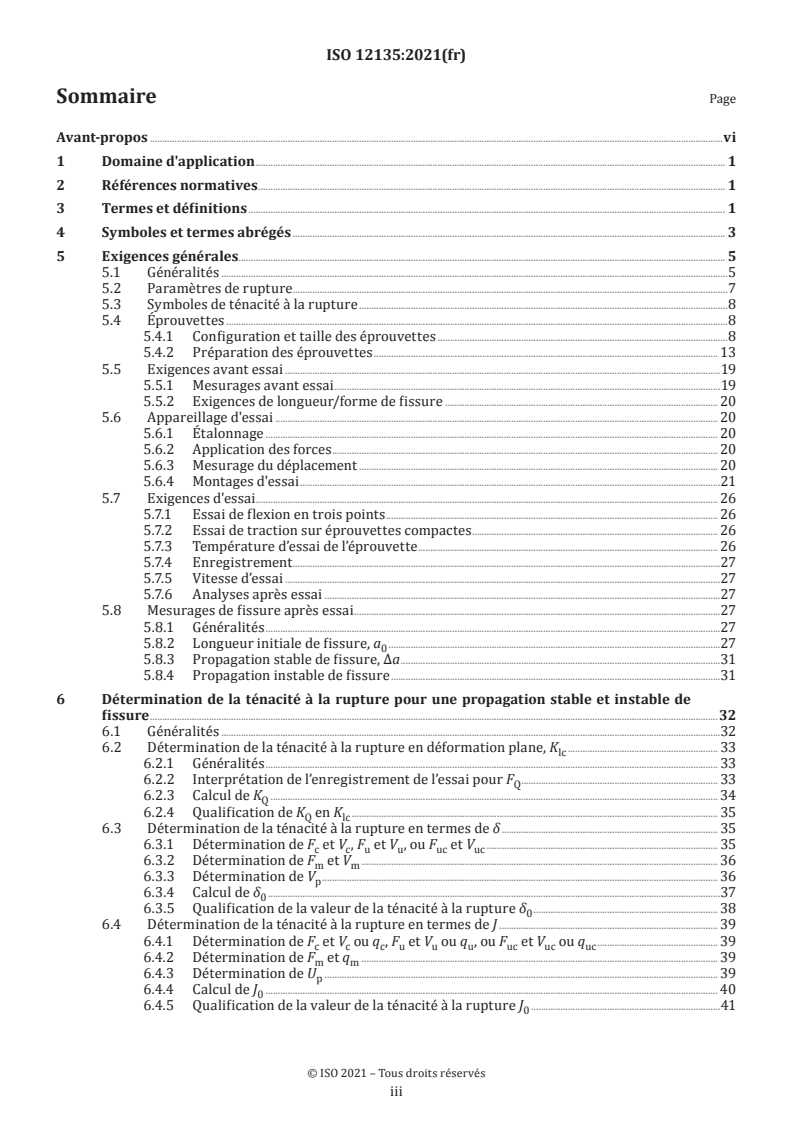
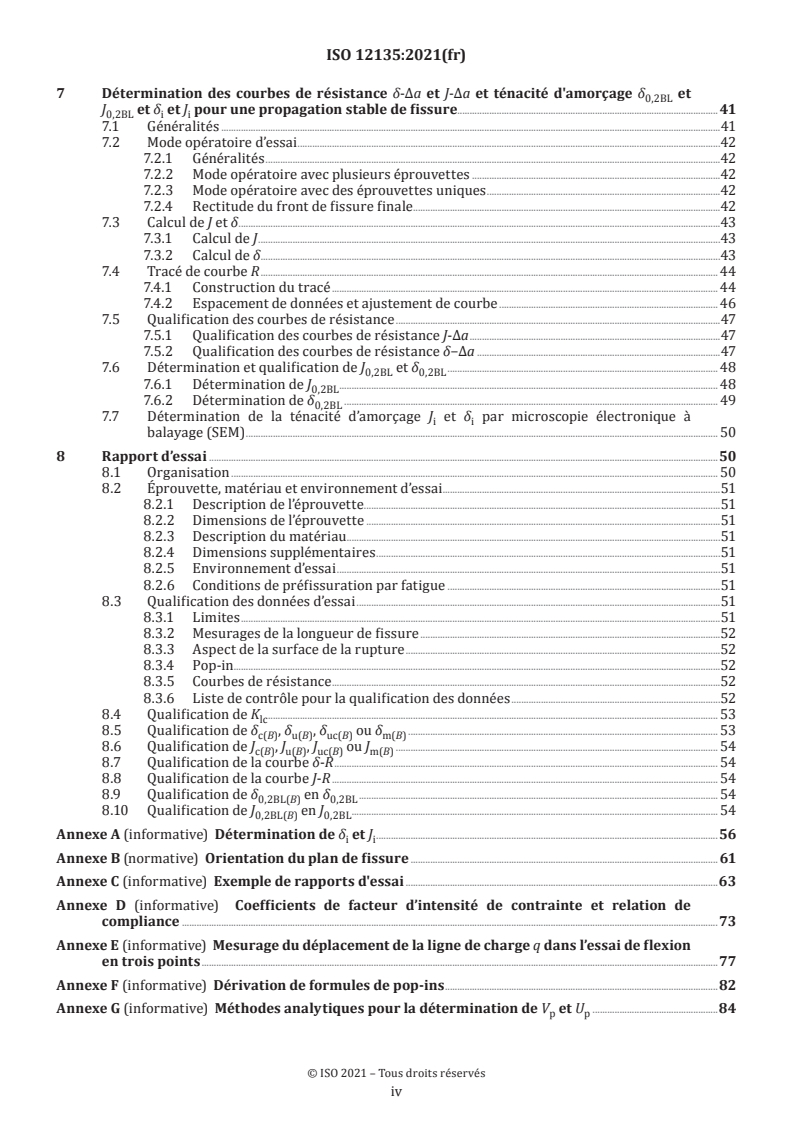
ISO 12135:2021 - Matériaux métalliques — Méthode unifiée d'essai pour la détermination de la ténacité quasi statique
Overview
ISO 12135:2021 - Metallic materials - Unified method of test for the determination of quasistatic fracture toughness - provides a unified, internationally recognized test methodology for measuring fracture toughness of homogeneous metallic materials under quasistatic loading. The standard covers determination of fracture parameters expressed as K (stress intensity), δ (crack-tip opening displacement), J (J-integral) and R‑curves for both stable and unstable crack extension. Specimens are notched, precracked by fatigue, and tested under slowly increasing displacement; fracture toughness is assessed at or after the onset of ductile crack extension or instability.
Key technical topics and requirements
ISO 12135 defines detailed technical requirements for:
- Specimen types and configurations - includes Compact Tension (CT) and Three‑Point Bend (TPB) geometries and sizing guidance.
- Specimen preparation and pre‑test measurements - notching, fatigue precracking, and initial crack length measurement.
- Test apparatus and calibration - force application, displacement measurement (including load‑line displacement q), and fixture recommendations.
- Test procedures and rates - controlled, slowly increasing displacement for quasistatic loading.
- Fracture parameter calculations - procedures to calculate K, δ and J from test records and post‑test crack measurements.
- R‑curve (resistance curve) measurement - methods for single‑ and multiple‑specimen procedures when stable ductile tearing occurs.
- Data qualification and reporting - criteria for qualifying values (including pop‑in detection), reporting requirements and sample test report structure.
- Special considerations - behaviour in ferritic steels (cleavage interruptions), limitations on fracture‑at‑arrest, and statistical variability of results.
The standard also contains informative and normative annexes covering compliance relationships, SEM initiation toughness determination, power‑law fits for crack extension, and guidelines for single‑specimen methods.
Practical applications and users
ISO 12135 is used where reliable quasistatic fracture toughness data are needed to support design, safety assessment and materials qualification:
- Material testing laboratories and certification bodies
- Fracture mechanics and materials engineers in aerospace, oil & gas, power generation, automotive and civil structures
- R&D teams developing alloys or heat treatments
- Quality assurance for components subject to crack‑sensitive loading (pressure vessels, pipelines, structural steel)
- Regulators and standards committees requiring standardized toughness data
This standard is essential for assessing resistance to crack initiation and tearing, feeding into fitness‑for‑service evaluations, fracture‑critical design and failure investigations.
Related standards
- ISO 15653 - complementary requirements for testing weldments.
- ASTM E1921 - statistical approaches for fracture toughness in the ductile‑to‑brittle transition region (referenced for probabilistic treatment; ISO 12135 does not prescribe test counts or statistical application).
Keywords: ISO 12135, fracture toughness, quasistatic, metallic materials, K, J, δ, R‑curve, fatigue precracking, compact tension, three‑point bend, fracture mechanics.
Relations
- Effective Date
- 25-Aug-2026
- Effective Date
- 25-Aug-2026
- Effective Date
- 25-Aug-2026
- Effective Date
- 25-Aug-2026
- Effective Date
- 25-Aug-2026
- Effective Date
- 23-Apr-2020
Buy Documents
ISO 12135:2021 - Metallic materials -- Unified method of test for the determination of quasistatic fracture toughness
ISO 12135:2021 - Metallic materials — Unified method of test for the determination of quasistatic fracture toughness Released:15. 08. 2022
ISO 12135:2021 - Matériaux métalliques — Méthode unifiée d'essai pour la détermination de la ténacité quasi statique
Get Certified
Connect with accredited certification bodies for this standard

Element Materials Technology
Materials testing and product certification.

Inštitut za kovinske materiale in tehnologije
Institute of Metals and Technology. Materials testing, metallurgical analysis, NDT.
Sponsored listings
Frequently Asked Questions
ISO 12135:2021 is a standard published by the International Organization for Standardization (ISO). Its full title is "Metallic materials — Unified method of test for the determination of quasistatic fracture toughness". This standard covers: This document specifies methods for determining fracture toughness in terms of K, δ, J and R-curves for homogeneous metallic materials subjected to quasistatic loading. Specimens are notched, precracked by fatigue and tested under slowly increasing displacement. The fracture toughness is determined for individual specimens at or after the onset of ductile crack extension or at the onset of ductile crack instability or unstable crack extension. In cases where cracks grow in a stable manner under ductile tearing conditions, a resistance curve describing fracture toughness as a function of crack extension is measured. In some cases in the testing of ferritic materials, unstable crack extension can occur by cleavage or ductile crack initiation and growth, interrupted by cleavage extension. The fracture toughness at crack arrest is not covered by this document. Special testing requirements and analysis procedures are necessary when testing weldments, and these are described in ISO 15653 which is complementary to this document. Statistical variability of the results strongly depends on the fracture type, for instance, fracture toughness associated with cleavage fracture in ferritic steels can show large variation. For applications that require high reliability, a statistical approach can be used to quantify the variability in fracture toughness in the ductile-to-brittle transition region, such as that given in ASTM E1921. However, it is not the purpose of this document to specify the number of tests to be carried out nor how the results of the tests are to be applied or interpreted.
This document specifies methods for determining fracture toughness in terms of K, δ, J and R-curves for homogeneous metallic materials subjected to quasistatic loading. Specimens are notched, precracked by fatigue and tested under slowly increasing displacement. The fracture toughness is determined for individual specimens at or after the onset of ductile crack extension or at the onset of ductile crack instability or unstable crack extension. In cases where cracks grow in a stable manner under ductile tearing conditions, a resistance curve describing fracture toughness as a function of crack extension is measured. In some cases in the testing of ferritic materials, unstable crack extension can occur by cleavage or ductile crack initiation and growth, interrupted by cleavage extension. The fracture toughness at crack arrest is not covered by this document. Special testing requirements and analysis procedures are necessary when testing weldments, and these are described in ISO 15653 which is complementary to this document. Statistical variability of the results strongly depends on the fracture type, for instance, fracture toughness associated with cleavage fracture in ferritic steels can show large variation. For applications that require high reliability, a statistical approach can be used to quantify the variability in fracture toughness in the ductile-to-brittle transition region, such as that given in ASTM E1921. However, it is not the purpose of this document to specify the number of tests to be carried out nor how the results of the tests are to be applied or interpreted.
ISO 12135:2021 is classified under the following ICS (International Classification for Standards) categories: 77.040.10 - Mechanical testing of metals. The ICS classification helps identify the subject area and facilitates finding related standards.
ISO 12135:2021 has the following relationships with other standards: It is inter standard links to EN 4800-005:2025, EN 4800-001:2025, EN 10225-3:2019+A1:2023, EN ISO/ASTM 52909:2022, EN ISO/ASTM 52909:2024, ISO 12135:2016. Understanding these relationships helps ensure you are using the most current and applicable version of the standard.
ISO 12135:2021 is available in PDF format for immediate download after purchase. The document can be added to your cart and obtained through the secure checkout process. Digital delivery ensures instant access to the complete standard document.
Standards Content (Sample)
INTERNATIONAL ISO
STANDARD 12135
Third edition
2021-07
Metallic materials — Unified method
of test for the determination of
quasistatic fracture toughness
Matériaux métalliques — Méthode unifiée d'essai pour la
détermination de la ténacité quasi statique
Reference number
©
ISO 2021
© ISO 2021
All rights reserved. Unless otherwise specified, or required in the context of its implementation, no part of this publication may
be reproduced or utilized otherwise in any form or by any means, electronic or mechanical, including photocopying, or posting
on the internet or an intranet, without prior written permission. Permission can be requested from either ISO at the address
below or ISO’s member body in the country of the requester.
ISO copyright office
CP 401 • Ch. de Blandonnet 8
CH-1214 Vernier, Geneva
Phone: +41 22 749 01 11
Email: copyright@iso.org
Website: www.iso.org
Published in Switzerland
ii © ISO 2021 – All rights reserved
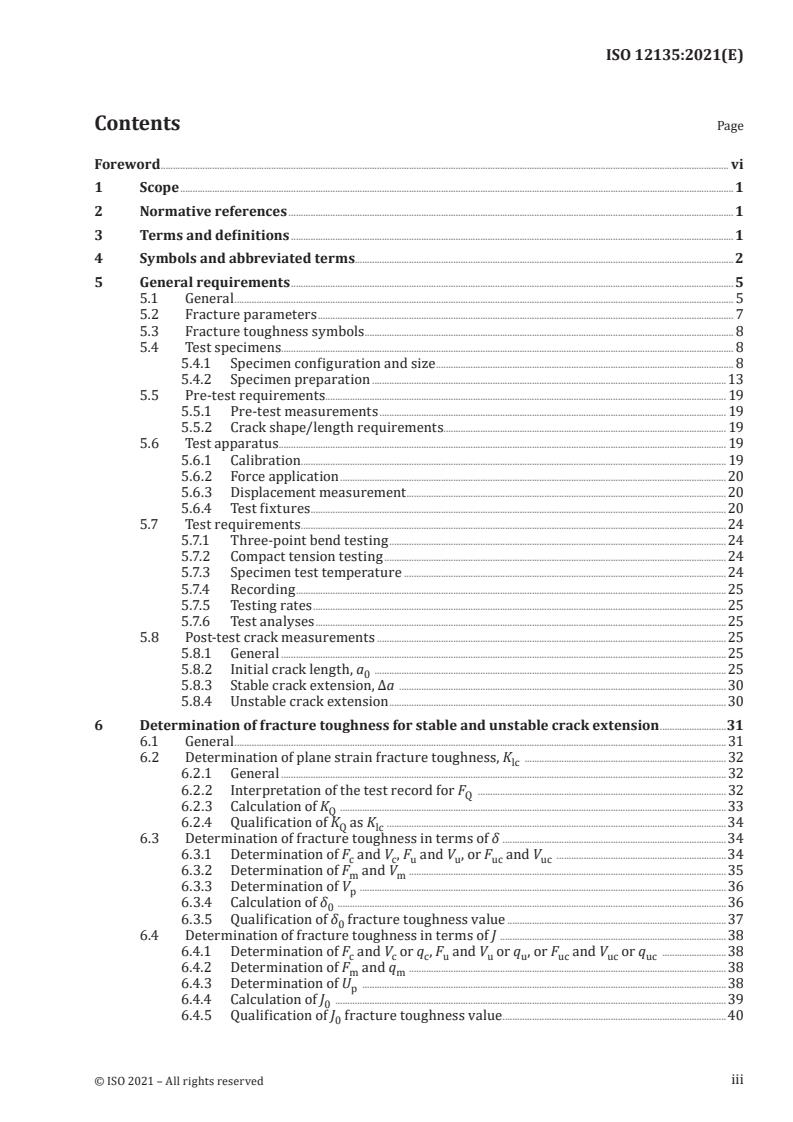
Contents Page
Foreword .vi
1 Scope . 1
2 Normative references . 1
3 Terms and definitions . 1
4 Symbols and abbreviated terms . 2
5 General requirements . 5
5.1 General . 5
5.2 Fracture parameters. 7
5.3 Fracture toughness symbols . 8
5.4 Test specimens . 8
5.4.1 Specimen configuration and size . 8
5.4.2 Specimen preparation .13
5.5 Pre-test requirements .19
5.5.1 Pre-test measurements .19
5.5.2 Crack shape/length requirements .19
5.6 Test apparatus .19
5.6.1 Calibration .19
5.6.2 Force application .20
5.6.3 Displacement measurement .20
5.6.4 Test fixtures .20
5.7 Test requirements .24
5.7.1 Three-point bend testing .24
5.7.2 Compact tension testing .24
5.7.3 Specimen test temperature.24
5.7.4 Recording .25
5.7.5 Testing rates .25
5.7.6 Test analyses .25
5.8 Post-test crack measurements .25
5.8.1 General.25
5.8.2 Initial crack length, a .25
5.8.3 Stable crack extension, Δa .30
5.8.4 Unstable crack extension .30
6 Determination of fracture toughness for stable and unstable crack extension .31
6.1 General .31
6.2 Determination of plane strain fracture toughness, K .32
lc
6.2.1 General.32
6.2.2 Interpretation of the test record for F .32
Q
6.2.3 Calculation of K .33
Q
6.2.4 Qualification of K as K .34
Q lc
6.3 Determination of fracture toughness in terms of δ .34
6.3.1 Determination of F and V , F and V , or F and V .34
c c u u uc uc
6.3.2 Determination of F and V .35
m m
6.3.3 Determination of V .36
p
6.3.4 Calculation of δ .36
6.3.5 Qualification of δ fracture toughness value .37
6.4 Determination of fracture toughness in terms of J .38
6.4.1 Determination of F and V or q , F and V or q , or F and V or q .38
c c c u u u uc uc uc
6.4.2 Determination of F and q .38
m m
6.4.3 Determination of U .38
p
6.4.4 Calculation of J .39
6.4.5 Qualification of J fracture toughness value .40
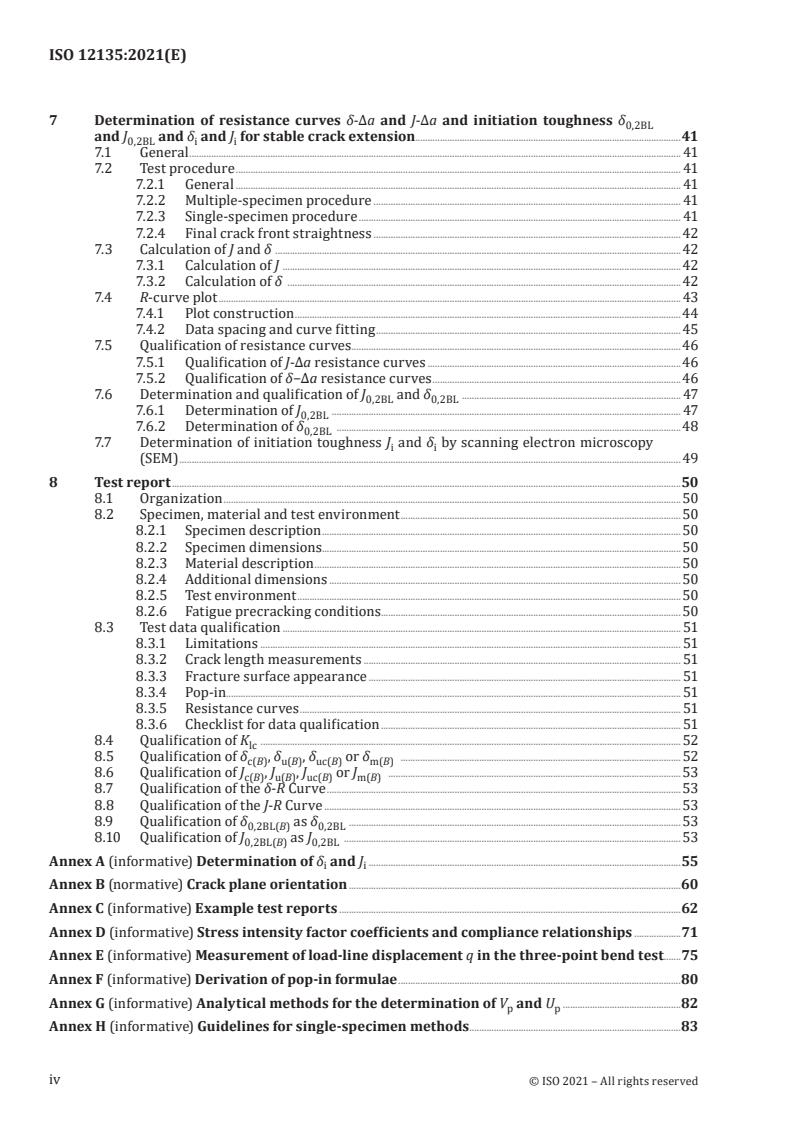
7 Determination of resistance curves δ-Δa and J-Δa and initiation toughness δ and
0,2BL
J and δ and J for stable crack extension .41
0,2BL i i
7.1 General .41
7.2 Test procedure .41
7.2.1 General.41
7.2.2 Multiple-specimen procedure .41
7.2.3 Single-specimen procedure .41
7.2.4 Final crack front straightness .42
7.3 Calculation of J and δ .42
7.3.1 Calculation of J .42
7.3.2 Calculation of δ .42
7.4 R-curve plot .43
7.4.1 Plot construction .44
7.4.2 Data spacing and curve fitting .45
7.5 Qualification of resistance curves .46
7.5.1 Qualification of J-Δa resistance curves .46
7.5.2 Qualification of δ−Δa resistance curves .46
7.6 Determination and qualification of J and δ .47
0,2BL 0,2BL
7.6.1 Determination of J .47
0,2BL
7.6.2 Determination of δ .48
0,2BL
7.7 Determination of initiation toughness J and δ by scanning electron microscopy (SEM) .49
i i
8 Test report .49
8.1 Organization .49
8.2 Specimen, material and test environment .50
8.2.1 Specimen description .50
8.2.2 Specimen dimensions .50
8.2.3 Material description . .50
8.2.4 Additional dimensions .50
8.2.5 Test environment .50
8.2.6 Fatigue precracking conditions .50
8.3 Test data qualification .51
8.3.1 Limitations .51
8.3.2 Crack length measurements .51
8.3.3 Fracture surface appearance .51
8.3.4 Pop-in .51
8.3.5 Resistance curves .51
8.3.6 Checklist for data qualification .51
8.4 Qualification of K .52
lc
8.5 Qualification of δ , δ , δ or δ .52
c(B) u(B) uc(B) m(B)
8.6 Qualification of J , J , J or J .53
c(B) u(B) uc(B) m(B)
8.7 Qualification of the δ-R Curve .53
8.8 Qualification of the J-R Curve .53
8.9 Qualification of δ as δ .53
0,2BL(B) 0,2BL
8.10 Qualification of J as J .53
0,2BL(B) 0,2BL
Annex A (informative) Determination of δ and J .55
i i
Annex B (normative) Crack plane orientation .60
Annex C (informative) Example test reports .62
Annex D (informative) Stress intensity factor coefficients and compliance relationships .71
Annex E (informative) Measurement of load-line displacement q in the three-point bend test .75
Annex F (informative) Derivation of pop-in formulae .80
Annex G (informative) Analytical methods for the determination of V and U .82
p p
Annex H (informative) Guidelines for single-specimen methods .83
Annex I (normative) Power-law fits to crack extension data (see Reference [42]) .97
iv © ISO 2021 – All rights reserved
Bibliography .98
Foreword
ISO (the International Organization for Standardization) is a worldwide federation of national standards
bodies (ISO member bodies). The work of preparing International Standards is normally carried out
through ISO technical committees. Each member body interested in a subject for which a technical
committee has been established has the right to be represented on that committee. International
organizations, governmental and non-governmental, in liaison with ISO, also take part in the work.
ISO collaborates closely with the International Electrotechnical Commission (IEC) on all matters of
electrotechnical standardization.
The procedures used to develop this document and those intended for its further maintenance are
described in the ISO/IEC Directives, Part 1. In particular, the different approval criteria needed for the
different types of ISO documents should be noted. This document was drafted in accordance with the
editorial rules of the ISO/IEC Directives, Part 2 (see www .iso .org/ directives).
Attention is drawn to the possibility that some of the elements of this document may be the subject of
patent rights. ISO shall not be held responsible for identifying any or all such patent rights. Details of
any patent rights identified during the development of the document will be in the Introduction and/or
on the ISO list of patent declarations received (see www .iso .org/ patents).
Any trade name used in this document is information given for the convenience of users and does not
constitute an endorsement.
For an explanation of the voluntary nature of standards, the meaning of ISO specific terms and
expressions related to conformity assessment, as well as information about ISO's adherence to the
World Trade Organization (WTO) principles in the Technical Barriers to Trade (TBT), see www .iso .org/
iso/ foreword .html.
This document was prepared by Technical Committee ISO/TC 164, Mechanical testing of metals,
Subcommittee SC 4, Fatigue, fracture and toughness testing.
This third edition cancels and replaces the second edition (ISO 12135:2016), which has been technically
revised.
The main changes compared to the previous edition are as follows:
— formulae to calculate CTOD have been replaced with those based on rigid rotation assumption
throughout; replacing the previous R-curve formulae based on CTOD from J. CTOD formulae for
SENBs are now those based on recent research to include the material yield to tensile strength ratio
in the CTOD formulae;
— the determination of J directly from displacement defined in terms of CMOD has been included, in
addition to the methods based on load line displacement;
— where fatigue precrack straightness requirements cannot be met due to internal residual stresses,
the application of modification techniques, originally developed for weld specimens, is now
permitted;
— the rotation correction factor for compact specimens has been revised with a new formula;
— editorial changes have been made to improve consistency of terms and definitions used throughout
the document.
Any feedback or questions on this document should be directed to the user’s national standards body. A
complete listing of these bodies can be found at www .iso .org/ members .html.
vi © ISO 2021 – All rights reserved
INTERNATIONAL STANDARD ISO 12135:2021(E)
Metallic materials — Unified method of test for the
determination of quasistatic fracture toughness
1 Scope
This document specifies methods for determining fracture toughness in terms of K, δ, J and R-curves for
homogeneous metallic materials subjected to quasistatic loading. Specimens are notched, precracked
by fatigue and tested under slowly increasing displacement. The fracture toughness is determined for
individual specimens at or after the onset of ductile crack extension or at the onset of ductile crack
instability or unstable crack extension. In cases where cracks grow in a stable manner under ductile
tearing conditions, a resistance curve describing fracture toughness as a function of crack extension
is measured. In some cases in the testing of ferritic materials, unstable crack extension can occur
by cleavage or ductile crack initiation and growth, interrupted by cleavage extension. The fracture
toughness at crack arrest is not covered by this document. Special testing requirements and analysis
procedures are necessary when testing weldments, and these are described in ISO 15653 which is
complementary to this document.
Statistical variability of the results strongly depends on the fracture type, for instance, fracture
toughness associated with cleavage fracture in ferritic steels can show large variation. For applications
that require high reliability, a statistical approach can be used to quantify the variability in fracture
toughness in the ductile-to-brittle transition region, such as that given in ASTM E1921. However, it is
not the purpose of this document to specify the number of tests to be carried out nor how the results of
the tests are to be applied or interpreted.
2 Normative references
The following documents are referred to in the text in such a way that some or all of their content
constitutes requirements of this document. For dated references, only the edition cited applies. For
undated references, the latest edition of the referenced document (including any amendments) applies.
ISO 3785, Metallic materials — Designation of test specimen axes in relation to product texture
ISO 7500-1, Metallic materials — Calibration and verification of static uniaxial testing machines — Part 1:
Tension/compression testing machines — Calibration and verification of the force-measuring system
ISO 9513, Metallic materials — Calibration of extensometer systems used in uniaxial testing
3 Terms and definitions
For the purposes of this document, the following terms and definitions apply.
ISO and IEC maintain terminological databases for use in standardization at the following addresses:
— ISO Online browsing platform: available at https:// www .iso .org/ obp
— IEC Electropedia: available at http:// www .electropedia .org/
3.1
stress intensity factor
K
magnitude of the elastic stress-field singularity for a homogeneous, linear-elastic body
Note 1 to entry: The stress intensity factor is a function of applied force, crack length, specimen size and specimen
geometry.
3.2
crack-tip opening displacement
δ
relative opening displacement of the crack surfaces normal to the original (undeformed) crack plane at
the tip of the fatigue precrack, evaluated using the rotation point formula
3.3
J-integral
line or surface integral that encloses the crack front from one crack surface to the other and
characterizes the local stress-strain field at the crack tip
3.4
J
loading parameter, equivalent to the J-integral (3.3), the specific values of which, experimentally
determined by this method of test (J , J , J ,…), characterize fracture toughness under elastic-plastic
c i u
conditions
3.5
stable crack extension
crack extension which stops or would stop when the applied displacement is held constant as a test
progresses under displacement control
3.6
unstable crack extension
abrupt crack extension occurring with or without prior stable crack extension (3.5)
3.7
pop-in
abrupt discontinuity in the force versus displacement record, featured as a sudden increase in
displacement and, generally, a decrease in force followed by an increase in force
Note 1 to entry: Displacement and force subsequently increase beyond their values at pop-in.
Note 2 to entry: When conducting tests by this method, pop-ins can result from unstable crack extension
(3.6) in the plane of the precrack and are to be distinguished from discontinuity indications arising from: i)
delaminations or splits normal to the precrack plane; ii) roller or pin slippage in bend or compact specimen
load trains, respectively; iii) improper seating of displacement gauges in knife edges; iv) ice cracking in low-
temperature testing; v) electrical interference in the instrument circuitry of force and displacement measuring
and recording devices.
3.8
crack extension resistance curves
R-curves
variation in δ (3.2) or J (3.4) with stable crack extension (3.5)
4 Symbols and abbreviated terms
Symbol Unit Designation
a mm Nominal crack length (for the purposes of fatigue precracking, an assigned value less
than a )
a mm Final crack length (a + Δa)
f 0
a mm Instantaneous crack length
i
a mm Length of machined notch
m
a mm Initial crack length
NOTE 1 This is not a complete list of parameters. Only the main parameters are given, other parameters are referred to in
the text.
NOTE 2 The values of all parameters used in calculations are assumed to be those measured or calculated for the
temperature of the test, unless otherwise specified.
2 © ISO 2021 – All rights reserved
Symbol Unit Designation
Δa mm Stable crack extension including blunting
Δa mm Crack extension limit for δ or J controlled crack extension
max
B mm Specimen thickness
B mm Specimen net thickness between side grooves
N
C m/N Specimen elastic compliance
CMOD mm Crack-mouth opening displacement, V
CTOD mm Crack tip opening displacement, δ
E GPa Modulus of elasticity at the pertinent temperature
F kN Applied force
F kN Applied force at the onset of unstable crack extension or pop-in when Δa is less than
c
0,2 mm offset from the construction line (Figure 2)
F kN Force value corresponding to the intersection of the test record with the secant line
d
(Figure 18)
F kN Maximum fatigue precracking force
f
F kN Limiting collapse load estimated for a given specimen type
L
F kN Maximum force for a test which exhibits a maximum force plateau preceding fracture
m
with no significant prior pop-ins (Figure 2)
F kN Provisional force value used for the calculation of K
Q Q
F kN Applied force at the onset of unstable crack extension or pop-in when Δa is equal to or
u
greater than the 0,2 mm offset from the construction line (Figure 2)
J MJ/m Experimental equivalent to the J-integral
J MJ/m Size sensitive fracture resistance J at onset of unstable crack extension or pop-in when
c(B)
stable crack extension is less than 0,2 mm offset from the construction line (B = spec-
imen thickness in mm)
J MJ/m J at upper limit of J-controlled crack extension
g
J MJ/m Size-insensitive fracture resistance J at initiation of stable crack extension
i
J MJ/m Size sensitive fracture resistance J at the first attainment of a maximum force plateau
m(B)
for fully plastic behaviour (B = specimen thickness in mm)
J MJ/m Limit of J-R material behaviour defined by this method of test
max
J MJ/m Size sensitive fracture resistance J at the onset of unstable crack extension or pop-in
u(B)
when the event is preceded by stable crack extension equal to or greater than 0,2 mm
offset from the construction line (B = specimen thickness in mm)
J MJ/m Size sensitive fracture resistance J at the onset of unstable crack extension or pop-in
uc(B)
when stable crack extension cannot be measured (B = specimen thickness in mm)
J MJ/m J unclassified, and uncorrected for stable crack extension
J MJ/m Size insensitive fracture resistance J at 0,2 mm stable crack extension offset from the
0,2BL
construction line
J MJ/m Size sensitive fracture resistance J at 0,2 mm stable crack extension offset from the
0,2BL(B)
construction line (B = specimen thickness in mm)
0,5
K MPa m Stress intensity factor
0,5
K MPa m Maximum value of K during the final stage of fatigue precracking
f
0,5
K MPa m Plane strain linear elastic fracture toughness
lc
0,5
K MPa m Plane strain linear elastic fracture toughness equivalent to J
J0,2BL 0,2BL
0,5
K MPa m A provisional value of K
Q lc
NOTE 1 This is not a complete list of parameters. Only the main parameters are given, other parameters are referred to in
the text.
NOTE 2 The values of all parameters used in calculations are assumed to be those measured or calculated for the
temperature of the test, unless otherwise specified.
Symbol Unit Designation
M M
M — Where M appears as a superscript designation (such as J or δ ), it indicates that re-
sidual stress modification techniques have been applied to the specimen prior to test.
q mm Load-line displacement. q equals V in compact specimens (Figure 14).
R MPa Ultimate tensile strength perpendicular to crack plane at the test temperature
m
R MPa 0,2 % offset yield strength perpendicular to crack plane at the test temperature
p0,2
S mm Span between outer loading points in a three-point bend test
T °C Test temperature
U J Area under plot of force F versus crack-mouth opening displacement V, or load-line
displacement q
U J Elastic component of U
e
U J Plastic component of U (Figure 20)
p
V mm In bend specimens, V is the crack-mouth opening displacement (CMOD), which is the
opening displacement at the notch edges (Figure 13). In compact specimens, the open-
ing displacement, V, is determined at the load-line. V equals q in compact specimens
(Figure 14).
V mm Elastic component of V
e
V mm Displacement measured by clip gauges mounted on knife edges at a distance z from the
g
crack -mouth. Where integral knife edges are used, V =V (Figure 13).
g
V mm Plastic component of V
p
W mm Width of the test specimen
z mm For bend and straight-notch compact specimens, z is the initial distance of the crack-
mouth opening gauge measurement position from the notched edge of the specimen,
either further from the crack tip [+z in Figure 8 b)] or closer to the crack tip (−z); or, for
a stepped-notch compact specimen, z is the initial distance of the crack-mouth opening
gauge measurement position either beyond (+z) or before (−z) the initial load-line.
δ mm Crack-tip opening displacement (CTOD)
δ mm Size sensitive fracture resistance δ at the onset of unstable crack extension or pop-in
c(B)
when stable crack extension is less than 0,2 mm crack offset from the construction line
(B = specimen thickness in mm)
δ mm δ at the limit of δ-controlled crack extension
g
δ mm Fracture resistance δ at initiation of stable crack extension
i
δ mm Size sensitive fracture resistance δ at the first attainment of a maximum force plateau
m(B)
for fully plastic behaviour (B = specimen thickness in mm)
δ mm Limit of δ-R curve defined by this method of test
max
δ mm Size sensitive fracture resistance δ at the onset of unstable crack extension or pop-in
u(B)
when the event is preceded by stable crack extension equal to or greater than 0,2 mm
offset from the construction line (B = specimen thickness in mm)
δ mm Size sensitive fracture resistance δ at the onset of unstable crack extension or pop-in
uc(B)
when stable crack extension Δa cannot be measured (B = specimen thickness in mm)
δ mm δ unclassified, and uncorrected for stable crack extension
δ mm Size insensitive fracture resistance δ at 0,2 mm crack extension offset from construc-
0,2BL
tion line
δ mm Size sensitive fracture resistance δ at 0,2 mm stable crack extension offset from con-
0,2BL(B)
struction line (B = specimen thickness in mm)
η — Dimensionless function of geometry used to calculate J
p
ν — Poisson's ratio
NOTE 1 This is not a complete list of parameters. Only the main parameters are given, other parameters are referred to in
the text.
NOTE 2 The values of all parameters used in calculations are assumed to be those measured or calculated for the
temperature of the test, unless otherwise specified.
4 © ISO 2021 – All rights reserved
5 General requirements
5.1 General
The fracture toughness of metallic materials can be characterized in terms of either specific (single
point) values (see Clause 6), or a continuous curve relating fracture resistance to crack extension over
a limited range of crack extension (see Clause 7). The procedures and parameters used to determine
fracture toughness vary depending upon the level of plasticity realized in the test specimen during
the test. Under any given set of conditions, however, any one of the fatigue-precracked test specimen
configurations specified in this method may be used to measure any of the fracture toughness
parameters considered. In all cases, tests are performed by applying slowly increasing displacements
to the test specimen and measuring the forces and displacements realized during the test. The
forces and displacements are then used in conjunction with certain pre-test and post-test specimen
measurements to determine the fracture toughness that characterizes the material’s resistance to
crack extension. Details of the test specimens and general information relevant to the determination
of all fracture parameters are given in this method. A flow-chart illustrating the way this method can
be used is presented in Figure 1. Characteristic types of force versus displacement records obtained in
fracture toughness tests are shown in Figure 2.
Figure 1 — General flowchart showing how to use the standard method of test
6 © ISO 2021 – All rights reserved
Key
X crack-mouth opening displacement (V) or load-line displacement (q)
Y force (F)
NOTE 1 The classifications of F , F and F are described in 6.3.1 and 6.4.1.
c u m
NOTE 2 Pop-in behaviour is a function of the material toughness and parameters of the test setup such as the
testing machine/specimen compliance and the recorder response rate.
a
Fracture.
b
Pop-in.
Figure 2 — Characteristic types of force versus displacement records in fracture tests
5.2 Fracture parameters
Specific (point) values of fracture toughness are determined from individual specimens to define the
onset of unstable crack extension or describe stable crack extension.
NOTE K characterizes the resistance to extension of a sharp crack so that i) the state of stress near the
lc
crack front closely approximates plane strain, and ii) the crack tip plastic zone is small compared with the
specimen crack size, thickness and ligament ahead of the crack.
K is considered a size-insensitive measurement of fracture toughness under the above conditions.
lc
Certain test criteria shall be met in order to qualify measurements of K .
lc
The parameters δ , J , δ , J , δ and J also characterize the resistance of a material to unstable
c c u u uc uc
extension of a sharp crack. However, these measurements are regarded as size-sensitive and as such
characterize only the specimen thickness tested. The specimen thickness is thus noted in millimetre
units in parentheses appended to the parameter symbol when reporting a test result.
When stable crack extension is extensive, a test procedure and fracture toughness measurement shall
be performed as specified in Clause 7. Stable crack extension is characterized either in terms of crack
tip opening displacement δ and fracture toughness J parameters, or of a continuous δ- and
0,2BL 0,2BL
J-resistance curve. The values δ and J , regarded as specimen size insensitive, are engineering
0,2BL 0,2BL
estimates of the onset of stable crack extension, not to be confused with the actual initiation toughness
δ and J . Measurement of δ and J is described in Annex A.
i i i i
Two procedures are available for determining δ and J . The multiple specimen procedure
0,2BL 0,2BL
requires several nominally identical specimens to be monotonically loaded, each to different amounts
of displacement. Measurements of force and displacement are made and recorded. Specimen crack
fronts are marked (e.g. by heat tinting or post-test fatiguing) after testing, thus enabling measurement
of stable crack extension on the specimen halves after each specimen is broken open. Post-test cooling
of ferritic material specimens to ensure brittle behaviour can be helpful in preserving crack front
markings prior to breaking open the specimens.
A minimum of six specimens is required by the multiple-specimen method. When material availability
is limited, a single-specimen procedure based on either unloading compliance or the potential drop
technique may be used. There is no restriction on the single-specimen procedure providing sufficient
accuracy can be demonstrated. In all cases, certain criteria are to be met before δ or J values
0,2BL 0,2BL
and δ- or J-resistance curves are qualified by this standard method of test.
5.3 Fracture toughness symbols
Fracture toughness symbols identified in this document are given in Table 1.
Table 1 — Fracture toughness symbols
Size sensitive quantities Qualifying limits
Parameter Size insensitive quantities
(specific to thickness B tested) to R-curves
K
lc
K
K
J0,2BL
δ
c(B)
δ
i
δ δ δ , δ (Δa )
0,2BL(B) g g max
δ
0,2BL
δ , δ , δ
u(B) uc(B) m(B)
J
c(B)
J
i
J J J J (Δa )
0,2BL(B) g, g max
J
0,2BL
J , J , J
u(B) uc(B) m(B)
5.4 Test specimens
5.4.1 Specimen configuration and size
Dimensions and tolerances of specimens shall conform to Figures 3 to 5.
8 © ISO 2021 – All rights reserved
The intersection of the crack starter notch tips with the two specimen surfaces shall be equally distant from the top
and bottom edges of the specimen to within 0,005 W.
NOTE 1 Integral or attachable knife edges for clip gauge attachment can be used (see Figures 8 and 9).
NOTE 2 For starter notch and fatigue crack configuration, see Figure 6.
NOTE 3 1,0 ≤ W/B ≤ 4,0 (W/B = 2 preferred).
NOTE 4 0,45 ≤ a/W ≤ 0,70. For K determination, 0,45 ≤ a/W ≤ 0,55.
lc
NOTE 5 Surface roughness Ra in micrometres.
a
See Figures 6 to 8 and 5.4.2.3.
Figure 3 — Proportional dimensions and tolerances for bend specimen
The intersection of the crack starter notch tips with the two specimen surfaces shall be equally distant from the top
and bottom edges of the specimen to within 0,005 W.
NOTE 1 Integral or attachable knife edges for clip gauge attachment can be used (see Figures 8 and 9).
NOTE 2 For starter notch and fatigue crack configuration, see Figure 6.
NOTE 3 0,8 ≤ W/B ≤ 4,0 (W/B = 2 preferred).
NOTE 4 0,45 ≤ a/W ≤ 0,70. For K determination, 0,45 ≤ a/W ≤ 0,55.
lc
+0,004W
NOTE 5
Alternative pin hole diameter, φ 0,188 W .
NOTE 6 Surface roughness Ra in micrometres.
a
See Figures 6 to 8 and 5.4.2.3.
Figure 4 — Proportional dimensions and tolerances for straight-notch compact specimen
10 © ISO 2021 – All rights reserved
The intersection of the crack starter notch tips with the two specimen surfaces shall be equally distant from the top
and bottom edges of the specimen to within 0,005 W.
Second step may not be necessary for some clip gauges; configuration optional providing fatigue crack starter notch
and fatigue crack fit within the envelope represented in Figure 6.
NOTE 1 Integral or attachable knife edges for clip gauge attachment can be used (see Figures 8 and 9).
NOTE 2 For starter notch and fatigue crack configuration, see Figure 6.
NOTE 3 0,8 ≤ W/B ≤ 4,0 (W/B = 2 preferred).
NOTE 4 0,45 ≤ a/W ≤ 0,70. For K determination, 0,45 ≤ a/W ≤ 0,55.
lc
+0,004W
Alternative pin hole diameter, φ 0,188 W . When this pin size is used, notch opening can be
NOTE 5 0
increased to 0,21 W maximum.
NOTE 6 Surface roughness Ra in micrometres.
a
See Figures 6 to 8.
Figure 5 — Proportional dimensions and tolerances for stepped-notch compact specimen
The choice of specimen design shall take into consideration the likely outcome of the test (see Figure 1),
any preference for δ or J fracture toughness values, the crack plane orientation of interest (Annex B)
and the quantity and condition of test material available.
NOTE 1 All specimen designs (Figures 3 to 5) are suitable for determining K , δ and J values, although there
lc
are special procedural requirements for J values calculated from measurements made away from the load line.
Table 2 provides guidance on specimen size for K measurement.
lc
Table 2 — Minimum recommended thickness for K testing
lc
B
R
p0,2
mm
E
R
p0,2
0,005 0 ≤ < 0,005 7 75
E
R
p0,2
0,005 7 ≤ < 0,006 2 63
E
R
p0,2
0,006 2 ≤ < 0,006 5 50
E
R
p0,2
0,006 5 ≤ < 0,006 8 4
...
INTERNATIONAL ISO
STANDARD 12135
Third edition
2021-07
Corrected version
2022-08
Metallic materials — Unified method
of test for the determination of
quasistatic fracture toughness
Matériaux métalliques — Méthode unifiée d'essai pour la
détermination de la ténacité quasi statique
Reference number
© ISO 2021
All rights reserved. Unless otherwise specified, or required in the context of its implementation, no part of this publication may
be reproduced or utilized otherwise in any form or by any means, electronic or mechanical, including photocopying, or posting on
the internet or an intranet, without prior written permission. Permission can be requested from either ISO at the address below
or ISO’s member body in the country of the requester.
ISO copyright office
CP 401 • Ch. de Blandonnet 8
CH-1214 Vernier, Geneva
Phone: +41 22 749 01 11
Email: copyright@iso.org
Website: www.iso.org
Published in Switzerland
ii
Contents Page
Foreword . vi
1 Scope . 1
2 Normative references . 1
3 Terms and definitions . 1
4 Symbols and abbreviated terms.2
5 General requirements . 5
5.1 General . 5
5.2 Fracture parameters . 7
5.3 Fracture toughness symbols . 8
5.4 Test specimens. 8
5.4.1 Specimen configuration and size . 8
5.4.2 Specimen preparation .13
5.5 Pre-test requirements . 19
5.5.1 Pre-test measurements . 19
5.5.2 Crack shape/length requirements. 19
5.6 Test apparatus. 19
5.6.1 Calibration . . . 19
5.6.2 Force application . 20
5.6.3 Displacement measurement . 20
5.6.4 Test fixtures . 20
5.7 Test requirements. 24
5.7.1 Three-point bend testing . 24
5.7.2 Compact tension testing . 24
5.7.3 Specimen test temperature . 24
5.7.4 Recording . 25
5.7.5 Testing rates . 25
5.7.6 Test analyses . 25
5.8 Post-test crack measurements . 25
5.8.1 General . 25
5.8.2 Initial crack length, a .25
5.8.3 Stable crack extension, Δa .30
5.8.4 Unstable crack extension .30
6 Determination of fracture toughness for stable and unstable crack extension .31
6.1 General . 31
6.2 Determination of plane strain fracture toughness, K . 32
lc
6.2.1 General . 32
6.2.2 Interpretation of the test record for F . 32
Q
6.2.3 Calculation of K .33
Q
6.2.4 Qualification of K as K .34
Q lc
6.3 Determination of fracture toughness in terms of δ .34
6.3.1 Determination of F and V , F and V , or F and V .34
c c u u uc uc
6.3.2 Determination of F and V . 35
m m
6.3.3 Determination of V . 36
p
6.3.4 Calculation of δ .36
6.3.5 Qualification of δ fracture toughness value . 37
6.4 Determination of fracture toughness in terms of J .38
6.4.1 Determination of F and V or q , F and V or q , or F and V or q .38
c c c u u u uc uc uc
6.4.2 Determination of F and q .38
m m
6.4.3 Determination of U .38
p
6.4.4 Calculation of J . 39
6.4.5 Qualification of J fracture toughness value .40
iii
7 Determination of resistance curves δ-Δa and J-Δa and initiation toughness δ
0,2BL
and J and δ and J for stable crack extension .41
0,2BL i i
7.1 General . 41
7.2 Test procedure . 41
7.2.1 General . 41
7.2.2 Multiple-specimen procedure . 41
7.2.3 Single-specimen procedure . 41
7.2.4 Final crack front straightness . 42
7.3 Calculation of J and δ . 42
7.3.1 Calculation of J . . 42
7.3.2 Calculation of δ . 42
7.4 R-curve plot . 43
7.4.1 Plot construction .44
7.4.2 Data spacing and curve fitting . 45
7.5 Qualification of resistance curves . .46
7.5.1 Qualification of J-Δa resistance curves .46
7.5.2 Qualification of δ−Δa resistance curves .46
7.6 Determination and qualification of J and δ . 47
0,2BL 0,2BL
7.6.1 Determination of J . . 47
0,2BL
7.6.2 Determination of δ .48
0,2BL
7.7 Determination of initiation toughness J and δ by scanning electron microscopy
i i
(SEM) .49
8 Test report .50
8.1 Organization .50
8.2 Specimen, material and test environment .50
8.2.1 Specimen description .50
8.2.2 Specimen dimensions.50
8.2.3 Material description .50
8.2.4 Additional dimensions .50
8.2.5 Test environment .50
8.2.6 Fatigue precracking conditions.50
8.3 Test data qualification . 51
8.3.1 Limitations . 51
8.3.2 Crack length measurements . 51
8.3.3 Fracture surface appearance . 51
8.3.4 Pop-in. 51
8.3.5 Resistance curves . 51
8.3.6 Checklist for data qualification . 51
8.4 Qualification of K . 52
lc
8.5 Qualification of δ , δ , δ or δ . 52
c(B) u(B) uc(B) m(B)
8.6 Qualification of J , J , J or J . 53
c(B) u(B) uc(B) m(B)
8.7 Qualification of the δ-R Curve . 53
8.8 Qualification of the J-R Curve . 53
8.9 Qualification of δ as δ . 53
0,2BL(B) 0,2BL
8.10 Qualification of J as J . 53
0,2BL(B) 0,2BL
Annex A (informative) Determination of δ and J .55
i i
Annex B (normative) Crack plane orientation .60
Annex C (informative) Example test reports .62
Annex D (informative) Stress intensity factor coefficients and compliance relationships .71
Annex E (informative) Measurement of load-line displacement q in the three-point bend test.75
Annex F (informative) Derivation of pop-in formulae .80
Annex G (informative) Analytical methods for the determination of V and U .82
p p
Annex H (informative) Guidelines for single-specimen methods .83
iv
Annex I (normative) Power-law fits to crack extension data (see Reference [42]) .97
Bibliography .98
v
Foreword
ISO (the International Organization for Standardization) is a worldwide federation of national standards
bodies (ISO member bodies). The work of preparing International Standards is normally carried out
through ISO technical committees. Each member body interested in a subject for which a technical
committee has been established has the right to be represented on that committee. International
organizations, governmental and non-governmental, in liaison with ISO, also take part in the work.
ISO collaborates closely with the International Electrotechnical Commission (IEC) on all matters of
electrotechnical standardization.
The procedures used to develop this document and those intended for its further maintenance are
described in the ISO/IEC Directives, Part 1. In particular, the different approval criteria needed for the
different types of ISO documents should be noted. This document was drafted in accordance with the
editorial rules of the ISO/IEC Directives, Part 2 (see www.iso.org/directives).
Attention is drawn to the possibility that some of the elements of this document may be the subject of
patent rights. ISO shall not be held responsible for identifying any or all such patent rights. Details of
any patent rights identified during the development of the document will be in the Introduction and/or
on the ISO list of patent declarations received (see www.iso.org/patents).
Any trade name used in this document is information given for the convenience of users and does not
constitute an endorsement.
For an explanation of the voluntary nature of standards, the meaning of ISO specific terms and
expressions related to conformity assessment, as well as information about ISO's adherence to
the World Trade Organization (WTO) principles in the Technical Barriers to Trade (TBT), see
www.iso.org/iso/foreword.html.
This document was prepared by Technical Committee ISO/TC 164, Mechanical testing of metals,
Subcommittee SC 4, Fatigue, fracture and toughness testing.
This third edition cancels and replaces the second edition (ISO 12135:2016), which has been technically
revised.
The main changes compared to the previous edition are as follows:
— formulae to calculate CTOD have been replaced with those based on rigid rotation assumption
throughout; replacing the previous R-curve formulae based on CTOD from J. CTOD formulae for
SENBs are now those based on recent research to include the material yield to tensile strength ratio
in the CTOD formulae;
— the determination of J directly from displacement defined in terms of CMOD has been included, in
addition to the methods based on load line displacement;
— where fatigue precrack straightness requirements cannot be met due to internal residual stresses,
the application of modification techniques, originally developed for weld specimens, is now
permitted;
— the rotation correction factor for compact specimens has been revised with a new formula;
— editorial changes have been made to improve consistency of terms and definitions used throughout
the document.
Any feedback or questions on this document should be directed to the user’s national standards body. A
complete listing of these bodies can be found at www.iso.org/members.html.
This corrected version of ISO 12135:2021 incorporates the following corrections:
— in Figure 6 a) the envelope tip angle was corrected from 60° to 30°;
vi
— in 7.3.1, Formula (35) was corrected, with the addition of "Δ" before "a", to read:
2 η U γ ⋅Δa
a
FS⋅ 1−ν
pp p
J= g ⋅⋅+ 11− ;
05,
15, WE BW−a Wa−
() ()
BB⋅ W
() N 0 0
N
— in 7.3.2, Formula (38) was corrected, with the deletion of "+z", to read:
2 1−raΔ ++rB
a ()
FS⋅ 1−ν p pN
g +
δ = ⋅V ;
1 p
05,
15, WmRE
1−raΔ ++rB a
()BB⋅ W p02, ()
pp N 0
N
— in 7.3.2, Formula (43) was corrected, with the deletion of "+z", to read:
a 05,,40Δa+ 46 WWa−
()
F 1−ν
0 0
δ = g ⋅ + ⋅V ;
2 p
05,
WR2 E 05,,40aa+Δ + 46W
()
BB⋅⋅W p02, 0
()
N
— in Table C.3 the small "v" was corrected to capital "V";
2 2
a a
— in Annex D, Formula (D.7) was corrected, with the replacement of 1− with 1− , to read:
W W
2 34
a 15,8 a a a a
g = 0,,121+−1210,,159 −14771+ ,30 ;
W W W W W
a
1−
W
— in Annex H, Formula (H.13) was corrected, with the replacement of "g " with "g ", to read:
6 4
a
g
W a
coefficient λ= and the function to read: g .
a
W
0,est
g
W
vii
INTERNATIONAL STANDARD ISO 12135:2021(E)
Metallic materials — Unified method of test for the
determination of quasistatic fracture toughness
1 Scope
This document specifies methods for determining fracture toughness in terms of K, δ, J and R-curves for
homogeneous metallic materials subjected to quasistatic loading. Specimens are notched, precracked
by fatigue and tested under slowly increasing displacement. The fracture toughness is determined for
individual specimens at or after the onset of ductile crack extension or at the onset of ductile crack
instability or unstable crack extension. In cases where cracks grow in a stable manner under ductile
tearing conditions, a resistance curve describing fracture toughness as a function of crack extension
is measured. In some cases in the testing of ferritic materials, unstable crack extension can occur
by cleavage or ductile crack initiation and growth, interrupted by cleavage extension. The fracture
toughness at crack arrest is not covered by this document. Special testing requirements and analysis
procedures are necessary when testing weldments, and these are described in ISO 15653 which is
complementary to this document.
Statistical variability of the results strongly depends on the fracture type, for instance, fracture
toughness associated with cleavage fracture in ferritic steels can show large variation. For applications
that require high reliability, a statistical approach can be used to quantify the variability in fracture
toughness in the ductile-to-brittle transition region, such as that given in ASTM E1921. However, it is
not the purpose of this document to specify the number of tests to be carried out nor how the results of
the tests are to be applied or interpreted.
2 Normative references
The following documents are referred to in the text in such a way that some or all of their content
constitutes requirements of this document. For dated references, only the edition cited applies. For
undated references, the latest edition of the referenced document (including any amendments) applies.
ISO 3785, Metallic materials — Designation of test specimen axes in relation to product texture
ISO 7500-1, Metallic materials — Calibration and verification of static uniaxial testing machines — Part 1:
Tension/compression testing machines — Calibration and verification of the force-measuring system
ISO 9513, Metallic materials — Calibration of extensometer systems used in uniaxial testing
3 Terms and definitions
For the purposes of this document, the following terms and definitions apply.
ISO and IEC maintain terminological databases for use in standardization at the following addresses:
— ISO Online browsing platform: available at https:// www .iso .org/ obp
— IEC Electropedia: available at http:// www .electropedia .org/
3.1
stress intensity factor
K
magnitude of the elastic stress-field singularity for a homogeneous, linear-elastic body
Note 1 to entry: The stress intensity factor is a function of applied force, crack length, specimen size and specimen
geometry.
3.2
crack-tip opening displacement
δ
relative opening displacement of the crack surfaces normal to the original (undeformed) crack plane at
the tip of the fatigue precrack, evaluated using the rotation point formula
3.3
J-integral
line or surface integral that encloses the crack front from one crack surface to the other and
characterizes the local stress-strain field at the crack tip
3.4
J
loading parameter, equivalent to the J-integral (3.3), the specific values of which, experimentally
determined by this method of test (J , J , J ,…), characterize fracture toughness under elastic-plastic
c i u
conditions
3.5
stable crack extension
crack extension which stops or would stop when the applied displacement is held constant as a test
progresses under displacement control
3.6
unstable crack extension
abrupt crack extension occurring with or without prior stable crack extension (3.5)
3.7
pop-in
abrupt discontinuity in the force versus displacement record, featured as a sudden increase in
displacement and, generally, a decrease in force followed by an increase in force
Note 1 to entry: Displacement and force subsequently increase beyond their values at pop-in.
Note 2 to entry: When conducting tests by this method, pop-ins can result from unstable crack extension
(3.6) in the plane of the precrack and are to be distinguished from discontinuity indications arising from: i)
delaminations or splits normal to the precrack plane; ii) roller or pin slippage in bend or compact specimen
load trains, respectively; iii) improper seating of displacement gauges in knife edges; iv) ice cracking in low-
temperature testing; v) electrical interference in the instrument circuitry of force and displacement measuring
and recording devices.
3.8
crack extension resistance curves
R-curves
variation in δ (3.2) or J (3.4) with stable crack extension (3.5)
4 Symbols and abbreviated terms
Symbol Unit Designation
a mm Nominal crack length (for the purposes of fatigue precracking, an assigned value less
than a )
a mm Final crack length (a + Δa)
f 0
a mm Instantaneous crack length
i
a mm Length of machined notch
m
a mm Initial crack length
NOTE 1 This is not a complete list of parameters. Only the main parameters are given, other parameters are referred to in
the text.
NOTE 2 The values of all parameters used in calculations are assumed to be those measured or calculated for the
temperature of the test, unless otherwise specified.
Symbol Unit Designation
Δa mm Stable crack extension including blunting
Δa mm Crack extension limit for δ or J controlled crack extension
max
B mm Specimen thickness
B mm Specimen net thickness between side grooves
N
C m/N Specimen elastic compliance
CMOD mm Crack-mouth opening displacement, V
CTOD mm Crack tip opening displacement, δ
E GPa Modulus of elasticity at the pertinent temperature
F kN Applied force
F kN Applied force at the onset of unstable crack extension or pop-in when Δa is less than
c
0,2 mm offset from the construction line (Figure 2)
F kN Force value corresponding to the intersection of the test record with the secant line
d
(Figure 18)
F kN Maximum fatigue precracking force
f
F kN Limiting collapse load estimated for a given specimen type
L
F kN Maximum force for a test which exhibits a maximum force plateau preceding fracture
m
with no significant prior pop-ins (Figure 2)
F kN Provisional force value used for the calculation of K
Q Q
F kN Applied force at the onset of unstable crack extension or pop-in when Δa is equal to or
u
greater than the 0,2 mm offset from the construction line (Figure 2)
J MJ/m Experimental equivalent to the J-integral
J MJ/m Size sensitive fracture resistance J at onset of unstable crack extension or pop-in when
c(B)
stable crack extension is less than 0,2 mm offset from the construction line (B = spec-
imen thickness in mm)
J MJ/m J at upper limit of J-controlled crack extension
g
J MJ/m Size-insensitive fracture resistance J at initiation of stable crack extension
i
J MJ/m Size sensitive fracture resistance J at the first attainment of a maximum force plateau
m(B)
for fully plastic behaviour (B = specimen thickness in mm)
J MJ/m Limit of J-R material behaviour defined by this method of test
max
J MJ/m Size sensitive fracture resistance J at the onset of unstable crack extension or pop-in
u(B)
when the event is preceded by stable crack extension equal to or greater than 0,2 mm
offset from the construction line (B = specimen thickness in mm)
J MJ/m Size sensitive fracture resistance J at the onset of unstable crack extension or pop-in
uc(B)
when stable crack extension cannot be measured (B = specimen thickness in mm)
J MJ/m J unclassified, and uncorrected for stable crack extension
J MJ/m Size insensitive fracture resistance J at 0,2 mm stable crack extension offset from the
0,2BL
construction line
J MJ/m Size sensitive fracture resistance J at 0,2 mm stable crack extension offset from the
0,2BL(B)
construction line (B = specimen thickness in mm)
0,5
K MPa m Stress intensity factor
0,5
K MPa m Maximum value of K during the final stage of fatigue precracking
f
0,5
K MPa m Plane strain linear elastic fracture toughness
lc
0,5
K MPa m Plane strain linear elastic fracture toughness equivalent to J
J0,2BL 0,2BL
0,5
K MPa m A provisional value of K
Q lc
NOTE 1 This is not a complete list of parameters. Only the main parameters are given, other parameters are referred to in
the text.
NOTE 2 The values of all parameters used in calculations are assumed to be those measured or calculated for the
temperature of the test, unless otherwise specified.
Symbol Unit Designation
M M
M — Where M appears as a superscript designation (such as J or δ ), it indicates that re-
sidual stress modification techniques have been applied to the specimen prior to test.
q mm Load-line displacement. q equals V in compact specimens (Figure 14).
R MPa Ultimate tensile strength perpendicular to crack plane at the test temperature
m
R MPa 0,2 % offset yield strength perpendicular to crack plane at the test temperature
p0,2
S mm Span between outer loading points in a three-point bend test
T °C Test temperature
U J Area under plot of force F versus crack-mouth opening displacement V, or load-line
displacement q
U J Elastic component of U
e
U J Plastic component of U (Figure 20)
p
V mm In bend specimens, V is the crack-mouth opening displacement (CMOD), which is the
opening displacement at the notch edges (Figure 13). In compact specimens, the open-
ing displacement, V, is determined at the load-line. V equals q in compact specimens
(Figure 14).
V mm Elastic component of V
e
V mm Displacement measured by clip gauges mounted on knife edges at a distance z from the
g
crack -mouth. Where integral knife edges are used, V =V (Figure 13).
g
V mm Plastic component of V
p
W mm Width of the test specimen
z mm For bend and straight-notch compact specimens, z is the initial distance of the crack-
mouth opening gauge measurement position from the notched edge of the specimen,
either further from the crack tip [+z in Figure 8 b)] or closer to the crack tip (−z); or, for
a stepped-notch compact specimen, z is the initial distance of the crack-mouth opening
gauge measurement position either beyond (+z) or before (−z) the initial load-line.
δ mm Crack-tip opening displacement (CTOD)
δ mm Size sensitive fracture resistance δ at the onset of unstable crack extension or pop-in
c(B)
when stable crack extension is less than 0,2 mm crack offset from the construction line
(B = specimen thickness in mm)
δ mm δ at the limit of δ-controlled crack extension
g
δ mm Fracture resistance δ at initiation of stable crack extension
i
δ mm Size sensitive fracture resistance δ at the first attainment of a maximum force plateau
m(B)
for fully plastic behaviour (B = specimen thickness in mm)
δ mm Limit of δ-R curve defined by this method of test
max
δ mm Size sensitive fracture resistance δ at the onset of unstable crack extension or pop-in
u(B)
when the event is preceded by stable crack extension equal to or greater than 0,2 mm
offset from the construction line (B = specimen thickness in mm)
δ mm Size sensitive fracture resistance δ at the onset of unstable crack extension or pop-in
uc(B)
when stable crack extension Δa cannot be measured (B = specimen thickness in mm)
δ mm δ unclassified, and uncorrected for stable crack extension
δ mm Size insensitive fracture resistance δ at 0,2 mm crack extension offset from construc-
0,2BL
tion line
δ mm Size sensitive fracture resistance δ at 0,2 mm stable crack extension offset from con-
0,2BL(B)
struction line (B = specimen thickness in mm)
η — Dimensionless function of geometry used to calculate J
p
ν — Poisson's ratio
NOTE 1 This is not a complete list of parameters. Only the main parameters are given, other parameters are referred to in
the text.
NOTE 2 The values of all parameters used in calculations are assumed to be those measured or calculated for the
temperature of the test, unless otherwise specified.
5 General requirements
5.1 General
The fracture toughness of metallic materials can be characterized in terms of either specific (single
point) values (see Clause 6), or a continuous curve relating fracture resistance to crack extension over
a limited range of crack extension (see Clause 7). The procedures and parameters used to determine
fracture toughness vary depending upon the level of plasticity realized in the test specimen during
the test. Under any given set of conditions, however, any one of the fatigue-precracked test specimen
configurations specified in this method may be used to measure any of the fracture toughness
parameters considered. In all cases, tests are performed by applying slowly increasing displacements
to the test specimen and measuring the forces and displacements realized during the test. The
forces and displacements are then used in conjunction with certain pre-test and post-test specimen
measurements to determine the fracture toughness that characterizes the material’s resistance to
crack extension. Details of the test specimens and general information relevant to the determination
of all fracture parameters are given in this method. A flow-chart illustrating the way this method can
be used is presented in Figure 1. Characteristic types of force versus displacement records obtained in
fracture toughness tests are shown in Figure 2.
Figure 1 — General flowchart showing how to use the standard method of test
Key
X crack-mouth opening displacement (V) or load-line displacement (q)
Y force (F)
NOTE 1 The classifications of F , F and F are described in 6.3.1 and 6.4.1.
c u m
NOTE 2 Pop-in behaviour is a function of the material toughness and parameters of the test setup such as the
testing machine/specimen compliance and the recorder response rate.
a
Fracture.
b
Pop-in.
Figure 2 — Characteristic types of force versus displacement records in fracture tests
5.2 Fracture parameters
Specific (point) values of fracture toughness are determined from individual specimens to define the
onset of unstable crack extension or describe stable crack extension.
NOTE K characterizes the resistance to extension of a sharp crack so that i) the state of stress near the
lc
crack front closely approximates plane strain, and ii) the crack tip plastic zone is small compared with the
specimen crack size, thickness and ligament ahead of the crack.
K is considered a size-insensitive measurement of fracture toughness under the above conditions.
lc
Certain test criteria shall be met in order to qualify measurements of K .
lc
The parameters δ , J , δ , J , δ and J also characterize the resistance of a material to unstable
c c u u uc uc
extension of a sharp crack. However, these measurements are regarded as size-sensitive and as such
characterize only the specimen thickness tested. The specimen thickness is thus noted in millimetre
units in parentheses appended to the parameter symbol when reporting a test result.
When stable crack extension is extensive, a test procedure and fracture toughness measurement shall
be performed as specified in Clause 7. Stable crack extension is characterized either in terms of crack
tip opening displacement δ and fracture toughness J parameters, or of a continuous δ- and
0,2BL 0,2BL
J-resistance curve. The values δ and J , regarded as specimen size insensitive, are engineering
0,2BL 0,2BL
estimates of the onset of stable crack extension, not to be confused with the actual initiation toughness
δ and J . Measurement of δ and J is described in Annex A.
i i i i
Two procedures are available for determining δ and J . The multiple specimen procedure
0,2BL 0,2BL
requires several nominally identical specimens to be monotonically loaded, each to different amounts
of displacement. Measurements of force and displacement are made and recorded. Specimen crack
fronts are marked (e.g. by heat tinting or post-test fatiguing) after testing, thus enabling measurement
of stable crack extension on the specimen halves after each specimen is broken open. Post-test cooling
of ferritic material specimens to ensure brittle behaviour can be helpful in preserving crack front
markings prior to breaking open the specimens.
A minimum of six specimens is required by the multiple-specimen method. When material availability
is limited, a single-specimen procedure based on either unloading compliance or the potential drop
technique may be used. There is no restriction on the single-specimen procedure providing sufficient
accuracy can be demonstrated. In all cases, certain criteria are to be met before δ or J values
0,2BL 0,2BL
and δ- or J-resistance curves are qualified by this standard method of test.
5.3 Fracture toughness symbols
Fracture toughness symbols identified in this document are given in Table 1.
Table 1 — Fracture toughness symbols
Size sensitive quantities Qualifying limits
Parameter Size insensitive quantities
(specific to thickness B tested) to R-curves
K
lc
K
K
J0,2BL
δ
c(B)
δ
i
δ δ δ , δ (Δa )
0,2BL(B) g g max
δ
0,2BL
δ , δ , δ
u(B) uc(B) m(B)
J
c(B)
J
i
J J J J (Δa )
0,2BL(B) g, g max
J
0,2BL
J , J , J
u(B) uc(B) m(B)
5.4 Test specimens
5.4.1 Specimen configuration and size
Dimensions and tolerances of specimens shall conform to Figures 3 to 5.
The intersection of the crack starter notch tips with the two specimen surfaces shall be equally distant from the top
and bottom edges of the specimen to within 0,005 W.
NOTE 1 Integral or attachable knife edges for clip gauge attachment can be used (see Figures 8 and 9).
NOTE 2 For starter notch and fatigue crack configuration, see Figure 6.
NOTE 3 1,0 ≤ W/B ≤ 4,0 (W/B = 2 preferred).
NOTE 4 0,45 ≤ a/W ≤ 0,70. For K determination, 0,45 ≤ a/W ≤ 0,55.
lc
NOTE 5 Surface roughness Ra in micrometres.
a
See Figures 6 to 8 and 5.4.2.3.
Figure 3 — Proportional dimensions and tolerances for bend specimen
The intersection of the crack starter notch tips with the two specimen surfaces shall be equally distant from the top
and bottom edges of the specimen to within 0,005 W.
NOTE 1 Integral or attachable knife edges for clip gauge attachment can be used (see Figures 8 and 9).
NOTE 2 For starter notch and fatigue crack configuration, see Figure 6.
NOTE 3 0,8 ≤ W/B ≤ 4,0 (W/B = 2 preferred).
NOTE 4 0,45 ≤ a/W ≤ 0,70. For K determination, 0,45 ≤ a/W ≤ 0,55.
lc
+0,004W
NOTE 5
Alternative pin hole diameter, φ 0,188 W .
NOTE 6 Surface roughness Ra in micrometres.
a
See Figures 6 to 8 and 5.4.2.3.
Figure 4 — Proportional dimensions and tolerances for straight-notch compact specimen
The intersection of the crack starter notch tips with the t
...
Norme
internationale
ISO 12135
Troisième édition
Matériaux métalliques —
2021-07
Méthode unifiée d'essai pour la
détermination de la ténacité quasi
statique
Metallic materials — Unified method of test for the determination
of quasistatic fracture toughness
Numéro de référence
DOCUMENT PROTÉGÉ PAR COPYRIGHT
© ISO 2021
Tous droits réservés. Sauf prescription différente ou nécessité dans le contexte de sa mise en œuvre, aucune partie de cette
publication ne peut être reproduite ni utilisée sous quelque forme que ce soit et par aucun procédé, électronique ou mécanique,
y compris la photocopie, ou la diffusion sur l’internet ou sur un intranet, sans autorisation écrite préalable. Une autorisation peut
être demandée à l’ISO à l’adresse ci-après ou au comité membre de l’ISO dans le pays du demandeur.
ISO copyright office
Case postale 401 • Ch. de Blandonnet 8
CH-1214 Vernier, Genève
Tél.: +41 22 749 01 11
E-mail: copyright@iso.org
Web: www.iso.org
Publié en Suisse
ii
Sommaire Page
Avant-propos .vi
1 Domaine d'application . 1
2 Références normatives . 1
3 Termes et définitions . 1
4 Symboles et termes abrégés . 3
5 Exigences générales . . 5
5.1 Généralités .5
5.2 Paramètres de rupture.7
5.3 Symboles de ténacité à la rupture .8
5.4 Éprouvettes .8
5.4.1 Configuration et taille des éprouvettes .8
5.4.2 Préparation des éprouvettes . 13
5.5 Exigences avant essai .19
5.5.1 Mesurages avant essai .19
5.5.2 Exigences de longueur/forme de fissure . 20
5.6 Appareillage d'essai . 20
5.6.1 Étalonnage . 20
5.6.2 Application des forces . 20
5.6.3 Mesurage du déplacement . 20
5.6.4 Montages d'essai .21
5.7 Exigences d'essai . . 26
5.7.1 Essai de flexion en trois points . 26
5.7.2 Essai de traction sur éprouvettes compactes . 26
5.7.3 Température d’essai de l’éprouvette . 26
5.7.4 Enregistrement .27
5.7.5 Vitesse d’essai .27
5.7.6 Analyses après essai .27
5.8 Mesurages de fissure après essai .27
5.8.1 Généralités .27
5.8.2 Longueur initiale de fissure, a .27
5.8.3 Propagation stable de fissure, Δa .31
5.8.4 Propagation instable de fissure .31
6 Détermination de la ténacité à la rupture pour une propagation stable et instable de
fissure .32
6.1 Généralités .32
6.2 Détermination de la ténacité à la rupture en déformation plane, K . 33
lc
6.2.1 Généralités . 33
6.2.2 Interprétation de l’enregistrement de l’essai pour F . 33
Q
6.2.3 Calcul de K . 34
Q
6.2.4 Qualification de K en K . 35
Q lc
6.3 Détermination de la ténacité à la rupture en termes de δ . 35
6.3.1 Détermination de F et V , F et V , ou F et V . 35
c c u u uc uc
6.3.2 Détermination de F et V . 36
m m
6.3.3 Détermination de V . 36
p
6.3.4 Calcul de δ .37
6.3.5 Qualification de la valeur de la ténacité à la rupture δ . 38
6.4 Détermination de la ténacité à la rupture en termes de J . 39
6.4.1 Détermination de F et V ou q , F et V ou q , ou F et V ou q . 39
c c c u u u uc uc uc
6.4.2 Détermination de F et q . 39
m m
6.4.3 Détermination de U . 39
p
6.4.4 Calcul de J . 40
6.4.5 Qualification de la valeur de la ténacité à la rupture J .41
iii
7 Détermination des courbes de résistance δ-Δa et J-Δa et ténacité d'amorçage δ et
0,2BL
J et δ et J pour une propagation stable de fissure. 41
0,2BL i i
7.1 Généralités .41
7.2 Mode opératoire d’essai . .42
7.2.1 Généralités .42
7.2.2 Mode opératoire avec plusieurs éprouvettes .42
7.2.3 Mode opératoire avec des éprouvettes uniques .42
7.2.4 Rectitude du front de fissure finale . .42
7.3 Calcul de J et δ .43
7.3.1 Calcul de J .43
7.3.2 Calcul de δ .43
7.4 Tracé de courbe R . 44
7.4.1 Construction du tracé . 44
7.4.2 Espacement de données et ajustement de courbe . 46
7.5 Qualification des courbes de résistance .47
7.5.1 Qualification des courbes de résistance J-Δa .47
7.5.2 Qualification des courbes de résistance δ−Δa .47
7.6 Détermination et qualification de J et δ . 48
0,2BL 0,2BL
7.6.1 Détermination de J . 48
0,2BL
7.6.2 Détermination de δ . 49
0,2BL
7.7 Détermination de la ténacité d’amorçage J et δ par microscopie électronique à
i i
balayage (SEM) . 50
8 Rapport d’essai .50
8.1 Organisation . 50
8.2 Éprouvette, matériau et environnement d’essai . .51
8.2.1 Description de l’éprouvette .51
8.2.2 Dimensions de l’éprouvette .51
8.2.3 Description du matériau .51
8.2.4 Dimensions supplémentaires .51
8.2.5 Environnement d’essai .51
8.2.6 Conditions de préfissuration par fatigue .51
8.3 Qualification des données d’essai .51
8.3.1 Limites .51
8.3.2 Mesurages de la longueur de fissure .52
8.3.3 Aspect de la surface de la rupture .52
8.3.4 Pop-in.52
8.3.5 Courbes de résistance .52
8.3.6 Liste de contrôle pour la qualification des données .52
8.4 Qualification de K . 53
lc
8.5 Qualification de δ , δ , δ ou δ . 53
c(B) u(B) uc(B) m(B)
8.6 Qualification de J , J , J ou J . 54
c(B) u(B) uc(B) m(B)
8.7 Qualification de la courbe δ-R . 54
8.8 Qualification de la courbe J-R . 54
8.9 Qualification de δ en δ . 54
0,2BL(B) 0,2BL
8.10 Qualification de J en J . . 54
0,2BL(B) 0,2BL
Annexe A (informative) Détermination de δ et J .56
i i
Annexe B (normative) Orientation du plan de fissure . 61
Annexe C (informative) Exemple de rapports d'essai .63
Annexe D (informative) Coefficients de facteur d’intensité de contrainte et relation de
compliance .73
Annexe E (informative) Mesurage du déplacement de la ligne de charge q dans l’essai de flexion
en trois points .77
Annexe F (informative) Dérivation de formules de pop-ins .82
Annexe G (informative) Méthodes analytiques pour la détermination de V et U .84
p p
iv
Annexe H (informative) Lignes directrices pour les méthodes avec éprouvette unique .85
Annexe I (normative) Ajustements de la loi de puissance aux données de propagation de fissure
(voir Référence [42]) .101
Bibliographie .103
v
Avant-propos
L'ISO (Organisation internationale de normalisation) est une fédération mondiale d'organismes nationaux
de normalisation (comités membres de l'ISO). L'élaboration des Normes internationales est en général
confiée aux comités techniques de l'ISO. Chaque comité membre intéressé par une étude a le droit de faire
partie du comité technique créé à cet effet. Les organisations internationales, gouvernementales et non
gouvernementales, en liaison avec l'ISO participent également aux travaux. L'ISO collabore étroitement avec
la Commission électrotechnique internationale (IEC) en ce qui concerne la normalisation électrotechnique.
Les procédures utilisées pour élaborer le présent document et celles destinées à sa mise à jour sont
décrites dans les Directives ISO/IEC, Partie 1. Il convient, en particulier, de prendre note des différents
critères d'approbation requis pour les différents types de documents ISO. Le présent document a
été rédigé conformément aux règles de rédaction données dans les Directives ISO/IEC, Partie 2 (voir
www.iso.org/directives).
L’attention est appelée sur le fait que certains des éléments du présent document peuvent faire l’objet
de droits de propriété autres que ceux qui sont mentionnés ci-dessus. L’ISO ne saurait être tenue pour
responsable de ne pas avoir identifié tout ou partie de tels droits de propriété. Les détails concernant les
références aux droits de propriété intellectuelle ou autres droits analogues identifiés lors de l'élaboration du
document sont indiqués dans l'Introduction et/ou dans la liste des déclarations de brevets reçues par l'ISO
(voir www.iso.org/patents).
Les appellations commerciales éventuellement mentionnées dans le présent document sont données pour
information, par souci de commodité, à l'intention des utilisateurs, et ne sauraient constituer un engagement.
Pour une explication de la nature volontaire des normes, la signification des termes et expressions
spécifiques de l'ISO liés à l'évaluation de la conformité, ou pour toute information au sujet de l'adhésion de
l'ISO aux principes de l'Organisation mondiale du commerce (OMC) concernant les obstacles techniques au
commerce (OTC), voir le lien suivant: www.iso.org/iso/fr/avant-propos.
Le présent document a été élaboré par le comité d'études ISO/TC 164 Essais mécaniques des métaux, Sous-
comité SC 4, Essais de fatigue, de rupture et de ténacité.
Cette troisième édition annule et remplace la deuxième édition (ISO 12135:2016), qui a fait l'objet d'une
révision technique.
Les principales modifications par rapport à l'édition précédente sont les suivantes:
— les formules pour calculer le CTOD ont toutes été remplacées par celles basées sur une hypothèse de
rotation rigide; remplacement des formules de courbes R précédentes basées sur le CTOD à partir de J.
Les formules CTOD pour les SENB sont maintenant celles basées sur des recherches récentes pour inclure
le rapport entre le rendement du matériau et la résistance à la traction dans les formules CTOD;
— la détermination de J directement à partir du déplacement défini en termes de CMOD a été incluse, en
plus des méthodes basées sur le déplacement de la ligne de charge;
— lorsque les exigences de rectitude de préfissure de fatigue ne peuvent pas être satisfaites en raison de
contraintes résiduelles internes, l’application de techniques de modification, développées à l’origine pour
les éprouvettes de soudure, est maintenant autorisée;
— la rotation du facteur de correction pour les éprouvettes compactes a été révisée avec une nouvelle
formule;
— des modifications éditoriales ont été apportées pour améliorer la cohérence des termes et définitions
utilisés dans le document.
Il convient que l’utilisateur adresse tout retour d’information ou toute question concernant le présent
document à l’organisme national de normalisation de son pays. Une liste exhaustive desdits organismes se
trouve à l’adresse www.iso.org/members.html.
vi
La présente version française de l’ISO 12135:2021 correspond à la version anglaise publiée le 2021-07 et
corrigée le 2022-08.
vii
Norme internationale ISO 12135:2021(fr)
Matériaux métalliques — Méthode unifiée d'essai pour la
détermination de la ténacité quasi statique
1 Domaine d'application
Le présent document spécifie des méthodes pour déterminer la ténacité à la rupture en termes de courbes K,
δ, J et R pour les matériaux métalliques homogènes soumis à une charge quasi-statique. Les éprouvettes sont
entaillées, préfissurées par fatigue et soumises à essai sous un déplacement croissant lentement. La ténacité à
la rupture est déterminée pour des éprouvettes individuelles au début ou après le début de la propagation de
fissure ductile ou au début de l’instabilité de fissure ductile ou de la propagation instable de fissure. Dans les
cas où les fissures se développent de manière stable dans des conditions de déchirement ductile, une courbe
de résistance décrivant la ténacité à la rupture en fonction de la propagation de fissure est mesurée. Dans
certains cas, lors des essais de matériaux ferritiques, une propagation instable de fissure peut se produire
par clivage ou amorçage et propagation de fissure ductile, interrompue par une propagation du clivage. La
ténacité à la rupture lors de l’arrêt d’une fissure n’est pas couverte par le présent document. Des exigences
d’essai et des modes opératoires d’analyse spéciaux sont nécessaires lors de l’essai des assemblages soudés,
et ceux-ci sont décrits dans l’ISO 15653 qui est complémentaire au présent document.
La variabilité statistique des résultats dépend fortement du type de rupture, par exemple, la ténacité à la
rupture associée à une fracture par clivage dans les aciers ferritiques peut présenter une grande variation.
Pour les applications qui exigent une grande fiabilité, une approche statistique peut être utilisée pour
quantifier la variabilité de la ténacité à la rupture dans la région de transition ductile/fragile, comme celle
donnée dans l’ASTM E1921. Cependant, le présent document n’a pas pour objet de spécifier le nombre d’essais
à effectuer ni la manière dont les résultats de ces essais sont applicables ou interprétables.
2 Références normatives
Les documents suivants sont cités dans le texte de sorte qu’ils constituent, pour tout ou partie de leur
contenu, des exigences du présent document. Pour les références datées, seule l’édition citée s’applique. Pour
les références non datées, la dernière édition de la publication à laquelle il est fait référence s'applique (y
compris tous les amendements).
ISO 3785, Matériaux métalliques — Désignation des axes des éprouvettes en relation avec la texture du produit
ISO 7500-1, Matériaux métalliques — Étalonnage et vérification des machines pour essais statiques uniaxiaux
— Partie 1: Machines d'essai de traction/compression — Étalonnage et vérification du système de mesure de
force
ISO 9513, Matériaux métalliques — Étalonnage des chaînes extensométriques utilisées lors d'essais uniaxiaux
3 Termes et définitions
Pour les besoins du présent document, les termes et définitions suivants s’appliquent.
L'ISO et l'IEC tiennent à jour des bases de données terminologiques destinées à être utilisées en normalisation,
consultables aux adresses suivantes:
— ISO Online browsing platform: disponible à l’adresse https:// www .iso .org/ obp
— IEC Electropedia: disponible à l’adresse https:// www .electropedia .org/
3.1
facteur d'intensité de contrainte
K
grandeur représentant la singularité dans le domaine élastique en déformation pour un corps homogène
élastique linéaire
Note 1 à l'article: Le facteur d’intensité de contrainte est une fonction de la force appliquée, de la longueur de fissure,
de la taille de l’éprouvette et de la géométrie de l’éprouvette.
3.2
écartement à fond de fissure
δ
écartement relatif des surfaces de fissure normal au plan de fissure original (non déformé) au fond de la
préfissure de fatigue, évalué en utilisant la formule du point de rotation
3.3
intégrale J
intégrale de ligne ou de surface qui enferme le front de fissure d’une surface de fissure à l’autre et caractérise
le champ local de contrainte-déformation à fond de fissure
3.4
J
paramètre de chargement équivalent à l’intégrale J (3.3), dont les valeurs spécifiques, déterminées
expérimentalement par cette méthode d’essai (J , J , J ,…), caractérisent la ténacité à la rupture dans des
c i u
conditions de plasticité
3.5
propagation stable de fissure
propagation de fissure qui s’arrête ou s’arrêterait lorsque le déplacement appliqué est maintenu constant
pendant qu’un essai progresse sous contrôle de déplacement
3.6
propagation instable de fissure
propagation de fissure brutale se produisant avec ou sans propagation stable de fissure (3.5) préliminaire
3.7
pop-in
discontinuité brutale dans l’enregistrement de la force en fonction du déplacement, qui se traduit par
un accroissement soudain du déplacement et, généralement, une diminution de la force suivie d’une
augmentation de la force
Note 1 à l'article: Le déplacement et la force augmentent ensuite au-delà de leurs valeurs au pop-in.
Note 2 à l'article: Lors de la réalisation d’essais selon cette méthode, les pop-ins peuvent résulter d’une propagation
instable de fissure (3.6) dans le plan de la préfissure et seront distingués des indications de discontinuité résultant de:
i) délaminages ou fentes normales au plan de la préfissure; ii) glissement du rouleau ou de la goupille dans les trains de
charge d’éprouvettes de flexion ou compactes, respectivement; iii) placement incorrect des capteurs de déplacement
sur les bords de couteaux; iv) rupture des croûtes de givre lors d’essais à basse température; v) interférence électrique
dans les circuits des instruments de mesure et d’enregistrement de la force et du déplacement.
3.8
courbes de résistance à la propagation de fissure
courbes R
variation de δ (3.2) ou J (3.4) avec propagation stable de fissure (3.5)
4 Symboles et termes abrégés
Symbole Unité Désignation
a mm Longueur nominale de la fissure (aux fins de la préfissuration par fatigue, une valeur
assignée inférieure à a )
a mm Longueur finale de fissure (a + Δa)
f 0
a mm Longueur instantanée de fissure
i
a mm Longueur de l’entaille usinée
m
a mm Longueur initiale de fissure
Δa mm Propagation stable de fissure y compris émoussement
Δa mm Limite de propagation de fissure pour une propagation de fissure contrôlée δ ou J
max
B mm Épaisseur de l’éprouvette
B mm Épaisseur du filet d’éprouvette entre les rainures latérales
N
C m/N Compliance élastique de l'éprouvette
CMOD mm Écartement des lèvres de la fissure, V
CTOD mm Écartement à fond de fissure, δ
E GPa Module d’élasticité à la température pertinente
F kN Force appliquée
F kN Force appliquée au début de la propagation instable de fissure ou de pop-in lorsque Δa
c
est inférieure à 0,2 mm de la droite de construction (Figure 2)
F kN Valeur de force correspondant à l’intersection de l’enregistrement de l’essai avec la
d
droite sécante (Figure 18)
F kN Force maximale de préfissuration par fatigue
f
F kN Charge d’affaissement limite estimée pour un type d’éprouvette donné
L
F kN Force maximale pour un essai qui présente un plateau de force maximale précédant la
m
rupture sans apparition de pop-ins préalables significatifs (Figure 2)
F kN Valeur de force provisoire utilisée pour le calcul de K
Q Q
F kN Force appliquée au début de la propagation instable de fissure ou de pop-ins lorsque Δa
u
est égale ou supérieure à 0,2 mm de la ligne de construction (Figure 2)
J MJ/m Équivalent expérimental à l’intégrale J
J MJ/m Résistance à la rupture dépendant de la taille J au début de la propagation instable de
c(B)
fissure ou de pop-in lorsque la propagation stable de fissure est inférieure à 0,2 mm de
la ligne de construction (B = épaisseur de l’éprouvette en mm)
J MJ/m J à la limite supérieure de la propagation de fissure contrôlée
g
J MJ/m Résistance à la rupture indépendante de la taille J à l’amorçage de la propagation stable
i
de fissure
J MJ/m Résistance à la rupture dépendante de la taille J lors de la première atteinte d’un pla-
m(B)
teau de force maximale pour un comportement entièrement plastique (B = épaisseur
de l’éprouvette en mm)
J MJ/m Limite de comportement du matériau J-R définie par cette méthode d’essai
max
J MJ/m Résistance à la rupture dépendante de la taille J au début de la propagation instable
u(B)
de fissure ou de pop-in lorsque l’événement est précédé d’une propagation stable de
fissure égale ou supérieure à 0,2 mm de la droite de construction (B = épaisseur de
l’éprouvette en mm)
J MJ/m Résistance à la rupture dépendante de la taille J au début de la propagation instable de
uc(B)
fissure ou de pop-in lorsque la propagation stable de fissure ne peut pas être mesurée
(B = épaisseur de l’éprouvette en mm)
J MJ/m J non classé, et non corrigé pour propagation stable de fissure
NOTE 1 Il ne s’agit pas d’une liste complète de paramètres. Seuls les paramètres principaux sont donnés, d’autres paramètres
sont cités dans le texte.
NOTE 2 Les valeurs de tous les paramètres utilisés dans les calculs sont supposées être celles mesurées ou calculées pour la
température de l’essai, sauf indication contraire.
Symbole Unité Désignation
J MJ/m Résistance à la rupture indépendante de la taille J à une propagation stable de fissure
0,2BL
de 0,2 mm par rapport à la droite de construction
J MJ/m Résistance à la rupture dépendante de la taille J à une propagation stable de fissure de
0,2BL(B)
0,2 mm par rapport à la droite de construction (B = épaisseur de l’éprouvette en mm)
0,5
K MPa m Facteur d'intensité de contrainte
0,5
K MPa m Valeur maximale de K durant la phase finale de la préfissuration par fatigue
f
0,5
K MPa m Ténacité à la rupture élastique linéaire en déformation plane
lc
0,5
K MPa m Ténacité à la rupture élastique linéaire en déformation plane équivalente à J
J0,2BL 0,2BL
0,5
K MPa m Valeur provisoire de K
Q lc
M M
M — Lorsque M apparaît comme une désignation en exposant (telle que J ou δ ), cela indique
que des techniques de modification de la contrainte résiduelle ont été appliquées à
l’éprouvette avant l’essai.
q mm Déplacement de la ligne de charge. q est égal à V dans les éprouvettes compactes (Figure 14).
R MPa Résistance ultime à la traction perpendiculaire au plan de fissure à la température d’essai
m
R MPa Limite conventionnelle d’élasticité à 0,2 % perpendiculaire au plan de fissure à la tem-
p0,2
pérature d’essai
S mm Distance entre les points de chargement extérieurs dans un essai de pliage en trois points
T °C Température d’essai
U J Aire sous le tracé de la courbe de la force F en fonction de l’écartement des lèvres de la
fissure V, ou du déplacement de la ligne de charge q
U J Composante élastique de U
e
U J Composante plastique de U (Figure 20)
p
V mm Dans les éprouvettes de flexion, V est l’écartement des lèvres de la fissure (CMOD),
qui est l’écartement au niveau des bords d’entaille (Figure 13). Dans les éprouvettes
compactes, l’écartement, V, est déterminé à la ligne de charge. V est égal q dans les
éprouvettes compactes (Figure 14).
V mm Composante élastique de V
e
V mm Déplacement mesuré par extensomètre monté sur les bords de couteau à une distance
g
z des lèvres de fissure. Dans lequel les bords de couteaux intégrés sont utilisés, V = V
g
(Figure 13).
V mm Composante plastique de V
p
W mm Largeur de l'éprouvette
z mm Pour les éprouvettes compactes de flexion et avec entaille droite, z est la distance ini-
tiale de la position de mesurage du capteur d’ouverture de l’entaille et du bord entaillé
de l’éprouvette, soit plus loin du fond de fissure [+z à la Figure 8 b)] ou plus proche du
fond de fissure (−z); ou, pour une éprouvette compacte avec entaille en gradins, z est
la distance initiale de la position de mesurage du capteur d’ouverture de l’entaille, soit
au-delà de (+z) ou avant (-z) la ligne de charge initiale.
δ mm Écartement à fond de fissure (CTOD)
δ mm Résistance à la rupture dépendante de la taille δ au début de la propagation instable de
c(B)
fissure ou de pop-in lorsque la propagation stable de fissure est inférieure à 0,2 mm de
la droite de construction (B = épaisseur de l’éprouvette en mm)
δ mm δ à la limite de la propagation de fissure contrôlée δ
g
δ mm Résistance à la rupture δ à l’amorçage de la propagation stable de fissure
i
δ mm Résistance à la rupture dépendante de la taille δ à la première atteinte d’un plateau
m(B)
de force maximale pour un comportement entièrement plastique (B = épaisseur de
l’éprouvette en mm)
NOTE 1 Il ne s’agit pas d’une liste complète de paramètres. Seuls les paramètres principaux sont donnés, d’autres paramètres
sont cités dans le texte.
NOTE 2 Les valeurs de tous les paramètres utilisés dans les calculs sont supposées être celles mesurées ou calculées pour la
température de l’essai, sauf indication contraire.
Symbole Unité Désignation
δ mm Limite de courbe δ-R définie par cette méthode d’essai
max
δ mm Résistance à la rupture dépendante de la taille δ au début de la propagation instable
u(B)
de fissure ou de pop-in lorsque l’événement est précédé d’une propagation stable de
fissure égale ou supérieure à 0,2 mm de la droite de construction (B = épaisseur de
l’éprouvette en mm)
δ mm Résistance à la rupture dépendante de la taille δ au début de la propagation instable de
uc(B)
fissure ou de pop-in lorsque la propagation stable de fissure Δa ne peut pas être mesurée
(B = épaisseur de l’éprouvette en mm)
δ mm δ non classé, et non corrigé pour une propagation stable de fissure
δ mm Résistance à la rupture indépendante de la taille δ pour une propagation de fissure à
0,2BL
0,2 mm de la droite de construction
δ mm Résistance à la rupture dépendante de la taille δ pour une propagation stable de fissure
0,2BL(B)
à 0,2 mm de la droite de construction (B = épaisseur de l’éprouvette en mm)
η — Fonction sans dimension de géométrie utilisée pour calculer J
p
ν — Coefficient de Poisson
NOTE 1 Il ne s’agit pas d’une liste complète de paramètres. Seuls les paramètres principaux sont donnés, d’autres paramètres
sont cités dans le texte.
NOTE 2 Les valeurs de tous les paramètres utilisés dans les calculs sont supposées être celles mesurées ou calculées pour la
température de l’essai, sauf indication contraire.
5 Exigences générales
5.1 Généralités
La ténacité à la rupture des matériaux métalliques peut être caractérisée en termes de valeurs spécifiques
(en un seul point) (voir Article 6), ou une courbe continue mettant en relation la résistance à la rupture
à la propagation de fissure sur une plage limitée de propagation de fissure (voir Article 7). Les modes
opératoires et paramètres utilisés pour déterminer la ténacité à la rupture varient en fonction du niveau de
plasticité réalisé dans l’éprouvette pendant l’essai. Dans n’importe quel ensemble de conditions, cependant,
il est permis d’utiliser l’une quelconque des configurations d’éprouvette préfissurée en fatigue spécifiées
dans cette méthode pour mesurer n’importe lequel des paramètres de ténacité à la rupture considérés. Dans
tous les cas, les essais sont effectués en appliquant des déplacements croissants lentement à l’éprouvette et
en mesurant les forces et les déplacements réalisés pendant l’essai. Les forces et déplacements sont ensuite
utilisés conjointement avec certains mesurages de l’éprouvette avant et après l’essai pour déterminer la
ténacité à la rupture qui caractérise la résistance du matériau à la propagation de fissure. Les détails relatifs
aux éprouvettes et les informations générales pertinentes pour la détermination de tous les paramètres de
rupture sont donnés dans cette méthode. Un organigramme illustrant la manière dont cette méthode peut
être utilisée est présenté à la Figure 1. Les types caractéristiques des enregistrements de force par rapport
au déplacement obtenus lors des essais de ténacité sont montrés à la Figure 2.
Figure 1 — Organigramme général montrant la manière d’utiliser la méthode standard d’essai
Légende
X écartement des lèvres de fissure (V) ou déplacement de la ligne de charge (q)
Y force (F)
NOTE 1 Les classifications de F , F et F sont décrites en 6.3.1 et 6.4.1.
c u m
NOTE 2 Le comportement des pop-ins est une fonction de la ténacité du matériau et des paramètres du montage d’essai
tels que la compliance de l’éprouvette/la machine d’essai et la vitesse de réponse de l’enregistreur.
a
Rupture.
b
Pop-in.
Figure 2 — Types caractéristiques des enregistrements de force par rapport au déplacement dans
les essais de rupture
5.2 Paramètres de rupture
Les valeurs spécifiques (ponctuelles) de la ténacité à la rupture sont déterminées à partir d’éprouvettes
individuelles pour définir le début de la propagation instable de fissure ou décrire la propagation stable de
fissure.
NOTE K caractérise la résistance à la propagation d’une fissure nette de sorte que i) l’état de contrainte près du
lc
front de fissure s’approche étroitement de la déformation plane, et ii) la zone plastique à fond de fissure est petite par
rapport à la taille, l’épaisseur et le ligament de la fissure de l’éprouvette en avant de la fissure.
K est considérée comme un mesurage indépendant de la taille de la ténacité à la rupture dans les conditions
lc
ci-dessus. Certains critères d’essai doivent être satisfaits afin de qualifier les mesurages de K .
lc
Les paramètres δ , J , δ , J , δ et J caractérisent également la résistance d’un matériau à la propagation
c c u u uc uc
instable d’une fissure nette. Cependant, ces mesurages sont considérés comme dépendants de la taille et,
en tant que tels, ne caractérisent que l’épaisseur de l’éprouvette soumise à essai. L’épaisseur de l’éprouvette
est donc notée en unités millimétriques entre parenthèses, ajoutée au symbole du paramètre lors de la
notification d’un résultat d’essai.
Lorsque la propagation stable de fissure est étendue, un mode opératoire d’essai et un mesurage de la
ténacité à la rupture doivent être effectués comme spécifié à l’Article 7. La propagation stable de fissure
est caractérisée soit en termes de paramètres d’écartement à fond de fissure δ et de ténacité à la
0,2BL
rupture J , soit d’une courbe de résistance continue δ et J
...