

EN ISO 15618-1:2001
(Main)Qualification testing of welders for under-water welding - Part 1: Diver-welders for hyperbaric wet welding (ISO 15618-1:2001)
- Abstract
This standard applies to welding processes where the skill of the diver-welder has a significant influence on weld
quality.
This standard specifies essential requirements, ranges of approval, test conditions, acceptance requirements and
certification for the approval testing of diver-welder performance for the welding of steels underwater in hyperbaric
wet environment. The recommended format for the certificate of approval testing is given in Annex A.
During the approval test the diver-welder should be required to show adequate practical experience and job
knowledge (test non mandatory) of the welding processes, materials and safety requirements for which he is to be
approved, information on these aspects is given in Annex B.
This standard is applicable when the diver-welder's testing is required by the purchaser, by inspection authorities or
by other organisations.
The welding processes referred to in this standard include those fusion welding processes which are designated as
manual or partly mechanised welding. It does not cover fully mechanised and fully automatic processes (see 5.2).
All new approvals should be in accordance with this standard from the date of this issue.
However, this standard does not invalidate previous diver-welder approvals made to former national standards or
specifications, providing the intent of the technical requirements is satisfied and the previous approvals are relevant
to the application and production work on which they are employed.
Also, where additional tests should be carried out to make the approval technically equivalent it is only necessary
to do the additional tests on a test piece which should be made in accordance with this standard.
- Status
- Withdrawn
- Publication Date
- 14-Dec-2001
- Withdrawal Date
- 29-Sep-2026
- Technical Committee
- CEN/TC 121 - Welding
- Drafting Committee
- CEN/TC 121/SC 4 - Quality management in the field of welding
- Current Stage
- 9960 - Withdrawal effective - Withdrawal
- Start Date
- 28-Sep-2016
- Completion Date
- 30-Sep-2026

Relations
- Effective Date
- 08-Jun-2022
- Effective Date
- 25-Aug-2026
- Effective Date
- 28-Jan-2026
- Effective Date
- 28-Jan-2026
- Effective Date
- 28-Jan-2026
- Refers
EN ISO 5173:2023 - Destructive tests on welds in metallic materials - Bend tests (ISO 5173:2023) - Effective Date
- 28-Jan-2026
- Refers
EN ISO 17638:2016 - Non-destructive testing of welds - Magnetic particle testing (ISO 17638:2016) - Effective Date
- 28-Jan-2026
- Effective Date
- 28-Jan-2026
- Effective Date
- 28-Jan-2026
- Effective Date
- 28-Jan-2026
- Effective Date
- 28-Jan-2026
- Effective Date
- 28-Jan-2026
- Effective Date
- 28-Jan-2026
- Effective Date
- 28-Jan-2026
- Effective Date
- 28-Jan-2026
Get Certified
Connect with accredited certification bodies for this standard

DVS-ZERT GmbH
German welding certification society.
CARES (UK Certification Authority for Reinforcing Steels)
UK certification for reinforcing steels and construction.
EWF/IIW (European/International Welding Federation)
International welding personnel certification.
Sponsored listings
Frequently Asked Questions
EN ISO 15618-1:2001 is a standard published by the European Committee for Standardization (CEN). Its full title is "Qualification testing of welders for under-water welding - Part 1: Diver-welders for hyperbaric wet welding (ISO 15618-1:2001)". This standard covers: This standard applies to welding processes where the skill of the diver-welder has a significant influence on weld quality. This standard specifies essential requirements, ranges of approval, test conditions, acceptance requirements and certification for the approval testing of diver-welder performance for the welding of steels underwater in hyperbaric wet environment. The recommended format for the certificate of approval testing is given in Annex A. During the approval test the diver-welder should be required to show adequate practical experience and job knowledge (test non mandatory) of the welding processes, materials and safety requirements for which he is to be approved, information on these aspects is given in Annex B. This standard is applicable when the diver-welder's testing is required by the purchaser, by inspection authorities or by other organisations. The welding processes referred to in this standard include those fusion welding processes which are designated as manual or partly mechanised welding. It does not cover fully mechanised and fully automatic processes (see 5.2). All new approvals should be in accordance with this standard from the date of this issue. However, this standard does not invalidate previous diver-welder approvals made to former national standards or specifications, providing the intent of the technical requirements is satisfied and the previous approvals are relevant to the application and production work on which they are employed. Also, where additional tests should be carried out to make the approval technically equivalent it is only necessary to do the additional tests on a test piece which should be made in accordance with this standard.
This standard applies to welding processes where the skill of the diver-welder has a significant influence on weld quality. This standard specifies essential requirements, ranges of approval, test conditions, acceptance requirements and certification for the approval testing of diver-welder performance for the welding of steels underwater in hyperbaric wet environment. The recommended format for the certificate of approval testing is given in Annex A. During the approval test the diver-welder should be required to show adequate practical experience and job knowledge (test non mandatory) of the welding processes, materials and safety requirements for which he is to be approved, information on these aspects is given in Annex B. This standard is applicable when the diver-welder's testing is required by the purchaser, by inspection authorities or by other organisations. The welding processes referred to in this standard include those fusion welding processes which are designated as manual or partly mechanised welding. It does not cover fully mechanised and fully automatic processes (see 5.2). All new approvals should be in accordance with this standard from the date of this issue. However, this standard does not invalidate previous diver-welder approvals made to former national standards or specifications, providing the intent of the technical requirements is satisfied and the previous approvals are relevant to the application and production work on which they are employed. Also, where additional tests should be carried out to make the approval technically equivalent it is only necessary to do the additional tests on a test piece which should be made in accordance with this standard.
EN ISO 15618-1:2001 is classified under the following ICS (International Classification for Standards) categories: 25.160.01 - Welding, brazing and soldering in general. The ICS classification helps identify the subject area and facilitates finding related standards.
EN ISO 15618-1:2001 has the following relationships with other standards: It is inter standard links to EN ISO 15618-1:2016, ISO 857-1:1998, EN ISO 6520-1:2007, EN ISO 15608:2025, EN ISO 17639:2022, EN ISO 5173:2023, EN ISO 17638:2016, EN ISO 15607:2019, EN ISO 4063:2023, EN 3475-413:2002, EN ISO 15609-1:2019, EN ISO 17636-2:2022, EN ISO 17636-1:2022, EN ISO 17640:2018, EN ISO 3452-1:2021. Understanding these relationships helps ensure you are using the most current and applicable version of the standard.
EN ISO 15618-1:2001 is available in PDF format for immediate download after purchase. The document can be added to your cart and obtained through the secure checkout process. Digital delivery ensures instant access to the complete standard document.
Standards Content (Sample)
SLOVENSKI STANDARD
01-maj-2003
Preskušanje varilcev za podvodno varjenje - 1. del: Podvodni varilci za mokro
varjenje v vodi pod povišanim tlakom (ISO 15618-1:2001)
Qualification testing of welders for under-water welding - Part 1: Diver-welders for
hyperbaric wet welding (ISO 15618-1:2001)
Prüfung von Schweißern für Unterwasserschweißen - Teil 1: Unterwasserschweißer für
Nassschweißen unter Überdruck (ISO 15618-1:2001)
Epreuve de qualification des soudeurs pour le soudage sous l'eau - Partie 1:
Scaphandriers soudeurs pour le soudage hyperbare en pleine eau (ISO 15618-1:2001)
Ta slovenski standard je istoveten z: EN ISO 15618-1:2001
ICS:
03.100.30 Vodenje ljudi Management of human
resources
25.160.10 Varilni postopki in varjenje Welding processes
2003-01.Slovenski inštitut za standardizacijo. Razmnoževanje celote ali delov tega standarda ni dovoljeno.
EUROPEAN STANDARD
EN ISO 15618-1
NORME EUROPÉENNE
EUROPÄISCHE NORM
December 2001
ICS 25.160.01
English version
Qualification testing of welders for under-water welding - Part 1:
Diver-welders for hyperbaric wet welding (ISO 15618-1:2001)
Epreuve de qualification des soudeurs pour le soudage Prüfung von Schweißern für Unterwasserschweißen - Teil
sous l'eau - Partie 1: Scaphandriers soudeurs pour le 1: Unterwasserschweißer für Nassschweißen unter
soudage hyperbare en pleine eau (ISO 15618-1:2001) Überdruck (ISO 15618-1:2001)
This European Standard was approved by CEN on 14 August 2000.
CEN members are bound to comply with the CEN/CENELEC Internal Regulations which stipulate the conditions for giving this European
Standard the status of a national standard without any alteration. Up-to-date lists and bibliographical references concerning such national
standards may be obtained on application to the Management Centre or to any CEN member.
This European Standard exists in three official versions (English, French, German). A version in any other language made by translation
under the responsibility of a CEN member into its own language and notified to the Management Centre has the same status as the official
versions.
CEN members are the national standards bodies of Austria, Belgium, Czech Republic, Denmark, Finland, France, Germany, Greece,
Iceland, Ireland, Italy, Luxembourg, Netherlands, Norway, Portugal, Spain, Sweden, Switzerland and United Kingdom.
EUROPEAN COMMITTEE FOR STANDARDIZATION
COMITÉ EUROPÉEN DE NORMALISATION
EUROPÄISCHES KOMITEE FÜR NORMUNG
Management Centre: rue de Stassart, 36 B-1050 Brussels
© 2001 CEN All rights of exploitation in any form and by any means reserved Ref. No. EN ISO 15618-1:2001 E
worldwide for CEN national Members.
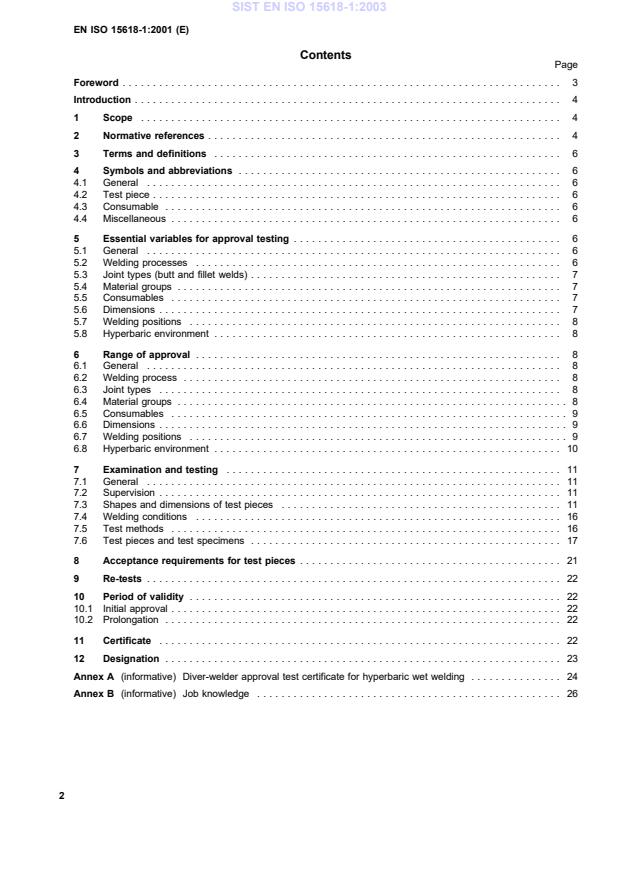
Contents
Page
Foreword . 3
Introduction . 4
1 Scope . 4
2 Normative references . 4
3 Terms and definitions . 6
4 Symbols and abbreviations . 6
4.1 General . 6
4.2 Test piece . 6
4.3 Consumable . 6
4.4 Miscellaneous . 6
5 Essential variables for approval testing . 6
5.1 General . 6
5.2 Welding processes . 6
5.3 Joint types (butt and fillet welds) . 7
5.4 Material groups . 7
5.5 Consumables . 7
5.6 Dimensions . 7
5.7 Welding positions . 8
5.8 Hyperbaric environment . 8
6 Range of approval . 8
6.1 General . 8
6.2 Welding process . 8
6.3 Joint types . 8
6.4 Material groups . 8
6.5 Consumables . 9
6.6 Dimensions . 9
6.7 Welding positions . 9
6.8 Hyperbaric environment . 10
7 Examination and testing . 11
7.1 General . 11
7.2 Supervi si on . 11
7.3 Shapes and dimensions of test pieces . 11
7.4 Welding conditions . 16
7.5 Test methods . 16
7.6 Test pieces and test specimens . 17
8 Acceptance requirements for test pieces . 21
9 Re-tests . 22
10 Period of validity . 22
10.1 Initial approval . 22
10.2 Prol ongati on . 22
11 Certificate . 22
12 Designation . 23
Annex A (informative) Diver-welder approval test certificate for hyperbaric wet welding . 24
Annex B (informative) Job knowledge . 26
Foreword
The text of EN ISO 15618-1:2001 has been prepared by Technical Committee CEN/TC 121 "Welding", the
secretariat of which is held by DS, in collaboration with Technical Committee ISO/TC 44 "Welding and allied
processes".
This European Standard shall be given the status of a national standard, either by publication of an identical text or
by endorsement, at the latest by June 2002, and conflicting national standards shall be withdrawn at the latest by
June 2002.
According to the CEN/CENELEC Internal Regulations, the national standards organizations of the following
countries are bound to implement this European Standard: Austria, Belgium, Czech Republic, Denmark, Finland,
France, Germany, Greece, Iceland, Ireland, Italy, Luxembourg, Netherlands, Norway, Portugal, Spain, Sweden,
Switzerland and the United Kingdom.
Introduction
This standard covers the principles to be observed in the approval testing of diver-welder performance for the fusion
welding of steels in a hyperbaric wet environment.
The ability of the diver-welder to follow verbal or written instructions and testing of his skill are therefore important
factors in ensuring the quality of the welded product.
Testing of skill to this standard depends on welding methods in which uniform rules and test conditions are complied
with, and standard test pieces are used.
This standard is intended to provide the basis for the mutual recognition by examining bodies for approval relating
to the diver-welder's competence in the various fields of application. Tests should be carried out in accordance with
this standard unless additional tests are specified by the relevant application standard when these should be applied.
The test weld can be used to approve a welding procedure and the diver-welder provided that all the relevant
requirements, e.g. test piece dimensions, are satisfied.
The diver-welder's skill and job knowledge continue to be approved only if the diver-welder is working with
reasonable continuity on welding work within the extent of approval.
1 Scope
This standard applies to welding processes where the skill of the diver-welder has a significant influence on weld
quality.
This standard specifies essential requirements, ranges of approval, test conditions, acceptance requirements and
certification for the approval testing of diver-welder performance for the welding of steels underwater in hyperbaric
wet environment. The recommended format for the certificate of approval testing is given in Annex A.
During the approval test the diver-welder should be required to show adequate practical experience and job
knowledge (test non mandatory) of the welding processes, materials and safety requirements for which he is to be
approved, information on these aspects is given in Annex B.
This standard is applicable when the diver-welder's testing is required by the purchaser, by inspection authorities or
by other organisations.
The welding processes referred to in this standard include those fusion welding processes which are designated as
manual or partly mechanised welding. It does not cover fully mechanised and fully automatic processes (see 5.2).
All new approvals should be in accordance with this standard from the date of this issue.
However, this standard does not invalidate previous diver-welder approvals made to former national standards or
specifications, providing the intent of the technical requirements is satisfied and the previous approvals are relevant
to the application and production work on which they are employed.
Also, where additional tests should be carried out to make the approval technically equivalent it is only necessary
to do the additional tests on a test piece which should be made in accordance with this standard. Consideration of
previous approvals to national standards or specifications should be at the time of the enquiry/contract stage and
agreed between the contracting parties.
The certificate of approval testing is issued under the sole responsibility of the examiner or examining body.
2 Normative references
This European Standard incorporates by dated or undated reference, provisions from other publications. These
normative references are cited at the appropriate places in the text and the publications are listed hereafter. For
dated references, subsequent amendments to or revisions of any of these publications apply to this European
Standard only when incorporated in it by amendment or revision. For undated references the latest edition of the
publication referred to applies (including amendments).
EN 288-1
Specification and approval of welding procedures for metallic materials – Part 1: General rules for fusion welding
EN 288-2
Specification and approval of welding procedures for metallic materials – Part 2: Welding procedure specification
for arc welding
EN 499
Welding consumables – Covered electrodes for manual metal arc welding of non alloy and fine grain steels –
Classification
EN 571-1
Non destructive testing – Penetrant testing – Part 1: General principles
EN 910
Destructive tests on welds in metallic materials – Bend tests
EN 970
Non-destructive examination of fusion welds – Visual examination
EN 1290
Non-destructive examination of welds – Magnetic particles examination of welds
EN 1320
Destructive tests on welds in metallic materials – Fracture test
EN 1321
Destructive tests on welds in metallic materials – Macroscopic and microscopic examination of welds
EN 1435
Non-destructive examination of welds – Radiographic examination of welded joints
EN 1714
Non destructive examination of welds – Ultrasonic examination of welded joints
EN ISO 4063
Welding and allied processes – Nomenclature of processes and reference numbers (ISO 4063:1998)
prEN ISO 5817
Welding – Fusion-welded joints in steel, nickel, titanium and their alloys (beam welding excluded) – Quality levels
for imperfections (ISO/DIS 5817:2000)
EN ISO 6520-1
Welding and allied processes – Classification of geometric imperfections in metallic materials – Part 1: Fusion
welding (ISO 6520:1998)
EN ISO 6947
Welds – Working positions – Definitions of angles of slope and rotation (ISO 6947:1993)
CR ISO 15608
Welding – Guidelines for a metallic material grouping system (ISO/TR 15608:2000)
ISO 857-1
Welding and allied processes – Vocabulary – Part 1: Metal welding processes
3 Terms and definitions
For the purposes of this standard, the following terms and definitions and the definitions in EN 288-1 apply.
3.1
diver-welder
a person who performs the welding under hyperbaric conditions
3.2
hyperbaric wet welding
the process of welding in a hyperbaric wet environment at an elevated pressure with no mechanical barrier around
the arc and with the diver-welder working directly in the water
4 Symbols and abbreviations
4.1 General
Where the full wording is not used, the following symbols and abbreviations shall be used when completing the test
certificate (see annex A).
4.2 Test piece
a nominal throat thickness
BW butt weld
D outside diameter of the smaller pipe
FW fillet weld
Pplate
t plate or pipe wall thickness
Tpipe
z leg length of fillet weld
4.3 Consumable
R rutile covering
RR rutile thick covering
RB rutile basic covering
fc flux cored
mc metal cored
4.4 Miscellaneous
bs welding from both sides
gg back gouging or back grinding of welds
mb welding with backing material
ss single-side welding
wd water depth
sa salt water
fr fresh water
5 Essential variables for approval testing
5.1 General
The criteria specified in this clause shall be examined in order to identify the ability of the diver-welder in these
areas. Each criterion is considered to be a significant factor in the approval testing.
The diver-welder approval test shall be carried out on test pieces and is independent of the type of construction.
5.2 Welding processes
Welding processes are defined in ISO 857-1 and reference numbers of welding processes for symbolic representa-
tion are listed in EN ISO 4063.
This standard covers the following welding processes applicable in hyperbaric wet environment.
111 manual metal arc welding (metal arc welding with covered electrode);
114 self-shielded tubular-cored arc welding;
136 tubular cored metal arc welding with active gas shield;
137 tubular cored metal arc welding with inert gas shield.
Other fusion welding processes by agreement.
5.3 Joint types (butt and fillet welds)
Test pieces shall be produced for butt weld (BW) and fillet weld (FW) in plates (P) or pipes ) (T) for approval tests
in accordance with 7.3.
5.4 Material groups
The designation of steel groups of material as defined in CR ISO 15608 shall apply.
This standard applies to the following material groups according to CR ISO 15608: 1 and 8.
In general, diver-welder's approval test shall involve depositing weld metal having a chemical composition compatible
with any of the steels in the parent metal group(s).
When the filler metal is dissimilar to the parent metal group, an approval for that combination of parent metal group
and filler metal is needed.
5.5 Consumables
5.5.1 General
It is assumed that in most approval tests the filler metal will be similar to the parent metal. When a diver-welder's
test has been carried out using a filler metal, shielding gas or flux suitable for a certain material group, this test will
only confer approval on the diver-welder to use those consumables (filler metal, shielding gas or flux) for other
materials from the same material group.
5.5.2 Metal-arc welding with covered electrodes
Covered electrode groups are classified with respect to the most important characteristics according to EN 499 as
given in 4.3. In the case of hyperbaric wet welding only three of these classifications are applicable. These are
– R rutile covering;
– RR rutile thick covering;
– RB rutile basic covering.
NOTE The covered electrodes for wet application are specially designed electrodes with an additional water
protective coating adjusted according to the composition of the alloying elements of the core wire and the flux.
For flux cored arc welding in wet environment special designed wire electrodes are applied. These are of the
seamless or the folded type. The internal flux is covered and protected against excessive moisture penetration
by the surrounding metal.
5.6 Dimensions
The diver-welder approval test shall be based on the thickness of the material (i.e. plate thickness or wall thickness
of pipe) and pipe diameters which the diver-welder will use in production. A range of approval is listed for each of
the ranges of plate thickness and pipe wall thickness or pipe diameter as specified in tables 1 and 2.
It is not intended that thicknesses or diameters should be measured precisely but rather the general philosophy
behind the values given in tables 1 and 2 should be applied.
) The word "pipe", alone or in combination, is used to mean "pipe", "tube" or "hollow section".
Table 1 - Test piece thickness (plate or pipe) and range of approval
Test piece thickness t
Range of approval
mm
t £ 6‡ t (max. 6 mm)
t > 6 0,5 t to 2 t (min. 6 mm)
Table 2 - Test piece diameter and range of approval
a
Test piece diameter D
Range of approval
mm
D £ 100 0,7 D to 2 D
100 < D £ 300 0,5 D to 2 D (min. 75 mm)
D > 300 > 0,5 D
a
For structural hollow sections "D" is the dimension of the
smallest side.
5.7 Welding positions
The welding positions shall be taken from EN ISO 6947.
The positions PF and H-L045 are exclusively used for process 114, 136 and 137 (see table 4).
5.8 Hyperbaric environment
The diver-welder approval test shall be carried out under actual or simulated hyperbaric conditions, taking into
account:
– diving depth;
– visibility;
– water temperature;
– salinity.
6 Range of approval
6.1 General
As a general rule, the test piece approves the diver-welder not only for the conditions used in the test, but also for
all joints which are considered easier to weld. The range of approval for each type of test is given in the relevant
subclauses and tables. In these tables the range of approval is indicated in the same horizontal line.
6.2 Welding process
Each test approves one welding process. A change of welding process requires a new approval test. However, it is
possible for a diver-welder to be approved for more than one welding process by a single test or by several approval
tests to be used to cover a multi-process joint.
6.3 Joint types
Depending on the test piece, the range of welds for which the diver-welder is approved is shown in table 3; the
following additional criteria are applicable:
a) approval for welds in plates in all relevant positions covers welds on pipes having an outside diameter
‡ 600 mm;
b) in cases where the production work is predominantly fillet welding, it is recommended that the diver-welder
should be approved also by an appropriate fillet welding test, i.e. on plate, pipe or branch connection;
c) approval of welding from both sides without gouging covers welds from one side with backing and welds from
both sides with gouging;
d) in cases where the production work is either predominantly branch welding or involves a complex branch
connection, it is recommended that the diver-welder should receive special training. In some cases a diver-welder
approval test on a branch connection including any restricted access may be necessary.
Table 3 - Range of approval for tests (Details of weld type)
Range of approval
Butt welds Lap welds Fillet welds
welded from welded from
one side both sides
Details of weld type
(ss) (bs)
with
with backing
gouging plate pipe plate pipe
(mb)
(gg)
welded with
a a
from one backing x x x x x x
side (ss) (mb)
Butt welds
welded with
a a
from both gouging x x x x x x
sides (bs) (gg)
Lap welds
a a
plate – – x x x x
pipe – – x x x x
plate
a
Fillet
– – – – x x
welds
pipe
– – – – x x
a
See 6.3 a)
Key
x indicates those welds for which the welder is approved
– indicates for what the diver welder is not approved
6.4 Material groups
According to the material group of the test piece, specified in 5.4, the diver-welder is only approved for this special
material group. For any steel not covered the diver-welder shall carry out an approval test, which only approves for
that steel.
6.5 Consumables
It is not permitted to:
– change the standard or commercial designation of the electrodes and waterprotective coating;
– add or omit the waterprotective coating;
– change the nominal electrode diameter;
– change the nominal composition of the shielding gas.
6.6 Dimensions
The range of approval according to plate thickness or wall thickness of pipe and/or pipe diameter is shown in
tables 1 and 2.
6.7 Welding positions
The range of approval for each welding position is given in table 4. The welding positions and codes refer to
EN ISO 6947.
Table 4 - Range of approval according to welding position
Range of approval
Plate Pipe
Welding position of Butt welds Fillet welds Lap welds Fillet welds
test piece
PA PC PG PF PE PA PB PG PF PD PB PD PG PF H-L045 J-L045 PB PG PF PD
c c a c c a,b a c a,d
PA x – – – – x x – – – – – – – – – x – – –
PC x x – – – x x – – – – – – – – – x – – –
Butt
PG – – x – – – – x – – – – – – – – – x – –
welds
c
PF x – – x – x x – x – – – – – – – x – x –
P
L
PE x x – – x x x – – x – – – – – – x – – x
A
T
PA – – – – – x – – – – – – – – – – – – – –
E
S
PB – – – – – x x – – – – – – – – – x – – –
Fillet
PG – – – – – – – x – – – – – – – – – x – –
welds
c
PF – – – – – x x – x – – – – – – – x – – –
d
PD – – – – – x x – – x – – – – – – x – – x
PB – – – – – x x – – – x – – – – – x – – –
PD – – – – – x x – – x x x – – – – x – – x
a
PG – – – – – – – x – – – – x – – – – x – –
Lap
welds 3
PF – – – – – x x – x – x – – x – – x – x –
P
c
H
...