


prEN ISO 80079-38
(Main)Explosive atmospheres - Part 38: Equipment and components in explosive atmospheres in underground mines (ISO/IEC DIS 80079-38:2025)
Explosive atmospheres - Part 38: Equipment and components in explosive atmospheres in underground mines (ISO/IEC DIS 80079-38:2025)
ISO/IEC 80079-38:2016 is published as a dual logo standard and specifies the explosion protection requirements for the design, construction, assessment and information for use (maintenance, repair, marking) of equipment that may be an individual item or form an assembly. This includes machinery and components for use in mines susceptible to explosive atmospheres of firedamp and/or combustible dust. The standard atmospheric conditions (relating to the explosion characteristics of the atmosphere) under which it may be assumed that equipment can be operated are: - temperature -20 °C to 60 °C; - pressure 80 kPa (0,8 bar) to 110 kPa (1,1 bar); - and air with normal oxygen content, typically 21 % v/v. This part of ISO/IEC 80079 applies for equipment and components according to EPL Mb to be used in explosive atmospheres containing firedamp and/or combustible dust. For equipment and components according to EPL Ma, the requirements of this standard and of ISO 80079-36 and IEC 60079-0 apply. It is necessary to take account of external conditions to the equipment which may affect the hazard and the resultant protection measures. These measures may include ventilation, gas detection or gas drainage. This part of ISO/IEC 80079 also deals with the prevention of ignitions of explosive atmospheres caused by burning (or smouldering) of combustible material such as fabric fibres, plastic "O"-rings, rubber seals, lubricating oils or greases used in the construction of the equipment if such items could be an ignition source. For example, the mechanical failure of rotating shaft bearings can result in frictional heating that ignites its plastic cage, plastic seal or lubricating grease. Detailed requirements and test procedures for the fire protection of conveyer belts are not part of this part of ISO/IEC 80079. Keywords: explosive atmospheres in underground mines, combustible dust
Explosionsfähige Atmosphären - Teil 38: Geräte und Komponenten in explosionsfähigen Atmosphären in untertägigen Bergwerken (ISO/IEC DIS 80079-38:2025)
Atmosphères explosives - Partie 38: Appareils et composants destinés à être utilisés dans les mines souterraines grisouteuses (ISO/IEC DIS 80079-38:2025)
ISO/IEC 80079-38:2016 est publiée en tant que norme sous double logo et spécifie les exigences relatives aux techniques de protection contre l'explosion au niveau de la conception, de la construction, de l'évaluation et des informations sur l'utilisation (maintenance, réparation et marquage) des appareils qui peuvent être des éléments individuels ou faire partie d'un assemblage. Ces appareils comprennent les machines et les composants prévus pour être utilisés dans les mines pouvant présenter des risques liés au grisou et/ou poussières combustibles. Les conditions atmosphériques normales (relatives aux caractéristiques de l'explosion de l'atmosphère), selon lesquelles il peut être pris pour hypothèse que les appareils peuvent fonctionner, sont les suivantes: - température de -20 °C à 60 °C; - pression de 80 kPa (0,8 bar) à 110 kPa (1,1 bar); - et air à teneur normale en oxygène, généralement, typiquement 21 % v/v. La présente partie de l'ISO/IEC 80079 s'applique aux appareils et aux composants selon EPL Mb destinés à être utilisés en atmosphères explosives contenant le grisou et/ou les poussières combustibles. Les exigences de la présente norme, de l'ISO 80079-36 et de l'IEC 60079-0 s'appliquent aux appareils et aux composants selon EPL Ma. Les conditions externes doivent être prises en considération pour les appareils qui peuvent affecter les dangers et les mesures de protection qui en résultent. Ces mesures peuvent inclure la ventilation, la détection de gaz et le captage de gaz. La présente partie de l'ISO/IEC 80079 traite également de la prévention des inflammations des atmosphères explosives provoquées par la combustion (ou le feu couvant) de matériaux combustibles tels que les fibres textiles, les joints toriques en matières synthétiques, les joints d'étanchéité en caoutchouc, les huiles et graisses de lubrification qui sont nécessaires à l'appareil lorsque ces éléments pourraient représenter une source d'inflammation. L'échauffement provoqué par friction par exemple en raison d'une défaillance d'ordre mécanique ou du palier d'arbre peut enflammer la cage en plastique, le joint en plastique lui-même ou le lubrifiant. Les exigences détaillées et les procédures d'essai pour la protection contre l'incendie des courroies transporteuses ne font pas partie de la présente partie de l'ISO/IEC 80079. Mots clés: utilisés dans les mines souterraines grisouteuses, poussières combustibles
Eksplozivne atmosfere - 38. del: Oprema in komponente, namenjene za uporabo v eksplozivnih atmosferah v podzemnih rudnikih (ISO/IEC DIS 80079-38:2025)
General Information
- Status
- Not Published
- Publication Date
- 28-Sep-2026
- Technical Committee
- CEN/TC 305 - Potentially explosive atmospheres - Explosion prevention and protection
- Drafting Committee
- CEN/TC 305/WG 5 - Equipment and protection systems for mining
- Current Stage
- 4060 - Closure of enquiry - Enquiry
- Start Date
- 23-May-2025
- Completion Date
- 23-May-2025
Relations
- Effective Date
- 05-Jun-2024
- Effective Date
- 05-Jun-2024
Overview
The prEN ISO 80079-38:2025 standard titled "Explosive atmospheres - Part 38: Equipment and components in explosive atmospheres in underground mines" is developed by CEN in collaboration with the International Electrotechnical Commission (IEC). This standard specifically targets the explosion protection requirements for equipment and components used in underground mining environments where explosive atmospheres containing firedamp and combustible dust exist.
The document focuses on the design, construction, testing, maintenance, repair, and marking of machinery and components intended for potentially explosive underground mine atmospheres. It covers equipment rated with Equipment Protection Levels (EPL) Mb and Ma, addressing various safety and operational parameters under defined atmospheric conditions, including temperatures from -20 °C to 60 °C, pressure between 80 kPa to 110 kPa, and normal ambient oxygen content of about 21% v/v.
Key Topics
Explosion Protection Requirements
The standard outlines comprehensive safety requirements for both electrical and non-electrical equipment intended for use in explosive atmospheres underground. This includes ignition hazard assessment, over-current and earth-fault protective measures, mechanical protection, and proper handling of electric cables integrated into the equipment.Equipment Types Covered
Specific attention is given to mining machines such as cutting and stripping equipment, rope haulages, fans (both ventilation and other types), internal combustion engines, air compressors, brakes, traction batteries, and equipment using optical, electromagnetic, or ultrasonic energy.Ignition Source Prevention
The standard addresses potential ignition sources such as smouldering or burning of combustible materials like plastic seals, lubricating greases, or fabric fibers used in equipment. Measures to prevent frictional heating, mechanical failures, and other ignition risks are discussed in detail.Fire Protection Measures
Guidance on selecting fire-resistant fluids for hydraulic and pneumatic systems, fire prevention in cable-reeling equipment, and fire safety related to electric cables integral to mining machines is provided. However, fire protection of conveyor belts is excluded from this part.Marking and Information for Use
Requirements for clear marking, maintenance instructions, and warnings are included to ensure safe operation and upkeep of equipment in explosive atmospheres.
Applications
This standard is applicable in underground mining operations where explosive atmospheres are common due to the presence of firedamp (methane gas) or combustible dust. It is critical for manufacturers, safety engineers, equipment design specialists, and compliance officials involved in:
- Designing and constructing mining machinery and components that must operate safely in hazardous environments.
- Conducting ignition hazard assessments and implementing explosion protection measures.
- Ensuring compliance with international safety regulations to minimize risks of explosion or fire in mines.
- Guiding maintenance and repair operations with appropriate marking and documentation to maintain equipment integrity over time.
- Enhancing operational safety by integrating protection techniques such as ventilation, gas monitoring, and gas drainage systems.
The standard provides a robust framework for the safe use and certification of equipment under strict atmospheric and operational conditions prevalent in underground mines worldwide.
Related Standards
To complement prEN ISO 80079-38:2025, the following related standards should be considered for comprehensive explosion protection compliance:
- ISO/IEC 80079-36: Deals with non-electrical equipment in explosive atmospheres and safety requirements for use in more hazardous zones (EPL Ma requirements).
- IEC 60079-0: Provides general requirements for electrical equipment used in explosive atmospheres.
- ISO/IEC 80079 Series: Comprehensive standards for equipment and protective systems intended for explosive atmospheres covering design, testing, and marking guidelines.
Integration of these standards ensures a holistic approach to safety management and regulatory adherence in the mining industry.
Keywords: explosive atmospheres in underground mines, combustible dust, firedamp, explosion protection, mining machine safety, ignition hazard assessment, EPL Mb, EPL Ma, fire protection in mines, mining equipment standards, IEC 80079-38.

Get Certified
Connect with accredited certification bodies for this standard

Intertek Testing Services NA Inc.
Intertek certification services in North America.

UL Solutions
Global safety science company with testing, inspection and certification.

ANCE
Mexican certification and testing association.
Sponsored listings
Frequently Asked Questions
prEN ISO 80079-38 is a draft published by the European Committee for Standardization (CEN). Its full title is "Explosive atmospheres - Part 38: Equipment and components in explosive atmospheres in underground mines (ISO/IEC DIS 80079-38:2025)". This standard covers: ISO/IEC 80079-38:2016 is published as a dual logo standard and specifies the explosion protection requirements for the design, construction, assessment and information for use (maintenance, repair, marking) of equipment that may be an individual item or form an assembly. This includes machinery and components for use in mines susceptible to explosive atmospheres of firedamp and/or combustible dust. The standard atmospheric conditions (relating to the explosion characteristics of the atmosphere) under which it may be assumed that equipment can be operated are: - temperature -20 °C to 60 °C; - pressure 80 kPa (0,8 bar) to 110 kPa (1,1 bar); - and air with normal oxygen content, typically 21 % v/v. This part of ISO/IEC 80079 applies for equipment and components according to EPL Mb to be used in explosive atmospheres containing firedamp and/or combustible dust. For equipment and components according to EPL Ma, the requirements of this standard and of ISO 80079-36 and IEC 60079-0 apply. It is necessary to take account of external conditions to the equipment which may affect the hazard and the resultant protection measures. These measures may include ventilation, gas detection or gas drainage. This part of ISO/IEC 80079 also deals with the prevention of ignitions of explosive atmospheres caused by burning (or smouldering) of combustible material such as fabric fibres, plastic "O"-rings, rubber seals, lubricating oils or greases used in the construction of the equipment if such items could be an ignition source. For example, the mechanical failure of rotating shaft bearings can result in frictional heating that ignites its plastic cage, plastic seal or lubricating grease. Detailed requirements and test procedures for the fire protection of conveyer belts are not part of this part of ISO/IEC 80079. Keywords: explosive atmospheres in underground mines, combustible dust
ISO/IEC 80079-38:2016 is published as a dual logo standard and specifies the explosion protection requirements for the design, construction, assessment and information for use (maintenance, repair, marking) of equipment that may be an individual item or form an assembly. This includes machinery and components for use in mines susceptible to explosive atmospheres of firedamp and/or combustible dust. The standard atmospheric conditions (relating to the explosion characteristics of the atmosphere) under which it may be assumed that equipment can be operated are: - temperature -20 °C to 60 °C; - pressure 80 kPa (0,8 bar) to 110 kPa (1,1 bar); - and air with normal oxygen content, typically 21 % v/v. This part of ISO/IEC 80079 applies for equipment and components according to EPL Mb to be used in explosive atmospheres containing firedamp and/or combustible dust. For equipment and components according to EPL Ma, the requirements of this standard and of ISO 80079-36 and IEC 60079-0 apply. It is necessary to take account of external conditions to the equipment which may affect the hazard and the resultant protection measures. These measures may include ventilation, gas detection or gas drainage. This part of ISO/IEC 80079 also deals with the prevention of ignitions of explosive atmospheres caused by burning (or smouldering) of combustible material such as fabric fibres, plastic "O"-rings, rubber seals, lubricating oils or greases used in the construction of the equipment if such items could be an ignition source. For example, the mechanical failure of rotating shaft bearings can result in frictional heating that ignites its plastic cage, plastic seal or lubricating grease. Detailed requirements and test procedures for the fire protection of conveyer belts are not part of this part of ISO/IEC 80079. Keywords: explosive atmospheres in underground mines, combustible dust
prEN ISO 80079-38 is classified under the following ICS (International Classification for Standards) categories: 29.260.20 - Electrical apparatus for explosive atmospheres; 73.100.30 - Equipment for drilling and mine excavation. The ICS classification helps identify the subject area and facilitates finding related standards.
prEN ISO 80079-38 has the following relationships with other standards: It is inter standard links to EN ISO/IEC 80079-38:2016/A1:2018, EN ISO/IEC 80079-38:2016. Understanding these relationships helps ensure you are using the most current and applicable version of the standard.
prEN ISO 80079-38 is associated with the following European legislation: EU Directives/Regulations: 2014/34/EU, 2023/1230; Standardization Mandates: M/596, M/605. When a standard is cited in the Official Journal of the European Union, products manufactured in conformity with it benefit from a presumption of conformity with the essential requirements of the corresponding EU directive or regulation.
prEN ISO 80079-38 is available in PDF format for immediate download after purchase. The document can be added to your cart and obtained through the secure checkout process. Digital delivery ensures instant access to the complete standard document.
Standards Content (Sample)
SLOVENSKI STANDARD
01-maj-2025
Eksplozivne atmosfere - 38. del: Oprema in komponente, namenjene za uporabo v
eksplozivnih atmosferah v podzemnih rudnikih (ISO/IEC DIS 80079-38:2025)
Explosive atmospheres - Part 38: Equipment and components in explosive atmospheres
in underground mines (ISO/IEC DIS 80079-38:2025)
Explosionsfähige Atmosphären - Teil 38: Geräte und Komponenten in explosionsfähigen
Atmosphären in untertägigen Bergwerken (ISO/IEC DIS 80079-38:2025)
Atmosphères explosives - Partie 38: Appareils et composants destinés à être utilisés
dans les mines souterraines grisouteuses (ISO/IEC DIS 80079-38:2025)
Ta slovenski standard je istoveten z: prEN ISO 80079-38
ICS:
29.260.20 Električni aparati za Electrical apparatus for
eksplozivna ozračja explosive atmospheres
73.100.30 Oprema za vrtanje in Equipment for drilling and
izkopavanje mine excavation
2003-01.Slovenski inštitut za standardizacijo. Razmnoževanje celote ali delov tega standarda ni dovoljeno.
31M/246/CDV
COMMITTEE DRAFT FOR VOTE (CDV)
PROJECT NUMBER:
ISO/IEC 80079-38 ED2
DATE OF CIRCULATION: CLOSING DATE FOR VOTING:
2025-02-28 2025-05-23
SUPERSEDES DOCUMENTS:
31M/211/CD, 31M/219A/CC
IEC SC 31M : NON-ELECTRICAL EQUIPMENT AND PROTECTIVE SYSTEMS FOR EXPLOSIVE ATMOSPHERES
SECRETARIAT: SECRETARY:
Germany Mrs Anke Sachtleben
OF INTEREST TO THE FOLLOWING COMMITTEES: HORIZONTAL FUNCTION(S):
TC 31,SC 31G,SC 31J
ASPECTS CONCERNED:
SAFETY
SUBMITTED FOR CENELEC PARALLEL VOTING NOT SUBMITTED FOR CENELEC PARALLEL VOTING
This document is still under study and subject to change. It should not be used for reference purposes.
Recipients of this document are invited to submit, with their comments, notification of any relevant patent rights of which t hey
are aware and to provide supporting documentation.
Recipients of this document are invited to submit, with their comments, notification of any relevant “In Some Countries” clau ses
to be included should this proposal proceed. Recipients are reminded that the CDV stage is the final stage for submitting ISC
clauses. (SEE AC/22/2007 OR NEW GUIDANCE DOC).
TITLE:
Explosive atmospheres - Part 38: Equipment and components in explosive atmospheres in underground
mines
PROPOSED STABILITY DATE: 2027
NOTE FROM TC/SC OFFICERS:
electronic file, to make a copy and to print out the content for the sole purpose of preparing National Committee positions.
You may not copy or "mirror" the file or printed version of the document, or any part of it, for any other purpose without
permission in writing from IEC.
31M/246/CDV 2 ISO/IEC 80079-38 ED2 © ISO/IEC 2024
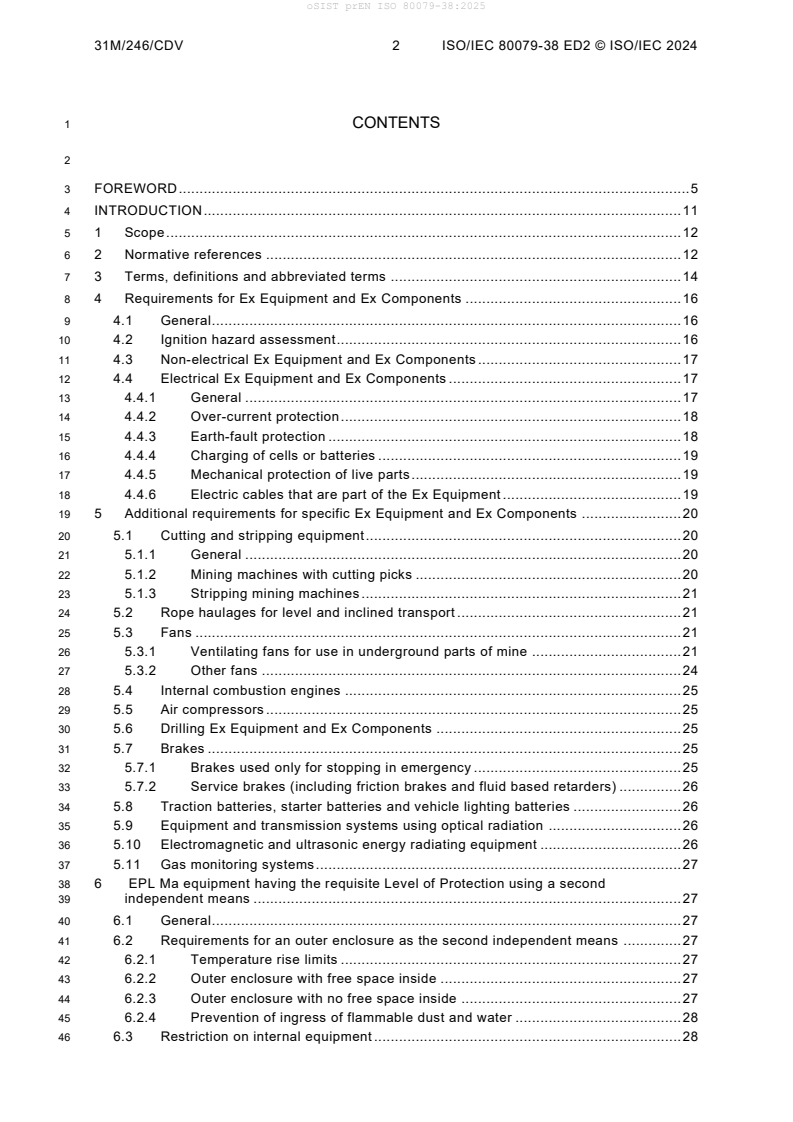
1 CONTENTS
3 FOREWORD . 5
4 INTRODUCTION . 11
5 1 Scope . 12
6 2 Normative references . 12
7 3 Terms, definitions and abbreviated terms . 14
8 4 Requirements for Ex Equipment and Ex Components . 16
9 4.1 General . 16
10 4.2 Ignition hazard assessment. 16
11 4.3 Non-electrical Ex Equipment and Ex Components . 17
12 4.4 Electrical Ex Equipment and Ex Components . 17
13 4.4.1 General . 17
14 4.4.2 Over-current protection . 18
15 4.4.3 Earth-fault protection . 18
16 4.4.4 Charging of cells or batteries . 19
17 4.4.5 Mechanical protection of live parts . 19
18 4.4.6 Electric cables that are part of the Ex Equipment . 19
19 5 Additional requirements for specific Ex Equipment and Ex Components . 20
20 5.1 Cutting and stripping equipment . 20
21 5.1.1 General . 20
22 5.1.2 Mining machines with cutting picks . 20
23 5.1.3 Stripping mining machines . 21
24 5.2 Rope haulages for level and inclined transport . 21
25 5.3 Fans . 21
26 5.3.1 Ventilating fans for use in underground parts of mine . 21
27 5.3.2 Other fans . 24
28 5.4 Internal combustion engines . 25
29 5.5 Air compressors . 25
30 5.6 Drilling Ex Equipment and Ex Components . 25
31 5.7 Brakes . 25
32 5.7.1 Brakes used only for stopping in emergency . 25
33 5.7.2 Service brakes (including friction brakes and fluid based retarders) . 26
34 5.8 Traction batteries, starter batteries and vehicle lighting batteries . 26
35 5.9 Equipment and transmission systems using optical radiation . 26
36 5.10 Electromagnetic and ultrasonic energy radiating equipment . 26
37 5.11 Gas monitoring systems . 27
38 6 EPL Ma equipment having the requisite Level of Protection using a second
39 independent means . 27
40 6.1 General . 27
41 6.2 Requirements for an outer enclosure as the second independent means . 27
42 6.2.1 Temperature rise limits . 27
43 6.2.2 Outer enclosure with free space inside . 27
44 6.2.3 Outer enclosure with no free space inside . 27
45 6.2.4 Prevention of ingress of flammable dust and water . 28
46 6.3 Restriction on internal equipment . 28
ISO/IEC 80079-38 ED2 © ISO/IEC 2024 3 31M/246/CDV
47 6.4 Additional type testing for equipment meeting the requisite level of
48 protection by a second independent means . 28
49 6.5 Examples of EPL Ma Equipment having two forms of protection listed in 6.3 . 29
50 7 Fire protection . 31
51 7.1 General . 31
52 7.2 Non-metallic materials . 31
53 7.3 Hydraulic and pneumatic equipment. 31
54 7.3.1 General . 31
55 7.3.2 Fire resistant fluids . 32
56 7.4 Cable-reeling equipment . 32
57 7.5 Fire prevention on electric cables that are part of the mining machine . 33
58 8 Information for use . 33
59 8.1 Signals and warning notices . 33
60 8.2 Instructions . 33
61 8.2.1 Information on use . 33
62 8.2.2 Information on maintenance and repair . 33
63 9 Marking . 34
64 Annex A (informative) Example of an ignition hazard assessment for a shearer
65 intended for use in an explosive atmosphere of a coal mine . 35
66 A.1 General . 35
67 A.2 EPL and intended use of equipment . 35
68 A.3 Construction/description of the equipment with regard to ignition protection . 35
69 A.4 Ignition control and monitoring system . 36
70 A.5 Compliance with the basic methodology and requirements in IEC 60079-0
71 and ISO 80079-36 . 36
72 A.6 Ignition hazard assessment of the electrical parts of the equipment . 37
73 A.7 Ignition hazard assessment of non-electrical ignition sources . 37
74 A.8 Equipment marking . 37
75 Annex B (informative) Additional guidance . 41
76 B.1 Establishing maximum service temperature . 41
77 B.2 Dust deposits and other material in the gap of moving parts . 41
78 B.3 Short-circuit protection . 41
79 B.4 Earth-fault protection . 41
80 B.5 Electric cables that are part of the equipment . 41
81 B.6 Cutting and stripping equipment . 42
82 B.7 Cable-reeled equipment . 42
83 Bibliography . 43
85 Figure 1 – EPL Ma encapsulation “mb” or powder filling “q” equipment inside a
86 flameproof enclosure “db” or pressurized enclosure “pxb” enclosure with optional
87 power supplies . 29
88 Figure 2 – EPL Ma increased safety “eb“ . 29
89 or intrinsically safe “ib” apparatus inside a flameproof “db” or a pressurized “pxb”
90 enclosure . 29
91 Figure 3 – EPL Ma constructional safety “c” inside a flameproof “db” or pressurized
92 “pxb” enclosure . 30
93 Figure 4 – EPL Ma intrinsically safe “ib” or increased safety “eb” apparatus inside an
94 enclosure with encapsulation “mb”, or powder filling “q” or “qb” . 30
95 Figure A.1 – Layout and construction of the coal face shearer . 36
31M/246/CDV 4 ISO/IEC 80079-38 ED2 © ISO/IEC 2024
97 Table 1 – Combination of materials . 24
98 Table 2 – Limit values for hydraulic fluids . 32
99 Table A.1 – Example of an ignition hazard assessment for a shearer, EPL Mb (1 of 3) . 38
ISO/IEC 80079-38 ED2 © ISO/IEC 2024 5 31M/246/CDV
102 INTERNATIONAL ELECTROTECHNICAL COMMISSION
103 ____________
105 EXPLOSIVE ATMOSPHERES –
107 Part 38: Equipment and components in explosive
108 atmospheres in underground mines
111 FOREWORD
112 1) The International Electrotechnical Commission (IEC) is a worldwide organization for standardization comprising
113 all national electrotechnical committees (IEC National Committees). The object of IEC is to promote international
114 co-operation on all questions concerning standardization in the electrical and electronic fields. To this end and
115 in addition to other activities, IEC publishes International Standards, Technical Specifications, Technical Reports,
116 Publicly Available Specifications (PAS) and Guides (hereafter referred to as “IEC Publication(s)”). Their
117 preparation is entrusted to technical committees; any IEC National Committee interested in the subject dealt with
118 may participate in this preparatory work. International, governmental and non-governmental organizations liaising
119 with the IEC also participate in this preparation. IEC collaborates closely with the International Organization for
120 Standardization (ISO) in accordance with conditions determined by agreement between the two organizations.
121 2) The formal decisions or agreements of IEC on technical matters express, as nearly as possible, an international
122 consensus of opinion on the relevant subjects since each technical committee has representation from all
123 interested IEC National Committees.
124 3) IEC Publications have the form of recommendations for international use and are accepted by IEC National
125 Committees in that sense. While all reasonable efforts are made to ensure that the technical content of IEC
126 Publications is accurate, IEC cannot be held responsible for the way in which they are used or for any
127 misinterpretation by any end user.
128 4) In order to promote international uniformity, IEC National Committees undertake to apply IEC Publications
129 transparently to the maximum extent possible in their national and regional publications. Any divergence between
130 any IEC Publication and the corresponding national or regional publication shall be clearly indicated in the latter.
131 5) IEC itself does not provide any attestation of conformity. Independent certification bodies provide conformity
132 assessment services and, in some areas, access to IEC marks of conformity. IEC is not responsible for any
133 services carried out by independent certification bodies.
134 6) All users should ensure that they have the latest edition of this publication.
135 7) No liability shall attach to IEC or its directors, employees, servants or agents including individual experts and
136 members of its technical committees and IEC National Committees for any personal injury, property damage or
137 other damage of any nature whatsoever, whether direct or indirect, or for costs (including legal fees) and
138 expenses arising out of the publication, use of, or reliance upon, this IEC Publication or any other IEC
139 Publications.
140 8) Attention is drawn to the Normative references cited in this publication. Use of the referenced publications is
141 indispensable for the correct application of this publication.
142 9) Attention is drawn to the possibility that some of the elements of this IEC Publication may be the subject of patent
143 rights. IEC shall not be held responsible for identifying any or all such patent rights.
144 ISO/IEC 80079-38 has been prepared by subcommittee 31M: Non-electrical equipment and
145 protective systems for explosive atmospheres, of IEC technical committee 31: Equipment for
146 explosive atmospheres.
147 It is published as a double logo standard.
148 This second edition cancels and replaces the first edition, published in 2016. This edition
149 constitutes a technical revision.
150 Users of this document are advised that interpretation sheets clarifying the interpretation of this
151 document can be published. Interpretation sheets are available from the IEC webstore and can
152 be found in the “history” tab of the page for each document.
153 The significance of changes between ISO/IEC Standard, ISO/IEC 80079-38, Edition 1, 2016-02
154 and ISO/IEC 80079-38, Edition 2, 20XX-XX is as listed below:
31M/246/CDV 6 ISO/IEC 80079-38 ED2 © ISO/IEC 2024
Type
Changes Clause Minor and Extension Major
editorial technical
changes changes
Throughout document where appropriate General X
changed “equipment” and “components” to
“Ex Equipment” and “Ex Components”.
Throughout the document “machine” General X
changed to “mining machine”.
Throughout the body of the document General C1
removed the use of “should” by, in most
cases, moving the clause to Annex C as
guidance.
Refences to “standard” changed to X
“document” where appropriate in General
accordance with ISO/IEC Directives.
Throughout the document changed “e.g.” to General X
“for example” in accordance with ISO/IEC
Directives.
Scope changed to cover “construction, 1 C2
testing and marking for use in Group I” from
“design, construction, assessment and
information for use (maintenance, repair,
marking)”. Hand tools are no longer
covered by the standard.
Note added to scope to clarify that Group I 1 X
takes account that coal dust may be
present with or without methane.
Note added to scope to clarify that Group I 1 X
also covers mines other than coal mines.
Note added to scope to clarify that 1 X
“assembly” is not identical to the meaning
in IEC 60079-46.
Scope expanded to cover Ma as well as 1 C3
Mb.
Change of definition of “firedamp” to align 3.1 X
with definition in IEC 60079-0.
Deletion of definition “protection against Former 3.2 X
firedamp explosions”
Change of definition of “flammable X
substance” to align with definition in IEC
60079-10-1.
Deletion of definition “component” Former 3.4 X
Change of definition of “equipment” to align X
with definition in IEC 60079-0.
Deletion of definition “explosion” Former 3.6 X
ISO/IEC 80079-38 ED2 © ISO/IEC 2024 7 31M/246/CDV
Type
Changes Clause Minor and Extension Major
editorial technical
changes changes
Deletion of definition “explosive Former 3.7 X
atmosphere”
Deletion of definition “intended use” Former 3.8 X
Change of definition of “machinery” to 3.7 X
“mining machinery” with added admitted
term of “mining machine”.
Deletion of definition “minimum ignition Former 3.11 X
energy”
Deletion of definition “potentially explosive Former 3.12 X
atmospheres”
Deletion of definition “self-ignition of dust Former 3.13 X
in bulk”
Change of definition of “Equipment 3.9 X
Protection Level” to align with definition in
IEC 60079-0.
Change of definition of “EPL Ma” to align 3.10 X
with definition in IEC 60079-0.
Change of definition of “EPL Mb” to align 3.113.13 X
with definition in IEC 60079-0.
Change of definition of “maximum surface 3.12 X
temperature to align with definition in IEC
60079-0.
Introduction of definition of “safety device” 3.15 X
from IEC TS 60079-42.
Definitions from IEC 60079-0 included for 3.3 and 3.5 X
“Ex Component” and “Ex Equipment”
Introduction of requirements regarding 4.1 X
Specific Conditions of Use
Rewording of requirements for ignition 4.24.2 X
hazard assessment including introduction
of a calling reference to Annex A,
Revision of requirements regarding 4.4.3 X
insulation faults to provide two options.
Introduction of requirements for 4.4.6.1 X
temperature rating of cables.
Rewording of requirements for ventilating 5.3.1 X
fans
Reference to standard under development 5.4 X
for internal combustion engines – ISO/IEC
80079-41
31M/246/CDV 8 ISO/IEC 80079-38 ED2 © ISO/IEC 2024
Type
Changes Clause Minor and Extension Major
editorial technical
changes changes
Reference to requirements in IEC 60079-0 5.8 X
for traction batteries, starter batteries and
vehicle lighting batteries.
Additional requirement for batteries not 5.8 X
complying with IEC 60079-11 ia Ma to
comply with IEC 60079-33 Ex sa Ma
Optical radiation requirements in standard 5.9 X
replaced with requirement to comply with
IEC 60079-28.
Electromagnetic and ultrasonic energy 5.10 X
radiating equipment requirements in
standard replaced with requirement to
comply with IEC 60079-0.
Gas monitoring now refers to IEC 60079- 5.11 C4
29-0 and does not include any other
requirements.
Note added to state that gas detector may 5.11 X
be required on mobile mining machines.
New section “EPL Ma equipment having the 6 C5
requisite Level of Protection using a
second independent means” has been
added.
Subsection headings added for General 7.3 X
and Fire resistant fluids
Requirements for conveyor belting deleted. Former 6.7 C6
Marking requirements revised including for 9 C7
Ma and Mb situations
Example of an ignition hazard assessment Former Annex C8
for a conveyor belt intended for use in a A
coal mine deleted as conveyor belts are no
longer part of the standard.
Deletion of annex on ignition sources as Former Annex C9
information is in ISO 80079-36 C
Deletion of Annex on Guidance on potential Former Annex C10
risks for converter-fed motors D
Tests for surface protective coating for Former Annex C11
Group I hand tools of EPL Mb deleted as E
hand tools are not part of this edition.
Inclusion of informative guidance material, Annex B C12
most of which was formerly in body of
standard.
Bibliography revised, in particular to move Bibliography X
documents from the reference section
ISO/IEC 80079-38 ED2 © ISO/IEC 2024 9 31M/246/CDV
Type
Changes Clause Minor and Extension Major
editorial technical
changes changes
where not referenced and to remove
documents not considered relevant.
157 NOTE: The technical changes referred to include the significance of technical changes in the revised IEC Standard,
158 but they do not form an exhaustive list of all modifications from the previous version. More guidance may be found
159 by referring to the Redline Version of the standard.
160 Explanations:
161 A) Definitions
162 Minor and editorial changes clarification
163 decrease of technical requirements
164 minor technical change
165 editorial corrections
167 These are changes which modify requirements in an editorial or a minor technical way. They
168 include changes of the wording to clarify technical requirements without any technical change,
169 or a reduction in level of existing requirement.
171 Extension addition of technical options
173 These are changes which add new or modify existing technical requirements, in a way that new
174 options are given, but without increasing requirements for equipment that was fully compliant
175 with the previous standard. Therefore, these will not have to be considered for products in
176 conformity with the preceding edition.
178 Major technical changes addition of technical requirements
179 increase of technical requirements
181 These are changes to technical requirements (addition, increase of the level or removal) made
182 in a way that a product in conformity with the preceding edition will not always be able to fulfil
183 the requirements given in the later edition. These changes have to be considered for products
184 in conformity with the preceding edition.
186 NOTE These changes represent current technological knowledge. However, these changes should not normally have
187 an influence on equipment already placed on the market.
188 B) Information about the background of Changes
189 C1 The body of the document has been changed to only mandatory text to make it more
190 suitable to use for conformity assessment.
191 C2 The scope was made clearer for the application and to remove hand tools from the scope.
192 C3 The scope was expanded to include Ma equipment as well as Mb equipment.
193 C4 The relevant standard for gas monitoring has changed from IEC 60079-29 to IEC 60079-
194 29-0 and hence the latest standard is referenced.
195 C5 The new section now provides requirements relevant to Ma.
31M/246/CDV 10 ISO/IEC 80079-38 ED2 © ISO/IEC 2024
196 C6 Conveyor belts are now longer part of the scope and so requirements were deleted.
197 C7 Marking updated to address both Ma and Mb with the introduction of Ma in the scope.
198 C8 See C6 regarding conveyor belts and hence example no longer relevant.
199 C9 The information on ignition sources is available in ISO 80079-36 and so there is no need
200 to duplicate the information here.
201 C10 There is no calling clause to this annex and the information is of a general nature not
202 specific to mines
203 C11 With hand tools now longer in the scope, this test is no longer needed.C12 Most of the
204 guidance material from the body of the previous edition of the standard is now in this annex.
205 The text of this document is based on the following documents:
FDIS Report on voting
31M/XX/FDIS 31M/XX/RVD
207 Full information on the voting for the approval of this document can be found in the report on
208 voting indicated in the above table. In ISO, the document has been approved by XX P members
209 out of XX having cast a vote.
210 This publication has been drafted in accordance with the ISO/IEC Directives, Part 2.
211 A list of all parts of the IEC 60079 series, under the general title Explosive atmospheres, as
212 well as the ISO/IEC 80079 series, can be found on the IEC website.
213 The committee has decided that the contents of this publication will remain unchanged until the
214 stability date indicated on the IEC web site under "http://webstore.iec.ch" in the data related to
215 the specific publication. At this date, the publication will be
216 • reconfirmed,
217 • withdrawn,
218 • replaced by a revised edition, or
219 • amended.
221 The National Committees are requested to note that for this publication the stability date
222 is xxxx
223 THIS TEXT IS INCLUDED FOR THE INFORMATION OF THE NATIONAL COMMITTEES AND WILL BE DELETED
224 AT THE PUBLICATION STAGE.
ISO/IEC 80079-38 ED2 © ISO/IEC 2024 11 31M/246/CDV
227 INTRODUCTION
228 This part of ISO/IEC 80079 specifies requirements for the constructional features of Ex
229 Equipment and Ex Components that may be an individual item or form an assembly, to enable
230 them to be used in mines, or parts of mines, susceptible to explosive atmospheres of firedamp,
231 combustible dust or a combination of the two.
232 Most of the Ex Equipment used on mining machinery complies with the Type of Protection
233 standards as an individual item of equipment, for example motors and switchgear, and they
234 have their own marking requirements. The Type of Protection standards, however, do not deal
235 with the interconnection of Ex Equipment and Ex Components.
236 Both non-electrical Ex Equipment and the interconnection of electrical/non-electrical Ex
237 Equipment might require an ignition hazard assessment.
238 The need for this document arises because of major operational differences between
239 underground mining operations and those in other industries working with, or in, explosive
240 atmospheres. Examples of these differences are:
241 – firedamp can be released during the extraction of coal or other mining where firedamp is
242 trapped;
243 – the ignitability of the atmosphere around Ex Equipment and Ex Components usually
244 depends upon the amount of dilution offered by an active ventilating system;
245 – the atmosphere in the general body of mine air in which machinery is working can change
246 from one that is not explosive to one that is explosive (for example, during an outburst of
247 firedamp) and, depending on the likelihood, this may impact on the EPL required (Ma versus
248 Mb) ;
249 – persons working in the mine are usually situated within the explosive atmosphere;
250 – there is a need to monitor constantly the mine atmosphere at strategic places to ensure that
251 power can be disconnected from all Ex Equipment except EPL Ma Ex Equipment which is
252 suitable for use in a constantly present explosive atmosphere;
253 – in gassy coal mines, an initial explosion of firedamp can raise combustible dust clouds that
254 when ignited commonly provide a significantly more serious explosion;
255 – some mining machinery contains cutting devices and drilling devices that might produce an
256 ignition risk from sparks generated from contact with strata containing high concentrations
257 of quartz or iron pyrites; and
258 – long roadways in coal mines are equipped with mineral conveying systems carrying a
259 product that has a potential for raising a combustible dust cloud and the release of firedamp.
31M/246/CDV 12 ISO/IEC 80079-38 ED2 © ISO/IEC 2024
262 EXPLOSIVE ATMOSPHERES –
264 Part 38: Equipment and components in explosive
265 atmospheres in underground mines
267 1 Scope
268 This part of ISO/IEC 80079 specifies the explosion protection requirements for the construction,
269 testing and marking for Group I of Ex Equipment that can be an individual item, or be an
270 assembly of multiple items of Ex Equipment and Ex Components forming mining machinery.
271 NOTE 1 The Group I designation takes account of the fact coal dust (which is a combustible dust) is expected to
272 be present, with or without the presence of firedamp, which is predominately methane.
273 NOTE 2 The definition of Group I also covers mines other than coal mines that are susceptible to firedamp.
274 NOTE 3 The term “assembly” as used in this document is not identical in meaning to the term “Equipment Assembly”
275 as defined in IEC 60079-46.
276 The standard atmospheric conditions (relating to the explosion characteristics of the
277 atmosphere) under which it can be assumed that Ex Equipment can be operated are:
278 • temperature -20 °C to +60 °C;
279 • pressure 80 kPa (0,8 bar) to 110 kPa (1,1 bar); and
280 • air with normal oxygen content, typically a volume fraction of 21 %.
281 This part of ISO/IEC 80079 applies for Ex Equipment and Ex Components with Explosion
282 Protection Levels (EPLs) Ma and Mb.
283 This document supplements and modifies the general requirements of IEC 60079-0. Where a
284 requirement of this document conflicts with a requirement of IEC 60079-0, the requirement of
285 this document takes precedence.
286 This document is not applicable to tunnelling situations where firedamp or coal dust might be
287 produced if such situations are not classified as mines. However, it might be appropriate to
288 use this document as guidance for those situations.
289 2 Normative references
290 The following documents, in whole or in part, are normatively referenced in this document and
291 are indispensable for its application. For dated references, only the edition cited applies. For
292 undated references, the latest edition of the referenced document (including any amendments)
293 applies.
294 IEC 60079-0, Explosive atmospheres – Part 0: Equipment – General requirements
295 IEC 60079-1, Explosive atmospheres – Part 1: Equipment protection by flameproof enclosures
296 "d"
297 IEC 60079-5, Explosive atmospheres – Part 5: Equipment protection by powder filling "q"
298 IEC 60079-11, Explosive atmospheres – Part 11: Equipment protection by intrinsic safety "i"
299 IEC 60079-18, Explosive atmospheres – Part 18: Equipment protection by encapsulation "m"
300 IEC 60079-25, Explosive atmospheres – Part 25: Intrinsically safe electrical systems
ISO/IEC 80079-38 ED2 © ISO/IEC 2024 13 31M/246/CDV
301 IEC 60079-28, Explosive atmospheres – Part 28: Protection of equipment and transmission
302 systems using optical radiation
303 IEC 60079-29-0, Explosive atmospheres – Part 29-0: Gas detectors – General requirements
304 and test methods (under development)
305 IEC 60079-33, Explosive Atmospheres - Part 33: Equipment protection by special protection “s”
306 IEC 60204-1, Safety of machinery – Electrical equipment of machines – Part 1: General
307 requirements
308 IEC 60204-11, Safety of machinery – Electrical equipment of machines – Part 11: Requirements
309 for HV equipment for voltages above 1 000 V a.c. or 1 500 V d.c. and not exceeding 36 kV
310 IEC 60332-1 (all parts), Tests on electric and optical fibre cables under fire conditions
311 IEC 60529, Degrees of protection provided by enclosures (IP Code)
312 ISO 340, Conveyor belts – Laboratory scale flammability characteristics – Requirements and
313 test method
314 ISO 630-5, Structural steels – Part 5: Technical delivery conditions for structural steels with
315 improved atmospheric corrosion resistance
316 ISO 1940-1, Mechanical vibration – Balance quality requirements for rotors in a constant (rigid)
317 state – Part 1: Specification and verification of balance tolerances
318 ISO 7010, Graphical symbols – Safety colours and safety signs – Registered safety signs
319 ISO 14935, Petroleum and related products – Determination of wick flame persistence of fire-
320 resistant fluids
321 ISO 15029-1, Petroleum and related products – Determination of spray ignition characteristics
322 of fire-resistant fluids – Part 1: Spray flame persistence – Hollow-cone nozzle method
323 ISO/TS 15029-2, Petroleum and related products – Determination of spray ignition
324 characteristics of fire-resistant fluids – Part 2: Spray test – Stabilized flame heat release method
325 ISO 80079-36 Explosive atmospheres – Part 36: Non-electrical equipment for explosive
326 atmospheres – Basic method and requirements
327 ISO 80079-37, Explosive atmospheres – Part 37: Non-electrical equipment for explosive
328 atmospheres – Non-electrical type of protection constructional safety “c”, control of ignition
329 sources “b”, liquid immersion “k”
330 ISO/IEC 80079-41, Explosive atmospheres - Part 41: Reciprocating internal combustion
331 engines (under development)
332 EN 1676, Aluminium and aluminium alloys – Alloyed ingots for remelting – Specifications
333 EN 12163, Copper and copper alloys – Rod for general purposes
334 EN 10025-2, Hot rolled products of structural steels – Part 2: Technical delivery conditions for
335 non-alloy structural steels
31M/246/CDV 14 ISO/IEC 80079-38 ED2 © ISO/IEC 2024
336 3 Terms, definitions and abbreviated terms
337 For the purposes of this document, the following terms and definitions apply.
338 ISO and IEC maintain terminology databases for use in standardization at the following
339 addresses:
340 • IEC Electropedia: available at https://www.electropedia.org/
341 • ISO Online browsing platform: available at https://www.iso.org/obp
342 NOTE Additional definitions applicable to explosive atmospheres can be found in IEC 60050-426.
343 3.1
344 firedamp
345 flammable mixture of gases naturally occurring in a mine
346 Note 1 to entry: Firedamp consists mainly of methane, but always contains small quantities of other gases, such as
347 nitrogen, carbon dioxide, and hydrogen, and sometimes ethane and carbon monoxide. The terms firedamp and
348 methane are used frequently in mining practice as synonyms.
349 [SOURCE: IEC 60079-0:2017, 3.44]
350 3.2
351 flammable substance
352 substance which is itself flammable, or is capable of producing a flammable gas, vapour or mist
353 [SOURCE: IEC 60079-10-1:2020, 3.6.1 ]
354 3.3
355 Ex Component
356 equipment intended to be part of Ex Equipment, marked with the symbol “U”, which is not
357 intended to be used alone, and requires additional consideration when incorporated into Ex
358 Equipment
359 [SOURCE: IEC 60079-0:2017, 3.36]
360 3.4
361 equipment
362 general term including apparatus, fittings, devices, components, and the like used as a part of
363 or in connection with, an installation
364 [SOURCE: IEC 60079-0:2017, 3.31]
365 3.5
366 Ex Equipment
367 explosion-protected equipment
368 Note 1 to entry: Such equipment often includes Ex Components, but additional evaluation is always required as part
369 of their incorporation into equipment.
370 [SOURCE: IEC 60079-0:2017, 3.37]
371 3.6
372 explosive atmosphere
373 mixture with air, under atmospheric conditions, of flammable substances in the form of gas,
374 vapour, dust, fibres, or flyings which, after ignition, permits self-sustaining propagation
375 [SOURCE: IEC 60079-0:2017, 3.38]
ISO/IEC 80079-38 ED2 © ISO/IEC 2024 15 31M/246/CDV
376 3.7
377 mining machinery
378 mining machine
379 assembly, fitted with or intended to be fitted with a drive system consisting of linked parts or
380 components, at least one of which moves, and which are joined together for use in mines
381 Note 1 to entry: The term "machinery" also covers an assembly of machines which, in order to achieve the same
382 end, are arranged and controlled so that they function as an integral whole.
383 3.8
384 malfunction
385 equipment or components which do not perform their intended function with respect to explosion
386 protection
387 Note 1 to entry: For the purposes of this document this can happen due to a variety of reasons, including
388 – failure of one (or more) of the component parts of the equipment or components;
389 – external disturbances (for example shocks, vibration, electromagnetic fields);
390 – design error or deficiency (e.g. software errors);
391 – disturbance of the power supply or other services;
392 – loss of control by the operator (especially for hand-held machines).
393 [SOURCE: IEC 60079-0:2017, 3.56]
394 3.9
395 Equipment Protection level
396 EPL
397 Level of Protection assigned to equipment based on its likelihood of becoming a source of
398 ignition and distinguishing the differences between explosive gas atmospheres, explosive dust
399 atmospheres, and the explosive atmospheres in mines susceptible to firedamp.
400 [SOURCE: IEC 60079-0:2017, 3.33]
401 3.10
402 EPL Ma
403 equipment for installation in a mine susceptible to firedamp, having a " very high" Level of
404 Protection, which has sufficient security that it is unlikely to become an ignition source in normal
405 operation, during expected malfunctions or during rare malfunctions, even when left energized
406 in the presence of an outbreak of gas
407 [SOURCE: IEC 60079-0:2017, 3.33.1]
408 3.11
409 EPL Mb
410 equipment for installation in a mine susceptible to firedamp, having a "high" Level of Protection,
411 which has sufficient security that it is unlikely to become a source of ignition in normal operation
412 or during expected malfunctions in the time span between there being an outbreak of gas and
413 the equipment being de-energized
414 [SOURCE: IEC 60079-0:2017, 3.33.2]
415 3.12
416 maximum surface temperature
417 highest temperature which is attained in service under the most adverse conditions (but within
418 the specified tolerances) by any part or surface of Ex Equipment
419 [SOURCE:IEC 60079-0:2017, 3.57]
420 3.13
421 non-electrical equipment
422 equipment which can achieve its intended function mechanically
31M/246/CDV 16 ISO/IEC 80079-38 ED2 © ISO/IEC 2024
423 Note 1 to entry: Equipment addressed in ISO 80079-36 can be powered by any kind of energy including electrical
424 equipment.
425 [SOURCE: ISO 80079-36:2016, 3.7]
426 3.14
427 mechanical sparks
428 sparks, as well as showers of sparks, produced by impact or friction between two similar or
429 dissimilar solid materials
430 3.15
431 incendive sparks
432 mechanical sparks with sufficient thermal energy to ignite a flammable atmosphere
433 3.16
434 hydraulic fluids
435 all fluids and their concentrates for hydraulic transmission and monitoring with exception of
436 water
437 3.17
438 safety device
439 device intended for use inside or outside explosive atmospheres but required for or contributing
440 to the safe functioning of Ex Equipment and protective systems with respect to the risks of
441 explosion
442 Note 1 to entry: Safety devices differ from the term devices used in the IEC 61508 and IEC 61511 series. Safety
443 devices can be compared to the terms like “safety-related system (IEC 61508)” or “safety instrumented system (IEC
444 61511)”.
445 [SOURCE: IEC TS 60079-42:2019, 3.1]
446 4 Requirements for Ex Equipment and Ex Components
447 4.1 General
448 Ex Equipment and Ex Components shall conform with the applicable requirements for EPL Ma
449 or Mb according to the IEC 60079 series for electrical equipment and according to the
450 ISO/IEC 80079 series for non-electrical equipment, for Group I. The requirement for conformity
451 with Ma or Mb will depend on the intended application.
452 When Ex Equipment or Ex Components are installed on a mining machine, the Specific
453 Conditions of Use or the Schedule of Limitations specified in the certificates shall be complied
454 with as part of the assembly or the mining machine certificate number shall include the “X” suffix
455 in accordance with the marking requirements of IEC 60079-0 and the remaining Specific
456 Conditions of Use shall be listed on that certificate.
457 NOTE Typical conditions for Specific Cond
...
Questions, Comments and Discussion
Ask us and Technical Secretary will try to provide an answer. You can facilitate discussion about the standard in here.
Loading comments...