

EN 18205:2026
(Main)Qualification of welding procedures for plastic materials
- Abstract
This document specifies a procedure to qualify a preliminary welding procedure specification (pWPS) by welding procedure tests to produce a qualified welding procedure specification (WPS).
NOTE 1 The application of this document ensures that the qualification of the pWPS is carried out according to a uniform test procedure.
NOTE 2 The primary purpose of a welding procedure qualification is to demonstrate that the joining process proposed for construction is capable of producing joints having the required mechanical properties for the intended application.
This document applies to the following thermoplastic welding processes:
- hot gas welding: round nozzle, speed, wedge;
- extrusion welding;
- heated tool welding: butt, socket, wedge.
This document applies to the welding of the following products:
- sheet;
- pipe (unreinforced, solid wall only);
- fittings (unreinforced only);
- lining membrane/
This document covers the welding of the following groups of materials:
a) for sheets, pipes and fittings:
- PVC (PVC-U, PVC-C);
- PP (PP-B, PP-H, PP-R);
- PE;
- PVDF;
- ECTFE, PFA and FEP;
b) for lining membranes:
- PVC-P;
- PE;
- ECB;
- PP;
c) for pipes and fittings only:
- PA-U (PA-U 11, PA-U 12).
- Status
- Published
- Publication Date
- 10-Nov-2026
- Technical Committee
- CEN/TC 249 - Plastics
- Drafting Committee
- CEN/TC 249/WG 16 - Welding of thermoplastics
- Current Stage
- 6060 - Definitive text made available (DAV) - Publishing
- Start Date
- 11-Nov-2026
- Due Date
- 07-Jan-2027
- Completion Date
- 07-Jan-2027

EN 18205 is a CEN standard for qualifying welding procedures for plastic materials. It specifies how a preliminary welding procedure specification (pWPS) is tested to produce a qualified welding procedure specification (WPS) for thermoplastic welding of sheets, pipes, fittings and lining membranes. It is written for organizations that need to show that a proposed joining process can make joints with the required mechanical properties for the intended application.
What does EN 18205 specify?
EN 18205 specifies the procedure for qualifying a preliminary welding procedure specification (pWPS) by welding procedure tests. It covers how test pieces are made, examined, tested and recorded so that the result becomes a qualified WPS.
The scope is limited to specific thermoplastic welding processes and products. It applies to hot gas welding, extrusion welding, and heated tool welding, and to sheet, pipe, fittings and lining membrane products made from the listed thermoplastic material groups.
| Annex | What it covers |
|---|---|
| Annex A | Informative Welding procedure qualification record (WPQR) format for hot gas welding |
The document is organized into scope, normative references, terms and definitions, the pWPS, the welding procedure test, test pieces, examination and testing, range of qualification, and an informative annex with a WPQR example. That structure matters in practice because it shows where to find the procedure, how to test it, and how far the resulting qualification can be extended.
What are the key requirements of EN 18205?
EN 18205 sets out a qualification route from pWPS to WPS, and it ties that route to defined test pieces, inspection, destructive testing and qualification limits. The main practical result is that a welding organization must prove its procedure on representative specimens before using it in production.
How is the procedure qualified?
Clause 4 requires the pWPS to be prepared in accordance with CEN/TS 16892. Clause 5 then requires the welding and testing of test pieces to follow Clauses 6 and 7.
In practice, this means the process settings, joint design and consumables are not chosen ad hoc. They have to be written down first, then verified by test.
What happens to the test pieces?
Clause 6 requires the test pieces to be prepared and welded in accordance with the pWPS, and their shape and dimensions are given in Figures 1 to 7. The figures cover butt welds on sheet and pipe, socket welds, and lap seams on lining membranes.
This matters because the qualification test must reflect the real joint form and product type. Cutting of specimens must avoid significant damage to the weld or heat affected zone, so sample preparation itself can affect validity.
How are the test pieces examined and tested?
Clause 7 requires visual examination during all stages of welding and mechanical testing. The destructive testing depends on the joint type and product, with Table 1 linking each test piece to the relevant bend, tensile, peel or crush test standard and to the number of specimens.
The acceptance levels are also specific. Visual examination uses EN 13100-1, imperfection classification follows EN 14728, and acceptance levels for surface imperfections follow EN 16296. If the surface condition does not meet EN 16296, the test piece fails.
What is recorded in the WPQR?
Clause 7.2 requires a welding procedure qualification record (WPQR) that captures the assessed test piece, any re-tests, the relevant WPS items, and the visual and destructive test results. Annex A shows an example format for hot gas welding.
In practice, the WPQR is the paper trail that lets a buyer, auditor or engineer see exactly what was tested and what passed. It is also the document used to present the qualification in a uniform way.
How wide is the qualification range?
Clause 8 limits where the qualified procedure may be used. A standard welding procedure specification (sWPS) may be used in workshops or sites without further qualification, but any change outside the variable ranges of a WPS or sWPS requires a new welding procedure test.
The qualification is also tied to the organization responsible for welding, the parent material, thickness, welding process, welding position, joint type and quality level. In practice, that means a valid test on one material or joint form does not automatically cover a different one.
What changes trigger requalification?
Clause 8.9 gives process-specific triggers for requalification. Examples include changes in gas type, backing, welding speed, gas temperature, extrudate temperature, heater plate temperature, pressure settings, overlap length, and weld tool or nip roller type.
These limits matter because small parameter changes can alter joint quality. The standard therefore tells the welding organization which process variables must stay within the qualified range and which changes need a new test.
What terms does EN 18205 define?
The standard uses several key terms that matter for qualification and record keeping.
- Preliminary welding procedure specification (pWPS) - the initial written welding instruction that is tested and qualified under this standard.
- Welding procedure specification (WPS) - the qualified set of welding variables used for production welding.
- Standard welding procedure specification (sWPS) - a WPS based on acceptable welding variables from standard industry practice and specified in standards or specifications.
- Welding procedure qualification record (WPQR) - the record that collects the test results and assessment for each test piece.
- Parent material - the base thermoplastic material being welded, which controls how far a qualification can be extended.
- Quality level - the imperfection level used for acceptance; qualification applies to that level and any less stringent level.
- Backing - the backing condition used during welding; changing between backing and no backing can require requalification.
Who uses EN 18205?
EN 18205 is used by welding organizations that qualify procedures for thermoplastic fabrication. It is relevant to makers of sheets, pipes, fittings and lining membranes, and to teams working with hot gas, extrusion and heated tool welding.
It is also used by quality managers, inspectors and buyers who need evidence that a procedure has been tested and recorded against a defined method. In practice, they use it to decide whether a WPS can be accepted for a given material, thickness, joint type and process window.
The document also matters to welding personnel and equipment suppliers. The standard requires written confirmation from the equipment manufacturer for welding positions intended to be used, so equipment capability is part of the qualification package.
Which standards are used with EN 18205?
EN 18205 relies on a set of named standards for test methods, inspection, vocabulary and related procedure control.
- CEN/TS 16892 - gives the basis for preparing the pWPS.
- EN 12814-1 - provides the bend test method used for several joint types.
- EN 12814-2 - provides the tensile test method and short-term tensile welding factor reference.
- EN 12814-4 - provides the peel test and crush test methods.
- EN 12814-7 - provides the tensile test with waisted test specimens.
- EN 12814-8 - gives the bend test acceptance requirements.
- EN 13100-1 - gives the visual examination method for welded thermoplastic joints.
- EN 14728 - classifies imperfections in thermoplastic welds.
- EN 16296 - sets quality levels for surface imperfections.
- EN 13067 - provides related terms and definitions for plastics welding personnel qualification.
- EN ISO 23936-1 - supplies terms and definitions used for thermoplastics in oil and gas-related media.
- ISO/TR 20118 - supplies terms and guidance linked to PVC fire characteristics.
- ISO/TR 25901-1 - supplies general welding vocabulary.
- ISO 13953 - supports the brittle rupture criterion for PE and PA-U pipe tensile testing.
What does the EN 18205 document contain?
EN 18205 contains worked-out guidance in the form of test-piece figures, a test matrix, qualification-range rules and a record template. Figures 1 to 7 show the test-piece layouts for butt welds on sheet and pipe, socket welds, and lining membrane lap seams.
Table 1 links each test piece to the applicable test standard and the required number of specimens. Table 2 sets the thickness qualification ranges for certain welding processes, which is what a welding engineer uses to decide how far one tested thickness can be extended.
The document also describes how to carry out visual examination, how to handle re-testing, and how to judge failure and pass conditions for bend, peel and tensile tests. Annex A gives a practical WPQR format for hot gas welding, which is useful for procedure approval files, internal audits and traceable production records.
Get Certified
Connect with accredited certification bodies for this standard

DVS-ZERT GmbH
German welding certification society.

CARES (UK Certification Authority for Reinforcing Steels)
UK certification for reinforcing steels and construction.

EWF/IIW (European/International Welding Federation)
International welding personnel certification.
Sponsored listings
Frequently Asked Questions
EN 18205:2026 is a standard published by the European Committee for Standardization (CEN). Its full title is "Qualification of welding procedures for plastic materials". This standard covers: This document specifies a procedure to qualify a preliminary welding procedure specification (pWPS) by welding procedure tests to produce a qualified welding procedure specification (WPS). NOTE 1 The application of this document ensures that the qualification of the pWPS is carried out according to a uniform test procedure. NOTE 2 The primary purpose of a welding procedure qualification is to demonstrate that the joining process proposed for construction is capable of producing joints having the required mechanical properties for the intended application. This document applies to the following thermoplastic welding processes: - hot gas welding: round nozzle, speed, wedge; - extrusion welding; - heated tool welding: butt, socket, wedge. This document applies to the welding of the following products: - sheet; - pipe (unreinforced, solid wall only); - fittings (unreinforced only); - lining membrane/ This document covers the welding of the following groups of materials: a) for sheets, pipes and fittings: - PVC (PVC-U, PVC-C); - PP (PP-B, PP-H, PP-R); - PE; - PVDF; - ECTFE, PFA and FEP; b) for lining membranes: - PVC-P; - PE; - ECB; - PP; c) for pipes and fittings only: - PA-U (PA-U 11, PA-U 12).
This document specifies a procedure to qualify a preliminary welding procedure specification (pWPS) by welding procedure tests to produce a qualified welding procedure specification (WPS). NOTE 1 The application of this document ensures that the qualification of the pWPS is carried out according to a uniform test procedure. NOTE 2 The primary purpose of a welding procedure qualification is to demonstrate that the joining process proposed for construction is capable of producing joints having the required mechanical properties for the intended application. This document applies to the following thermoplastic welding processes: - hot gas welding: round nozzle, speed, wedge; - extrusion welding; - heated tool welding: butt, socket, wedge. This document applies to the welding of the following products: - sheet; - pipe (unreinforced, solid wall only); - fittings (unreinforced only); - lining membrane/ This document covers the welding of the following groups of materials: a) for sheets, pipes and fittings: - PVC (PVC-U, PVC-C); - PP (PP-B, PP-H, PP-R); - PE; - PVDF; - ECTFE, PFA and FEP; b) for lining membranes: - PVC-P; - PE; - ECB; - PP; c) for pipes and fittings only: - PA-U (PA-U 11, PA-U 12).
EN 18205:2026 is classified under the following ICS (International Classification for Standards) categories: 25.160.10 - Welding processes. The ICS classification helps identify the subject area and facilitates finding related standards.
EN 18205:2026 is available in PDF format for immediate download after purchase. The document can be added to your cart and obtained through the secure checkout process. Digital delivery ensures instant access to the complete standard document.
Standards Content (Sample)
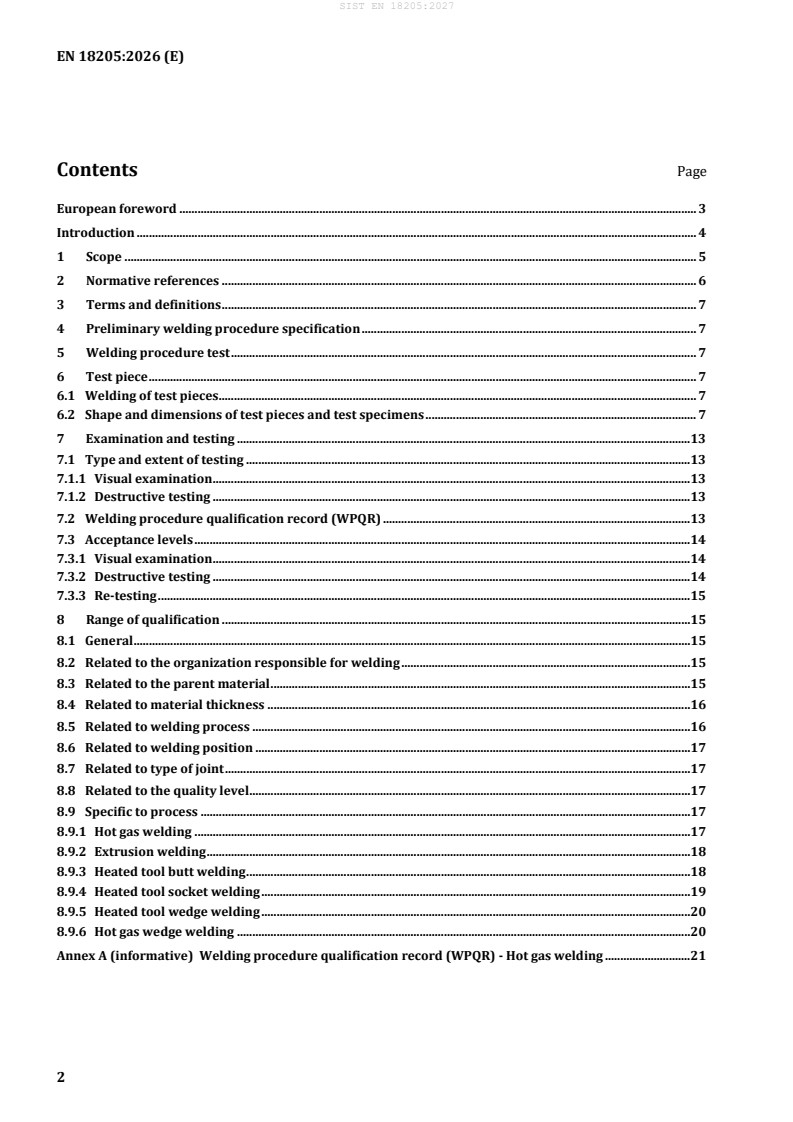
Contents
- Introduction
- 1 Scope
- 2 Normative references
- 3 Terms and definitions
- 3.1 standard welding procedure specification
- 4 Preliminary welding procedure specification
- 5 Welding procedure test
- 6 Test piece
- 6.1 Welding of test pieces
- 6.2 Shape and dimensions of test pieces and test specimens
- 7 Examination and testing
- 7.1 Type and extent of testing
- 3 Tensile
- 7.2 Welding procedure qualification record (WPQR)
- 7.3 Acceptance levels
- 8 Range of qualification
- 8.1 General
- 8.2 Related to the organization responsible for welding
- 8.3 Related to the parent material
- 8.4 Related to material thickness
- 8.5 Related to welding process
- 8.6 Related to welding position
- 8.7 Related to type of joint
- 8.8 Related to the quality level
- 8.9 Specific to process
- Annex A
Introduction
This document covers the principles to be observed in the qualification testing of welding procedures for thermoplastic materials.
SIST EN 18205:2027 EN 18205:2026 (E)
1 Scope
This document specifies a procedure to qualify a preliminary welding procedure specification (pWPS) by welding procedure tests to produce a qualified welding procedure specification (WPS). NOTE 1 The application of this document ensures that the qualification of the pWPS is carried out according to a uniform test procedure.
NOTE 2 The primary purpose of a welding procedure qualification is to demonstrate that the joining process proposed for construction is capable of producing joints having the required mechanical properties for the intended application.
This document applies to the following thermoplastic welding processes:
- hot gas welding: round nozzle, speed, wedge;
- extrusion welding;
- heated tool welding: butt, socket, wedge.
This document applies to the welding of the following products:
- sheet;
- pipe (unreinforced, solid wall only);
- fittings (unreinforced only);
- lining membrane/ This document covers the welding of the following groups of materials:
a) for sheets, pipes and fittings:
- PVC (PVC-U, PVC-C); - PP (PP-B, PP-H, PP-R); - PE; - PVDF; - ECTFE, PFA and FEP; b) for lining membranes:
- PVC-P; - PE; - ECB; - PP; c) for pipes and fittings only:
- PA-U (PA-U 11, PA-U 12).
SIST EN 18205:2027 EN 18205:2026 (E)
2 Normative references
The following documents are referred to in the text in such a way that some or all of their content constitutes requirements of this document. For dated references, only the edition cited applies. For undated references, the latest edition of the referenced document (including any amendments) applies. CEN/TS 16892, Plastics - Welding of thermoplastics - Specification of welding procedures EN 12814-1, Testing of welded joints of thermoplastics semi-finished products - Part 1: Bend test EN 12814-2, Testing of welded joints of thermoplastics semi-finished products - Part 2: Tensile test EN 12814-4, Testing of welded joints of thermoplastics semi-finished products - Part 4: Peel test EN 12814-7, Testing of welded joints of thermoplastics semi-finished products - Part 7: Tensile test with waisted test specimens EN 12814-8, Testing of welded joints of thermoplastics semi-finished products - Part 8: Requirements EN 13100-1, Non destructive testing of welded joints of thermoplastics semi-finished products - Part 1:
Visual examination EN 14728, Imperfections in thermoplastic welds - Classification EN 16296, Imperfections in thermoplastics welded joints - Quality levels EN 13067, Plastics welding personnel - Qualification of welders - Thermoplastics welded assemblies EN ISO 23936-1, Oil and gas industries including lower carbon energy - Non-metallic materials in contact with media related to oil and gas production - Part 1: Thermoplastics (ISO 23936-1) ISO/TR 20118, Plastics - Guidance on fire characteristics and fire performance of PVC materials used in building applications ISO/TR 25901-1, Welding and allied processes - Vocabulary - Part 1: General terms ISO 13953, Polyethylene (PE) pipes and fittings - Determination of the tensile strength and failure mode of test pieces from a butt-fused joint
SIST EN 18205:2027 EN 18205:2026 (E)
3 Terms and definitions
For the purposes of this document, the terms and definitions given in EN 13067, EN ISO 23936-1, ISO/TR 20118, ISO/TR 25901-1 and the following apply.
ISO and IEC maintain terminology databases for use in standardization at the following addresses:
- ISO Online browsing platform: available at http://www.iso.org/obp
- IEC Electropedia: available at http://www.electropedia.org/
3.1 standard welding procedure specification
sWPS welding procedure specification that contains acceptable welding variables based on standard industry practice and is specified in national or international standards or industry specifications
4 Preliminary welding procedure specification
The preliminary welding procedure specification (pWPS) shall be prepared in accordance with CEN/TS 16892.
5 Welding procedure test
The welding and testing of test pieces shall be in accordance with Clauses 6 and 7.
6 Test piece
6.1 Welding of test pieces
Preparation and welding of the test pieces shall be carried out in accordance with the pWPS. All welding parameters shall be recorded in a welding procedure qualification record (see 7.2).
6.2 Shape and dimensions of test pieces and test specimens
The dimensions of the test piece and the number of test specimens to be cut from the test piece are specified in Figures 1 to 7.
The shapes, dimensions and conditioning of the test specimens are specified in the relevant test standards.
Cutting the test specimens shall be carried out without significant damage to the welds and their heat affected zones.
SIST EN 18205:2027 EN 18205:2026 (E) Minimum dimensions in millimetres
Key 1 discard 2 6 bend test specimens cut from within this area 3 weld Figure 1 — Test piece for a butt weld on sheet (for bend test specimens)
SIST EN 18205:2027 EN 18205:2026 (E)
Key 1 4 test specimens, 1 in each location (x1, x2, y1, y2) 2 weld l ≥ 350 or 2 dn, whichever is longer Figure 2 — Test piece for a butt weld on pipe (for bend or tensile test specimens)
SIST EN 18205:2027 EN 18205:2026 (E) Minimum dimensions in millimetres
Key 1 discard 2 5 tensile test specimens cut from within this area 3 tensile test specimens (for reference) 4 weld Figure 3 —Test piece for a butt weld on sheet (for tensile test specimens)
SIST EN 18205:2027 EN 18205:2026 (E)
Key 1 socket 2 pipe l ≥ 5 dn Figure 4 — Test piece for a socket weld Minimum dimensions in millimetres
a) Test piece for lining membranes b) Lap seam without testing channel Key 1 discard 2 5 peel test specimens cut from within this area 3 welding zone Figure 5 — Test piece for lining membranes - Lap seam without testing channel
SIST EN 18205:2027 EN 18205:2026 (E) Minimum dimensions in millimetres
a) Test piece for lining membranes b) Lap seam with testing channel Key 1 discard 2 5 peel test specimens cut from within this area 3 welding zone a the dimensions are dictated by the machine, WPS employed Figure 6 — Test piece for lining membranes - Lap seam with testing channel Minimum dimensions in millimetres
a) Test piece for lining membranes b) Lap seam extrusion welded Key 1 5 test specimens cut from around the joint 2 welding zone a the dimensions are dictated by the WPS employed Figure 7 — Test piece for lining membranes - Lap seam extrusion welded
SIST EN 18205:2027 EN 18205:2026 (E)
7 Examination and testing
7.1 Type and extent of testing
7.1.1 Visual examination
Visual examination shall be carried out and recorded during all stages of welding and mechanical testing.
7.1.2 Destructive testing
The type and extent of mechanical testing shall be in accordance with the requirements in Table 1. Table 1 — Testing of the test pieces Number of Test piece Figure Type of test Test standard specimens 1 Bend EN 12814-1 6 a Butt weld on sheet 5 (weld) EN 12814-2/
...