

EN 16590-1:2014
(Main)Tractors and machinery for agriculture and forestry - Safety-related parts of control systems - Part 1: General principles for design and development (ISO 25119-1:2010 modified)
- Abstract
This part of EN 16590 sets out general principles for the design and development of safety-related parts of control systems (SRP/CS) on tractors used in agriculture and forestry and on self-propelled ride-on machines and mounted, semi-mounted and trailed machines used in agriculture. It can also be applied to municipal equipment (e.g. street sweeping machines). It specifies the characteristics and categories required of SRP/CS for carrying out their safety functions.
This part of EN 16590 is applicable to the safety-related parts of electrical/electronic/programmable electronic systems (E/E/PES), as these relate to mechatronic systems. It does not specify which safety functions, categories or performance levels are to be used for particular machines.
Machine specific standards (type-C standards) can identify performance levels and/or categories or they should be determined by the manufacturer of the machine based on risk assessment.
It is not applicable to non-E/E/PES systems (e.g. hydraulic, mechanic or pneumatic).
NOTE See also EN ISO 12100 for design principles related to the safety of machinery.
- Status
- Withdrawn
- Publication Date
- 22-Apr-2014
- Withdrawal Date
- 06-Oct-2026
- Technical Committee
- CEN/TC 144 - Tractors and machinery for agriculture and forestry
- Drafting Committee
- CEN/TC 144/WG 1 - General safety requirements
- Current Stage
- 9960 - Withdrawal effective - Withdrawal
- Start Date
- 19-Dec-2018
- Completion Date
- 07-Oct-2026
- Directive
- 2006/42/EC - Directive 2006/42/EC of the European Parliament and of the Council of 17 May 2006 on machinery, and amending Directive 95/16/EC (recast)OJ Ref: C, C 054, C 92 OJ Date: 13-Feb-2015

Relations
- Effective Date
- 26-Dec-2018
- Effective Date
- 28-Jan-2026
- Effective Date
- 28-Jan-2026
- Effective Date
- 28-Jan-2026
- Effective Date
- 09-Feb-2026
Get Certified
Connect with accredited certification bodies for this standard

BSI Group
BSI (British Standards Institution) is the business standards company that helps organizations make excellence a habit.

Control Union Certifications
Global certification for agriculture and sustainability.

ECOCERT
Organic and sustainability certification.
Sponsored listings
Frequently Asked Questions
EN 16590-1:2014 is a standard published by the European Committee for Standardization (CEN). Its full title is "Tractors and machinery for agriculture and forestry - Safety-related parts of control systems - Part 1: General principles for design and development (ISO 25119-1:2010 modified)". This standard covers: This part of EN 16590 sets out general principles for the design and development of safety-related parts of control systems (SRP/CS) on tractors used in agriculture and forestry and on self-propelled ride-on machines and mounted, semi-mounted and trailed machines used in agriculture. It can also be applied to municipal equipment (e.g. street sweeping machines). It specifies the characteristics and categories required of SRP/CS for carrying out their safety functions. This part of EN 16590 is applicable to the safety-related parts of electrical/electronic/programmable electronic systems (E/E/PES), as these relate to mechatronic systems. It does not specify which safety functions, categories or performance levels are to be used for particular machines. Machine specific standards (type-C standards) can identify performance levels and/or categories or they should be determined by the manufacturer of the machine based on risk assessment. It is not applicable to non-E/E/PES systems (e.g. hydraulic, mechanic or pneumatic). NOTE See also EN ISO 12100 for design principles related to the safety of machinery.
This part of EN 16590 sets out general principles for the design and development of safety-related parts of control systems (SRP/CS) on tractors used in agriculture and forestry and on self-propelled ride-on machines and mounted, semi-mounted and trailed machines used in agriculture. It can also be applied to municipal equipment (e.g. street sweeping machines). It specifies the characteristics and categories required of SRP/CS for carrying out their safety functions. This part of EN 16590 is applicable to the safety-related parts of electrical/electronic/programmable electronic systems (E/E/PES), as these relate to mechatronic systems. It does not specify which safety functions, categories or performance levels are to be used for particular machines. Machine specific standards (type-C standards) can identify performance levels and/or categories or they should be determined by the manufacturer of the machine based on risk assessment. It is not applicable to non-E/E/PES systems (e.g. hydraulic, mechanic or pneumatic). NOTE See also EN ISO 12100 for design principles related to the safety of machinery.
EN 16590-1:2014 is classified under the following ICS (International Classification for Standards) categories: 35.240.68 - IT applications in agriculture; 35.240.99 - IT applications in other fields; 65.060.01 - Agricultural machines and equipment in general. The ICS classification helps identify the subject area and facilitates finding related standards.
EN 16590-1:2014 has the following relationships with other standards: It is inter standard links to EN ISO 25119-1:2018, EN 16590-3:2014, EN 16590-2:2014, EN 16590-4:2014, EN 60335-2-72:2012. Understanding these relationships helps ensure you are using the most current and applicable version of the standard.
EN 16590-1:2014 is associated with the following European legislation: EU Directives/Regulations: 2006/42/EC; Standardization Mandates: M/396. When a standard is cited in the Official Journal of the European Union, products manufactured in conformity with it benefit from a presumption of conformity with the essential requirements of the corresponding EU directive or regulation.
EN 16590-1:2014 is available in PDF format for immediate download after purchase. The document can be added to your cart and obtained through the secure checkout process. Digital delivery ensures instant access to the complete standard document.
Standards Content (Sample)
2003-01.Slovenski inštitut za standardizacijo. Razmnoževanje celote ali delov tega standarda ni dovoljeno.QMHQSicherheit von Land- und Forstmaschinen - Sicherheitsbezogene Teile von Steuerungen - Teil 1: Allgemeine Gestaltungs- und Entwicklungsleitsätze (ISO 25119-1:2010 modifiziert)Tracteurs et matériels agricoles et forestiers - Parties des systèmes de commande relatives à la sécurité - Partie 1: Principes généraux pour la conception et le développement (ISO 25119-1:2010 modifiée)Tractors and machinery for agriculture and forestry - Safety-related parts of control systems - Part 1: General principles for design and development (ISO 25119-1:2010 modified)65.060.01Kmetijski stroji in oprema na splošnoAgricultural machines and equipment in general35.240.99IT applications in other fieldsICS:Ta slovenski standard je istoveten z:EN 16590-1:2014SIST EN 16590-1:2014en,fr,de01-julij-2014SIST EN 16590-1:2014SLOVENSKI
STANDARD
EUROPEAN STANDARD NORME EUROPÉENNE EUROPÄISCHE NORM
EN 16590-1
April 2014 ICS 35.240.99; 65.060.01
English Version
Tractors and machinery for agriculture and forestry - Safety-related parts of control systems - Part 1: General principles for design and development (ISO 25119-1:2010 modified)
Tracteurs et matériels agricoles et forestiers - Parties des systèmes de commande relatives à la sécurité - Partie 1: Principes généraux pour la conception et le développement (ISO 25119-1:2010 modifié)
Sicherheit von Land- und Forstmaschinen - Sicherheitsbezogene Teile von Steuerungen - Teil 1: Allgemeine Gestaltungs- und Entwicklungsleitsätze (ISO 25119-1:2010 modifiziert) This European Standard was approved by CEN on 23 February 2014.
CEN members are bound to comply with the CEN/CENELEC Internal Regulations which stipulate the conditions for giving this European Standard the status of a national standard without any alteration. Up-to-date lists and bibliographical references concerning such national standards may be obtained on application to the CEN-CENELEC Management Centre or to any CEN member.
This European Standard exists in three official versions (English, French, German). A version in any other language made by translation under the responsibility of a CEN member into its own language and notified to the CEN-CENELEC Management Centre has the same status as the official versions.
CEN members are the national standards bodies of Austria, Belgium, Bulgaria, Croatia, Cyprus, Czech Republic, Denmark, Estonia, Finland, Former Yugoslav Republic of Macedonia, France, Germany, Greece, Hungary, Iceland, Ireland, Italy, Latvia, Lithuania, Luxembourg, Malta, Netherlands, Norway, Poland, Portugal, Romania, Slovakia, Slovenia, Spain, Sweden, Switzerland, Turkey and United Kingdom.
EUROPEAN COMMITTEE FOR STANDARDIZATION
COMITÉ EUROPÉEN DE NORMALISATION
EUROPÄISCHES KOMITEE FÜR NORMUNG
CEN-CENELEC Management Centre:
Avenue Marnix 17,
B-1000 Brussels © 2014 CEN All rights of exploitation in any form and by any means reserved worldwide for CEN national Members. Ref. No. EN 16590-1:2014 E SIST EN 16590-1:2014
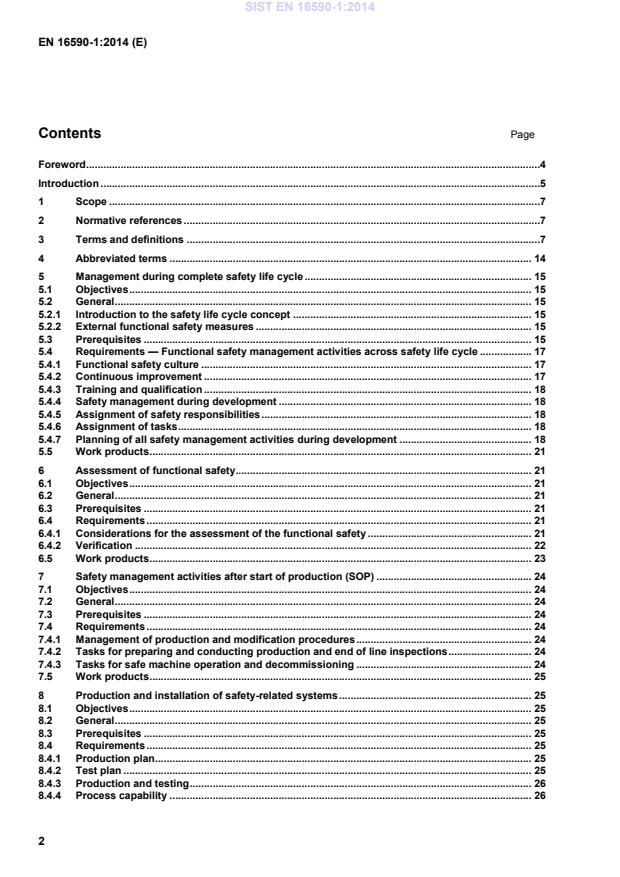
Example of the structure of a project-specific safety plan . 27 A.1 General . 27 A.2 Change log . 27 A.3 Objective of overall project . 27 A.4 Schedule . 27 A.5 Project organisation . 27 A.5.1 Project team organisation . 27 A.5.2 Project team members . 28 A.5.3 Safety management . 28 Annex ZA (informative)
Relationship between this European Standard and the Essential Requirements of EU Machinery Directive 2006/42/EC . 30 Bibliography . 31
For the purposes of EN 16590, the performance for each hazardous situation is divided into five levels, a, b, c, d and e, where the functional safety contributed by the SRP/CS in “a” is low and in “e” is high. 3.2 required agricultural performance level AgPLr performance level (AgPL) needed to achieve the required functional safety for each safety-related function SIST EN 16590-1:2014
Common-cause failures ought not be confused with common mode failures (see EN ISO 12100). 3.6 controllability involved individual's possibility of avoiding harm in the situation that is putting him/her at risk 3.7 dangerous detected failure rate dd dangerous failure rate of those components where fault detection is realised 3.8 dangerous failure failure in which an SRP/CS is no longer able to maintain the required performance level, even if the safety-related function is maintained by other (redundant) system components (due to reduction of the resulting performance level) 3.9 dangerous failure rate d fraction of all components with dangerous failure per time unit 3.10 diagnostic coverage DC fraction of the probability of detected dangerous failures, dd, and the probability of total dangerous failures, d, expressed by: dddDCλλ=∑∑ Note 1 to entry: Diagnostic coverage can exist for the whole or parts of a high-risk functional system, e.g. for sensors and/or logic system and/or final elements. Note 2 to entry: The value of DC is defined according to Table 1. Note 3 to entry: For SRP/CS consisting of several parts, an average value, DCavg, is used (see EN 16590-2:2014, Annex C). SIST EN 16590-1:2014
It is developed during the concept phase of the safety life cycle. SIST EN 16590-1:2014
It is developed during the concept phase of the safety life cycle. 3.22 functional safety requirement requirement for a safety-related function of the E/E/PES system 3.23 hardware safety requirement requirement that applies to safety-related hardware and which is included as an element of a technical safety requirement 3.24 harm physical injury 3.25 hazard potential source of harm 3.26 hazardous situation circumstance in which a person is exposed to a hazard or hazards, exposure to which can have immediate or long-term effects 3.27 intended use Ãof a machineÄ use in accordance with the information provided in the operator's manual 3.28 inspection systematic, formal verification method used to review product quality Note 1 to entry:
During an inspection, the work product is checked by one or more assessors to see whether it complies with the requirements. The inspection is organised and moderated by an inspection leader. The author of the work product participates in the inspection but cannot lead the process. 3.29 life of the machine life cycle time between production and decommissioning 3.30 manual reset function within the safety-related parts of the control system used to manually restore one or more safety-related functions before restarting the machine SIST EN 16590-1:2014
It comprises all elements of the system, including power supplies, sensors and other input devices, data highways and other communication paths, and actuators and other output devices. 3.36 protective measure measure intended to achieve functional safety, as implemented by the designer (intrinsic design, safeguarding and complementary measures, information for use), and the user (organisation, safe working procedures, supervision, permit to work, systems, additional safeguards, personal protective equipment, training) SIST EN 16590-1:2014
The combined safety-related parts of a control system start at the point where the safety-related signals are initiated (e.g. the actuating cam and the roller of the position switch) and end at the output of the power control elements (e.g. the main contacts of the contactor), and include monitoring systems. 3.47 severity measure of the most likely degree of harm to an endangered individual SIST EN 16590-1:2014
The SRL is categorised into four groups: SRL = B, 1, 2 and 3. 3.49 software safety requirement requirement that applies to safety-related software and that is included as an element of a technical safety requirement 3.50 supplier manufacturer and distributor of new and spare parts for tractors for agriculture and forestry, self-propelled ride-on machines and mounted, semi-mounted and trailed machines used in agriculture, and municipal equipment cf. manufacturer (3.31) 3.51 symmetric channel numerical combination of single-channel MTTFdc for a dual- or redundant-channel system 3.52 systematic failure failure related in a deterministic way to a certain cause, which can only be eliminated by a modification of the design or of the manufacturing process, operational procedures, documentation or other relevant factors Note 1 to entry: Corrective maintenance without modification will usually not eliminate the failure cause. Note 2 to entry: A systematic failure can be induced by simulating the failure cause. EXAMPLE Human error in the safety requirements specification, the design, manufacture, installation, operation of the hardware, or the design and implementation of the software. 3.53 technical safety concept entire collection of technical
...