

EN 12480:2015
(Main)Gas meters - Rotary displacement gas meters
- Abstract
This European Standard specifies ranges, construction, performances, output characteristics and testing of rotary displacement gas meters (hereinafter referred to as RD meters or simply meters) for gas volume measurement.
This European Standard applies to rotary displacement gas meters used to measure the volume of fuel gases of at least the 1st, 2nd and 3rd gas families, the composition of which is specified in EN 437:2003+A1:2009, at a maximum working pressure up to and including 20 bar over an ambient and gas temperature range of at least −10 °C to +40 °C.
This European Standard applies to meters that are installed in locations with vibration and shocks of low significance and in
• closed locations (indoor or outdoor with protection as specified by the manufacturer) with condensing or with non-condensing humidity
or, if specified by the manufacturer,
• open locations (outdoor without any covering) with condensing humidity or with non-condensing humidity;
Unless otherwise specified in this standard:
• all pressures used are gauge;
• all influence quantities, except the one under test, are kept relatively constant at their reference value.
This European Standard also applies to meters with a maximum allowable pressure PS and the volume V of less than 6 000 bar • litres or with a product of PS and DN of less than 3 000 bar.
NOTE These limits are the same as in EU directive 97/23/EC.
This European Standard can be used for both pattern approval and individual meter testing. Cross-reference tables are given in:
• Annex A for the tests that need to be undertaken for pattern approval;
• Annex B for individual meter testing.
Some parts of this standard cover meters with mechanical index only.
The risk philosophy adopted in this standard is based on the analysis of hazards on account of pressure. The standard applies principles to eliminate or reduce hazards. Where these hazards cannot be eliminated appropriate protection measures are specified.
- Status
- Withdrawn
- Publication Date
- 10-Mar-2015
- Withdrawal Date
- 06-Oct-2026
- Technical Committee
- CEN/TC 237 - Gas meters
- Drafting Committee
- CEN/TC 237/WG 2 - Rotary displacement gas meters
- Current Stage
- 9960 - Withdrawal effective - Withdrawal
- Start Date
- 21-Feb-2018
- Completion Date
- 07-Oct-2026
- Directive
- 2004/22/EC - Measuring instruments



Relations
- Effective Date
- 18-Mar-2015
- Effective Date
- 02-Apr-2014
- Effective Date
- 28-Feb-2018
- Effective Date
- 25-Aug-2026
- Effective Date
- 25-Aug-2026
- Effective Date
- 25-Aug-2026
- Effective Date
- 25-Aug-2026
- Effective Date
- 25-Aug-2026
- Refers
ISO 7724-3:1984 - Paints and varnishes — Colorimetry — Part 3: Calculation of colour differences - Effective Date
- 25-Aug-2026
- Effective Date
- 25-Aug-2026
- Effective Date
- 25-Aug-2026
- Effective Date
- 02-Jun-2026
- Effective Date
- 09-Feb-2026
- Effective Date
- 09-Feb-2026
- Effective Date
- 09-Feb-2026
Get Certified
Connect with accredited certification bodies for this standard

DIBt (Deutsches Institut für Bautechnik)
German Institute for Building Technology.
DIN CERTCO
DIN Group product certification.

Aboma Certification B.V.
Specialized in construction, metal, and transport sectors.
Sponsored listings
Frequently Asked Questions
EN 12480:2015 is a standard published by the European Committee for Standardization (CEN). Its full title is "Gas meters - Rotary displacement gas meters". This standard covers: This European Standard specifies ranges, construction, performances, output characteristics and testing of rotary displacement gas meters (hereinafter referred to as RD meters or simply meters) for gas volume measurement. This European Standard applies to rotary displacement gas meters used to measure the volume of fuel gases of at least the 1st, 2nd and 3rd gas families, the composition of which is specified in EN 437:2003+A1:2009, at a maximum working pressure up to and including 20 bar over an ambient and gas temperature range of at least −10 °C to +40 °C. This European Standard applies to meters that are installed in locations with vibration and shocks of low significance and in • closed locations (indoor or outdoor with protection as specified by the manufacturer) with condensing or with non-condensing humidity or, if specified by the manufacturer, • open locations (outdoor without any covering) with condensing humidity or with non-condensing humidity; Unless otherwise specified in this standard: • all pressures used are gauge; • all influence quantities, except the one under test, are kept relatively constant at their reference value. This European Standard also applies to meters with a maximum allowable pressure PS and the volume V of less than 6 000 bar • litres or with a product of PS and DN of less than 3 000 bar. NOTE These limits are the same as in EU directive 97/23/EC. This European Standard can be used for both pattern approval and individual meter testing. Cross-reference tables are given in: • Annex A for the tests that need to be undertaken for pattern approval; • Annex B for individual meter testing. Some parts of this standard cover meters with mechanical index only. The risk philosophy adopted in this standard is based on the analysis of hazards on account of pressure. The standard applies principles to eliminate or reduce hazards. Where these hazards cannot be eliminated appropriate protection measures are specified.
This European Standard specifies ranges, construction, performances, output characteristics and testing of rotary displacement gas meters (hereinafter referred to as RD meters or simply meters) for gas volume measurement. This European Standard applies to rotary displacement gas meters used to measure the volume of fuel gases of at least the 1st, 2nd and 3rd gas families, the composition of which is specified in EN 437:2003+A1:2009, at a maximum working pressure up to and including 20 bar over an ambient and gas temperature range of at least −10 °C to +40 °C. This European Standard applies to meters that are installed in locations with vibration and shocks of low significance and in • closed locations (indoor or outdoor with protection as specified by the manufacturer) with condensing or with non-condensing humidity or, if specified by the manufacturer, • open locations (outdoor without any covering) with condensing humidity or with non-condensing humidity; Unless otherwise specified in this standard: • all pressures used are gauge; • all influence quantities, except the one under test, are kept relatively constant at their reference value. This European Standard also applies to meters with a maximum allowable pressure PS and the volume V of less than 6 000 bar • litres or with a product of PS and DN of less than 3 000 bar. NOTE These limits are the same as in EU directive 97/23/EC. This European Standard can be used for both pattern approval and individual meter testing. Cross-reference tables are given in: • Annex A for the tests that need to be undertaken for pattern approval; • Annex B for individual meter testing. Some parts of this standard cover meters with mechanical index only. The risk philosophy adopted in this standard is based on the analysis of hazards on account of pressure. The standard applies principles to eliminate or reduce hazards. Where these hazards cannot be eliminated appropriate protection measures are specified.
EN 12480:2015 is classified under the following ICS (International Classification for Standards) categories: 91.140.40 - Gas supply systems. The ICS classification helps identify the subject area and facilitates finding related standards.
EN 12480:2015 has the following relationships with other standards: It is inter standard links to EN 12480:2002/A1:2006, EN 12480:2002, EN 12480:2018, ISO 1083:2004, ISO 8434-1:2007, ISO 7005-2:1988, ISO 2768-1:1989, ISO 8434-2:2007, ISO 7724-3:1984, ISO 8434-6:2009, ISO 8434-3:2005, EN IEC 61000-6-3:2026, EN IEC 61000-6-3:2021, ISO 834-1:1999, EN IEC 61000-6-4:2019. Understanding these relationships helps ensure you are using the most current and applicable version of the standard.
EN 12480:2015 is associated with the following European legislation: EU Directives/Regulations: 2004/22/EC, 2014/32/EU, 2014/68/EU, 97/23/EC; Standardization Mandates: M/071, M/347, M/374, M/541. When a standard is cited in the Official Journal of the European Union, products manufactured in conformity with it benefit from a presumption of conformity with the essential requirements of the corresponding EU directive or regulation.
EN 12480:2015 is available in PDF format for immediate download after purchase. The document can be added to your cart and obtained through the secure checkout process. Digital delivery ensures instant access to the complete standard document.
Standards Content (Sample)
2003-01.Slovenski inštitut za standardizacijo. Razmnoževanje celote ali delov tega standarda ni dovoljeno.Plinomeri - Plinomeri z rotacijskimi batiGaszähler - DrehkolbengaszählerCompteurs de gaz - Compteurs de gaz à déplacement rotatifGas meters - Rotary displacement gas meters91.140.40Sistemi za oskrbo s plinomGas supply systemsICS:Ta slovenski standard je istoveten z:EN 12480:2015SIST EN 12480:2015en,fr,de01-junij-2015SIST EN 12480:2015SLOVENSKI
STANDARDSIST EN 12480:2004/A1:2006SIST EN 12480:20041DGRPHãþD
EUROPEAN STANDARD NORME EUROPÉENNE EUROPÄISCHE NORM
EN 12480
March 2015 ICS 91.140.40 Supersedes EN 12480:2002English Version
Gas meters - Rotary displacement gas meters
Compteurs de gaz - Compteurs de gaz à déplacement rotatif
Gaszähler - Drehkolbengaszähler This European Standard was approved by CEN on 11 January 2015.
CEN members are bound to comply with the CEN/CENELEC Internal Regulations which stipulate the conditions for giving this European Standard the status of a national standard without any alteration. Up-to-date lists and bibliographical references concerning such national standards may be obtained on application to the CEN-CENELEC Management Centre or to any CEN member.
This European Standard exists in three official versions (English, French, German). A version in any other language made by translation under the responsibility of a CEN member into its own language and notified to the CEN-CENELEC Management Centre has the same status as the official versions.
CEN members are the national standards bodies of Austria, Belgium, Bulgaria, Croatia, Cyprus, Czech Republic, Denmark, Estonia, Finland, Former Yugoslav Republic of Macedonia, France, Germany, Greece, Hungary, Iceland, Ireland, Italy, Latvia, Lithuania, Luxembourg, Malta, Netherlands, Norway, Poland, Portugal, Romania, Slovakia, Slovenia, Spain, Sweden, Switzerland, Turkey and United Kingdom.
EUROPEAN COMMITTEE FOR STANDARDIZATION
COMITÉ EUROPÉEN DE NORMALISATION EUROPÄISCHES KOMITEE FÜR NORMUNG
CEN-CENELEC Management Centre:
Avenue Marnix 17,
B-1000 Brussels © 2015 CEN All rights of exploitation in any form and by any means reserved worldwide for CEN national Members. Ref. No. EN 12480:2015 ESIST EN 12480:2015
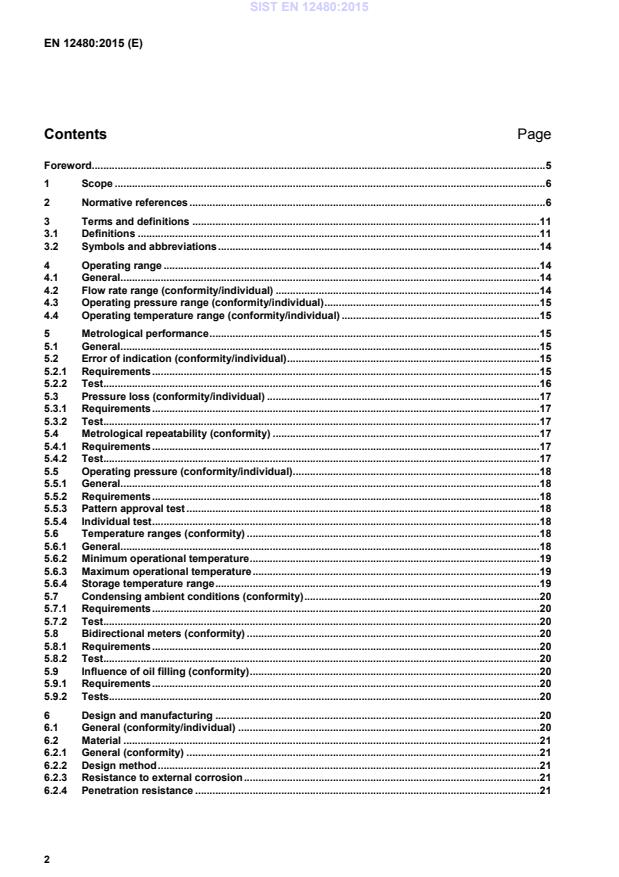
Contents Page Foreword . 5 1 Scope . 6 2 Normative references . 6 3 Terms and definitions . 11 3.1 Definitions . 11 3.2 Symbols and abbreviations . 14 4 Operating range . 14 4.1 General . 14 4.2 Flow rate range (conformity/individual) . 14 4.3 Operating pressure range (conformity/individual) . 15 4.4 Operating temperature range (conformity/individual) . 15 5 Metrological performance . 15 5.1 General . 15 5.2 Error of indication (conformity/individual) . 15 5.2.1 Requirements . 15 5.2.2 Test . 16 5.3 Pressure loss (conformity/individual) . 17 5.3.1 Requirements . 17 5.3.2 Test . 17 5.4 Metrological repeatability (conformity) . 17 5.4.1 Requirements . 17 5.4.2 Test . 17 5.5 Operating pressure (conformity/individual). 18 5.5.1 General . 18 5.5.2 Requirements . 18 5.5.3 Pattern approval test . 18 5.5.4 Individual test . 18 5.6 Temperature ranges (conformity) . 18 5.6.1 General . 18 5.6.2 Minimum operational temperature . 19 5.6.3 Maximum operational temperature . 19 5.6.4 Storage temperature range . 19 5.7 Condensing ambient conditions (conformity) . 20 5.7.1 Requirements . 20 5.7.2 Test . 20 5.8 Bidirectional meters (conformity) . 20 5.8.1 Requirements . 20 5.8.2 Test . 20 5.9 Influence of oil filling (conformity) . 20 5.9.1 Requirements . 20 5.9.2 Tests . 20 6 Design and manufacturing . 20 6.1 General (conformity/individual) . 20 6.2 Material . 21 6.2.1 General (conformity) . 21 6.2.2 Design method . 21 6.2.3 Resistance to external corrosion . 21 6.2.4 Penetration resistance . 21 SIST EN 12480:2015
6.2.5 Adhesion of the protective coating . 22 6.2.6 Materials for pressurized parts . 22 6.3 Robustness . 24 6.3.1 Resistance to internal pressure (conformity/individual) . 24 6.3.2 Fire resistance (conformity) . 25 6.3.3 External leak tightness (conformity/individual) . 25 6.3.4 Overload (conformity) . 26 6.3.5 Bending and torsional moment (conformity) . 26 6.4 Transportation and storage (conformity/individual) . 28 6.4.1 Protection against foreign matter . 28 6.4.2 Protection against damage . 29 6.5 Connections (conformity) . 29 6.6 Pressure and temperature tappings (conformity) . 29 6.6.1 Pressure tappings . 29 6.6.2 Temperature tappings . 30 6.7 Manufacturing . 30 7 Meter output (conformity) . 31 7.1 Index . 31 7.1.1 General . 31 7.1.2 Magnetic coupling . 31 7.1.3 Mechanical indicating device . 31 7.1.4 Test element . 32 7.2 Index window . 33 7.2.1 Requirements . 33 7.2.2 Tests . 33 7.3 Output drive shafts . 34 7.3.1 Requirements . 34 7.3.2 Tests . 36 7.4 Pulse generators . 36 7.4.1 General . 36 7.4.2 Specification for low frequency pulse generator . 37 7.4.3 Specification for high frequency pulse generator . 37 7.4.4 Electrical Connection . 37 8 Durability (conformity) . 38 8.1 Requirements . 38 8.2 Tests . 38 9 Marking, labelling and packaging (conformity/individual) . 38 9.1 General . 38 9.2 Direction of flow . 39 9.3 Pressure tappings . 39 9.4 Durability and legibility of marking . 39 9.4.1 Requirements . 39 9.4.2 Test . 39 10 Documentation (conformity) . 39 10.1 General . 39 10.2 Documentation related to the manufacturer's tests . 39 10.3 Declaration of conformity . 40 10.4 Instruction manual . 40 Annex A (normative)
Pattern approval . 41 Annex B (normative)
Individual meter testing . 43 Annex C (normative)
Resistance to high temperature (optional) . 44 C.1 Requirements . 44 SIST EN 12480:2015
C.2 Test . 44 C.2.1 Apparatus . 44 C.2.2 Test conditions . 44 C.2.3 Test procedure . 45 C.3 Marking . 46 Annex D (normative)
Compliance evaluation for gas meters . 47 D.1 General . 47 D.2 Quality Management System . 47 D.2.1 General . 47 D.2.2 Procedures . 47 D.2.3 Manufacturer’s compliance evaluation . 48 D.2.4 Issue of the certificate of compliance . 48 Annex E (normative)
Non-destructive testing (NDT) . 49 Annex F (normative)
Materials for pressurized parts . 51 Annex G (normative)
Additional tests for meters to be used in open locations . 63 G.1 General . 63 G.2 Weathering . 63 G.2.1 Requirements . 63 G.2.2 Test . 63 Annex H (normative)
Meter family . 64 H.1 Definition of meter family . 64 H.2 Criteria for grouping meters together in order to form a family . 64 Annex ZA (informative)
Relationship between this European Standard and the Essential Requirements of EU Directive 2014/32 Measuring Instruments Directive . 65 Annex ZB (informative)
Relationship between this European Standard and the Essential Requirements of EU Directive 97/23/EC . 69 Bibliography . 71
Foreword This document (EN 12480:2015) has been prepared by Technical Committee CEN/TC 237 “Gas meters”, the secretariat of which is held by BSI. This European Standard shall be given the status of a national standard, either by publication of an identical text or by endorsement, at the latest by September 2015 and conflicting national standards shall be withdrawn at the latest by September 2015. Attention is drawn to the possibility that some of the elements of this document may be the subject of patent rights. CEN [and/or CENELEC] shall not be held responsible for identifying any or all such patent rights. This document supersedes EN 12480:2002. This document has been prepared under a mandate given to CEN by the European Commission and the European Free Trade Association, and supports essential requirements of EU Directives. For relationship with EU Directives, see informative Annex ZA and ZB, which are integral parts of this document. According to the CEN-CENELEC Internal Regulations, the national standards organizations of the following countries are bound to implement this European Standard: Austria, Belgium, Bulgaria, Croatia, Cyprus, Czech Republic, Denmark, Estonia, Finland, Former Yugoslav Republic of Macedonia, France, Germany, Greece, Hungary, Iceland, Ireland, Italy, Latvia, Lithuania, Luxembourg, Malta, Netherlands, Norway, Poland, Portugal, Romania, Slovakia, Slovenia, Spain, Sweden, Switzerland, Turkey and the United Kingdom. SIST EN 12480:2015
1 Scope This European Standard specifies ranges, construction, performances, output characteristics and testing of rotary displacement gas meters (hereinafter referred to as RD meters or simply meters) for gas volume measurement. This European Standard applies to rotary displacement gas meters used to measure the volume of fuel gases of at least the 1st, 2nd and 3rd gas families, the composition of which is specified in EN 437:2003+A1:2009, at a maximum working pressure up to and including 20 bar over an ambient and gas temperature range of at least −10 °C to +40 °C. This European Standard applies to meters that are installed in locations with vibration and shocks of low significance and in • closed locations (indoor or outdoor with protection as specified by the manufacturer) with condensing or with non-condensing humidity or, if specified by the manufacturer, • open locations (outdoor without any covering) with condensing humidity or with non-condensing humidity; Unless otherwise specified in this standard: • all pressures used are gauge; • all influence quantities, except the one under test, are kept relatively constant at their reference value. This European Standard also applies to meters with a maximum allowable pressure PS and the volume V of less than 6 000 bar · litres or with a product of PS and DN of less than 3 000 bar. NOTE These limits are the same as in EU directive 97/23/EC. This European Standard can be used for both pattern approval and individual meter testing. Cross-reference tables are given in: • Annex A for the tests that need to be undertaken for pattern approval; • Annex B for individual meter testing. Some parts of this standard cover meters with mechanical index only. The risk philosophy adopted in this standard is based on the analysis of hazards on account of pressure. The standard applies principles to eliminate or reduce hazards. Where these hazards cannot be eliminated appropriate protection measures are specified. 2 Normative references The following documents, in whole or in part, are normatively referenced in this document and are indispensable for its application. For dated references, only the edition cited applies. For undated references, the latest edition of the referenced document (including any amendments) applies. EN 485-2:2013, Aluminium and aluminium alloys - Sheet, strip and plate - Part 2: Mechanical properties EN 586-2:1994, Aluminium and aluminium alloys - Forgings - Part 2: Mechanical properties and additional property requirements SIST EN 12480:2015
EN 754-2:2013, Aluminium and aluminium alloys - Cold drawn rod/bar and tube - Part 2: Mechanical properties EN 755-2:2013, Aluminium and aluminium alloys - Extruded rod/bar, tube and profiles - Part 2: Mechanical properties EN 1057:2006+A1:2010, Copper and copper alloys - Seamless, round copper tubes for water and gas in sanitary and heating applications EN 1092-1:2007+A1:2013, Flanges and their joints - Circular flanges for pipes, valves, fittings and accessories, PN designated - Part 1: Steel flanges EN 1092-2:1997, Flanges and their joints - Circular flanges for pipes, valves, fittings and accessories, PN designated - Part 2: Cast iron flanges EN 1092-3:2003, Flanges and their joints - Circular flanges for pipes, valves, fittings and accessories, PN designated - Part 3: Copper alloy flanges EN 1092-4:2002, Flanges and their joints - Circular flanges for pipes, valves, fittings and accessories, PN designated - Part 4: Aluminium alloy flanges EN 1563:2011, Founding - Spheroidal graphite cast irons EN 1652:1997, Copper and copper alloys - Plate, sheet, strip and circles for general purposes EN 1706:2010, Aluminium and aluminium alloys - Castings - Chemical composition and mechanical properties EN 1759-1:2004, Flanges and their joint - Circular flanges for pipes, valves, fittings and accessories, Class designated - Part 1: Steel flanges, NPS 1/2 to 24 EN 1759-3:2003, Flanges and their joints - Circular flanges for pipes, valves, fittings and accessories, Class designated - Part 3: Copper alloy flanges EN 1759-4:2003, Flanges and their joint - Circular flanges for pipes, valves, fittings and accessories, class designated - Part 4: Aluminium alloy flanges EN 1982:2008, Copper and copper alloys - Ingots and castings EN 10025 (all parts), Hot rolled products of structural steels EN 10028-2:2009, Flat products made of steels for pressure purposes - Part 2: Non-alloy and alloy steels with specified elevated temperature properties EN 10028-3:2009, Flat products made of steels for pressure purposes - Part 3: Weldable fine grain steels, normalized EN 10028-4:2009, Flat products made of steels for pressure purposes - Part 4: Nickel alloy steels with specified low temperature properties EN 10028-6:2009, Flat products made of steels for pressure purposes - Part 6: Weldable fine grain steels, quenched and tempered EN 10028-7:2007, Flat products made of steels for pressure purposes - Part 7: Stainless steels EN 10083-1:2006, Steels for quenching and tempering - Part 1: General technical delivery conditions SIST EN 12480:2015
EN 10083-2:2006, Steels for quenching and tempering - Part 2: Technical delivery conditions for non alloy steels EN 10087:1998, Free-cutting steels - Technical delivery conditions for semi-finished products, hot-rolled bars and rods EN 10088-1:2014, Stainless steels - List of stainless steels EN 10088-3:2014, Stainless steels - Technical delivery conditions for semi-finished products, bars, rods, wire, sections and bright products of corrosion resisting steels for general purposes EN 10111:2008, Continuously hot rolled low carbon steel sheet and strip for cold forming - Technical delivery conditions EN 10130:2006, Cold rolled low carbon steel flat products for cold forming - Technical delivery conditions EN 10204:2004, Metallic products - Types of inspection documents EN 10222-1:1998, Steel forgings for pressure purposes - Part 1: General requirements for open die forgings EN 10222-5:1999, Steel forgings for pressure purposes - Part 5: Martensitic, austenitic and austenitic-ferritic stainless steels EN 10213:2007, Steel castings for pressure purposes EN 10250-1:1999, Open die steel forgings for general engineering purposes - Part 1: General requirements EN 10250-2:1999, Open die steel forgings for general engineering purposes - Part 2: Non-alloy quality and special steels EN 10250-4:1999, Open die steel forgings for general engineering purposes - Part 4: Stainless steels EN 10272:2007, Stainless steel bars for pressure purposes EN 10277-3:2008, Bright steel products - Technical delivery conditions - Part 3: Free-cutting steels EN 12164:2011, Copper and copper alloys - Rod for free machining purposes EN 12165:2011, Copper and copper alloys - Wrought and unwrought forging stock EN 12516-1:2014, Valves - Shell design strength - Part 1: Tabulation method for steel valve shells EN 12516-2:2014, Industrial valves - Shell design strength - Part 2: Calculation method for steel valve shells EN 12516-3:2002, Valves - Shell design strength - Part 3: Experimental method EN 12516-4:2014, Industrial valves - Shell design strength - Part 4: Calculation method for valve shells manufactured in metallic materials other than steel EN 60529:1991, Degrees of protection provided by enclosures (IP Code) EN 60730-1:2000, Automatic electrical controls for household and similar use - Part 1: General requirements EN 61000-6, Electromagnetic compatibility (EMC) Generic standards (IEC 61000-6) EN ISO 898-1:2013, Mechanical properties of fasteners made of carbon steel and alloy steel - Part 1: Bolts, screws and studs with specified property classes - Coarse thread and fine pitch thread (ISO 898-1:2013) SIST EN 12480:2015
EN ISO 898-2:2012, Mechanical properties of fasteners made of carbon steel and alloy steel - Part 2: Nuts with specified property classes - Coarse thread and fine pitch thread (ISO 898-2:2012) EN ISO 1518-2:2011, Paints and varnishes - Determination of scratch resistance - Part 2: Variable-loading method (ISO 1518-2:2011) EN ISO 2409:2013, Paints and varnishes - Cross-cut test (ISO 2409:2013) EN ISO 3506 (all parts), Mechanical properties of corrosion-resistant stainless steel fasteners (ISO 3506) EN ISO 6270-1:2001, Paints and varnishes - Determination of resistance to humidity - Part 1: Continuous condensation (ISO 6270-1:1998) EN ISO 9606-1:2013, Qualification testing of welders - Fusion welding - Part 1: Steels (ISO 9606-1:2012 including Cor 1:2012) EN ISO 9606-2:2004, Qualification test of welders - Fusion welding - Part 2: Aluminium and aluminium alloys (ISO 9606-2:2004) EN ISO 9712:2012, Non-destructive testing - Qualification and certification of NDT personnel (ISO 9712:2012) EN ISO 10675-1:2013, Non-destructive testing of welds - Acceptance levels for radiographic testing - Part 1: Steel, nickel, titanium and their alloys (ISO 10675-1:2008) EN ISO 11666:2010, Non-destructive testing of welds - Ultrasonic testing - Acceptance levels (ISO 11666:2010) EN ISO 14732:2013, Welding personnel - Qualification testing of welding operators and weld setters for mechanized and automatic welding of metallic materials (ISO 14732:2013) EN ISO 15607:2003, Specification and qualification of welding procedures for metallic materials - General rules (ISO 15607:2003) EN ISO 15609-1:2004, Specification and qualification of welding procedures for metallic materials - Welding procedure specification - Part 1: Arc welding (ISO 15609-1:2004) EN ISO 15614-1:2004, Specification and qualification of welding procedures for metallic materials - Welding procedure test - Part 1: Arc and gas welding of steels and arc welding of nickel and nickel alloys (ISO 15614-1:2004) EN ISO 15614-2:2005, Specification and qualification of welding procedures for metallic materials - Welding procedure test - Part 2: Arc welding of aluminium and its alloys (ISO 15614-2:2005) EN ISO 17636-1:2013, Non-destructive testing of welds - Radiographic testing - Part 1: X- and gamma-ray techniques with film (ISO 17636-1:2013) EN ISO 17636-2:2013, Non-destructive testing of welds - Radiographic testing - Part 2: X- and gamma-ray techniques with digital detectors (ISO 17636-2:2013) EN ISO 17637:2011, Non-destructive testing of welds - Visual testing of fusion-welded joints (ISO 17637:2003) EN ISO 17640:2010, Non-destructive testing of welds - Ultrasonic testing - Techniques, testing levels, and assessment (ISO 17640:2010) EN ISO 23279:2010, Non-destructive testing of welds - Ultrasonic testing - Characterization of indications in welds (ISO 23279:2010) SIST EN 12480:2015
ISO 834-1:1999, Fire-resistance tests — Elements of building construction — Part 1: General requirements ISO 1083:2004, Spheroidal graphite cast irons - Classification ISO 2768-1:1989, General tolerances — Part 1: Tolerances for linear and angular dimensions without individual tolerance indications ISO 7005-1:2011, Pipe flanges — Part 1: Steel flanges for industrial and general service piping systems ISO 7005-2:1988, Metallic flanges — Part 2: Cast iron flanges ISO 7724-3:1984, Paints and varnishes — Colorimetry — Part 3: Calculation of colour differences ISO 8434 (all parts), Hydraulic fluid power — Connection for tubes and hoses — Dimensions and designs for 37 degrees flare and 24 degrees flareless fittings ISO 17663:2009, Welding — Quality requirements for heat treatment in connection with welding and allied processes ASTM A 105/A 105M:2011, Standard Specification for Carbon Steel Forgings for Piping Applications ASTM A 106/A 106M:2011, Standard Specification for Seamless Carbon Steel Pipe for High Temperature Service ASTM A 182/A 182M:2012, Standard Specification for Forged or Rolled Alloy and Stainless Steel Pipe Flanges, Forged Fittings, and Valves and Parts for High Temperature Service ASTM A 193/A 193M:2012, Standard Specification for Alloy Steel and Stainless Steel Bolting for High Temperature or High Pressure Service and Other Special Purpose Applications ASTM A 194/A 194M:2012, Standard Specification for Carbon and Alloy Steel Nuts for Bolts for High Pressure or High Temperature Service, or Both ASTM A 213/A 213M:2011, Standard Specification for Seamless Ferritic and Austenitic Alloy Steel Boiler, Superheater, and Heat Exchanger Tubes ASTM A 234/A 234M:2011, Standard Specification for Piping Fittings of Wrought Carbon Steel and Alloy Steel for Moderate and High Temperature Service ASTM A 240/A 240M:2012, Standard Specification for Chromium and Chromium Nickel Stainless Steel Plate, Sheet, and Strip for Pressure Vessels and for General Applications ASTM A 266/A 266M:2011, Standard Specification for Carbon Steel Forgings for Pressure Vessel Components ASTM A 269:2010, Standard Specification for Seamless and Welded Austenitic Stainless Steel Tubing for General Service ASTM A 276:2010, Standard Specification for Stainless Steel Bars and Shapes ASTM A 312/A 312M:2012, Standard Specification for Seamless, Welded, and Heavily Cold Worked Austenitic Stainless Steel Pipes ASTM A 320/A 320M:2011, Standard Specification for Alloy Steel and Stainless Steel Bolting for Low Temperature Service ASTM A 333/A 333M:2011, Specification for Seamless and Welded Steel Pipe for Low-Temperature Service SIST EN 12480:2015
ASTM A 350/A 350M:2010, Standard Specification for Carbon and Low-Alloy Steel Forgings, Requiring Notch Toughness Testing for Piping Components ASTM A 395/A 395M:2009, Standard Specification for Ferritic Ductile Iron Pressure-Retaining Castings for Use at Elevated Temperatures ASTM A 420/A 420M:2006, Specification for Piping Fittings of Wrought Carbon Steel and Alloy Steel for Low-Temperature Service ASTM A 513/A 513M:2012, Standard Specification for Electric Resistance Welded Carbon and Alloy Steel Mechanical Tubing ASTM A 516/A 516M:2010, Standard Specification for Pressure Vessel Plates, Carbon Steel, for Moderate and Lower Temperature Service ASTM A 536:2009, Standard Specification for Ductile Iron Castings ASTM A 564/A 564M:2010, Standard Specification for Hot Rolled and Cold Finished Age Hardening Stainless Steel Bars and Shapes ASTM A 694/A 694M:2008, Standard Specification for Carbon and Alloy Steel Forgings for Pipe Flanges, Fittings, Valves, and Parts for High Pressure Transmission Service ASTM A 707/A 707M:2010, Standard Specification for Forged Carbon and Alloy Steel Flanges for Low Temperature Service ASTM A 874/A 874M:2009, Standard Specification for Ferritic Ductile Iron Castings Suitable for Low Temperature Service ASTM B 85/B 85M:2010, Standard Specification for Aluminum Alloy Die Castings ASTM F 593:2008, Standard Specification for Stainless Steel Bolts, Hex Cap Screws, and Studs ASTM F 594:2009, Standard Specification for Stainless Steel Nuts 3 Terms and definitions 3.1 Definitions For the purposes of this document, the following terms and definitions apply. 3.1.1 accuracy class 1,0 accuracy achieved by a meter, which has an error of indication between −2 % and +2 % for flow rates Q, where Qmin ≤ Q < Qt, and an error of indication between −1 % and +1 % for flow rates Q, where Qt ≤ Q ≤ Qmax 3.1.2 cyclic volume volume of the gas measured by one complete revolution of the element(s) 3.1.3 density of gas mass of gas divided by the volume SIST EN 12480:2015
3.1.4 allowable design temperature range range of gas temperatures(minimum to maximum) for which the meter is designed as declared and marked on the meter 3.1.5 diameter nominal size of diameter 3.1.6 error of indication value which shows the relationship in percentage terms of the difference between the volume indicated by the meter and the volume which has actually flowed through the meter, to the latter value: where iccE100VVV−=⋅ Vi is the indicated volume and Vc is the volume which has actually flowed through the meter 3.1.7 maximum allowable design pressure maximum pressure for which the meter is designed as specified by the manufacturer 3.1.8 Minimum flow rate lowest flow rate at which the gas meter provides indications that satisfy the requirements regarding maximum permissible error (MPE) 3.1.9 maximum flow rate highest flow rate at which the gas meter provides indications that satisfy the requirements regarding maximum permissible error (MPE) 3.1.10 meter family group of meters of different sizes but with similar construction (see Annex H) Note 1 to entry: By specifying a meter family it is possible to reduce the number of tests and documents during assessment. 3.1.11 metering conditions conditions of the gas prevailing at the point of measurement 3.1.12 metering pressure absolute pressure at which the volume of the gas is measured 3.1.13 normal conditions of use conditions referring to the meter operating: • within the range of working pressure • within the operational temperature and gas temperature range SIST EN 12480:2015
• with the distributed gas 3.1.14 operating pressure range limits of working pressure, as declared by the manufacturer, for which the meter will continue to operate within its metrological characteristics 3.1.15 operating temperature range range of gas and ambient temperatures for which the meter satisfies the metrological requirements of this standard 3.1.16 overload flow rate highest flow rate at which the meter operates for a short period of time without deteriorating 3.1.17 pressure loss non-recoverable pressure drop caused by the presence of the meter in the pipeline 3.1.18 rotary displacement meter (RD meter) gas volume meter in which a rigid measuring compartment is formed between the walls of a stationary chamber and rotating element or elements Note 1 to entry: Each rotation of the element(s) displaces a fixed volume of gas which is cumulatively registered and indicated by an indicating device. It is designed to measure, memorize and display the volume of a fuel gas that has passed through it. 3.1.19 storage temperature range range of temperatures at which the meter can be stored without being adversely affected 3.1.20 transitional flow rate flow rate occurring between the maximum and minimum flow rates at which the flow rate range is divided into two zones, the upper zone and the lower zone, each zone having a characteristic MPE 3.1.21 volume of meter internal volume of meter excluding the volume of internal parts 3.1.22 working pressure pressure of the gas at the inlet of the meter 3.1.23 limit pressure pressure at which yielding becomes apparent in any component of the meter or its fixtures 3.1.24 safety factor body ratio of the limit pressure pl to the maximum allowable pressure PS applied to the meter body 3.1.25 safety factor others ratio of the limit pressure pl to the maximum allowable pressure PS applied to other pressure containing parts of the meter SIST EN 12480:2015
3.2 Symbols and abbreviations Table 1 — Symbols Symbol Represented quantity SI Unit Vcyc cyclic volume dm3
Density of gas kg„m-3 TS Allowable design temperature range °C DN Diameter Dimensionless E Error of indication % MPE Maximum permissible error % WME Weighted mean error % PS Maximum allowable design pressure bar Q flow rate m3/h pm Metering pressure bar p Operating pressure range bar t Operating temperature range °C Qr Overload flow rate m3/h ts Storage temperature range °C Qt Transitional flow rate m3/h V Volume of meter L pl Limit pressure bar Sb Safety factor body Dimensionless S Safety factor others Dimensionless Subscripts
m Metering conditions of the gas
min Minimum
max Maximum
i Indicated
t Transitional
4 Operating range 4.1 General Gas meters shall be classified according to accuracy class 1,0. The values of maximum flow rates and the corresponding values of the upper limits of the minimum flow rates shall be one of those given in 4.2, when the meter is tested with air of density approximately 1,2 kg/m3. 4.2 Flow rate range (conformity/individual) Unless specified by the purchaser, the values of the maximum and minimum flow rate of rotary displacement gas meters are decimal multiples and sub-multiples of these values. SIST EN 12480:2015
For example for one decade: Qmax (m3/h):
100, 160, 250, 400, 650 Qmin (m3/h): 10, 13, 16, 20, 25, 32, 40, 50, 65, 80 With Qmax ≥ 20 Qmin 4.3 Operating pressure range (conformity/individual) The upper limit of the operating pressure range shall not exceed the maximum allowable design pressure. The operating pressure range stated by manufacturer shall be marked on the meter. 4.4 Operating temperature range (conformity/individual) All meters shall be capable of meeting the requirements in 5.6 for the following: gas; ambient; storage; design temperature ranges: • a minimum ambient temperature range of –10 °C to 40 °C. NOTE a wider ambient temperature range using a minimum temperature of –10 °C, –25 °C, or –40 °C and a maximum temperature of 40 °C, 55 °C, or 70 °C may be used. • a minimum gas temperature range of 40 K (the gas temperature range shall be within the ambient temperature range); • a minimum storage temperature range of –20 °C to 60 °C (see Clause 5.6) (the storage temperature range may be wider than or equal to the ambient temperature range). The operating temperature range shall be inside the limits of the allowable design temperature range. The operating temperature range stated by manufacturer shall be marked on the meter. 5 Metrological performance 5.1 General The uncertainty of the test rig (best measurement capability) shall be at a maximum of 1/5 of the MPE for the initial pattern approval test and at a maximum of 1/3 of the MPE for the individual meter testing. 5.2 Error of indication (conformity/individual) 5.2.1 Requirements When tested in accordance with 5.2.2, the meter error of indication shall be within the limits specified in Table 2. Table 2 — Limits of maximum permissible errors Flow rate Q m3/h Maximum permissible errors Qmin ≤ Q < Qt Qt
≤ Q ≤ Qmax ±2 % ±1 % SIST
...