

EN 1563:2011
(Main)Founding - Spheroidal graphite cast irons
- Abstract
This European Standard defines the grades and the corresponding requirements for spheroidal graphite cast irons.
This European Standard specifies 2 groups of spheroidal graphite cast iron grades by a classification based on mechanical properties measured on machined test pieces prepared from cast samples. The first group deals with ferritic to pearlitic grades. The second group deals with solid-solution strengthened ferritic grades.
This European Standard does not cover technical delivery conditions for iron castings (see EN 1559-1 [3] and EN 1559-3 [4]).
This European Standard does not cover all aspects of:
- ausferritic spheroidal graphite cast irons which are specified in EN 1564 [5];
- low alloyed ferritic spheroidal graphite cast irons which are specified in prEN 16124 [6];
- austenitic cast irons which are specified in EN 13835 [7];
- spheroidal graphite cast irons used for pipes, fittings and their joints which are the subject of EN 545 [8], EN 598 [9] and EN 969 [10];
- the grades of spheroidal graphite cast iron as specified in EN 545 which are used for products such as industrial valves, non industrial manually operated shut-off valves and flanges and their joints, which are the subject of the applicable European product standards.
- Status
- Withdrawn
- Publication Date
- 20-Dec-2011
- Withdrawal Date
- 06-Oct-2026
- Technical Committee
- CEN/TC 190 - Foundry technology
- Current Stage
- 9960 - Withdrawal effective - Withdrawal
- Start Date
- 15-Aug-2018
- Completion Date
- 07-Oct-2026
- Directive
- 2014/68/EU - Directive 2014/68/EU of the European Parliament and of the Council of 15 May 2014 on the harmonisation of the laws of the Member States relating to the making available on the market of pressure equipmentOJ Ref: C 293/01 OJ Date: 12-Aug-2016
97/23/EC - Pressure equipmentOJ Ref: C, C 104 OJ Date: 11-Apr-2012


Relations
- Effective Date
- 28-Dec-2011
- Effective Date
- 28-Dec-2011
- Effective Date
- 22-Dec-2008
- Effective Date
- 22-Aug-2018
- Effective Date
- 28-Jan-2026
- Effective Date
- 28-Jan-2026
- Effective Date
- 28-Jan-2026
- Effective Date
- 28-Jan-2026
- Refers
EN 764-5:2002 - Pressure Equipment - Part 5: Compliance and Inspection Documentation of Materials - Effective Date
- 28-Jan-2026
- Effective Date
- 28-Jan-2026
- Effective Date
- 28-Jan-2026
- Effective Date
- 28-Jan-2026
- Effective Date
- 28-Jan-2026
- Effective Date
- 28-Jan-2026
- Effective Date
- 28-Jan-2026
Get Certified
Connect with accredited certification bodies for this standard

Element Materials Technology
Materials testing and product certification.

Inštitut za kovinske materiale in tehnologije
Institute of Metals and Technology. Materials testing, metallurgical analysis, NDT.
Sponsored listings
Frequently Asked Questions
EN 1563:2011 is a standard published by the European Committee for Standardization (CEN). Its full title is "Founding - Spheroidal graphite cast irons". This standard covers: This European Standard defines the grades and the corresponding requirements for spheroidal graphite cast irons. This European Standard specifies 2 groups of spheroidal graphite cast iron grades by a classification based on mechanical properties measured on machined test pieces prepared from cast samples. The first group deals with ferritic to pearlitic grades. The second group deals with solid-solution strengthened ferritic grades. This European Standard does not cover technical delivery conditions for iron castings (see EN 1559-1 [3] and EN 1559-3 [4]). This European Standard does not cover all aspects of: - ausferritic spheroidal graphite cast irons which are specified in EN 1564 [5]; - low alloyed ferritic spheroidal graphite cast irons which are specified in prEN 16124 [6]; - austenitic cast irons which are specified in EN 13835 [7]; - spheroidal graphite cast irons used for pipes, fittings and their joints which are the subject of EN 545 [8], EN 598 [9] and EN 969 [10]; - the grades of spheroidal graphite cast iron as specified in EN 545 which are used for products such as industrial valves, non industrial manually operated shut-off valves and flanges and their joints, which are the subject of the applicable European product standards.
This European Standard defines the grades and the corresponding requirements for spheroidal graphite cast irons. This European Standard specifies 2 groups of spheroidal graphite cast iron grades by a classification based on mechanical properties measured on machined test pieces prepared from cast samples. The first group deals with ferritic to pearlitic grades. The second group deals with solid-solution strengthened ferritic grades. This European Standard does not cover technical delivery conditions for iron castings (see EN 1559-1 [3] and EN 1559-3 [4]). This European Standard does not cover all aspects of: - ausferritic spheroidal graphite cast irons which are specified in EN 1564 [5]; - low alloyed ferritic spheroidal graphite cast irons which are specified in prEN 16124 [6]; - austenitic cast irons which are specified in EN 13835 [7]; - spheroidal graphite cast irons used for pipes, fittings and their joints which are the subject of EN 545 [8], EN 598 [9] and EN 969 [10]; - the grades of spheroidal graphite cast iron as specified in EN 545 which are used for products such as industrial valves, non industrial manually operated shut-off valves and flanges and their joints, which are the subject of the applicable European product standards.
EN 1563:2011 is classified under the following ICS (International Classification for Standards) categories: 77.080.10 - Irons; 77.140.80 - Iron and steel castings. The ICS classification helps identify the subject area and facilitates finding related standards.
EN 1563:2011 has the following relationships with other standards: It is inter standard links to EN 1563:1997/A1:2002, EN 1563:1997/A2:2005, EN 1563:1997, EN 1563:2018, EN ISO 6892-1:2009, EN ISO 148-1:2010, EN ISO 945-1:2008, EN ISO 6506-1:2014, EN 764-5:2002, EN 10204:2004, EN 12480:2015, EN 15776:2011+A1:2015, EN 14071:2015+A1:2019, EN 12480:2018, EN 13445-6:2014/A1:2015. Understanding these relationships helps ensure you are using the most current and applicable version of the standard.
EN 1563:2011 is associated with the following European legislation: EU Directives/Regulations: 2014/68/EU, 97/23/EC; Standardization Mandates: M/071. When a standard is cited in the Official Journal of the European Union, products manufactured in conformity with it benefit from a presumption of conformity with the essential requirements of the corresponding EU directive or regulation.
EN 1563:2011 is available in PDF format for immediate download after purchase. The document can be added to your cart and obtained through the secure checkout process. Digital delivery ensures instant access to the complete standard document.
Standards Content (Sample)
2003-01.Slovenski inštitut za standardizacijo. Razmnoževanje celote ali delov tega standarda ni dovoljeno.Livarstvo - (Siva) litina s kroglastim grafitomGießereiwesen - Gusseisen mit KugelgraphitFonderie - Fontes à graphite sphéroïdalFounding - Spheroidal graphite cast irons77.080.10ŽelezoIronsICS:Ta slovenski standard je istoveten z:EN 1563:2011SIST EN 1563:2012en,fr,de01-februar-2012SIST EN 1563:2012SLOVENSKI
STANDARDSIST EN 1563:1998/A2:2005SIST EN 1563:1998/A1:2003SIST EN 1563:19981DGRPHãþD
EUROPEAN STANDARD NORME EUROPÉENNE EUROPÄISCHE NORM
EN 1563
December 2011 ICS 77.080.10 Supersedes EN 1563:1997English Version
Founding - Spheroidal graphite cast irons
Fonderie - Fontes à graphite sphéroïdal
Gießereiwesen - Gusseisen mit Kugelgraphit This European Standard was approved by CEN on 12 November 2011.
CEN members are bound to comply with the CEN/CENELEC Internal Regulations which stipulate the conditions for giving this European Standard the status of a national standard without any alteration. Up-to-date lists and bibliographical references concerning such national standards may be obtained on application to the CEN-CENELEC Management Centre or to any CEN member.
This European Standard exists in three official versions (English, French, German). A version in any other language made by translation under the responsibility of a CEN member into its own language and notified to the CEN-CENELEC Management Centre has the same status as the official versions.
CEN members are the national standards bodies of Austria, Belgium, Bulgaria, Croatia, Cyprus, Czech Republic, Denmark, Estonia, Finland, France, Germany, Greece, Hungary, Iceland, Ireland, Italy, Latvia, Lithuania, Luxembourg, Malta, Netherlands, Norway, Poland, Portugal, Romania, Slovakia, Slovenia, Spain, Sweden, Switzerland and United Kingdom.
EUROPEAN COMMITTEE FOR STANDARDIZATION
COMITÉ EUROPÉEN DE NORMALISATION EUROPÄISCHES KOMITEE FÜR NORMUNG
Management Centre:
Avenue Marnix 17,
B-1000 Brussels © 2011 CEN All rights of exploitation in any form and by any means reserved worldwide for CEN national Members. Ref. No. EN 1563:2011: ESIST EN 1563:2012
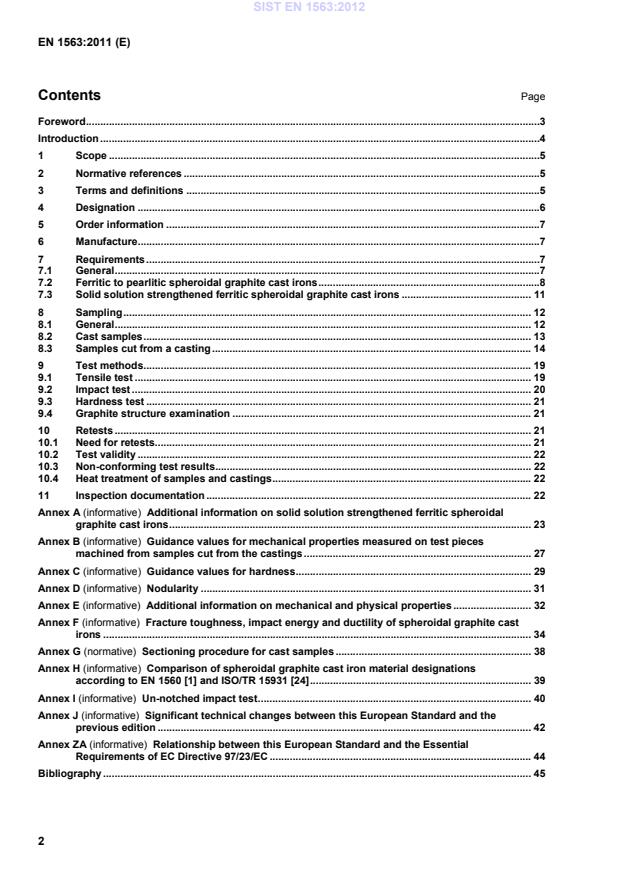
Additional information on solid solution strengthened ferritic spheroidal graphite cast irons . 23Annex B (informative)
Guidance values for mechanical properties measured on test pieces machined from samples cut from the castings . 27Annex C (informative)
Guidance values for hardness . 29Annex D (informative)
Nodularity . 31Annex E (informative)
Additional information on mechanical and physical properties . 32Annex F (informative)
Fracture toughness, impact energy and ductility of spheroidal graphite cast irons . 34Annex G (normative)
Sectioning procedure for cast samples . 38Annex H (informative)
Comparison of spheroidal graphite cast iron material designations according to EN 1560 [1] and ISO/TR 15931 [24] . 39Annex I (informative)
Un-notched impact test . 40Annex J (informative)
Significant technical changes between this European Standard and the previous edition . 42Annex ZA (informative)
Relationship between this European Standard and the Essential Requirements of EC Directive 97/23/EC . 44Bibliography . 45 SIST EN 1563:2012
(ISO 945-1:2008) EN ISO 6506-1, Metallic materials — Brinell hardness test — Part 1: Test method (ISO 6506-1) EN ISO 6892-1:2009, Metallic materials — Tensile testing — Part 1: Method of test at ambient temperature (ISO 6892-1:2009) 3 Terms and definitions For the purposes of this document, the following terms and definitions apply. 3.1 spheroidal graphite cast iron cast material, iron, carbon and silicon-based, the carbon being present mainly in the form of spheroidal graphite particles NOTE Spheroidal graphite cast iron is also known as ductile iron, and less commonly as nodular iron. SIST EN 1563:2012
ferritic to pearlitic spheroidal graphite cast iron spheroidal graphite cast iron with a matrix containing ferrite or pearlite or a combination of both NOTE Pearlite can be partially or totally replaced by bainite or tempered martensite in grades having higher strength 3.3 solid-solution strengthened ferritic spheroidal graphite cast iron spheroidal graphite cast iron with a matrix mainly consisting of ferrite, solution strengthened mainly by silicon 3.4 graphite spheroidizing treatment operation that brings the liquid iron into contact with a substance to produce graphite in the predominantly spheroidal (nodular) form during solidification NOTE This operation is often followed by a second one called inoculation. 3.5 cast sample quantity of material cast to represent the cast material, including separately cast sample, side by side cast sample and cast-on sample 3.6 separately cast sample sample cast in a separate sand mould under representative manufacturing conditions and material grade 3.7 side-by-side cast sample sample cast in the mould alongside the casting, with a joint running system 3.8 cast-on sample sample attached directly to the casting 3.9 relevant wall thickness wall thickness representative of the casting, defined for the determination of the size of the cast samples to which the mechanical properties apply 4 Designation The material shall be designated either by symbol or by number as given in Tables 1, 2 or 3. In the case of samples cut from the casting the letter C is added at the end of the designation by symbol. NOTE The comparison of EN 1563 grade designations with the grades from the ISO standard for spheroidal graphite cast iron, ISO 1083:2004 [11], is given in Annex H. SIST EN 1563:2012
min min min
t ≤ 30 220 350 22 EN-GJS-350-22-LT a 5.3100 30 < t ≤ 60 210 330 18
60 < t ≤ 200 200 320 15
t ≤ 30 220 350 22 EN-GJS-350-22-RT b 5.3101 30 < t ≤ 60 220 330 18
60 < t ≤ 200 210 320 15
t ≤ 30 220 350 22 EN-GJS-350-22 5.3102 30 < t ≤ 60 220 330 18
60 < t ≤ 200 210 320 15
t ≤ 30 240 400 18 EN-GJS-400-18-LT a 5.3103 30 < t ≤ 60 230 380 15
60 < t ≤200 220 360 12
t ≤ 30 250 400 18 EN-GJS-400-18-RT b 5.3104 30 < t ≤ 60 250 390 15
60 < t ≤ 200 240 370 12
t ≤ 30 250 400 18 EN-GJS-400-18 5.3105 30 < t ≤ 60 250 390 15
60 < t ≤ 200 240 370 12
t ≤ 30 250 400 15 EN-GJS-400-15 5.3106 30 < t ≤ 60 250 390 14
60 < t ≤ 200 240 370 11
t ≤ 30 310 450 10 EN-GJS-450-10 5.3107 30 < t ≤ 60 to be agreed upon between the manufacturer and the purchaser
60 < t ≤ 200
t ≤ 30 320 500 7 EN-GJS-500-7 5.3200 30 < t ≤ 60 300 450 7
60 < t ≤ 200 290 420 5
t ≤ 30 370 600 3 EN-GJS-600-3 5.3201 30 < t ≤ 60 360 600 2
60 < t ≤ 200 340 550 1
t ≤ 30 420 700 2 EN-GJS-700-2 5.3300 30 < t ≤ 60 400 700 2
60 < t ≤ 200 380 650 1
t ≤ 30 480 800 2 EN-GJS-800-2 5.3301 30 < t ≤ 60 to be agreed upon between the manufacturer and the purchaser
60 < t ≤ 200
t ≤ 30 600 900 2 EN-GJS-900-2 5.3302 30 < t ≤ 60 to be agreed upon between the manufacturer and the purchaser
60 < t ≤ 200 NOTE The mechanical properties of test pieces machined from cast samples may not reflect exactly the properties of the casting itself. Values for tensile properties of the casting are given in Annex B for guidance. a LT for low temperature. b RT for room temperature. SIST EN 1563:2012
7.2.2 Test pieces machined from samples cut from a casting If applicable, the manufacturer and the purchaser shall agree on: the location(s) on a casting where the sample(s) shall be taken; the mechanical properties that shall be measured; the minimum values, or allowable range of values, for these mechanical properties (for information, see Annex B). NOTE 1 The properties of castings may not be uniform, depending on the complexity of the castings and variation in their section thickness. SIST EN 1563:2012
Tensile strength Elongation t mm Rp0,2 MPa min Rm MPa min A % min Symbol Number EN-GJS-450-18 5.3108 t ≤ 30 350 450 18 30 ≤ t ≤ 60 340 430 14 t > 60 to be agreed upon between the manufacturer and the purchaser EN-GJS-500-14 5.3109 t ≤ 30 400 500 14 30 ≤ t ≤ 60 390 480 12 t > 60 to be agreed upon between the manufacturer and the purchaser EN-GJS-600-10 5.3110 t ≤ 30 470 600 10 30 ≤ t ≤ 60 450 580 8 t > 60 to be agreed upon between the manufacturer and the purchaser NOTE The mechanical properties of test pieces machined from cast samples may not reflect exactly the properties of the casting itself. Values for tensile properties of the casting are given in Annex B for guidance.
The properties of castings may not be uniform, depending on the complexity of the castings and variation in their section thicknesses. 7.3.3 Hardness Brinell hardness and its range values for the grades listed in Table 3 shall only be specified when agreed between the manufacturer and the purchaser by the time of acceptance of the order. Information regarding hardness is given in Annex C. 7.3.4 Graphite structure The graphite structure shall be mainly of form V and VI in accordance with EN ISO 945-1. A more precise definition may be agreed between the manufacturer and the purchaser. NOTE 1 A.2.3 gives more information on graphite structure. NOTE 2 Annex D gives more information regarding nodularity. 7.3.5 Matrix structure Information on matrix structure is given in Table E.1 and A.2.2. 8 Sampling 8.1 General Samples shall be made from the same material as that used to produce the casting(s) which they represent. Several types of samples (separately cast samples, cast-on samples, side-by-side cast samples, samples cut from a casting) can be used, depending on the mass and wall thickness of the casting. When relevant the type of sample should be agreed between the manufacturer and the purchaser. Unless otherwise agreed the choice of the option is left to the discretion of the manufacturer. When the mass of the casting exceeds 2 000 kg and its relevant wall thickness 60 mm, cast-on samples or side-by-side samples should preferably be used; the dimensions and the location of the sample shall be agreed between the manufacturer and the purchaser by the time of acceptance of the order. If the spheroidizing treatment is carried out in the mould (in-mould process), the separately cast sample should be avoided. All samples shall be adequately marked to guarantee full traceability to the castings which they represent. The samples shall be subject to the same heat treatment, as that of the castings they represent, if any. Tensile and impact test pieces shall be finally machined from the samples after the heat treatment. SIST EN 1563:2012
8.2.2 Frequency and number of tests Samples representative of the material shall be produced at a frequency in accordance with the process quality assurance procedures adopted by the manufacturer or as agreed with the purchaser. In the absence of a process quality assurance procedure or any other agreement between the manufacturer and the purchaser, a minimum of one cast sample for the tensile test shall be produced to confirm the material grade, at a frequency to be agreed between the manufacturer and the purchaser. When impact tests are required, samples shall be produced at a frequency to be agreed between the manufacturer and the purchaser. 8.2.3 Separately cast samples The samples shall be cast separately in sand moulds and under representative manufacturing conditions. The moulds used to cast the separately cast samples shall have comparable thermal behaviour to the moulding material used to cast the castings. The samples shall meet the requirements of either Figures 1, 2 or 3. The samples shall be removed from the mould at a temperature similar to that of the castings. 8.2.4 Side-by-side cast samples Side-by-side cast samples are representative of the castings concurrently cast and also of all other castings of a similar relevant wall thickness from the same test unit. SIST EN 1563:2012
Dimensions in millimetres
Key a For information only. b The length z shall be chosen to allow a test piece of dimensions shown in Figure 5 to be machined from the sample. The thickness of the sand mould surrounding the samples shall be at least 40 mm. Figure 1 — Separately cast or side-by-side cast samples — Option 1: U-shaped sample SIST EN 1563:2012
Dimension Type I II III lV u 12,5 25 50 75 v 40 55 100 125 x 25 40 50 65 y a 135 140 150 175 z b A function of the test piece length a For information only. b z shall be chosen to allow a test piece of dimensions shown in Figure 5 to be machined from the cast sample. The thickness of the sand mould surrounding the samples shall be at least: 40 mm for types I and II; 80 mm for type III and IV. Figure 2 — Separately cast or side by side cast samples — Option 2: Y-shaped sample SIST EN 1563:2012
Type a
Type b
Type c
Type A B D H Hb Lf Ln Lt W a 4,5 5,5 25 50 — Lt + 20 Lt – 50 a 100 b 4,5 5,5 25 50 — Lt + 20 Lt – 50 50 c 4,0 5,0 25 35 15 Lt + 20 Lt – 50 50 a Lt shall be chosen to allow a test piece of dimensions shown in Figure 5 to be machined from the cast sample.
The thickness of the sand mould surrounding the samples shall be at least 40 mm. Figure 3 — Separately cast or side-by-side cast samples — Option 3: Round bar-shaped sample
Key 1 casting Dimensions in millimetres Type Relevant wall thickness of castings t a b c h Lt max. min. A t ≤ 12,5 15 11 7,5 20 to 30 a B 12,5 < t ≤ 30 25 19 12,5 30 to 40 C 30 < t ≤ 60 40 30 20 40 to 65 D 60 < t ≤ 200 70 52,5 35 65 to 105 a Lt shall be chosen to allow a test piece of a dimension shown in Figure 5 to be machined from the cast sample. The thickness of the sand mould surrounding the samples shall be at least: 40 mm for types A and B; 80 mm for type C and D. If smaller dimensions are agreed, the followings relationships apply: b = 0,75 × a c = 0,5 × a Figure 4 — Cast-on samples SIST EN 1563:2012
d Lo Lc min. 5 25 30 7 35 42 10 50 60 14 a 70 84 20 100 120 a Preferred dimension for 25 mm cast sample diameter. where Lo is the original gauge length, i.e. Lo = 5 × d; d is the diameter of the test piece along the gauge length; Lc is the parallel length, Lc > Lo (in principle, Lc – Lo ≥ d); Lt is the total length of the test piece, which depends on Lc; r is the transition radius, which shall be at least 4 mm. NOTE The method of gripping the ends of the test piece, together with their length lt may be agreed between the manufacturer and the purchaser. Figure 5 — Tensile test piece 9.2 Impact test The impact test shall be carried out on three Charpy V-notched impact test pieces (see Figure 6) in accordance with EN ISO 148-1:2010, using test equipment with an appropriate energy to determine the properties correctly. SIST EN 1563:2012
Dimensions in millimetres
Figure 6 — Charpy V-notched impact test piece 9.3 Hardness test The hardness shall be determined as Brinell hardness in accordance with EN ISO 6506-1. Alternative hardness tests may also be agreed upon. The test shall be carried out on the test pieces or at one or several points on the castings after preparation of the testing area in accordance with the agreement between the manufacturer and the purchaser. If the measuring locations are not the subject of an agreement, they shall be chosen by the manufacturer. If it is not possible to carry out the hardness test on the casting, then by agreement between the manufacturer and the purchaser, the hardness test may be carried out on a knob cast-on to the casting. 9.4 Graphite structure examination The graphite structure shall be confirmed by metallographic examination. Non-destructive methods can also give information. In case of dispute, the results of the microscopic examination shall prevail. 10 Retests 10.1 Need for retests Retests shall be carried out if a test is not valid. Retests are permitted to be carried out if a test result does not meet the mechanical property requirements for the specified grade. SIST EN 1563:2012
If the manufacturer conducts retests, two retests shall be carried out for each failed test. If both retests give results that meet the specified requirements, the material shall be deemed to conform to this European Standard. If one or both retests give results that fail to meet the specified requirements, the material shall be deemed not to conform to this European Standard. 10.4 Heat treatment of samples and castings Unless otherwise specified, in the case of castings in the as-cast condition with mechanical properties not in conformance with this European Standard, a heat treatment may be carried out. In the case of castings which have undergone a heat treatment and for which the test results are not valid or not satisfactory, the manufacturer shall be permitted to re-heat treat the castings and the representative samples. In this event, the samples shall receive the same number of heat treatments as the castings. If the results of the tests carried out on the test pieces machined from the re-heat treated samples are satisfactory, then the re-heat treated castings shall be regarded as conforming to the specified requirements of this European Standard. The number of re-heat treatment cycles shall not exceed two. 11 Inspection documentation When requested by the purchaser and agreed with the manufacturer, the manufacturer shall issue for the products the appropriate inspection documentation according to EN 10204:2004. When ordering material for pressure equipment applications, the equipment manufacturer has the obligation to request appropriate inspection documentation according to the applicable product or application standard(s), EN 764-5:2002 and EN 10204:2004. The material manufacturer is responsible for affirming conformity with the specification for the material ordered. SIST EN 1563:2012
Additional information on solid solution strengthened ferritic spheroidal graphite cast irons A.1 General This informative annex applies to solid solution strengthened ferritic spheroidal graphite cast iron grades as specified in Table 3. A.2 Material constitution A.2.1 Chemical composition In order to fulfil the requirements for the mechanical properties, a ferritic structure solid solution strengthened by silicon is recommended. Table A.1 — Guidance values for chemical composition
Designation Si % approx. a P % max. Mn % max. b Symbol Number EN-GJS-450-18 5.3108 3,20 0,05 0,50 EN-GJS-500-14 5.3109 3,80 0,05 0,50 EN-GJS-600-10 5.3110 4,30 0,05 0,50 a Si content may be lower due to other alloying elements. b With lower Mn content (e.g. 0,30 %), machinability and elongation will be improved. With increasing silicon content, the carbon content should be decreased correspondingly. A.2.2 Matrix structure The matrix should be predominantly ferrite with a maximum pearlite content of 5 %. The amount of free cementite should not exceed 1 %. A.2.3 Graphite structure The graphite structure should be mainly of form V and VI in accordance with EN ISO 945-1. Due to the increased silicon content, these solid solution strengthened ferritic spheroidal graphite cast irons may show some compacted graphite (form III) in heavy sections. However ferritic matrices are, also for higher levels of solution strengthening by silicon, much less sensitive to reduced nodularity than cast irons strengthened by substantial amounts of pearlite. A level of approximately 20 % of form lll can be accepted, provided the remainder is mainly of form V and VI, to fulfil the minimum tensile properties specified in this European Standard. SIST EN 1563:2012
Rp0,2 (MPa) Key a ferritic, ferritic-pearlitic, pearlitic and ausferritic spheroidal graphite cast irons b solution strengthened ferritic spheroidal graphite cast irons Figure A.1 — Spheroidal graphite cast irons — 25 mm cast samples — Ratio 0,2 % proof strength/tensile strength Another characteristic property of these solid solution strengthened ferritic spheroidal graphite cast irons is that for an equal value in hardness, proof strength is significantly higher, as is shown in Figure A.2 (see also Table C.1). Rp0,2 /Rm SIST EN 1563:2012
Key a ferritic, ferritic-pearlitic and pearlitic spheroidal graphite cast irons b solution strengthened ferritic spheroidal graphite cast irons Figure A.2 — Spheroidal graphite cast irons — Relation between Brinell hardness and 0,2 % proof strength (curve based on the average values of this European Standard) Rp0,2 (MPa) SIST EN 1563:2012
However, the relationship between tensile strength and Brinell hardness is more or less identical to that of the ferritic/pearlitic grades of spheroidal graphite cast irons, as is shown in Figure A.3.
Key a ferritic, ferritic-pearlitic and pearlitic spheroidal graphite cast irons b solution strengthened ferritic spheroidal graphite cast irons Figure A.3 — Spheroidal graphite cast irons — Relation between hardness and tensile strength (curve based on the average values of this European Standard) A.3.2.2 Other mechanical and physical properties For information see Annex E and Annex F. A.3.3 Machinability Compared to the corresponding ferritic/pearlitic grades, the solid solution strengthened ferritic spheroidal graphite cast iron grades exhibit considerably less hardness variation due to their single-phase matrix structure. For a same level of hardness, this reduction in hardness variation (see Table C.1), combined with a negligible amount of pearlite, results i
...