

EN 3-8:2006
(Main)Portable fire extinguishers - Part 8: Additional requirements to EN 3-7 for the construction, resistance to pressure and mechanical tests for extinguishers with a maximum allowable pressure equal to or lower than 30 bar
- Abstract
This European Standard specifies the rules of design, type testing, fabrication and inspection control of portable fire extinguishers manufactured with metallic bodies as far as pressure risk is concerned.
This part applies to portable fire extinguishers of which the maximum allowable pressure PS is lower than or equal to 30 bar and containing non-explosive, non-flammable, non-toxic and non-oxidising fluids.
This European Standard also applies to the metallic gas cartridge of a volume less than 0,12 l (see Annex E) and gives guidance for sound engineering practice for metallic gas cartridges equal to or greater than 0,12 l and less than 0,5 l, see Annex F.
This European Standard does not apply to carbon dioxide fire extinguishers.
NOTE Annex A gives the classification of the different parts forming the portable fire extinguisher.
- Status
- Withdrawn
- Publication Date
- 05-Dec-2006
- Withdrawal Date
- 06-Oct-2026
- Technical Committee
- CEN/TC 70 - Manual means of fire fighting equipment
- Drafting Committee
- CEN/TC 70 - Manual means of fire fighting equipment
- Current Stage
- 9960 - Withdrawal effective - Withdrawal
- Start Date
- 18-Aug-2021
- Completion Date
- 07-Oct-2026
2014/68/EU - Directive 2014/68/EU of the European Parliament and of the Council of 15 May 2014 on the harmonisation of the laws of the Member States relating to the making available on the market of pressure equipmentOJ Ref: C 293/01 OJ Date: 12-Aug-2016
97/23/EC - Pressure equipmentOJ Ref: C, C 118 OJ Date: 26-May-2007



Relations
- Effective Date
- 25-Aug-2021
- Effective Date
- 28-Jan-2026
- Effective Date
- 28-Jan-2026
- Effective Date
- 28-Jan-2026
- Effective Date
- 28-Jan-2026
- Effective Date
- 28-Jan-2026
- Effective Date
- 28-Jan-2026
- Effective Date
- 28-Jan-2026
- Effective Date
- 28-Jan-2026
- Effective Date
- 28-Jan-2026
- Effective Date
- 28-Jan-2026
- Effective Date
- 28-Jan-2026
- Effective Date
- 09-Feb-2026
- Effective Date
- 09-Feb-2026
- Effective Date
- 09-Feb-2026
Get Certified
Connect with accredited certification bodies for this standard

CIS Institut d.o.o.
Personal Protective Equipment (PPE) certification body. Notified Body NB-2890 for EU Regulation 2016/425 PPE.

Kiwa BDA Testing
Building and construction product certification.
Kmetijski inštitut Slovenije
Agricultural Institute of Slovenia. Soil testing, plant health, agricultural product analysis.
Sponsored listings
Frequently Asked Questions
EN 3-8:2006 is a standard published by the European Committee for Standardization (CEN). Its full title is "Portable fire extinguishers - Part 8: Additional requirements to EN 3-7 for the construction, resistance to pressure and mechanical tests for extinguishers with a maximum allowable pressure equal to or lower than 30 bar". This standard covers: This European Standard specifies the rules of design, type testing, fabrication and inspection control of portable fire extinguishers manufactured with metallic bodies as far as pressure risk is concerned. This part applies to portable fire extinguishers of which the maximum allowable pressure PS is lower than or equal to 30 bar and containing non-explosive, non-flammable, non-toxic and non-oxidising fluids. This European Standard also applies to the metallic gas cartridge of a volume less than 0,12 l (see Annex E) and gives guidance for sound engineering practice for metallic gas cartridges equal to or greater than 0,12 l and less than 0,5 l, see Annex F. This European Standard does not apply to carbon dioxide fire extinguishers. NOTE Annex A gives the classification of the different parts forming the portable fire extinguisher.
This European Standard specifies the rules of design, type testing, fabrication and inspection control of portable fire extinguishers manufactured with metallic bodies as far as pressure risk is concerned. This part applies to portable fire extinguishers of which the maximum allowable pressure PS is lower than or equal to 30 bar and containing non-explosive, non-flammable, non-toxic and non-oxidising fluids. This European Standard also applies to the metallic gas cartridge of a volume less than 0,12 l (see Annex E) and gives guidance for sound engineering practice for metallic gas cartridges equal to or greater than 0,12 l and less than 0,5 l, see Annex F. This European Standard does not apply to carbon dioxide fire extinguishers. NOTE Annex A gives the classification of the different parts forming the portable fire extinguisher.
EN 3-8:2006 is classified under the following ICS (International Classification for Standards) categories: 13.220.10 - Fire-fighting. The ICS classification helps identify the subject area and facilitates finding related standards.
EN 3-8:2006 has the following relationships with other standards: It is inter standard links to EN 3-8:2021, EN ISO 15614-2:2005, EN ISO 15614-1:2004, EN 10204:2004, EN 13133:2000, EN ISO 4892-2:1999, EN ISO 9606-2:2004, EN 13134:2000, EN ISO 15614-12:2004, EN 3-7:2004, EN 1320:1996, EN 287-1:2004, EN 61138:1997, EN 50600-2-5:2016, EN IEC 62368-1:2024. Understanding these relationships helps ensure you are using the most current and applicable version of the standard.
EN 3-8:2006 is associated with the following European legislation: EU Directives/Regulations: 2008/68/EC, 2014/68/EU, 2014/90/EU, 94/55/EC, 96/49/EC, 96/86/EC, 96/87/EC, 96/98/EC, 97/23/EC; Standardization Mandates: M/071, M/086. When a standard is cited in the Official Journal of the European Union, products manufactured in conformity with it benefit from a presumption of conformity with the essential requirements of the corresponding EU directive or regulation.
EN 3-8:2006 is available in PDF format for immediate download after purchase. The document can be added to your cart and obtained through the secure checkout process. Digital delivery ensures instant access to the complete standard document.
Standards Content (Sample)
2003-01.Slovenski inštitut za standardizacijo. Razmnoževanje celote ali delov tega standarda ni dovoljeno.Portable fire extinguishers - Part 8: Additional requirements to EN 3-7 for the construction, resistance to pressure and mechanical tests for extinguishers with a maximum allowable pressure equal to or lower than 30 barExtincteurs d'incendie portatifs - Partie 8: Exigences additionnelles a l'EN 3-7 pour la construction, la résistance a la pression et les essais mécaniques pour extincteurs dont la pression maximale admissible est inférieure ou égale a 30 barTragbare Feuerlöscher - Teil 8: Zusätzliche Anforderungen zu EN 3-7 an die konstruktive Ausführung, Druckfestigkeit, mechanische Prüfungen für tragbare Feuerlöscher mit einem maximal zulässigen Druck kleiner gleich 30 barTa slovenski standard je istoveten z:EN 3-8:2006SIST EN 3-8:2007en13.220.10Gašenje požaraFire-fightingICS:SLOVENSKI
STANDARDSIST EN 3-8:200701-marec-2007
EUROPEAN STANDARDNORME EUROPÉENNEEUROPÄISCHE NORMEN 3-8December 2006ICS 13.220.10 English VersionPortable fire extinguishers - Part 8: Additional requirements toEN 3-7 for the construction, resistance to pressure andmechanical tests for extinguishers with a maximum allowablepressure equal to or lower than 30 barExtincteurs d'incendie portatifs - Partie 8: Exigencesadditionnelles à l'EN 3-7 pour la construction, la résistanceà la pression et les essais mécaniques pour extincteursdont la pression maximale admissible est inférieure ouégale à 30 barTragbare Feuerlöscher - Teil 8: Zusätzliche Anforderungenzu EN 3-7 an die konstruktive Ausführung, Druckfestigkeit,mechanische Prüfungen für tragbare Feuerlöscher miteinem maximal zulässigen Druck kleiner gleich 30 barThis European Standard was approved by CEN on 2 November 2006.CEN members are bound to comply with the CEN/CENELEC Internal Regulations which stipulate the conditions for giving this EuropeanStandard the status of a national standard without any alteration. Up-to-date lists and bibliographical references concerning such nationalstandards may be obtained on application to the Central Secretariat or to any CEN member.This European Standard exists in three official versions (English, French, German). A version in any other language made by translationunder the responsibility of a CEN member into its own language and notified to the Central Secretariat has the same status as the officialversions.CEN members are the national standards bodies of Austria, Belgium, Cyprus, Czech Republic, Denmark, Estonia, Finland, France,Germany, Greece, Hungary, Iceland, Ireland, Italy, Latvia, Lithuania, Luxembourg, Malta, Netherlands, Norway, Poland, Portugal, Romania,Slovakia, Slovenia, Spain, Sweden, Switzerland and United Kingdom.EUROPEAN COMMITTEE FOR STANDARDIZATIONCOMITÉ EUROPÉEN DE NORMALISATIONEUROPÄISCHES KOMITEE FÜR NORMUNGManagement Centre: rue de Stassart, 36
B-1050 Brussels© 2006 CENAll rights of exploitation in any form and by any means reservedworldwide for CEN national Members.Ref. No. EN 3-8:2006: E
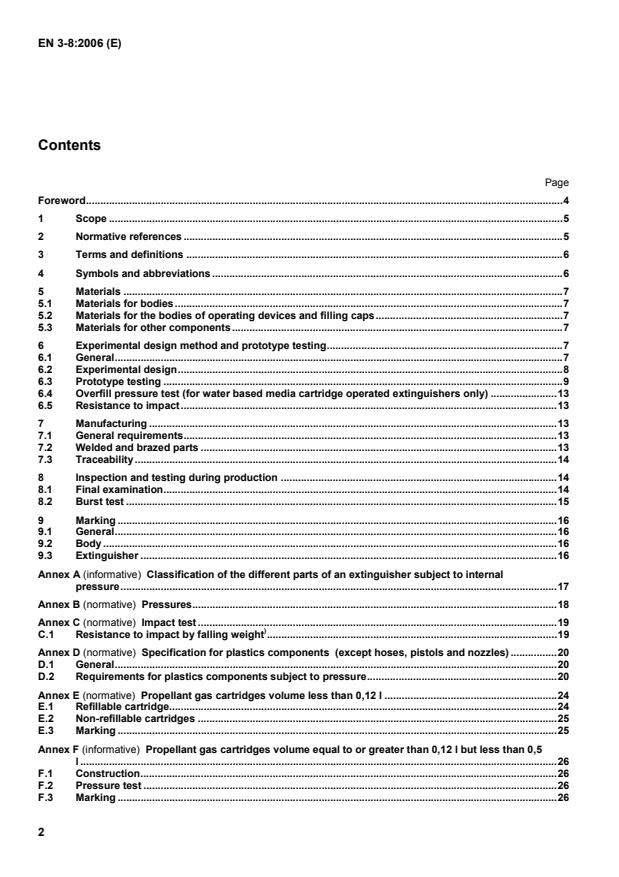
Classification of the different parts of an extinguisher subject to internal pressure.17 Annex B (normative)
Pressures.18 Annex C (normative)
Impact test.19 C.1 Resistance to impact by falling weight).19 Annex D (normative)
Specification for plastics components
(except hoses, pistols and nozzles).20 D.1 General.20 D.2 Requirements for plastics components subject to pressure.20 Annex E (normative)
Propellant gas cartridges volume less than 0,12 l.24 E.1 Refillable cartridge.24 E.2 Non-refillable cartridges.25 E.3 Marking.25 Annex F (informative)
Propellant gas cartridges volume equal to or greater than 0,12 l but less than 0,5 l.26 F.1 Construction.26 F.2 Pressure test.26 F.3 Marking.26
Overfill pressure test.28 Annex ZA (informative)
Relationship between this European Standard and the Essential Requirements of EU Directive 97/23/EC.29
Figure 1 — Crushing test for long bodies.10 Figure 2 — Crushing test for short bodies.11 Table 1 — Number of bodies to be sampled.15 Table 2 — Batch sampling plan following failure.16 Table A.1 — Classification.17 Figure B.1 — Scheme of pressure.18 Table D.1 — Drop height for hammer test.22 Figure D.1 — Example of thread profile.23 Table ZA.1 — Correspondence between this European Standard and Directive 97/23/EC.29
conformity of a portable fire extinguisher to EN 3 part 7 According to the CEN/CENELEC Internal Regulations, the national standards organizations of the following countries are bound to implement this European Standard: Austria, Belgium, Cyprus, Czech Republic, Denmark, Estonia, Finland, France, Germany, Greece, Hungary, Iceland, Ireland, Italy, Latvia, Lithuania, Luxembourg, Malta, Netherlands, Norway, Poland, Portugal, Romania, Slovakia, Slovenia, Spain, Sweden, Switzerland and United Kingdom.
1) Withdrawn and replaced by EN 3-7. 2) EN 3-8 and 3-9 update and amend EN 3-3. On publication of these EN 3-3 will be withdrawn. 3) In preparation. EN 3-10 updates and amends EN 3-6. On publication of EN 3-10 EN 3-6 will be withdrawn.
Annex A gives the classification of the different parts forming the portable fire extinguisher. 2 Normative references The following referenced documents are indispensable for the application of this document. For dated references, only the edition cited applies. For undated references, the latest edition of the referenced document (including any amendments) applies. EN 3-7:2004, Portable fire extinguishers — Part 7: Characteristics, performance requirements and test methods EN 287-1:2004, Qualification test of welders — Fusion welding — Part 1: Steels EN 1320:1996, Destructive tests on welds in metallic materials — Fracture test EN 1418:1997, Welding personnel — Approval testing of welding operators for fusion welding and resistance weld setters for fully mechanized and automatic welding of metallic materials EN 10204:20044), Metallic products — Types of inspection documents EN 13133:2000, Brazing — Brazer approval EN 13134:2000, Brazing — Procedure approval EN ISO 4892-2:1999, Plastics — Methods of exposure to laboratory light sources — Part 2: Xenon-arc lamps (ISO 4892-2:2006) EN ISO 9606-2:2004, Qualification test of welders — Fusion welding — Part 2: Aluminium and aluminium alloys (ISO 9606-2:2004) EN ISO 15614-1:2004, Specification and qualification of welding procedures for metallic materials — Welding procedure test — Part 1: Arc and gas welding of steels and arc welding of nickel and nickel alloys (ISO 15614-1:2004) EN ISO 15614-2:2005, Specification and qualification of welding procedures for metallic materials — Welding procedure test - Part 2: Arc welding of aluminium and its alloys (ISO 15614-2:2005) EN ISO 15614-12:2004, Specification and qualification of welding procedures for metallic materials — Welding procedure test — Part 12: Spot, seam and projection welding (ISO 15614-12:2004)
4) This standard is also applicable to non-metallic products (see EN 10204:2004, 1.2).
A wider temperature range may be declared by the manufacturer.
Where this is the case, the temperatures and pressures used in this European Standard shall be amended to reflect this new temperature range.
5 specimens; for 6.3.3:
5 specimens. The tests described in 6.3.2 and 6.3.3 shall be carried out on a minimum of 10 bodies and fittings. All the bodies used for the tests shall bear all normal markings indicated in Clause 9 and shall be in their finished state (e.g. painted). Fittings include operating devices, filling caps and hose assemblies. The fittings need not be tested as part of the complete extinguisher but the test equipment connection and blanking features shall replicate the adjacent components. 6.3.2 Burst test under pressure 6.3.2.1 Test conditions The burst test under hydraulic pressure shall be carried out using an installation which permits a regular increase of pressure at not more than 2 bar/s until the body bursts and also permits the variation of pressure to be recorded as a function of time. 6.3.2.2 Requirements – Bodies The bursting pressure Pr shall not be less than 2,7 times the maximum allowable pressure PS subject to a minimum of 55 bar. The burst test shall not cause the body to fragment. The main break shall show no signs of brittleness, for example the edges of the break shall not be radial, but shall be inclined relative to a diametral plane and shall have a reduction in area over their entire thickness. The break shall not show any obvious defects in the material. The break shall not originate in the body marking area or weld. 6.3.2.3 Requirements – Fittings The bursting pressure Pr shall not be less than 2,7 times the maximum allowable pressure PS. The burst test shall not cause the fitting to fragment. The break shall not show any obvious defects in the material. The break shall not originate in the marking area.
Key D nominal external diameter of the body DB diameter of the mandrel Figure 1 — Crushing test for long bodies
The body shall be crushed to (10 ± 1) % of its external diameter. The duration of the movement of the mandrel shall be within a period of 30 s to 60 s. For bodies with a longitudinal weld, the weld seam shall be at 90° to the support line. For bodies with a transverse weld, the crushing shall be carried out at an angle of 45° to the weld. Following the crushing test, the body shall be subjected to the test pressure PT. The body shall not have any cracks or leaks.
Key R (12,5 ± 1) mm D/3 ± 1 % D = distance between mandrels at completion of crushing D actual outside diameter of cylinder Figure 2 — Crushing test for short bodies 6.3.4 Pressure test (test pressure PT) – Bodies, fittings and assemblies 6.3.4.1 Test conditions Bodies, fittings and assemblies shall be submitted to the pressure test which shall be carried out using apparatus that permits a regular increase of pressure at a maximum of 2 bar/s up to the moment the test pressure is reached. Five samples of bodies and fittings and one assembly shall be tested.
...