

EN 12201-2:2011
(Main)Plastics piping systems for water supply, and for drainage and sewerage under pressure - Polyethylene (PE) - Part 2: Pipes
- Abstract
This European Standard specifies the characteristics of pipes made from polyethylene (PE 100, PE 80 and PE 40)
for buried and above ground applications, intended for the conveyance of water for human consumption, raw water
prior to treatment, drainage and sewerage under pressure, vacuum sewer systems, and water for other purposes.
NOTE 1 For PE components intended for the conveyance of water for human consumption and raw water prior to treatment
attention is drawn to 5.3 of this European Standard. Components manufactured for water for general purposes, drainage and
sewerage may not be suitable for water supply for human consumption.
It also specifies the test parameters for the test methods referred to in this standard.
In conjunction with Part 1 and Parts 3 to 5 of EN 12201, it is applicable to PE pipes, their joints and to joints with
components of PE and other materials intended to be used under the following conditions:
a) allowable operating pressure, PFA, up to 25 bar 1);
b) an operating temperature of 20 °C as a reference temperature;
c) buried in the ground;
d) sea outfalls;
e) laid in water;
f) above ground, including pipes suspended below bridges.
NOTE 2 For applications operating at constant temperatures greater than 20 °C and up to 40 °C, see Annex A of EN 12201-
1:2011.
NOTE 3 Pipes constructions including barrier layers are not covered by this document.
EN 12201 covers a range of allowable operating pressures and gives requirements concerning colours and
additives.
It covers three types of pipe:
PE pipes (outside diameter dn) including any identification stripes;
PE pipes with co-extruded layers on either or both the outside and/or inside of the pipe (total outside diameter
dn) as specified in Annex B, where all layers have the same MRS rating;
PE pipes (outside diameter dn) with a peelable, contiguous thermoplastics additional layer on the outside of the
pipe (‘coated pipe’) as specified in Annex C.
NOTE 4 It is the responsibility of the purchaser or specifier to make the appropriate selections from these aspects, taking into
account their particular requirements and any relevant national guidance or regulations and installation practices or codes.
NOTE 5 Assessment of the resistance to slow crack growth of the PE pipe compound used for the manufacture of products
to this document is required in accordance with Table 2 of EN 12201-1:2011.
- Status
- Withdrawn
- Publication Date
- 06-Sep-2011
- Withdrawal Date
- 24-Sep-2013
- Technical Committee
- CEN/TC 155 - Plastics piping systems and ducting systems
- Current Stage
- 9960 - Withdrawal effective - Withdrawal
- Start Date
- 25-Sep-2013
- Completion Date
- 25-Sep-2013

Relations
- Effective Date
- 01-Apr-2009
- Replaces
EN 12201-2:2003 - Plastics piping systems for water supply - Polyethylene (PE) - Part 2: Pipes - Effective Date
- 01-Apr-2009
- Effective Date
- 19-Jan-2023
- Effective Date
- 25-Aug-2026
- Effective Date
- 25-Aug-2026
- Effective Date
- 09-Feb-2026
- Effective Date
- 09-Feb-2026
- Effective Date
- 28-Jan-2026
- Effective Date
- 28-Jan-2026
- Effective Date
- 28-Jan-2026
- Effective Date
- 28-Jan-2026
- Effective Date
- 28-Jan-2026
- Effective Date
- 28-Jan-2026
- Effective Date
- 28-Jan-2026
- Effective Date
- 28-Jan-2026
Get Certified
Connect with accredited certification bodies for this standard

DIBt (Deutsches Institut für Bautechnik)
German Institute for Building Technology.
DIN CERTCO
DIN Group product certification.
Zavod za gradbeništvo Slovenije (ZAG) - Inšpekcija
ZAG inspection body for construction products, structures, and materials.
Sponsored listings
Frequently Asked Questions
EN 12201-2:2011 is a standard published by the European Committee for Standardization (CEN). Its full title is "Plastics piping systems for water supply, and for drainage and sewerage under pressure - Polyethylene (PE) - Part 2: Pipes". This standard covers: This European Standard specifies the characteristics of pipes made from polyethylene (PE 100, PE 80 and PE 40) for buried and above ground applications, intended for the conveyance of water for human consumption, raw water prior to treatment, drainage and sewerage under pressure, vacuum sewer systems, and water for other purposes. NOTE 1 For PE components intended for the conveyance of water for human consumption and raw water prior to treatment attention is drawn to 5.3 of this European Standard. Components manufactured for water for general purposes, drainage and sewerage may not be suitable for water supply for human consumption. It also specifies the test parameters for the test methods referred to in this standard. In conjunction with Part 1 and Parts 3 to 5 of EN 12201, it is applicable to PE pipes, their joints and to joints with components of PE and other materials intended to be used under the following conditions: a) allowable operating pressure, PFA, up to 25 bar 1); b) an operating temperature of 20 °C as a reference temperature; c) buried in the ground; d) sea outfalls; e) laid in water; f) above ground, including pipes suspended below bridges. NOTE 2 For applications operating at constant temperatures greater than 20 °C and up to 40 °C, see Annex A of EN 12201- 1:2011. NOTE 3 Pipes constructions including barrier layers are not covered by this document. EN 12201 covers a range of allowable operating pressures and gives requirements concerning colours and additives. It covers three types of pipe: PE pipes (outside diameter dn) including any identification stripes; PE pipes with co-extruded layers on either or both the outside and/or inside of the pipe (total outside diameter dn) as specified in Annex B, where all layers have the same MRS rating; PE pipes (outside diameter dn) with a peelable, contiguous thermoplastics additional layer on the outside of the pipe (‘coated pipe’) as specified in Annex C. NOTE 4 It is the responsibility of the purchaser or specifier to make the appropriate selections from these aspects, taking into account their particular requirements and any relevant national guidance or regulations and installation practices or codes. NOTE 5 Assessment of the resistance to slow crack growth of the PE pipe compound used for the manufacture of products to this document is required in accordance with Table 2 of EN 12201-1:2011.
This European Standard specifies the characteristics of pipes made from polyethylene (PE 100, PE 80 and PE 40) for buried and above ground applications, intended for the conveyance of water for human consumption, raw water prior to treatment, drainage and sewerage under pressure, vacuum sewer systems, and water for other purposes. NOTE 1 For PE components intended for the conveyance of water for human consumption and raw water prior to treatment attention is drawn to 5.3 of this European Standard. Components manufactured for water for general purposes, drainage and sewerage may not be suitable for water supply for human consumption. It also specifies the test parameters for the test methods referred to in this standard. In conjunction with Part 1 and Parts 3 to 5 of EN 12201, it is applicable to PE pipes, their joints and to joints with components of PE and other materials intended to be used under the following conditions: a) allowable operating pressure, PFA, up to 25 bar 1); b) an operating temperature of 20 °C as a reference temperature; c) buried in the ground; d) sea outfalls; e) laid in water; f) above ground, including pipes suspended below bridges. NOTE 2 For applications operating at constant temperatures greater than 20 °C and up to 40 °C, see Annex A of EN 12201- 1:2011. NOTE 3 Pipes constructions including barrier layers are not covered by this document. EN 12201 covers a range of allowable operating pressures and gives requirements concerning colours and additives. It covers three types of pipe: PE pipes (outside diameter dn) including any identification stripes; PE pipes with co-extruded layers on either or both the outside and/or inside of the pipe (total outside diameter dn) as specified in Annex B, where all layers have the same MRS rating; PE pipes (outside diameter dn) with a peelable, contiguous thermoplastics additional layer on the outside of the pipe (‘coated pipe’) as specified in Annex C. NOTE 4 It is the responsibility of the purchaser or specifier to make the appropriate selections from these aspects, taking into account their particular requirements and any relevant national guidance or regulations and installation practices or codes. NOTE 5 Assessment of the resistance to slow crack growth of the PE pipe compound used for the manufacture of products to this document is required in accordance with Table 2 of EN 12201-1:2011.
EN 12201-2:2011 is classified under the following ICS (International Classification for Standards) categories: 23.040.05 - Pipeline and its parts for external sewage systems; 23.040.20 - Plastics pipes; 91.140.60 - Water supply systems; 93.020 - Earthworks. Excavations. Foundation construction. Underground works; 93.030 - External sewage systems. The ICS classification helps identify the subject area and facilitates finding related standards.
EN 12201-2:2011 has the following relationships with other standards: It is inter standard links to EN 13244-2:2002, EN 12201-2:2003, EN 12201-2:2011+A1:2013, ISO 4433-2:1997, ISO 4433-1:1997, ISO 11357-6:2008, ISO 6259-3:1997, EN ISO 3126:2005, EN ISO 13968:2008, EN 3858:2002, EN ISO 2505:2023, EN ISO 1133-2:2011, EN ISO 1133-1:2022, EN 12201-5:2024, EN ISO 6259-1:2015. Understanding these relationships helps ensure you are using the most current and applicable version of the standard.
EN 12201-2:2011 is associated with the following European legislation: EU Directives/Regulations: 305/2011, 89/106/EEC. When a standard is cited in the Official Journal of the European Union, products manufactured in conformity with it benefit from a presumption of conformity with the essential requirements of the corresponding EU directive or regulation.
EN 12201-2:2011 is available in PDF format for immediate download after purchase. The document can be added to your cart and obtained through the secure checkout process. Digital delivery ensures instant access to the complete standard document.
Standards Content (Sample)
2003-01.Slovenski inštitut za standardizacijo. Razmnoževanje celote ali delov tega standarda ni dovoljeno.Cevni sistemi iz polimernih materialov za oskrbo z vodo in za odvodnjavanje in kanalizacijo pod tlakom - Polietilen (PE) - 2. del: CeviKunststoff-Rohrleitungssysteme für die Wasserversorgung und für Entwässerungs- und Abwasserdruckleitungen - Polyethylen (PE) - Teil 2: RohreSystèmes de canalisations en plastique pour l'alimentation en eau et pour les branchements et les collecteurs d'assainissement avec pression - Polyéthylène (PE) - Partie 2: TubesPlastics piping systems for water supply, and for drainage and sewerage under pressure - Polyethylene (PE) - Part 2: Pipes93.030Zunanji sistemi za odpadno vodoExternal sewage systems91.140.60Sistemi za oskrbo z vodoWater supply systems23.040.20Cevi iz polimernih materialovPlastics pipesICS:Ta slovenski standard je istoveten z:EN 12201-2:2011SIST EN 12201-2:2011en,fr,de01-december-2011SIST EN 12201-2:2011SLOVENSKI
STANDARDSIST EN 13244-2:2003SIST EN 12201-2:20031DGRPHãþD
EUROPEAN STANDARD NORME EUROPÉENNE EUROPÄISCHE NORM
EN 12201-2
September 2011 ICS 23.040.20 Supersedes EN 12201-2:2003, EN 13244-2:2002English Version
Plastics piping systems for water supply, and for drainage and sewerage under pressure - Polyethylene (PE) - Part 2: Pipes
Systèmes de canalisations en plastique pour l'alimentation en eau et pour les branchements et les collecteurs d'assainissement avec pression - Polyéthylène (PE) - Partie 2: Tubes
Kunststoff-Rohrleitungssysteme für die Wasserversorgung und für Entwässerungs- und Abwasserdruckleitungen - Polyethylen (PE) - Teil 2: Rohre This European Standard was approved by CEN on 8 July 2011.
CEN members are bound to comply with the CEN/CENELEC Internal Regulations which stipulate the conditions for giving this European Standard the status of a national standard without any alteration. Up-to-date lists and bibliographical references concerning such national standards may be obtained on application to the CEN-CENELEC Management Centre or to any CEN member.
This European Standard exists in three official versions (English, French, German). A version in any other language made by translation under the responsibility of a CEN member into its own language and notified to the CEN-CENELEC Management Centre has the same status as the official versions.
CEN members are the national standards bodies of Austria, Belgium, Bulgaria, Croatia, Cyprus, Czech Republic, Denmark, Estonia, Finland, France, Germany, Greece, Hungary, Iceland, Ireland, Italy, Latvia, Lithuania, Luxembourg, Malta, Netherlands, Norway, Poland, Portugal, Romania, Slovakia, Slovenia, Spain, Sweden, Switzerland and United Kingdom.
EUROPEAN COMMITTEE FOR STANDARDIZATION
COMITÉ EUROPÉEN DE NORMALISATION EUROPÄISCHES KOMITEE FÜR NORMUNG
Management Centre:
Avenue Marnix 17,
B-1000 Brussels © 2011 CEN All rights of exploitation in any form and by any means reserved worldwide for CEN national Members. Ref. No. EN 12201-2:2011: ESIST EN 12201-2:2011
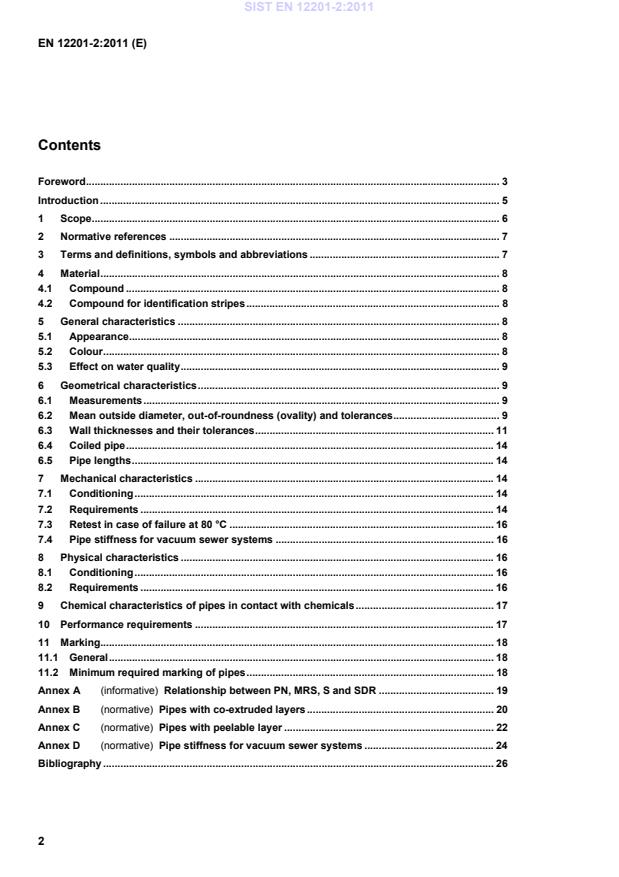
Relationship between PN, MRS, S and SDR . 19Annex B(normative)
Pipes with co-extruded layers . 20Annex C(normative)
Pipes with peelable layer . 22Annex D(normative)
Pipe stiffness for vacuum sewer systems . 24Bibliography . 26 SIST EN 12201-2:2011
System Standards are based on the results of the work being undertaken in ISO/TC 138, "Plastics pipes, fittings and valves for the transport of fluids", which is a Technical Committee of the International Organization for Standardization (ISO). They are supported by separate standards on test methods to which references are made throughout the System Standard.
The System Standards are consistent with general standards on functional requirements and on recommended practice for installation.
EN 12201 consists of the following parts: EN 12201-1:, Plastics piping systems for water supply, and for drainage and sewerage under pressure — Polyethylene (PE) — Part 1: General; EN 12201-2:, Plastics piping systems for water supply, and for drainage and sewerage under pressure — Polyethylene (PE) — Part 2: Pipes (this standard); EN 12201-3:, Plastics piping systems for water supply, and for drainage and sewerage under pressure — Polyethylene (PE) — Part 3: Fittings; EN 12201-4 , Plastics piping systems for water supply, and for drainage and sewerage under pressure — Polyethylene (PE) — Part 4: Valves for water supply systems; EN 12201-5, Plastics piping systems for water supply, and for drainage and sewerage under pressure — Polyethylene (PE) — Part 5: Fitness for purpose of the system; CEN/TS 12201-7, Plastics piping systems for water supply — Polyethylene (PE) — Part 7: Guidance for the assessment of conformity.
In this revision, the scope of this standard includes two additional types of pipe;- PE pipes with co-extruded layers on either or both the outside and/or inside of the pipe as specified in Annex B, where all layers have the same MRS rating; PE pipes with a peelable, contiguous thermoplastics additional layer on the outside of the pipe (‘coated pipe’) as specified in Annex C. In this revision, pipe diameters specified have been increased to 2500 mm. Test methods have been updated as appropriate and in accordance with other parts of this standard.
EN 12201-1:2011, EN 12201-3:2011 [1] and prEN 12201-4:2011 [2]. Characteristics for fitness of purpose are covered in EN 12201-5:2011 and CEN/TS 12201-7 [3] gives guidance for the assessment of conformity. This Part of EN 12201 covers the characteristics of pipes. SIST EN 12201-2:2011
NOTE 2 For applications operating at constant temperatures greater than 20 °C and up to 40 °C, see Annex A of
EN 12201-1:2011. NOTE 3 Pipes constructions including barrier layers are not covered by this document.
EN 12201 covers a range of allowable operating pressures and gives requirements concerning colours and additives. It covers three types of pipe: PE pipes (outside diameter dn) including any identification stripes; PE pipes with co-extruded layers on either or both the outside and/or inside of the pipe (total outside diameter dn) as specified in Annex B, where all layers have the same MRS rating; PE pipes (outside diameter dn) with a peelable, contiguous thermoplastics additional layer on the outside of the pipe (‘coated pipe’) as specified in Annex C. NOTE 4 It is the responsibility of the purchaser or specifier to make the appropriate selections from these aspects, taking into account their particular requirements and any relevant national guidance or regulations and installation practices or codes. NOTE 5 Assessment of the resistance to slow crack growth of the PE pipe compound used for the manufacture of products to this document is required in accordance with Table 2 of EN 12201-1:2011.
1) 1 bar = 0,1 MPa = 105 Pa; 1 MPa = 1 N/mm2. SIST EN 12201-2:2011
EN ISO 13968, Plastics piping and ducting systems —Thermoplastics pipes — Determination of ring flexibility (ISO 13968:2008) ISO 4433-1:1997, Thermoplastics pipes — Resistance to liquid chemicals — Classification — Part 1: Immersion test method ISO 4433-2:1997, Thermoplastics pipes — Resistance to liquid chemicals — Classification — Part 2: Polyolefin pipes ISO 6259-3:1997, Thermoplastics pipes — Determination of tensile properties — Part 3: Polyolefin pipes ISO 11357-6, Plastics — Differential scanning calorimetry (DSC) — Part 6: Determination of oxidation induction time (isothermal OIT) and oxidation induction temperature (dynamic OIT) 3 Terms and definitions, symbols and abbreviations For the purposes of this document, the terms and definitions, symbols and abbreviations given in
EN 12201-1 apply. SIST EN 12201-2:2011
The ends of the pipe shall be cut cleanly and square to the axis of the pipe. 5.2 Colour Pipes intended for the conveyance of water for human consumption shall be black or blue. In addition, black pipes may be identified by blue stripes, according to national preference. Blue pipes or black pipes with blue stripes are intended for the conveyance of water for human consumption only.
Pipes intended for other purposes, drainage and sewerage shall be black or black with brown stripes or according to national preference.
The outer coextruded layer of coextruded pipes (see Annex B) or the outer peelable layer of peelable layer pipes (see Annex C) for pipe intended for the conveyance of water for human consumption shall be either black or blue. In addition identification stripes may be used according to national preference for the application. The outer coextruded layer of coextruded pipes (see Annex B) or the outer peelable layer of peelable layer pipes (see Annex C) for pipe intended for other purposes shall be either black or black with brown stripes or brown or according to national preference. In addition identification stripes of a different colour may be used according to national preference for the application.
NOTE 1 In some countries, pipes made from non-pigmented compound in conjunction with an external peelable layer are permitted, providing the compound conforms to the requirements of this standard. If this is allowed in a country, this should be clearly stated in the national foreword. NOTE 2 For above ground installations, all components other than black should be protected from direct UV light. NOTE 3 The national preference for colour should be stated in the National Foreword. SIST EN 12201-2:2011
1 000
1 200 1 400 1 600 1 800 2 000
2 250
2 500 16 20 25 32 40 50 63 75 90 110 125 140 160 180 200 225 250 280 315 355 400 450 500 560 630 710 800 900 1 000 1 200 1 400 1 600 1 800 2 000
2 250
2 500
16,0 20,0 25,0 32,0 40,0 50,0 63,0 75,0 90,0 110,0 125,0 140,0 160,0 180,0 200,0 225,0 250,0 280,0 315,0 355,0 400,0 450,0 500,0 560,0 630,0 710,0 800,0 900,0 1 000,0 1 200,0 1 400,0 1 600,0
1 800,0 2 000,0
2 250,0
2 500,0 16,3 20,3 25,3 32,3 40,4 50,4 63,4 75,5 90,6 110,7 125,8 140,9 161,0 181,1 201,2 226,4 251,5 281,7 316,9 357,2 402,4 452,7 503,0 563,4 633,8 716,4 807,2 908,1 1 009,0 1 210,8 c 1 412,6 c 1 614,4 c 1 816,2 c
2 018,0 c
2270,3 c
2522,5 c
1,2 1,2 1,2 1,3 1,4 1,4 1,5 1,6 1,8 2,2 2,5 2,8 3,2 3,6 4,0 4,5 5,0 9,8 11,1 12,5 14,0 15,6 17,5 19,6 22,1 24,9 28,0 — — — — — —
—
—
—
a
In accordance with ISO 11922-1:1997 [7] grade B for sizes ≤ 630 and grade A for sizes > 710 except for dn 40 and 50. b In accordance with ISO 11922-1:1997 [7] grade N for sizes ≤ 630 and is measured at the point of manufacture. c
Tolerance calculated as 0,009dn and does not conform to grade A in ISO 11922-1:1997 [7]. d For straight lengths of pipe with diameters ≥ 900 the maximum out-of-roundness shall be agreed between the manufacturer and the purchaser.
NOTE 2 Tolerance bands in accordance with ISO 11922-1:1997 [7] are calculated using the following formulae, as applicable. a)
Grade A: 0,009dn rounded to the next greater 0,1 mm with a minimum value of 0,3 mm and a maximum value of 10,0 mm; b)
Grade B: 0,006dn rounded up to the next greater 0,1 mm with a minimum value of 0,3 mm and a maximum value of 4,0 mm; c)
Grade N:
...