

EN 12984:2005+A1:2010
(Main + Amendment)Food processing machinery - Portable and/or hand-guided machines and appliances with mechanically driven cutting tools - Safety and hygiene requirements
- Abstract
1.1 This European Standard covers portable and/or hand-guided machines and appliances equipped with mechanically driven cutting tools.
This European Standard specifies requirements for the design and manufacture of portable and/or hand-guided machines and appliances equipped with electrically, hydraulically or pneumatically driven cutting tools (see Figures 1 to 9), hereinafter referred to as "machines".
The machines covered by this European Standard are used for slaughtering animals, for cutting up animal carcasses, poultry and other foodstuff such as e.g. fish.
They are mainly intended for use in slaughterhouses and rooms, which are used for cutting and preparing. These machines are used for the industry and trade.
This European Standard specifies all significant hazards, hazardous situations and events relevant to the machines in the scope, when they are used as intended and under conditions of misuse which are reasonably foreseeable by the manufacturer (see Clause 4).
This European Standard deals with the hazards which can arise during commissioning, operation, maintenance and de-commissioning of the machine.
This European Standard is not applicable to portable and/or hand-guided machines and appliances equipped with electrically, hydraulically or pneumatically driven cutting tools, which are manufactured before the date of publication of this European Standard by CEN.
1.2 This European Standard covers the following machines subdivided into tool types:
1.2.1 Saws (see Figures 1 to 5)
- Circular saws (see Figures 1 and 2);
- straight blade reciprocating saws (see Figures 3 and 4);
- band saws (see Figure 5).
Figure 1 - Cutting saw
Figure 2 - Leg saw, horn saw
Figure 3 - Sternum saw
Figure 4 - Reciprocating saw
Figure 5 - Band saw for carcasses
1.2.2 Shears, pincers (see Figures 6 and 7)
Figure 6 - Pincer/shear
Figure 7 - Pincer for cutting the feet of pigs/shear
1.2.3 Knives (see Figures 8 and 9)
- Ring-blade circu
- Status
- Published
- Publication Date
- 08-Jun-2010
- Withdrawal Date
- 30-Dec-2010
- Technical Committee
- CEN/TC 153 - Food processing machinery - Safety and hygiene specifications
- Drafting Committee
- CEN/TC 153/WG 2 - Meat processing machinery
- Current Stage
- 9092 - Decision on results of review/2YR ENQ - revise - Review Enquiry
- Start Date
- 13-Oct-2024
- Completion Date
- 07-Oct-2026
- Directive
- 2006/42/EC - Directive 2006/42/EC of the European Parliament and of the Council of 17 May 2006 on machinery, and amending Directive 95/16/EC (recast)OJ Ref: C, C 284 OJ Date: 20-Oct-2010

Overview - EN 12984:2005+A1:2010 (CEN)
EN 12984:2005+A1:2010 is a European (CEN) Type C standard that sets safety and hygiene requirements for portable and/or hand‑guided food processing machinery equipped with mechanically driven cutting tools. It covers electrically, hydraulically or pneumatically driven saws, shears/pincers and knives used mainly in slaughterhouses, meat processing and fish processing environments. The standard addresses hazards during commissioning, operation, maintenance and de‑commissioning and includes Amendment 1 (2010).
Keywords: EN 12984, food processing machinery, portable hand-guided machines, safety and hygiene requirements, CEN standard.
Key topics and technical requirements
- Scope and machine types: circular saws, reciprocating and band saws, leg/horn/ sternum saws, pincers/shears, ring-blade and rotating knives, derinders and flexible-driven circular knives.
- Hazard identification: mechanical, electrical, hydraulic/pneumatic, noise, vibration, ergonomic and hygiene hazards; includes foreseeable misuse.
- Design and construction: requirements for guards, fixed and movable protective devices, safe power transmission and ergonomic controls suitable for hand‑guided operation.
- Hygiene and cleanability: design principles (Annex A) to ensure surfaces, joints and fasteners in food areas are cleanable and minimise contamination risk; guidance on cleaning (including considerations for pressurised water).
- Safety verification and information: tests, verification of protective measures, marking, operating instructions and operator training requirements.
- Lifecycle coverage: measures for commissioning, routine use, maintenance and de‑commissioning.
- Regulatory alignment: relationship to Machinery Directive (EU Directive 2006/42/EC) and complements EN 1672‑2 (hygiene requirements).
Practical applications - who uses this standard
- Machine designers and manufacturers developing portable/hand‑guided cutting tools for the meat, poultry and fish industries to achieve CE compliance.
- Safety engineers and compliance officers who evaluate machinery risk assessments and verify conformity with EU machinery safety and hygiene expectations.
- Meat processors, slaughterhouses and food processors selecting safe, hygienic tools for carcass cutting, skinning, halving and trimming operations.
- Testing and certification bodies assessing guards, ergonomics, noise/vibration mitigation and cleanability.
Related standards
- EN 1672‑2 (Food processing machinery - Hygiene)
- EN 60204‑1 (Electrical equipment of machines)
- EN 60745‑1 (Hand‑held motor-operated tools)
- EN 953 (Machine guards)
- EN 982 / EN 983 (Hydraulic/pneumatic safety)
- EN ISO 11688‑1 (Noise design)
EN 12984 is essential for ensuring that portable cutting tools used in food processing meet recognised safety, hygiene and ergonomic best practices across European markets.
Relations
- Effective Date
- 12-Apr-2010
- Effective Date
- 25-Aug-2026
- Effective Date
- 09-Feb-2026
- Refers
EN 60745-1:2006 - Hand-held motor-operated electric tools - Safety - Part 1: General requirements - Effective Date
- 09-Feb-2026
- Effective Date
- 09-Feb-2026
- Effective Date
- 28-Jan-2026
- Effective Date
- 28-Jan-2026
- Effective Date
- 28-Jan-2026
- Effective Date
- 28-Jan-2026
- Effective Date
- 28-Jan-2026
- Effective Date
- 28-Jan-2026
- Effective Date
- 28-Jan-2026
- Effective Date
- 28-Jan-2026
- Effective Date
- 28-Jan-2026
- Effective Date
- 28-Jan-2026
Get Certified
Connect with accredited certification bodies for this standard

BSI Group
BSI (British Standards Institution) is the business standards company that helps organizations make excellence a habit.

Bureau Veritas
Bureau Veritas is a world leader in laboratory testing, inspection and certification services.

DNV
DNV is an independent assurance and risk management provider.
Sponsored listings
Frequently Asked Questions
EN 12984:2005+A1:2010 is a standard published by the European Committee for Standardization (CEN). Its full title is "Food processing machinery - Portable and/or hand-guided machines and appliances with mechanically driven cutting tools - Safety and hygiene requirements". This standard covers: 1.1 This European Standard covers portable and/or hand-guided machines and appliances equipped with mechanically driven cutting tools. This European Standard specifies requirements for the design and manufacture of portable and/or hand-guided machines and appliances equipped with electrically, hydraulically or pneumatically driven cutting tools (see Figures 1 to 9), hereinafter referred to as "machines". The machines covered by this European Standard are used for slaughtering animals, for cutting up animal carcasses, poultry and other foodstuff such as e.g. fish. They are mainly intended for use in slaughterhouses and rooms, which are used for cutting and preparing. These machines are used for the industry and trade. This European Standard specifies all significant hazards, hazardous situations and events relevant to the machines in the scope, when they are used as intended and under conditions of misuse which are reasonably foreseeable by the manufacturer (see Clause 4). This European Standard deals with the hazards which can arise during commissioning, operation, maintenance and de-commissioning of the machine. This European Standard is not applicable to portable and/or hand-guided machines and appliances equipped with electrically, hydraulically or pneumatically driven cutting tools, which are manufactured before the date of publication of this European Standard by CEN. 1.2 This European Standard covers the following machines subdivided into tool types: 1.2.1 Saws (see Figures 1 to 5) - Circular saws (see Figures 1 and 2); - straight blade reciprocating saws (see Figures 3 and 4); - band saws (see Figure 5). Figure 1 - Cutting saw Figure 2 - Leg saw, horn saw Figure 3 - Sternum saw Figure 4 - Reciprocating saw Figure 5 - Band saw for carcasses 1.2.2 Shears, pincers (see Figures 6 and 7) Figure 6 - Pincer/shear Figure 7 - Pincer for cutting the feet of pigs/shear 1.2.3 Knives (see Figures 8 and 9) - Ring-blade circu
1.1 This European Standard covers portable and/or hand-guided machines and appliances equipped with mechanically driven cutting tools. This European Standard specifies requirements for the design and manufacture of portable and/or hand-guided machines and appliances equipped with electrically, hydraulically or pneumatically driven cutting tools (see Figures 1 to 9), hereinafter referred to as "machines". The machines covered by this European Standard are used for slaughtering animals, for cutting up animal carcasses, poultry and other foodstuff such as e.g. fish. They are mainly intended for use in slaughterhouses and rooms, which are used for cutting and preparing. These machines are used for the industry and trade. This European Standard specifies all significant hazards, hazardous situations and events relevant to the machines in the scope, when they are used as intended and under conditions of misuse which are reasonably foreseeable by the manufacturer (see Clause 4). This European Standard deals with the hazards which can arise during commissioning, operation, maintenance and de-commissioning of the machine. This European Standard is not applicable to portable and/or hand-guided machines and appliances equipped with electrically, hydraulically or pneumatically driven cutting tools, which are manufactured before the date of publication of this European Standard by CEN. 1.2 This European Standard covers the following machines subdivided into tool types: 1.2.1 Saws (see Figures 1 to 5) - Circular saws (see Figures 1 and 2); - straight blade reciprocating saws (see Figures 3 and 4); - band saws (see Figure 5). Figure 1 - Cutting saw Figure 2 - Leg saw, horn saw Figure 3 - Sternum saw Figure 4 - Reciprocating saw Figure 5 - Band saw for carcasses 1.2.2 Shears, pincers (see Figures 6 and 7) Figure 6 - Pincer/shear Figure 7 - Pincer for cutting the feet of pigs/shear 1.2.3 Knives (see Figures 8 and 9) - Ring-blade circu
EN 12984:2005+A1:2010 is classified under the following ICS (International Classification for Standards) categories: 67.260 - Plants and equipment for the food industry. The ICS classification helps identify the subject area and facilitates finding related standards.
EN 12984:2005+A1:2010 has the following relationships with other standards: It is inter standard links to EN 12984:2005, ISO 8598:1996, EN 60529:1991, EN 60745-1:2006, EN IEC 61558-2-6:2025, EN 1672-2:2005, EN ISO 21920-2:2022, EN 2286:1989, EN ISO 13849-1:2008, EN ISO 12100-2:2003, EN ISO 13857:2008, EN ISO 4413:2010, EN ISO 12100-1:2003, CR 1030-1:1995, EN ISO 14120:2015. Understanding these relationships helps ensure you are using the most current and applicable version of the standard.
EN 12984:2005+A1:2010 is associated with the following European legislation: EU Directives/Regulations: 2006/42/EC, 98/37/EC; Standardization Mandates: M/396. When a standard is cited in the Official Journal of the European Union, products manufactured in conformity with it benefit from a presumption of conformity with the essential requirements of the corresponding EU directive or regulation.
EN 12984:2005+A1:2010 is available in PDF format for immediate download after purchase. The document can be added to your cart and obtained through the secure checkout process. Digital delivery ensures instant access to the complete standard document.
Standards Content (Sample)
2003-01.Slovenski inštitut za standardizacijo. Razmnoževanje celote ali delov tega standarda ni dovoljeno.Nahrungsmittelmaschinen - Tragbare und/oder handgeführte Maschinen und Geräte mit mechanisch angetriebenen Schneidwerkzeugen - Sicherheits- und HygieneanforderungenMachines pour la transformation des produits alimentaires -Machines et appareils portatifs et/ou guidés à la main munis d'outils coupants mus mécaniquement - Prescriptions relatives à la sécurité et à l'hygièneFood processing machinery - Portable and/or hand-guided machines and appliances with mechanically driven cutting tools - Safety and hygiene requirements67.260Tovarne in oprema za živilsko industrijoPlants and equipment for the food industryICS:Ta slovenski standard je istoveten z:EN 12984:2005+A1:2010SIST EN 12984:2006+A1:2010en,fr,de01-oktober-2010SIST EN 12984:2006+A1:2010SLOVENSKI
STANDARD
EUROPEAN STANDARD NORME EUROPÉENNE EUROPÄISCHE NORM
EN 12984:2005+A1
June 2010 ICS 67.260 Supersedes EN 12984:2005English Version
Food processing machinery - Portable and/or hand-guided machines and appliances with mechanically driven cutting tools -Safety and hygiene requirements
Machines pour la transformation des produits alimentaires -Machines et appareils portatifs et/ou guidés à la main munis d'outils coupants mus mécaniquement - Prescriptions relatives à la sécurité et à l'hygiène
Nahrungsmittelmaschinen - Tragbare und/oder handgeführte Maschinen und Geräte mit mechanisch angetriebenen Schneidwerkzeugen - Sicherheits- und Hygieneanforderungen This European Standard was approved by CEN on 26 September 2005 and includes Amendment 1 approved by CEN on 6 May 2010.
CEN members are bound to comply with the CEN/CENELEC Internal Regulations which stipulate the conditions for giving this European Standard the status of a national standard without any alteration. Up-to-date lists and bibliographical references concerning such national standards may be obtained on application to the CEN Management Centre or to any CEN member.
This European Standard exists in three official versions (English, French, German). A version in any other language made by translation under the responsibility of a CEN member into its own language and notified to the CEN Management Centre has the same status as the official versions.
CEN members are the national standards bodies of Austria, Belgium, Bulgaria, Croatia, Cyprus, Czech Republic, Denmark, Estonia, Finland, France, Germany, Greece, Hungary, Iceland, Ireland, Italy, Latvia, Lithuania, Luxembourg, Malta, Netherlands, Norway, Poland, Portugal, Romania, Slovakia, Slovenia, Spain, Sweden, Switzerland and United Kingdom.
EUROPEAN COMMITTEE FOR STANDARDIZATION
COMITÉ EUROPÉEN DE NORMALISATION EUROPÄISCHES KOMITEE FÜR NORMUNG
Management Centre:
Avenue Marnix 17,
B-1000 Brussels © 2010 CEN All rights of exploitation in any form and by any means reserved worldwide for CEN national Members. Ref. No. EN 12984:2005+A1:2010: ESIST EN 12984:2006+A1:2010
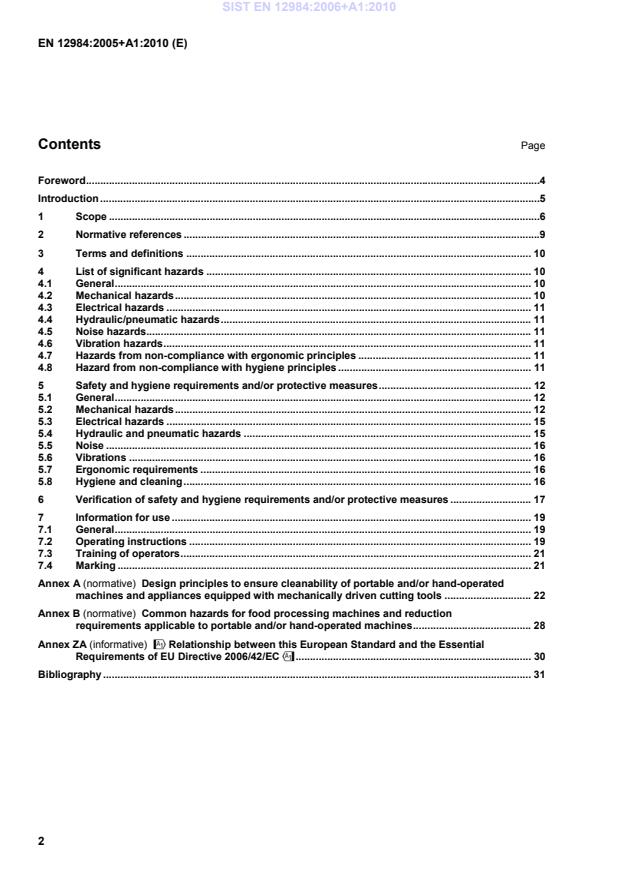
Design principles to ensure cleanability of portable and/or hand-operated machines and appliances equipped with mechanically driven cutting tools . 22Annex B (normative)
Common hazards for food processing machines and reduction requirements applicable to portable and/or hand-operated machines . 28Annex ZA (informative)
!Relationship between this European Standard and the Essential Requirements of EU Directive 2006/42/EC" . 30Bibliography . 31 SIST EN 12984:2006+A1:2010
!EN 1672-2:2005" and Annex B. According to the CEN/CENELEC Internal Regulations, the national standards organizations of the following countries are bound to implement this European Standard: Austria, Belgium, Bulgaria, Croatia, Cyprus, Czech Republic, Denmark, Estonia, Finland, France, Germany, Greece, Hungary, Iceland, Ireland, Italy, Latvia, Lithuania, Luxembourg, Malta, Netherlands, Norway, Poland, Portugal, Romania, Slovakia, Slovenia, Spain, Sweden, Switzerland and United Kingdom.
1 Scope 1.1 This European Standard covers portable and/or hand-guided machines and appliances equipped with mechanically driven cutting tools. This European Standard specifies requirements for the design and manufacture of portable and/or hand-guided machines and appliances equipped with electrically, hydraulically or pneumatically driven cutting tools (see Figures 1 to 9), hereinafter referred to as “machines”. The machines covered by this European Standard are used for slaughtering animals, for cutting up animal carcasses, poultry and other foodstuff such as e.g. fish. They are mainly intended for use in slaughterhouses and rooms, which are used for cutting and preparing. These machines are used for the industry and trade. !This European Standard specifies all significant hazards, hazardous situations and events relevant to the machines in the scope, when they are used as intended and under conditions of misuse which are reasonably foreseeable by the manufacturer (see Clause 4)." This European Standard deals with the hazards which can arise during commissioning, operation, maintenance and de-commissioning of the machine. This European Standard is not applicable to portable and/or hand-guided machines and appliances equipped with electrically, hydraulically or pneumatically driven cutting tools, which are manufactured before the date of publication of this European Standard by CEN. 1.2 This European Standard covers the following machines subdivided into tool types: 1.2.1 Saws (see Figures 1 to 5) Circular saws (see Figures 1 and 2); straight blade reciprocating saws (see Figures 3 and 4); band saws (see Figure 5). Figure 1 — Cutting saw Figure 2 — Leg saw, horn saw SIST EN 12984:2006+A1:2010
Figure 3 — Sternum saw Figure 4 — Reciprocating saw
Figure 5 — Band saw for carcasses
1.2.2 Shears, pincers (see Figures 6 and 7)
Figure 6 — Pincer/shear Figure 7 — Pincer for cutting the feet of pigs/shear
1.2.3 Knives (see Figures 8 and 9) Ring-blade circular knives; circular knives with simple or double blade; reciprocating knives with one or two straight blades; rotating knives. SIST EN 12984:2006+A1:2010
Figure 8 — Derinder Figure 9 — Flexible driven circular knife
Portable and/or hand-guided machines are constructed of a machine housing with a motor or pressure cylinder within the housing, or a motor which drives the tool via a flexible drive cable, the tool being hand-held at the place of use or being hand-guided on a movable device. The motor or drive can comprise electrical, hydraulic or pneumatic components. For weight balancing, a suspension unit with a tensioning spring or a counter-balancer can make the work easier for the operator. This equipment is not covered by this European Standard. 1.3 Intended use Portable and/or hand-guided machines are used on suspended or lying, stunned and blood-drained animals for cutting off legs, feet and horns, for cutting out anuses, for skinning, for opening the sternum, for halving, quartering or further cutting carcasses and for removing fat. Although it should be advised against, this European Standard, taking into account practice, deals with the hazards due to cleaning with pressurised water. With the aim of clarifying the intentions of this European Standard and avoiding doubts when reading it, the following assumptions were made for operation: only designated and instructed persons operate the machine, place of use is adequately lit, and the equipment will be used in an environment with hygiene hazards but without other special hazards. SIST EN 12984:2006+A1:2010
...