

EN 12809:2001
(Main)Residential independent boilers fired by solid fuel - Nominal heat output up to 50 kW - Requirements and test methods
- Abstract
This European Standard specifies requirements relating to the design, manufacture, construction, performance (efficiency and emission), safety, instructions and marking together with associated test methods and test fuels for type testing residential independent boilers fired by solid fuel.
This standard is applicable to hand and automatically fired appliances having nominal heat outputs up to 50 kW, the primary function of which is to provide hot water for central heating and/or domestic use, and which are designed for use only with open vented systems at a working pressure not exceeding 2 bar. In addition to their primary function of providing hot water these appliances also provide space heating to the place of installation. These appliances may burn either solid mineral fuels, peat briquettes or natural or manufactured wood logs or be multi-fuel in accordance with the appliance manufacturer's instructions.
This standard is not applicable to independent boilers for hot water only production and having heat outputs of less than 5 kW.
This standard is also not applicable to the design and construction of automatic stoking devices.
- Status
- Withdrawn
- Publication Date
- 12-Jun-2001
- Withdrawal Date
- 29-Sep-2026
- Technical Committee
- CEN/TC 295 - Residential solid fuel burning appliances
- Drafting Committee
- CEN/TC 295/WG 1 - Cookers
- Current Stage
- 9960 - Withdrawal effective - Withdrawal
- Start Date
- 21-Dec-2022
- Completion Date
- 30-Sep-2026
- Directive
- 305/2011 - Regulation (eu) No 305/2011 of the European Parliament and of the Council of 9 march 2011 laying down harmonised conditions for the marketing of construction products and repealing council directive 89/106/eecOJ Ref: C, C 259 OJ Date: 08-Aug-2014
89/106/EEC - Construction productsOJ Ref: C, C 139, C 319 OJ Date: 08-Jun-2005
Buy Documents





Relations
- Effective Date
- 08-Jun-2022
- Effective Date
- 08-Jun-2022
- Effective Date
- 01-Aug-2018
- Effective Date
- 25-Aug-2026
- Effective Date
- 25-Aug-2026
- Effective Date
- 25-Aug-2026
- Effective Date
- 25-Aug-2026
- Effective Date
- 25-Aug-2026
- Effective Date
- 25-Aug-2026
- Effective Date
- 25-Aug-2026
- Effective Date
- 25-Aug-2026
- Refers
ISO 331:1983 - Coal — Determination of moisture in the analysis sample — Direct gravimetric method - Effective Date
- 25-Aug-2026
- Effective Date
- 25-Aug-2026
- Effective Date
- 25-Aug-2026
- Effective Date
- 25-Aug-2026
Buy Documents
Get Certified
Connect with accredited certification bodies for this standard

DIBt (Deutsches Institut für Bautechnik)
German Institute for Building Technology.
DIN CERTCO
DIN Group product certification.

Aboma Certification B.V.
Specialized in construction, metal, and transport sectors.
Sponsored listings
Frequently Asked Questions
EN 12809:2001 is a standard published by the European Committee for Standardization (CEN). Its full title is "Residential independent boilers fired by solid fuel - Nominal heat output up to 50 kW - Requirements and test methods". This standard covers: This European Standard specifies requirements relating to the design, manufacture, construction, performance (efficiency and emission), safety, instructions and marking together with associated test methods and test fuels for type testing residential independent boilers fired by solid fuel. This standard is applicable to hand and automatically fired appliances having nominal heat outputs up to 50 kW, the primary function of which is to provide hot water for central heating and/or domestic use, and which are designed for use only with open vented systems at a working pressure not exceeding 2 bar. In addition to their primary function of providing hot water these appliances also provide space heating to the place of installation. These appliances may burn either solid mineral fuels, peat briquettes or natural or manufactured wood logs or be multi-fuel in accordance with the appliance manufacturer's instructions. This standard is not applicable to independent boilers for hot water only production and having heat outputs of less than 5 kW. This standard is also not applicable to the design and construction of automatic stoking devices.
This European Standard specifies requirements relating to the design, manufacture, construction, performance (efficiency and emission), safety, instructions and marking together with associated test methods and test fuels for type testing residential independent boilers fired by solid fuel. This standard is applicable to hand and automatically fired appliances having nominal heat outputs up to 50 kW, the primary function of which is to provide hot water for central heating and/or domestic use, and which are designed for use only with open vented systems at a working pressure not exceeding 2 bar. In addition to their primary function of providing hot water these appliances also provide space heating to the place of installation. These appliances may burn either solid mineral fuels, peat briquettes or natural or manufactured wood logs or be multi-fuel in accordance with the appliance manufacturer's instructions. This standard is not applicable to independent boilers for hot water only production and having heat outputs of less than 5 kW. This standard is also not applicable to the design and construction of automatic stoking devices.
EN 12809:2001 is classified under the following ICS (International Classification for Standards) categories: 91.140.10 - Central heating systems. The ICS classification helps identify the subject area and facilitates finding related standards.
EN 12809:2001 has the following relationships with other standards: It is inter standard links to EN 16510-2-4:2022, EN 16510-1:2022, EN 16510-1:2018, ISO 351:1996, ISO 228-1:1994, ISO 609:1996, ISO 1928:1995, ISO 687:1974, ISO 501:1981, ISO 7-1:1994, ISO 228-2:1987, ISO 331:1983, ISO 562:1998, ISO 1171:1997, ISO 334:1992. Understanding these relationships helps ensure you are using the most current and applicable version of the standard.
EN 12809:2001 is associated with the following European legislation: EU Directives/Regulations: 305/2011, 89/106/EEC; Standardization Mandates: M/129. When a standard is cited in the Official Journal of the European Union, products manufactured in conformity with it benefit from a presumption of conformity with the essential requirements of the corresponding EU directive or regulation.
EN 12809:2001 is available in PDF format for immediate download after purchase. The document can be added to your cart and obtained through the secure checkout process. Digital delivery ensures instant access to the complete standard document.
Standards Content (Sample)
2003-01.Slovenski inštitut za standardizacijo. Razmnoževanje celote ali delov tega standarda ni dovoljeno.Heizkessel für feste Brennstoffe - Nennwärmeleistung bis 50 kW - Anforderungen und PrüfungChaudieres domestiques a combustible solide destinées a etre implantées dans le volume habitable - Puissance calorifique nominale inférieure ou égale a 50 kW - Exigences et méthodes d'essaiResidential independent boilers fired by solid fuel - Nominal heat output up to 50 kW - Requirements and test methods97.100.30Grelniki na trdo gorivoSolid fuel heaters91.140.10Sistemi centralnega ogrevanjaCentral heating systemsICS:Ta slovenski standard je istoveten z:EN 12809:2001SIST EN 12809:2003en01-januar-2003SIST EN 12809:2003SLOVENSKI
STANDARD
EUROPEAN STANDARDNORME EUROPÉENNEEUROPÄISCHE NORMEN 12809June 2001ICS 91.140.10English versionResidential independent boilers fired by solid fuel - Nominal heatoutput up to 50 kW - Requirements and test methodsChaudières domestiques à combustible solide destinées àêtre implantées dans le volume habitable - Puissancecalorifique nominale inférieure ou égale à 50 kW -Exigences et méthodes d'essaiHeizkessel für feste Brennstoffe - Nennwärmeleistung bis50 kW - Anforderungen und PrüfungThis European Standard was approved by CEN on 7 April 2001.CEN members are bound to comply with the CEN/CENELEC Internal Regulations which stipulate the conditions for giving this EuropeanStandard the status of a national standard without any alteration. Up-to-date lists and bibliographical references concerning such nationalstandards may be obtained on application to the Management Centre or to any CEN member.This European Standard exists in three official versions (English, French, German). A version in any other language made by translationunder the responsibility of a CEN member into its own language and notified to the Management Centre has the same status as the officialversions.CEN members are the national standards bodies of Austria, Belgium, Czech Republic, Denmark, Finland, France, Germany, Greece,Iceland, Ireland, Italy, Luxembourg, Netherlands, Norway, Portugal, Spain, Sweden, Switzerland and United Kingdom.EUROPEAN COMMITTEE FOR STANDARDIZATIONCOMITÉ EUROPÉEN DE NORMALISATIONEUROPÄISCHES KOMITEE FÜR NORMUNGManagement Centre: rue de Stassart, 36
B-1050 Brussels© 2001 CENAll rights of exploitation in any form and by any means reservedworldwide for CEN national Members.Ref. No. EN 12809:2001 ESIST EN 12809:2003
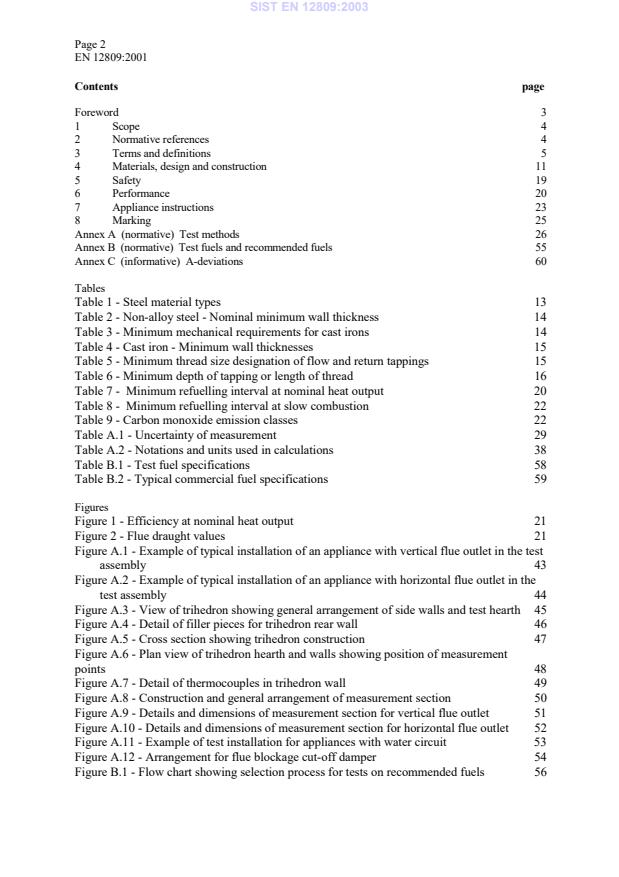
Page 2EN 12809:2001ContentspageForeword31Scope42 Normative references43Terms and definitions54Materials, design and construction115Safety196Performance207 Appliance instructions238 Marking25Annex A
(normative)
Test methods26Annex B
(normative)
Test fuels and recommended fuels55Annex C
(informative)
A-deviations60TablesTable 1 - Steel material types13Table 2 - Non-alloy steel - Nominal minimum wall thickness14Table 3 - Minimum mechanical requirements for cast irons14Table 4 - Cast iron - Minimum wall thicknesses15Table 5 - Minimum thread size designation of flow and return tappings15Table 6 - Minimum depth of tapping or length of thread16Table 7 -
Minimum refuelling interval at nominal heat output20Table 8 -
Minimum refuelling interval at slow combustion22Table 9 - Carbon monoxide emission classes22Table A.1 - Uncertainty of measurement29Table A.2 - Notations and units used in calculations38Table B.1 - Test fuel specifications58Table B.2 - Typical commercial fuel specifications59FiguresFigure 1 - Efficiency at nominal heat output21Figure 2 - Flue draught values21Figure A.1 - Example of typical installation of an appliance with vertical flue outlet in the testassembly43Figure A.2 - Example of typical installation of an appliance with horizontal flue outlet in thetest assembly44Figure A.3 - View of trihedron showing general arrangement of side walls and test hearth45Figure A.4 - Detail of filler pieces for trihedron rear wall46Figure A.5 - Cross section showing trihedron construction47Figure A.6 - Plan view of trihedron hearth and walls showing position of measurementpoints48Figure A.7 - Detail of thermocouples in trihedron wall49Figure A.8 - Construction and general arrangement of measurement section50Figure A.9 - Details and dimensions of measurement section for vertical flue outlet51Figure A.10 - Details and dimensions of measurement section for horizontal flue outlet52Figure A.11 - Example of test installation for appliances with water circuit53Figure A.12 - Arrangement for flue blockage cut-off damper54Figure B.1 - Flow chart showing selection process for tests on recommended fuels56SIST EN 12809:2003
Page 3EN 12809:2001ForewordThis European Standard has been prepared by Technical Committee CEN/TC 295 "Residential solidfuel burning appliances", the secretariat of which is held by BSI.This European Standard shall be given the status of a national standard, either by publication of anidentical text or by endorsement, at the latest by December 2001, and conflicting national standardsshall be withdrawn at the latest by December 2002.According to the CEN/CENELEC Internal Regulations, the national standards organizations of thefollowing countries are bound to implement this European Standard: Austria, Belgium, CzechRepublic, Denmark, Finland, France, Germany, Greece, Iceland, Ireland, Italy, Luxembourg,Netherlands, Norway, Portugal, Spain, Sweden, Switzerland and the United Kingdom.SIST EN 12809:2003
Page 4EN 12809:20011ScopeThis European Standard specifies requirements relating to the design, manufacture, construction,performance (efficiency and emission), safety, instructions and marking together with associated testmethods and test fuels for type testing residential independent boilers fired by solid fuel.This standard is applicable to hand and automatically fired appliances having nominal heat outputs upto 50 kW, the primary function of which is to provide hot water for central heating and/or domesticuse, and which are designed for use only with open vented systems at a working pressure notexceeding 2 bar. In addition to their primary function of providing hot water these appliances alsoprovide space heating to the place of installation. These appliances may burn either solid mineralfuels, peat briquettes or natural or manufactured wood logs or be multi-fuel in accordance with theappliance manufacturer’s instructions.This standard is not applicable to independent boilers for hot water only production and having heatoutputs of less than 5 kW.This standard is also not applicable to the design and construction of automatic stoking devices.2 Normative referencesThis European Standard incorporates by dated or undated reference, provisions from otherpublications. These normative references are cited at the appropriate places in the text and thepublications are listed hereafter. For dated references, subsequent amendments to or revisionsof any of these publications apply to this European Standard only when incorporated in it byamendment or revision. For undated references the latest edition of the publication applies(including amendments).EN 1561:1997Founding - Grey cast ironsEN 1563:1997Founding - Spheroidal graphite cast ironsEN 10025:1993Hot rolled products of non-alloy structural steels - Technical delivery conditionsEN 10027-2:1992Designation systems for steels - Part 2: Numerical systemEN 10028-2:1992Flat products made of steels for pressure purposes - Part 2: Non-alloy and alloysteels with specified elevated temperature propertiesEN 10029:1991Hot rolled steel plates 3 mm thick or above - Tolerances on dimensions,shape and massEN 10088-2:1995Stainless steels - Part 2: Technical delivery conditions for sheet/plate and strip forgeneral purposesEN 10111:1998Continuously hot–rolled low carbon steel sheet and strip for coldforming - Technical delivery conditionsEN 10120:1996Steel sheet and strip for welded gas cylindersISO 7-1: 2000Pipe threads where pressure-tight joints are made on the threads -Part 1: Dimensions, tolerances and designationSIST EN 12809:2003
Page 5EN 12809:2001ISO 7-2: 2000Pipe threads where pressure-tight joints are made on the threads -Part 2: Verification by means of limit gaugesISO 228-1: 1994Pipe threads where pressure-tight joints are not made on the threads -Part 1: Dimensions, tolerances and designationISO 228-2: 1987Pipe threads where pressure-tight joints are not made on the threads -Part 2: Verification by means of limit gaugesISO 331:1983Coal - Determination of moisture in the analysis sample - Directgravimetric methodISO 334:1992Solid mineral fuels - Determination of total sulfur - EschkamethodISO 351:1996Solid mineral fuels - Determination of total sulfur - Hightemperature combustion methodISO 501:1981Coal - Determination of the crucible swelling numberISO 562:1998Hard coal and coke - Determination of volatile matterISO 609:1996Solid mineral fuels - Determination of carbon and hydrogen -High temperature combustion methodISO 687:1974Coke - Determination of moisture in the analysis sampleISO 1171:1997Solid mineral fuels - Determination of ash contentISO 1928:1995Solid mineral fuels - Determination of gross calorific value bythe bomb calorimetric method, and calculation of net calorificvalue3Terms and definitionsFor the purposes of this European Standard, the following terms and definitions apply.3.1air inlet controlmanual or automatic device to control the quantity of air supplied for combustion3.2ashpanremovable receptacle shaped to receive the residue falling from the firebed3.3ashpitenclosed chamber designed to receive the residue or the ashpan3.4basic firebedquantity of glowing embers which ensures ignition of the test fuel to be chargedSIST EN 12809:2003
Page 6EN 12809:2001NOTE
The basic firebed may be specified by the manufacturer.3.5boilervessel in which water is heated, intended for fitting in or forming an integral part of a solid fuelappliance3.6boiler waterwaysspace within a boiler which contains water3.7bottomgratepart of the appliance at the base of the firebox which supports the fire-bed through which the residuefalls into the ashpan or ashpit and through which combustion air and/or combustion gases may be drawn3.8burning ratereduction in the mass of fuel per unit of time3.9charging doordoor which covers the refuelling opening3.10combustion airair supplied to the firebox, which is entirely or partially used to burn the fuel3.11combustion air selectordevice for adjusting the primary and/or secondary air according to the type of fuel burned3.12combustion control devicemechanism for setting the primary and/or secondary air in accordance with the burning rate required3.13combustion gasescompounds in gaseous form produced inside an appliance when fuel is burned3.14dampermechanism to change the resistance to flow of the combustion gases3.15de-ashingprocess of clearing a fuelbed and discharging residue into the collecting receptacle3.16de-ashing mechanismdevice to agitate or disturb the ash to facilitate its removal from the firebedSIST EN 12809:2003
Page 7EN 12809:2001NOTE
It may also be used to change the bottomgrate operating position on some appliances.3.17direct water systemhot water system in which stored domestic hot water is heated directly by hot water circulating from theboiler3.18draught regulatorinlet device for admission air downstream of the firebed, enabling the flue draught to be controlled3.19efficiencyratio of total heat output to total heat input during the test period expressed as a percentage3.20firebed ; fuelbedfuel contained in the firebox3.21firebox; combustion chamberthat part of the appliance in which fuel is burned3.22firebox openingaperture in the firebox through which the appliance may be fuelled3.23firedoordoor through which the fire may be viewed and which may be opened to allow refuelling of the firebed3.24flue draughtdifferential between the static air pressure in the place of installation and the static pressure at the fluegas measurement point3.25flue gasesgaseous compounds leaving the appliance flue spigot and entering the flue gas connector3.26flue gas adaptorfitting which allows for variations in size and shape of the flue components3.27flue gas connectorduct through which flue gases are conveyed from the appliance into the chimney flue3.28flue gas mass flowmass of flue gas drawn off from the appliance per unit of timeSIST EN 12809:2003
Page 8EN 12809:20013.29flue gas temperaturetemperature of the flue gas at the specified point in the measurement section3.30flue spigot; flue socketintegral part of the appliance for connecting the flue gas connector thus permitting the deliberate escapeof products of combustion into the chimney flue3.31fluewaythat part of the appliance designed to convey combustion gases from the firebox to the flue spigot3.32front firebars; deepening plategrating or plate fitted at the front of the firebox opening to prevent spillage of fuel and ash or to changethe firebox capacity, or both3.33fuel hopperfuel store integral with the appliance from which fuel is fed to the firebox3.34fuel regulatordevice for controlling the size of the firebed3.35heat inputquantity of energy, which the fuel provides to the appliance3.36heat outputquantity of useful heat released by the appliance3.37indirect water systemhot water system in which stored domestic hot water is heated by a primary heater through which hotwater from the boiler is circulated without mixing of the primary (heating) water and the storeddomestic hot water3.38maximum water operating pressurelimiting water pressure up to which the boiler of an appliance can be safely operated3.39nominal heat outputtotal heat output of the appliance quoted by the manufacturer and achieved under defined test conditionswhen burning the specified test fuel3.40operating tooldevice supplied with the appliance for handling movable, adjustable and/or hot componentsSIST EN 12809:2003
Page 9EN 12809:20013.41primary aircombustion air, which passes through the fuel bed3.42recovery capabilityability of the fire to re-ignite existing or newly charged fuel after a defined burning period withoutexternal assistance3.43recommended fuelfuel of commercial quality listed in the appliance manufacturer's instructions, and shown to achieve theclaimed performance when tested in accordance with this European Standard3.44refuelling intervalperiod of time for which the combustion may be maintained in the appliance with a single load of fuel,without intervention by the user3.45residueashes, including combustibles, which collect in the ashpit3.46secondary airair supplied for the purpose of completing the combustion of gases leaving the fuel bed3.47slow-combustion capabilityability of an appliance to continue operating at a low burning rate for a specified minimum periodwithout any input of fuel and without any interference with the combustion process, in such a mannerthat the firebed can be recovered at the end of this period3.48slow combustion heat outputheat output achieved during the test period under slow combustion conditions3.49solid fuelnatural or manufactured solid mineral fuels, natural or manufactured wood logs and peat briquettes3.50solid mineral fuelcoal, lignite, coke and fuels derived from theseSIST EN 12809:2003
Page 10EN 12809:20013.51space-heating outputheat output provided by convection and radiation to the room3.52start-up devicemechanism to divert the path of the heating gases and/or change the combustion air opening crosssection during the ignition period3.53steady-state conditionstage at which values to be measured in successive equal periods of time do not exhibit significantchange3.54integral fuel storage containerenclosed area forming part of the appliance, but not connected directly to the fuel charging area, inwhich fuel is stored prior to it being physically transferred by the user to the fuel charging position3.55test fuelfuel of commercial quality being characteristic of its type to be used for testing appliances3.56thermostattemperature sensitive device which automatically changes the combustion air inlet cross-sectional area3.57total heat outputrate of useful heat released by the appliance3.58type test pressurepressure to which all waterways of the test appliance are subjected3.59water-heating outputheat output to water averaged during the test period3.60working surfacesall surfaces of an appliance designed to transmit heat to the surrounding atmosphereNOTE
All external surfaces of a heating boiler including the flue gas connector in accordance withthis standard are classified as working surfaces because they are designed to transmit heat to the roomin which the appliance is installed.SIST EN 12809:2003
Page 11EN 12809:20014Materials, design and construction4.1 Production documentationTo identify the appliance, the manufacturer shall have available documents and/or scaled assemblydrawings showing the basic design and construction of the appliance. The documentation and/or thedrawings shall include at least the following information:- the specification of the materials used in the construction of the appliance;- the nominal heat output in kW using fuels recommended by the manufacturer;- the welding process used in the manufacture of the boiler shell;NOTE
The symbol for the type of weld used is sufficient.- the permissible maximum operating water temperature in °C;- the permissible maximum water operating pressure in bar;- the type test pressure in bar;- the water heating output in kW. 4.2General constructionThe shape and dimensions of the components and equipment and the method of design andmanufacture, and if assembled on site the method of assembly and installation, shall ensure that whenoperated in accordance with the appropriate test(s) and exposed to the associated mechanical,chemical and thermal stresses, the appliance shall operate reliably and safely such that during normaloperation, no combustion gases posing a hazard can escape into the room in which the appliance isinstalled nor can embers fall out.Component parts such as covers, operating controls, safety devices and electrical accessories shall bearranged in such a way that their surface temperatures, under the test conditions described in A.4.7,do not exceed those specified either by the manufacturer or in the relevant component part standard.The appliance shall meet the requirements detailed in 4.3 to 4.7 as appropriate to the material ofconstruction and intended usage.The appliance shall be capable of operating safely at a permissible maximum water operatingpressure as declared by the manufacturer of up to but not exceeding 2 bar and shall meet therequirements of the type pressure test described in 5.3.Parts which act as a seal shall be located securely; for example by means of bolts, gaskets or welding;to prevent the ingress or leakage of air, water or combustion products.Where a seal is made with fire-cement, the cement shall be supported by adjacent metal surfaces.SIST EN 12809:2003
Page 12EN 12809:2001Component parts, which require periodic replacement and/or removal, shall be either designed oridentified so as to ensure correct fitting.No part of the appliance shall comprise of or contain asbestos.
Hard solder containing cadmium in itsformulation shall not be used.Where thermal insulation is used, it shall be made of non-combustible material and shall not be aknown hazard to health in its applied position.NOTE
The thermal insulation should withstand normal thermal and mechanical stresses.4.3Boilers constructed of steel4.3.1Parts subject to water pressureOne or more of the steel materials complying at least with the specifications given in Table 1 shall beused for the manufacture of those parts of the appliance subject to water pressure.4.3.2Nominal minimum wall thicknessesThe nominal minimum wall thickness of non-alloyed steel sheets and tubes subject to water pressure(other than immersion coils or safety heat exchangers) shall be in accordance with Table 2.The tolerances on the nominal minimum wall thicknesses for non-alloyed steels given in Table 2shall be as specified in EN 10029:1991.SIST EN 12809:2003
Page 13EN 12809:2001Table 1 - Steel material typesReferencesMaterial TypeMaterial number in accordancewith EN 10027-2:1992EN 10111:1998DD 111.0332DD 121.0398DD 131.0335DD 141.0389EN 10025:1993S235JR1.0037S235JRG21.0038S235JO1.0114S235J2G31.0116S275JR1.0044S275JO1.0143S275J2G31.0144S355JR1.0045S355JO1.0553S355J2G31.0570S355K2G31.0595EN 10028-2:1992P235GH1.0345P265GH1.0425P295GH1.0481P355GH1.047316Mo31.541513CrMo4-51.733510CrMo9-101.738010CrMo9-101.7383EN 10120:1996P245NB1.0111P265NB1.0423P3 IONB1.0437P355NB1.0557EN 10088-2:1995X5CrNi 18-101.4301X6CrNi 17-12-21.4401X6CrNiTil8-101.4541X6CrNiNb 18-101.4550X6CrNiMo Ti 17-12 -21.4571X6CrNiMoNb 17-12 -21.4580X3CrNiMo 17-3-31.4436NOTE
Materials and wall thicknesses other than those specified may only be used onproduction of appropriate evidence as regards at least their equivalent corrosionresistance, heat resistance and strength to non-alloy steel at the material thicknessesspecified in Table 2 for the particular application/usage.SIST EN 12809:2003
Page 14EN 12809:2001Table 2 - Non-alloy steel - Nominal minimum wall thicknessApplication/UsageNominal minimumwall thicknessmmWalls of combustion chamber in contact with fire and/orwater5Walls of convection heating surfaces outsidecombustion chamber (except circular tubes)4Circular tubes used in convection part of heat exchanger3,2Water cooled grate tubes4Surfaces not in contact with the fire or the products ofcombustion3NOTE
The nominal minimum wall thicknesses listed for a particularapplication/usage have been specified taking into consideration:- the permissible maximum water operating pressure (stated by the manufacturer);- the material properties;- the heat transfer location.4.4Boilers constructed of cast iron4.4.1Parts subject to water pressureThe minimum mechanical properties of cast irons used for parts subject to water pressure shall be inaccordance with the values listed in Table 3.Table 3 - Minimum mechanical requirements for cast ironsGrey cast iron (In accordance with EN 1561:1997)- Tensile strength Rm> 150 N/mm2- Brinell hardness160 HB to 220 HBSpheroidal graphite cast iron (In accordance with EN 1563:1997):- Tensile strength Rm> 400 N/mm2- Elongation18%A3SIST EN 12809:2003
Page 15EN 12809:20014.4.2Minimum wall thicknessesThe wall thicknesses shall be not less than the minimum thickness listed in Table 4.Table 4 - Cast iron - Minimum wall thicknessesGrey cast ironSpheroidal graphitecast ironNominalheat outputMinimum wall thicknesseskWmm< 303,53,0 30 < 504,03,54.5Boiler shell tappingsThe threads of boiler shell tappings, for flow and return pipes, shall be not less than the minimumthread size designation given in Table 5.Where tapered threads are used, they shall be in accordance with the requirements of ISO 7-1:1994and ISO 7-2:2000. Where parallel threads are used, they shall be in accordance with ISO 228-1:2000and ISO 228-2:1987. The design and position of flow tappings shall be such that air will not beretained within the boiler shell.Table 5 - Minimum thread size designation of flow and return tappingsNominal heat outputkWGravity circulationthread sizedesignation 1)Pumped circulationthread sizedesignation 1) 221½> 22
351¼1 35 < 501½11)
Designation in accordance with ISO 7 –1:1994 and ISO 7-2:2000 orISO 228 –1:2000 and ISO 228-2:1987.SIST EN 12809:2003
Page 16EN 12809:2001The minimum depth of tapping or length of thread shall be not less than the minimum values given inTable 6.Table 6 - Minimum depth of tapping or length of threadThread sizedesignation 1)Minimum depth of tappingor length of threadmm½ to 1¼1½16191) Designation in accordance with ISO 7-1:1994 and ISO 7-2:2000 orISO 228-1:2000 and ISO 228-2:1987.If the appliance is supplied with reducing bushes in horizontal flow tappings, these shall be eccentricand fixed so that the reduced outlet is uppermost.4.6Draining of boiler shellWhere a drain socket is provided in the boiler shell, it shall have a minimum thread size designationof ½ and shall be accordance with either ISO 7-1:1994 and ISO 7-2:2000 if tapered threads are usedor ISO 228-1:2000 and ISO 228-2:1987 if parallel threads are used.4.7Boiler Waterways4.7.1Venting of the water sectionsThe boiler shell and its component waterways shall be designed in such a way that their respectivewater sections are well vented.
To minimize the build up of sediment, designed sharp or wedge-shaped waterways with a taper towards the bottom shall be avoided.The design of the boiler shell shall ensure a free flow of water through all parts such that undernormal operation in accordance with the manufacturer’s instructions, no undue boiling noises shalloccur.4.7.2Boilers used with direct water systemsThe minimum internal dimension of waterways in boilers designed for direct water systems shall benot less than 25 mm.4.7.3Boilers used with indirect water systemsThe minimum internal dimension of waterways throughout the main body of the appliance shall benot less than 20 mm, except where waterways have to be reduced locally to facilitate manufacture orare in areas not in direct contact with burning fuel; in these cases the width of the waterways shall benot less than 15 mm.4.7.4Water tightnessHoles, for screws and similar components, which are used for the attachment or removal of parts,shall not open into waterways or spaces through which water flows.NOTE
This does not apply to pockets for measuring, control and safety equipment.SIST EN 12809:2003
Page 17EN 12809:20014.8Combustion air supply4.8.1GeneralThe supply of combustion air shall either be by natural draught or by fan assistance.NOTE
A manually adjustable air by-pass capable of being completely closed is advisable for naturaldraught boilers fitted with thermostatic air control.4.8.2Primary air inlet controlThe appliance shall be fitted with a thermostatically controlled primary air inlet control actuated bywater temperature.
The design shall be such that during normal operation of the appliance, neitherash nor unburned fuel can prevent the movement or closure of the air inlet control.The ‘cold’ setting of the primary air inlet control shall be clearly marked and the method ofadjustment shall be described in the user instructions.The thermostat shall have a variable temperature range and be of the immersion or dry pocket type. The pocket shall be positioned so that the thermostat senses the temperature of the flow water fromthe appliance.4.8.3Secondary air inlet controlWhere a secondary air inlet control is provided the position of air entry shall be so designed that thepassage of air is not restricted when the firebox is filled to the manufacturer’s recommended capacity.4.9Ash-pit door and firedoorAny ash-pit door and firedoor shall be designed to prevent accidental opening and to facilitatepositive closure.NOTE
Doors used for closing the ash-pit and combustion chamber should be designed to ensure apositive seal is made around the openings when the doors are closed.4.10BottomgrateThe bottomgrate, excluding those with water cooled firebars, shall be capable of being removed andshall be so designed or marked as to ensure correct assembly.
A de-ashing mechanism shall be fittedwhere fuels other than wood are burned.
The bottomgrate shall not become dislodged during the de-ashing process.NOTE 1
The preferred design should allow de-ashing to be carried out with the ash-pit door closed.The de-ashing operation should be possible without undue effort.NOTE 2
If it is necessary to remove the ash-pit door to de-ash the fire, the appliance should bedesigned such that there is no undue spillage of ash during the de-ashing operation.SIST EN 12809:2003
Page 18EN 12809:20014.11Ashpan and ash removalA means of removing ash residue from the appliance shall be provided.
Where an ashpan is providedit shall be capable of containing the combustion ash residue from two full charges of fuel whilstretaining sufficient space above to allow adequate flow of primary combustion air through thebottomgrate or fire bed. If the ashpan resides in the appliance it shall locate in the ashpit in such away that it allows the free passage of primary combustion air and in such a position that it does notobstruct any primary air inlet control.NOTE
An ash-pan should be designed and constructed to ensure that:a)it effectively collects the residue material from beneath the bottomgrate;b)it can be easily and safely withdrawn, carried and emptied when hot, using thetool(s) provided, without undue spillage of residue material.4.12Control of flue gasIf a flue damper is fitted, it shall be of a type which does not block the flue totally.
The damper shallbe easy to operate and incorporate an aperture within the blade which, in a continuous area, occupiesat least 20 cm2 or 3 % of the cross-sectional area of the blade if this is greater.The position of the damper shall be recognizable to the user from the setting of the device.A flue damper shall not be fitted to an appliance with a forced draught fan but shall be permissiblefor appliances with an induced draught fan.If a draught regulator is fitted the minimum cross sectional area requirement shall not be applicablebut the device shall be easily accessible for cleaning.4.13Flue draught test pointA test tapping for the measurement of the flue draught shall be provided either in the boiler fluewayor in the flue gas connector.If a draught regulator is incorporated, the test measurement point shall be taken before the draughtregulator.4.14Fan cut-out safety deviceIf the appliance is fitted with a forced draught fan to provide combustion air, then a cut-out safetydevice shall be provided to switch off the fan in the event of a flue blockage (see 5.5).4.15Flue spigot or socketThe flue spigot or socket shall be designed to enable a gas tight connection to be made between theflue gas connector and the appliance. Where the flue gas connector fits over an outlet spigot, theoverlap shall be a minimum of 40 mm. Where the flue gas connector fits into a socket, the insertiondepth shall be a minimum of 25 mm.NOTE
It is recommended that provision is made for sealing the flue gas connector into the socketwith glass fibre rope and heat resistant sealing compound.SIST EN 12809:2003
Page 19EN 12809:20014.16Front firebars and/or deepening plateIf the appliance is fitted with removable front firebars and/or deepening plate, they shall be designedsuch that they can neither be incorrectly fitted nor accidentally dislodged.NOTE
The front firebars/deepening plate should be designed to retain the fuel or ash duringoperation of the appliance particularly during refuelling or de-ashing of the appliance.4.17FluewaysIt shall be possible to clean the flueways of the appliance completely using commercially availabletools or brushes, unless special cleaning tools or brushes are provided by the appliance manufacturer.The size of the flueway in its minimum dimension shall be not less than 30 mm except that it shall bepermissible to reduce it to not less than 15 mm for appliances designed only to burn fuels other thanbituminous coals and peat briquettes and where an access door(s) is provided for cleaning theflueway.4.18Provision for cleaning boiler heating surfaces, and flue connectorAll boiler-heating surfaces shall be accessible from the flue gas side for inspection and cleaning.Means shall also be provided for cleaning the appliance outlet and flue connector. Advice on howthis cleaning shall be carried out shall be given in the appliance operating instructions.5Safety5.1Temperature in integral fuel storage containerWhen tested during the performance test at nominal heat output in accordance with A.4.7, themaximum temperature measured in any integral fuel storage container, if provided, shall not exceedthe ambient temperature by more than 65 K.5.2Temperature of adjacent combustible materialsWhen tested during the performance test at nominal heat output in accordance with A.4.7, and whenthe appliance is installed in accordance with the clearance distances specified in the manufacturer’sinstallation instructions, the temperature of the trihedron test hearth and walls or any other structuresurrounding the appliance e.g. ceiling comprising combustible material shall not exceed the ambienttemperature by more than 65 K.5.3Strength and leaktightness of boiler shellThe boiler shell and its water carrying components shall not leak or become permanently deformedwhen subjected to the type pressure test described in A.4.10 and during the nominal heat output testdescribed in A.4.7.5.4Operating toolsAn operating tool shall be provided where it would otherwise be necessary to touch any surfacehaving a temperature above ambient by more than the following values:- 35 K for metals;SIST EN 12809:2003
Page 20EN 12809:2001- 45 K for porcelain, vitreous enamel or similar materials;- 60 K for plastics, rubber or wood.These temperature requirements shall be assessed during the nominal heat output test described inA.4.7.5.5Fan cut-out safety deviceWhere a safety cut-out device is provided for a fan supplying forced draught combustion air asspecified in 4.14 then when tested in accordance with A.4.9, the safety device shall switch off the fanwithin 15 min following obstruction of the flue.6Performance6.1Refuelling interval at nominal heat outputWhen tested in accordance with A.4.7, the refuelling interval at nominal heat output, on one chargeof test fuel, shall be not less than the values given in Table 7 as appropriate to the appliance type orthe test fuel used.Table 7 -
Minimum refuelling interval at nominal heat outputAppliance typeTest Fuel Type(as detailed in Table B.1)Minimum refuelling intervalhoursBatch fed appliancesWood logs or peat briquettesAll other test fuels24Hopper fed appliancesAnthracite10Where the refuelling interval declared by the manufacturer is greater than the minimum refuellinginterval given in Table 7, the manufacturer’s declared value shall be verified when tested during thenominal heat output test in accordance with A.4.7.6.2Efficiency at nominal heat outputWhen tested in accordance with A.4.7, the measured total efficiency from the mean of at least twoseparate test results at nominal heat output shall be not less than the values given in Figure 1 asappropriate to the test fuel used.NOTE
In some countries national laws require limits for minimum efficiency under slow combustionconditions and for weighted values for efficiency to be used.SIST EN 12809:2003
Page 21EN 12809:20010510152025303540455055Nominal heat output kW60657075806065707580Efficiency
%Wood logsBituminous coal, lignite briquettes & peat
briquettesAll other test fuelsFigure 1 - Efficiency at nominal heat output6.3Flue gas temperatureDuring the test at nominal heat output in accordance with A.4.7, the mean flue gas temperature in thetest measurement section shall be measured and recorded.6.4Nominal heat outputWhen tested in accordance with A.4.7, the mean value for the nominal heat output from at least twoseparate valid tests shall be not less than the manufacturer’s claimed value.6.5Flue draughtThe flue draught values, related to the appliance’s nominal heat output, given in Figure 2 shall betaken as the values for the static pressure to be applied in the measurement section when undertakingthe nominal heat output test in accordance with A.4.7.Figure 2 - Flue draught valuesWhen undertaking the nominal heat output test in accordance with A.4.7 the static pressure shall bekept within
2 Pa of the specified value. For the slow combustion test in accordance with A.4.8 thestatic pressure shall be kept within
1 Pa of the specified value.5101520253035404550Nominal heat output kW051015202530051015202530Flue draught PaNominal heat output testSlow combustion testSIST EN 12809:2003
Page 22EN 12809:2001Where the flue draught values for the nominal heat output test given in Figure 2 need to be exceededin order to obtain the manufacturer’s declared nominal heat output, the required flue draught shall beclearly stated in the appliance’s installation instructions. For appliances having a fan assisted primaryair supply, the static pressure in the measurement section shall be set to that value which gives themanufacturer’s declared over-firebed pressure.6.6Slow combustion and recoveryIf the manufacturer claims that the appliance is capable of slow combustion, it shall be possible tomaintain combustion, in accordance with A.4.8, over at least the minimum refuelling intervals givenin Table 8, using one charge of test fuel of mass equivalent to that used for the performance test atnominal heat output test and calculated as detailed in A.4.2.Table 8 -
Minimum refuelling interval at slow combustionAppliance TypeTest Fuel Types(as detailed in Table B.1)Minimum refuelling intervalhoursBatch fed applianceWood logs or peat briquettesAll other test fuels1015Hopper fed applianceAnthracite48Where the refuelling interval(s) declared by the manufacturer is greater than the minimum refuellinginterval(s) given in Table 8 then the declared value(s) shall be verified during the slow combustiontest in accordance with A.4.8.At the end of the slow combustion test period it shall be possible to recover the fire.Recovery shall be deemed satisfactory if a small part of the fuel is visibly ignited within 30 minutesunder the test conditions specified in A.4.8.4.6.7Carbon monoxide emission classesWhen measured during the nominal heat output test in accordance with A.4.7, the mean carbonmonoxide concentration calculated to 13 % oxygen (O2) content in the flue gas shall meetthe limit values for the appropriate CO class for the appliance as given in Table 9.NOTE
In some countries national laws also require limits for particulate and organic compoundemissions, emissions under slow combustion conditions and for weighted values for emissions to beused.
In some countries clean air legislation is based on the use of authorised fuels.Table 9 - Carbon monoxide emission classesAppliance CO classCO emission class limits (at 13 % 02)%Class 1 0,3Class 2>0,3
0,8Class 3>0,8
1,0SIST EN 12809:2003
Page 23EN 12809:20017 Appliance instructions7.1GeneralInstructions written in the language of the country of intended destination shall accompany theappliance and shall describe the installation, operation, maintenance and, if assembled on site, theassembly of the appliance and shall not be in contradiction to the requirements or test results inaccordance with this standard.7.2Installation instructionsThe installation instructions shall contain at least the following information:- a statement to the fact that “all local regulations, including those referring to national andEuropean standards need to be complied with when installing the appliance”;- the appliance model number and type;- the mass of the appliance, in kg;- the nominal heat output for each type of recommended fuel (total heat output and heat towater kW) and an indication of the heat released to the room in which the appliance isinstalled;- the maximum operating water pressure, in bar;- the requirements for the electrical power supply (where applicable);- the mean flue gas temperature (in ºC) directly downstream of the flue spigot at nominal heatoutput;- the flue gas mass flow(in g/s) at nominal heat output if required by national/localregulation;- the minimum chimney draught requirements (in Pa) at nominal heat output;- the water capacity and instructions for fitting a drain-cock in the lowest part of the system;- the setting of temperature controller and method of adjusting the “cold” setting distance;- a statement that a flue damper shall not be used with a forced draught boiler and advice thata draught regulator is a safer method of draught control;- a means of dissipating excess heat from the boiler, such as using a radiator;- full assembly instructions for the appliance, especially if supplied in parts;- any commissioning instructions, as appropriate;- the installation and operation of any control and safety equipment;SIST EN 12809:2003
Page 24EN 12809:2001- the requirements for the supply of combustion air especially for simultaneous operationwith other appliances and for the need of air inlet grilles be so positioned that they are notliable to blockage;- a statement that an air extraction device shall not be used in the same room as the applianceunless an adequate supply of ventilation air is provided;- advice to be given regarding the source of combustion air being taken from a room alreadysupplying another appliance especially an open fire unless an adequate additional supply ofair is provided;- any necessary safety clearance distances from combustible materials shall be specified andany recommendations for other protective measures against the risk of fire, if required, shallbe stated;- advice on the need to provide adequate access for cleaning the flue gas connector and thechimney flue.7.3User operating instructionsThe user operating instructions shall contain at least the following information:- a statement to the fact that “all local regulations, including those referring to national andEuropean standards need to be complied with when installing the appliance”;- a list of recommended fuels including type and size in accordance with this standard;- instructions for the safe and efficient operation of the boiler including the ignitionprocedure;- details of the method of refuelling and de-ashing the appliance and the maximum fillingheight in fire-box or capacity of hopper and typical refuelling intervals at nominal heat outputfor the various types of recommended fuels;- details of the method of regularly cleaning flueways, flue gas connector and chimney flueand a special note to check for blockage prior to relighting after a prolonged shut-downperiod;- advice on the need for regular maintenance by a competent engineer;- advise that the boiler shall not be used as an incinerator and that non-recommended fuelsshall not be used;- recommendations on keeping air intake grilles, supplying combustion air, free fromblockage;- a warning that the external surfaces of the appliance will be hot to touch during operationand due care will need to be taken;- instructions for simple fault finding and the procedure for safe shut-down of the appliancein the event of malfunction e.g. overheating, interruption of water supply;SIST EN 12809:2003
Page 25EN 12809:2001- advice on safe operation of the appliance especially under adverse flue draught conditionsor adverse weather particularly where there is the potential of freezing;- ventilation requirements for simultaneous operation with other heating appliances;- recommendations on adherence to any necessary safety clearances from combustiblematerials and recommendations for other protective measures against the risk of fire ifrequired;- a warning that the fire-box and ash-pit covers shall always be kept closed except duringignition, refuelling and removal of residue material to prevent fume spillage;- advice about the action to be taken in the event of a chimney fire;- a recommendation to use only replacement parts authorised by the manufacturer;- a warning against any unauthorized modification of the appliance.8 MarkingEach appliance shall be permanently and legibly marked, in a place where it is accessible so that theinformation can be read when the appliance is in its final location, with the following minimuminformation:- the number of this European Standard;- the manufacturer’s name or registered trade mark;- the appliance CO class, the model number and/or designation or type to enable theappliance to be identified;- the nominal boiler and space heating outputs, in kW and efficiency (and range of outputs orefficiencies dependent on fuel type, as applicable);- the permissible maximum water operating pressure, in bar;- the minimum clearance distances from combustible materials, in mm, as appropriate;- a permanent safety warning label bearing the following wording:WARNINGFumes resulting from blocked chimneys are dangerous. Keep chimney and flue-pipeclear; sweep according to manufacturer’s instructions.Keep boiler flueways clear; clean according to manufacturer’s instructions.Use only recommended fuels.Read operating instructions.NOTE
It is recommended that the lettering on the safety warning label should be a minimum of 2,7mm high.SIST EN 12809:2003
Page 26EN 12809:2001Annex A(normative)Test methodsA.1Test environmentA.1.1Ambient room temperatureThe ambient room temperature of the test laboratory shall be measured at a point lying on acircumference of a circle with a radius of (1,2 ± 0,1) m traced from the side of the appliance, at aheight of (0,50 ± 0,01) m above the platform scale and away from any direct radiation.For measurement of the ambient room temperature, a thermocouple or other temperatu
...
2003-01.Slovenski inštitut za standardizacijo. Razmnoževanje celote ali delov tega standarda ni dovoljeno.Heizkessel für feste Brennstoffe - Nennwärmeleistung bis 50 kW - Anforderungen und PrüfungChaudieres domestiques a combustible solide destinées a etre implantées dans le volume habitable - Puissance calorifique nominale inférieure ou égale a 50 kW - Exigences et méthodes d'essaiResidential independent boilers fired by solid fuel - Nominal heat output up to 50 kW - Requirements and test methods97.100.30Grelniki na trdo gorivoSolid fuel heaters91.140.10Sistemi centralnega ogrevanjaCentral heating systemsICS:Ta slovenski standard je istoveten z:EN 12809:2001SIST EN 12809:2003de01-januar-2003SIST EN 12809:2003SLOVENSKI
STANDARD
EUROPÄISCHE NORMEUROPEAN STANDARDNORME EUROPÉENNEEN 12809Juni 2001ICS 91.140.10Deutsche FassungHeizkessel für feste Brennstoffe - Nennwärmeleistung bis 50 kW- Anforderungen und PrüfungResidential independent boilers fired by solid fuel - Nominalheat output up to 50 kW - Requirements and test methodsChaudières domestiques à combustible solide destinées àêtre implantées dans le volume habitable - Puissancecalorifique nominale inférieure ou égale à 50 kW -Exigences et méthodes d'essaiDiese Europäische Norm wurde vom CEN am 7.April 2001 angenommen.Die CEN-Mitglieder sind gehalten, die CEN/CENELEC-Geschäftsordnung zu erfüllen, in der die Bedingungen festgelegt sind, unter denendieser Europäischen Norm ohne jede Änderung der Status einer nationalen Norm zu geben ist. Auf dem letzen Stand befindliche Listendieser nationalen Normen mit ihren bibliographischen Angaben sind beim Management-Zentrum oder bei jedem CEN-Mitglied auf Anfrageerhältlich.Diese Europäische Norm besteht in drei offiziellen Fassungen (Deutsch, Englisch, Französisch). Eine Fassung in einer anderen Sprache,die von einem CEN-Mitglied in eigener Verantwortung durch Übersetzung in seine Landessprache gemacht und dem Management-Zentrum mitgeteilt worden ist, hat den gleichen Status wie die offiziellen Fassungen.CEN-Mitglieder sind die nationalen Normungsinstitute von Belgien, Dänemark, Deutschland, Finnland, Frankreich, Griechenland, Irland,Island, Italien, Luxemburg, Niederlande, Norwegen, Österreich, Portugal, Schweden, Schweiz, Spanien, der Tschechischen Republik unddem Vereinigten Königreich.EUROPÄISCHES KOMITEE FÜR NORMUNGEUROPEAN COMMITTEE FOR STANDARDIZATIONCOMITÉ EUROPÉEN DE NORMALISATIONManagement-Zentrum: rue de Stassart, 36
B-1050 Brüssel© 2001 CENAlle Rechte der Verwertung, gleich in welcher Form und in welchemVerfahren, sind weltweit den nationalen Mitgliedern von CEN vorbehalten.Ref. Nr. EN 12809:2001 DSIST EN 12809:2003
,-. ",!!!!!!!!!!!!!!!!!!!!!!!!!!!!!!!!!!!!!!!R%,$ 0!!!!!!!!!!!!!!!!!!!!!!!!!!!!!!R*&", !!!!!!!!!!!!!!!!!!!!!!!!!!!RR. !!!!!!!!!!!!!!!!!!!!!!!!!!!!!!!!!!!!!22I/)%'
$% !!!!!!!!!!!!!!!!!!!F%$ *$!!!!!!!!!!!!!!!!!!!!!!!FA%$ *$*L &C !!!!!!!!!!!!!!!!!F1%' $?(!!!!!!!!!!!!!!!!!!!!!!!!1D+ !!!!!!!!!!!!!!!!!!!!!!!!!!!!!!!!!%* %J*&K<&*!!!!!!!!!!!!!!!!!!!!!!!%* .J*&K<0$4'.!!!!!2R%* J*&K%B%0, !!!!!!!!!!!!!!!!!!!!2*'!!!!!!!!!!!!!!!!!!!!!!!!!!!!!!!!!!!!!!!!!!!!!!!!!!R*$*$ *-!!!!!!!!!!!!2-6$,*$$/!!!!!!!!!!!!!!!!!!!!!!!F$ ,$ CS&"'*B$/'*+!!!!!!!!!!A$$+$L( $-,$!!!!!!!!!!!!!1$0$*0,(' !!!!!!!!!!!!!!!!!F$0$*0,*'*!!!!!!!!!!!!!!!!!!!!!1D'*D'=$!!!!!!!!!!!!!!!!!!1%!!!!!!!!!!!!!!!!!!!!!!!!!!!!!!!!!!!!!!!!!.!4+/*<0!!!!!!!!!!!!!!!!!!!!!2A.!4+/*54*$'0'.!!!!!!!!!!21I/
*$0,(' !!!!!!!!!!!!!!!!!!!A?C$$/BI!!!!!!!!!!!!!!!!!!!!!!!!!!!!!!!A%!.4'$54*''*?(/%0 *+<*0*!!!!!!!!!!!!!!!!!!R%!.4'$54*''*?(,** %0 *+<*0*!!!!!!!!!!!!!!!!!RR%!R"$*$
,-R"#.H)$/**&. *',$)*0!=$$.(
*'**'*+/)$$*+I$4$**'$4(+0+/++!.' )(*/)'*$)?'*$)?*/)-'*$)'*$)'*$)*')L=0 )$'*$), )Q)< *'),$),+)4*)$40'/$$*" DC !<&*$<0$544 &('+/'.! '*$B$**0/?(0+,(' &&,$,$!%S%'' *& !?(/C,$*'.)0/)'+0/)'+$$.*%' $?(''&! '+/')$+B$.*,*,()$',(' &, *'! '$%'
$% &**?C$5!<0'/*!*&", $*$@,' ''=+)$$<0'B/*$*$* !.$*",
C4(M$ $N0B *0$!.$*",
'$'+% *0$.+
<0'/*J'S'M$ K!SIST EN 12809:2003
,-21B82)1B8)B8)B81)RR8R)RR28)RF8A)F8)FA8)A8A)A1812)181)8F)))*0*.('+%*$&?0*''$**'))*0 '*+%*$"0 /($$$%/*)5 * '$.)$$*O$$*+ 0$<0'')+ $0 ''.('?(.)$I*,(,$)*(+/')$I*+/'SIST EN 12809:2003
,-F)%'$?(?*0$)$$*?0( )$$"0 /($$%/**''$$$"0 '$E$"0
* ,$/C)100%0*$.*@O):
)$$?''C &'S)$$?*+ L)$ *+$',$"0 $.$))))0$"0 .*'0?($ *C "0$ )5)+*'0(')**+., $%0'$"0 /($)*$?0+)%+5)$.*,*$/$I*,*BO/'*&D'0+,$))$*,($$<+*<+*
0"('&-*,(' +-*B,(+SIST EN 12809:2003
,-A)?*&*$.)'$?()$$.&0*,$)Q ?*)$$$?(0/,$/*)))$$$*?00*,$/*!/*+*''$?0. C,$/*)5%0 *4/)+ *C "0$ )$$%0 *+?(&'*$$*"0$ /C)*? )$*"($ &.*'-CS$?* ')%D**')$$$%0 *&$?($+ C)*0 *$%0 **$?(@O)4*$%0 ** '
*&?*$%0 *+C))*$"$$?*C 0 -$<'*)$$***''&.$%&$$E$$*?* &C $?*&($SIST EN 12809:2003
,-1))):
*.*'0$?()*$.$?* '* ))5))+))*&$?( ++0*I( ))%+5)$.*,*<(,(0+,$)$$,*I*&+/'+/')$*$*.*,*$$*+,* ,$))-+$/)0+$$+/'00,$/*))&'' *-*,(' $?()$0$"0 $ ' <0$<0$
,$)5)5$$*.0C$"0 ')5*
0.,$++$)5).0'*$'7*'()$$%' $''* $$$)55.0**',$/*)5+%'S'00*.*$')$%*''* *',$SIST EN 12809:2003
,-)5*L)$+O,/$&''($ "0 $$*.0&'*$-*+ ,$)5%,$*,$/*)5$,($$<$*D''' B.$
-*,(' )5*'*'.$')$$** ''$),'+)'+0/$0/)+/').*/')D/$$$** ''.)+$*$D&/$*' + I( )+%+)+).0+*$)0$$**$' $ ''* O*0($+$I,'($)+5. +**''$?()$$/$.*&0$$$.0&*,$)$&.0$.* 0*,$)++54**/.0'*$'7*'()$$< &?(&,$,$)+*($)+%&$?( ++0*I(SIST EN 12809:2003
,-)+/A3!/)$*''I*, $<' + ,$)+',$I(' I*,($$<$*)*%'' *& $!O*''+ +"
'')*$-$$.*,$?('$!/*$E$O $' $% *0*'86$4+/*$0$% $?(&,$I/36$,(' 0",$ $&''4'.!6$*0$'' ,*$.*'&,$,S&*36$+'( *=*'.04*$I*U36$+'( *=*'I*00$/36$544$/36$I*,(' !?$%0 $.*'$$% )$*"*$%'
$'' $)*''&+* 0*)$O*0*$$*''*'')$*$?(0.0*$4$< $$@,' *)$.'* +&'( $*0)$*00'.0,/"0
*-*$$I$%'' * '* $/-'*(''!.*'),"/'$ ).$')& $'/O0C'$*+$)$*0'(4*$%!2!100<0$
,$$&''$$0$.*' ' I0!?(0+ '$I/$D/$$& ",$ $%$ &2!R02!1''!?(0$&''*
0+'( *=*'I*B.0$/0'S'00,$/C$$%$ $F!R0054$/4 ''!.*')$*'%0$ $)+!.!$*0)*$,S I%0$ O '')$$* +$*'''(*0++!.*')$ '(S +$E$,$ 0*,$)$,$*+' $+/+)$*
0*,$/C!D'$?($**%00$%0*'!*'C')$*$*')$&,$,$!SIST EN 12809:2003
,-I(&,$,$)*00*.*$'0$$**$",$ ''/0/*-$/$*''!**0''+&,$!$,*$$/&' *'0'$BJ%*&*BB'* ),(*K)$&I*$/0*4,$)*0*0''+4!RF#-!RRF#!2RF#-R!A1F#!221F#!2R1F#-R!22RFF#!2FRFF#!FFRRFF#-R!F1RFFD-R!FF
,-*$ *&-,*$/0*4'$$*0''R* I4!VA1BB!22VAB!2F2VA0B!2FFVA1BB!2F1VA01BB!2FVR1BRBR!22RA!RR!RRF2!R+,/&,$)''+$$ 'D0($ /)I(BI$*$( /$? /$0$.*4 E",$ *,),$*0'' ***'B(/D'B('*,!.*4 E%,$ $,*$$/I($$?*)$?$E$I*. /F)I($$I($D&/*0 0$0'(*S*'0$?*J%*&/C TK2)/C TD&/'$I(*R)I* /'(02)0'()$$?$$"0 B4$/. /R)./
' $<** ' 86$*=*'+'( I*00$/3J*% *0$''K6$I/ *36$''$I(0 * !6O
/>6.''(6O
/>6 >SIST EN 12809:2003
,-*
0I*$$/$
*'$*0''2* I!-,$$+$I*$ $D'"'*B$/'*' $
*'$*0''F*
0-,$$ CS!.",$ &D ' ,$ '$%$ &1)'$!.",$ &+5'$-,$ ')'$!%$ $L* $"'*++,(')$*/L*'0$I*$ $+/'&0'0!$$B'( $-,$$*
*'$*0''A*
0$,!I$?($+*'"'*+$+/* *)$=+$0 )$*$$+%'**,0' !ID'/C4%0'*+0$)$ ,$ CS&W′′*0$1)'$)0D ' ,$$0+5'$-,$)'$)4!$.'$ &%0'*
+& )$*/* $/'C I*, )$*/&'*)+&$!,(' -L*''B-*4D ' *4B-≤RFX>RF≤FW*.+ *1B$B$B$B.+ $-,$ CS*$$L( $-,$W0XAW*.+ *1B$B$B$BSIST EN 12809:2003
,-R%'
$D'/C4I*$'*$*''''')$*0*'00*$%' $''/+'( $ (*!$*0 &I*, +/'$/I*5$*
*'!$*0 &I*, $$*4/C4$?($0* )* ),$I*, C'$+,$)'' +')$.0$)$$/D*/0$.3$?(''$I$I*, $0* !,$)$,*$I $(!O&"0 '*,$$*'?C$$/$'"'*+' !''*''''0*$&C'' &'S0*LB.54*& ,$!?(*<(' ' * *)$'I*B4*0( ,$!%'
' )$*,($$.0$?(,$"0 /($&0*.$.,
$ ' &$$$*'S!*&**0'4*'' *0$0$I*B$0'(B4*$?( ,$!0$,$!* ' ,$)$*&'Q&$,$$'S**+! '$Q
,$!?*0$B)%*&',* /'(0)*0*&*$),*$.*''+&,$! $*,($%*$* %,*$$ ,$/*!SIST EN 12809:2003
,-2?*''%/*&*$)$$"0 /($&+,&''.B'' */C3$*0
$*0$"0 /($$O&<('$$?*0$B$$*?0&*$! 0+''!*K,/ &''$"0 /($*')$$$?*B.$*''0KSO*$'$$J$K& I/+ JK0(S "&"0 /($* + ) * $',$/*!&C'' &'S!' '+0$$Q *'DB*$B*0?' '0+)$+*( $?'($ S$$$T'($?' '),$ CS!@$* +
0'(+'( !O $?C$$/+,$+ *+ $+/'$"0$ /&+!0'B" &*$)$''&$O *0'*' !$?(/ 0'("0 '* *) &+)$$*-0'(?*''$.'/ $+ *BE%0 *, *0*'JF!FK!%0 *+*+' )$* *$"0$ +,"0$ /$?( ''!I$*"0$ /$%0 *+*S'S)$N0'*44 $0* !I$*"0$ /+ /,$)0* !**'$E$&+!" $?(0*0*E4'*)$$*+' )$*,$*' +,$&'*$.
'C/C!+/*'!+ *+
0('I/+ $.
,$/C)*$*''$''$?(4+''I/+ $.'!$,$+ *+ 0* !$0'?B(0* )$/0CD'$0/&,$$$4$
C *0!SIST EN 12809:2003
,-F%''+'($+/'+ *
$
,$/C!,0$
$.$ *' $?(*
0,$!.< $,(' *%!2!1$*$*=*'4* "*0('*'*$%''*' $''$*$4** 0$I($)*$.$+/'$*'',*$D4$$$$**&,$),$$/4 *%!2!$$< $,(' *%!2!1+ ,$!.$ ,/+ &+),?'(0,$)$4*$*B4**'' $I086*''66D)-$'+!4*B%$ $,($$< $,(' *%!2!1+04!?*''"0 ' 0'(*%!2!2&*$)0$< *%!2!$& $*-0'(*'0&*.'/ $+ *BE%0 *, *0*'!.$< *%!2!1$*$.$*0,(' ?'' <0
*'$*0''1$?(*$E$$&,$<0 *I!I$&''*
0.$*BI CS$*'$*0''1 *)$*$$&'' *I0$< *%!2!1+04!%$?(<0**0''.!$B.$*%''*$
,-A.< *%!2!1$*$ -*,/
*$0,(' 6'*$" 0&$+,%00*$4$6$.'$ *I$&,$.!$ ,II/
*$+&,$!I($$< 0,(' *%!2!1$'%0 *4*$/+$+ !.$< *%!2!1$*$',(' 6'*$" 0&$+,%00*$4$6
*'$&''*
0!I$?C$$/*.'$)0+ *$,(' $?()$0$,(' 4 *%!2!1$*/$/+''!SIST EN 12809:2003
,-1.$ $< $,(' *%!2!1$?C$$/0±&$ *I *',$!.$,*'*4 *%!2!$*$%0, ±0* !I$.'$*
0?C$$/,$< $,(' 0,$)$&''*
0,(' +)$ $?C$$/$%''*' $?($'*+ 0!.?("0 B'B-0'($*/$/*$&'' *I '',$!I$?(*% *0$'',*'*00
)$"0 *%!2!0$$*0'' *.$*BI?'' <0 '*,0$< $,(' $0*%!2!' !I$&''*
0.$*BI CS$*'$*0'' *)$*$$0$< $,*'**%!2!+04!*I$+$? '*'+$''$),
'$.*'0&R*%!2!!20*+$!.$ ,($$,(' 4 *%!2!1$*$'D'=$B/+*)0+ **JKB-*'%0 *)$*0''*
0I$4$BD'*0!-++*' $L*+ '*.!'%' *''*).0)I* $$O*0*$?(*$I$4+$%$ $$< 0*$!%$?(<0**0''.!$B.$*%''*$)R≤)D'*R>)≤)SIST EN 12809:2003
,-%''*' $' $% *0*'8$$*''*$+/'+0*$36540+ $?(36-,$?( 36,(' *''4'.J-*,(' $I*,(' K$$I(*0 *0*$%'' *36*=*'I*00$/36$%$ *$'/%'J*''+$K36'%0 *4*U0,(' ) %0 *+36%0 ** !0,(' )$**'$C' ' &'* 36%$ *$$B?C$$/0,(' 36% *0)$*0+/'/ 0'(/%0 *B' &,$,$%0' 0 I(),&+/'C*''J/B+/C4K36,$ %' $00*36*''*$.0,& 'B$ 36%$ *$O&"0 ')0$0.0*$?($*L'* )$*+0 $)$*+.'/ 36,$$'
C '/&"0$ /$3$*)*''*$+(+'.' & 36,'$"0 '+*()$0*$?()0$D*6& )*$+(+'L+& 3*S*
.*$ *&00***'36,* '(S
$?()$"0$ /$$!.$ *' $' $% *0*'8$$.0$+/'+0*$36"+4'.)$%$*$36%' $$,*'.0$+/'$$%+$& * 3*$$*?* &C $?''*$$.$*0,(' $4'.36$*
&*$+ *, )$"0$ /$$$4+'',*$*"4)0$*'( .00 36$-$ '(S I* $?**36,)$*$+/'*'%0*''&0 $/'*0.&,$,$$*36,0$*?*'&L'* $O'&"0 '36I* )$*$(S0'($+/'0.0S/C$4$" 036?'/ $$*"*$%S00*$?(C*'')+!.!0SIST EN 12809:2003
,-6,0$.0$?(0$0'?C$$/0$
6%$ *$.'
'+ .0*$?(3
.*$ *36I* )$*?*$%**0$/
'+*'$)%*6,**S*00*$36I*,)$*$?(&($,$$*!#$?($**$'0**0*''),$?(*$ ' *$0$)' $$* *0 /+86$*$''$$ * I*+36$,(' I*B$*+' J$.&I(' %0(
/&$.
...