

EN 17691-1:2025
(Main)Components for BAC control loops - Valve and actuator assemblies - Part 1: Water-based HVAC applications
- Abstract
This document specifies requirements and test methods of valve-actuator assemblies in individual zone control of water-based HVAC applications.
This document does not apply to control valves of nominal diameter larger than DN50.
This document is applicable to pressure independent and pressure dependent control valve-actuator assemblies of relevant categories: 2-port, 3-port and 6-port valves (if they incorporate a control valve function).
Where a certain control loop as a combination of controller and valve-actuator assembly was assessed under EN 15500-1 [3], this document allows the assessment of the performance of combinations of that controller with different valve-actuator assemblies. The tests in this document ensure that valve/actuator assemblies, as components of control loops, can be replaced with products that provide comparable or better performance.
In hydronic system, valve-actuator assembly is a component of control loop that controls water flow rate according to the application control demand.
- Status
- Published
- Publication Date
- 16-Dec-2025
- Technical Committee
- CEN/TC 247 - Controls for mechanical building services
- Current Stage
- 6060 - Definitive text made available (DAV) - Publishing
- Start Date
- 17-Dec-2025
- Due Date
- 02-Mar-2026
- Completion Date
- 17-Dec-2025

Overview - EN 17691-1:2025 (Components for BAC control loops)
EN 17691-1:2025 specifies requirements and test methods for valve‑actuator assemblies used in individual‑zone control of water‑based HVAC (hydronic) applications. The standard covers both pressure independent and pressure dependent assemblies for 2‑port, 3‑port and 6‑port valves (when they perform a control function). It does not apply to control valves with nominal diameter larger than DN50. The aim is to ensure valve/actuator assemblies can be interchanged in Building Automation and Control (BAC) loops while delivering comparable or better control performance.
Key topics and technical requirements
- Scope and exclusions: Applies to DN50 and smaller valve‑actuator assemblies for water‑based HVAC; includes PICV and conventional control valves.
- Performance metrics: Evaluation based on declared KPIs and measured properties including flow control characteristic and pressure dependency.
- Control performance scoring: Combination of flow control test output (expressed as RMSE) and pressure dependency test output. Note: pressure dependency > 50% results in loss of one performance class.
- Test methods & setup: Defines closed loop test setup, DUT (device under test) requirements, and test section requirements. Includes mandatory tests, test case definitions (flow characteristic, pressure dependency), and rules for product family testing.
- Interchangeability: Criteria and declarations that allow a valve‑actuator assembly to be replaced in a control loop with minimal effect on overall loop performance. Annex A provides an example interchangeability declaration.
- Terminology and interfaces: Clear definitions for control loop elements (sensor, controller, actuator, valve), travel, nominal flow coefficient (kvs), relative travel/flow, control signals (2‑point, 3‑point, modulating).
Practical applications and who uses this standard
- HVAC system designers & engineers: To select valve‑actuator assemblies that meet control accuracy and energy performance targets.
- Manufacturers & product managers: To test, declare KPIs, and demonstrate interchangeability with controllers tested under EN 15500‑1.
- Test laboratories & certification bodies: For repeatable measurement procedures and performance class assignment.
- Facility managers & specifiers: To ensure replacement components will maintain comfort, energy efficiency and compliance with regulatory energy requirements.
- System integrators: To verify compatibility of actuators and valves in hydronic BAC loops and avoid performance degradation.
Related standards
- EN 15500‑1:2017 - Electronic individual zone control equipment (controller assessments referenced).
- EN ISO 7345:2018, EN ISO 52000‑1:2017 - Applied for terminology and energy performance context.
EN 17691‑1:2025 supports predictable component interchangeability, consistent testing, and improved energy performance in water‑based BAC control loops.
Relations
- Effective Date
- 28-Jan-2026
- Effective Date
- 28-Jan-2026
- Effective Date
- 28-Jan-2026
Get Certified
Connect with accredited certification bodies for this standard

DIBt (Deutsches Institut für Bautechnik)
German Institute for Building Technology.
DIN CERTCO
DIN Group product certification.

Aboma Certification B.V.
Specialized in construction, metal, and transport sectors.
Sponsored listings
Frequently Asked Questions
EN 17691-1:2025 is a standard published by the European Committee for Standardization (CEN). Its full title is "Components for BAC control loops - Valve and actuator assemblies - Part 1: Water-based HVAC applications". This standard covers: This document specifies requirements and test methods of valve-actuator assemblies in individual zone control of water-based HVAC applications. This document does not apply to control valves of nominal diameter larger than DN50. This document is applicable to pressure independent and pressure dependent control valve-actuator assemblies of relevant categories: 2-port, 3-port and 6-port valves (if they incorporate a control valve function). Where a certain control loop as a combination of controller and valve-actuator assembly was assessed under EN 15500-1 [3], this document allows the assessment of the performance of combinations of that controller with different valve-actuator assemblies. The tests in this document ensure that valve/actuator assemblies, as components of control loops, can be replaced with products that provide comparable or better performance. In hydronic system, valve-actuator assembly is a component of control loop that controls water flow rate according to the application control demand.
This document specifies requirements and test methods of valve-actuator assemblies in individual zone control of water-based HVAC applications. This document does not apply to control valves of nominal diameter larger than DN50. This document is applicable to pressure independent and pressure dependent control valve-actuator assemblies of relevant categories: 2-port, 3-port and 6-port valves (if they incorporate a control valve function). Where a certain control loop as a combination of controller and valve-actuator assembly was assessed under EN 15500-1 [3], this document allows the assessment of the performance of combinations of that controller with different valve-actuator assemblies. The tests in this document ensure that valve/actuator assemblies, as components of control loops, can be replaced with products that provide comparable or better performance. In hydronic system, valve-actuator assembly is a component of control loop that controls water flow rate according to the application control demand.
EN 17691-1:2025 is classified under the following ICS (International Classification for Standards) categories: 91.140.10 - Central heating systems; 91.140.30 - Ventilation and air-conditioning systems; 97.120 - Automatic controls for household use. The ICS classification helps identify the subject area and facilitates finding related standards.
EN 17691-1:2025 has the following relationships with other standards: It is inter standard links to EN ISO 52000-1:2017, EN 15500-1:2017, EN ISO 7345:2018. Understanding these relationships helps ensure you are using the most current and applicable version of the standard.
EN 17691-1:2025 is available in PDF format for immediate download after purchase. The document can be added to your cart and obtained through the secure checkout process. Digital delivery ensures instant access to the complete standard document.
Standards Content (Sample)
SLOVENSKI STANDARD
01-februar-2026
Sestavni deli za krmilno zanko BAC - Sklopi ventilov in aktuatorjev - 1. del:
Aplikacije HVAC na vodni osnovi
Components for BAC control loops - Valve and actuator assemblies - Part 1: Water-
based HVAC applications
Komponenten für BAC-Regelkreise - Armaturen und Antriebsbaugruppen - Teil 1:
Wasserbasierte HLK-Anwendungen
Composants pour les boucles d’automatisation et de régulation du bâtiment (BAC) -
Ensembles vannes et actionneurs - Partie 1: Applications CVC à eau
Ta slovenski standard je istoveten z: EN 17691-1:2025
ICS:
91.140.10 Sistemi centralnega Central heating systems
ogrevanja
91.140.30 Prezračevalni in klimatski Ventilation and air-
sistemi conditioning systems
97.120 Avtomatske krmilne naprave Automatic controls for
za dom household use
2003-01.Slovenski inštitut za standardizacijo. Razmnoževanje celote ali delov tega standarda ni dovoljeno.
EN 17691-1
EUROPEAN STANDARD
NORME EUROPÉENNE
December 2025
EUROPÄISCHE NORM
ICS 97.120
English Version
Components for BAC control loops - Valve and actuator
assemblies - Part 1: Water-based HVAC applications
Composants pour les boucles d'automatisation et de Komponenten für BAC-Regelkreise - Armaturen und
régulation du bâtiment (BAC) - Ensembles vannes et Antriebsbaugruppen - Teil 1: Wasserbasierte HLK-
actionneurs - Partie 1: Applications CVC à eau Anwendungen
This European Standard was approved by CEN on 10 November 2025.
CEN members are bound to comply with the CEN/CENELEC Internal Regulations which stipulate the conditions for giving this
European Standard the status of a national standard without any alteration. Up-to-date lists and bibliographical references
concerning such national standards may be obtained on application to the CEN-CENELEC Management Centre or to any CEN
member.
This European Standard exists in three official versions (English, French, German). A version in any other language made by
translation under the responsibility of a CEN member into its own language and notified to the CEN-CENELEC Management
Centre has the same status as the official versions.
CEN members are the national standards bodies of Austria, Belgium, Bulgaria, Croatia, Cyprus, Czech Republic, Denmark, Estonia,
Finland, France, Germany, Greece, Hungary, Iceland, Ireland, Italy, Latvia, Lithuania, Luxembourg, Malta, Netherlands, Norway,
Poland, Portugal, Republic of North Macedonia, Romania, Serbia, Slovakia, Slovenia, Spain, Sweden, Switzerland, Türkiye and
United Kingdom.
EUROPEAN COMMITTEE FOR STANDARDIZATION
COMITÉ EUROPÉEN DE NORMALISATION
EUROPÄISCHES KOMITEE FÜR NORMUNG
CEN-CENELEC Management Centre: Rue de la Science 23, B-1040 Brussels
© 2025 CEN All rights of exploitation in any form and by any means reserved Ref. No. EN 17691-1:2025 E
worldwide for CEN national Members.
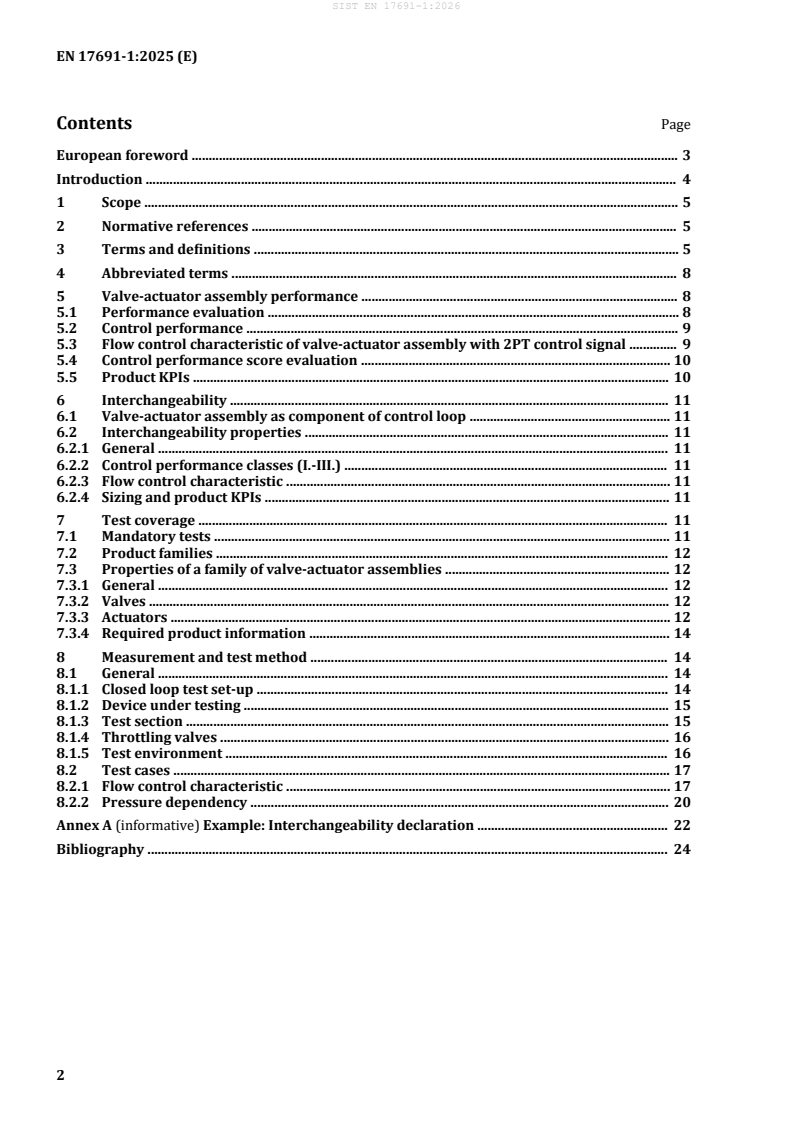
Contents Page
European foreword . 3
Introduction . 4
1 Scope . 5
2 Normative references . 5
3 Terms and definitions . 5
4 Abbreviated terms . 8
5 Valve-actuator assembly performance . 8
5.1 Performance evaluation . 8
5.2 Control performance . 9
5.3 Flow control characteristic of valve-actuator assembly with 2PT control signal . 9
5.4 Control performance score evaluation . 10
5.5 Product KPIs . 10
6 Interchangeability . 11
6.1 Valve-actuator assembly as component of control loop . 11
6.2 Interchangeability properties . 11
6.2.1 General . 11
6.2.2 Control performance classes (I.-III.) . 11
6.2.3 Flow control characteristic . 11
6.2.4 Sizing and product KPIs . 11
7 Test coverage . 11
7.1 Mandatory tests . 11
7.2 Product families . 12
7.3 Properties of a family of valve-actuator assemblies . 12
7.3.1 General . 12
7.3.2 Valves . 12
7.3.3 Actuators . 12
7.3.4 Required product information . 14
8 Measurement and test method . 14
8.1 General . 14
8.1.1 Closed loop test set-up . 14
8.1.2 Device under testing . 15
8.1.3 Test section . 15
8.1.4 Throttling valves . 16
8.1.5 Test environment . 16
8.2 Test cases . 17
8.2.1 Flow control characteristic . 17
8.2.2 Pressure dependency . 20
Annex A (informative) Example: Interchangeability declaration . 22
Bibliography . 24
European foreword
This document (EN 17691-1:2025) has been prepared by Technical Committee CEN/TC 247 “Building
Automation, Controls and Building Management”, the secretariat of which is held by SNV.
This European Standard shall be given the status of a national standard, either by publication of an
identical text or by endorsement, at the latest by June 2026, and conflicting national standards shall be
withdrawn at the latest by June 2026.
Attention is drawn to the possibility that some of the elements of this document may be the subject of
patent rights. CEN shall not be held responsible for identifying any or all such patent rights.
This document is part of a series of standards on components of building automation and control loop.
A list of all parts in a series can be found on the CEN website.
Any feedback and questions on this document should be directed to the users’ national standards body.
A complete listing of these bodies can be found on the CEN website.
According to the CEN-CENELEC Internal Regulations, the national standards organisations of the
following countries are bound to implement this European Standard: Austria, Belgium, Bulgaria, Croatia,
Cyprus, Czech Republic, Denmark, Estonia, Finland, France, Germany, Greece, Hungary, Iceland, Ireland,
Italy, Latvia, Lithuania, Luxembourg, Malta, Netherlands, Norway, Poland, Portugal, Republic of North
Macedonia, Romania, Serbia, Slovakia, Slovenia, Spain, Sweden, Switzerland, Tu�rkiyé and the United
Kingdom.
Introduction
Various EU Directives and national regulations regarding energy saving and energy performance of
buildings require proof of energy éfficiéncy.
These requirements and rising energy costs are encouraging owners and occupiers of buildings to
reduce their energy consumption. The cost for energy will be a critical factor in property rental and sale
in the future.
Building Automation and Controls (BAC) have a strong impact on the energy performance of a building.
This is shown in the existing Building Automation and Control (BAC) standards (mainly EN ISO 52120-1
[1], CEN ISO/TR 52120-2 [2]). The standards also show the importance of BAC quality to achieve the
desired comfort (e.g. human health and productivity) at maximum éfficiéncy via control accuracy, BAC
functions and BAC strategies.
For the measurement of the control accuracy (CA value) based on European Standard EN ISO 52120-1
[1], CEN ISO/TR 52120-2 [2], EN 15500-1 [3] and its accompanying Technical Report CEN/TR 15500-2
[4], a controller is tested as part of a control loop, consisting of the loop elements room temperature
sensor / controller / actuator / valve shown in Figure 1:
Key
1 application of a control loop (example water flow heating system)
2 sensor temperature
3 controller
4 actuator
5 valve
Figure 1 — Control loop elements
Both the controller as well as components contribute to the overall performance of a control loop.
A controller can be used in combination with different control loop elements, if they fulfil the
requirements of the interfaces to each other, and if the basic characteristics of the replaced control loop
elements are the same.
The EN 17691 series [5] and EN 17690-1 [6] will cover the different components used in conjunction
with a BAC controller. All these components contribute to the control accuracy of a control loop. These
standards will contribute to classify the components.
1 Scope
This document spécifiés requirements and test methods of valve-actuator assemblies in individual zone
control of water-based HVAC applications.
This document does not apply to control valves of nominal diameter larger than DN50.
This document is applicable to pressure independent and pressure dependent control valve-actuator
assemblies of relevant categories: 2-port, 3-port and 6-port valves (if they incorporate a control valve
function).
Where a certain control loop as a combination of controller and valve-actuator assembly was
assessed under EN 15500-1 [3], this document allows the assessment of the performance of
combinations of that controller with different valve-actuator assemblies. The tests in this document
ensure that valve/actuator assemblies, as components of control loops, can be replaced with products
that provide comparable or better performance.
In hydronic system, valve-actuator assembly is a component of control loop that controls water flow
rate according to the application control demand.
2 Normative references
The following documents are referred to in the text in such a way that some or all of their content
constitutes requirements of this document. For dated references, only the edition cited applies. For
undated references, the latest edition of the referenced document (including any amendments) applies.
EN ISO 7345, Thermal performance of buildings and building components - Physical quantities and
definitions (ISO 7345:2018)
EN 15500-1, Energy Performance of Buildings - Control for heating, ventilating and air conditioning
applications - Part 1: Electronic individual zone control equipment - Modules M3-5, M4-5, M5-5
EN ISO 52000-1, Energy performance of buildings - Overarching EPB assessment - Part 1: General
framework and procedures (ISO 52000-1:2017)
3 Terms and definitions
For the purposes of this document, the terms and définitions given in EN ISO 7345, EN ISO 52000-1,
EN 15500-1 and the following apply.
ISO and IEC maintain terminology databases for use in standardization at the following addresses:
— ISO Online browsing platform: available at http://www.iso.org/obp
— IEC Electropedia: available at http://www.electropedia.org/
3.1
control loop
loop that consists of sensors for measurement, controller, actuators, valves and communication of
variables
Note 1 to entry: Controlled variables are transmitted from the sensors to the controller. The controller interprets
the signals and generates appropriate manipulated variables based on set-points, which it transmits to the
actuators. Process changes due to disturbances result in new sensor signals identifying the state of the process,
which are again transmitted to the controller.
3.2
control valve
component with the ability to change the fluid flow rate
3.3
actuator
component that is responsible for changing the position of the closure member of the control valve,
based on a signal from a controller
3.4
linear motion control valve
control valve with a linear motion closure member
EXAMPLE globe valve, gate valve
3.5
valve-actuator assembly
assembly of valve and actuator that forms the device under test (DUT)
3.6
closed position
H , φ
0 0
position of the control valve where the flow passageway is at the minimum
3.7
open position
H , φ
max max
position of the control valve where the flow passageway is at the maximum
3.8
travel
H, φ
displacement of the closure member
Note 1 to entry: Travel is expressed in mm.
3.9
nominal travel
H , φ
100 100
displacement of the closure member from the closed position to the fully open position
Note 1 to entry: Nominal travel is in mm.
3.10
relative travel
h
ratio of the travel at a given opening compared to the nominal travel
Note 1 to entry: Relative travel is in %.
3.11
nominal flow capacity
Q
flow capacity at the open position
Note 1 to entry: Nominal flow capacity is in m /h.
3.12
relative flow capacity
ratio of the capacity at a given opening compared to the nominal capacity
Note 1 to entry: Relative flow capacity is expressed in %.
3.13
valve-actuator assembly flow presetting
Qm /h
flow capacity value that can be preset in a valve-actuator assembly (3.5), where presetting can be made
on a valve or an actuator (3.3)
Note 1 to entry: Valve-actuator presetting is expressed in m /h, %.
3.14
nominal flow coefficient
k
vs
basic coéfficiént used to state flow capacity of a control valve (3.2) at fully open position (3.7)
Note 1 to entry: Nominal flow coéfficiént is expressed in m /h.
3.15
relative flow coefficient
ratio of the flow coéfficiént at a relative travel (3.10) to the nominal flow coefficient (3.14)
Note 1 to entry: Relative flow coéfficiént is expressed in %.
3.16
linear characteristic
Φ
characteristic where equal increments of relative travel (3.10) yield equal increments of relative flow
characteristic
3.17
modified equal percentage characteristic
Φ
characteristic which combines inherent linear and inherent equal percentage flow characteristic
3.18
control signal
Y
actuator (3.3) input signal
Note 1 to entry: Control signal is expressed in V, mA, …
3.19
nominal control signal
Y
control signal (3.18) value corresponding to valve-actuator position delivering nominal capacity / flow
coéfficiént
Note 1 to entry: Nominal control signal is expressed in V, mA, …
3.20
relative control signal
y
ratio of actual control signal and control signal (3.18) span: y = Y−Y /Y -Y
0 100 0
Note 1 to entry: Relative control signal is expressed in %.
3.21
root mean square error
RMSE
measure of the average difference between a statistical model’s predicted values and the actual values
Note 1 to entry: Mathematically, it is the standard deviation of the residuals. Residuals represent the distance
between the regression line and the data points.
4 Abbreviated terms
Abbreviation Explanation
VA valve-actuator assembly
HVAC heating, ventilation, air conditioning
PICV* pressure independent control valve
CV control valve (pressure dependent)
BAC building automation and controls
DUT device under testing
2PT 2-point controlled (on/ off)
3PT floating point device, 3-point controlled
MOA modulating device, steadily controlled
BUS digital, networked device, fiéld bus controlled
KPI key performance indicator
RMSE root mean square error
* In the market also referred to as PIBCV: Pressure Independent Balancing & Control Valve.
5 Valve-actuator assembly performance
5.1 Performance evaluation
Valve-actuator assemblies shall be evaluated based on performance properties. Performance properties
are based on tests described in this document and KPIs declared by manufacturer.
The common Formula (1) describes the flow rate where whole hydronic system itself has an influéncé
on actual flow rate as differential pressure across control valve-actuator assembly typically varies
during operation.
∆p
v
(1)
Q = k .
v
∆p
1bar
where
water flow
Q [m /h]
flow coéfficiént of the valve
k [m /h]
v
Δp [bar] differential pressure across the valve
v
Δp [bar] 1 bar differential pressure
1bar
5.2 Control performance
Control performance of valve-actuator assemblies shall be evaluated based on two performance
properties:
— flow control characteristic (see 8.2.1)
— pressure dependency (see 8.2.2).
Control performance test score shall be obtained by measurement output of flow control characteristic
(RMSE value) multiplied by the pressure dependency test output.
In addition, pressure dependency test result higher than 50 % results in a loss of one performance class.
Below examples (Table 1 and Table 2) showing final control performance assessment without and with
pressure dependency adjustment.
Table 1 — Example of control performance assessment for PICV
Test result
Flow control characteristic (RMSE) 4,2
a
3 %
Pressure dependency
a
1,03
Multiplier
Test score 4,3
a
The maximum value is 224 % as theoretical value for pressure dependent control valve.
Table 2 — Example of control performance assessment for pressure dependant CV
Test result
Flow control characteristic (RMSE) 4,2
a
55 %
Pressure dependency
a
1,55
Multiplier
6,5
Test score
+ additional class deduction
a
max value is 224 % as theoretical value for pressure dependent control valve
5.3 Flow control characteristic of valve-actuator assembly with 2PT control signal
Flow control characteristic of valve-actuator assembly with 2PT control signal is meaningless as it has
only two positions: open and closed one. However, it is important to be able to compare control
performance of such assembly as valve-actuator assemblies with 2PT control signal are commonly used
in real applications.
To allow comparison, this document spécifiés a reference RMSE values for valve-actuator assembly with
2PT control signal. They are based on comparison of ideal flow control characteristic (for both linear
with Φ value of 1 and Φ with value of 0,25) and theoretical charac
...