

EN 10308:2001
(Main)Non destructive testing - Ultrasonic testing of steel bars
- Abstract
Part 5 of this document, in addition to part 1, specifies requirements for flat and long products of hot rolled steels with improved atmospheric corrosion resistance in the grades and qualities given in Tables 2 and 3 (chemical composition) and Tables 4 and 5 (mechanical properties) in the usual delivery conditions as given in 6.3.
The thicknesses in which products of the steel grades and qualities specified in this document may be supplied are given in Table 1.
In addition to EN 10025-1:2004 the steels specified in this document are especially intended for use in welded, bolted and riveted components which shall have enhanced resistance to atmospheric corrosion, for service at ambient temperatures (subject to the restrictions described in 7.4.1).
The steels specified in this Part 5 are not intended to be heat treated except products delivered in the delivery condition +N. Stress relief annealing is permitted (see also the NOTE in 7.3.1.1 of EN 10025-1:2004). Products delivered in +N condition can be hot formed and/or normalized after delivery (see Clause 3).
- Status
- Published
- Publication Date
- 13-Nov-2001
- Withdrawal Date
- 30-May-2002
- Technical Committee
- ECISS/TC 101 - Test methods for steel (other than chemical analysis)
- Drafting Committee
- ECISS/TC 2 - Steel - Physico-chemical and non-destructive testing
- Current Stage
- 9060 - Closure of 2 Year Review Enquiry - Review Enquiry
- Start Date
- 02-Dec-2025
- Completion Date
- 02-Dec-2025

Overview
EN 10308:2001 - "Non destructive testing - Ultrasonic testing of steel bars" is a CEN European Standard that defines the technical requirements and procedures for manual pulse‑echo ultrasonic testing (UT) of steel bars and equivalent sections up to 400 mm diameter or equivalent thickness. The standard covers equipment, calibration, scanning techniques, sensitivity setting, recording and acceptance, and personnel qualification - and allows mechanised or automatic methods when agreed between purchaser and supplier.
Key topics and requirements
- Scope: Manual pulse‑echo ultrasonic testing of steel bars (mechanised/automatic allowed by agreement). Single‑side testing using the first back‑wall echo.
- Principle: Detection and evaluation of discontinuities by comparing echo amplitudes to reference flat‑bottomed holes (FBH) and sizing by the –6 dB beam‑width technique.
- Equipment:
- Instruments with A‑scan presentation (EN 12668‑1).
- Probes: nominal frequency 1–6 MHz; largest transducer dimension typically 9–25 mm. Double transducer probes usable up to 150 mm bars; single transducers for bars > 60 mm.
- Calibration and reference blocks per EN 12223; reference FBH tolerance ±5% on diameter.
- Couplant: water commonly used; same couplant for calibration and scanning.
- Calibration & sensitivity:
- Routine calibration per EN 12668‑3.
- Sensitivity set using DAC (Distance Amplitude Curve) or DGS techniques (see EN 583‑5).
- Scanning:
- Two coverage options: grid scanning (scan lines per table) or complete scanning (overlap ≥ 10% of transducer diameter).
- Surface must be free from paint, loose scale or contaminants that impair coupling.
- Procedure & reporting:
- UT must follow a written procedure; purchaser/supplier must agree on stage of manufacture, coverage, quality class, acceptance levels, sizing methods, and whether purchaser will witness tests.
- Personnel: Recommended qualification/certification per EN 473 (or equivalent).
Applications
EN 10308 is used to ensure internal quality and integrity of steel bars and rods before further processing or delivery. Typical applications:
- Quality control at steel mills and rolling plants
- Incoming inspection at fabricators and machine shops
- Final inspection of bar stock for construction, forging, machining and assembly
- Acceptance testing where traceable UT calibration and documented procedures are required
Who uses this standard
- NDT technicians and supervisors
- Quality engineers and inspectors in steel production and fabrication
- Purchasing/specification engineers who define acceptance criteria
- Third‑party inspection bodies and certification organizations
Related standards (normative references)
- EN 12668‑1 / EN 12668‑2 / EN 12668‑3 (equipment and probe verification)
- EN 12223 (calibration block)
- EN 583‑2, EN 583‑5 (UT sensitivity, characterization/sizing)
- EN 473 (NDT personnel certification)
Keywords: EN 10308, ultrasonic testing, non‑destructive testing, NDT, steel bars, pulse‑echo, calibration, DAC, DGS, A‑scan.
Relations
- Effective Date
- 28-Jan-2026
- Effective Date
- 28-Jan-2026
- Effective Date
- 28-Jan-2026
- Effective Date
- 28-Jan-2026
- Effective Date
- 28-Jan-2026
- Effective Date
- 28-Jan-2026
- Effective Date
- 28-Jan-2026
- Effective Date
- 28-Jan-2026
- Effective Date
- 28-Jan-2026
- Effective Date
- 28-Jan-2026
- Effective Date
- 28-Jan-2026
- Effective Date
- 28-Jan-2026
- Effective Date
- 28-Jan-2026
- Effective Date
- 28-Jan-2026
- Effective Date
- 28-Jan-2026
Get Certified
Connect with accredited certification bodies for this standard

Element Materials Technology
Materials testing and product certification.

Inštitut za kovinske materiale in tehnologije
Institute of Metals and Technology. Materials testing, metallurgical analysis, NDT.
Sponsored listings
Frequently Asked Questions
EN 10308:2001 is a standard published by the European Committee for Standardization (CEN). Its full title is "Non destructive testing - Ultrasonic testing of steel bars". This standard covers: Part 5 of this document, in addition to part 1, specifies requirements for flat and long products of hot rolled steels with improved atmospheric corrosion resistance in the grades and qualities given in Tables 2 and 3 (chemical composition) and Tables 4 and 5 (mechanical properties) in the usual delivery conditions as given in 6.3. The thicknesses in which products of the steel grades and qualities specified in this document may be supplied are given in Table 1. In addition to EN 10025-1:2004 the steels specified in this document are especially intended for use in welded, bolted and riveted components which shall have enhanced resistance to atmospheric corrosion, for service at ambient temperatures (subject to the restrictions described in 7.4.1). The steels specified in this Part 5 are not intended to be heat treated except products delivered in the delivery condition +N. Stress relief annealing is permitted (see also the NOTE in 7.3.1.1 of EN 10025-1:2004). Products delivered in +N condition can be hot formed and/or normalized after delivery (see Clause 3).
Part 5 of this document, in addition to part 1, specifies requirements for flat and long products of hot rolled steels with improved atmospheric corrosion resistance in the grades and qualities given in Tables 2 and 3 (chemical composition) and Tables 4 and 5 (mechanical properties) in the usual delivery conditions as given in 6.3. The thicknesses in which products of the steel grades and qualities specified in this document may be supplied are given in Table 1. In addition to EN 10025-1:2004 the steels specified in this document are especially intended for use in welded, bolted and riveted components which shall have enhanced resistance to atmospheric corrosion, for service at ambient temperatures (subject to the restrictions described in 7.4.1). The steels specified in this Part 5 are not intended to be heat treated except products delivered in the delivery condition +N. Stress relief annealing is permitted (see also the NOTE in 7.3.1.1 of EN 10025-1:2004). Products delivered in +N condition can be hot formed and/or normalized after delivery (see Clause 3).
EN 10308:2001 is classified under the following ICS (International Classification for Standards) categories: 77.040.20 - Non-destructive testing of metals; 77.140.60 - Steel bars and rods. The ICS classification helps identify the subject area and facilitates finding related standards.
EN 10308:2001 has the following relationships with other standards: It is inter standard links to EN ISO 22232-3:2020, EN ISO 22232-1:2020, EN ISO 22232-2:2020, EN ISO 2400:2025, EN ISO 5577:2025, EN ISO 9712:2022, EN ISO 16811:2025, EN ISO 16827:2025, EN 10084:2008, EN 10083-3:2006, EN 10088-5:2009, EN 12952-2:2011, EN 10273:2016, EN 10272:2016, EN 10343:2009. Understanding these relationships helps ensure you are using the most current and applicable version of the standard.
EN 10308:2001 is available in PDF format for immediate download after purchase. The document can be added to your cart and obtained through the secure checkout process. Digital delivery ensures instant access to the complete standard document.
Standards Content (Sample)
SLOVENSKI STANDARD
01-junij-2002
Neporušitveno preskušanje - Ultrazvočno preskušanje jeklenih palic
Non destructive testing - Ultrasonic testing of steel bars
Zerstörungsfreie Prüfung - Ultraschallprüfung von Stäben aus Stahl
Essais non destructifs - Contrôle par ultrasons des barres en acier
Ta slovenski standard je istoveten z: EN 10308:2001
ICS:
77.040.20 Neporušitveno preskušanje Non-destructive testing of
kovin metals
77.140.60 Jeklene palice in drogovi Steel bars and rods
2003-01.Slovenski inštitut za standardizacijo. Razmnoževanje celote ali delov tega standarda ni dovoljeno.
EUROPEAN STANDARD
EN 10308
NORME EUROPÉENNE
EUROPÄISCHE NORM
November 2001
ICS 77.040.20; 77.140.60
English version
Non destructive testing - Ultrasonic testing of steel bars
Essais non destructifs - Contrôle par ultrasons des barres Zerstörungsfreie Prüfung - Ultraschallprüfung von Stäben
en acier aus Stahl
This European Standard was approved by CEN on 30 September 2001.
CEN members are bound to comply with the CEN/CENELEC Internal Regulations which stipulate the conditions for giving this European
Standard the status of a national standard without any alteration. Up-to-date lists and bibliographical references concerning such national
standards may be obtained on application to the Management Centre or to any CEN member.
This European Standard exists in three official versions (English, French, German). A version in any other language made by translation
under the responsibility of a CEN member into its own language and notified to the Management Centre has the same status as the official
versions.
CEN members are the national standards bodies of Austria, Belgium, Czech Republic, Denmark, Finland, France, Germany, Greece,
Iceland, Ireland, Italy, Luxembourg, Netherlands, Norway, Portugal, Spain, Sweden, Switzerland and United Kingdom.
EUROPEAN COMMITTEE FOR STANDARDIZATION
COMITÉ EUROPÉEN DE NORMALISATION
EUROPÄISCHES KOMITEE FÜR NORMUNG
Management Centre: rue de Stassart, 36 B-1050 Brussels
© 2001 CEN All rights of exploitation in any form and by any means reserved Ref. No. EN 10308:2001 E
worldwide for CEN national Members.
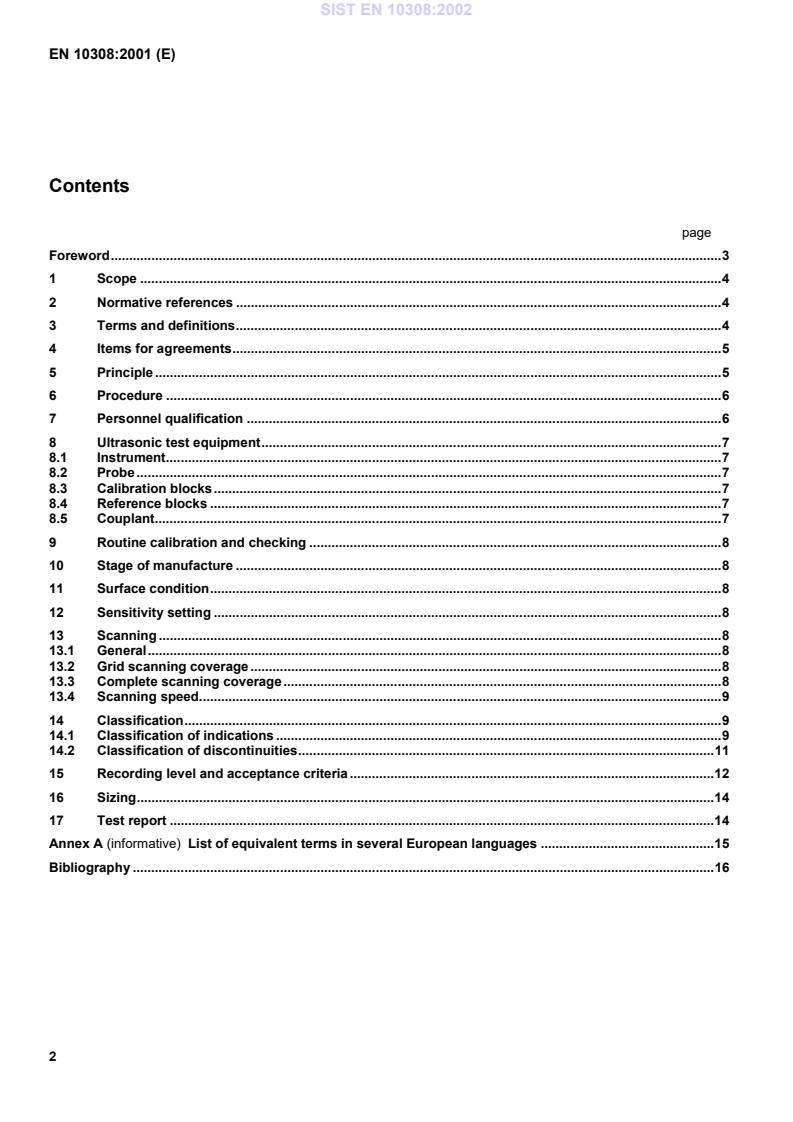
Contents
page
Foreword.3
1 Scope .4
2 Normative references .4
3 Terms and definitions.4
4 Items for agreements.5
5 Principle.5
6 Procedure .6
7 Personnel qualification .6
8 Ultrasonic test equipment.7
8.1 Instrument.7
8.2 Probe .7
8.3 Calibration blocks.7
8.4 Reference blocks .7
8.5 Couplant.7
9 Routine calibration and checking .8
10 Stage of manufacture .8
11 Surface condition.8
12 Sensitivity setting .8
13 Scanning.8
13.1 General.8
13.2 Grid scanning coverage .8
13.3 Complete scanning coverage.8
13.4 Scanning speed.9
14 Classification.9
14.1 Classification of indications .9
14.2 Classification of discontinuities.11
15 Recording level and acceptance criteria .12
16 Sizing.14
17 Test report .14
Annex A (informative) List of equivalent terms in several European languages .15
Bibliography .16
Foreword
This European Standard has been prepared by Technical Committee ECISS/TC 2 "Steel - Physico-chemical and
non-destructive testing", the secretariat of which is held by AFNOR.
This European Standard shall be given the status of a national standard, either by publication of an identical text or
by endorsement, at the latest by May 2002, and conflicting national standards shall be withdrawn at the latest by
May 2002.
Annex A is informative.
This standard includes a Bibliography.
According to the CEN/CENELEC Internal Regulations, the national standards organizations of the following
countries are bound to implement this European Standard: Austria, Belgium, Czech Republic, Denmark, Finland,
France, Germany, Greece, Iceland, Ireland, Italy, Luxembourg, Netherlands, Norway, Portugal, Spain, Sweden,
Switzerland and the United Kingdom.
1 Scope
This European Standard describes the techniques to be used for the manual, pulse-echo, ultrasonic testing of steel
bars of diameter or equivalent thickness less or equal to 400 mm or equivalent section. Mechanised,
semi-automatic or automatic techniques may be used but should be agreed between the purchaser and the
supplier.
2 Normative references
This European Standard incorporates by dated or undated reference, provisions from other publications. These
normative references are cited at the appropriate places in the text, and the publications are listed hereafter. For
dated references, subsequent amendments to or revisions of any of these publications apply to this European
Standard only when incorporated in it by amendment or revision. For undated references the latest edition of the
publication referred to applies (including amendments).
EN 473, Non destructive testing - Qualification and certification of NDT personnel – General principles.
EN 583-2, Non-destructive testing - Ultrasonic examination - Part 2: Sensitivity and range setting.
EN 583-5, Non-destructive testing - Ultrasonic examination - Part 5: Characterization and sizing of discontinuities.
EN 1330-4, Non destructive testing - Terminology - Part 4: Terms used in ultrasonic testing.
EN 12223, Non-destructive testing - Ultrasonic examination - Specification for calibration block n°1.
EN 12668-1, Non-destructive testing - Characterization and verification of ultrasonic examination equipment - Part
1: Instruments.
EN 12668-2, Non-destructive testing - Characterization and verification of ultrasonic examination equipment – Part
2: Probes.
EN 12668-3, Non-destructive testing - Characterization and verification of ultrasonic examination equipment - Part
3: Combined equipment.
3 Terms and definitions
Definitions for general terms of non-destructive testing can be found in other European Standards, e.g. EN 1330-1
and EN 1330-2. For the purposes of this European Standard, the following terms and definitions given in EN 1330-
4 apply, together with the following.
3.1
manual testing
testing by an operator applying an ultrasonic probe, or probes, to the product surface, manually executing the
appropriate scanning pattern on the product surface and assessing ultrasonic signal indications on the electronic
equipment screen either by direct viewing or by built-in signal amplitude alarm devices
3.2
automatic and semi-automatic testing
testing using a mechanised means of applying the ultrasonic probe or probes to, and executing the appropriate
scanning pattern on the flat product surface, together with ultrasonic signal indication evaluation by electronic
means
NOTE Such testing can be either fully automatic with no operator involvement, or semi-automatic when the operator
performs basic equipment operation functions.
A list of equivalent terms in several European languages in given in annex A.
4 Items for agreements
The following aspects concerning ultrasonic testing shall be agreed between the purchaser and supplier at the time
of the enquiry or order:
a) the manufacturing stage(s) at which ultrasonic testing shall be performed (see clause 10);
b) the volume(s) to be tested and whether grid scanning coverage or complete scanning coverage is required
(see clause 13);
c) the Quality Class required, or the Quality Classes and the zones to which they apply (see clause 15);
d) the applicable evaluation level and acceptance criteria if different from those detailed in Tables 2 and 3;
e) whether any special scanning coverage, equipment or couplant is required in addition to that detailed in
clauses 8 and 13;
f) the scanning technique to be used if not manual;
g) the sizing techniques to be used for extended discontinuities (see clause 16);
h) the technique(s) to be used for setting sensitivity (see clause 12);
i) whether the test is to be conducted in the presence of the purchaser or his representative;
j) whether a written procedure shall be submitted for approval by the purchaser (see clause 6).
5 Principle
The method used is based on the reflection of ultrasonic waves (generally longitudinal), the direction of which is
approximately perpendicular to the surface of the product. The examination consists of:
a) locating and evaluation of discontinuity by comparing the amplitude of the discontinuity echo with the
amplitude of the echo of a flat-bottomed hole of a given diameter and located at the same depth as the
discontinuity.
NOTE Only those discontinuities giving an echo in amplitude equal to or greater than that obtained with the reference flat-
bottomed hole are taken into consideration.
b) determining the area of the discontinuity according to the – 6 dB beam width technique.
If areas with particular permeability are located, the testing conditions shall be adjusted in order to test these areas
with the required sensitivity level.
The examination is carried out during the first ultrasonic scan (first back wall echo) for all the product thicknesses or
diameter and from one side only.
6 Procedure
The inspection is normally carried out in the place of production or on the premises of the supplier. If specified on
1)
the order, the inspection may take place in the presence of the purchaser or his representative .
Ultrasonic testing shall be performed in accordance with a written procedure. Where specified in the enquiry or
order, the written procedure shall be submitted to the purchaser for approval prior to testing.
Th
...