

EN 17371-1:2021
(Main)Provision of services - Part 1: Service procurement - Guidance for the assessment of the capacity of service providers and evaluation of service proposals
- Abstract
This document provides guidance for the assessment of the capacity of service providers and the evaluation of service proposals in order to improve and facilitate the process of procuring services.
This document is applicable to:
a) Service buyers and service providers regardless of type, size or the nature of the services;
b) Service providers who may be inside or outside the service buyers' organization; and
c) Any interested parties who are directly or indirectly involved in or affected by a procurement process.
This document is not applicable to business-to-consumer (B2C) service contracts or for works contracts.
NOTE 1 "Works contracts" are contracts that have as their object the execution, or both the design and execution, of a work are not covered in this document. Contracts having as their object only the design of a work are covered.
NOTE 2 "Work" means the outcome of building or civil engineering works taken as a whole which is sufficient in itself to fulfil an economic or technical function.
- Status
- Published
- Publication Date
- 30-Mar-2021
- Withdrawal Date
- 29-Sep-2021
- Technical Committee
- CEN/TC 447 - Services - Procurement, contracts and performance assessment
- Drafting Committee
- CEN/TC 447/WG 4 - Service Procurement
- Current Stage
- 9060 - Closure of 2 Year Review Enquiry - Review Enquiry
- Start Date
- 02-Sep-2026
- Completion Date
- 02-Sep-2026


Overview
EN 17371-1:2021 (CEN) - "Provision of services - Part 1: Service procurement" - is a European guidance standard for the assessment of the capacity of service providers and the evaluation of service proposals. It aims to improve and streamline the service procurement process for both public and private buyers by offering a harmonized framework for selection, evaluation and award decisions. The standard applies to service buyers and service providers of any size or sector, excludes business-to-consumer (B2C) contracts and most works contracts (design-only works are covered).
Key Topics
EN 17371-1:2021 addresses practical, actionable areas of procurement practice, including:
- Service procurement process: guidance on drafting technical specifications, gathering information and organizing tendering for public and private procurement.
- Criteria for assessing provider capacity: recommended evidence and purpose for legal capacity, economic and financial capacity, human resources, materials/equipment/infrastructure, references and credentials.
- Criteria for evaluating service proposals: principles for selecting and weighting criteria, scoring proposals, and assessing technical content and financial offers.
- Financial assessment: methods to rate financial proposals, detect abnormally low bids and apply proportional or linear scoring models.
- Performance and public-interest criteria: consideration of sustainability, accessibility and other non-price factors where relevant.
- Supporting annexes: practical tools such as a sourcing process (Annex A), proposal evaluation methods (Annex B), sustainability/accessibility criteria (Annex C) and deviation handling (Annex D).
Practical Applications
EN 17371-1:2021 is useful for:
- Service buyers (public authorities, private organizations) who need a consistent, transparent approach to shortlist and award service contracts.
- Service providers preparing tenders and demonstrating capacity across legal, financial, technical and organisational dimensions.
- Procurement advisors, consultancies and list managers who design selection systems, pre-qualification and scoring matrices.
- Public procurement officials who must align selection and award procedures with European/national procurement rules while incorporating sustainability and accessibility considerations.
Benefits include improved comparability of bids, reduced procurement risk, clearer evidence requirements and support for best-value decision-making.
Related Standards
- Part of the EN 17371 series (covers procurement - Part 1). Subsequent parts address service contracting (EN 17371-2) and service execution (EN 17371-3).
- Prepared by CEN/TC 447 (Horizontal standards for provision of services).
Keywords: EN 17371-1:2021, service procurement, assessment of service providers, evaluation of service proposals, CEN, procurement criteria, sustainability, accessibility, best value.
Relations
- Effective Date
- 28-Jan-2026
- Effective Date
- 28-Jan-2026
- Effective Date
- 28-Jan-2026
- Effective Date
- 28-Jan-2026
- Effective Date
- 28-Jan-2026
Get Certified
Connect with accredited certification bodies for this standard

BSI Group
BSI (British Standards Institution) is the business standards company that helps organizations make excellence a habit.

Bureau Veritas
Bureau Veritas is a world leader in laboratory testing, inspection and certification services.

DNV
DNV is an independent assurance and risk management provider.
Sponsored listings
Frequently Asked Questions
EN 17371-1:2021 is a standard published by the European Committee for Standardization (CEN). Its full title is "Provision of services - Part 1: Service procurement - Guidance for the assessment of the capacity of service providers and evaluation of service proposals". This standard covers: This document provides guidance for the assessment of the capacity of service providers and the evaluation of service proposals in order to improve and facilitate the process of procuring services. This document is applicable to: a) Service buyers and service providers regardless of type, size or the nature of the services; b) Service providers who may be inside or outside the service buyers' organization; and c) Any interested parties who are directly or indirectly involved in or affected by a procurement process. This document is not applicable to business-to-consumer (B2C) service contracts or for works contracts. NOTE 1 "Works contracts" are contracts that have as their object the execution, or both the design and execution, of a work are not covered in this document. Contracts having as their object only the design of a work are covered. NOTE 2 "Work" means the outcome of building or civil engineering works taken as a whole which is sufficient in itself to fulfil an economic or technical function.
This document provides guidance for the assessment of the capacity of service providers and the evaluation of service proposals in order to improve and facilitate the process of procuring services. This document is applicable to: a) Service buyers and service providers regardless of type, size or the nature of the services; b) Service providers who may be inside or outside the service buyers' organization; and c) Any interested parties who are directly or indirectly involved in or affected by a procurement process. This document is not applicable to business-to-consumer (B2C) service contracts or for works contracts. NOTE 1 "Works contracts" are contracts that have as their object the execution, or both the design and execution, of a work are not covered in this document. Contracts having as their object only the design of a work are covered. NOTE 2 "Work" means the outcome of building or civil engineering works taken as a whole which is sufficient in itself to fulfil an economic or technical function.
EN 17371-1:2021 is classified under the following ICS (International Classification for Standards) categories: 03.080.20 - Services for companies; 03.100.10 - Purchasing. Procurement. Logistics. The ICS classification helps identify the subject area and facilitates finding related standards.
EN 17371-1:2021 has the following relationships with other standards: It is inter standard links to EN ISO 11127-5:2021, EN ISO 16961:2024, EN ISO 8504-2:2019, EN ISO 11127-6:2022, EN ISO 21809-1:2018. Understanding these relationships helps ensure you are using the most current and applicable version of the standard.
EN 17371-1:2021 is associated with the following European legislation: Standardization Mandates: M/517. When a standard is cited in the Official Journal of the European Union, products manufactured in conformity with it benefit from a presumption of conformity with the essential requirements of the corresponding EU directive or regulation.
EN 17371-1:2021 is available in PDF format for immediate download after purchase. The document can be added to your cart and obtained through the secure checkout process. Digital delivery ensures instant access to the complete standard document.
Standards Content (Sample)
SLOVENSKI STANDARD
01-junij-2021
Zagotavljanje storitev - 1. del: Storitve nabave - Navodilo za ocenjevanje
sposobnosti ponudnikov storitev in vrednotenje storitvenih predlogov
Provision of services - Part 1: Service procurement - Guidance for the assessment of the
capacity of service providers and evaluation of service proposals
Dienstleistungserbringung - Teil 1: Dienstleistungsbeschaffung - Leitlinien für die
Bewertung der Kapazität von Dienstleistern und die Bewertung von
Dienstleistungsangeboten
Processus dachat de prestations de services - Evaluation de la capacité des
fournisseurs de services
Ta slovenski standard je istoveten z: EN 17371-1:2021
ICS:
03.080.20 Storitve za podjetja Services for companies
03.100.10 Nabava. Dobava. Logistika Purchasing. Procurement.
Logistics
2003-01.Slovenski inštitut za standardizacijo. Razmnoževanje celote ali delov tega standarda ni dovoljeno.
EN 17371-1
EUROPEAN STANDARD
NORME EUROPÉENNE
March 2021
EUROPÄISCHE NORM
ICS 03.080.20; 03.100.10
English Version
Provision of services - Part 1: Service procurement -
Guidance for the assessment of the capacity of service
providers and evaluation of service proposals
Prestation de services - Partie 1 : Achat de services - Dienstleistungserbringung - Teil 1:
Recommandations pour l'évaluation de la capacité des Dienstleistungsbeschaffung - Leitlinien für die
prestataires de services et l'évaluation des Bewertung der Kapazität von Dienstleistern und die
propositions de services Bewertung von Dienstleistungsangeboten
This European Standard was approved by CEN on 3 May 2020.
CEN members are bound to comply with the CEN/CENELEC Internal Regulations which stipulate the conditions for giving this
European Standard the status of a national standard without any alteration. Up-to-date lists and bibliographical references
concerning such national standards may be obtained on application to the CEN-CENELEC Management Centre or to any CEN
member.
This European Standard exists in three official versions (English, French, German). A version in any other language made by
translation under the responsibility of a CEN member into its own language and notified to the CEN-CENELEC Management
Centre has the same status as the official versions.
CEN members are the national standards bodies of Austria, Belgium, Bulgaria, Croatia, Cyprus, Czech Republic, Denmark, Estonia,
Finland, France, Germany, Greece, Hungary, Iceland, Ireland, Italy, Latvia, Lithuania, Luxembourg, Malta, Netherlands, Norway,
Poland, Portugal, Republic of North Macedonia, Romania, Serbia, Slovakia, Slovenia, Spain, Sweden, Switzerland, Turkey and
United Kingdom.
EUROPEAN COMMITTEE FOR STANDARDIZATION
COMITÉ EUROPÉEN DE NORMALISATION
EUROPÄISCHES KOMITEE FÜR NORMUNG
CEN-CENELEC Management Centre: Rue de la Science 23, B-1040 Brussels
© 2021 CEN All rights of exploitation in any form and by any means reserved Ref. No. EN 17371-1:2021 E
worldwide for CEN national Members.
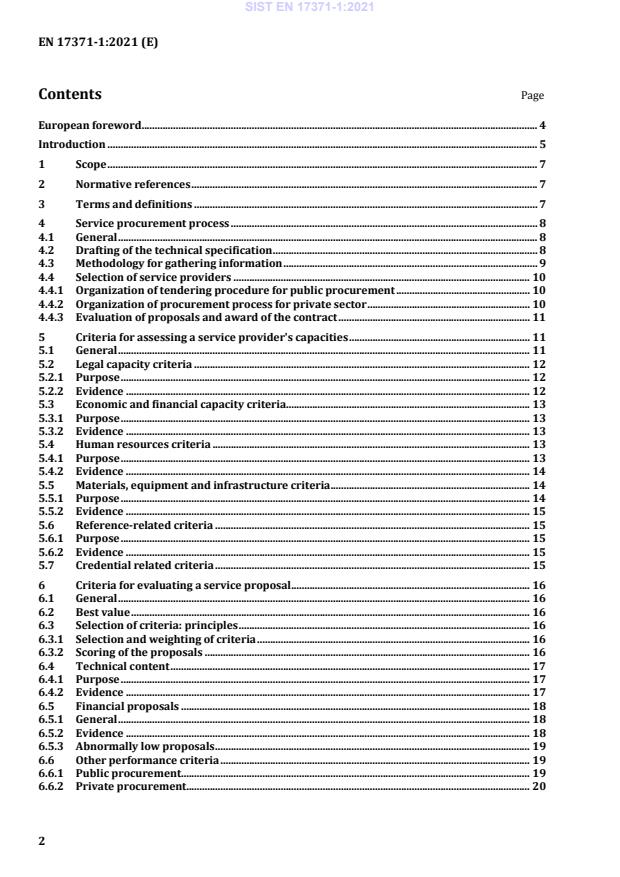
Contents Page
European foreword . 4
Introduction . 5
1 Scope . 7
2 Normative references . 7
3 Terms and definitions . 7
4 Service procurement process . 8
4.1 General . 8
4.2 Drafting of the technical specification . 8
4.3 Methodology for gathering information . 9
4.4 Selection of service providers . 10
4.4.1 Organization of tendering procedure for public procurement . 10
4.4.2 Organization of procurement process for private sector . 10
4.4.3 Evaluation of proposals and award of the contract . 11
5 Criteria for assessing a service provider's capacities . 11
5.1 General . 11
5.2 Legal capacity criteria . 12
5.2.1 Purpose . 12
5.2.2 Evidence . 12
5.3 Economic and financial capacity criteria. 13
5.3.1 Purpose . 13
5.3.2 Evidence . 13
5.4 Human resources criteria . 13
5.4.1 Purpose . 13
5.4.2 Evidence . 14
5.5 Materials, equipment and infrastructure criteria . 14
5.5.1 Purpose . 14
5.5.2 Evidence . 15
5.6 Reference-related criteria . 15
5.6.1 Purpose . 15
5.6.2 Evidence . 15
5.7 Credential related criteria . 15
6 Criteria for evaluating a service proposal . 16
6.1 General . 16
6.2 Best value . 16
6.3 Selection of criteria: principles . 16
6.3.1 Selection and weighting of criteria . 16
6.3.2 Scoring of the proposals . 16
6.4 Technical content . 17
6.4.1 Purpose . 17
6.4.2 Evidence . 17
6.5 Financial proposals . 18
6.5.1 General . 18
6.5.2 Evidence . 18
6.5.3 Abnormally low proposals . 19
6.6 Other performance criteria . 19
6.6.1 Public procurement. 19
6.6.2 Private procurement. 20
Annex A (informative) Sourcing Process. 21
Annex B (informative) Evaluation of Service Proposal . 23
B.1 General . 23
B.2 Purpose . 23
B.3 Ranking of tenders: different scenarios . 23
B.4 Method of rating the financial criterion . 24
B.4.1 General . 24
B.4.2 Rating of the financial criterion according to the proportional model . 24
B.4.3 Rating of the financial criterion according to the linear model . 25
B.5 How to weight criteria . 25
B.5.1 General . 25
B.5.2 Case 1 . 25
B.5.3 Case 2 . 26
Annex C (informative) Sustainability and Accessibility Criteria . 27
Annex D (informative) A–deviations . 29
Bibliography . 32
European foreword
This document (EN 17371-1:2021) has been prepared by Technical Committee CEN/TC 447 “Horizontal
standards for the provision of services”, the secretariat of which is held by BSI.
This European Standard shall be given the status of a national standard, either by publication of an
identical text or by endorsement, at the latest by September 2021, and conflicting national standards shall
be withdrawn at the latest by September 2021.
Attention is drawn to the possibility that some of the elements of this document may be the subject of
patent rights. CEN shall not be held responsible for identifying any or all such patent rights.
This document has been prepared under a mandate given to CEN by the European Commission and the
European Free Trade Association.
According to the CEN-CENELEC Internal Regulations, the national standards organisations of the
following countries are bound to implement this European Standard: Austria, Belgium, Bulgaria, Croatia,
Cyprus, Czech Republic, Denmark, Estonia, Finland, France, Germany, Greece, Hungary, Iceland, Ireland,
Italy, Latvia, Lithuania, Luxembourg, Malta, Netherlands, Norway, Poland, Portugal, Republic of North
Macedonia, Romania, Serbia, Slovakia, Slovenia, Spain, Sweden, Switzerland, Turkey and the United
Kingdom.
Introduction
This document is part of a series of European Standards that address different phases in the provision of
services (see Figure 1): the service procurement phase (EN 17371-1), the service contracting phase
1)
(EN 17371-2 ) and the service execution phase (EN 17371-3).
Each part of the series can be used individually or in combination with the other parts.
Figure 1 — Phases in the provision of services
The drafting of the series was initiated after CEN presented the findings of a study on the potential and a
possible impact of horizontal service standards on the EU single market for services. This study was as a
response to the standardization request M/517 from the European Commission for programming and
development of horizontal service standards. The objective of this standardization request was to
encourage the development of voluntary European Standards covering issues common to many service
sectors. Such standards should aim to facilitate compatibility between services providers and improve
information and the quality of services to the recipient.
This document provides recommendations focusing on the:
— service procurement process through to the selection of providers/service providers;
— criteria for assessing a service provider's capacities to deliver the service to be provided;
— criteria for evaluating a service proposal.
The goal is to build on existing best practice and avoid additional constraints, in particular on medium,
small and micro organizations, including by the provision of a framework and template. This document
reflects the most important trends within service procurement. It is aimed at, e.g:
— organizations purchasing services (also referred to as “service buyers” in this document);
— organizations providing services (also referred to as “providers” and “service providers” in this
document);
1) Under preparation. Stage at the time of publication: FprEN 17371-2.
— governmental departments (national or European) in their role as authorities defining the rules and
procedures governing public procurement;
— organizations advising customers how to select service providers (such as consultancies);
— organizations that manage systems for shortlisting or (pre)qualifying service providers for the
purpose of helping their customers select service providers that are capable of fulfilling their needs
and successfully leading their projects;
— organizations responsible for compiling official lists of approved providers, meaning those who are
authorized to bid on certain contracts;
— organizations responsible for sourcing service providers.
Whilst not the focus of the document, it is recognized that societal stakeholders including consumers,
labour and environmental NGOs have legitimate interests in service procurement, for example in areas
such as accessibility, privacy and sustainability. These interests have been taken into account in this
document.
The recommendations specified by this document are common to both private and public purchase,
wherever a recommendation applies only to one type of purchase it is identified. Taking into account the
European/national legislations on public procurement, some recommendations should be considered as
requirements by the public buyers.
1 Scope
This document provides guidance for the assessment of the capacity of service providers and the
evaluation of service proposals in order to improve and facilitate the process of procuring services.
This document is applicable to:
a) Service buyers and service providers regardless of type, size or the nature of the services;
b) Service providers who may be inside or outside the service buyers' organization; and
c) Any interested parties who are directly or indirectly involved in or affected by a procurement process.
This document is not applicable to business-to-consumer (B2C) service contracts or for works contracts.
NOTE 1 “Works contracts” are contracts that have as their object the execution, or both the design and execution,
of a work are not covered in this document. Contracts having as their object only the design of a work are covered.
NOTE 2 “Work” means the outcome of building or civil engineering works taken as a whole which is sufficient in
itself to fulfil an economic or technical function.
2 Normative references
There are no normative references in this document.
3 Terms and definitions
For the purposes of this document, the following terms and definitions apply.
ISO and IEC maintain terminological databases for use in standardization at the following addresses:
— IEC Electropedia: available at http://www.electropedia.org/
— ISO Online browsing platform: available at https://www.iso.org/obp
3.1
interested party
person or organization that can affect, be affected by, or perceive themselves to be affected by service
procurement
3.2
procurement
activity of acquiring services from providers which could be public procurement or any other form of
procurement
3.3
public procurement
any procurement regulated by public procurement rules (international, EU, national, regional)
3.4
service buyer
organization that buys services from a service provider
Note 1 to entry: In public procurement, the service buyer may also be known as the contracting authority/entity.
3.5
service procurement
activities enabling an organization to enter into a contract with one or more service providers
3.6
service provider
organization or part of an organization that offers, supplies and/or manages one or more services
Note 1 to entry: A service provider can be external or internal to the services buyer's organization.
3.7
subcontractor
organization contracted by the provider to perform a specific part of a contract
3.8
tenderer/bidder
organization that submits/has submitted a tender or an offer
4 Service procurement process
4.1 General
This clause describes the elements of the service procurement process prior to signing a contract.
Organizations may schedule these elements in any order. Some elements may not be applicable in
particular cases.
The service procurement process includes consideration of human resources, material, equipment and
infrastructure resources as relevant to the service to be provided.
These considerations should be embedded in a wider strategic approach (sometimes called sourcing)
that considers the whole cycle from initial planning and identification of needs until the end of service
contract (See Annex A).
The buyer shall determine whether public procurement legislation applies. If this is the case, the
normative clauses marked public procurement shall be applicable.
4.2 Drafting of the technical specification
In order to develop a good invitation to tender it is necessary to provide to potential bidders a clear
statement of what the buyer wishes to procure.
The buyer should determine the service and the service provider requirements including statutory and
regulatory requirements and requirements of the end user, for example:
— cost/price;
— on-time delivery;
— reporting;
— quality criteria;
— service provider sustainability (e.g. environmental, social aspects);
— accessibility;
— avoidance of discrimination;
— health and safety;
— security;
— reliability;
— responsiveness, competency;
— communication.
It may specify required minimum performance levels for each requirement.
A pre-requisite is that the buyer understands what services are currently being delivered and at what
cost. The buyer then needs to have a clear understanding of which services it wishes to procure and how
they are to be delivered. Only then may a clear statement be provided to bidders which will, in due course,
form a major part of the evaluation of tenders prior to the award of a contract.
The specification of service requirement is a vital component in a good procurement of services and will
form the basis of the services to be procured and their delivery.
The service buyer should also determine the relative importance of the requirements in order to
prioritize them. This makes the further steps of the process of service procurement more effective and
improves the service delivered.
Any conflicting requirements should be identified and resolved at the beginning of the process. A
comprehensive list of prioritized requirements on the service and service provider should be the result.
The buyer should consider any risks such as the use of outdated information (e.g. standards) and
opportunities (e.g. evaluation from former tenders).
In determining requirements related to end users, organizations should consider the extent to which the
service can be accessed, understood and used by the widest range of users, including persons with
disabilities.
In the European Union and its CEN member countries, there are statutory and/or regulatory
requirements related to accessibility that shall be reflected in requirements and specifications, where
relevant.
4.3 Methodology for gathering information
Methods of gathering information for the determination of the service provider requirements include:
— consulting internal interested parties, e.g. managers of the relevant functions;
— consulting external interested parties, e.g. end users, qualification and certification bodies, regulation
bodies, trade associations and trade unions;
— market research and analysis;
— reviewing available documented internal information, e.g. lessons learned and known experience
from previous projects, market research and analysis.
4.4 Selection of service providers
4.4.1 Organization of tendering procedure for public procurement
4.4.1.1 Market research and choice of the procurement procedure
Preliminary market consultation following a market analysis can be helpful before determining the
procurement procedure.
The choice of the most appropriate procedure is determined by different factors, e.g. the estimated
number of potential tenderers, the planning of the contracting authorities, the specific nature of the
service concerned.
One of the following procedures should be chosen:
a) Open procedure,
b) Restricted procedure,
c) Competitive procedure with negotiation,
d) Negotiated procedure without prior publication (when foreseen and duly justified),
e) Competitive dialogue, and
f) Innovation partnership.
4.4.1.2 Procurement documents
Procurement documents should include:
— the contract notice;
— the technical specification (including any additional documents, such as referenced standards);
— the proposed conditions of contract;
— templates and instructions for presentation by bidders and tenderers;
— invitation to tender (including applicable obligations).
The purpose of the technical specification is to lay down the characteristics of the service, with minimum
requirements for the service in question.
NOTE Contracting authorities can make known their intentions of planned procurements through the
publication of a prior information notice.
4.4.2 Organization of procurement process for private sector
4.4.2.1 Procurement process
In private procurement there are no statutory rules for choosing a procurement process but the following
guidelines are provided to help to make the procurement process successful.
A service buyer should:
— decide whether there is to be a formal tendering process or request for proposal;
— provide templates and instructions for presentations by bidders and tenderers;
— provide information on generally applicable obligations and additional documents, such as
referenced standards.
Once a bidder has been selected the service buyer and the bidder should:
— agree a service level agreement which will be the basis for the relationship between the buyer and
service deliverer during the duration of the contract;
— review process for service delivery during the contract;
— ensure that there is a simple, clear set of contract conditions (which include dispute resolution and
termination procedures).
4.4.2.2 Procurement documents
Organizations should produce:
— a technical specification;
— a proposed contract;
— templates and instructions for presentations by bidders;
— information on generally applicable obligations;
— additional documents, such as referenced standards.
4.4.3 Evaluation of proposals and award of the contract
Where multiple tenders are received these should be assessed according to how well they correspond to
the buyer's service requirements, the selection criteria and the cost of the proposed delivery of services.
Once this process has been completed contract negotiations may commence with the selected
provider(s).
NOTE In public procurement contract negotiations cannot always be allowed.
Once there is agreement the contract can be awarded.
5 Criteria for assessing a service provider's capacities
5.1 General
The purpose is to define the criteria that buyers can use to assess a provider's ability to provide a specified
service with a view to awarding contracts or implementing a specific system for prequalifying, qualifying
and shortlisting providers.
NOTE In public procurement this is referred to as eligibility.
The criteria should be directly linked to the subject-matter and proportionate to the value of the contract.
They can also be used by:
— organizations which provide a list of prequalified, qualified or shortlisted service providers;
— organizations responsible for defining official lists of approved economic operators;
— organizations developing reference documents for prequalifying, qualifying, shortlisting and
approving providers.
5.2 Legal capacity criteria
5.2.1 Purpose
The objective of legal capacity criteria is to ensure that a provider's organization is legally incorporated,
to assess its ability to enter into contracts and to evaluate its capacity to pursue the professional activity
necessary to carry out the specific service(s) being provided.
As such, buyers should determine whether the provider:
— is incorporated in the companies register and/or a trade or professional register in its country if
applicable (e.g. VAT number);
— complies with the legal requirements within the jurisdiction in which it is operating, for example:
payment of social security contributions, taxes, etc.;
Buyers should also check whether it has been established by a final judgement that the provider - or its
de facto or de jure directors - is guilty of any of the following such as:
— participation in a criminal organization;
— corruption, collusion;
— fraud;
— terrorist-related offences or offences linked to terrorist activities;
— money laundering;
— any other disqualifying factors.
NOTE In public procurement this is referred to as exclusion grounds.
Buyers should also determine that the provider is not subject to insolvency or winding up procedures
and that its de facto or de jure directors are not disqualified or have not filed for personal bankruptcy.
5.2.2 Evidence
5.2.2.1 General
Providers may be requested to submit documents to demonstrate their ability to satisfy the criteria
relating to their legal capacity to carry out a relevant activity such as:
— official certificate or third party documentation issued within the last three months to confirm that
the provider's company has been legally incorporated;
— up-to-date certificate issued by the organization (in the CEN member country) responsible for
collecting social security contributions for salaried employees and self-employed persons;
— up-to-date certificate confirming that the provider is in compliance with its tax obligations;
— extract from the judicial record issued within the last three months for the director(s) and also the
economic operators.
If CEN member countries or the country concerned does not issue some of the means of proof listed
above, or where such means of proof do not specify all the cases stipulated in Subclause 5.2.1, they may
be replaced by a declaration on oath or, in CEN member countries where there is no provision for a
declaration on oath, by a solemn declaration made by the person concerned before a competent judicial
or administrative authority, a notary, or a competent professional or trade body in the CEN member
country or country of origin of the provider, or the CEN member countries or country in which the
provider is established.
5.2.2.2 Public procurement: self declaration
Any bidders in a public procurement process are required to fill out the European Single Procurement
Document (ESPD). This document is a self-declaration of financial status, abilities and suitability of the
bidder for a public procurement procedure.
The self-declaration of the succesful bidder shall be checked by the buyer.
NOTE Most of the EU countries have at least one ESPD service available and more information can be found
about those services and contact points.
5.3 Economic and financial capacity criteria
5.3.1 Purpose
The objective is to assess a provider's economic and financial capacity to deliver the services to be
provided.
5.3.2 Evidence
Providers should be required to provide financial information, normally for no more than the last three
financial years depending on their date of registration, such as:
— income statement (or extracts of the income statement) for the last year for which accounts have
been closed;
— accounting balance sheet (or extracts of the balance sheet) for the last year for which accounts have
been closed, where publication is required by law;
— statement of overall turnover and, if applicable, turnover for the area(s) of activity relating to the
services to be provided, typically for no more than the last three financial years depending on the
date of creation;
— valid insurance certificate covering its liability relating to the service(s) to be provided.
The buyer may request that the provider satisfies a certain minimum yearly turnover in the area covered
by the contract. In public procurement, the minimum yearly turnover that providers are required to have
shall not exceed two times the estimated contract value.
In the case of newly incorporated organizations that have yet to complete a financial year, provisional
financial information or financial parts of the business plan may be requested.
The buyer should check whether the financial practices of the provider could put the buyer's reputation
at risk.
5.4 Human resources criteria
5.4.1 Purpose
The objective is to determine whether the provider has the necessary human resources (number of
personnel, relevant competencies) for the specific service(s) being provided.
5.4.2 Evidence
An assessment of the provider's human resources focuses on both quality and quantity of personnel,
including posted workers. It concerns all functions and levels within the organization (directors,
executives, technicians and operations staff). This assessment should also apply to subcontractors.
Depending on the service(s), the following requirements may be defined:
— a minimum level of internal human resources in terms of quantity (minimum personnel) and quality
(educational and vocational qualifications, experience (relevant personal track record), certifications
and authorizations/ accreditations if applicable, etc.);
— the permissible limits relating to outsourced services or the use of external human resources
respecting relevant national rules.
Providers may be requested to submit one or more of the following documents (where applicable) to
demonstrate their capacity to satisfy the human resources criteria, for example:
— statement indicating the availability of personnel required to carry out specific tasks and whether
they are employees or subcontractors;
— for personnel identified or proposed by the provider:
— curriculum vitae describing their career path (educational and vocational qualifications,
professional experience, credentials, etc.);
— regulatory certifications, approvals or accreditations;
— description of the provider's subcontractor management policy;
— description of the provider's human resources management policy;
— the bidder's policy on collective agreements at the place of work.
Buyers may also assess whether the provider is in violation of the International Labour Organization
fundamental labour rights (child labour, any form of discrimination, forced labour and freedom of
association).
5.5 Materials, equipment and infrastructure criteria
5.5.1 Purpose
The aim is to determine whether the provider has the necessary technical resources and, if applicable,
methods for the specific service(s) being provided.
The criteria should include any materials, equipment and infrastructure used in the service provision.
5.5.2 Evidence
Depending on the service(s), the following requirements may be defined:
— minimum amount and capability of equipment (tools, software, etc.) and infrastructure (buildings,
communication systems, etc.);
— availability and quality characteristics of materials (chemicals, publications, etc.);
— permissible limits relating to the use of external technical resources.
Providers may be requested to submit documents to demonstrate their capacity to satisfy the materials,
equipment and infrastructure criteria; for example:
— description of materials;
— description of equipment that the provider will use to perform the service(s);
— description of infrastructure;
— description of the provider's external equipment management policy.
5.6 Reference-related criteria
5.6.1 Purpose
The aim is to determine whether the provider's references demonstrate that it has the necessary
professional experience for the specific service(s) being provided.
5.6.2 Evidence
Service providers should be asked to provide evidence that they have already carried out similar services
with an appropriate level of quality.
Depending on the service(s), requirements can be defined, for example, in terms of the:
— list of similar services provided to other clients;
— statements from clients that services have been correctly performed;
— description of the provider's subcontractor management policy.
When providers do not have the required references, it is recommended that buyers define from the
outset what they will consider to be equivalent means of proof.
5.7 Credential related criteria
To assess a provider's capacity for the specific service(s) being provided, the provider's credentials (for
example: qualifications, accreditations, certifications, authorisations, labels, etc.) may be requested and
taken into consideration for all or part of the aforementioned criteria.
Such credentials should be issued by independent “third-party” organizations.
When providers do not possess the required credentials, it is recommended that buyers define from the
outset what they will consider to be equivalent means of proof.
6 Criteria for evaluating a service proposal
6.1 General
This clause addresses the main criteria that buyers can use to evaluate a service proposal, and how to use
these criteria.
The selection and the weighting and the scoring of the selection criteria used should enable a proposal to
be selected that corresponds as closely as possible to the requirements expressed by the buyer in its
specification.
NOTE In public procurement the term “contract award” is substituted for “selection”.
They should be the subject of an in-depth consideration before the procurement procedure.
The capacity of the provider to deliver the proposal should be kept in mind (See Clause 5).
6.2 Best value
Best value should be determined by selecting the tender that best meets all of the criteria for delivering
the services defined by the buyer. This is normally achieved by considerations of life-cycle costing and
other criteria rather than the lowest priced bid. Determining best value can be aided by sector specific
best value guides where they exist.
NOTE In public procurement, selecting best value means selecting the most economically advantageous tender
(MEAT).
6.3 Selection of criteria: principles
6.3.1 Selection and weighting of criteria
The criteria for evaluating a service proposal, as well as any weighting, should be justified by the
requirements of the buyer as set out in the tender document.
NOTE 1 This is compulsory in public procurement.
NOTE 2 In public procurement “tender document” is replaced by “procurement document”.
The technical content, the price or compliance with corporate policies, commitments (such as social and
environmental protection, sustainability, accessibility) and legal obligations may be cited among the main
criteria for evaluating a service proposal.
Each criterion is allocated a coefficient and all of the criteria are analysed at the same time together, so
that each bidder accurately knows how each element of its proposal will be assessed.
6.3.2 Scoring of the proposals
It is important that an objective method has been selected for scoring proposals that ensures candidates
will be treated equally.
Each proposal should be scored against the selection criteria provided by the service buyer before
applying the weighting coefficients. No new criteria should be added and none removed. That comparison
exclusively uses the elements requested and received within the framework of the tender.
The scoring of each proposal against each criterion should accurately reflect the spread of the expected
impact from each proposal.
The following, for example, should be avoided:
— methods that involve establishing the maximum and minimum level of scoring based on extreme
proposals (the best and the worst);
— scoring levels where the best score would be allocated to the proposal that is the closest to the
financial estimate of the contracting authority;
— binary scoring systems (using only 0 or 10 score).
It is recommended to:
— define minimum scores concerning the technical content so that the proposal is admissible;
— score the technical content of a proposal before analysing the price.
Annex B shows the importance and influence of the rating and weighting of the criteria in the context of
an evaluation of a service proposal.
6.4 Technical content
6.4.1 Purpose
Technical content will depend on the nature of the service provision in question.
The buyer should include criteria related to:
— the provider’s understanding of the requirements;
— the organization, work methods and solutions considered for each performance phase of the contract
that the service provider intends to implement;
— the deliverables;
— the quality process that the service provider proposes for the contract;
— the safety approach that the service provider proposes for the contract;
— the human resources (qualifications, experience, organization) and equipment that the provider
plans to use to provide the services;
— the measures taken by the bidder to meet the service delivery times and for the organization and
scheduling of all tasks and components of the contract;
— the intellectual property to be used in the performance of the contract.
These criteria should also be considered with regard to subcontracting.
6.4.2 Evidence
6.4.2.1 Project plan
The service provider should set out details of its project delivery and management plan.
6.4.2.2 Organization and work methods by phase
The service provider should submit an organization chart of the employees, their roles and
responsibilities, and the proposed solutions and delivery methods.
In the case of subcontracting or where there is a group of service providers, the bidder should explain its
role and that of each subcontractor or each member of the group.
6.4.2.3 Support for service delivery
The service provider should submit a list and a description of documents, tools to be used (such as
reporting) and a list of actions to be taken throughout each phase of the contract and before overall
approval at the end of the contract.
6.4.2.4 Dedicated human resources and equipment for contract performance
The final value of the service provided is highly dependant on the competencies of the personnel included
in the service provision.
The bidder should set out roles and responsibilities, the specific expertise and the type of employment
contract for each of the key employees involved in the delivery of the contract.
The bidder may be requested to supply CVs of employees and their l
...