

EN 16602-70-40:2023
(Main)Space product assurance - Processing and quality assurance requirements for hard brazing of metallic materials for flight hardware
- Abstract
2021-04-21: This EN is based on ECSS-Q-ST-70-40C
- Status
- Published
- Publication Date
- 27-Jun-2023
- Technical Committee
- CEN/CLC/TC 5 - Space
- Drafting Committee
- CEN/CLC/TC 5/WG 6 - Upstream standards
- Current Stage
- 6060 - Definitive text made available (DAV) - Publishing
- Start Date
- 28-Jun-2023
- Due Date
- 23-Aug-2023
- Completion Date
- 28-Jun-2023

Overview
EN 16602-70-40:2023 - Space product assurance: processing and quality assurance requirements for hard brazing of metallic materials for flight hardware - is a CEN adaptation of ECSS-Q-ST-70-40C that defines processing, inspection and QA requirements specifically for brazing and soldering used in space flight hardware. The standard treats brazing and soldering synonymously (including filler metals with liquidus below 450 °C) and is intended to be tailored for specific space projects in conformance with ECSS system rules.
Key topics and requirements
- Scope and applicability
- Applies to brazing processes used for space flight hardware (torch, furnace, dip/salt-bath, induction).
- Excludes adhesive bonding, electronic assembly soldering and hybrid-manufacturing soldering.
- Process documentation
- Brazing Procedure Specification (BPS) - required process definition, drawings and cleanliness requirements.
- Brazing Verification Test Plan (BVTP) and reporting to demonstrate process capability prior to production.
- Personnel and responsibilities
- Roles defined: brazer, brazing operator, brazing inspector, brazing responsible and design/engineering authority.
- Training and competence for brazers and inspectors are mandated.
- Equipment, materials and consumables
- Requirements for filler metals (braze metal), flux, tooling/fixtures and process equipment.
- Inspection and testing
- Non‑destructive testing (NDT) and destructive testing strategies, with brazing acceptance criteria and classification of imperfections (derived from EN ISO 18279).
- Tailorable safety classes and quality levels to reflect mission criticality.
- Process verification & production control
- Steps for process verification, delta verification, alpha/beta samples, and requirements for re-brazing/repairs.
- Documentation and traceability during flight hardware production, and recording of process parameters and nonconformances.
- Quality assurance
- Maintenance of BPS, QA responsibilities, inspection/test methods and NCR handling.
Practical applications - who uses this standard
- Spacecraft manufacturers, structural and mechanical engineers designing flight hardware.
- Process engineers and production managers responsible for brazing operations and shop floor control.
- QA and inspection teams implementing NDT, destructive testing and acceptance criteria.
- Design authorities, procurement and suppliers of metallic assemblies for satellites, launch vehicles and space instruments.
- Test laboratories validating brazing processes for flight hardware.
Related standards
- ECSS-Q-ST-70-40C (originating ECSS document)
- ECSS-Q-ST-70-39 (welding)
- ECSS-Q-ST-70-16 (adhesive bonding) - excluded scope
- ECSS-Q-ST-70-61 (soldering for electronics) - excluded scope
- EN ISO 18279 (source for brazing imperfection classification)
Keywords: EN 16602-70-40:2023, space product assurance, hard brazing, brazing procedure specification (BPS), brazing verification test plan (BVTP), flight hardware brazing, brazing acceptance criteria, ECSS.
Relations
- Effective Date
- 28-Jan-2026
Get Certified
Connect with accredited certification bodies for this standard

BUREAU VERITAS Certification Germany
Bureau Veritas certification in Germany.

DVS-ZERT GmbH
German welding certification society.

Element Materials Technology
Materials testing and product certification.
Sponsored listings
Frequently Asked Questions
EN 16602-70-40:2023 is a standard published by the European Committee for Standardization (CEN). Its full title is "Space product assurance - Processing and quality assurance requirements for hard brazing of metallic materials for flight hardware". This standard covers: 2021-04-21: This EN is based on ECSS-Q-ST-70-40C
2021-04-21: This EN is based on ECSS-Q-ST-70-40C
EN 16602-70-40:2023 is classified under the following ICS (International Classification for Standards) categories: 25.160.10 - Welding processes; 25.160.50 - Brazing and soldering; 49.140 - Space systems and operations. The ICS classification helps identify the subject area and facilitates finding related standards.
EN 16602-70-40:2023 has the following relationships with other standards: It is inter standard links to EN ISO 18797-2:2021. Understanding these relationships helps ensure you are using the most current and applicable version of the standard.
EN 16602-70-40:2023 is associated with the following European legislation: Standardization Mandates: M/496. When a standard is cited in the Official Journal of the European Union, products manufactured in conformity with it benefit from a presumption of conformity with the essential requirements of the corresponding EU directive or regulation.
EN 16602-70-40:2023 is available in PDF format for immediate download after purchase. The document can be added to your cart and obtained through the secure checkout process. Digital delivery ensures instant access to the complete standard document.
Standards Content (Sample)
SLOVENSKI STANDARD
01-september-2023
Zagotavljanje kakovosti proizvodov v vesoljski tehniki - Zahteve za obdelavo in
zagotavljanje kakovosti za trdo spajkanje kovinskih materialov za letalsko strojno
opremo
Space product assurance - Processing and quality assurance requirements for hard
brazing of metallic materials for flight hardware
Raumfahrt Produktsicherung - Prozess- und Qualitätssicherungsanforderungen für das
Hartlöten von Metallen für Flughardware
Assurance produit des projets spatiaux - Exigences de traitement et d'assurance qualité
pour le brasage fort de matériaux métalliques pour matériel de vol
Ta slovenski standard je istoveten z: EN 16602-70-40:2023
ICS:
03.120.99 Drugi standardi v zvezi s Other standards related to
kakovostjo quality
25.160.50 Trdo in mehko lotanje Brazing and soldering
49.140 Vesoljski sistemi in operacije Space systems and
operations
2003-01.Slovenski inštitut za standardizacijo. Razmnoževanje celote ali delov tega standarda ni dovoljeno.
EUROPEAN STANDARD EN 16602-70-40
NORME EUROPÉENNE
EUROPÄISCHE NORM
June 2023
ICS 25.160.50; 49.140
English version
Space product assurance - Processing and quality
assurance requirements for hard brazing of metallic
materials for flight hardware
Assurance produit des projets spatiaux - Exigences de Raumfahrtproduktsicherung - Prozess- und
traitement et d'assurance qualité pour le brasage fort Qualitätssicherungsanforderungen für das Hartlöten
de matériaux métalliques pour matériel de vol von Metallen für Flughardware
This European Standard was approved by CEN on 28 November 2022.
CEN and CENELEC members are bound to comply with the CEN/CENELEC Internal Regulations which stipulate the conditions for
giving this European Standard the status of a national standard without any alteration. Up-to-date lists and bibliographical
references concerning such national standards may be obtained on application to the CEN-CENELEC Management Centre or to
any CEN and CENELEC member.
This European Standard exists in three official versions (English, French, German). A version in any other language made by
translation under the responsibility of a CEN and CENELEC member into its own language and notified to the CEN-CENELEC
Management Centre has the same status as the official versions.
CEN and CENELEC members are the national standards bodies and national electrotechnical committees of Austria, Belgium,
Bulgaria, Croatia, Cyprus, Czech Republic, Denmark, Estonia, Finland, France, Germany, Greece, Hungary, Iceland, Ireland, Italy,
Latvia, Lithuania, Luxembourg, Malta, Netherlands, Norway, Poland, Portugal, Republic of North Macedonia, Romania, Serbia,
Slovakia, Slovenia, Spain, Sweden, Switzerland, Türkiye and United Kingdom.
CEN-CENELEC Management Centre:
Rue de la Science 23, B-1040 Brussels
© 2023 CEN/CENELEC All rights of exploitation in any form and by any means
Ref. No. EN 16602-70-40:2023 E
reserved worldwide for CEN national Members and for
CENELEC Members.
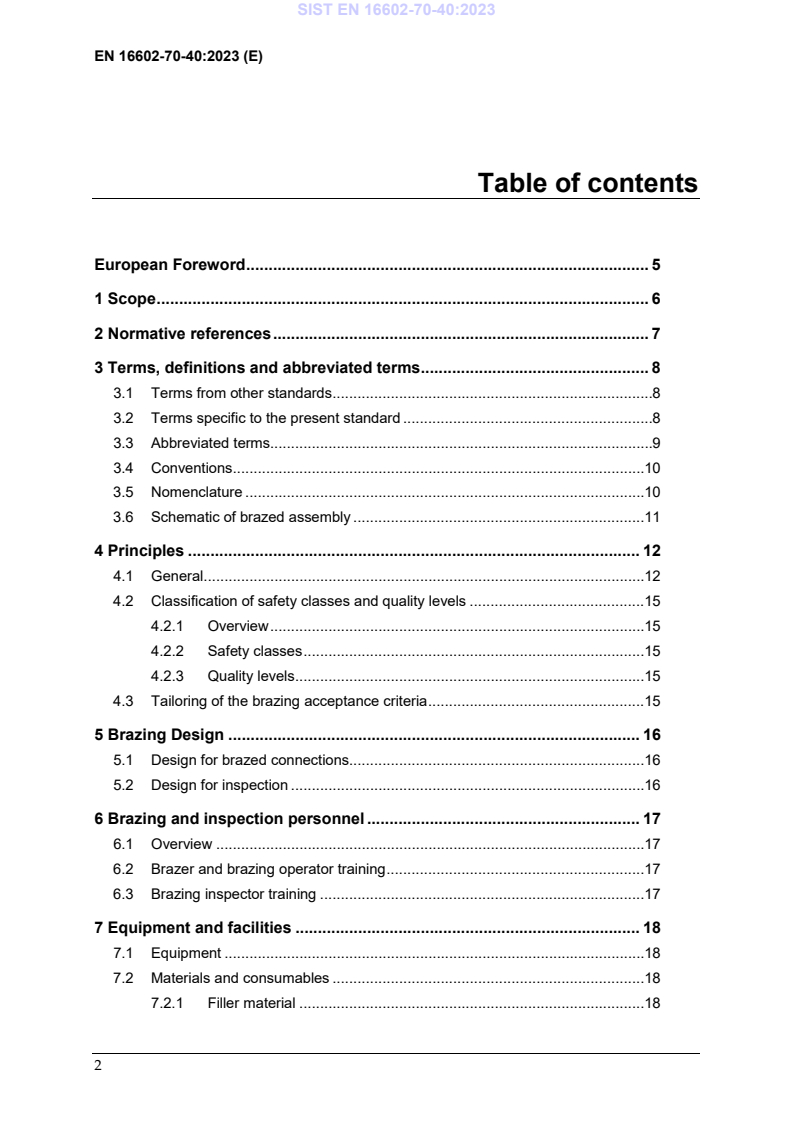
Table of contents
European Foreword . 5
1 Scope . 6
2 Normative references . 7
3 Terms, definitions and abbreviated terms . 8
3.1 Terms from other standards .8
3.2 Terms specific to the present standard .8
3.3 Abbreviated terms. 9
3.4 Conventions.10
3.5 Nomenclature .10
3.6 Schematic of brazed assembly .11
4 Principles . 12
4.1 General .12
4.2 Classification of safety classes and quality levels . 15
4.2.1 Overview . 15
4.2.2 Safety classes .15
4.2.3 Quality levels .15
4.3 Tailoring of the brazing acceptance criteria . 15
5 Brazing Design . 16
5.1 Design for brazed connections.16
5.2 Design for inspection .16
6 Brazing and inspection personnel . 17
6.1 Overview .17
6.2 Brazer and brazing operator training .17
6.3 Brazing inspector training .17
7 Equipment and facilities . 18
7.1 Equipment .18
7.2 Materials and consumables .18
7.2.1 Filler material .18
7.2.2 Flux .18
7.2.3 Tooling and fixtures .18
8 Brazing procedure specification (BPS) . 19
8.1 General .19
8.2 Drawing .19
8.3 Process description .19
8.4 Cleanliness aspects of Brazing .19
8.4.1 Overview . 19
8.4.2 Requirements .19
9 Brazing inspection . 21
9.1 Non-destructive testing .21
9.2 Destructive testing .21
10 Brazing acceptance criteria . 22
10.1 General .22
10.2 Classification of Imperfections .22
10.3 Brazing Imperfections Acceptance Criteria . 22
10.4 Selection of quality levels.23
11 Brazing process verification . 28
11.1 General .28
11.2 Brazing Verification Test Plan .28
11.3 Completion of verification .30
11.4 Delta verification . 30
11.5 Re-brazing, in-process correction .30
11.6 Repair-brazing .31
11.7 Documentation .31
12 Flight hardware production . 32
12.1 Documentation . 32
12.2 Requirements for flight hardware brazing . 32
12.2.1 General . 32
12.2.2 Extent of testing to support flight hardware production . 32
13 Quality assurance . 34
13.1 Maintenance of BPS .34
13.2 Quality control .34
13.2.1 Documentation of brazing parameters. 34
13.2.2 Anomalies and nonconformances occurring during the brazing
process . 34
13.2.3 Inspection and test methods .35
Annex A (normative) Brazing Procedure Specification (BPS) - DRD . 36
A.1 DRD identification . 36
A.1.1 Requirement identification and source document . 36
A.1.2 Purpose and objective .36
A.2 Expected response .36
A.2.1 Scope and content .36
A.2.2 Special remarks .37
Annex B (normative) Brazing Verification Test Plan (BVTP) - DRD . 38
B.1 DRD identification . 38
B.1.1 Purpose and scope .38
B.2 Expected response .38
B.2.1 Scope and content .38
B.2.2 Special remarks .38
Bibliography . 39
Figures
Figure 3-1: Schematic of a brazed and soldered joint (taken from EN ISO 18279:2004)
..................................................................................................................11
Figure 4-1: Steps for brazing process verification and flight hardware production . 14
Tables
Table 10-1: Classification of imperfections in Brazing joints (the classification of
imperfections is derived from EN ISO 18279:2004) . 24
Table 11-1: Test Matrix for standard test . 30
Table 12-1: Tests to be performed on parts performed during production of flight
hardware .33
European Foreword
This document (EN 16602-70-40:2023) has been prepared by Technical
Committee CEN-CENELEC/TC 5 “Space”, the secretariat of which is held by
DIN.
This standard (EN 16602-70-40:2023) originates from ECSS-Q-ST-70-40C.
This document has been prepared under a standardization request given to CEN
by the European Commission and the European Free Trade Association.
This document has been developed to cover specifically space systems and has
therefore precedence over any EN covering the same scope but with a wider
domain of applicability (e.g. : aerospace).
Scope
This Standard specifies the processing and quality assurance requirements for
brazing processes for space flight applications. Brazing is understood as the
joining and sealing of materials by means of a solidification of a liquid filler
metal.
The term brazing in this standard is used as equivalent to soldering, in cases that
the filler materials have liquidus temperatures below 450 °C.
Brazing and soldering are allied processes to welding and this standard is
supplementing the standard for welding ECSS-Q-ST-70-39.
This standard does not cover requirements for:
• Joining processes by adhesive bonding (ECSS-Q-ST-70-16),
• Soldering for electronic assembly purposes (ECSS-Q-ST-70-61),
• Soldering used in hybrid manufacturing (ESCC 2566000).
The standard covers but is not limited to the following brazing processes:
• Torch brazing,
• Furnace brazing,
• Dip Brazing and Salt-bath brazing,
• Induction Brazing.
This Standard does not detail the brazing definition phase and brazing pre-
verification phase, including the derivation of design allowables.
This standard may be tailored for the specific characteristic and constraints of a
space project in conformance with ECSS-S-ST-00.
Normative references
The following normative documents contain provisions which, through
reference in this text, constitute provisions of this ECSS Standard. For dated
references, subsequent amendments to, or revision of any of these publications
do not apply. However, parties to agreements based on this ECSS Standard are
encouraged to investigate the possibility of applying the more recent editions of
the normative documents indicated below. For undated references, the latest
edition of the publication referred to applies.
EN reference Reference in text Title
EN 16601-00-01 ECSS-S-ST-00-01 ECSS system – Glossary of terms
EN 16603-10-02 ECSS-E-ST-10-02 Space engineering – Verification
EN 16603-32-01 ECSS-E-ST-32-01 Space engineering – Fracture control
EN 16601-40 ECSS-M-ST-40 Space management – Configuration and information
management
EN 16602-10-09 ECSS-Q-ST-10-09 Space product assurance – Nonconformance control
system
EN 16602-70 ECSS-Q-ST-70 Space product assurance – Materials, mechanical
parts and processes
Terms, definitions and abbreviated terms
3.1 Terms from other standards
a. For the purpose of this Standard, the terms and definitions from ECSS-S-
ST-00-01 apply and in particular the following:
1. critical
b. For the purpose of this Standard, the terms and definitions from ECSS-E-
ST-32-01 apply and in particular the following:
1. fail-safe
3.2 Terms specific to the present standard
3.2.1 alpha sample
sample brazed prior to the start of a production run, used to verify selected
aspects of the quality of the brazing joint to be produced during production
3.2.2 beta sample
sample brazed at the end of a production run, used to verify selected aspects of
the quality of the brazing joint to be produced during production
3.2.3 braze metal
see “filler metal”
3.2.4 brazer
person who performs brazing in a manual operation, guides the heating means,
ensures the introduction of the brazing filler material and verifies the braze joint
configuration specified by the design
3.2.5 brazing
joining and sealing of parent materials by means of a solidification of a liquid
filler metal
NOTE Terms brazing and soldering are synonymous
independent from the liquidus temperature or
the filler material. For more details see clause 4.
3.2.6 brazing inspector
person with the responsibility and ability to judge the quality of brazed joints in
relation to the specification
3.2.7 brazing operator
person who prepares the joint and sets up brazing equipment and thereby has
direct influence on the brazed joint quality
3.2.8 brazing responsible
person who is nominated by the company to follow and organise brazing
processes, establish the BPS, be responsible for training and realisation of
acceptable brazing for production
3.2.9 design and engineering authority
organization that has the responsibility for the structural integrity and
maintenance of flightworthiness of the hardware and compliance with all
relevant documents related to brazing and soldering
3.2.10 filler metal
material required for soldered/brazed joints
NOTE The term “braze metal” is synonymous
3.2.11 flux
material which promotes wetting of the parent material by the filler metal
3.2.12 parent material
material being brazed and soldered
3.2.13 soldering
see “brazing”
NOTE Terms soldering and brazing are used
synonymously in this standard. For more details
see clause 4.
3.3 Abbreviated terms
For the purpose of this Standard, the abbreviated terms and symbols from ECSS-
S-ST-00-01 and the following apply:
Abbreviation Meaning
brazing procedure specification
BPS
brazing verification test plan
BVTP
brazing verification test report
BVTR
coefficient of thermal expansion
CTE
European Cooperation for Space Standardization
ECSS
heat affected zone
HAZ
nonconformance report
NCR
non-destructive test
NDT
request for approval
RfA
3.4 Conventions
For the purpose of this Standard, the following conventions apply:
Convention Meaning
qualification In this ECSS-Q-ST-70-40 the term is synonymous
with the term "verification" used in ECSS
documentation.
qualification test plan used in common brazing documentation, this
(QTP) term is synonymous with the term "Brazing
verification test plan (BVTP)" from this ECSS-Q-
ST-70-40
qualification test report used in common brazing documentation, this
(QTR) term is synonymous with the term "Brazing
verification test report (BVTR)" from this ECSS-
Q-ST-70-40
3.5 Nomenclature
The following nomenclature applies throughout this document:
a. The word “shall” is used in this Standard to express requirements.
All the requirements are expressed with the word “shall”.
b. The word “should” is used in this Standard to express
recommendations. All the recommendations are expressed with the
word “should”.
NOTE It is expected that, during tailoring,
recommendations in this document are either
converted into requirements or tailored out.
c. The words “may” and “need not” are used in this Standard to
express positive and negative permissions, respectively. All the
positive permissions are expressed with the word “may”. All the
negative permissions are expressed with the words “need not”.
d. The word “can” is used in this Standard to express capabilities or
possibilities, and therefore, if not accompanied by one of the
previous words, it implies descriptive text.
NOTE In ECSS “may” and “can” have completely
different meanings: “may” is normative
(permission), and “can” is descriptive.
e. The present and past tenses are used in this Standard to express
statements of fact, and therefore they imply descriptive text.
3.6 Schematic of brazed assembly
Figure 3-1 shows a typical joint made by brazing and soldering.
Figure 3-1: Schematic of a brazed and soldered joint (taken from EN ISO
18279:2004)
Principles
4.1 General
Brazing is the joining of two materials by the introduction of a liquid metal filler
that on solidification holds the two materials together. The parent materials can
react with the braze alloy but remain solid during the process. This differs from
welding where the parent materials partially melt during the joining operation.
The process of brazing has been in use for several millennia, pictures of craftsmen
carrying out brazing operations have been found in an Egyptian tomb from
around 1475 BCE. This long history and development as an artisanal skill has
resulted in a wide imprecise vocabulary with similar terms having different
meanings in multiple languages. For example, by convention, English
differentiates between brazing and soldering when the liquidus temperature of
the filler is above or below 450°C respectively.
In this standard the term brazing is meant to cover also “soldering” processes
with filler materials melting at temperatures lower than 450°C. When the term
brazing is used, then this is meant equivalent to soldering in case that the filler
materials have liquidus temperature below 450°C.
Not all languages make the same distinction. To add to the confusion the filler
metal referred to as ‘silver solder’ is in fact a braze alloy and translations of terms
such as ‘soft brazing’ and ‘hard brazing’ are also freely used in several languages.
The 450°C boundary in the past was convenient in that it allowed a
differentiation between the:
a. higher temperature process producing strong structural joints and,
b. lower temperature processes used for sealing and joining plumbing
joints and now electronic systems.
Although this boundary is still used it is less relevant in modern brazing systems
where many lower temperature alloys, for example based on tin or indium, have
provided good structural joints in space systems. Soldering for exclusively
electronic applications has already been extensively covered by its own
standards and will not be covered by this standard.
A significant advantage of brazing is that with the correct selection of process,
flux system, braze alloy and joint design, reliable structural joints can be made
between almost any combination of parent materials. Within the space industry
we have successfully used brazing to make structural joints between metals,
ceramics, glasses, ceramic matrix composites (CMCs) and reinforced plastics.
Often a brazing process is selected when a joint between complex material
combinations is required in difficult environments. As an example, outgassing of
brazed systems can be very low simplifying cleanliness aspects.
This standard specifies the necessary requirements to perform brazing for space
applications, and is comprised of the following clauses:
1. Brazing design,
2. Brazing and inspection personnel,
3. Equipment and facilities,
4. Brazing Procedure Specification (BPS),
5. Brazing inspection,
6. Brazing acceptance criteria,
7. Brazing process verification,
8. Flight hardware production,
9. Quality assurance.
Figure 4-1 identifies the steps to be taken in order to produce a verified process
which can then be used to produce flight hardware.
Figure 4-1: Steps for brazing process verification and flight hardware production
4.2 Classification of safety classes and quality levels
4.2.1 Overview
Brazed joints follow the same definition as welded joints for the classification
related to safety classes depending on their function. Furthermore, the
acceptance criteria for imperfections are by definition of three quality levels.
4.2.2 Safety classes
Class 1 joints are considered critical and structural. Failure of a Class 1 joint
results in a loss of spacecraft, major components, loss of life, or loss of control of
the spacecraft. Class 1 joints have the highest level of scrutiny in terms of
acceptance, which is appropriat
...