

EN 16838:2024
(Main)Refrigerated display scooping cabinets and pozzetto for gelato - Classification, requirements, performance and energy consumption testing
- Abstract
This document specifies classification, requirements for the construction, performance and energy consumption testing of:
- gelato scooping cabinets used for sale and display of artisan and self-made gelato;
- pozzetto used for sale of artisan and self-made gelato, without any display function.
It specifies test conditions and methods for checking that the requirements have been satisfied, their marking and the list of their characteristics to be declared by the manufacturer.
- Status
- Published
- Publication Date
- 29-Oct-2024
- Current Stage
- 6060 - Definitive text made available (DAV) - Publishing
- Start Date
- 30-Oct-2024
- Due Date
- 28-May-2024
- Completion Date
- 30-Oct-2024
- Directive
- 2019/2018 - COMMISSION DELEGATED REGULATION (EU) 2019/2018 of 11 March 2019
supplementing Regulation (EU) 2017/1369 of the European Parliament and of the Council with regard to energy labelling of refrigerating appliances with a direct sales functionOJ Ref: 2025/533, OJ, OJ L, OJ L, 2025/533 OJ Date: 26-Mar-2025
2019/2024 - COMMISSION REGULATION (EU) 2019/2024 of 1 October 2019 laying down ecodesign requirements for refrigerating appliances with a direct sales function pursuant to Directive 2009/125/EC of the European Parliament and of the CouncilOJ Ref: 2025/533, OJ, OJ L, OJ L, 2025/533 OJ Date: 26-Mar-2025
- Mandate
- M/XXX - M/XXX
Overview - EN 16838:2024 (Refrigerated display scooping cabinets and pozzetto for gelato)
EN 16838:2024 (identical to EN 16838:2024) defines the classification, construction, performance and energy consumption testing for refrigerated appliances intended for artisan and self‑made gelato:
- Gelato scooping cabinets (display units used to store, display and scoop tubs of gelato)
- Pozzetto (non‑display cabinets used to store and scoop gelato)
The standard specifies test conditions and methods (inside and outside test rooms), marking requirements and the list of characteristics manufacturers must declare. It supersedes EN 16838:2019 and adds provisions for split systems and measurement methods for remote condensing units.
Key technical topics and requirements
- Classification by temperature and product family to standardize performance categories.
- Construction and materials requirements for safe, hygienic commercial use.
- Refrigerating and electrical system requirements, including remote and split condensing units.
- Operating characteristics: defrosting, anti‑condensate measures, temperature display and control.
- Energy consumption metrics and definitions (used for performance and rating):
- DEC (Direct Electrical Energy Consumption)
- REC (Refrigeration Electrical Energy Consumption for remote units)
- TEC (Total Energy Consumption = DEC + REC)
- TECR, AEC, DFEC, FEC, LEC, PEC - component and revised consumption measures
- Test methods and conditions: detailed procedures for temperature tests, water vapour condensation tests, electrical energy consumption tests, and heat extraction measurement when the condensing unit is remote.
- Marking and manufacturer information: mandatory marking plate data and declared characteristics for transparency and compliance.
- Annexes: data requirements for performance/energy rating and informative relationships to EU Ecodesign and Energy Labelling regulations (Annex ZA and ZB).
Practical applications - who uses this standard
- Manufacturers and product designers of refrigerated display cabinets and pozzetti - to design compliant, energy‑efficient appliances and prepare declaration data.
- Test laboratories and certification bodies - to perform standardized performance and energy consumption testing.
- Retailers, gelato shops and foodservice buyers - to compare models for temperature control, display performance and energy consumption.
- Regulators and procurement teams - to verify compliance with EU ecodesign and energy‑labelling requirements.
- Energy auditors and sustainability teams - to evaluate and optimize refrigeration energy use in commercial settings.
Related standards (normative / informative)
- IEC 60335‑1, IEC 60335‑2‑89 (safety of electrical refrigeration appliances)
- ISO 5149‑2 (refrigerating systems safety/environment)
- Annex ZA / Annex ZB link the standard to EU Commission Regulations on ecodesign (EU No 2019/2024) and energy labelling (EU No 2019/2018).
Keywords: EN 16838:2024, refrigerated display scooping cabinets, pozzetto, gelato, energy consumption testing, classification, performance testing, commercial refrigerating appliances.
Relations
- Effective Date
- 18-Jan-2023
- Effective Date
- 09-Feb-2026
- Effective Date
- 09-Feb-2026
- Effective Date
- 09-Feb-2026
Frequently Asked Questions
EN 16838:2024 is a standard published by the European Committee for Standardization (CEN). Its full title is "Refrigerated display scooping cabinets and pozzetto for gelato - Classification, requirements, performance and energy consumption testing". This standard covers: This document specifies classification, requirements for the construction, performance and energy consumption testing of: - gelato scooping cabinets used for sale and display of artisan and self-made gelato; - pozzetto used for sale of artisan and self-made gelato, without any display function. It specifies test conditions and methods for checking that the requirements have been satisfied, their marking and the list of their characteristics to be declared by the manufacturer.
This document specifies classification, requirements for the construction, performance and energy consumption testing of: - gelato scooping cabinets used for sale and display of artisan and self-made gelato; - pozzetto used for sale of artisan and self-made gelato, without any display function. It specifies test conditions and methods for checking that the requirements have been satisfied, their marking and the list of their characteristics to be declared by the manufacturer.
EN 16838:2024 is classified under the following ICS (International Classification for Standards) categories: 97.130.20 - Commercial refrigerating appliances. The ICS classification helps identify the subject area and facilitates finding related standards.
EN 16838:2024 has the following relationships with other standards: It is inter standard links to EN 16838:2019, IEC 60335-2-89:2019, ISO 5149-2:2014, IEC 60335-1:2020. Understanding these relationships helps ensure you are using the most current and applicable version of the standard.
EN 16838:2024 is associated with the following European legislation: EU Directives/Regulations: 2019/2018, 2019/2024; Standardization Mandates: M/582, M/XXX. When a standard is cited in the Official Journal of the European Union, products manufactured in conformity with it benefit from a presumption of conformity with the essential requirements of the corresponding EU directive or regulation.
EN 16838:2024 is available in PDF format for immediate download after purchase. The document can be added to your cart and obtained through the secure checkout process. Digital delivery ensures instant access to the complete standard document.
Standards Content (Sample)
SLOVENSKI STANDARD
01-januar-2025
Nadomešča:
SIST EN 16838:2019
Hladilne vitrine in skrinje za sladoled - Razvrščanje, zahteve, zmogljivost in
preskus porabe energije
Refrigerated display scooping cabinets and pozzetto for gelato - Classification,
requirements, performance and energy consumption testing
Verkaufskühlmöbel und Pozzetti für Speiseeis - Klassifizierung, Anforderungen, Leistung
und Energieaufnahmeprüfung
Vitrines réfrigérées de vente de glace et pozzetto - Classification, exigences,
performance et essai de consommation énergétique
Ta slovenski standard je istoveten z: EN 16838:2024
ICS:
97.130.20 Hladilne naprave za trgovine Commercial refrigerating
appliances
2003-01.Slovenski inštitut za standardizacijo. Razmnoževanje celote ali delov tega standarda ni dovoljeno.
EN 16838
EUROPEAN STANDARD
NORME EUROPÉENNE
October 2024
EUROPÄISCHE NORM
ICS 97.130.20 Supersedes EN 16838:2019
English Version
Refrigerated display scooping cabinets and pozzetto for
gelato - Classification, requirements, performance and
energy consumption testing
Vitrines réfrigérées de vente de glace et pozzetti - Verkaufskühlmöbel und Pozzetti für Speiseeis -
Classification, exigences, performance et essai de Klassifizierung, Anforderungen, Leistung und
consommation énergétique Energieaufnahmeprüfung
This European Standard was approved by CEN on 30 September 2024.
CEN members are bound to comply with the CEN/CENELEC Internal Regulations which stipulate the conditions for giving this
European Standard the status of a national standard without any alteration. Up-to-date lists and bibliographical references
concerning such national standards may be obtained on application to the CEN-CENELEC Management Centre or to any CEN
member.
This European Standard exists in three official versions (English, French, German). A version in any other language made by
translation under the responsibility of a CEN member into its own language and notified to the CEN-CENELEC Management
Centre has the same status as the official versions.
CEN members are the national standards bodies of Austria, Belgium, Bulgaria, Croatia, Cyprus, Czech Republic, Denmark, Estonia,
Finland, France, Germany, Greece, Hungary, Iceland, Ireland, Italy, Latvia, Lithuania, Luxembourg, Malta, Netherlands, Norway,
Poland, Portugal, Republic of North Macedonia, Romania, Serbia, Slovakia, Slovenia, Spain, Sweden, Switzerland, Türkiye and
United Kingdom.
EUROPEAN COMMITTEE FOR STANDARDIZATION
COMITÉ EUROPÉEN DE NORMALISATION
EUROPÄISCHES KOMITEE FÜR NORMUNG
CEN-CENELEC Management Centre: Rue de la Science 23, B-1040 Brussels
© 2024 CEN All rights of exploitation in any form and by any means reserved Ref. No. EN 16838:2024 E
worldwide for CEN national Members.
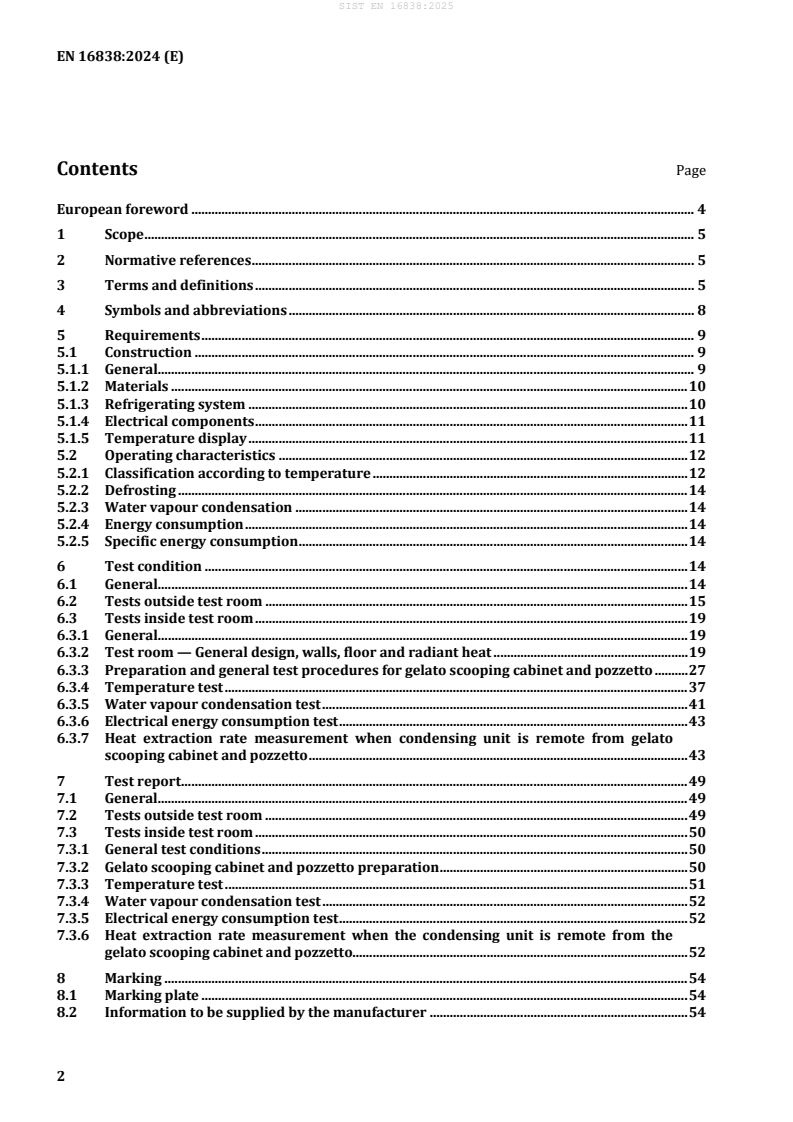
Contents Page
European foreword . 4
1 Scope . 5
2 Normative references . 5
3 Terms and definitions . 5
4 Symbols and abbreviations . 8
5 Requirements . 9
5.1 Construction . 9
5.1.1 General. 9
5.1.2 Materials . 10
5.1.3 Refrigerating system . 10
5.1.4 Electrical components . 11
5.1.5 Temperature display . 11
5.2 Operating characteristics . 12
5.2.1 Classification according to temperature . 12
5.2.2 Defrosting . 14
5.2.3 Water vapour condensation . 14
5.2.4 Energy consumption . 14
5.2.5 Specific energy consumption . 14
6 Test condition . 14
6.1 General. 14
6.2 Tests outside test room . 15
6.3 Tests inside test room . 19
6.3.1 General. 19
6.3.2 Test room — General design, walls, floor and radiant heat . 19
6.3.3 Preparation and general test procedures for gelato scooping cabinet and pozzetto . 27
6.3.4 Temperature test . 37
6.3.5 Water vapour condensation test . 41
6.3.6 Electrical energy consumption test . 43
6.3.7 Heat extraction rate measurement when condensing unit is remote from gelato
scooping cabinet and pozzetto . 43
7 Test report . 49
7.1 General. 49
7.2 Tests outside test room . 49
7.3 Tests inside test room . 50
7.3.1 General test conditions . 50
7.3.2 Gelato scooping cabinet and pozzetto preparation . 50
7.3.3 Temperature test . 51
7.3.4 Water vapour condensation test . 52
7.3.5 Electrical energy consumption test . 52
7.3.6 Heat extraction rate measurement when the condensing unit is remote from the
gelato scooping cabinet and pozzetto. 52
8 Marking . 54
8.1 Marking plate . 54
8.2 Information to be supplied by the manufacturer . 54
Annex A (normative) Data requirements for performance and energy rating of gelato
scooping cabinets and pozzetto . 56
A.1 General . 56
A.2 Designation of gelato scooping cabinets families . 56
A.3 Data requirements for rating of gelato scooping cabinets and pozzetto with
incorporated condensing unit . 56
A.4 Data requirements for rating of gelato scooping cabinets and pozzetto with remote
condensing unit . 59
Annex ZA (informative) Relationship between this European Standard and the ecodesign
requirements of Commission Regulation (EU) No 2019/2024 OJEU L 315/313 aimed
to be covered . 60
Annex ZB (informative) Relationship between this European Standard and the energy
labelling requirements of Commission Delegated Regulation (EU) No 2019/2018
OJEU L 315/155 aimed to be covered . 61
European foreword
This document (EN 16838:2024) has been prepared by Technical Committee CEN/TC 44 “Commercial
and Professional Refrigerating Appliances and Systems, Performance and Energy Consumption”, the
secretariat of which is held by UNI.
This European Standard shall be given the status of a national standard, either by publication of an
identical text or by endorsement, at the latest by April 2025, and conflicting national standards shall be
withdrawn at the latest by April 2025.
Attention is drawn to the possibility that some of the elements of this document may be the subject of
patent rights. CEN shall not be held responsible for identifying any or all such patent rights.
This document supersedes EN 16838:2019.
— addition of Annexes ZA and ZB;
— definition of the split system and relevant method for the measurement of energy consumption.
This document has been prepared under a standardization request addressed to CEN by the European
Commission. The Standing Committee of the EFTA States subsequently approves these requests for its
Member States.
For the relationship with EU Legislation, see informative Annexes ZA and ZB, which are integral parts of
this document.
Any feedback and questions on this document should be directed to the users’ national standards body.
A complete listing of these bodies can be found on the CEN website.
According to the CEN-CENELEC Internal Regulations, the national standards organisations of the
following countries are bound to implement this European Standard: Austria, Belgium, Bulgaria,
Croatia, Cyprus, Czech Republic, Denmark, Estonia, Finland, France, Germany, Greece, Hungary, Iceland,
Ireland, Italy, Latvia, Lithuania, Luxembourg, Malta, Netherlands, Norway, Poland, Portugal, Republic of
North Macedonia, Romania, Serbia, Slovakia, Slovenia, Spain, Sweden, Switzerland, Türkiye and the
United Kingdom.
1 Scope
This document specifies classification, requirements for the construction, performance and energy
consumption testing of:
— gelato scooping cabinets used for sale and display of artisan and self-made gelato;
— pozzetto used for sale of artisan and self-made gelato, without any display function.
It specifies test conditions and methods for checking that the requirements have been satisfied, their
marking and the list of their characteristics to be declared by the manufacturer.
2 Normative references
The following documents are referred to in the text in such a way that some or all of their content
constitutes requirements of this document. For dated references, only the edition cited applies. For
undated references, the latest edition of the referenced document (including any amendments) applies.
IEC 60335-1:2020, Household and similar electrical appliances — Safety — Part 1: General requirements
IEC 60335-2-89:2019, Household and similar electrical appliances — Safety — Part 2-89: Particular
requirements for commercial refrigerating appliances and ice-makers with an incorporated or remote
refrigerant unit or motor-compressor
ISO 5149-2:2014, Refrigerating systems and heat pumps — Safety and environmental requirements —
Part 2: Design, construction, testing, marking and documentation
3 Terms and definitions
For the purposes of this document, the following terms and definitions apply.
ISO and IEC maintain terminology databases for use in standardization at the following addresses:
— ISO Online browsing platform: available at https://www.iso.org/obp/
— IEC Electropedia: available at https://www.electropedia.org/
3.1
gelato scooping cabinets
refrigerating appliance with a direct sales function which enables artisan and self-made gelato
contained in tubs to be stored, displayed and scooped within prescribed temperature limits
Note 1 to entry: Artisan and self-made gelato are hereafter called “gelato”.
3.2
pozzetto
refrigerating appliance with a direct sales function which enables artisan and self-made gelato
contained in tubs to be stored and scooped within prescribed temperature limits
Note 1 to entry: Pozzetto is not provided of a display function.
3.3
storage section
non-visible part of the gelato scooping cabinet used only to store the product, separated from the
display volume and with a different access
3.4
display section
visible part of the gelato scooping cabinet used to display and to scoop the product
3.5
pozzetto section
part of the pozzetto used to scoop the product
3.6
cover
sliding door or night curtain or swivel panes
3.7
lid
removable cover for pozzetto section
3.8
gelato tub
container intended to store gelato
3.9
net volume
volume containing gelato within the top edge of the tub
3.10
top display area of gelato tub
area delimited by the external perimeter of a visible gelato tub top side
3.11
front display area of gelato tub
area delimited by the external perimeter of a visible gelato tub front side
3.12
lateral display area of gelato tub
area delimited by the external perimeter of a visible gelato tub lateral side
3.13
total net storage volume
V
s
sum of net volume of each tub contained in the storage section
3.14
total net volume of pozzetto section
V
p
sum of net volume of each tub contained in pozzetto section
3.15
total display area
TDA
sum of the top, front and lateral display areas of each visible gelato tub
3.16
product family
group of gelato scooping cabinets and pozzetto in accordance with Table A.1
3.17
anti-condensate energy consumption
AEC
energy consumed to remove condensate on the external surface of the gelato scooping cabinet and
pozzetto, which includes fan and condensate heater energy expressed in kW⋅h per day
3.18
defrost energy consumption
DFEC
energy consumed by defrost heaters during defrost period expressed in kW⋅h per day
3.19
fan energy consumption
FEC
energy consumed by fan motors expressed in kW⋅h per day
3.20
lighting energy consumption
LEC
energy consumed by lights fitted in the gelato scooping cabinet and pozzetto, expressed in kW⋅h per day
3.21
condensate evaporator pan energy consumption
PEC
energy consumed to evaporate water collected from defrost expressed in kW⋅h per day
3.22
total revised refrigeration energy consumption
TECR
total revised energy consumption obtained from DEC and additional or alternative component energy
consumption
3.23
direct electrical energy consumption
DEC
daily electrical energy consumption of electrical components of the cabinet
3.24
refrigeration electrical energy consumption
REC
daily refrigeration electrical energy consumption for remote gelato scooping cabinet and remote
pozzetto for compression-type refrigerating system
3.25
total energy consumption
TEC
sum of direct electrical energy consumption and refrigeration electrical energy consumption
3.26
condensing unit
combination of one or more compressors, condensers, and liquid receivers (when required) and the
regularly furnished accessories
3.27
remote condensing unit
condensing unit that is located remotely from the gelato scooping cabinet and pozzetto, which is not an
integral part of the cabinet
3.28
split condensing unit
condensing unit that is located remotely from the gelato scooping cabinet and pozzetto, which is
supplied with the cabinet
4 Symbols and abbreviations
t running time — time during which compressor is running (or solenoid valve is open),
run
within 24 h, expressed in hours
t stopping time — time during which compressor is not running (or solenoid valve is closed)
stop
within 24 h and excluding defrost time, expressed in hours
t defrost time — time during which compressor is running and hot gas solenoid valve is
deft
open (or reverse cycle valve is open)
q mass flow rate of liquid refrigerant in kilograms per second
m
Δt time between two consecutive measuring samples, in hours
N number of measuring samples in 24 h
max
n number of defrosts during 24 h
deft
TDA total display area, in square meters
V total net volume of pozzetto section, in litres
p
V total net volume of storage section, in litres
s
TEC/TDA specific energy consumption (SEC-D) for gelato scooping cabinet expressed in kilowatt
hours per 24 h per square meters
TEC/V specific energy consumption (SEC-V ) for pozzetto expressed in kilowatt hours per 24 h
p p
per litres
t relative or percentage running time:
rr
tt
run run
t
rr
tt+ 24− t
run stop deft
where
tt++ t =24h
run stop deft
Φ instant heat extraction rate in kilowatts
n
h , h specific enthalpy in kilojoules per kilogram, where state in Figure 15 corresponds to
8 4
refrigerant outlet, and state in Figure 16 to refrigerant inlet, of gelato scooping cabinet and
pozzetto
θ refrigerant temperature at evaporator outlet, in degrees Celsius
θ refrigerant temperature at the gelato scooping cabinet and pozzetto outlet, in degrees
Celsius
θ refrigerant temperature at the gelato scooping cabinet and pozzetto inlet, in degrees
Celsius
θ refrigerant temperature at evaporator inlet, in degrees Celsius
p refrigerant pressure at the gelato scooping cabinet and pozzetto outlet, in Pascals
θ arithmetic average of evaporator-saturated temperature obtained from pressure p by
mrun 8
referring to table of saturation properties for refrigerant in use — during t , in degrees
run
Celsius
θ arithmetic average of evaporator-saturated temperature obtained from pressure p by
min 8
referring to table of saturation properties for refrigerant in use — during the last 10 % of
all running periods, in degrees Celsius
T = θ + 273,15 in Kelvin
mrun mrun
5 Requirements
5.1 Construction
5.1.1 General
5.1.1.1 Strength and rigidity
The gelato scooping cabinet or pozzetto and its parts shall be constructed with adequate strength and
rigidity for normal conditions of handling, transport and use and attention shall be given to the
following:
a) interior fittings, including shelves, baskets, rails, etc. and their supports, shall be sufficiently strong
for the duty required;
b) where sliding shelves, baskets, trays or drawers are fitted they shall retain their shape and ease of
movement when fully loaded;
==
c) any fitments which are provided with stops to prevent accidental removal shall be self-supporting
when fully loaded and withdrawn to the limit of the stops.
5.1.1.2 Pipes and connections
Pipes and connections to moving or resiliently mounted parts shall be arranged so as not to foul or
transmit harmful vibrations to other parts. All other pipes and connections shall be securely anchored
and sufficient free length and/or vibration eliminators shall be provided to prevent failure due to
fatigue. Where necessary, pipes and valves shall be adequately thermally insulated.
5.1.1.3 Condensate drainage
Where drains, drip trays or evaporation receptacles are fitted, they shall have ample capacity and shall
be easily accessible and cleanable.
Any condensate or defrost water receptacle, or group of receptacles, requiring to be emptied manually
shall have a capacity equivalent to at least 48 h of normal operation in the appropriate climate class for
which the gelato scooping cabinet or pozzetto is intended.
5.1.1.4 Joints and seams
All construction joints and seams within the net volume shall prevent the accumulation of potentially
contaminating substances.
All construction joints and seams within the net volume shall permit the easy removal of any deposits of
potentially contaminating substances.
5.1.2 Materials
The materials shall be durable and shall not favour the development of mould or emit odours.
Under normal conditions of use, materials in contact with foodstuffs shall be resistant to moisture and
shall neither be toxic nor contaminate them.
5.1.3 Refrigerating system
5.1.3.1 Design and construction
The design and construction of all parts of the refrigerating system subject to internal pressure shall
take into account the maximum working pressure to which they are subjected when the gelato scooping
cabinet and pozzetto are in operation or at rest.
For gelato scooping cabinets and pozzetto with integral condensing unit or components thereof which
are charged with refrigerant prior to transportation, the maximum ambient temperature during transit
shall be taken into account. All refrigerant containing components shall be in accordance with
ISO 5149-2:2014.
5.1.3.2 Condensation
There shall be suitable means to prevent water condensed on cold surfaces of the gelato scooping
cabinet and pozzetto and their parts from harmfully affecting the operation of the refrigerating system
or its controls.
5.1.3.3 System protection
For gelato scooping cabinets fitted with covers, the refrigerating system shall suffer no damage if any
cover in the gelato scooping cabinet is left open while the gelato scooping cabinet is operating in an
ambient temperature corresponding to the climate class (see Table 4) for which the gelato scooping
cabinet is intended.
When the cover is kept open under normal operating conditions (for example, during product loading)
or is left open accidentally, any automatic motor overload protective device may come into operation.
For pozzetto fitted with lids, the refrigerating system shall suffer no damage if any lid in the pozzetto is
left open while the pozzetto is operating in an ambient temperature corresponding to the climate class
(see Table 4) for which the pozzetto is intended.
When the lid is kept open under normal operating conditions (for example, during product loading) or
is left open accidentally, any automatic motor overload protective device may come into operation.
5.1.3.4 Refrigerant
When deciding on the refrigerant for the system, attention shall be given to the possible hazards
associated with the use of certain refrigerants, due to their toxicity, flammability etc. Guidance on this
point is available in ISO 5149-2:2014.
5.1.4 Electrical components
Electrical components shall be in accordance with IEC 60335-2-89:2019 and IEC 60335-1:2020.
5.1.5 Temperature display
5.1.5.1 General
The gelato scooping cabinets and pozzetto shall incorporate a temperature display instrument showing
the air temperature in the refrigerated equipment to provide an indication of the operation and
functioning of refrigerating equipment and information on its operating state.
NOTE As a rule, measured air temperature is not identical with gelato temperature in gelato scooping
cabinets and pozzetto.
5.1.5.2 Temperature-measuring instrument
Suitable temperature-measuring instruments shall be used, i.e. those that fulfil the following
requirements:
— the unit symbol (°C) shall be inscribed or displayed on the temperature-measuring instrument;
— the range of measurement shall be at least from −25 °C to +15 °C;
— the scale division or smallest numerical increment shall be less than or equal to 1 °C;
— the maximum errors shall be 2 K over the total measuring range;
— the time constant t of the sensor shall be equal to or less than 20 min.
NOTE The t time is the time in which 90 % of a sudden temperature change of 20 °C is indicated, the
measurement medium being moderately agitated air (velocity 1 m/s).
5.1.5.3 Temperature sensor location
The temperature sensor location shall be readily accessible to enable on site testing for the correct
indication of temperature and replacement of the temperature measuring instrument on site in service.
NOTE 1 The temperature sensor of a thermometer is considered to be “readily accessible” if it is reachable
directly for examination. It ought to be necessary to remove access panel(s) to carry out replacement.
NOTE 2 For gelato scooping cabinets and pozzetto with natural convection cooling, the positioning of the
temperature sensor in a guide tube is also considered to be “readily accessible” if the sensor is introduced into and
removed from the guide tube without a tool.
Wherever possible, the mounting method shall not supply heat to, or withdraw heat from the
temperature sensor.
The temperature sensor shall be protected against heat radiation from the external ambient.
The temperature sensor location is defined as part of the temperature test of the gelato scooping
cabinet and pozzetto. During the temperature test air temperatures at the declared sensor location shall
be measured and these values noted in the test report.
NOTE 3 It is the responsibility of the supplier and end user to ensure that the temperature measurements
comply with national regulation on temperature control of gelato.
5.2 Operating characteristics
5.2.1 Classification according to temperature
The performance of gelato scooping cabinet and pozzetto shall comply with one of the classifications
defined in Table 1. The performance shall be verified in accordance with the conditions and test
methods specified in 6.3.3.
Table 1 — Temperature classes
Highest temperature, θ , Lowest temperature, θ , of
Class Highest minimum
ah b
temperature, θ , of all
of warmest M-test gelato coldest M-test gelato tubs al
a
tubs colder than or equal test tubs colder than
warmer than or equal to
a a
to or equal to
°C
G1 −10 −14 —
G2 −10 −16 —
G3 −10 −18 —
L1 −15 — −18
L2 −12 — −18
L3 −12 — −15
S Special classification
a
See Figure 1.
a) temperature curves of the warmest and of the highest minimum value of M-test gelato tub
b) temperature curves of the warmest and of the coldest M-test gelato tub
Key
a temperature curve a of warmest M-test gelato tub
b temperature curve b of coldest M-test gelato tub
c temperature curve with the highest minimum value of all M-gelato tubs
θ temperature
θ highest temperature of warmest M-test gelato tubs
ah
θ lowest temperature of coldest M-test gelato tubs
b
θ highest minimum temperature of all M-gelato tubs
al
t time
T test period
Figure 1 — Relevant temperature curves of M-test gelato tubs
5.2.2 Defrosting
The accumulation of ice, frost or snow on surfaces within the refrigerated space, as well as the
accumulation of drained defrost water, shall not occur, as it would impair the performance of gelato
scooping cabinets other than those which are intended to be defrosted manually. This shall be verified
according to the conditions and test methods specified in 6.3.4.5.
The proposed defrosting procedures (automatic or manual) shall not affect the temperature
requirements.
For gelato scooping cabinets or sections of gelato scooping cabinets with manual defrosting, the
manufacturer shall supply all necessary instructions for the correct operation of the defrosting system.
5.2.3 Water vapour condensation
The performance of gelato scooping cabinets shall not be impaired by water vapour condensation. The
amount of water vapour condensation shall be verified according to the conditions and test methods
specified in 6.3.5.
5.2.4 Energy consumption
The total energy consumption (TEC) shall be measured and calculated according to the conditions and
the test methods specified in 6.3.6 and 6.3.7.
When the condensing unit is integral to the cabinet, the total energy consumption (TEC) is equal to the
direct electrical energy consumption (DEC).
When the condensing unit is not fitted in the cabinet, the total energy consumption is:
— the sum of REC and DEC for remote condensing unit, see 6.3.6.3;
— equal to DEC for split condensing unit placed in the same climate class test room conditions, see
6.3.6.2.
5.2.5 Specific energy consumption
The specific energy consumption is the rate between TEC and TDA for gelato scooping cabinet (SEC-D).
The specific energy consumption is the rate between TEC and V for pozzetto (SEC-V ).
p p
6 Test condition
6.1 General
When the characteristics of a gelato scooping cabinet and pozzetto are to be verified, all the tests and
inspections shall be applied to one and the same gelato scooping cabinet and pozzetto. These tests and
inspections may also be made individually for the study of a particular characteristic.
Table 2 lists the tests and inspections. Gelato scooping cabinets and pozzetto shall comply with the
requirements specified in 6.1 using the appropriate test method.
Table 2 — Test summary
Tests and inspections Requirement clause in this Test method
part
Physical dimensions 6.2 Outside test
room
(see 6.2)
Temperature 5.2.2 6.3.4
Inside test
Defrosting 5.2.3 6.3.4
room
Energy consumption 5.2.5 6.3.6 and 6.3.7
(see 6.3)
Water vapour condensation 5.2.4 6.3.5
6.2 Tests outside test room
The tests which may be carried out outside the test room deal with the inspection of construction
characteristics, physical dimensions.
Measurements shall be made with the gelato scooping cabinet and pozzetto not in operation but
situated in a place where the temperature is maintained between 16 °C and 30 °C.
For gelato scooping cabinets and pozzetto having detachable ends, overall dimensions are given with
and without ends. If the Gelato scooping cabinet and pozzetto includes jacks or other components for
adjustment of height, the height defined shall be the minimum height necessary at installation of the
gelato scooping cabinet and pozzetto.
The total net volume Vs is calculated as sum of the volume of each tub contained in the storage section.
The total net volume V is calculated as sum of the volume of each tub contained in the pozzetto section.
p
The total display area (TDA) shall be calculated according to the number of top visible gelato tubs
(inside the dashed line in Figure 2) multiplied by its top display area of gelato tub (see Table 3 and
Figure 5).
In case the cabinet is designed for the use of transparent gelato tubs, the total display area (TDA) shall
be calculated adding the following:
— the number of front visible gelato tubs (inside the dashed line in Figure 3) multiplied by its front
display area of gelato tub (see Table 3 and Figure 5);
— the number of end walls visible gelato tubs (inside the dashed line in Figure 4) multiplied by their
lateral display area of gelato tub (see Table 3 and Figure 5).
Key
perimeter of the top display area
Figure 2 — Top display area
Key
perimeter of the front display area
Figure 3 — Front display area
Key
perimeter of the lateral display area
Figure 4 — Lateral display area
Table 3 — Examples of gelato tubs dimensions
Top Front
Lateral
display display
display
Type A L P Volume area of area of
area of
gelato gelato
gelato tub
tub tub
2 2 2
mm mm mm l
m m m
GN 1/4 162 265 65 1,9 0,0429 0,0099 0,0166
GN 1/4 162 265 100 2,5 0,0429 0,0152 0,0255
GN 1/4 162 265 150 4,1 0,0429 0,0228 0,0383
GN 1/4 162 265 200 4,9 0,0429 0,0304 0,0510
Gelato Tubs 165 360 80 3,4 0,0594 0,0124 0,0280
Gelato Tubs 165 360 120 5 0,0594 0,0186 0,0420
Gelato Tubs 165 360 150 7 0,0594 0,0233 0,0525
Top Front
Lateral
display display
display
Type A L P Volume area of area of
area of
gelato gelato
gelato tub
tub tub
2 2 2
mm mm mm l m m m
Gelato Tubs 165 360 180 8 0,0594 0,0279 0,0630
Gelato Tubs 250 360 80 5,4 0,0900 0,0192 0,0280
Gelato Tubs 250 360 120 8 0,0900 0,0288 0,0420
Gelato Tubs 250 360 150 11 0,0900 0,0360 0,0525
Gelato Tubs 250 360 180 14 0,0900 0,0432 0,0630
Any other geometrical shapes of tubs
For the definitions of A, L, P see Figure 7.
Key
1 top area
2 lateral area
3 front area
Figure 5 — Area of gelato tubs
6.3 Tests inside test room
6.3.1 General
The tests which are carried out inside the test room deal with the measurement of the following
characteristics:
— temperature and defrosting;
— electrical energy consumption;
— water vapour condensation;
— heat extraction rate.
These measurements should be made simultaneously.
6.3.2 Test room — General design, walls, floor and radiant heat
6.3.2.1 General
The test room shall be a parallelepiped space in which two of the opposite side walls, referred to as the
discharge technical side wall and the return technical side wall, are designed to create an even,
horizontal air flow within the test room. By convention, the distance separating these two technical side
walls is referred to as the “length” of the test room.
The minimum useful dimensions (length, width, height) of the test room shall be dependent on the
overall dimensions (length, depth, height) of the gelato scooping cabinet and pozzetto to be tested and
on the location of the display opening of the gelato scooping cabinet and pozzetto (see Figure 9).
The ceiling and the two non-technical side walls of the room shall be thermally insulated and shall be
equipped with an inner metal skin.
A minimum insulation level equivalent to 60 mm of rigid polyurethane foam (λ = 0,03 W/m °C) should
be used for the building of a new test room.
The floor shall be made of concrete or of thermally equivalent material and/or shall be sufficiently
insulated to ensure that external climatic conditions do not affect the floor temperature.
Lighting shall be installed to maintain 600 lx ± 100 lx measured at a height of 1 m above the floor level
and shall be lit continuously during the test period. The emission spectrum of that lighting device within
the infrared field shall not include peaks of a value of more than 500 W/5 nm/1 m.
The walls, ceilings and any partitions of rooms intended for the testing of gelato scooping cabinets and
pozzetto shall have an emissivity between 0,9 and 1 at 25 °C.
6.3.2.2 Test room (empty) — Thermal and air flow characteristics
An experimental evaluation of the test-room performances shall be carried out minimum once per year:
— with test room empty and with lighting switched on,
— in a test-room climate class 3 (see Table 4),
— measuring the velocity, temperature and relative humidity of the air at different points of two
vertical planes parallel to the technical side walls and 600 mm away from the technical side walls,
— with the climate measuring point located at the geometrical centre of the test room during this
evaluation.
These measuring points shall form a two-dimensional grid in which the step is a maximum of 500 mm
in the horizontal and vertical directions. The peripheral line of points shall be located at a maximum of
500 mm from the other two side walls, floor and ceiling.
A three-dimensional grid inside the test room shall be investigated when obstacles/irregularities
projected into the room of more than 1 m surface area facing the discharge technical side wall exist
along the walls.
The mean horizontal air velocity measured during 1 min with a maximal interval of 5 s at each of the
points defined above shall lie between 0,1 m/s and 0,2 m/s.
Air temperature measured at each of the points defined above shall not deviate from the rated
temperature of the test-room climate class by more than 2 °C.
The test room shall be capable of maintaining values of humidity within ±3 units of the relative
humidity percentage figures of the rated humidity of the test room temperature class at the specified
measuring points.
Surface temperature of walls, ceiling and floor shall be measured in proximity to the points which
constitute the peripheral line of the grid defined above. These surface temperatures shall remain within
a tolerance of ±2 °C in relation to the air temperature measured at the nearest point of the grid.
6.3.2.3 Test room climate definition
6.3.2.3.1 Test room climate classes
Tests shall be carried out in one of the climate classes according to Table 4.
During the test, the test room shall be capable of maintaining values of temperature and humidity
within ±1 °C of the temperature and ±5 units of the relative humidity percentage figures at the specified
climate measuring point(s) (see Figure 6). The exception to this is test-room climate class 3, for which
the tolerance of the relative humidity is instead ±3 units.
Table 4 — Climate classes
Test room climate Dry bulb Relative humidity Dew point Water vapour
class temperature mass in dry air
° C % ° C g/kg
0 20 50 9,3 7,3
1 16 80 12,6 9,1
8 24 55 14,4 10,2
2 22 65 15,2 10,8
3 25 60 16,7 12,0
4 30 55 20,0 14,8
6 27 70 21,1 15,8
5 40 40 23,9 18,8
7 35 75 30,0 27,3
NOTE The water vapour mass in dry air is one of the main points influencing the performance and the
energy consumption of the gelato scooping cabinets and pozzetto. Therefore, the order of the climate class in the
table is based on the water vapour mass column.
6.3.2.3.2 Climate measuring point
The point for measurement of ambient temperature and relative humidity shall be located in the test
room airflow 100 mm upstream of the gelato scooping cabinet and pozzetto (i.e. on the higher supply
side of the gelato scooping cabinet and pozzetto) in line with the work top of the gelato scooping
cabinet and pozzetto at a vertical height of 300 mm (see Figure 6).
For plug-in gelato scooping cabinets and pozzetto, the warm condenser air flow shall be prevented from
influencing the temperature at the measuring point.
a) Climate measuring point for gelato scooping cabinets
b) Climate measuring point for pozzetto
Figure 6 — Climate measuring point for gelato scooping cabinets and pozzetto
6.3.2.3.3 Test gelato tubs
Gelato tubs are filled with the following test mixture up to load limit of the tubs. The reference test
mixture contains the ingredients reported in Table 5 per 1 000 g:
Table 5 — Ingredients of the reference test mixture
Ingredients for 1 000 g of test mixture Quantity
g
Partly skimmed milk 700
Saccharose 180
Dextrose 20
Maltodextrin 100
6.3.2.3.4 M-test gelato tubs
Test gelato tubs with two temperature measuring probes are introduced in the test load as shown in
Figure 7. The tolerance for the position of the probe shall be 0/+5 mm for gelato tubs.
The tolerance for the centre position of the probe shall be ±3 mm for gelato tubs.
Dimensions in millimetres
a) Positioning of the measuring probes for gelato tubs
b) Positioning of the measuring probes for cylinder gelato tubs
Key
A tubs width
L tubs length
P tubs height or depth
Figure 7 — Positioning of the measuring probes for gelato scooping cabinets and pozzetto
6.3.2.3.5 Alternative for filling test tubs
Alternative filling test tubs having the dimensions shown in Table 3 and density of (480 ± 80) kg/m
can be used. Cellular or foam material shall not be used.
Colour can be important if dark enough to be affected by ambient heat radiation; however, a pastel
colour, e.g. light pink, pale blue or green, shall have no significant effect in normal surroundings.
The contents shall be water soaked into a porous material such as a natural, plastics or cellulose sponge.
Table 6 — Temperature and specific enthalpy of filler test gelato tub
Temperature Specific enthalpy
°C kJ/kg
−5 0
−4 3
−3 4
−2 7
−1 10
0 45
+1 172
+2 183
+3 194
+4 206
+5 218
Table 7 — Temperature and increase in specific enthalpy of filler test gelato
...