

EN ISO 23953-2:2023
(Main)Refrigerated display cabinets - Part 2: Classification, requirements and test conditions (ISO 23953-2:2023)
- Abstract
This document specifies requirements for the performance of refrigerated display cabinets used in the sale and display of foodstuffs and construction characteristics impacting performance. It specifies test conditions and methods for checking that the requirements have been satisfied, as well as classification of the cabinets, their marking and the list of their characteristics to be declared by the manufacturer.
This document is not applicable to refrigerated vending machines, commercial beverage coolers covered by ISO 22044, ice cream freezers covered by ISO 22043. It is also not applicable to cabinets intended for storage or cabinets intended for use, for instance, in catering or non-retail refrigerated applications.
This document does not cover health and safety aspects and ergonomic principles.
This document is not intended to specify storage temperature for foodstuff.
- Status
- Published
- Publication Date
- 19-Dec-2023
- Technical Committee
- CEN/TC 44 - Household refrigerating appliances and commercial refrigerated cabinets
- Drafting Committee
- CEN/TC 44/WG 1 - Commercial refrigerated display cabinets
- Current Stage
- 6060 - Definitive text made available (DAV) - Publishing
- Start Date
- 20-Dec-2023
- Completion Date
- 20-Dec-2023
- Directive
- 2019/2018 - COMMISSION DELEGATED REGULATION (EU) 2019/2018 of 11 March 2019
supplementing Regulation (EU) 2017/1369 of the European Parliament and of the Council with regard to energy labelling of refrigerating appliances with a direct sales functionOJ Ref: 2024/2397, OJ L, OJ L, 2024/2397 OJ Date: 12-Sep-2024
2019/2024 - COMMISSION REGULATION (EU) 2019/2024 of 1 October 2019 laying down ecodesign requirements for refrigerating appliances with a direct sales function pursuant to Directive 2009/125/EC of the European Parliament and of the CouncilOJ Ref: 2024/2397, OJ L, OJ L, 2024/2397 OJ Date: 12-Sep-2024
- Mandate
- M/XXX - M/XXX

Overview
EN ISO 23953-2:2023 (ISO 23953-2:2023) is the harmonized European adoption of an international standard for refrigerated display cabinets. It defines the classification, requirements and test conditions used to verify performance and declared characteristics of cabinets intended for retail sale and display of foodstuffs. The document covers construction elements that affect thermal and operational performance, required test methods, marking and the manufacturer’s list of declared characteristics. It does not cover vending machines, commercial beverage coolers (ISO 22044), ice-cream freezers (ISO 22043), storage-only cabinets, catering/non‑retail applications, health & safety or ergonomic principles, nor does it set storage temperatures for food.
Key topics and technical requirements
- Scope & classification: Classification of cabinets according to temperature classes and intended display function.
- Construction requirements: Materials, thermal insulation, refrigerating system interfaces and electrical components that impact performance.
- Operating characteristics: Requirements for defrosting, control and display of temperature, absence of odour/taste transfer, water vapour condensation behavior.
- Energy performance: Test methods to measure energy consumption and specific energy consumption for direct-sales refrigerated appliances.
- Test conditions & methods: Prescribed laboratory conditions and procedures for both tests inside and outside the test room (e.g., seal tests, dimensional checks, preparation of cabinet and loading conditions).
- Marking and declared data: Manufacturer marking and list of declared characteristics to support conformity assessment and product information.
- Regulatory alignment: Informative annexes relate the standard to EU ecodesign (Regulation (EU) No 2019/2024) and energy labelling (Delegated Regulation (EU) No 2019/2018) requirements - compliance with the normative clauses can provide a presumption of conformity where cited in the OJ.
Practical applications
- Ensures consistent, repeatable performance testing of refrigerated display cabinets for design validation and quality control.
- Supports energy labelling and ecodesign compliance for manufacturers selling in EU/EFTA markets.
- Guides procurement teams and spec writers in defining technical and performance requirements for retail refrigeration.
- Provides test laboratories and certification bodies with standardized methods to verify manufacturer claims.
Who should use this standard
- Refrigerated display cabinet manufacturers and R&D teams
- Independent test laboratories and certification bodies
- Retail equipment specifiers, store designers and facilities managers
- Energy compliance officers and regulators assessing ecodesign/energy‑labelling claims
Related standards and references
- ISO 23953 series (other parts addressing performance, test methods)
- ISO 22044 (commercial beverage coolers) - excluded from scope
- ISO 22043 (ice-cream freezers) - excluded from scope
- Commission Regulation (EU) No 2019/2024 and Delegated Regulation (EU) No 2019/2018 - energy/ecodesign context
Keywords: refrigerated display cabinets standard, ISO 23953-2, refrigerated cabinet testing, classification requirements, test conditions, energy labelling, ecodesign, commercial refrigerating appliances.
Relations
- Effective Date
- 24-Mar-2020
- Effective Date
- 25-Aug-2026
- Effective Date
- 09-Feb-2026
- Effective Date
- 09-Feb-2026
- Effective Date
- 09-Feb-2026
- Effective Date
- 09-Feb-2026
- Effective Date
- 28-Jan-2026
- Consolidated By
ISO 23953-2:2023 - Refrigerated display cabinets — Part 2: Classification, requirements and test conditions - Effective Date
- 12-Feb-2026
Frequently Asked Questions
EN ISO 23953-2:2023 is a standard published by the European Committee for Standardization (CEN). Its full title is "Refrigerated display cabinets - Part 2: Classification, requirements and test conditions (ISO 23953-2:2023)". This standard covers: This document specifies requirements for the performance of refrigerated display cabinets used in the sale and display of foodstuffs and construction characteristics impacting performance. It specifies test conditions and methods for checking that the requirements have been satisfied, as well as classification of the cabinets, their marking and the list of their characteristics to be declared by the manufacturer. This document is not applicable to refrigerated vending machines, commercial beverage coolers covered by ISO 22044, ice cream freezers covered by ISO 22043. It is also not applicable to cabinets intended for storage or cabinets intended for use, for instance, in catering or non-retail refrigerated applications. This document does not cover health and safety aspects and ergonomic principles. This document is not intended to specify storage temperature for foodstuff.
This document specifies requirements for the performance of refrigerated display cabinets used in the sale and display of foodstuffs and construction characteristics impacting performance. It specifies test conditions and methods for checking that the requirements have been satisfied, as well as classification of the cabinets, their marking and the list of their characteristics to be declared by the manufacturer. This document is not applicable to refrigerated vending machines, commercial beverage coolers covered by ISO 22044, ice cream freezers covered by ISO 22043. It is also not applicable to cabinets intended for storage or cabinets intended for use, for instance, in catering or non-retail refrigerated applications. This document does not cover health and safety aspects and ergonomic principles. This document is not intended to specify storage temperature for foodstuff.
EN ISO 23953-2:2023 is classified under the following ICS (International Classification for Standards) categories: 97.130.20 - Commercial refrigerating appliances. The ICS classification helps identify the subject area and facilitates finding related standards.
EN ISO 23953-2:2023 has the following relationships with other standards: It is inter standard links to EN ISO 23953-2:2015, ISO 23953-1:2023, ISO 817:2014, IEC 60335-2-89:2019, ISO 5149-2:2014, IEC 60335-1:2020, FprEN ISO 21285, ISO 23953-2:2023. Understanding these relationships helps ensure you are using the most current and applicable version of the standard.
EN ISO 23953-2:2023 is associated with the following European legislation: EU Directives/Regulations: 2019/2018, 2019/2024; Standardization Mandates: M/582, M/XXX. When a standard is cited in the Official Journal of the European Union, products manufactured in conformity with it benefit from a presumption of conformity with the essential requirements of the corresponding EU directive or regulation.
EN ISO 23953-2:2023 is available in PDF format for immediate download after purchase. The document can be added to your cart and obtained through the secure checkout process. Digital delivery ensures instant access to the complete standard document.
Standards Content (Sample)
SLOVENSKI STANDARD
01-februar-2024
Razstavne hladilne omare - 2. del: Razvrščanje, zahteve in preskusni pogoji (ISO
23953-2:2023)
Refrigerated display cabinets - Part 2: Classification, requirements and test conditions
(ISO 23953-2:2023)
Verkaufskühlmöbel - Teil 2: Klassifizierung, Anforderungen und Prüfbedingungen (ISO
23953-2:2023)
Meubles frigorifiques de vente - Partie 2: Classification, exigences et méthodes d'essai
(ISO 23953-2:2023)
Ta slovenski standard je istoveten z: EN ISO 23953-2:2023
ICS:
97.130.20 Hladilne naprave za trgovine Commercial refrigerating
appliances
2003-01.Slovenski inštitut za standardizacijo. Razmnoževanje celote ali delov tega standarda ni dovoljeno.
EN ISO 23953-2
EUROPEAN STANDARD
NORME EUROPÉENNE
December 2023
EUROPÄISCHE NORM
ICS 97.130.20 Supersedes EN ISO 23953-2:2015
English Version
Refrigerated display cabinets - Part 2: Classification,
requirements and test conditions (ISO 23953-2:2023)
Meubles frigorifiques de vente - Partie 2: Classification, Verkaufskühlmöbel - Teil 2: Klassifizierung,
exigences et méthodes d'essai (ISO 23953-2:2023) Anforderungen und Prüfbedingungen (ISO 23953-
2:2023)
This European Standard was approved by CEN on 25 September 2023.
CEN members are bound to comply with the CEN/CENELEC Internal Regulations which stipulate the conditions for giving this
European Standard the status of a national standard without any alteration. Up-to-date lists and bibliographical references
concerning such national standards may be obtained on application to the CEN-CENELEC Management Centre or to any CEN
member.
This European Standard exists in three official versions (English, French, German). A version in any other language made by
translation under the responsibility of a CEN member into its own language and notified to the CEN-CENELEC Management
Centre has the same status as the official versions.
CEN members are the national standards bodies of Austria, Belgium, Bulgaria, Croatia, Cyprus, Czech Republic, Denmark, Estonia,
Finland, France, Germany, Greece, Hungary, Iceland, Ireland, Italy, Latvia, Lithuania, Luxembourg, Malta, Netherlands, Norway,
Poland, Portugal, Republic of North Macedonia, Romania, Serbia, Slovakia, Slovenia, Spain, Sweden, Switzerland, Türkiye and
United Kingdom.
EUROPEAN COMMITTEE FOR STANDARDIZATION
COMITÉ EUROPÉEN DE NORMALISATION
EUROPÄISCHES KOMITEE FÜR NORMUNG
CEN-CENELEC Management Centre: Rue de la Science 23, B-1040 Brussels
© 2023 CEN All rights of exploitation in any form and by any means reserved Ref. No. EN ISO 23953-2:2023 E
worldwide for CEN national Members.
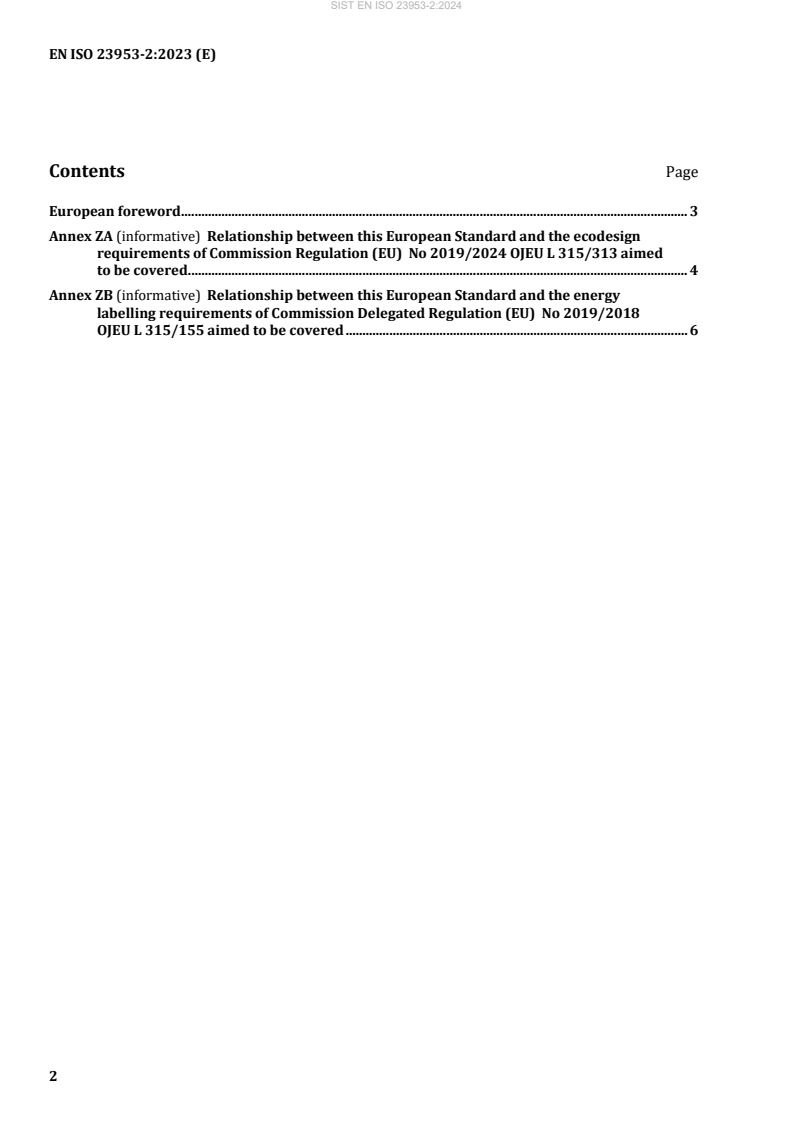
Contents Page
European foreword . 3
Annex ZA (informative) Relationship between this European Standard and the ecodesign
requirements of Commission Regulation (EU) No 2019/2024 OJEU L 315/313 aimed
to be covered . 4
Annex ZB (informative) Relationship between this European Standard and the energy
labelling requirements of Commission Delegated Regulation (EU) No 2019/2018
OJEU L 315/155 aimed to be covered . 6
European foreword
This document (EN ISO 23953-2:2023) has been prepared by Technical Committee ISO/TC 86
"Refrigeration and air-conditioning" in collaboration with Technical Committee CEN/TC 44
“Commercial and Professional Refrigerating Appliances and Systems, Performance and Energy
Consumption” the secretariat of which is held by UNI.
This European Standard shall be given the status of a national standard, either by publication of an
identical text or by endorsement, at the latest by June 2024, and conflicting national standards shall be
withdrawn at the latest by June 2024.
Attention is drawn to the possibility that some of the elements of this document may be the subject of
patent rights. CEN shall not be held responsible for identifying any or all such patent rights.
This document supersedes EN ISO 23953-2:2015.
This document has been prepared under a Standardization Request given to CEN by the European
Commission and the European Free Trade Association, and supports essential requirements of EU
Directive(s) / Regulation(s).
For the relationship with EU Directive(s) / Regulation(s), see informative Annex ZA and ZB, which is an
integral part of this document.
Any feedback and questions on this document should be directed to the users’ national standards
body/national committee. A complete listing of these bodies can be found on the CEN website.
According to the CEN-CENELEC Internal Regulations, the national standards organizations of the
following countries are bound to implement this European Standard: Austria, Belgium, Bulgaria,
Croatia, Cyprus, Czech Republic, Denmark, Estonia, Finland, France, Germany, Greece, Hungary, Iceland,
Ireland, Italy, Latvia, Lithuania, Luxembourg, Malta, Netherlands, Norway, Poland, Portugal, Republic of
North Macedonia, Romania, Serbia, Slovakia, Slovenia, Spain, Sweden, Switzerland, Türkiye and the
United Kingdom.
Endorsement notice
The text of ISO 23953-2:2023 has been approved by CEN as EN ISO 23953-2:2023 without any
modification.
Annex ZA
(informative)
Relationship between this European Standard and the ecodesign
requirements of Commission Regulation (EU)
No 2019/2024 OJEU L 315/313 aimed to be covered
This European Standard has been prepared under a Commission’s standardization request M/582
C(2022) 2764 final to provide one voluntary means of conforming to the ecodesign requirements of
st
Commission Regulation (EU) No 2019/2024 of 1 October 2019 implementing Directive 2009/125/EC
of the European Parliament and of the Council with regard to ecodesign requirements for refrigerating
appliances with a direct sales function OJEU L 315/313 keeping into account the amending Commission
Regulation (EU) 2021/341 of 23 February 2021 OJEU L 68/108.
Once this standard is cited in the Official Journal of the European Union under that Regulation,
compliance with the normative clauses of this standard given in Table ZA.1 confers, within the limits of
the scope of this standard, a presumption of conformity with the corresponding ecodesign
requirements of that Regulation and associated EFTA regulations.
Table ZA.1 — Correspondence between this European Standard and Commission Regulation
(EU) No 2019/2024 of 01 October 2019 implementing Directive 2009/125/EC of the European
Parliament and of the Council with regard to ecodesign requirements for refrigerating
appliances with a direct sales function OJEU L 315/313 and Commission’s standardisation
request M/582 C(2022) 2764 final
Ecodesign Requirements of
Regulation (EU) No Clause(s)/sub-clause(s)
Remarks/Notes
th
2019/2024 OJEU L 315/313 5 of this EN
December 2019
Article 4.3. (b) Annex D.3, D.4, D.5, D.6, D.7, D.8 Calculation methods
Annex III 1 Annex D.2 General condition for the test .
See below for loading height
references
5.3.3.3.2 a); b); c)
5.3.3.3.2 (d) i. Loading of vertical closed
freezer shall be half loading
5.3.3.3.2 (d) ii. Loading of vertical closed chilled
cabinet shall be full loading
Annex III 2 5.1, 5.2.1, 5.2.3, 5.3.1, 5.3.2, 5.3.3, Energy consumption and
5.3.4, 5.3.6, 5.3.7, Annex A and Annex A for S calculation.
TDA
Annex D
E is equivalent to E ; TDA is
daily TEC
equivalent to S .
TDA
Annex III Table 4 Table E.1 M and N coefficients
WARNING 1 — Presumption of conformity stays valid only as long as a reference to this European
Standard is maintained in the list published in the Official Journal of the European Union. Users of this
standard should consult frequently the latest list published in the Official Journal of the European
Union.
WARNING 2 — Other Union legislation may be applicable to the products falling within the scope of
this standard.
Annex ZB
(informative)
Relationship between this European Standard and the energy labelling
requirements of Commission Delegated Regulation (EU)
No 2019/2018 OJEU L 315/155 aimed to be covered
This European Standard has been prepared under a Commission’s standardization request M/582
C(2022) 2764 final to provide one voluntary means of conforming to the energy labelling requirements
st
of Commission Delegated Regulation (EU) No 2019/2018 of 1 October 2019 supplementing Directive
2010/30/EU of the European Parliament and of the Council with regard to energy labelling of
refrigerating appliances with a direct sales function OJEU L 315/155 keeping into account the amending
Commission Regulation (EU) 2021/340 of 17 December 2020 OJEU L 68/108.
Once this standard is cited in the Official Journal of the European Union under that Regulation,
compliance with the normative clauses of this standard given in Table ZB.1 confers, within the limits of
the scope of this standard, a presumption of conformity with the corresponding energy labelling
requirements of that Regulation and associated EFTA regulations.
Table ZB.1 — Correspondence between this European Standard and Commission Delegated
Regulation (EU) No 2019/2018 of 1st October 2019 supplementing Directive 2010/30/EU of the
European Parliament and of the Council with regard to energy labelling of refrigerating
appliances with a direct sales function OJEU L 315/155 and Commission’s standardisation
request M/582 C(2022) 2764 final
Energy labelling requirements
of Regulation (EU) No
Clause(s)/sub-clause(s)
Remarks/Notes
2019/2018 OJEU L 315/155
of this EN
th
5 December 2019
Annex III 1.2 item ,vi 5.1, 5.2.1, 5.2.3, 5.3.1, 5.3.2, 5.3.3, Testing methods , efficiency
5.3.4, 5.3.6, 5.3.7 and Annex D calculation
Edaily is equivalent to E , see
TEC
line below for Annex IV 2 b.
Annex III 1.2 items vii and ix Annex A S calculation
TDA
TDA is equivalent to S . See
TDA
line below for AnnexIV 2.c).4.d)
(TDA)
Annex III 1.2 items viii and x 5.3.4 Classification according to
temperature
Annex IV 1 Annex D.2 General condition for the test
Annex IV 2 5.1, 5.2.1, 5.2.3, 5.3.1, 5.3.2, 5.3.3, Energy consumption and
5.3.4, 5.3.6, 5.3.7, Annex A and Annex A for S calculation
TDA
Annex D
5.3.3.3.2 a); b); c)
5.3.3.3.2 (d) i. Loading of vertical closed
freezer shall be half loading
5.3.3.3.2 (d) ii. Loading of vertical closed chilled
cabinet shall be full loading
Annex IV 2 b 5.1, 5.2.1, 5.2.3, 5.3.1, 5.3.2, 5.3.3, E is equivalent to E .
daily TEC
5.3.4, 5.3.6, 5.3.7 and Annex D
Annex IV 2.c).4.d) (TDA) Annex A S calculation
TDA
TDA is equivalent to S .
TDA
Annex IV Table 3 Table E.1 M and N coefficients
WARNING 1 — Presumption of conformity stays valid only as long as a reference to this European
Standard is maintained in the list published in the Official Journal of the European Union. Users of this
standard should consult frequently the latest list published in the Official Journal of the European
Union.
WARNING 2 — Other Union legislation may be applicable to the products falling within the scope of
this standard.
INTERNATIONAL ISO
STANDARD 23953-2
Third edition
2023-11
Refrigerated display cabinets —
Part 2:
Classification, requirements and test
conditions
Meubles frigorifiques de vente —
Partie 2: Classification, exigences et méthodes d'essai
Reference number
ISO 23953-2:2023(E)
ISO 23953-2:2023(E)
© ISO 2023
All rights reserved. Unless otherwise specified, or required in the context of its implementation, no part of this publication may
be reproduced or utilized otherwise in any form or by any means, electronic or mechanical, including photocopying, or posting on
the internet or an intranet, without prior written permission. Permission can be requested from either ISO at the address below
or ISO’s member body in the country of the requester.
ISO copyright office
CP 401 • Ch. de Blandonnet 8
CH-1214 Vernier, Geneva
Phone: +41 22 749 01 11
Email: copyright@iso.org
Website: www.iso.org
Published in Switzerland
ii
ISO 23953-2:2023(E)
Contents Page
Foreword .v
1 Scope . 1
2 Normative references . 1
3 Terms, definitions, symbols and abbreviated terms . 1
3.1 Terms and definitions . 1
3.2 Symbols . 2
3.2.1 General . 2
3.2.2 Compression-type refrigeration systems . 3
3.2.3 Indirect refrigeration-type systems . 4
4 Requirements . 4
4.1 Construction . 4
4.1.1 General . 4
4.1.2 Materials . 5
4.1.3 Thermal insulation . 6
4.1.4 Refrigerating system . 6
4.1.5 Electrical components . 6
4.1.6 Temperature display . 7
4.2 Operating characteristics . 8
4.2.1 Absence of odour and taste . 8
4.2.2 Classification according to temperature. 8
4.2.3 Defrosting . 8
4.2.4 Water vapour condensation . 9
4.2.5 Energy consumption . 9
4.2.6 Specific energy consumption . 9
5 Tests . 9
5.1 General . 9
5.2 Tests outside test room . 10
5.2.1 General . 10
5.2.2 Seal test for doors and lids on low temperature applications . 10
5.2.3 Linear dimensions, areas . 10
5.3 Tests inside test room . 10
5.3.1 General . 10
5.3.2 General conditions . 10
5.3.3 Preparation of test cabinet and general test procedures . 21
5.3.4 Temperature test . .48
5.3.5 Water vapour condensation test .56
5.3.6 Electrical energy consumption test . 57
5.3.7 Heat extraction rate measurement when condensing unit is remote from
cabinet . 59
6 Test report .68
6.1 General .68
6.2 Tests outside test room .68
6.2.1 Seal test of doors and lids .68
6.2.2 Linear dimensions, areas and volumes .68
6.2.3 Test for absence of odour and taste . 69
6.3 Tests inside test room .69
6.3.1 General test conditions . 69
6.3.2 Cabinet preparation .69
6.3.3 Temperature test . . 70
6.3.4 Water vapour condensation test . 70
6.3.5 Electrical energy consumption test . 71
iii
ISO 23953-2:2023(E)
6.3.6 Heat extraction rate measurement when the condensing unit is remote
from the cabinet . 71
7 Marking . .73
7.1 Load limit.73
7.2 Marking plate . 75
7.3 Information to be supplied by the manufacturer . 75
Annex A (normative) Total display area (S ).77
TDA
Annex B (informative) Comparison between laboratory and in-store conditions .90
Annex C (informative) Test for absence of odour and taste .92
Annex D (normative) Performance and energy rating of commercial refrigerated display
cabinets .94
Annex E (normative) M and N coefficient values . 107
iv
ISO 23953-2:2023(E)
Foreword
ISO (the International Organization for Standardization) is a worldwide federation of national standards
bodies (ISO member bodies). The work of preparing International Standards is normally carried out
through ISO technical committees. Each member body interested in a subject for which a technical
committee has been established has the right to be represented on that committee. International
organizations, governmental and non-governmental, in liaison with ISO, also take part in the work.
ISO collaborates closely with the International Electrotechnical Commission (IEC) on all matters of
electrotechnical standardization.
The procedures used to develop this document and those intended for its further maintenance are
described in the ISO/IEC Directives, Part 1. In particular, the different approval criteria needed for the
different types of ISO document should be noted. This document was drafted in accordance with the
editorial rules of the ISO/IEC Directives, Part 2 (see www.iso.org/directives).
ISO draws attention to the possibility that the implementation of this document may involve the use
of (a) patent(s). ISO takes no position concerning the evidence, validity or applicability of any claimed
patent rights in respect thereof. As of the date of publication of this document, ISO had not received
notice of (a) patent(s) which may be required to implement this document. However, implementers are
cautioned that this may not represent the latest information, which may be obtained from the patent
database available at www.iso.org/patents. ISO shall not be held responsible for identifying any or all
such patent rights.
Any trade name used in this document is information given for the convenience of users and does not
constitute an endorsement.
For an explanation of the voluntary nature of standards, the meaning of ISO specific terms and
expressions related to conformity assessment, as well as information about ISO's adherence to
the World Trade Organization (WTO) principles in the Technical Barriers to Trade (TBT), see
www.iso.org/iso/foreword.html.
This document was prepared by Technical Committee ISO/TC 86, Refrigeration and air-conditioning,
Subcommittee SC 7, Testing and rating of commercial refrigerated display cabinets, in collaboration with
the European Committee for Standardization (CEN) Technical Committee CEN/TC 44, Commercial and
Professional Refrigerating Appliances and Systems, Performance and Energy Consumption, in accordance
with the Agreement on technical cooperation between ISO and CEN (Vienna Agreement).
This third edition cancels and replaces the second edition (ISO 23953-2:2015), which has been
technically revised.
The main changes are as follows:
— revision of:
— the scope has been revised as this document not applicable to commercial beverage coolers
covered by ISO 22044 and ice cream freezers covered by ISO 22043;
— mass flow with EEV only, to adapt standard to technological improvement;
— E also for brine / indirect cooling;
CPEC,24h
— testing repeatability;
— requirements for refrigerant with glide;
— addition of:
— extrapolation methods for liquid cooled condensing units, depth, height, length and plug-in
alternative components;
— liquid cooled condensing unit (semi plug-in) type;
v
ISO 23953-2:2023(E)
— S for new types of cabinets;
TDA
— standard rating conditions and configurations;
— marking, load limits, multiple loading line for different M-package temperature.
A list of all parts in the ISO 23953 series can be found on the ISO website.
Any feedback or questions on this document should be directed to the user’s national standards body. A
complete listing of these bodies can be found at www.iso.org/members.html.
vi
INTERNATIONAL STANDARD ISO 23953-2:2023(E)
Refrigerated display cabinets —
Part 2:
Classification, requirements and test conditions
1 Scope
This document specifies requirements for the performance of refrigerated display cabinets used in the
sale and display of foodstuffs and construction characteristics impacting performance. It specifies test
conditions and methods for checking that the requirements have been satisfied, as well as classification
of the cabinets, their marking and the list of their characteristics to be declared by the manufacturer.
This document is not applicable to refrigerated vending machines, commercial beverage coolers covered
by ISO 22044, ice cream freezers covered by ISO 22043. It is also not applicable to cabinets intended for
storage or cabinets intended for use, for instance, in catering or non-retail refrigerated applications.
This document does not cover health and safety aspects and ergonomic principles.
This document is not intended to specify storage temperature for foodstuff.
2 Normative references
The following documents are referred to in the text in such a way that some or all of their content
constitutes requirements of this document. For dated references, only the edition cited applies. For
undated references, the latest edition of the referenced document (including any amendments) applies.
ISO 817:2014, Refrigerants — Designation and safety classification
ISO 5149-2:2014, Refrigerating systems and heat pumps — Safety and environmental requirements — Part
2: Design, construction, testing, marking and documentation
ISO 23953-1:2023, Refrigerated display cabinets — Part 1: Vocabulary
IEC 60335-1:2020, Household and similar electrical appliances — Safety — Part 1: General requirements
IEC 60335-2-89:2019, Household and similar electrical appliances — Safety — Part 2-89: Particular
requirements for commercial refrigerating appliances and ice-makers with an incorporated or remote
refrigerant unit or motor-compressor
3 Terms, definitions, symbols and abbreviated terms
3.1 Terms and definitions
For the purposes of this document, the terms and definitions given in ISO 23953-1:2023 and the
following apply.
ISO and IEC maintain terminology databases for use in standardization at the following addresses:
— ISO Online browsing platform: available at https:// www .iso .org/ obp
— IEC Electropedia: available at https:// www .electropedia .org/
ISO 23953-2:2023(E)
3.1.1
running time
t
run
time during which compressor is running (or solenoid valve is open) or secondary refrigerant is
circulating (or solenoid valve is open), within 24 h
3.1.2
stopping time
t
stop
time during which compressor is not running (or solenoid valve is closed) or secondary refrigerant is
not circulating (or solenoid valve is closed), within 24 h and excluding defrost time
3.1.3
defrost time
t
deft
time during defrost during which compressor is not running (or solenoid valve is closed) or secondary
refrigerant is generally not circulating, within 24 h, but not considered as stopping time
3.2 Symbols
3.2.1 General
t running time, expressed in h
run
t stopping time, expressed in h
stop
t defrost time, expressed in h
deft
q mass flow rate of liquid refrigerant or secondary refrigerant in kg/s
m
Δt time between two consecutive measuring samples, in h
N number of measuring samples in 24 h
max
n number of defrosts during 24 h
deft
Φ heat extraction rate during a whole day, in kW
Φ heat extraction rate during a whole day excepting defrost time, in kW
24-deft
E anti-condensate energy consumption, in kWh
ACE,24h
E additional refrigeration energy consumption, in kWh
add
E compressor energy consumption, in kWh
CEC
E pumping electrical energy consumption, in kWh
CPEC,24h
E cooling system energy consumption, in kWh
CSEC
E direct daily electrical energy consumption, in kWh
DEC,24h
E defrost energy consumption, in kWh
DFEC
E fan energy consumption, in kWh
FEC
E heat extracted condenser, in kWh
HEC,24h
E revised heat removal energy consumption, in kWh
HECR,24h
ISO 23953-2:2023(E)
E heat load extracted daily, in kWh
HLE,24h
E heat removal energy consumption, in kWh
HREC
E additional heat removal energy consumption, in kWh
HRECA
E lighting energy consumption, in kWh
LEC
E condensate evaporator pan energy consumption, in kWh
PEC
E refrigeration electrical energy consumption, in kWh
REC,24h
E refrigeration electrical energy consumption compression-type, in kWh
REC-RC,24h
E refrigeration electrical energy consumption indirect, in kWh
REC-RI,24h
E additional refrigeration daily electrical energy consumption, in kWh
RECA,24h
E revised refrigeration energy consumption, in kWh
RECR,24h
E specific daily electrical energy consumption, in kWh/m
SEC
E total energy consumption, in kWh
TEC
E total revised daily electrical energy consumption, in kWh
TECR
E total revised daily electrical energy consumption, in kWh
TECR,24h
t relative or percentage running time:
rr
t t
run run
t = =
rr
tt+ 24− t
runstop deft
where
tt++ t =24
runstopdeft
Φ instant heat extraction rate in kW
n
3.2.2 Compression-type refrigeration systems
h , h specific enthalpy in kJ/kg, where state at point 8 corresponds to refrigerant outlet, and state
8 4
at point 4 to refrigerant inlet, of cabinet
θ refrigerant temperature at evaporator outlet, in °C
θ refrigerant temperature at cabinet outlet, in °C
θ refrigerant temperature at cabinet inlet, in °C
θ refrigerant temperature at evaporator inlet, in °C
θ evaporating temperature, calculated as the average of θ and θ obtained from pressure
mrun dew bub
p8 and averaged over the t period, in °C
run
θ condensing temperature, calculated as the average of θ and θ obtained from pressure
cond bub dew
p4 and averaged over the t period, in °C
run
ISO 23953-2:2023(E)
θ evaporating temperature, calculated as the average of θ and θ obtained from pressure
min dew bub
p8 by referring to table of saturation temperature in use and averaged over the last 10 % of
all t periods in °C
run
T = θ + 273,15 in Kelvin
mrun mrun
3.2.3 Indirect refrigeration-type systems
θ secondary refrigerant temperature at cabinet inlet, in °C
i
θ secondary refrigerant temperature at cabinet outlet, in °C
o
θ secondary refrigerant median temperature, in °C (θ + θ )/2
i o
θ arithmetic average of the secondary refrigerant median temperature (θ) during t , in °C
mrun run
q instant value of the secondary refrigerant mass flow during t , in kg/s
L run
c specific heat of secondary refrigerant, in kJ/(kg · K), at cabinet inlet
i
c specific heat of the secondary refrigerant, in kJ/(kg · K), at cabinet outlet
o
p − p pressure drop between inlet and outlet of cabinet during t , in kPa
irun orun run
v specific volume of secondary refrigerant, in m /kg
(simplification: v = constant = 0,001 m /kg)
4 Requirements
4.1 Construction
4.1.1 General
4.1.1.1 Strength and rigidity
The cabinet and its parts shall be constructed with adequate strength and rigidity for normal conditions
of handling, transport and use. Attention shall be given to the following:
a) interior fittings, including shelves, baskets, rails, etc. and their supports, shall be sufficiently strong
for the duty required;
b) where sliding shelves, baskets, trays or drawers are fitted they shall retain their shape and ease of
movement when fully loaded;
c) any fitments which are provided with stops to prevent accidental removal shall be self-supporting
when fully loaded and withdrawn to the limit of the stops;
d) stops.
4.1.1.2 Pipes and connections
Pipes and connections to moving or resiliently mounted parts shall be arranged so as not to foul or
transmit harmful vibrations to other parts. All other pipes and connections shall be securely anchored
and sufficient free length and/or vibration eliminators shall be provided to prevent failure due to
fatigue. Where necessary, pipes and valves shall be adequately thermally insulated.
ISO 23953-2:2023(E)
4.1.1.3 Condensate drainage
Where drains, drip trays or evaporation receptacles are fitted, they shall have sufficient capacity at the
rated climate class conditions.
NOTE Drains, drip trays or evaporation receptacles are to be easily accessible and cleanable.
Any condensate or defrost water receptacle, or group of receptacles, requiring to be emptied manually
shall have a capacity equivalent to at least 48 h of normal operation in the appropriate climate class for
which the cabinet is intended.
4.1.1.4 Closed refrigerated cabinets (self-service type)
Closed refrigerated cabinets shall meet certain special requirements as follows.
Hinged lids and doors shall be opened by different angles of at least 60°.
Transparent doors and lids shall be condensate-free at the climate class specified by the manufacturer.
NOTE Intermittent misting only is allowed, see 5.3.5.2.
Door fasteners and hinges under normal conditions of use shall be smooth and positive in action and
designed to function properly without undue wear.
When any doors or lids provided to ensure an air seal to the refrigerated space are closed, there shall be
no undue leakage of ambient air into the interior.
The doors or lids shall not open of their own accord.
The gasket shall be made from a material whose characteristics are compatible with the operating
conditions (especially temperatures). If the fastening device is mechanical, a stop or other means shall
be provided to prevent the gasket from being excessively deformed.
4.1.1.5 Joints and seams
All construction joints and seams within the net volume shall prevent the accumulation of potentially
contaminating substances.
All construction joints and seams within the net volume shall permit the easy removal of any deposits
of potentially contaminating substances.
4.1.2 Materials
4.1.2.1 General
The materials shall be durable and shall not favour the development of mould or emit odours.
Under normal conditions of use, materials in contact with foodstuffs shall be resistant to moisture and
shall neither be toxic nor contaminate them.
4.1.2.2 Wear resistance
Internal and external finishes shall be resistant to wear and capable of being cleaned effectively and
hygienically. Finishes shall not crack, chip, flake, rub off or soften under normal conditions of use or
during cleaning.
4.1.2.3 Corrosion resistance
Metal parts, used in the construction of cabinets, shall have resistance to corrosion appropriate to their
location and function.
ISO 23953-2:2023(E)
4.1.3 Thermal insulation
4.1.3.1 Efficiency
The thermal insulation shall be efficient and permanently fixed. In particular, the insulating material
shall not be subject to shrinkage and shall not allow under normal working conditions an accumulation
of moisture (see 4.2.4).
4.1.3.2 Vapour barrier
Suitable means shall be used to prevent deterioration of the thermal insulation by the ingress of
moisture.
4.1.3.3 Containment of insulation material
Where the insulation space is vented to the inside, it shall be ensured that particles of the insulation
material cannot escape into the foodstuff display compartment.
For fibrous insulation materials, it shall not be possible to insert a rigid probe of 1 mm diameter through
any aperture which allows access to the insulating material, the probe being applied with negligible
force.
4.1.4 Refrigerating system
4.1.4.1 Design and construction
The design and construction of all parts of the refrigerating system subject to internal pressure shall
take into account the maximum working pressure to which they are subjected when the cabinet is in
operation or at rest.
For refrigerated display cabinets with integral condensing unit or components thereof which are
charged with refrigerant prior to transportation, the maximum ambient temperature during transit
shall be taken into account. All refrigerant containing components shall be in accordance with
ISO 5149-2:2014.
4.1.4.2 Condensation
There shall be suitable means to prevent water condensed on cold surfaces of the cabinet and its parts
from harmfully affecting the operation of the refrigerating system or its controls.
4.1.4.3 System protection
For cabinets fitted with doors or lids, the refrigerating system shall suffer no damage if any door or lid
in the cabinet is left open while the cabinet is operating in an ambient temperature corresponding to
the climate class (see Table 3) for which the cabinet is intended.
4.1.4.4 Refrigerant
When deciding on the refrigerant for the system, attention shall be given to the possible hazards
associated with the use of certain refrigerants and heat-transfer media or secondary refrigerant, due to
their toxicity, flammability etc. Guidance on this point is available in ISO 5149-2:2014.
4.1.5 Electrical components
Electrical components shall be in accordance with IEC 60335-2-89:2019 and IEC 60335-1:2020.
Cabinets should incorporate a means of controlling all or part of the lighting using a manual switch,
sensor, timeclock or provision for an external control with a similar automatic device.
ISO 23953-2:2023(E)
4.1.6 Temperature display
4.1.6.1 General
The cabinets shall incorporate a temperature display instrument and can additionally have a means of
temperature monitoring, showing the air temperature in the refrigerated display cabinets to provide an
indication of the operation and functioning of refrigerating equipment and information on its operating
state.
NOTE As a rule, measured air temperature is not identical with foodstuff temperature in refrigerated
display cabinets.
4.1.6.2 Temperature-measuring instrument
Temperature-measuring instruments shall be used, i.e. fulfil the following requirements:
— the unit symbol (°C or °F) shall be inscribed or displayed on the temperature-measuring instrument;
— the range of measurement shall be at least from −25 °C to +15 °C;
— the scale division or smallest numerical increment shall be less than or equal to 1 °C;
— the maximum errors shall be 2 K over the total measuring range;
— the time constant t of the sensor shall be equal to or less than 20 min.
NOTE The t time is the time in which 90 % of a sudden temperature change of 20 °C is indicated, the
measurement medium being moderately agitated air (velocity 1 m/s).
4.1.6.3 Temperature sensor location
The temperature sensor location shall be readily accessible to enable on site testing for the correct
indication of temperature and replacement of the temperature measuring instrument on site in service.
NOTE 1 The temperature sensor of a thermometer is considered to be “readily accessible” if it can be reached
directly for examination. It can be necessary to remove access panel(s) to carry out replacement.
NOTE 2 For cabinets with natural convection cooling, the positioning of the temperature sensor in a guide
tube is also considered to be “readily accessible” if the sensor can be introduced into and removed from the guide
tube without a tool.
NOTE 3 For an electronic controller, it is possible to display a calculated temperature.
Wherever possible, the mounting method shall not suppl
...