

EN 13120:2009
(Main)Internal blinds - Performance requirements including safety
- Abstract
This European Standard specifies the requirements which internal blinds shall fulfil when fitted to a building. It deals also with the significant machinery hazards relating to construction, transport, installation, operation and maintenance of the blinds (see list of significant hazards in Annex B).
It applies to the internal blinds, whatever their design and nature of the materials used, as listed below:
- venetian blind: free hanging, guided, non-retractable;
- roller blind: free hanging, side guided, with tensioned fabric;
- vertical blind: free hanging, with top and bottom track, and sloping headrail;
- pleated blind: free hanging and guided.
These products may be operated manually, with or without compensating springs, or by means of electric motors (power operated products).
This standard does not apply to Roman Shades, Austrian, Festoon, Pinoleum, laterally moving pleated blinds, insect screens or blinds in sealed glazed units.
Noise aspects are not treated in this standard because this is not considered a safety issue.
This standard is not applicable to internal blinds which are manufactured before the date of publication of this standard.
- Status
- Withdrawn
- Publication Date
- 13-Jan-2009
- Withdrawal Date
- 18-Feb-2014
- Technical Committee
- CEN/TC 33 - Doors, windows, shutters and building hardware
- Drafting Committee
- CEN/TC 33/WG 3 - Blinds and shutters
- Current Stage
- 9960 - Withdrawal effective - Withdrawal
- Start Date
- 19-Feb-2014
- Completion Date
- 19-Feb-2014
- Directive
- 2006/42/EC - Directive 2006/42/EC of the European Parliament and of the Council of 17 May 2006 on machinery, and amending Directive 95/16/EC (recast)OJ Ref: C, C 214 OJ Date: 08-Sep-2009

Relations
- Effective Date
- 21-Jan-2009
- Effective Date
- 08-Jun-2022
- Effective Date
- 25-Aug-2026
- Effective Date
- 09-Feb-2026
- Effective Date
- 09-Feb-2026
- Effective Date
- 09-Feb-2026
- Effective Date
- 28-Jan-2026
- Effective Date
- 28-Jan-2026
- Effective Date
- 28-Jan-2026
- Effective Date
- 28-Jan-2026
- Effective Date
- 28-Jan-2026
- Effective Date
- 28-Jan-2026
- Effective Date
- 28-Jan-2026
- Refers
EN 12216:2002 - Shutters, external blinds, internal blinds - Terminology, glossary and definitions - Effective Date
- 28-Jan-2026
- Effective Date
- 28-Jan-2026
Get Certified
Connect with accredited certification bodies for this standard

DIBt (Deutsches Institut für Bautechnik)
German Institute for Building Technology.
DIN CERTCO
DIN Group product certification.

Aboma Certification B.V.
Specialized in construction, metal, and transport sectors.
Sponsored listings
Frequently Asked Questions
EN 13120:2009 is a standard published by the European Committee for Standardization (CEN). Its full title is "Internal blinds - Performance requirements including safety". This standard covers: This European Standard specifies the requirements which internal blinds shall fulfil when fitted to a building. It deals also with the significant machinery hazards relating to construction, transport, installation, operation and maintenance of the blinds (see list of significant hazards in Annex B). It applies to the internal blinds, whatever their design and nature of the materials used, as listed below: - venetian blind: free hanging, guided, non-retractable; - roller blind: free hanging, side guided, with tensioned fabric; - vertical blind: free hanging, with top and bottom track, and sloping headrail; - pleated blind: free hanging and guided. These products may be operated manually, with or without compensating springs, or by means of electric motors (power operated products). This standard does not apply to Roman Shades, Austrian, Festoon, Pinoleum, laterally moving pleated blinds, insect screens or blinds in sealed glazed units. Noise aspects are not treated in this standard because this is not considered a safety issue. This standard is not applicable to internal blinds which are manufactured before the date of publication of this standard.
This European Standard specifies the requirements which internal blinds shall fulfil when fitted to a building. It deals also with the significant machinery hazards relating to construction, transport, installation, operation and maintenance of the blinds (see list of significant hazards in Annex B). It applies to the internal blinds, whatever their design and nature of the materials used, as listed below: - venetian blind: free hanging, guided, non-retractable; - roller blind: free hanging, side guided, with tensioned fabric; - vertical blind: free hanging, with top and bottom track, and sloping headrail; - pleated blind: free hanging and guided. These products may be operated manually, with or without compensating springs, or by means of electric motors (power operated products). This standard does not apply to Roman Shades, Austrian, Festoon, Pinoleum, laterally moving pleated blinds, insect screens or blinds in sealed glazed units. Noise aspects are not treated in this standard because this is not considered a safety issue. This standard is not applicable to internal blinds which are manufactured before the date of publication of this standard.
EN 13120:2009 is classified under the following ICS (International Classification for Standards) categories: 91.060.50 - Doors and windows. The ICS classification helps identify the subject area and facilitates finding related standards.
EN 13120:2009 has the following relationships with other standards: It is inter standard links to EN 13120:2004, EN 13120:2009+A1:2014, ISO 9227:2006, EN IEC 60335-1:2023, EN IEC 60335-2-97:2023, EN 61310-1:2008, EN ISO 12100-2:2003, EN 14501:2021+A1:2025, EN 1670:2007, EN 14140:2014, EN 12280-2:2002, EN 20105-A02:1994, EN 14201:2004, EN 12216:2002, EN ISO 1421:2016. Understanding these relationships helps ensure you are using the most current and applicable version of the standard.
EN 13120:2009 is associated with the following European legislation: EU Directives/Regulations: 2006/42/EC, 98/37/EC; Standardization Mandates: M/079, M/396. When a standard is cited in the Official Journal of the European Union, products manufactured in conformity with it benefit from a presumption of conformity with the essential requirements of the corresponding EU directive or regulation.
EN 13120:2009 is available in PDF format for immediate download after purchase. The document can be added to your cart and obtained through the secure checkout process. Digital delivery ensures instant access to the complete standard document.
Standards Content (Sample)
2003-01.Slovenski inštitut za standardizacijo. Razmnoževanje celote ali delov tega standarda ni dovoljeno.Abschlüsse innen - Leistungs- und SicherheitsanforderungenStores intérieurs - Exigences de performance y compris la sécuritéInternal blinds - Performance requirements including safety91.060.50Vrata in oknaDoors and windowsICS:Ta slovenski standard je istoveten z:EN 13120:2009SIST EN 13120:2009en,fr,de01-junij-2009SIST EN 13120:2009SLOVENSKI
STANDARDSIST EN 13120:20041DGRPHãþD
EUROPEAN STANDARDNORME EUROPÉENNEEUROPÄISCHE NORMEN 13120January 2009ICS 91.060.50Supersedes EN 13120:2004
English VersionInternal blinds - Performance requirements including safetyStores intérieurs - Exigences de performance y compris lasécuritéAbschlüsse innen - Leistungs- undSicherheitsanforderungenThis European Standard was approved by CEN on 22 November 2008.CEN members are bound to comply with the CEN/CENELEC Internal Regulations which stipulate the conditions for giving this EuropeanStandard the status of a national standard without any alteration. Up-to-date lists and bibliographical references concerning such nationalstandards may be obtained on application to the CEN Management Centre or to any CEN member.This European Standard exists in three official versions (English, French, German). A version in any other language made by translationunder the responsibility of a CEN member into its own language and notified to the CEN Management Centre has the same status as theofficial versions.CEN members are the national standards bodies of Austria, Belgium, Bulgaria, Cyprus, Czech Republic, Denmark, Estonia, Finland,France, Germany, Greece, Hungary, Iceland, Ireland, Italy, Latvia, Lithuania, Luxembourg, Malta, Netherlands, Norway, Poland, Portugal,Romania, Slovakia, Slovenia, Spain, Sweden, Switzerland and United Kingdom.EUROPEAN COMMITTEE FOR STANDARDIZATIONCOMITÉ EUROPÉEN DE NORMALISATIONEUROPÄISCHES KOMITEE FÜR NORMUNGManagement Centre: rue de Stassart, 36
B-1050 Brussels© 2009 CENAll rights of exploitation in any form and by any means reservedworldwide for CEN national Members.Ref. No. EN 13120:2009: ESIST EN 13120:2009
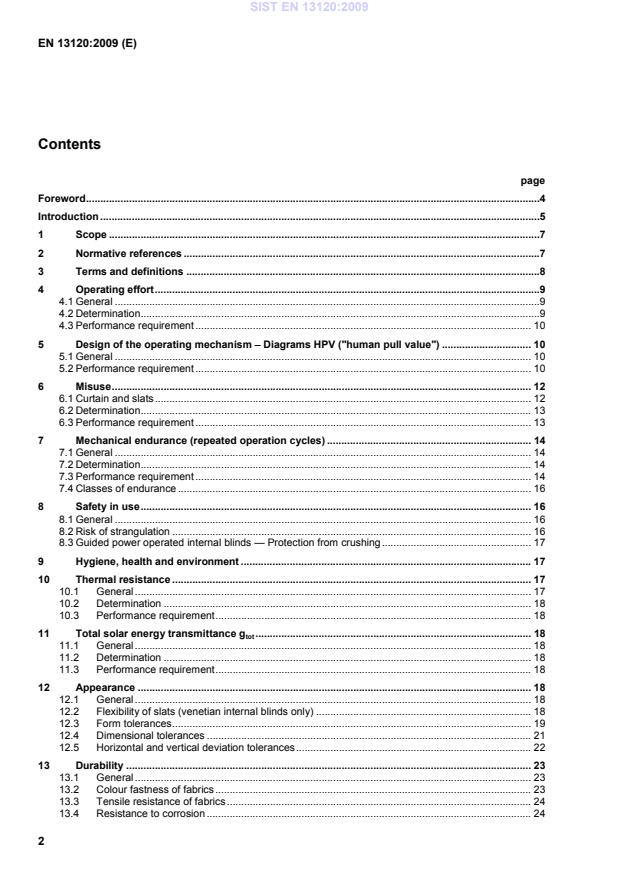
Definition of internal atmospheric conditions (Interior surroundings) . 30 Annex B (normative)
List of significant “machine” hazards . 32 Annex C (informative)
Common safety devices and measures . 33 Annex ZA (informative)
Relationship between this European Standard and the Essential Requirements of EU Directive 98/37/EC . 34 Annex ZB (informative)
Relationship between this European Standard and the Essential Requirements of EU Directive 2006/42/EC . 35 Bibliography . 36
According to the CEN/CENELEC Internal Regulations, the national standards organizations of the following countries are bound to implement this European Standard: Austria, Belgium, Bulgaria, Cyprus, Czech Republic, Denmark, Estonia, Finland, France, Germany, Greece, Hungary, Iceland, Ireland, Italy, Latvia, Lithuania, Luxembourg, Malta, Netherlands, Norway, Poland, Portugal, Romania, Slovakia, Slovenia, Spain, Sweden, Switzerland and the United Kingdom.
EN 12216:2002 and the following apply. 3.1 internal blind blind fitted in front of or on a window or in between glazings or anywhere within the internal surface of the building 3.2 intrinsic performance overall performances of the internal blind regardless of its application as opposed to specific performance 3.3 specific performance performance which may be additional and complementary to the intrinsic performances and refers to a specific product 3.4 curtain part of the product which is set in motion by the operating mechanism and ensures its function 3.5 extension/retraction movement of the curtain resulting in an increase/decrease in the surface area covered 3.6 opening/closing terms used to describe the increase in light (opening) or reduction of light (closing) in an extended position for products with slats or louvres which can be tilted or adjusted SIST EN 13120:2009
Class 1 Class 2 Crank or winch handle a, c, wand 30 15 Tape, cord or chain a, b, c 90 50 Rod, or vertical plane 90 50 Hand horizontal or sloping plane 50 30 NOTE 1
For spring loaded systems, 1,5 FM may be reached for locking in the fully extended or retracted position. NOTE 2
An internal blind belongs to Class 2 if both the operations of moving the curtain and tilting the slats or louvres belong to Class 2. Otherwise the internal blind is Class 1. a
Operation mechanism shall also fulfil the requirements in Clause 5. b
One direction movement and endless movement of the operating mechanism. c
Monocommand.
5 Design of the operating mechanism −−−− Diagrams HPV ("human pull value") 5.1 General Geometrical characteristics of operating mechanisms taking into account the comfort factor. 5.2 Performance requirement 5.2.1 Gear operation Gear with crank or winch handle shall have: a handle R of length less or equal to 0,20 m (R ≤ 0,20 m); a reduction ratio r of the gear less than 1:10 (average or mean reduction ratio when, for the same gear, several reductions exist). NOTE A reduction ratio of 1:10 means it is necessary to make ten turns of the crank to achieve one rotation of the roller tube or axle. 5.2.2 Tape, cord or chain operation Operating mechanisms shall have minimal dimensions as given in the HPV diagrams (see Figures 1 and 2). SIST EN 13120:2009
Key d diameter of a single cord or diameter of the ball of a ball chain
1 Acceptable 2 Non acceptable FM Operating effort Figure 1 — Diagram HPV for a cord or chain operation For a given diameter d of a single cord and the number n of cords known, the dHPV (in mm) can be determined by use of the table in Figure 1. The diameter calculated can be tested against the diagram at Figure 1 to determine the acceptability relative to the operating effort. The point obtained from dHPV and the measured effort shall be located in area 1 of the Figure 1 diagram.
Key 1 Acceptable 2 Non acceptable FM Operating effort L Width of the tape Figure 2 — Diagram HPV for a tape operation SIST EN 13120:2009
Key 1 Direction of extension 2 Direction of retraction 3 Obstruction a) Curtain fully extended b) Curtain fully retracted c) Curtain in intermediate position, obstructed during extension and/or retraction
Figure 3 — Illustration of the six possibilities of forced operation 6.1.2.3 Reversed operation Reversed operations are only applicable to roller internal blinds or to products using a rolling mechanism for extension or retraction. For these products, operation in situation a1 or b2 illustrated in Figure 3 is a reversed operation when the movement in the opposite direction is possible with an effort less than the limit of the class of operation. If the movement is not possible, it is a forced operation. SIST EN 13120:2009
Not concerned Rough PF = 1,2 FM + 20 CF = PF × R Forced c PI = FM CI = FM × R Reversed FM = value of the measured operating effort P = exerted misuse force
C = exerted misuse torque F = forced, I = reversed R = the maximum length of crank handle described in the technical instructions with R ≤ 0,20 m a
Operation by tape, cord or chain, rod, hand operation. b
Operation by crank or winch handles, wand. c
For power operated operations, the effort to be applied is the one produced by the motor.
NOTE There are no performance classes. 7 Mechanical endurance (repeated operation cycles) 7.1 General Ability of the internal blind to withstand a number of operating cycles corresponding to a given usage: the curtain: one cycle corresponds to a complete operation of curtain extension and retraction including the rest times; the slats/louvres: one tilt cycle is defined as a complete movement of the pivoting mechanism, moving the slats or louvres from one extreme position to the other and then back again. 7.2 Determination Shall be in accordance with the test methods specified in EN 14201. 7.3 Performance requirement 7.3.1 General After carrying out the cycles relating to the appropriate endurance class, the following requirements shall be fulfilled. 7.3.2 Manual operation The value of operating effort shall be maintained within the limit of the initial class. Appearance criteria shall be fulfilled: there shall not be visible defects other than those detailed in Clause 12. SIST EN 13120:2009
Figure 4 — Illustration of the accuracy of the limit stops for Class 1 and 2 SIST EN 13120:2009
...