

EN 1997-2:2024/prA1
(Amendment)Eurocode 7 - Geotechnical design - Part 2: Ground properties
- Abstract
1.1 Scope of FprEN 1997-2
(1) This document provides rules for determining ground properties for the design and verification of geotechnical structures.
(2) This document covers requirements and guidance for planning ground investigations, collecting information about ground properties and groundwater conditions, and preparation of the Ground Model.
(3) This document covers requirements and guidance for the selection of field investigation and laboratory test methods to obtain derived values of ground properties.
(4) This document covers requirements and guidance on the presentation of the results of ground investigation, including derived values of ground properties, in the Ground Investigation Report.
1.2 Assumptions
(5) The provisions in FprEN 1997-2 are based on the assumptions given in EN 1990 and FprEN 1997-1.
(6) This document is intended to be used in conjunction with FprEN 1997-1, which provides general rules for design and verification of all geotechnical structures.
(7) This document is intended to be used in conjunction with prEN 1997-3, which provides specific rules for design and verification of certain types of geotechnical structures.
(8) This document is intended to be used in conjunction with FprEN 1998-1-1 which provides the requirements for the ground properties needed to define the seismic action.
(9) This document is intended to be used in conjunction with FprEN 1998-5 which provides rules for the design of geotechnical structures in seismic regions.
- Status
- Not Published
- Publication Date
- 19-Jan-2028
- Technical Committee
- CEN/TC 250 - Structural Eurocodes
- Drafting Committee
- CEN/TC 250/SC 7 - Eurocode 7 - Geotechnical design
- Current Stage
- 4060 - Closure of enquiry - Enquiry
- Start Date
- 03-Sep-2026
- Due Date
- 31-Dec-2026
- Completion Date
- 31-Dec-2026

EN 1997-2:2024/prA1 is a CEN draft amendment to Eurocode 7 - Geotechnical design - Part 2: Ground properties, part of the second generation of the Eurocodes. It updates the standard's rules and terminology for ground investigation, ground property reporting, and linked structural and seismic references. Engineers, geotechnical specialists, laboratories, and specifiers use it together with EN 1997-2:2024 and the related Eurocode parts.
What does EN 1997-2:2024/prA1 specify?
EN 1997-2:2024/prA1 specifies amendments to EN 1997-2:2024 across the whole document, with targeted changes in the foreword, introduction, Clause 2, Clause 3, Clause 5, and Clause 7. In practice, it refreshes cross-references, terminology, and wording used when planning investigations and reporting ground properties.
The main structure of the amended document is:
- general modifications throughout the document
- changes to the European foreword
- changes to the Introduction
- Clause 2, Normative references
- Clause 3, Terms and definitions
- Clause 5, Ground investigation
- Clause 7, State, physical, and chemical properties
For users, that means the amendment is mainly about keeping the base standard aligned with newer Eurocode references and cleaner technical wording, rather than changing the overall subject of the document.
What are the key requirements of EN 1997-2:2024/prA1?
EN 1997-2:2024/prA1 updates the reference framework, the terminology, and several technical expressions used in ground investigation and ground property description. The changes matter because design notes, reports, and calculations need to use the updated Eurocode names and symbols consistently.
Updated Eurocode references
The amendment replaces references to EN 1990 with EN 1990-1 in most places, and updates links to EN 1997-1:2024, EN 1998-1-1:2024, EN 1998-5:2024 and EN 1997-3:2025 to their A1:2026 versions. This tells users which companion Eurocode texts the ground property rules are meant to work with.
Clause 2 also changes the normative reference to EN 1990 (all parts). In practice, designers and reviewers need to check the full EN 1990 family when applying the ground property rules.
Introduction and Eurocode context
The Introduction is updated to add EN 19100 Eurocode 10 - Design of glass structures to the list of Eurocodes, and to revise the note about future work on structural glass. This keeps the introduction aligned with the current Eurocode set and its development status.
Symbols and abbreviations
Clause 3 removes several symbols and definitions, replaces DP with DPT, and deletes the abbreviations MR, SCR, TCR and UCS. For users, this means calculation sheets, logs and reports should follow the revised notation and not rely on removed symbol names.
Ground investigation wording
Clause 5 changes the wording in the ground investigation section, including the statement that geophysical tests may be used to identify relevant features. It also changes “abrasivity” to “abrasiveness”. In practice, this is a terminology update for planning and describing investigation methods.
State, physical, and chemical properties
Clause 7 makes the same wording change from “abrasivity” to “abrasiveness”, including the title of 7.2.6 and Table 7.5. This matters when reporting rock or ground interaction properties, because the same term is used throughout the clause and in the table heading.
What terms does EN 1997-2:2024/prA1 define?
- Ground Model - the model used to represent ground conditions for geotechnical design and verification.
- Ground Investigation Report - the report that presents investigation results and the derived ground property values.
- Ground properties - the soil and rock properties used to describe how the ground will behave in design.
- Groundwater conditions - the water conditions in the ground that affect design and verification.
- Field investigation - site-based investigation work used to collect information about the ground.
- Laboratory test methods - test methods used on samples to obtain derived values of ground properties.
- Derived values - property values obtained from investigation data and testing rather than direct observation.
Who uses EN 1997-2:2024/prA1?
EN 1997-2:2024/prA1 is used by geotechnical engineers, structural designers, site investigation specialists, laboratories, and reviewers of geotechnical reports. It is relevant in civil engineering, foundations, underground works, earthworks, and related geotechnical design work.
It is also useful for quality managers and buyers who specify investigation deliverables, because it shows which terms, references, and property descriptions should appear in reports and technical submissions.
What changed in EN 1997-2:2024/prA1 from the previous edition?
EN 1997-2:2024/prA1 will modify EN 1997-2:2024. The amendment:
- updates cross-references to EN 1990-1, EN 1997-1:2024+A1:2026, EN 1998-1-1:2024+A1:2026, EN 1998-5:2024+A1:2026, and EN 1997-3:2025+A1:2026
- adds EN 19100 Eurocode 10 - Design of glass structures to the Introduction
- changes Clause 2 to reference EN 1990 (all parts)
- removes selected symbols and abbreviations in Clause 3, and replaces DP with DPT
- changes “abrasivity” to “abrasiveness” in Clause 5 and Clause 7
Which standards are used with EN 1997-2:2024/prA1?
- EN 1990 (all parts) - gives the basis of structural and geotechnical design.
- FprEN 1997-1 - provides the general rules for design and verification of all geotechnical structures.
- prEN 1997-3 - provides specific rules for design and verification of certain types of geotechnical structures.
- FprEN 1998-1-1 - sets the ground property requirements needed to define the seismic action.
- FprEN 1998-5 - gives rules for the design of geotechnical structures in seismic regions.
What does the EN 1997-2:2024/prA1 document contain?
EN 1997-2:2024/prA1 is a clause-by-clause amendment document, so its content is a list of changes to the base standard rather than a full rewrite. It covers the European foreword, Introduction, Clause 2, Clause 3, Clause 5 and Clause 7, with one affected table in Clause 7.
The document contains replacement instructions for references, wording changes in investigation and property clauses, and deletions of selected symbols and abbreviations. It also notes that some modifications are editorial corrections.
Relations
- Effective Date
- 19-Nov-2025
Get Certified
Connect with accredited certification bodies for this standard

DIBt (Deutsches Institut für Bautechnik)
German Institute for Building Technology.

DIN CERTCO
DIN Group product certification.

Zavod za gradbeništvo Slovenije (ZAG) - Inšpekcija
ZAG inspection body for construction products, structures, and materials.
Sponsored listings
Frequently Asked Questions
EN 1997-2:2024/prA1 is a draft published by the European Committee for Standardization (CEN). Its full title is "Eurocode 7 - Geotechnical design - Part 2: Ground properties". This standard covers: 1.1 Scope of FprEN 1997-2 (1) This document provides rules for determining ground properties for the design and verification of geotechnical structures. (2) This document covers requirements and guidance for planning ground investigations, collecting information about ground properties and groundwater conditions, and preparation of the Ground Model. (3) This document covers requirements and guidance for the selection of field investigation and laboratory test methods to obtain derived values of ground properties. (4) This document covers requirements and guidance on the presentation of the results of ground investigation, including derived values of ground properties, in the Ground Investigation Report. 1.2 Assumptions (5) The provisions in FprEN 1997-2 are based on the assumptions given in EN 1990 and FprEN 1997-1. (6) This document is intended to be used in conjunction with FprEN 1997-1, which provides general rules for design and verification of all geotechnical structures. (7) This document is intended to be used in conjunction with prEN 1997-3, which provides specific rules for design and verification of certain types of geotechnical structures. (8) This document is intended to be used in conjunction with FprEN 1998-1-1 which provides the requirements for the ground properties needed to define the seismic action. (9) This document is intended to be used in conjunction with FprEN 1998-5 which provides rules for the design of geotechnical structures in seismic regions.
1.1 Scope of FprEN 1997-2 (1) This document provides rules for determining ground properties for the design and verification of geotechnical structures. (2) This document covers requirements and guidance for planning ground investigations, collecting information about ground properties and groundwater conditions, and preparation of the Ground Model. (3) This document covers requirements and guidance for the selection of field investigation and laboratory test methods to obtain derived values of ground properties. (4) This document covers requirements and guidance on the presentation of the results of ground investigation, including derived values of ground properties, in the Ground Investigation Report. 1.2 Assumptions (5) The provisions in FprEN 1997-2 are based on the assumptions given in EN 1990 and FprEN 1997-1. (6) This document is intended to be used in conjunction with FprEN 1997-1, which provides general rules for design and verification of all geotechnical structures. (7) This document is intended to be used in conjunction with prEN 1997-3, which provides specific rules for design and verification of certain types of geotechnical structures. (8) This document is intended to be used in conjunction with FprEN 1998-1-1 which provides the requirements for the ground properties needed to define the seismic action. (9) This document is intended to be used in conjunction with FprEN 1998-5 which provides rules for the design of geotechnical structures in seismic regions.
EN 1997-2:2024/prA1 is classified under the following ICS (International Classification for Standards) categories: 91.010.30 - Technical aspects; 93.020 - Earthworks. Excavations. Foundation construction. Underground works. The ICS classification helps identify the subject area and facilitates finding related standards.
EN 1997-2:2024/prA1 has the following relationships with other standards: It is inter standard links to EN 1997-2:2024. Understanding these relationships helps ensure you are using the most current and applicable version of the standard.
EN 1997-2:2024/prA1 is available in PDF format for immediate download after purchase. The document can be added to your cart and obtained through the secure checkout process. Digital delivery ensures instant access to the complete standard document.
Standards Content (Sample)
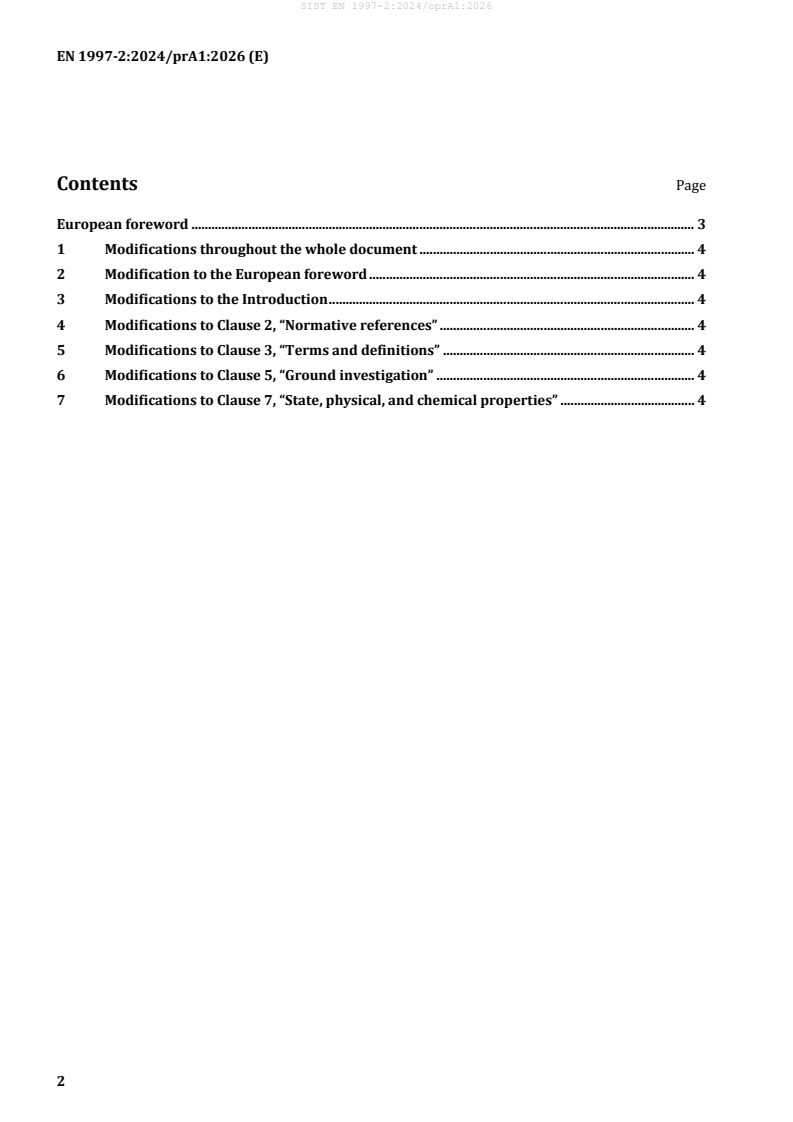
Contents
- European foreword
- 1 Modifications throughout the whole document
- 2 Modification to the European foreword
- 3 Modifications to the Introduction
- 4 Modifications to Clause 2, “Normative references”
- 5 Modifications to Clause 3, “Terms and definitions”
- 6 Modifications to Clause 5, “Ground investigation”
- 7 Modifications to Clause 7, “State, physical, and chemical properties”
European foreword
This document (EN 1997-2:2024/prA1:2026) has been prepared by Technical Committee CEN/TC 250 “Structural Eurocodes”, the secretariat of which is held by BSI. CEN/TC 250 is responsible for all Structural Eurocodes and has been assigned responsibility for structural and geotechnical design matters by CEN.
This document is currently submitted to the CEN Enquiry.
This document will amend EN 1997-2:2024.
NOTE Some modifications are purely editorial corrections to improve the quality of the document and these will not be tagged in the consolidated publication, as noted after the modification. The first generation of EN Eurocodes was published between 2002 and 2007. This document forms part of the second generation of the Eurocodes, which have been prepared under Mandate M/515 issued to CEN by the European Commission and the European Free Trade Association. The Eurocodes have been drafted to be used in conjunction with relevant execution, material, product and test standards, and to identify requirements for execution, materials, products and testing that are relied upon by the Eurocodes.
...