

SIST EN 1997-2:2024/oprA1:2026
(Amendment)Eurocode 7 - Geotechnical design - Part 2: Ground properties
- Abstract
1.1 Scope of FprEN 1997-2
(1) This document provides rules for determining ground properties for the design and verification of geotechnical structures.
(2) This document covers requirements and guidance for planning ground investigations, collecting information about ground properties and groundwater conditions, and preparation of the Ground Model.
(3) This document covers requirements and guidance for the selection of field investigation and laboratory test methods to obtain derived values of ground properties.
(4) This document covers requirements and guidance on the presentation of the results of ground investigation, including derived values of ground properties, in the Ground Investigation Report.
1.2 Assumptions
(5) The provisions in FprEN 1997-2 are based on the assumptions given in EN 1990 and FprEN 1997-1.
(6) This document is intended to be used in conjunction with FprEN 1997-1, which provides general rules for design and verification of all geotechnical structures.
(7) This document is intended to be used in conjunction with prEN 1997-3, which provides specific rules for design and verification of certain types of geotechnical structures.
(8) This document is intended to be used in conjunction with FprEN 1998-1-1 which provides the requirements for the ground properties needed to define the seismic action.
(9) This document is intended to be used in conjunction with FprEN 1998-5 which provides rules for the design of geotechnical structures in seismic regions.
- Status
- Not Published
- Public Enquiry End Date
- 29-Jul-2026
- Technical Committee
- KON - Structures
- Current Stage
- 4020 - Public enquire (PE) (Adopted Project)
- Start Date
- 17-Jun-2026
- Due Date
- 04-Nov-2026

SIST EN 1997-2:2024/oprA1:2026 is the Slovenian draft amendment to EN 1997-2:2024, prepared by CEN/TC 250 and published by SIST for enquiry. It updates Eurocode 7 - Geotechnical design - Part 2: Ground properties, which sets rules for determining ground properties, planning investigations, selecting test methods, and reporting ground data for geotechnical design and verification.
What does SIST EN 1997-2:2024/oprA1:2026 specify?
SIST EN 1997-2:2024/oprA1:2026 specifies amendments to EN 1997-2:2024. The underlying standard covers how to obtain and present the ground information needed to design and verify geotechnical structures, including the Ground Model, groundwater conditions, field investigation, laboratory testing, and the Ground Investigation Report.
The amendment is organized as a set of targeted changes to the base document:
- the European foreword
- the Introduction
- Clause 2, “Normative references”
- Clause 3, “Terms and definitions”
- Clause 5, “Ground investigation”
- Clause 7, “State, physical, and chemical properties”
In practice, this means the document is mainly a change package. Users need it to track revised cross-references, updated terminology, and wording changes in the parts of Eurocode 7 that deal with investigation and ground property description.
What are the key requirements of SIST EN 1997-2:2024/oprA1:2026?
The main effect of SIST EN 1997-2:2024/oprA1:2026 is to align EN 1997-2:2024 with updated Eurocode references and current terminology. For engineers and reviewers, the important point is that several references and terms change across the whole document, so project documents and investigation reports should use the updated names.
Updated Eurocode references
Across the whole document, EN 1990 is replaced by EN 1990-1 in most places, while the companion references are updated to EN 1997-1:2024+A1:2026, EN 1998-1-1:2024+A1:2026, and EN 1998-5:2024+A1:2026. In the European foreword, EN 1997-3:- is replaced with EN 1997-3:2025+A1:2026. In practice, this keeps the geotechnical document chain consistent with the current Eurocode set.
Normative references
Clause 2 replaces the reference to EN 1990 with EN 1990 (all parts), Eurocode - Basis of structural and geotechnical design. That matters because the document is intended to be read with the general Eurocode basis, not in isolation.
Terms and definitions
Clause 3 removes several symbol definitions and deletes the abbreviations MR, SCR, TCR and UCS. It also replaces the abbreviation DP with DPT. For users, this means reports, calculations and investigation records should follow the revised terminology rather than older shorthand.
Ground investigation
Clause 5 changes wording in the investigation provisions. It replaces “abrasivity” with “abrasiveness” and changes the wording in 5.3.2.2(3) so that geophysical tests may be used to identify the listed features. In practice, this clarifies the language used for investigation planning and allows geophysical methods as one possible tool.
State, physical, and chemical properties
Clause 7 makes the same terminology update in the section on abrasiveness, including the title of 7.2.6, 7.2.6(2), and Table 7.5. This helps keep the description of rock or soil wear-related properties consistent throughout the standard.
Editorial corrections
The European foreword notes that some modifications are purely editorial corrections. That matters because not every change is a technical change, but all of them affect the wording in the consolidated publication.
What terms does SIST EN 1997-2:2024/oprA1:2026 define?
- Ground Model - the organized representation of the ground conditions assembled from investigation data for design use.
- Ground Investigation Report - the report that presents the investigation results and derived ground property values.
- Ground investigation - the process of collecting information about ground properties and groundwater conditions for design and verification.
- Geophysical tests - investigation methods that may be used to identify subsurface features during ground investigation.
- Abrasiveness - the property name used in Clause 7 for the wear-related character of the ground.
- DPT - the abbreviation that replaces DP in the revised terminology set.
- National Annexes - the national documents used by Member States to set values related to regulatory safety matters.
Who uses SIST EN 1997-2:2024/oprA1:2026?
SIST EN 1997-2:2024/oprA1:2026 is used by geotechnical engineers, site investigation specialists, laboratory and field testing providers, and designers of foundations, earthworks, excavations, and underground works. It is also relevant to quality managers and buyers who need to check that investigation methods and reporting align with Eurocode-based design and verification.
In practice, users apply it when planning investigation campaigns, selecting field and laboratory tests, compiling the Ground Model, and preparing the Ground Investigation Report for a project.
What changed in SIST EN 1997-2:2024/oprA1:2026 from the previous edition?
This draft amendment will modify EN 1997-2:2024. The changes stated in the document include:
- replacement of EN 1990 with EN 1990-1 in most locations
- update of references to EN 1997-1:2024+A1:2026, EN 1998-1-1:2024+A1:2026, and EN 1998-5:2024+A1:2026
- update of the foreword reference to EN 1997-3:2025+A1:2026
- addition of EN 19100 Eurocode 10 - Design of glass structures in the Introduction
- deletion of several symbols and abbreviations in Clause 3
- change from “should” to “may” for geophysical tests in Clause 5
- replacement of “abrasivity” with “abrasiveness” in Clause 5 and Clause 7
Which standards are used with SIST EN 1997-2:2024/oprA1:2026?
- EN 1990 (all parts) - provides the basis of structural and geotechnical design.
- EN 1997-1:2024+A1:2026 - gives the general rules for design and verification of geotechnical structures.
- EN 1997-3:2025+A1:2026 - gives specific rules for certain types of geotechnical structures.
- EN 1998-1-1:2024+A1:2026 - provides the ground-property requirements needed to define seismic action.
- EN 1998-5:2024+A1:2026 - gives rules for geotechnical design in seismic regions.
- EN 19100 - is listed in the Introduction as Eurocode 10 - Design of glass structures.
What does the SIST EN 1997-2:2024/oprA1:2026 document contain?
SIST EN 1997-2:2024/oprA1:2026 contains a European foreword and a structured set of modification clauses. It gives the exact wording changes to apply to EN 1997-2:2024 rather than a full rewritten text.
The document covers whole-document reference updates, the revised Introduction, updated normative references, changes to terms and symbols, and wording changes in ground investigation and property description. It also updates Table 7.5 and related wording so that the ground-property terminology stays consistent across the standard.
Get Certified
Connect with accredited certification bodies for this standard

DIBt (Deutsches Institut für Bautechnik)
German Institute for Building Technology.
DIN CERTCO
DIN Group product certification.
Zavod za gradbeništvo Slovenije (ZAG) - Inšpekcija
ZAG inspection body for construction products, structures, and materials.
Sponsored listings
Frequently Asked Questions
SIST EN 1997-2:2024/oprA1:2026 is a draft published by the Slovenian Institute for Standardization (SIST). Its full title is "Eurocode 7 - Geotechnical design - Part 2: Ground properties". This standard covers: 1.1 Scope of FprEN 1997-2 (1) This document provides rules for determining ground properties for the design and verification of geotechnical structures. (2) This document covers requirements and guidance for planning ground investigations, collecting information about ground properties and groundwater conditions, and preparation of the Ground Model. (3) This document covers requirements and guidance for the selection of field investigation and laboratory test methods to obtain derived values of ground properties. (4) This document covers requirements and guidance on the presentation of the results of ground investigation, including derived values of ground properties, in the Ground Investigation Report. 1.2 Assumptions (5) The provisions in FprEN 1997-2 are based on the assumptions given in EN 1990 and FprEN 1997-1. (6) This document is intended to be used in conjunction with FprEN 1997-1, which provides general rules for design and verification of all geotechnical structures. (7) This document is intended to be used in conjunction with prEN 1997-3, which provides specific rules for design and verification of certain types of geotechnical structures. (8) This document is intended to be used in conjunction with FprEN 1998-1-1 which provides the requirements for the ground properties needed to define the seismic action. (9) This document is intended to be used in conjunction with FprEN 1998-5 which provides rules for the design of geotechnical structures in seismic regions.
1.1 Scope of FprEN 1997-2 (1) This document provides rules for determining ground properties for the design and verification of geotechnical structures. (2) This document covers requirements and guidance for planning ground investigations, collecting information about ground properties and groundwater conditions, and preparation of the Ground Model. (3) This document covers requirements and guidance for the selection of field investigation and laboratory test methods to obtain derived values of ground properties. (4) This document covers requirements and guidance on the presentation of the results of ground investigation, including derived values of ground properties, in the Ground Investigation Report. 1.2 Assumptions (5) The provisions in FprEN 1997-2 are based on the assumptions given in EN 1990 and FprEN 1997-1. (6) This document is intended to be used in conjunction with FprEN 1997-1, which provides general rules for design and verification of all geotechnical structures. (7) This document is intended to be used in conjunction with prEN 1997-3, which provides specific rules for design and verification of certain types of geotechnical structures. (8) This document is intended to be used in conjunction with FprEN 1998-1-1 which provides the requirements for the ground properties needed to define the seismic action. (9) This document is intended to be used in conjunction with FprEN 1998-5 which provides rules for the design of geotechnical structures in seismic regions.
SIST EN 1997-2:2024/oprA1:2026 is classified under the following ICS (International Classification for Standards) categories: 91.010.30 - Technical aspects; 93.020 - Earthworks. Excavations. Foundation construction. Underground works. The ICS classification helps identify the subject area and facilitates finding related standards.
SIST EN 1997-2:2024/oprA1:2026 is available in PDF format for immediate download after purchase. The document can be added to your cart and obtained through the secure checkout process. Digital delivery ensures instant access to the complete standard document.
Standards Content (Sample)
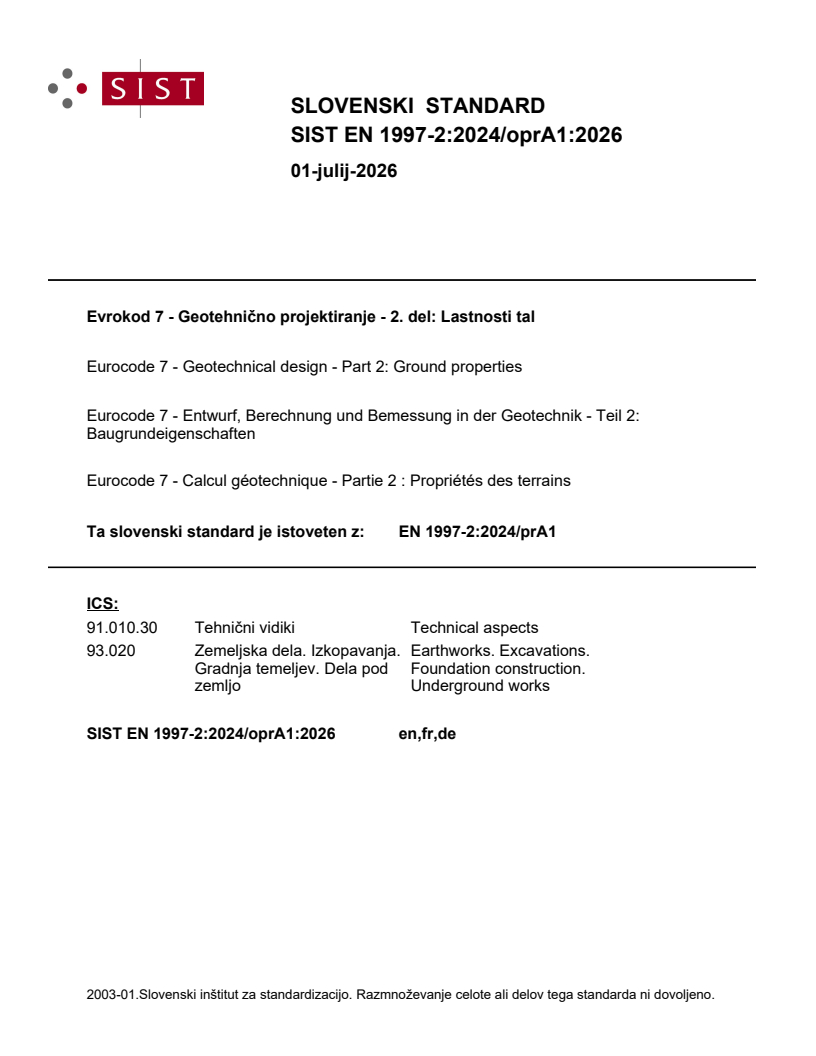
SLOVENSKI STANDARD
01-julij-2026
Evrokod 7 - Geotehnično projektiranje - 2. del: Lastnosti tal
Eurocode 7 - Geotechnical design - Part 2: Ground properties
Eurocode 7 - Entwurf, Berechnung und Bemessung in der Geotechnik - Teil 2:
Baugrundeigenschaften
Eurocode 7 - Calcul géotechnique - Partie 2 : Propriétés des terrains
Ta slovenski standard je istoveten z: EN 1997-2:2024/prA1
ICS:
91.010.30 Tehnični vidiki Technical aspects
93.020 Zemeljska dela. Izkopavanja. Earthworks. Excavations.
Gradnja temeljev. Dela pod Foundation construction.
zemljo Underground works
2003-01.Slovenski inštitut za standardizacijo. Razmnoževanje celote ali delov tega standarda ni dovoljeno.
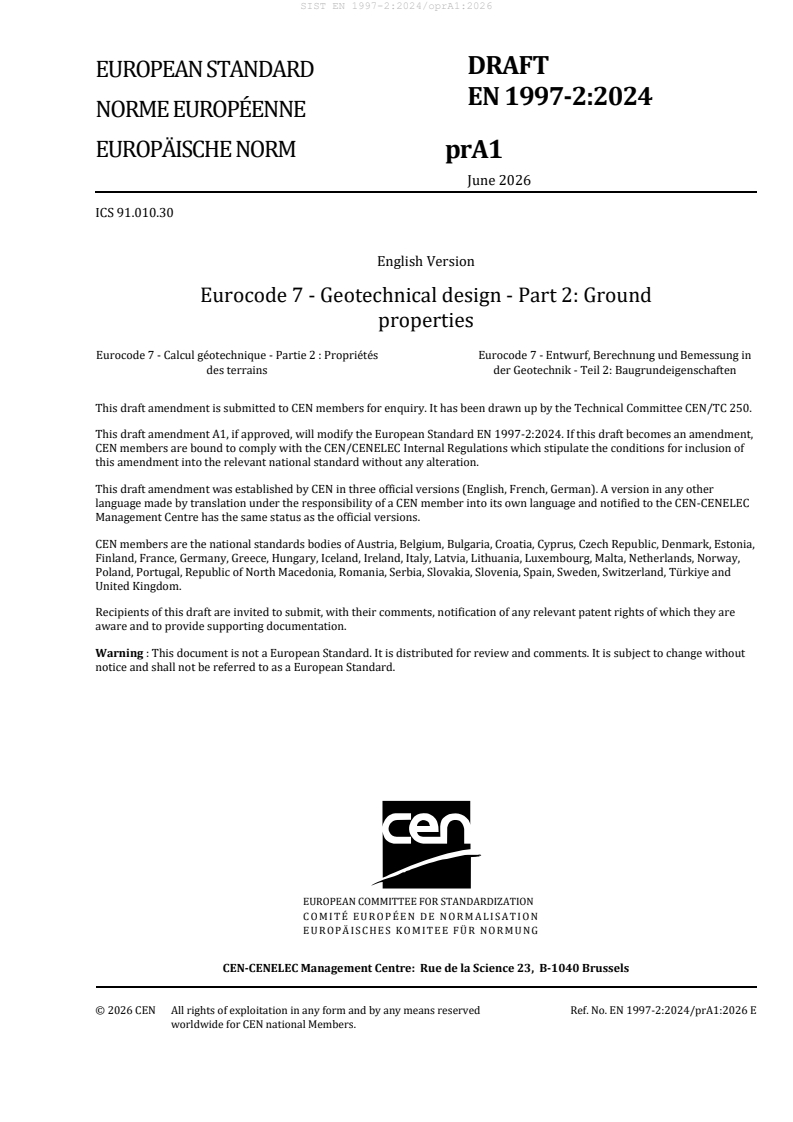
DRAFT
EUROPEAN STANDARD
EN 1997-2:2024
NORME EUROPÉENNE
EUROPÄISCHE NORM
prA1
June 2026
ICS 91.010.30
English Version
Eurocode 7 - Geotechnical design - Part 2: Ground
properties
Eurocode 7 - Calcul géotechnique - Partie 2 : Propriétés Eurocode 7 - Entwurf, Berechnung und Bemessung in
des terrains der Geotechnik - Teil 2: Baugrundeigenschaften
This draft amendment is submitted to CEN members for enquiry. It has been drawn up by the Technical Committee CEN/TC 250.
This draft amendment A1, if approved, will modify the European Standard EN 1997-2:2024. If this draft becomes an amendment,
CEN members are bound to comply with the CEN/CENELEC Internal Regulations which stipulate the conditions for inclusion of
this amendment into the relevant national standard without any alteration.
This draft amendment was established by CEN in three official versions (English, French, German). A version in any other
language made by translation under the responsibility of a CEN member into its own language and notified to the CEN-CENELEC
Management Centre has the same status as the official versions.
CEN members are the national standards bodies of Austria, Belgium, Bulgaria, Croatia, Cyprus, Czech Republic, Denmark, Estonia,
Finland, France, Germany, Greece, Hungary, Iceland, Ireland, Italy, Latvia, Lithuania, Luxembourg, Malta, Netherlands, Norway,
Poland, Portugal, Republic of North Macedonia, Romania, Serbia, Slovakia, Slovenia, Spain, Sweden, Switzerland, Türkiye and
United Kingdom.
Recipients of this draft are invited to submit, with their comments, notification of any relevant patent rights of which they are
aware and to provide supporting documentation.
Warning : This document is not a European Standard. It is distributed for review and comments. It is subject to change without
notice and shall not be referred to as a European Standard.
EUROPEAN COMMITTEE FOR STANDARDIZATION
COMITÉ EUROPÉEN DE NORMALISATION
EUROPÄISCHES KOMITEE FÜR NORMUNG
CEN-CENELEC Management Centre: Rue de la Science 23, B-1040 Brussels
© 2026 CEN All rights of exploitation in any form and by any means reserved Ref. No. EN 1997-2:2024/prA1:2026 E
worldwide for CEN national Members.
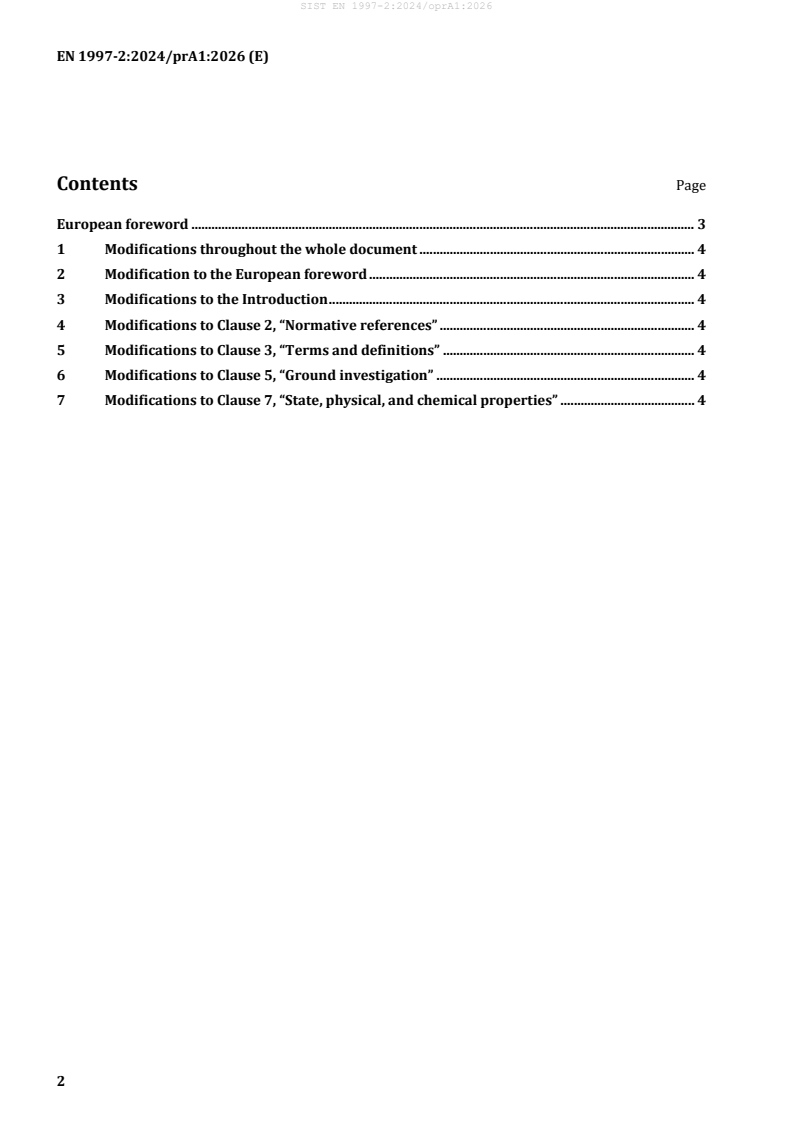
Contents Page
European foreword . 3
1 Modifications throughout the whole document . 4
2 Modification to the European foreword . 4
3 Modifications to the Introduction . 4
4 Modifications to Clause 2, “Normative references” . 4
5 Modifications to Clause 3, “Terms and definitions” . 4
6 Modifications to Clause 5, “Ground invest
...