

SIST EN 1997-2:2007
(Main)Eurocode 7 - Geotechnical design - Part 2: Ground investigation and testing
- Abstract
Requirements for the execution, interpretation and use of results of laboratory tests to assist in the geotechnical design of structures
- Status
- Published
- Publication Date
- 11-Jun-2007
- Technical Committee
- KON - Structures
- Current Stage
- 6060 - National Implementation/Publication (Adopted Project)
- Start Date
- 30-May-2007
- Due Date
- 04-Aug-2007
- Completion Date
- 12-Jun-2007



SIST EN 1997-2:2007 is the Slovenian adoption of EN 1997-2:2007, identical to the CEN European Standard for Eurocode 7 ground investigation and testing. It specifies how to plan ground investigations, carry out common laboratory and field tests, interpret the results and derive geotechnical parameter values for buildings and civil engineering works, for use with EN 1997-1.
What does SIST EN 1997-2:2007 specify?
SIST EN 1997-2:2007 covers the geotechnical investigation work that supports design: planning, sampling, groundwater measurements, field testing, laboratory testing and reporting. It is written for use with EN 1997-1 and applies mainly to commonly used tests in geotechnical practice.
The standard says its rules are mainly for geotechnical category 2 projects. Category 1 is usually simpler and based on local experience, while category 3 often needs at least the same level of investigation plus additional or more advanced testing.
The document is organized in 6 sections and 24 informative annexes.
| Annex | What it covers |
|---|---|
| A | List of test results of geotechnical test standards |
| B | Planning of geotechnical investigations |
| C | Example of groundwater pressure derivations |
| D | Cone and piezocone penetration tests |
| E | Pressuremeter test |
| F | Standard penetration test |
| G | Dynamic probing test |
| H | Weight sounding test |
| I | Field vane test |
| J | Flat dilatometer test and Eoed correlations |
| K | Plate loading test |
| L | Preparation of soil specimens for testing |
| M | Tests for classification, identification and description of soil |
| N | Chemical testing of soil |
| O | Strength index testing of soil |
| P | Strength testing of soil |
| Q | Compressibility testing of soil |
| R | Compaction testing of soil |
| S | Permeability testing of soil |
| T | Preparation of specimen for testing on rock material |
| U | Classification testing of rock material |
| V | Swelling testing of rock material |
| W | Strength testing of rock material |
| X | Bibliography |
What are the key requirements of SIST EN 1997-2:2007?
Section 2 requires geotechnical investigations to be planned so that relevant information is available at each project stage and project risks can be managed. In practice, this means the investigation must support decisions on safety, delays, damage and construction sequencing, not just provide sample data.
Section 2 also sets the objectives of preliminary investigations. These should help assess site stability, compare alternative sites, choose structure position, understand effects on nearby works, identify borrow areas, and plan later design investigations. That matters because early ground data shapes the investigation programme and the foundation concept.
Section 3 links sampling quality to what the laboratory can legitimately use the sample for. Soil samples are divided into sampling categories A, B and C and five quality classes; the better classes are intended for less disturbed material, while lower classes are suitable only for more general description. For practical work, this determines whether a sample can support strength, compressibility or only classification testing.
Section 3 also requires groundwater measurements to use open or closed systems chosen to suit the ground permeability and the measurement objective. Open systems suit higher-permeability materials, while closed systems are suited to low-permeability ground and high artesian pressure. Continuous recording is required when short-term fluctuations matter.
Section 4 requires each field test programme to define the expected ground profile, the target depth and the ground and groundwater levels. The standard then requires the chosen equipment and procedure to match the relevant EN ISO field-test standard, and if the results do not fit the original ground model, the programme must be adjusted. In practice, this keeps the test campaign tied to what the site actually shows.
Section 4 also explains how to use common field tests. CPT and CPTU, PMT, FDT, SPT, DP, WST, FVT, DMT and PLT are all covered, each with objectives, specific requirements, evaluation and use of results. Their results may be used for profiles, strength and deformability estimates, foundation resistance, settlement estimates and pile-related interpretation.
Section 5 sets minimum rules for laboratory testing of soil and rock. It requires suitable specimen preparation, test procedures and reporting, and it covers classification, chemical, strength index, strength, compressibility, compaction and permeability tests for soil, plus classification, swelling and strength tests for rock. The practical point is that test choice must match the design question and the quality of the material recovered.
Section 6 requires the ground investigation report to present the geotechnical information, evaluate it and establish derived values. That report is the bridge between test results and design parameters.
What terms does SIST EN 1997-2:2007 define?
- Derived value - a geotechnical parameter obtained from test results by theory, correlation or empiricism.
- Disturbed sample - a sample in which soil structure, water content and/or constituents have been changed during sampling.
- Quality class - the laboratory classification used to judge the quality of a soil sample.
- Specimen - a part of a soil or rock sample used for a laboratory test.
- Strength index test - a test that gives an indication of shear strength, but not necessarily a representative value.
- Swelling - expansion caused by reduced effective stress, either by stress release or water absorption.
- CPTU - cone penetration test with pore water pressure measurement.
Who uses SIST EN 1997-2:2007?
SIST EN 1997-2:2007 is intended for clients, designers, geotechnical laboratories, field testing laboratories and public authorities. They use it to plan investigations, choose tests, interpret results, and derive geotechnical parameters for design and construction control.
What changed in SIST EN 1997-2:2007 from the previous edition?
SIST EN 1997-2:2007 supersedes ENV 1997-2:1999 and ENV 1997-3:1999.
Which standards are used with SIST EN 1997-2:2007?
- EN 1990:2002 - basis of structural design, used with Eurocode geotechnical design.
- EN 1997-1:2004 - general Eurocode 7 rules that this part supplements.
- EN ISO 14688-1 and EN ISO 14688-2 - identification and classification of soil.
- EN ISO 14689-1 - identification and description of rock.
- EN ISO 22475-1 - sampling by drilling and excavation and groundwater measurements.
- EN ISO 22476 parts - execution of the named field tests such as CPT/CPTU, DP, SPT, pressuremeter tests, FDT, FVT, mechanical CPT and PLT.
What does the SIST EN 1997-2:2007 document contain?
The document combines general rules with detailed test-specific guidance. Section 2 covers planning and sequencing of investigations, Section 3 covers sampling and groundwater measurements, Section 4 covers field tests, Section 5 covers laboratory tests, and Section 6 covers reporting and derived values.
Its annexes provide practical examples, correlations and detailed guidance for specific test types and specimen preparation. Several annexes give worked examples for using field-test results in design, such as spread foundations, settlements and pile resistance, while others expand the procedures for soil and rock classification, strength, compressibility, compaction, permeability and swelling.
Relations
- Effective Date
- 01-Jun-2007
- Replaces
SIST ENV 1997-3:2004 - Eurocode 7: Geotechnical design - Part 3: Design assisted by field testing - Effective Date
- 01-Jun-2007
- Effective Date
- 08-Mar-2023
- Merged From
oSIST prEN 1997-3:2022 - Eurocode 7 - Geotechnical design - Part 3: Geotechnical structures - Effective Date
- 08-Mar-2023
- Effective Date
- 28-Jan-2026
- Effective Date
- 28-Jan-2026
- Effective Date
- 28-Jan-2026
- Effective Date
- 28-Jan-2026
- Effective Date
- 28-Jan-2026
- Effective Date
- 28-Jan-2026
- Effective Date
- 28-Jan-2026
- Effective Date
- 28-Jan-2026
- Effective Date
- 28-Jan-2026
- Effective Date
- 28-Jan-2026
- Effective Date
- 28-Jan-2026
Get Certified
Connect with accredited certification bodies for this standard

DIBt (Deutsches Institut für Bautechnik)
German Institute for Building Technology.
DIN CERTCO
DIN Group product certification.
Zavod za gradbeništvo Slovenije (ZAG) - Inšpekcija
ZAG inspection body for construction products, structures, and materials.
Sponsored listings
Frequently Asked Questions
SIST EN 1997-2:2007 is a standard published by the Slovenian Institute for Standardization (SIST). Its full title is "Eurocode 7 - Geotechnical design - Part 2: Ground investigation and testing". This standard covers: Requirements for the execution, interpretation and use of results of laboratory tests to assist in the geotechnical design of structures
Requirements for the execution, interpretation and use of results of laboratory tests to assist in the geotechnical design of structures
SIST EN 1997-2:2007 is classified under the following ICS (International Classification for Standards) categories: 91.010.30 - Technical aspects; 93.020 - Earthworks. Excavations. Foundation construction. Underground works. The ICS classification helps identify the subject area and facilitates finding related standards.
SIST EN 1997-2:2007 has the following relationships with other standards: It is inter standard links to SIST ENV 1997-2:2004, SIST ENV 1997-3:2004, oSIST prEN 1997-2:2022, oSIST prEN 1997-3:2022, SIST EN ISO 22476-2:2005, SIST EN 1990:2004, SIST EN ISO 22476-6:2018, SIST EN 1997-1:2005, SIST EN ISO 14689:2018, SIST EN ISO 22476-8:2018, SIST EN ISO 22476-12:2009, oSIST prEN ISO 22476-9:2010, oSIST prEN ISO 22476-1:2005, SIST EN ISO 14688-2:2018, SIST EN ISO 22476-3:2005. Understanding these relationships helps ensure you are using the most current and applicable version of the standard.
SIST EN 1997-2:2007 is associated with the following European legislation: EU Directives/Regulations: 2005-01-4408, 305/2011, 89/106/EEC; Standardization Mandates: M/265, M/BC/CEN/89/11. When a standard is cited in the Official Journal of the European Union, products manufactured in conformity with it benefit from a presumption of conformity with the essential requirements of the corresponding EU directive or regulation.
SIST EN 1997-2:2007 is available in PDF format for immediate download after purchase. The document can be added to your cart and obtained through the secure checkout process. Digital delivery ensures instant access to the complete standard document.
Standards Content (Sample)
2003-01.Slovenski inštitut za standardizacijo. Razmnoževanje celote ali delov tega standarda ni dovoljeno.Eurocode 7 - Geotechnical design - Part 2: Ground investigation and testingEurocode 7 - Calcul géotechnique - Partie 2: Reconnaissance des terrains et essaisEurocode 7 - Entwurf, Berechnung und Bemessung in der Geotechnik - Teil 2: Erkundung und Untersuchung des BaugrundsTa slovenski standard je istoveten z:EN 1997-2:2007SIST EN 1997-2:2007en93.020Zemeljska dela. Izkopavanja. Gradnja temeljev. Dela pod zemljoEarthworks. Excavations. Foundation construction. Underground works91.010.30Technical aspectsICS:SIST ENV 1997-3:2004SIST ENV 1997-2:20041DGRPHãþDSLOVENSKI
STANDARDSIST EN 1997-2:200701-junij-2007
EUROPEAN STANDARDNORME EUROPÉENNEEUROPÄISCHE NORMEN 1997-2March 2007ICS 91.060.01; 91.120.20Supersedes ENV 1997-2:1999, ENV 1997-3:1999
English VersionEurocode 7 - Geotechnical design - Part 2: Ground investigationand testingEurocode 7 - Calcul géotechnique - Partie 2:Reconnaissance des terrains et essaisEurocode 7 - Entwurf, Berechnung und Bemessung in derGeotechnik - Teil 2: Erkundung und Untersuchung desBaugrundsThis European Standard was approved by CEN on 12 June 2006.CEN members are bound to comply with the CEN/CENELEC Internal Regulations which stipulate the conditions for giving this EuropeanStandard the status of a national standard without any alteration. Up-to-date lists and bibliographical references concerning such nationalstandards may be obtained on application to the CEN Management Centre or to any CEN member.This European Standard exists in three official versions (English, French, German). A version in any other language made by translationunder the responsibility of a CEN member into its own language and notified to the CEN Management Centre has the same status as theofficial versions.CEN members are the national standards bodies of Austria, Belgium, Bulgaria, Cyprus, Czech Republic, Denmark, Estonia, Finland,France, Germany, Greece, Hungary, Iceland, Ireland, Italy, Latvia, Lithuania, Luxembourg, Malta, Netherlands, Norway, Poland, Portugal,Romania, Slovakia, Slovenia, Spain, Sweden, Switzerland and United Kingdom.EUROPEAN COMMITTEE FOR STANDARDIZATIONCOMITÉ EUROPÉEN DE NORMALISATIONEUROPÄISCHES KOMITEE FÜR NORMUNGManagement Centre: rue de Stassart, 36
B-1050 Brussels© 2007 CENAll rights of exploitation in any form and by any means reservedworldwide for CEN national Members.Ref. No. EN 1997-2:2007: E
EN 1997-2: 2007 (E)
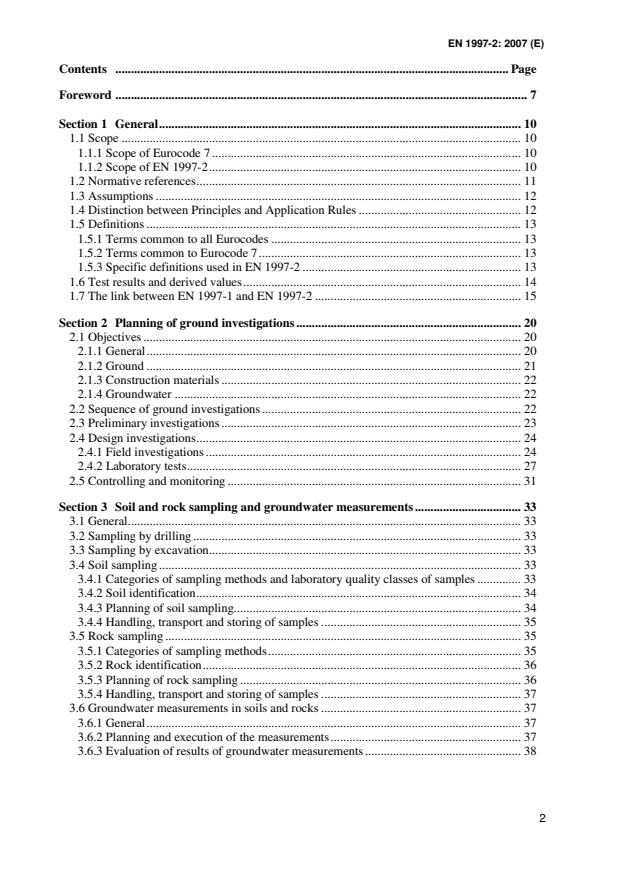
2 Contents .Page
Foreword .7
Section 1 General.10 1.1 Scope.10 1.1.1 Scope of Eurocode 7.10 1.1.2 Scope of EN 1997-2.10 1.2 Normative references.11 1.3 Assumptions.12 1.4 Distinction between Principles and Application Rules.12 1.5 Definitions.13 1.5.1 Terms common to all Eurocodes.13 1.5.2 Terms common to Eurocode 7.13 1.5.3 Specific definitions used in EN 1997-2.13 1.6 Test results and derived values.14 1.7 The link between EN 1997-1 and EN 1997-2.15
Section 2 Planning of ground investigations.20 2.1 Objectives.20 2.1.1 General.20 2.1.2 Ground.21 2.1.3 Construction materials.22 2.1.4 Groundwater.22 2.2 Sequence of ground investigations.22 2.3 Preliminary investigations.23 2.4 Design investigations.24 2.4.1 Field investigations.24 2.4.2 Laboratory tests.27 2.5 Controlling and monitoring.31
Section 3 Soil and rock sampling and groundwater measurements.33 3.1 General.33 3.2 Sampling by drilling.33 3.3 Sampling by excavation.33 3.4 Soil sampling.33 3.4.1 Categories of sampling methods and laboratory quality classes of samples.33 3.4.2 Soil identification.34 3.4.3 Planning of soil sampling.34 3.4.4 Handling, transport and storing of samples.35 3.5 Rock sampling.35 3.5.1 Categories of sampling methods.35 3.5.2 Rock identification.36 3.5.3 Planning of rock sampling.36 3.5.4 Handling, transport and storing of samples.37 3.6 Groundwater measurements in soils and rocks.37 3.6.1 General.37 3.6.2 Planning and execution of the measurements.37 3.6.3 Evaluation of results of groundwater measurements.38
EN 1997-2: 2007 (E)
3 Section 4 Field tests in soil and rock.40 4.1 General.40 4.2 General requirements.40 4.2.1 Planning a specific test programme.40 4.2.2 Execution.41 4.2.3 Evaluation.41 4.3 Cone penetration and piezocone penetration tests (CPT, CPTU).42 4.3.1 Objectives.42 4.3.2 Specific requirements.42 4.3.3 Evaluation of test results.43 4.3.4 Use of test results and derived values.43 4.4 Pressuremeter tests (PMT).45 4.4.1 Objectives.45 4.4.2 Specific requirements.45 4.4.3 Evaluation of test results.46 4.4.4 Use of test results and derived values.47 4.5 Flexible dilatometer test (FDT).48 4.5.1 Objectives.48 4.5.2 Specific requirements.48 4.5.3 Evaluation of test results.48 4.5.4 Use of test results and derived values.49 4.6 Standard penetration test (SPT).49 4.6.1 Objectives.49 4.6.2 Specific requirements.49 4.6.3 Evaluation of test results.49 4.6.4 Use of test results and derived values.50 4.7 Dynamic probing tests (DP).51 4.7.1 Objectives.51 4.7.2 Specific requirements.52 4.7.3 Evaluation of test results.52 4.7.4 Use of test results and derived values.52 4.8 Weight sounding test (WST).53 4.8.1 Objectives.53 4.8.2 Specific requirements.53 4.8.3 Evaluation of test results.54 4.8.4 Use of test results and derived values.54 4.9 Field vane test (FVT).55 4.9.1 Objectives.55 4.9.2 Specific requirements.55 4.9.3 Evaluation of test results.55 4.9.4 Use of test results and derived values.55 4.10 Flat dilatometer test (DMT).56 4.10.1 Objectives.56 4.10.2 Specific requirements.56 4.10.3 Evaluation of test results.56 4.10.4 Use of test results and derived values.57 4.11 Plate loading test (PLT).57 4.11.1 Objectives.57 4.11.2 Specific requirements.58 4.11.3 Evaluation of test results.58 4.11.4 Use of test results and derived values.58
EN 1997-2: 2007 (E)
Section 5 Laboratory tests on soil and rock.60 5.1 General.60 5.2 General requirements for laboratory tests.60 5.2.1.General requirements.60 5.2.2 Procedures, equipment and presentation.60 5.2.3 Evaluation of test results.60 5.3 Preparation of soil specimens for testing.61 5.3.1 Objective.61 5.3.2 Requirements.61 5.4 Preparation of rock specimens for testing.62 5.4.1 Objective.62 5.4.2 Requirements.62 5.5 Tests for classification, identification and description of soil.63 5.5.1 General.63 5.5.2 Requirements for all classification tests.63 5.5.3 Water content determination.63 5.5.4 Bulk density determination.64 5.5.5 Particle density determination.64 5.5.6 Particle size analysis.64 5.5.7 Consistency limits determination.65 5.5.8 Determination of the density index of granular soil.66 5.5.9 Soil dispersibility determination.67 5.5.10 Frost susceptibility.68 5.6 Chemical testing of soil and groundwater.68 5.6.1 Requirements for all chemical tests.68 5.6.2 Organic content determination.70 5.6.3 Carbonate content determination.71 5.6.4 Sulfate content determination.71 5.6.5 pH value determination (acidity and alkalinity).72 5.6.6 Chloride content determination.72 5.7 Strength index testing of soil.73 5.7.1 Objective.73 5.7.2 Requirements.73 5.7.3 Use of test results.73 5.8 Strength testing of soil.73 5.8.1 Objective and scope.73 5.8.2 General requirements.74 5.8.3 Evaluation and use of test results.75 5.8.4 Unconfined compression test.75 5.8.5 Unconsolidated, undrained triaxial compression test.76 5.8.6 Consolidated triaxial compression test.76 5.8.7 Consolidated direct shear box tests.77 5.9 Compressibility and deformation testing of soil.78 5.9.1 General.78 5.9.2 Oedometer compressibility testing.78 5.9.3 Triaxial deformability testing.80 5.10 Compaction testing of soil.81 5.10.1 Scope.81 5.10.2 Compaction tests.81 5.10.3 California Bearing ratio (CBR) test.81
EN 1997-2: 2007 (E)
5 5.11 Permeability testing of soil.82 5.11.1 Objective.82 5.11.2 Requirements.82 5.11.3 Evaluation and use of test results.83 5.12 Tests for classification of rocks.84 5.12.1 General.84 5.12.2 Requirements for all classification tests.84 5.12.3 Rock identification and description.84 5.12.4 Water content determination.85 5.12.5 Density and porosity determination.86 5.13 Swelling testing of rock material.86 5.13.1 General.86 5.13.2 General requirements.87 5.13.3 Evaluation of test results.87 5.13.4 Swelling pressure index under zero volume change.87 5.13.5 Swelling strain index for radially-confined specimens with axial surcharge.88 5.13.6 Swelling strain developed in unconfined rock specimen.89 5.14 Strength testing of rock material.89 5.14.1 General.89 5.14.2 Requirements for all strength tests.89 5.14.3 Evaluation of test results.90 5.14.4 Uniaxial compression and deformability test.90 5.14.5 Point load test.91 5.14.6 Direct shear test.92 5.14.7 Brazil test.93 5.14.8 Triaxial compression test.94
Section 6 Ground investigation report.95 6.1 General requirements.95 6.2 Presentation of geotechnical information.95 6.3 Evaluation of geotechnical information.96 6.4 Establishment of derived values.97
Annex A (informative) List of test results of geotechnical test standards.98 Annex B (informative) Planning of geotechnical investigations.101 Annex C (informative) Example of groundwater pressure derivations based
on a model and long term measurements.109 Annex D (informative) Cone and piezocone penetration tests.111 Annex E (informative) Pressure meter test.121 Annex F (informative) Standard penetration test.125 Annex G (informative) Dynamic probing test.129 Annex H (informative) Weight sounding test 134 Annex I (informative) Field vane test.133 Annex J (informative) Flat dilatometer test Example of correlations between EOED
and DMT results.138 Annex K (informative) Plate loading test.139 Annex L (informative) Detailed information on preparation of soil specimens
for testing.143 Annex M (informative) Detailed information on tests for classification, identification
and description of soil.150 Annex N (informative) Detailed information on chemical testing of soil.157
EN 1997-2: 2007 (E)
6 Annex O (informative) Detailed information on strength index testing of soil.162 Annex P (informative) Detailed information on strength testing of soil.163 Annex Q (informative) Detailed information on compressibility testing of soil.165 Annex R (informative) Detailed information on compaction testing of soil.166 Annex S (informative) Detailed information on permeability testing of soil.168 Annex T (informative) Preparation of specimen for testing on rockmaterial.170 Annex U (informative) Classification testing of rock material.171 Annex V (informative) Swelling testing of rock material.173 Annex W (informative) Strength testing of rock material.175 Annex X (informative) Bibliography.180
EN 1997-2: 2007 (E)
7 Foreword This document (EN 1997-2: 2007) has been prepared by Technical Committee CEN/TC 250 "Structural Eurocodes", the secretariat of which is held by BSI.
This European Standard shall be given the status of a national standard, either by publication of an identical text or by endorsement, at the latest by September 2007, and conflicting national standards shall be withdrawn at the latest by March 2010.
This document supersedes ENV 1997-2:1999 and ENV 1997-3:1999.
CEN/TC 250 is responsible for all Structural Eurocodes.
According to the CEN/CENELEC Internal Regulations, the national standards organizations of the following countries are bound to implement this European Standard: Austria, Belgium, Bulgaria Cyprus, Czech Republic, Denmark, Estonia, Finland, France, Germany, Greece, Hungary, Iceland, Ireland, Italy, Latvia, Lithuania, Luxembourg, Malta, Netherlands, Norway, Portugal, Poland, Romania, Slovakia, Slovenia, Spain, Sweden, Switzerland and the United Kingdom.
Background of the Eurocode programme In 1975, the Commission of the European Community decided on an action programme in the field of construction, based on article 95 of the Treaty. The objective of the programme was the elimination of technical obstacles to trade and the harmonization of technical specifications.
Within this action programme, the Commission took the initiative to establish a set of harmonised technical rules for the design of construction works, which, in a first stage, would serve as an alternative to the national rules in force in the Member States and, ultimately, would replace them.
For fifteen years, the Commission, with the help of a Steering Committee with representatives of Member States, conducted the development of the Eurocodes programme, which led to the first generation of European codes in the 1980s.
In 1989, the Commission and the Member States of the EU and EFTA decided, on the basis of an agreement1 between the Commission and CEN, to transfer the preparation and the publication of the Eurocodes to CEN through a series of Mandates, in order to provide them with a future status of European Standard (EN). This links de facto the Eurocodes with the provisions of all the Council’s Directives and/or Commission’s Decisions dealing with European standards (e.g. the Council Directive 89/106/EEC on construction products - CPD - and Council Directives 93/37/EEC, 92/50/EEC and 89/440/EEC on public works and services and equivalent EFTA Directives initiated in pursuit of setting up the internal market).
The Structural Eurocode programme comprises the following standards generally consisting of a number of Parts:
EN 1990 Eurocode : Basis of Structural Design
EN 1991 Eurocode 1: Actions on structures
1 Agreement between the Commission of the European Communities and the European Committee for Standardization (CEN) concerning the work on EUROCODES for the design of building and civil engineering works (BC/CEN/03/89).
EN 1997-2: 2007 (E)
8 EN 1992 Eurocode 2: Design of concrete structures EN 1993 Eurocode 3: Design of steel structures EN 1994 Eurocode 4: Design of composite steel and concrete structures EN 1995 Eurocode 5: Design of timber structures EN 1996 Eurocode 6: Design of masonry structures EN 1997 Eurocode 7: Geotechnical design EN 1998 Eurocode 8: Design of structures for earthquake resistance EN 1999 Eurocode 9: Design of aluminium structures
Eurocode standards recognise the responsibility of regulatory authorities in each Member State and have safeguarded their right to determine values related to regulatory safety matters at national level where these continue to vary from State to State.
Status and field of application of Eurocodes The Member States of the EU and EFTA recognise that Eurocodes serve as reference documents for the following purposes: — as a means to prove compliance of building and civil engineering works with the essential requirements of Council Directive 89/106/EEC, particularly Essential Requirement N°1 – Mechanical resistance and stability – and Essential Requirement N°2 – Safety in case of fire; — as a basis for specifying contracts for construction works and related engineering services; — as a framework for drawing up harmonised technical specifications for construction products (ENs and ETAs).
The Eurocodes, as far as they concern the construction works themselves, have a direct relationship with the Interpretative Documents2 referred to in Article 12 of the CPD, although they are of a different nature from harmonised product standards3. Therefore, technical aspects arising from the Eurocodes work need to be adequately considered by CEN Technical Committees and/or EOTA Working Groups working on product standards with a view to achieving full compatibility of these technical specifications with the Eurocodes.
The Eurocode standards provide common structural design rules for everyday use for the design of whole structures and component products of both a traditional and an innovative nature. Unusual forms of construction or design conditions are not specifically covered and additional expert consideration will be required by the designer in such cases.
2 According to Art. 3.3 of the CPD, the essential requirements (ERs) shall be given concrete form in interpretative documents for the creation of the necessary links between the essential requirements and the mandates for harmonised ENs and ETAGs/ETAs. 3 According to Art. 12 of the CPD the interpretative documents shall : a) give concrete form to the essential requirements by harmonising the terminology and the technical bases and indicating classes or levels for each requirement where necessary ; b) indicate methods of correlating these classes or levels of requirement with the technical specifications, e.g. methods of calculation and of proof, technical rules for project design, etc. ; c) serve as a reference for the establishment of harmonised standards and guidelines for European technical approvals. The Eurocodes, de facto, play a similar role in the field of the ER 1 and a part of ER 2.
EN 1997-2: 2007 (E)
9 National Standards implementing Eurocodes The National Standards implementing Eurocodes will comprise the full text of the Eurocode (including any annexes), as published by CEN, which may be preceded by a National title page and National foreword, and may be followed by a National annex.
The National annex may only contain information on those parameters, which are left open in the Eurocode for national choice, known as Nationally Determined Parameters, to be used for the design of buildings and civil engineering works to be constructed in the country concerned, i.e.: - values and/or classes where alternatives are given in the Eurocode; - values to be used where a symbol only is given in the Eurocode; - country specific data (geographical,
climatic), e.g. snow map; - the procedure to be used where alternative procedures are given in the Eurocode. It may also contain: - decisions on the application of informative annexes; - references to non-contradictory complementary information to assist the user to apply the Eurocode.
Links between Eurocodes and harmonised technical specifications (ENs and ETAs) for products There is a need for consistency between the harmonised technical specifications for construction products and the technical rules for works4. Furthermore, all the information accompanying the CE Marking of the construction products, which refer to Eurocodes, should clearly mention which Nationally Determined Parameters have been taken into account.
Additional information specific to Eurocode 7 EN 1997-2 gives guidance for the planning and interpretation of geotechnical laboratory and field tests that are used for the support of geotechnical design of buildings and civil engineering works.
EN 1997-2 is intended for clients, designers, geotechnical laboratories, field testing laboratories and public authorities.
EN 1997-2 is intended to be used with EN 1997-1.
When using EN 1997-2, particular regard should be paid to the underlying assumptions and conditions given in 1.3.
The six sections of EN 1997-2 are complemented by 24 informative annexes.
National annex for EN 1997-2 The national standard implementing EN 1997-2 should have a national annex containing all information concerning the application of EN 1997-2 in the relevant country.
4 See Art.3.3 and Art.12 of the CPD, as well as 4.2, 4.3.1, 4.3.2 and 5.2 of ID 1.
EN 1997-2: 2007 (E)
10 Section 1 General 1.1 Scope 1.1.1 Scope of Eurocode 7 (1) EN 1997 is intended to be used in conjunction with EN 1990:2002, which establishes the principles and requirements for safety and serviceability, describes the basis of design and verification and gives guidelines for related aspects of structural reliability.
(2) EN 1997 is intended to be applied to the geotechnical aspects of the design of buildings and civil engineering works. It is subdivided into various separate parts (see 1.1.2).
(3) EN 1997 is concerned with the requirements for strength, stability, serviceability and durability of structures. Other requirements, e.g. concerning thermal or sound insulation, are not considered.
(4) Numerical values of actions on buildings and civil engineering works to be taken into account in design are provided in EN 1991 for the various types of construction. Actions imposed by the ground, such as earth pressures, shall be calculated according to the rules of EN 1997.
(5) Separate European Standards are intended to be used to treat matters of execution and workmanship. They are denoted in the relevant sections.
(6) In EN 1997 execution is covered to the extent that is necessary to conform to the assumptions of the design rules.
(7) EN 1997 does not cover the special requirements of seismic design. EN 1998 provides additional rules for geotechnical seismic design, which complete or adapt the rules of this standard.
1.1.2 Scope of EN 1997-2 (1) EN 1997-2 is intended to be used in conjunction with EN 1997-1 and provides rules supplementary to EN 1997-1 related to: - planning and reporting of ground investigations; - general requirements for a number of commonly used laboratory and field tests; - interpretation and evaluation of test results; - derivation of values of geotechnical parameters and coefficients.
In addition, examples of the application of field test results to design are given.
NOTE Establishment of characteristic values is covered in EN 1997-1.
(2) This document gives no specific provisions for environmental ground investigations.
(3) Only commonly used geotechnical laboratory and field tests are covered in this standard. These were selected on the basis of their importance in geotechnical practice, availability in
EN 1997-2: 2007 (E)
11 commercial geotechnical laboratories and existence of an accepted testing procedure in Europe. The laboratory tests on soils are mainly applicable to saturated soils.
NOTE It is expected that updates of the present standard will gradually include laboratory and field tests covering additional aspects of soil and rock behaviour.
(4) The provisions of this standard apply primarily to projects of geotechnical category 2, as defined in 2.1 of EN 1997-1:2004. The ground investigation requirements for category 1 projects are normally limited as the verifications often will be based on local experience. For geotechnical category 3 projects, the amount of investigations required will normally be at least the same as indicated for geotechnical category 2 projects in the following sections. Additional investigations and more advanced tests, related to the circumstances that place a project in geotechnical category 3, may be necessary.
(5) The derivation of parameter values is dedicated primarily to the design of pile and spread foundations based on field testing, as detailed in Annexes D, E, F and G of EN 1997-1:2004.
1.2 Normative references (1) The following normative documents contain provisions which, through reference in this text, constitute provisions of this European Standard. For dated references, subsequent amendments to, or revisions of, any of these publications do not apply. However, parties to agreements based on this European Standard are encouraged to investigate the possibility of applying the most recent editions of the normative documents indicated below. For undated references, the last edition of the normative document referred to applies.
EN 1990:2002 Eurocode — Basis of structural design EN 1997-1:2004 Eurocode 7 — Geotechnical design — Part 1: General rules EN ISO 14688-1 Geotechnical investigation and testing — Identification and classification of soil — Part 1: Identification and description EN ISO 14688-2 Geotechnical investigation and testing — Identification and classification of soil — Part 2: Classification principles
EN ISO 14689-1 Geotechnical investigation and testing — Identification and classification of rock - Part 1: Identification and description
EN ISO 22475-15 Geotechnical investigation and testing — Sampling by drilling and excavation and groundwater measurements — Part 1: Technical principles of execution EN ISO 22476-15 Geotechnical investigation and testing — Field testing — Part 1: Electrical CPT and CPTU EN ISO 22476-2 Geotechnical investigation and testing — Field testing — Part 2: Dynamic probing EN ISO 22476-3 Geotechnical investigation and testing — Field testing — Part 3: Standard penetration test EN ISO 22476-45 Geotechnical investigation and testing — Field testing — Part 4: Ménard pressuremeter test EN ISO 22476-55 Geotechnical investigation and testing — Field testing — Part 5: Flexible dilatometer test EN ISO 22476-66 Geotechnical investigation and testing — Field testing — Part 6: Self boring pressuremeter test
5 to be published
EN 1997-2: 2007 (E)
12 EN ISO 22476-86 Geotechnical investigation and testing — Field testing — Part 8: Full displacement pressuremeter test EN ISO 22476-96 Geotechnical investigation and testing — Field testing — Part 9: Field vane test EN ISO 22476-126 Geotechnical investigation and testing — Field testing — Part 12: Mechanical CPT EN ISO 22476-136 Geotechnical investigation and testing — Field testing — Part 13: Plate loading test
NOTE The Bibliography presents a number of CEN ISO Technical Specifications (CEN ISO/TS), giving information on procedures, equipment, evaluation and presentation for some field and laboratory tests. These technical specifications may become European/ISO standards in due time. The National Standards Body may decide to keep its national standard in force during the lifetime of a CEN ISO/TS. National Annexes to EN 1997-2 may give information regarding national practise involved.
1.3 Assumptions (1) Reference is made to - EN 1990:2002, 1.3 and EN 1997-1:2004, 1.3.
(2) The provisions of this standard are based on the assumptions given below:
- data required for design are collected, recorded and interpreted by appropriately qualified personnel; - structures are designed by appropriately qualified and experienced personnel; - adequate continuity and communication exist between the personnel involved in data-collection, design and construction;
1.4 Distinction between Principles and Application Rules (1) Depending on the character of the individual clauses, distinction is made in EN 1997-2 between Principles and Application Rules.
(2) The Principles comprise: - general statements and definitions for which there is no alternative; - requirements and analytical models for which no alternative is permitted unless specifically stated.
(3) The Principles are preceded by the letter P.
(4) The Application Rules are examples of generally recognised rules which follow the Principles and satisfy their requirements.
(5) It is permissible to use alternatives to the Application Rules given in this standard, provided it is shown that the alternative rules accord with the relevant Principles and are at least equivalent with regard to the structural safety, serviceability and durability, which would be expected when using the Eurocodes.
NOTE If an alternative design rule is submitted for an application rule, the resulting design cannot be claimed to be wholly in accordance with EN 1997-2, although the design will remain in accordance with the Principles of EN 1997-1. When EN 1997-2 is used in respect of a property listed in an Annex Z of a product standard or an ETAG, the use of an alternative design rule may not be acceptable for CE marking.
EN 1997-2: 2007 (E)
13 (6) In EN 1997-2, the Application Rules are identified by a number in brackets e.g. as in this clause.
1.5 Definitions 1.5.1 Terms common to all Eurocodes (1)P The terms used in common for all Eurocodes are defined in EN 1990.
1.5.2 Terms common to Eurocode 7 (1)P The terms specific to EN 1997 are defined in 1.5.2 of EN 1997-1:2004.
1.5.3 Specific definitions used in EN 1997-2 1.5.3.1
derived value value of a geotechnical parameters obtained from test results by theory, correlation or empiricism (see 1.6)
1.5.3.2
disturbed sample sample where the soil structure, water content and/or constituents have been changed during sampling
1.5.3.3
measured value value that is measured in a test
1.5.3.4 natural specimen specimen made from the available (disturbed, un
...