

EN 12385-6:2004
(Main)Steel wire ropes - Safety - Part 6: Stranded ropes for mine shafts
- Abstract
This European Standard specifies the additional materials, manufacturing and testing requirements to those given in Part 1 for stranded ropes (with round and/or shaped strands) and flat ropes for use as hoist ropes, stage ropes and balance ropes in mine-shafts.
It shall be used in conjunction with Parts 1 and 2 of this standard.
NOTE 1 For the purposes of this standard, stage ropes are considered to be hoist ropes.
NOTE 2 This standard may also be used for ropes in other mining applications, e.g. surface mining.
The additional hazards covered by this European Standard are identified in clause 4.
- Status
- Published
- Publication Date
- 17-Feb-2004
- Withdrawal Date
- 30-Aug-2004
- Technical Committee
- CEN/TC 168 - Chains, ropes, webbing, slings and accessories - safaty
- Current Stage
- 9060 - Closure of 2 Year Review Enquiry - Review Enquiry
- Start Date
- 02-Sep-2024
- Completion Date
- 02-Sep-2024


Overview - EN 12385-6:2004 (Steel wire ropes for mine shafts)
EN 12385-6:2004 is a CEN safety standard that specifies additional material, manufacturing and testing requirements for stranded steel wire ropes (round and/or shaped strands) and flat ropes used as hoist, stage and balance ropes in mine shafts. It is intended to be used in conjunction with EN 12385‑1 (General requirements) and EN 12385‑2 (Definitions, designation and classification). The part also applies to some other mining uses (e.g., surface mining) and covers hazards specific to shaft hoisting such as uncontrolled relative movement between rope and driving sheave.
Key topics and technical requirements
- Scope and application: Ropes for new installations and those manufactured after publication; may be applied to spare ropes for existing systems.
- Materials: Requirements for wire types and grades; references to EN 10264‑2 and EN 10264‑3 for wire specifications. Limits on wire tensile strength and minimum wire diameters are specified for mine hoist and flat ropes.
- Rope cores and construction: Accepted core types (e.g., fibre cores, reinforced fibre cores) and strand/flat rope constructions tailored for shaft applications.
- Manufacture and finishing: Rules for wire joints, wire finish, compaction, stitching of flat ropes and construction for multi‑rope friction hoists.
- Lubrication and impregnating compounds: Requirements for lubricants, impregnation and service dressings to reduce wear and sheave interaction.
- Testing and verification: Mandatory tests for breaking force (methods for measured breaking force and aggregate breaking force), rope length mass, wire sampling and acceptance criteria. Annexes provide calculation factors and tables for breaking forces and rope masses.
- Safety hazards: Additional hazard identification (see clause 4) including rope/sheave interaction and associated protective measures.
Practical applications - who uses this standard
- Rope manufacturers designing and certifying mine hoist ropes and flat hoist ropes.
- Mine operators, hoist engineers and maintenance teams specifying and selecting safe hoist ropes.
- Procurement and quality teams verifying supplier compliance and test data.
- Inspection bodies and testing laboratories performing breaking‑force, wire and lubrication tests.
- Designers of hoisting equipment (friction hoists, drum hoists) ensuring rope compatibility with sheaves and drives.
Related standards
- EN 12385‑1 (General requirements)
- EN 12385‑2 (Definitions, designation and classification)
- EN 10264‑2 / EN 10264‑3 (Steel wire for ropes)
- ISO 3155 / ISO 3156 (Fibre components, impregnation and lubricant tests)
- EN ISO 9001 (Quality management)
- DIN 21258 (preservative compounds for friction drive ropes)
Using EN 12385‑6:2004 helps ensure compliant selection, manufacture and testing of steel wire ropes for mine shafts - improving hoist safety, longevity and regulatory conformity.
Relations
- Effective Date
- 17-Sep-2026
- Effective Date
- 25-Aug-2026
- Refers
ISO 3155:1976 - Stranded wire ropes for mine hoisting — Fibre components — Characteristics and tests - Effective Date
- 25-Aug-2026
- Effective Date
- 28-Jan-2026
- Effective Date
- 28-Jan-2026
- Effective Date
- 28-Jan-2026
- Effective Date
- 28-Jan-2026
- Effective Date
- 28-Jan-2026
- Effective Date
- 28-Jan-2026
- Refers
EN 12385-2:2002 - Steel wire ropes - Safety - Part 2: Definitions, designation and classification - Effective Date
- 28-Jan-2026
- Effective Date
- 28-Jan-2026
- Effective Date
- 28-Jan-2026
- Effective Date
- 28-Jan-2026
- Effective Date
- 28-Jan-2026
- Effective Date
- 28-Jan-2026
Get Certified
Connect with accredited certification bodies for this standard

Element Materials Technology
Materials testing and product certification.

Inštitut za kovinske materiale in tehnologije
Institute of Metals and Technology. Materials testing, metallurgical analysis, NDT.
Sponsored listings
Frequently Asked Questions
EN 12385-6:2004 is a standard published by the European Committee for Standardization (CEN). Its full title is "Steel wire ropes - Safety - Part 6: Stranded ropes for mine shafts". This standard covers: This European Standard specifies the additional materials, manufacturing and testing requirements to those given in Part 1 for stranded ropes (with round and/or shaped strands) and flat ropes for use as hoist ropes, stage ropes and balance ropes in mine-shafts. It shall be used in conjunction with Parts 1 and 2 of this standard. NOTE 1 For the purposes of this standard, stage ropes are considered to be hoist ropes. NOTE 2 This standard may also be used for ropes in other mining applications, e.g. surface mining. The additional hazards covered by this European Standard are identified in clause 4.
This European Standard specifies the additional materials, manufacturing and testing requirements to those given in Part 1 for stranded ropes (with round and/or shaped strands) and flat ropes for use as hoist ropes, stage ropes and balance ropes in mine-shafts. It shall be used in conjunction with Parts 1 and 2 of this standard. NOTE 1 For the purposes of this standard, stage ropes are considered to be hoist ropes. NOTE 2 This standard may also be used for ropes in other mining applications, e.g. surface mining. The additional hazards covered by this European Standard are identified in clause 4.
EN 12385-6:2004 is classified under the following ICS (International Classification for Standards) categories: 77.140.65 - Steel wire, wire ropes and link chains. The ICS classification helps identify the subject area and facilitates finding related standards.
EN 12385-6:2004 has the following relationships with other standards: It is inter standard links to EN ISO 9001:2026, ISO 3156:1976, ISO 3155:1976, EN ISO 10510:1999, EN 10264-2:2021, EN 10264-3:2023, EN ISO 10673:1998, EN 12385-1:2002, EN ISO 9001:2015, EN 12385-2:2002, EN 14805:2022, EN 16370:2013, EN 13814:2004, EN 13814-2:2019+A1:2024, EN 16370:2022. Understanding these relationships helps ensure you are using the most current and applicable version of the standard.
EN 12385-6:2004 is available in PDF format for immediate download after purchase. The document can be added to your cart and obtained through the secure checkout process. Digital delivery ensures instant access to the complete standard document.
Standards Content (Sample)
2003-01.Slovenski inštitut za standardizacijo. Razmnoževanje celote ali delov tega standarda ni dovoljeno.Drahtseile aus Stahldraht - Sicherheit - Teil 6: Litzenseile für Schachtförderanlagen des BergbausCâbles en acier - Sécurité - Partie 6: Câbles d'extraction a torons pour puits de minesSteel wire ropes - Safety - Part 6: Stranded ropes for mine shafts77.140.65Jeklene žice, jeklene vrvi in verigeSteel wire, wire ropes and link chainsICS:Ta slovenski standard je istoveten z:EN 12385-6:2004SIST EN 12385-6:2004en01-september-2004SIST EN 12385-6:2004SLOVENSKI
STANDARD
EUROPEAN STANDARDNORME EUROPÉENNEEUROPÄISCHE NORMEN 12385-6February 2004ICS 77.140; 77.140.65English versionSteel wire ropes - Safety - Part 6: Stranded ropes for mineshaftsCâbles en acier - Sécurité - Partie 6: Câbles d'extraction àtorons pour puits de minesDrahtseile aus Stahldraht - Sicherheit - Teil 6: Litzenseilefür Schachtförderanlagen des BergbausThis European Standard was approved by CEN on 3 November 2003.CEN members are bound to comply with the CEN/CENELEC Internal Regulations which stipulate the conditions for giving this EuropeanStandard the status of a national standard without any alteration. Up-to-date lists and bibliographical references concerning such nationalstandards may be obtained on application to the Central Secretariat or to any CEN member.This European Standard exists in three official versions (English, French, German). A version in any other language made by translationunder the responsibility of a CEN member into its own language and notified to the Central Secretariat has the same status as the officialversions.CEN members are the national standards bodies of Austria, Belgium, Cyprus, Czech Republic, Denmark, Estonia, Finland, France,Germany, Greece, Hungary, Iceland, Ireland, Italy, Latvia, Lithuania, Luxembourg, Malta, Netherlands, Norway, Poland, Portugal, Slovakia,Slovenia, Spain, Sweden, Switzerland and United Kingdom.EUROPEAN COMMITTEE FOR STANDARDIZATIONCOMITÉ EUROPÉEN DE NORMALISATIONEUROPÄISCHES KOMITEE FÜR NORMUNGManagement Centre: rue de Stassart, 36
B-1050 Brussels© 2004 CENAll rights of exploitation in any form and by any means reservedworldwide for CEN national Members.Ref. No. EN 12385-6:2004: ESIST EN 12385-6:2004
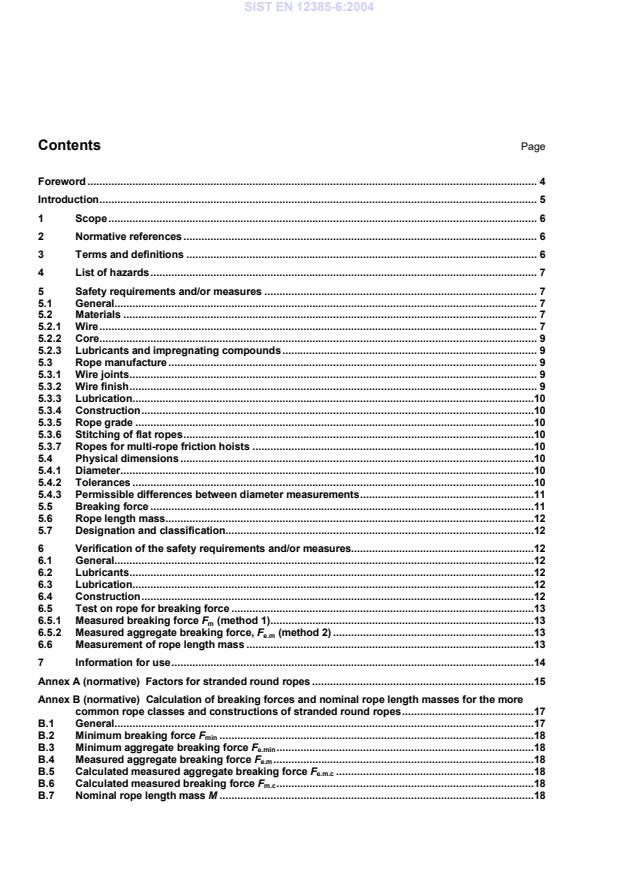
Contents Page Foreword.4 Introduction.5 1 Scope.6 2 Normative references.6 3 Terms and definitions.6 4 List of hazards.7 5 Safety requirements and/or measures.7 5.1 General.7 5.2 Materials.7 5.2.1 Wire.7 5.2.2 Core.9 5.2.3 Lubricants and impregnating compounds.9 5.3 Rope manufacture.9 5.3.1 Wire joints.9 5.3.2 Wire finish.9 5.3.3 Lubrication.10 5.3.4 Construction.10 5.3.5 Rope grade.10 5.3.6 Stitching of flat ropes.10 5.3.7 Ropes for multi-rope friction hoists.10 5.4 Physical dimensions.10 5.4.1 Diameter.10 5.4.2 Tolerances.10 5.4.3 Permissible differences between diameter measurements.11 5.5 Breaking force.11 5.6 Rope length mass.12 5.7 Designation and classification.12 6 Verification of the safety requirements and/or measures.12 6.1 General.12 6.2 Lubricants.12 6.3 Lubrication.12 6.4 Construction.12 6.5 Test on rope for breaking force.13 6.5.1 Measured breaking force Fm (method 1).13 6.5.2 Measured aggregate breaking force, Fe.m (method 2).13 6.6 Measurement of rope length mass.13 7 Information for use.14 Annex A (normative)
Factors for stranded round ropes.15 Annex B (normative)
Calculation of breaking forces and nominal rope length masses for the more common rope classes and constructions of stranded round ropes.17 B.1 General.17 B.2 Minimum breaking force Fmin.18 B.3 Minimum aggregate breaking force Fe.min.18 B.4 Measured aggregate breaking force Fe.m.18 B.5 Calculated measured aggregate breaking force Fe.m.c.18 B.6 Calculated measured breaking force Fm.c.18 B.7 Nominal rope length mass M.18 SIST EN 12385-6:2004
Tables of breaking forces and nominal rope length masses for the more common rope classes of flat ropes.19 Annex D (informative)
Factors for the calculation of the approximate outer wire diameters for the more common rope constructions of stranded round ropes.22 Annex E (informative)
Information which should be provided with an enquiry or order.24 E.1 Details of rope.24 E.2 Details of installation.24 E.2.1 Particulars of the shaft.24 E.2.2 Particulars of friction hoist driving sheave.24
Part 1 provides the general requirements for Parts 4 to 10.
Annexes A, B and C are normative. Annexes D and E are informative. According to the CEN/CENELEC Internal Regulations, the national standards organizations of the following countries are bound to implement this European Standard: Austria, Belgium, Cyprus, Czech Republic, Denmark, Estonia, Finland, France, Germany, Greece, Hungary, Iceland, Ireland, Italy, Latvia, Lithuania, Luxembourg, Malta, Netherlands, Norway, Poland, Portugal, Slovakia, Slovenia,
Spain, Sweden, Switzerland and the United Kingdom. SIST EN 12385-6:2004
This European Standard can also be used for ropes in other mining applications, e.g. surface mining. The additional hazards covered by this part of EN 12385 are listed in clause 4. This part of EN 13285 is applicable to ropes for new installations and ropes that have been manufactured after the publication of this standard. It may also be applied to spare ropes for existing installations 2 Normative references This European Standard incorporates by dated or undated reference, provisions from other publications. These normative references are cited at the appropriate places in the text and the publications are listed hereafter. For dated references, subsequent amendments to or revisions of any of these publications apply to this European Standard only when incorporated in it by amendment or revision. For undated references the latest edition of the publication referred to applies (including amendments). EN 10264-2, Steel wire and wire products – Steel wire for ropes – Part 2: Cold drawn non alloy steel wire for ropes for general applications. EN 10264-3, Steel wire and wire products – Steel wire for ropes – Part 3: Round and shaped non alloyed steel wire for high duty applications. EN 12385-1:2002, Steel wire ropes – Safety – Part 1: General requirements. EN 12385-2:2002, Steel wire ropes – Safety – Part 2: Definitions, designation and classification. DIN 21258, Preservative compounds for Koepe friction drive winding ropes in mining – Safety requirements and testing. EN ISO 9001, Quality management systems - Requirements (ISO 9001:2000). ISO 3155, Stranded wire ropes for mine hoisting - Fibre components - Characteristics and tests. ISO 3156, Stranded wire ropes for mine hoisting - Impregnation compounds, lubricants and service dressing - Characteristics and tests. 3 Terms and definitions For the purpose of this European Standard, the terms and definitions in EN 12385-2 apply together with the following: 3.1 calculated rope diameter dc theoretical diameter of a stranded rope where all outer strands just touch each other
3.2 built-up centre centre of a strand comprising a number of small wires manufactured in a separate operation instead of a large disproportional centre wire of a parallel or compound lay construction
EN 12385-1. 5.2 Materials 5.2.1 Wire 5.2.1.1 Before ropemaking Round wires, except those which form a built-up centre shall conform to: a) EN 10264-3 for hoist ropes and stage ropes; and b) EN 10264-2 for balance ropes and the stitching wires of flat hoist ropes. For a given rope grade, the tensile strength grades of the wires of stranded round ropes and flat ropes shall not exceed the limits given in Table 1.
Table 1 — Tensile strength grades of wires in stranded round ropes and flat ropes for a given rope grade Rope grade Tensile strength grade in N/mm²
minimum maximum 1180 1180 1370 1270 1180 1370 1370 1180 1570 1570 1370 1770 1670 1570 1860 1770 1570 1960 1860 1670 1960 1960 1770 1960 outer wires; 2160 inner wires
For shaped wires as centre wires, the tensile strength grade shall be less than or equal to 900 N/mm², with a tolerance not greater than that of the round wires of the same nominal metallic cross-section. The tensile strength grades of round and shaped wires used to form built-up centres shall be at least 300 N/mm2. For flat ropes, all loadbearing wires shall be of the same tensile strength grade. For outer wires the maximum tensile strength grade shall be 1960 N/mm² for bright and class B zinc-coated wires and 1770 N/mm² for class A zinc-coated wires. For inner wires the maximum tensile strength grade shall be 2160 N/mm² for bright and class B zinc-coated wires and 1770 N/mm² for class A zinc-coated wires. The minimum tensile strength grade of stitching wires for flat hoist ropes shall be 1150 N/mm². SIST EN 12385-6:2004
Stranded round ropes Minimum wire diameter for stranded round mine hoist ropes: 0,8 mm Flat ropes - 1,0
5.2.1.2 After ropemaking
Test methods and acceptance criteria for wires taken from the rope shall meet the requirements for stranded ropes in annex B of EN 12385-1:2002 with the addition that at least 90% of all of the wires tested shall be within the specified values. Filler and centre wires shall also be tested. In the case of built-up centres, either the individual wires or the centre as a whole shall be tested only for tensile strength. The tensile strength of wires from strands that have been compacted shall be calculated on the basis of their respective nominal diameters before stranding and compacting. The scope of the sampling depends on whether or not the rope manufacturer operates an independently verified quality management system: a) rope manufacturers operating a quality management system in accordance with EN ISO 9001 certified by an accredited third party certification body shall test the number of specimens given in annex B of EN 12385-1:2002 when the breaking force of the rope is specified as the minimum aggregate breaking force Fe.min . For flat ropes, the wires of one left-hand and one right-hand unit rope shall be tested; b) rope manufacturers NOT operating a quality management system in accordance with EN ISO 9001 certified by an accredited third party certification body shall test all loadbearing wires except those forming the built-up centre for: dimensions, tensile strength, reverse bend and torsion. Built-up centres shall be tested only for tensile strength. A test of the zinc coating shall be carried out on at least 20 % of wires of the same diameter in the same wire layer.
If the impregnating agent has to be heated for workability purposes, the temperature shall not reach a value that is liable to damage the fibre. The new fibrous material for friction hoist ropes shall have an extractable content, including the batch, of a maximum of 5 % of the mass of the dry fibre before ropemaking. The extractable content of the impregnated or lubricated fibrous material before ropemaking shall have a maximum of 25 % of the mass of the dry fibre. 5.2.3 Lubricants and impregnating compounds
The lubricant and any impregnating compounds for hoist ropes shall conform to ISO 3156. For friction hoist ropes, DIN 21258 also applies. The properties of the friction hoist rope lubricant shall take account of: - the coefficient of friction between the rope and the drive sheave, and; - the chemical compatibility of the lubricant with the respective sheave linings.
5.3 Rope manufacture 5.3.1 Wire joints The minimum distance between planned wire joints for hoist ropes shall be 36 x nominal rope diameter. 5.3.2 Wire finish Within a rope with zinc-coated wires, wires with both class A and class B finishes may be used provided that wires within the same layer are of the same class of finish. This is valid also for the filler and centre wires of round ropes, as well as for the stitching wires of flat ropes. NOTE The purchaser should specify any special wire finish requirements.
If the outer strand or the outer wire layer of the strands are not lubricated, all the wires shall be zinc coated. NOTE The purchaser should specify any special lubrication requirements. 5.3.4 Construction The rope construction shall be either one of those covered by the respective classes for stranded round and flat ropes as given in clause 5 of EN 12385-2:2002 or another construction as specified by the manufacturer. NOTE 1
Where another construction is specified by the manufacturer, this should be agreed with the purchaser. NOTE 2
Strands can be compacted. 5.3.5 Rope grade The rope grade shall not be less than 1270 or greater than 1960 for ropes with bright and class B zinc-coated wires and not less than 1270 or greater than 1770 for ropes with class A zinc-coated wires. The common rope grades for hoist ropes are 1570, 1670, 1770, 1860 and 1960, for flat balance ropes 1370 and 1570 and for round balance ropes 1180, 1270, 1370, 1570 and 1960. The rope grade shall be used in the calculation of minimum breaking force and minimum aggregate breaking force according to annex B. 5.3.6 Stitching of flat ropes Flat hoist ropes shall be single stitched. Flat balance ropes shall be single stitched, double stitched or riveted. 5.3.7 Ropes for multi-rope friction hoists Apart from the directions of lays, the rope designs shall be the same for all ropes manufactured as a set for a particular installation. 5.4 Physical dimensions 5.4.1 Diameter
In the case of 6- to 8-strand round strand hoist ropes with a fibre core according to 5.2.2 a) or reinforced fibre core according to 5.2.2 b), the nominal rope diameter d shall be equivalent to the calculated rope diameter, dc. 5.4.2 Tolerances When measured in accordance with 6.3.1 of EN 12385-1:2002, the rope diameter shall not vary from the nominal diameter d
by more than the values given in Table 3. When measured in accordance with 6.3.2 of EN 12385-1:200, the width and thickness of flat ropes shall not vary from the nominal width and thickness by more than the values given in Table 3.
Table 3 — Tolerances Rope type Ro
...