


EN 12385-2:2002
(Main)Steel wire ropes - Safety - Part 2: Definitions, designation and classification
Steel wire ropes - Safety - Part 2: Definitions, designation and classification
This Part of EN 12385 defines terms, specifies designations and classifies steel wire ropes and is for use in conjunction with all other Parts of this standard.It applies to ropes which have been manufactured after the date of issue of the standard.
Stahldrahtseile - Sicherheit - Teil 2: Begriffe, Bezeichnungen und Klassifizierung
Dieser Teil dieser Europäischen Norm definiert Begriffe, legt Bezeichnungen fest und teilt Drahtseile aus Stahldraht nach Klassen ein. Er ist zur Anwendung in Verbindung mit allen anderen Teilen dieser Norm vorgesehen.
Er gilt für Seile, die nach dem Ausgabedatum der Norm hergestellt wurden.
Câbles en acier - Sécurité - Partie 2: Définitions, désignation et classification
La présente partie de la norme européenne définit les termes, spécifie les désignations et classe les câbles en acier ; elle doit être utilisée avec l'ensemble des autres parties de la présente norme.
Elle s'applique aux câbles fabriqués après la date de publication de la norme.
Jeklene žične vrvi - Varnost - 2. del: Pojmi, označbe in razvrstitev
General Information
- Status
- Withdrawn
- Publication Date
- 03-Dec-2002
- Withdrawal Date
- 18-Mar-2008
- Technical Committee
- CEN/TC 168 - Chains, ropes, webbing, slings and accessories - safaty
- Current Stage
- 9960 - Withdrawal effective - Withdrawal
- Start Date
- 19-Mar-2008
- Completion Date
- 19-Mar-2008
- Directive
- 98/37/EC - Machinery
Relations
- Effective Date
- 18-Jan-2023
- Effective Date
- 28-Jan-2026
- Effective Date
- 28-Jan-2026
- Effective Date
- 28-Jan-2026
- Effective Date
- 28-Jan-2026
- Effective Date
- 28-Jan-2026
- Effective Date
- 28-Jan-2026
- Referred By
EN 12385-3:2004+A1:2008 - Steel wire ropes - Safety - Part 3: Information for use and maintenance - Effective Date
- 28-Jan-2026
- Effective Date
- 28-Jan-2026
- Effective Date
- 28-Jan-2026
- Effective Date
- 28-Jan-2026
- Effective Date
- 28-Jan-2026
- Effective Date
- 28-Jan-2026
- Effective Date
- 28-Jan-2026
- Effective Date
- 28-Jan-2026

Get Certified
Connect with accredited certification bodies for this standard

Element Materials Technology
Materials testing and product certification.

Inštitut za kovinske materiale in tehnologije
Institute of Metals and Technology. Materials testing, metallurgical analysis, NDT.
Sponsored listings
Frequently Asked Questions
EN 12385-2:2002 is a standard published by the European Committee for Standardization (CEN). Its full title is "Steel wire ropes - Safety - Part 2: Definitions, designation and classification". This standard covers: This Part of EN 12385 defines terms, specifies designations and classifies steel wire ropes and is for use in conjunction with all other Parts of this standard.It applies to ropes which have been manufactured after the date of issue of the standard.
This Part of EN 12385 defines terms, specifies designations and classifies steel wire ropes and is for use in conjunction with all other Parts of this standard.It applies to ropes which have been manufactured after the date of issue of the standard.
EN 12385-2:2002 is classified under the following ICS (International Classification for Standards) categories: 77.140.65 - Steel wire, wire ropes and link chains. The ICS classification helps identify the subject area and facilitates finding related standards.
EN 12385-2:2002 has the following relationships with other standards: It is inter standard links to EN 12385-2:2002+A1:2008, EN 13411-7:2006+A1:2008, EN 12927-8:2004, EN 13411-3:2004+A1:2008, EN 12927-1:2004, EN 12385-4:2002+A1:2008, EN 12927-5:2004, EN 12385-3:2004+A1:2008, EN 12385-6:2004, EN 13411-5:2003+A1:2008, EN 13414-1:2003+A2:2008, EN 12385-10:2003+A1:2008, EN 12927-2:2004, EN 13411-6:2004+A1:2008, EN 12927-3:2004. Understanding these relationships helps ensure you are using the most current and applicable version of the standard.
EN 12385-2:2002 is associated with the following European legislation: EU Directives/Regulations: 98/37/EC; Standardization Mandates: M/BC/CEN/91/1. When a standard is cited in the Official Journal of the European Union, products manufactured in conformity with it benefit from a presumption of conformity with the essential requirements of the corresponding EU directive or regulation.
EN 12385-2:2002 is available in PDF format for immediate download after purchase. The document can be added to your cart and obtained through the secure checkout process. Digital delivery ensures instant access to the complete standard document.
Standards Content (Sample)
2003-01.Slovenski inštitut za standardizacijo. Razmnoževanje celote ali delov tega standarda ni dovoljeno.Steel wire ropes - Safety - Part 2: Definitions, designation and classificationWHYCâbles en acier - Sécurité - Partie 2: Définitions, désignation et classificationStahldrahtseile - Sicherheit - Teil 2: Begriffe, Bezeichnungen und KlassifizierungTa slovenski standard je istoveten z:EN 12385-2:2002SIST EN 12385-2:2003en77.140.65ICS:SLOVENSKI
STANDARDSIST EN 12385-2:200301-maj-2003
EUROPEAN STANDARDNORME EUROPÉENNEEUROPÄISCHE NORMEN 12385-2December 2002ICS 77.140.65English versionSteel wire ropes - Safety - Part 2: Definitions, designation andclassificationCâbles en acier - Sécurité - Partie 2: Définitions,désignation et classificationStahldrahtseile - Sicherheit - Teil 2: Begriffe,Bezeichnungen und KlassifizierungThis European Standard was approved by CEN on 10 October 2002.CEN members are bound to comply with the CEN/CENELEC Internal Regulations which stipulate the conditions for giving this EuropeanStandard the status of a national standard without any alteration. Up-to-date lists and bibliographical references concerning such nationalstandards may be obtained on application to the Management Centre or to any CEN member.This European Standard exists in three official versions (English, French, German). A version in any other language made by translationunder the responsibility of a CEN member into its own language and notified to the Management Centre has the same status as the officialversions.CEN members are the national standards bodies of Austria, Belgium, Czech Republic, Denmark, Finland, France, Germany, Greece,Iceland, Ireland, Italy, Luxembourg, Malta, Netherlands, Norway, Portugal, Spain, Sweden, Switzerland and United Kingdom.EUROPEAN COMMITTEE FOR STANDARDIZATIONCOMITÉ EUROPÉEN DE NORMALISATIONEUROPÄISCHES KOMITEE FÜR NORMUNGManagement Centre: rue de Stassart, 36
B-1050 Brussels© 2002 CENAll rights of exploitation in any form and by any means reservedworldwide for CEN national Members.Ref. No. EN 12385-2:2002 E
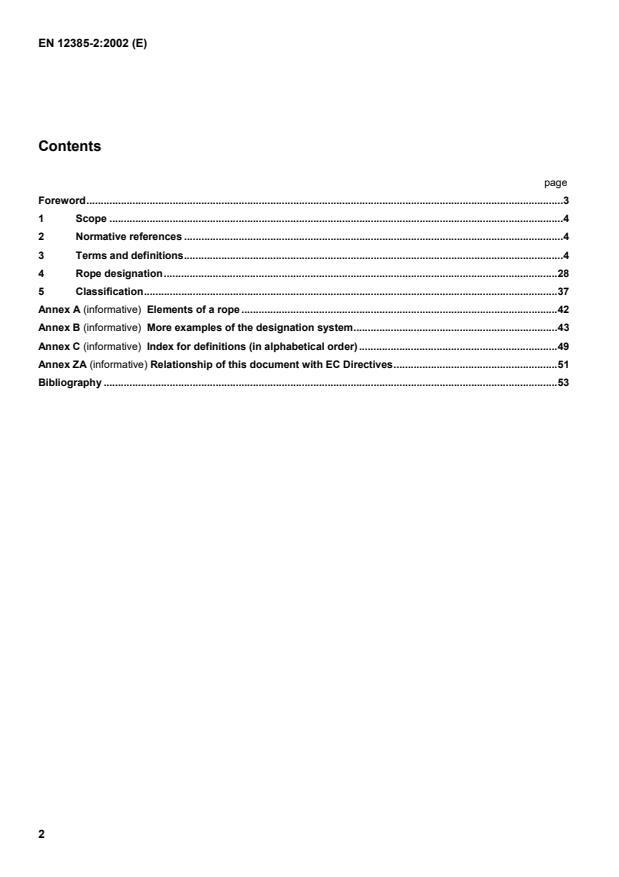
Elements of a rope.42Annex B (informative)
More examples of the designation system.43Annex C (informative)
Index for definitions (in alphabetical order).49Annex ZA (informative) Relationship of this document with EC Directives.51Bibliography.53
Strand types3.2.1strandan element of rope consisting of an assembly of wires of appropriate shape and dimensions laid helically in thesame direction in one or more layers around a centreNOTEStrands containing three or four wires in the first layer, or certain shaped strands (e.g. ribbon) cannot have a centre.
b) Strand with (1-6) built-up centreFigure 1 — Round strand with different centres3.2.3triangular strand (V)a strand with a perpendicular cross-section which is approximately the shape of a triangle, see Figure 2Figure 2 — Triangular strand with triangular (V) centre wireNOTETriangular strands can have built-up centres e.g. 3 ´ 2 + 3F, K1V-6, K3/9 etc.3.2.4oval strand (Q)a strand having a perpendicular cross-section which is approximately the shape of an oval, see Figure 3Figure 3 — Oval strand having oval shaped centre
Core types3.3.1core (C)central element of a round rope around which are laid helically the strands of a stranded rope or the unit ropes of acable laid rope3.3.2fibre core (FC)core made from either natural fibres (NFC) or synthetic fibres (SFC)NOTEFibre cores are normally produced in the sequence fibres to yarns, yarns to strands and strands to rope.3.3.3steel core (WC)core made from steel wires arranged as a wire strand (WSC) or as an independent wire rope (IWRC)NOTEThe steel core and/or its outer strands can also be covered with either fibre or solid polymer.3.3.4solid polymer core (SPC)core consisting of a solid polymer material having a round shape or a round shape with grooves. It may alsocontain an internal element of wire(s) or fibre3.4 Lubricants and preservation agents3.4.1rope lubricanta material applied during the manufacture of a strand, core or rope for the purpose of reducing internal frictionand/or assisting in providing protection against corrosion3.4.2impregnating agenta material used in the manufacture of natural fibre cores, coverings and inserts for the purpose of inhibiting rottingand decay
Rope types3.6.1
Stranded ropes3.6.1.1stranded ropean assembly of several strands laid helically in one or more layers around a core (single-layer rope) or centre(rotation-resistant or parallel-closed rope).NOTEStranded ropes consisting of three or four outer strands can, or cannot, have a core. 3.6.1.2single-layer ropestranded rope consisting of one layer of strands laid helically around a core, see Figure 11Figure 11 — Examples of single-layer stranded ropes3.6.1.3rotation-resistant ropestranded rope designed to generate reduced levels of torque and rotation when loaded see Figure 12NOTE 1Rotation-resistant ropes generally comprise an assembly of at least two layers of strands laid helically around acentre, the direction of lay of the outer strands being opposite to that of the underlying layer.NOTE 2Ropes having three or four strands can also be designed to exhibit rotational-resistant properties.NOTE 3Rotation-resistant ropes have previously been referred to as multi-strand and non-rotating ropes.
At leastone layer of wires is laid in the opposite direction i.e. contra-lay, to that of the other layer(s) to optimise rotational characteristics, 3.6.2.2spiral strand ropespiral rope comprising only round wires, see Figure 18Figure 18 — Example of spiral strand rope3.6.2.3half-locked coil ropespiral rope having an outer layer of alternate half-lock (H-shaped) and round wires, see Figure 19Figure 19 — Example of half-locked coil rope
Ropes with coverings and/or fillings3.6.3.1solid polymer covered roperope which is covered (coated) with a solid polymer3.6.3.2solid polymer filled roperope in which the free internal spaces are filled with a solid polymer. The polymer extends to, or slightly beyond, theouter circumference of the rope, see Figure 21Figure 21 — Solid polymer filled rope3.6.3.3solid polymer covered and filled roperope which is covered (coated) and filled with a solid polymer3.6.3.4cushioned core roperope in which the core is covered (coated), or filled and covered (coated), with a solid polymer, see Figure 22
b) s (left lay)Figure 30 — Lay direction of strands for stranded ropes3.8.2lay direction of rope (Z or S)the direction right (Z) or left (S) corresponding to the direction of lay of the outer wires in a spiral rope, the outerstrands in a stranded rope or the unit ropes in a cable-laid rope in relation to the longitudinal axis of the rope3.8.3ordinary lay (sZ or zS)stranded rope in which the direction of lay of the wires in the outer strands is in the opposite direction to the lay ofthe outer strands in the rope, see Figure 31
Left (zS)NOTEThe first letter denotes strand direction; the second letter denotes rope direction.Figure 31 — Ordinary lay3.8.4lang lay (zZ or sS)stranded rope in which the lay direction of the wires in the outer strands is in the same lay direction as that of theouter strands in the rope, see Figure 3212Right (zZ)
Left (sS)NOTEThe first letter denotes strand direction; the second letter denotes rope direction.Figure 32 — Lang lay
2.dC = A3.10.4calculated metallic cross-sectional area (Ac)the design value obtained from the sum of the metallic cross-sectional areas of the wires in the rope based on theirnominal diametersAc=åpd412n3.10.5measured metallic cross-sectional area (Am)the sum of the metallic cross-sectional areas of all the wires in the rope based on their measured diametersAmm=åpd4n213.10.6rope length mass factor (W)that factor which takes into account the mass of core and lubricant as well as the metallic elements3.10.7nominal rope length mass (M)that value derived from the product of the length mass factor and the square of the nominal diameterM = W.d2
...
Questions, Comments and Discussion
Ask us and Technical Secretary will try to provide an answer. You can facilitate discussion about the standard in here.
Loading comments...