

EN 287-6:2010
(Main)Qualification test of welders - Fusion welding - Part 6: Cast iron
- Abstract
This European Standard specifies main requirements, limits, inspection conditions and acceptance require-ments as well as related inspection documents of welders for welded cast iron test pieces and workpieces.
It provides a set of technical rules for a systematic qualification test of a welder‘s skills, and enables such qualifications to be uniformly accepted independently of the type of product, location and examiner/examining body.
This European Standard specifies the testing of a welder’s skill unless a higher level skill test is applicable.
The acceptance of a welder’s skill according to this standard implies a practical experience and knowledge regarding the welding process, materials and safety requirements (see Annex C).
This European Standard has to be used when requirements on part of a customer, testing or monitoring body or other organisation are postulated.
This European Standard defines the qualification test of welders for the fusion welding of cast iron. The weld-ing processes referred to in this standard include those fusion welding processes which are designated as manual or partly mechanized welding. It does not cover fully mechanized and automated welding processes (see EN 1418). Cast iron materials which are covered by this European Standard are mentioned in 5.4.
The inspection document and certification is made out in the name of the testing body’s liability.
- Status
- Withdrawn
- Publication Date
- 12-Jan-2010
- Withdrawal Date
- 06-Oct-2026
- Technical Committee
- CEN/TC 190 - Foundry technology
- Drafting Committee
- CEN/TC 190/WG 13 - Welding of cast iron
- Current Stage
- 9960 - Withdrawal effective - Withdrawal
- Start Date
- 25-Apr-2018
- Completion Date
- 07-Oct-2026

Relations
- Effective Date
- 24-Dec-2014
- Effective Date
- 25-Aug-2026
- Effective Date
- 28-Jan-2026
- Effective Date
- 28-Jan-2026
- Effective Date
- 28-Jan-2026
- Effective Date
- 28-Jan-2026
- Effective Date
- 28-Jan-2026
- Effective Date
- 28-Jan-2026
- Effective Date
- 28-Jan-2026
- Refers
EN ISO 17638:2016 - Non-destructive testing of welds - Magnetic particle testing (ISO 17638:2016) - Effective Date
- 28-Jan-2026
- Effective Date
- 28-Jan-2026
- Effective Date
- 28-Jan-2026
- Effective Date
- 28-Jan-2026
- Effective Date
- 28-Jan-2026
- Effective Date
- 28-Jan-2026
Get Certified
Connect with accredited certification bodies for this standard

DVS-ZERT GmbH
German welding certification society.
CARES (UK Certification Authority for Reinforcing Steels)
UK certification for reinforcing steels and construction.
EWF/IIW (European/International Welding Federation)
International welding personnel certification.
Sponsored listings
Frequently Asked Questions
EN 287-6:2010 is a standard published by the European Committee for Standardization (CEN). Its full title is "Qualification test of welders - Fusion welding - Part 6: Cast iron". This standard covers: This European Standard specifies main requirements, limits, inspection conditions and acceptance require-ments as well as related inspection documents of welders for welded cast iron test pieces and workpieces. It provides a set of technical rules for a systematic qualification test of a welder‘s skills, and enables such qualifications to be uniformly accepted independently of the type of product, location and examiner/examining body. This European Standard specifies the testing of a welder’s skill unless a higher level skill test is applicable. The acceptance of a welder’s skill according to this standard implies a practical experience and knowledge regarding the welding process, materials and safety requirements (see Annex C). This European Standard has to be used when requirements on part of a customer, testing or monitoring body or other organisation are postulated. This European Standard defines the qualification test of welders for the fusion welding of cast iron. The weld-ing processes referred to in this standard include those fusion welding processes which are designated as manual or partly mechanized welding. It does not cover fully mechanized and automated welding processes (see EN 1418). Cast iron materials which are covered by this European Standard are mentioned in 5.4. The inspection document and certification is made out in the name of the testing body’s liability.
This European Standard specifies main requirements, limits, inspection conditions and acceptance require-ments as well as related inspection documents of welders for welded cast iron test pieces and workpieces. It provides a set of technical rules for a systematic qualification test of a welder‘s skills, and enables such qualifications to be uniformly accepted independently of the type of product, location and examiner/examining body. This European Standard specifies the testing of a welder’s skill unless a higher level skill test is applicable. The acceptance of a welder’s skill according to this standard implies a practical experience and knowledge regarding the welding process, materials and safety requirements (see Annex C). This European Standard has to be used when requirements on part of a customer, testing or monitoring body or other organisation are postulated. This European Standard defines the qualification test of welders for the fusion welding of cast iron. The weld-ing processes referred to in this standard include those fusion welding processes which are designated as manual or partly mechanized welding. It does not cover fully mechanized and automated welding processes (see EN 1418). Cast iron materials which are covered by this European Standard are mentioned in 5.4. The inspection document and certification is made out in the name of the testing body’s liability.
EN 287-6:2010 is classified under the following ICS (International Classification for Standards) categories: 25.160.01 - Welding, brazing and soldering in general. The ICS classification helps identify the subject area and facilitates finding related standards.
EN 287-6:2010 has the following relationships with other standards: It is inter standard links to EN 287-6:2018, ISO 857-1:1998, EN 287-1:2004, EN ISO 17637:2016, EN ISO 6947:2019, EN ISO 15609-2:2019, EN ISO 6520-1:2007, EN ISO 15608:2025, EN ISO 17639:2022, EN ISO 17638:2016, EN ISO 4063:2023, EN 3475-413:2002, EN ISO 15609-1:2019, EN 1011-8:2018, EN ISO 3452-1:2021. Understanding these relationships helps ensure you are using the most current and applicable version of the standard.
EN 287-6:2010 is available in PDF format for immediate download after purchase. The document can be added to your cart and obtained through the secure checkout process. Digital delivery ensures instant access to the complete standard document.
Standards Content (Sample)
2003-01.Slovenski inštitut za standardizacijo. Razmnoževanje celote ali delov tega standarda ni dovoljeno.Preskušanje varilcev - Talilno varjenje - 6. del: Železova litinaPrüfung von Schweißern - Schmelzschweißen - Teil 6: GusseisenEpreuve de qualification des soudeurs - Soudage par fusion - Partie 6 : FontesQualification test of welders - Fusion welding - Part 6: Cast iron25.160.01Varjenje, trdo in mehko spajkanje na splošnoWelding, brazing and soldering in general03.100.30Vodenje ljudiManagement of human resourcesICS:Ta slovenski standard je istoveten z:EN 287-6:2010SIST EN 287-6:2010en,fr,de01-marec-2010SIST EN 287-6:2010SLOVENSKI
STANDARD
EUROPEAN STANDARD NORME EUROPÉENNE EUROPÄISCHE NORM
EN 287-6
January 2010 ICS 25.160.01 English Version
Qualification test of welders - Fusion welding - Part 6: Cast iron Epreuve de qualification des soudeurs - Soudage par fusion - Partie 6 : Fontes
Prüfung von Schweißern - Schmelzschweißen - Teil 6: Gusseisen This European Standard was approved by CEN on 28 November 2009.
CEN members are bound to comply with the CEN/CENELEC Internal Regulations which stipulate the conditions for giving this European Standard the status of a national standard without any alteration. Up-to-date lists and bibliographical references concerning such national standards may be obtained on application to the CEN Management Centre or to any CEN member.
This European Standard exists in three official versions (English, French, German). A version in any other language made by translation under the responsibility of a CEN member into its own language and notified to the CEN Management Centre has the same status as the official versions.
CEN members are the national standards bodies of Austria, Belgium, Bulgaria, Croatia, Cyprus, Czech Republic, Denmark, Estonia, Finland, France, Germany, Greece, Hungary, Iceland, Ireland, Italy, Latvia, Lithuania, Luxembourg, Malta, Netherlands, Norway, Poland, Portugal, Romania, Slovakia, Slovenia, Spain, Sweden, Switzerland and United Kingdom.
EUROPEAN COMMITTEE FOR STANDARDIZATION
COMITÉ EUROPÉEN DE NORMALISATION EUROPÄISCHES KOMITEE FÜR NORMUNG
Management Centre:
Avenue Marnix 17,
B-1000 Brussels © 2010 CEN All rights of exploitation in any form and by any means reserved worldwide for CEN national Members. Ref. No. EN 287-6:2010: ESIST EN 287-6:2010
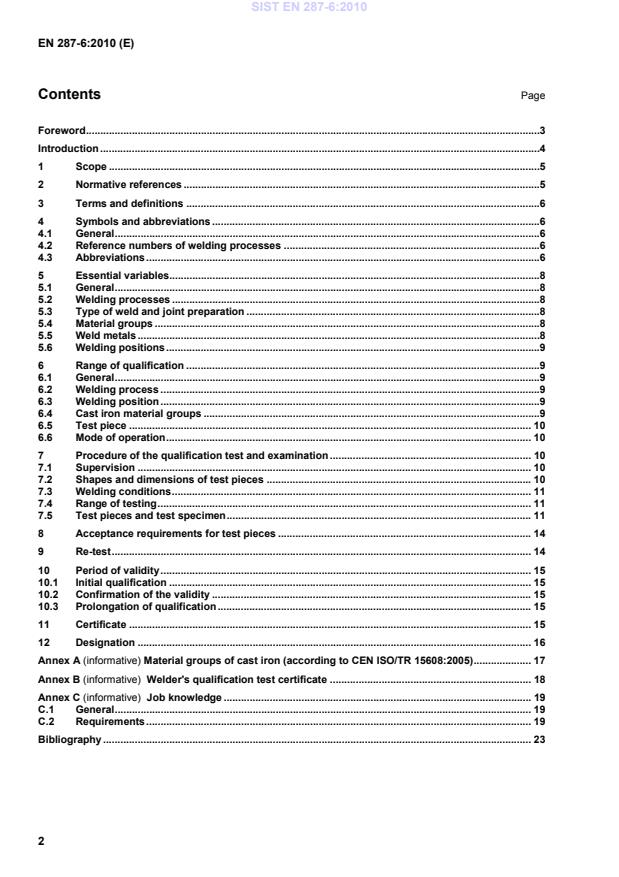
Welder's qualification test certificate . 18Annex C (informative)
Job knowledge . 19C.1General . 19C.2Requirements . 19Bibliography . 23 SIST EN 287-6:2010
This European Standard specifies the testing of a welder’s skill unless a higher level skill test is applicable. The acceptance of a welder’s skill according to this European Standard implies a practical experience and knowledge regarding the welding process, materials and safety requirements (see Annex C). This European Standard has to be used when requirements on part of a customer, testing or monitoring body or other organisation are postulated.
This European Standard defines the qualification test of welders for the fusion welding of cast iron. The welding processes referred to in this standard include those fusion welding processes which are designated as manual or partly mechanized welding. It does not cover fully mechanized and automated welding processes (see EN 1418). Cast iron materials which are covered by this European Standard are mentioned in 5.4. The inspection document and certification is made out in the name of the testing body’s liability. 2 Normative references The following referenced documents are indispensable for the application of this document. For dated references, only the edition cited applies. For undated references, the latest edition of the referenced document (including any amendments) applies. EN 287-1:2004, Qualification test of welders — Fusion welding — Part 1: Steels EN 571-1, Non destructive testing — Penetrant testing — Part 1: General principles EN 970, Non-destructive examination of fusion welds — Visual examination EN 1011-8, Welding — Recommendations for welding of metallic materials — Part 8: Welding of cast irons EN 1290, Non-destructive testing of welds — Magnetic particle testing of welds EN 1320, Destructive tests on welds in metallic materials — Fracture test EN 1321, Destructive tests on welds in metallic materials — Macroscopic and microscopic examination of welds EN ISO 1071, Welding consumables — Covered electrodes, wires, rods and tubular cored electrodes for fusion welding of cast iron — Classification (ISO 1071:2003) EN ISO 4063, Welding and allied processes — Nomenclature of processes and reference numbers (ISO 4063:2009) EN ISO 6520-1, Welding and allied processes — Classification of geometric imperfections in metallic materials — Part 1: Fusion welding (ISO 6520-1:2007) EN ISO 6947, Welds; working positions — Definitions of angles of slope and rotation (ISO 6947:1993) SIST EN 287-6:2010
manual metal arc welding; 114
self-shielded tubular-cored arc welding; 131
MIG welding with solid wire electrode; 135
MAG welding with solid wire electrode; 136
MAG welding with flux cored electrode; 141
TIG welding with solid filler material; 15
plasma arc welding; 311
oxyacetylene welding. 4.3 Abbreviations 4.3.1 Test pieces a
designed fillet weld thickness; BW
butt weld; FW
fillet weld; CPC simulated crack (cast iron plate crack); CPH tapped blind hole (cast iron plate hole); SIST EN 287-6:2010
material thickness of test piece (plate or wall thickness); z
leg length of fillet weld. 4.3.2 Consumables FeC-1
similar welding consumable; FeC-2
similar welding consumable; FeC-GF
similar welding consumable; FeC-GP
similar welding consumable; Fe1
iron based consumable; Fe2
iron based consumable; Ni
nickel based consumable; NiFe-1
nickel based consumable; NiFe-2
nickel based consumable; NiCu
nickel based consumable; Z
any concerted consumable. NOTE (see EN ISO 1071) 4.3.3 Other weld details
hw
homogeneous weld metal; sw
semi-homogeneous weld metal; nw
non-homogeneous weld metal; bs
welding from both sides; ss
single-side welding; gg
gouging or grinding of root run; ng
without gouging or grinding; mb
welding with backing; nb
welding without backing. SIST EN 287-6:2010
71 X X X X X X X X
72.1
X X
X X X
72.2
X X
X X X
72.3
X X X
X X X
72.4
X X X X X X X
73.1
X
73.2
X X X X X X
73.3
X X X X X X X
X
...