


EN 289:1993
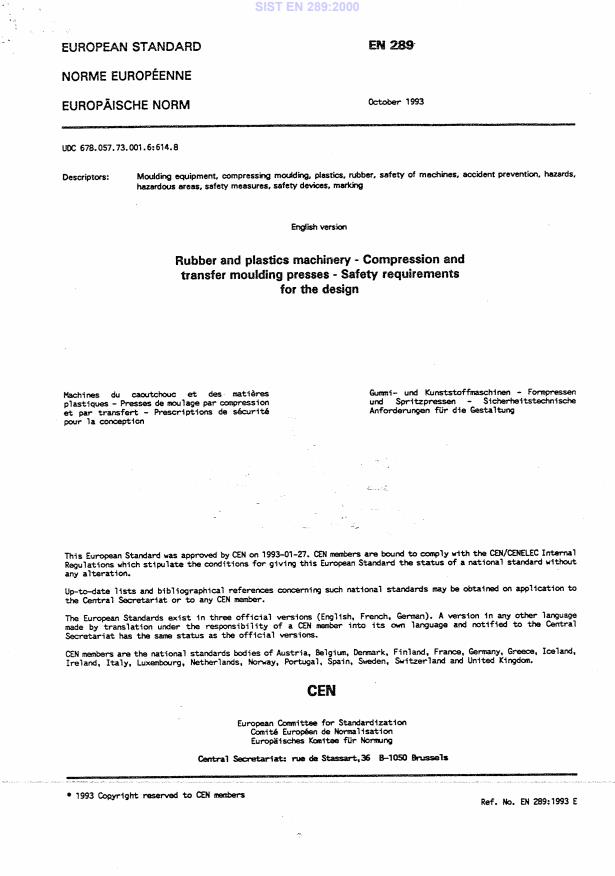
(Main)Rubber and plastics machinery - Compression and transfer moulding presses - Safety requirements for the design
Rubber and plastics machinery - Compression and transfer moulding presses - Safety requirements for the design
This European Standard specifies safety requirements for the design and construction of hydraulic machines with a vertical closing movement for the compression and transfer moulding of plastics and rubber. The following machines are excluded: a) injection moulding machines (see EN 201); b) presses for curing pneumatic tyres; c) presses for curing conveyor belting; d) presses for curing inner tubes and curing bags. Technical safety requirements for the design of ancillary equipment and exhaust ventilation are not covered by this standard.
Gummi- und Kunststoffmaschinen - Formpressen und Spritzpressen - Sicherheitstechnische Anforderungen für die Gestaltung
Diese Europäische Norm enthält die sicherheitstechnischen Anforderungen für Konstruktion und Bau von hydraulischen Pressen mit vertikaler Schliessbewegung zum Formpressen oder Spritzpressen von Kunststoff und Gummi. Die folgenden Maschinen sind ausgeschlossen: a) Spritzgiessmaschinen (siehe EN 201), b) Reifenpressen, c) Pressen für das Vulkanisieren von Förderbändern, d) Pressen für das Vulkanisieren von Reifenschläuchen und Heizbälgen.
Machines du caoutchouc et des matières plastiques - Presses de moulage par compression et par transfert - Prescriptions de sécurité pour la conception
Cette norme européenne donne des prescriptions pour la conception et la construction des machines hydrauliques à mouvement vertical de fermeture pour la moulage par compression ou transfert des plastiques et du caoutchouc. Les machines suivantes sont exclues:, - Machines à injecter (voir EN 201), - Presses de vulcanisation des pneumatiques, - Presses de vulcanisation des courroies transporteuses, - Presses de vulcanisation des chambres à air et vessies de cuisson.
Rubber and plastics machinery - Compression and transfer moulding presses - Safety requirements for the design
General Information
- Status
- Withdrawn
- Publication Date
- 26-Oct-1993
- Withdrawal Date
- 13-Jul-2004
- Technical Committee
- CEN/TC 145 - Rubber and plastics machines - Safety
- Drafting Committee
- CEN/TC 145/WG 2 - Compression moulding machines - Safety
- Current Stage
- 9960 - Withdrawal effective - Withdrawal
- Start Date
- 14-Jul-2004
- Completion Date
- 14-Jul-2004
- Directive
- 89/392/EEC - Machinery - Safety of machinery: general essential health and safety requirements
- Directive
- 98/37/EC - Machinery
Relations
- Effective Date
- 22-Dec-2008

Get Certified
Connect with accredited certification bodies for this standard

Smithers Quality Assessments
US management systems and product certification.

DIN CERTCO
DIN Group product certification.
Sponsored listings
Frequently Asked Questions
EN 289:1993 is a standard published by the European Committee for Standardization (CEN). Its full title is "Rubber and plastics machinery - Compression and transfer moulding presses - Safety requirements for the design". This standard covers: This European Standard specifies safety requirements for the design and construction of hydraulic machines with a vertical closing movement for the compression and transfer moulding of plastics and rubber. The following machines are excluded: a) injection moulding machines (see EN 201); b) presses for curing pneumatic tyres; c) presses for curing conveyor belting; d) presses for curing inner tubes and curing bags. Technical safety requirements for the design of ancillary equipment and exhaust ventilation are not covered by this standard.
This European Standard specifies safety requirements for the design and construction of hydraulic machines with a vertical closing movement for the compression and transfer moulding of plastics and rubber. The following machines are excluded: a) injection moulding machines (see EN 201); b) presses for curing pneumatic tyres; c) presses for curing conveyor belting; d) presses for curing inner tubes and curing bags. Technical safety requirements for the design of ancillary equipment and exhaust ventilation are not covered by this standard.
EN 289:1993 is classified under the following ICS (International Classification for Standards) categories: 83.200 - Equipment for the rubber and plastics industries. The ICS classification helps identify the subject area and facilitates finding related standards.
EN 289:1993 has the following relationships with other standards: It is inter standard links to EN 289:2004. Understanding these relationships helps ensure you are using the most current and applicable version of the standard.
EN 289:1993 is associated with the following European legislation: EU Directives/Regulations: 89/392/EEC, 98/37/EC; Standardization Mandates: M/BC/CEN/88/13. When a standard is cited in the Official Journal of the European Union, products manufactured in conformity with it benefit from a presumption of conformity with the essential requirements of the corresponding EU directive or regulation.
EN 289:1993 is available in PDF format for immediate download after purchase. The document can be added to your cart and obtained through the secure checkout process. Digital delivery ensures instant access to the complete standard document.
Standards Content (Sample)
2003-01.Slovenski inštitut za standardizacijo. Razmnoževanje celote ali delov tega standarda ni dovoljeno.Rubber and plastics machinery - Compression and transfer moulding presses - Safety requirements for the designGummi- und Kunststoffmaschinen - Formpressen und Spritzpressen - Sicherheitstechnische Anforderungen für die GestaltungMachines du caoutchouc et des matieres plastiques - Presses de moulage par compression et par transfert - Prescriptions de sécurité pour la conceptionRubber and plastics machinery - Compression and transfer moulding presses - Safety requirements for the design83.200Oprema za gumarsko industrijo in industrijo polimernih materialovEquipment for the rubber and plastics industries25.120.10Kovaški stroji. Stiskalnice. ŠkarjeForging equipme
...
Questions, Comments and Discussion
Ask us and Technical Secretary will try to provide an answer. You can facilitate discussion about the standard in here.
Loading comments...